Surrender Says Russia, and We'll Give You Peace
Surrender Says Russia, and We'll Give You Peace
"[The
dosage and type of toxin used was not enough to be life-threatening]
and most likely was intended to scare the victims as opposed to cause
permanent damage."
"The victims said they were not aware of who might have had an interest in an attack."
Bellincat
"We have destroyed the myth of the invincible Russian army."
"We
are resisting against the aggression of one of the strongest armies in
the world and have succeeded in making them change their goals."
Kyiv Mayor Vitali Klitschko
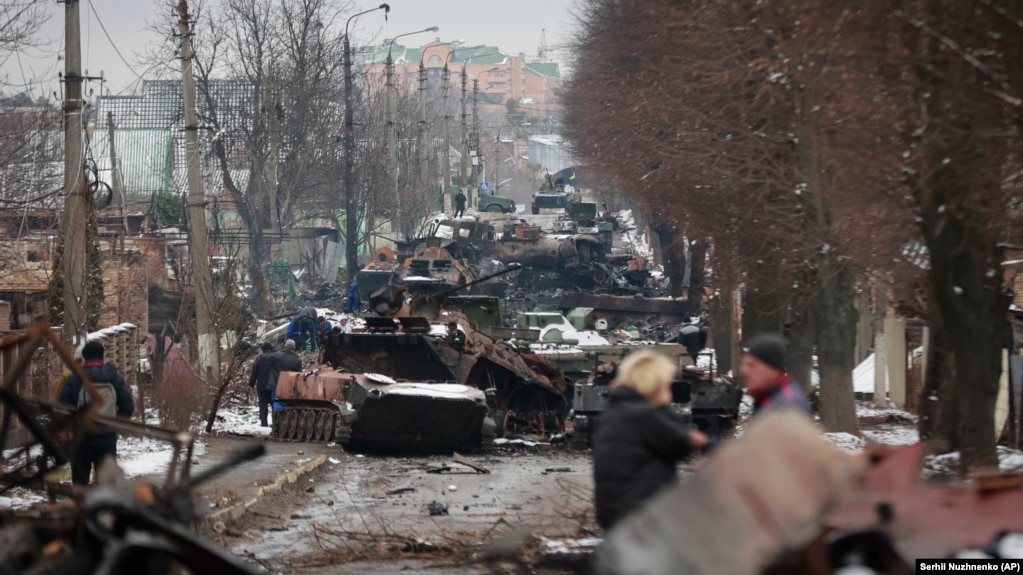 |
| The gutted remains of Russian military vehicles on a road in the town of Bucha, close to the capital, Kyiv, |
The Wall Street Journal
published a report on a little-commented incident whereby during peace
negotiations Russian oligarch Roman Abramovich -- whom Ukrainian
President Volodymyr Zelenskii prevailed upon to use his access to
Russian elite circles and involve himself in negotiations between
Ukraine and Russia -- and the Ukrainian team of negotiators were exposed
to a toxic substance from which they are recovering. The symptoms were
visibly red eyes, painful tearing and skin peeling on hands and faces.
Their
deteriorated health condition resulting from the poisoning by an
as-yet-unknown substance did not keep either the negotiators nor Mr.
Abramovich, from being fully engaged in matters around arranging for
ongoing negotiations to put a halt to the Russian invasion of Ukraine
and its deadly destruction. Experts who examined the event reached the
conclusion that "poisoning with n undefined chemical weapon" was the likely cause.
As
for the ongoing and maddeningly inconclusive peace talks to convince
Vladimir Putin to withdraw his troops from Ukraine, Dimytro Kuleba,
Ukraine's foreign minister felt a ceasefire remained the only hope his
country could have from the talks. "We are not trading people, land or sovereignty",
he said in response to the Kremlin's demands and intention to hive off
the Donbas from Ukraine to be included within Russian territory.
 |
| The aftermath of Russian artillery shelling on a residential
area in Mariupol where a rocket hit a house, according to the Armed
Forces of Ukraine, is seen in this screengrab from a video uploaded on
social media (Armed Forces of Ukraine/Handout via REUTERS) |
The
threat of Russian attacks continue to block exit routes east and west
for civilians desperate to leave their besieged towns and cities. The
devastated port of Mariupol's situation appears doomed. Within the
Russian troop encirclement, an estimated 160,000 residents remain
trapped in the siege. The city with its formerly 400,000 population has
been reduced by constant artillery shelling and bombs to a ghostly
vestige of its once-vibrant presence with 90 percent of its
infrastructure in rubble.
In the city of Kharkiv a pre-dawn missile hit a school. "They've not been able to take the city, so they've decided to destroy it",
observed a Ukrainian who had taken shelter in the school when his home
had been bombed out. In Irpin, close to Kyiv, the mayor spoke of
Ukrainian forces in full control. Ukrainian military had recaptured the
eastern town of Trostyanets as the military continued their offensive to
restore their ground.
The
Russian defence ministry stated that its troops destroyed ammunition
depots in the Zhytomyr region west of Kyiv, the prize goal that Moscow
keeps seeing eluding their grasp. As well, they claimed that 41
Ukrainian military depots had been hit in the past two days, reports
that remained unverified in a conflict known as much for its propaganda
as for its total lack of human scruples.
Kyiv
Mayor Klitschko spoke of 100 people killed in the capital, four
children among them. Russian bombing had destroyed 82 multi-storey
buildings in the capital as well. Also figures that elude verification.
Even while the inescapable reality is that one is a staunchly fierce
defender of its territorial integrity, the other a brutally unscrupulous
imperialist dictatorship.
 |
| A charred Russian tank and captured tanks in the Sumy region of Ukraine (REUTERS) |
Labels: Bombing, Destruction, Killing, Negotiations, Russian Invasion of Ukraine, Shelling, Ukraine Offensive
Surviving Mariupol
Surviving Mariupol
"The stuff that you're hearing about chemical weapons, this is straight out of their playbook."
"They
start saying that there are chemical weapons that have been stored by
their opponents or by the Americans, and so when they themselves deploy
chemical weapons, as I fear they may, they have a sort of ... fake
story, ready to go."
British Prime Minister Boris Johnson
"In
Russia, we are already considered dead. I was given the opportunity to
call my parents and they told me that a funeral for me had already been
arranged."
"If we are exchanged [as prisoners of war between Ukraine and Russia], then we will be shot by our own people."
Captured Russian soldier, begging Ukraine not to return him to Russia
"[The two Ukrainian de-bombers showed] mind-boggling bravery."
"This
Russia-dropped bomb would flatten a building -- and yet these Ukraine
EOD [explosive ordnance disposal] technicians defuse it with two hands
and a bottle of water, while shells audibly land nearby."
Charles Lister, senior fellow, Middle East Institute think-tank, Washington
"Some people will have food but I'm not sure for how long it will last. Many people report having no food for children."
"People started to attack each other for food."
"People started to ruin someone's car to take the gasoline out."
Sasha Volkov, deputy head, International Committee of the Red Cross delegation to Mariupol
"Because my mother is a midwife and my father owns a car, they are helping people and they can't just leave them."
"There
are a lot of people who, for example, are too old or who have babies
and they are scared to leave under the bombing and falling rockets."
"There is a humanitarian catastrophe happening in Ukraine and they need the world to help them."
Mariia Moskalenko, internally displaced
"Airstrikes started from the early morning. Airstrike after airstrike."
"All the historic centre is under bombardment."
"They want to absolutely delete our city, delete our people."
Petro Andrushenko, adviser to the mayor of Mariupol, East Ukraine
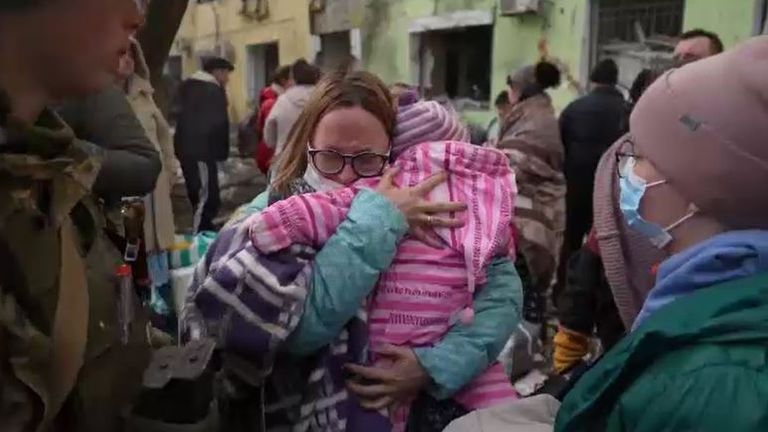 |
| A number of civilians were killed and dozens injured after a Russian attack on a maternity hospital in Mariupol |
Russian
expectations -- for the time being in any event -- appear to have been
dashed. Their lightning-strike invasion of Ukraine with the intention of
swiftly bringing matters to a head by decapitating the government of
the population's democratic choice has quite evidently not gone quite
according to plan. Despite superior fighting numbers and a decided
advantage in up-to-the-moment technical machinery of modern warfare, the
Kremlin appears to have vastly under-rated Ukraine's indomitable spirit
of resistance.
The
Russian military has been given orders of priority; Mariupol and Kyiv.
Kyiv is encircled and the Russian convoys have been bogged down, quite
literally. Mariupol's fate has been far more immediate, bombarded from
the sky, ground artillery aiming at the city's infrastructure --
hospitals not excluded -- it is in the process of being completely
destroyed. A plight seen by other towns and villages in the northeastern
part of the country, closer to Kyiv.
The
bombing of Mariupol's children's and maternity hospital saw three
people killed, with another 17 injured. Citizens of the city unable to
flee the bombardment since evacuation routes are also targeted are
running perilously low of the most basic requirements to prolong life. A
situation which has resulted in people turning against one another to
acquire for themselves what others too must have to exist; water, food,
warmth, medication.
The
people living in Mariupol this winter have been denied heat for days in
-9C overnight temperatures and they are steadily running out of food.
Which has led to events quite removed from normal life in the eastern
city, where people have been breaking into shops and supermarkets hoping
to garner food for their families. The deputy head of the International
Committee of the Red Cross delegation has reported that some people had
taken to attacking others.
It
is believed that over 1,200 civilians have been killed in the city of
430,000. The city's cemeteries no longer dig single graves for
individual corpses and conduct ordinary funerals. Instead a
25-metre-long trench has been prepared to receive the overwhelming
numbers of casualties that the city's morgues are unable to deal with.
In every metric of human existence, this situation really merits the
description of "humanitarian catastrophe".
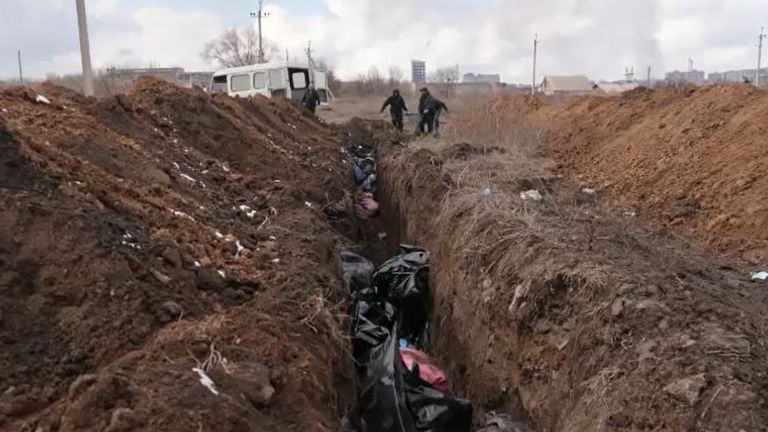 |
| A deep trench - some 25 metres long - has been dug in a cemetery in the heart of the city |
"We do not have the opportunity to bury them in private graves",
explained Vadym Boichenko, Mariupol's embattled mayor. At the opposite
end of the spectrum, Russia's foreign minister Sergey Lavrov saw fit to
dismiss concerns surrounding civilian casualties, characterizing them as
"pathetic shrieks", insisting the hospital was being used as a base by 'far-right fighters'.
Residents
of the city were advised to prepare dead bodies by tying their hands
and legs together, to cover them and leave them outside their homes.
Others drag bodies to the mass graves rolled into carpets or plastic
bags. There is no count being taken of the numbers that have been buried
in mass graves, nor are there records being kept of names and other
identifying features.
For
the most part the endless shelling by Russian forces is responsible for
the dead, while some have died from natural causes at their homes, but
because of full morgues, authorities are unable to arrange for their
collection. Family and friends are not permitted to gather at the
cemetery where those they know and love are being rolled into the
trenches.
Tanya,
a six-year-old, was among those killed in the shelling. She died of
dehydration, trapped under the rubble of her home. Her burial too was
among those other countless, unnamed corpses.
 |
| Dead
bodies are placed into a mass grave on the outskirts of Mariupol,
Ukraine, Wednesday, March 9, 2022, as people cannot bury their dead
because of the heavy shelling by Russian forces.
AP Photo/Evgeniy Maloletka
|
Labels: Artillery, Bombing, Russian Invasion of Ukraine, Shelling, War Crimes, War Dead
Labels: Artillery, Bombing, Russian Invasion of Ukraine, Shelling, War Crimes, War Dead
Syria's Agonizing Death Knell
"We call for an immediate ceasefire to prevent further suffering and what we fear may end in a bloodbath."
"The front lines and relentless violence continue to move closer to these areas which are packed with displaced people, with bombardments increasingly affecting displacement sites and their vicinity."
Jens Laerke, spokesman, Office for the Coordination of Humanitarian Affairs, United Nations
 |
| Syrian army soldiers are deployed in the town of Dahra Abd Rabouh, in Aleppo province, Syria, Feb. 17, 2020 |
Up to almost a million people altogether have fled the area around Idlib where the Syrian regime has been closing in on Syrian Sunni rebels to retake the area in Bashar al-Assad's determination to reunite greater Syria and return it to his rule. It has been costly. Over the past nine years of conflict much of the country has been pummeled, incessantly bombed and both ancient and modern infrastructure reduced to rubble, millions of Syrian Sunnis displaced internally, and millions more having fled conflict to become refugees have sought haven across the border in Turkey, living in squalid, crowded refugee camps, but for those who have managed to enter Europe.
 |
| Syrian state television said army units 'have liberated all the villages and small towns west of Aleppo city' [AFP] |
Hundreds of hospitals have been bombed by Syrian and Russian aircraft. The Russian warplanes have given air cover to Syria's military focusing on ground battle. In the last month alone, about a half-million people from Idlib, the last point of gathering before the Turkish border, where Syrian Sunnis have ended up after fleeing earlier capture by the Syrian military of rebel-held areas. Turkey, while actively supporting the rebel factions in Syria, refuses to allow any more Syrian refugees to cross the border to join the already-three-million-strong that have gathered over the years.
Turkey's preoccupation in launching its own border crossing into Syria to clear away its own version of rebel terrorists, has seen to it that the resident Kurdish population of the border area have flown with the Turkish army's advance, clearing the way for Recep Tayyip Erdogan to make good on his plan to re-settle as many of the refugee Syrians in Turkey on the abandoned farmland and in the Kurdish towns as he can make room for. At the same time, the Turkish army is challenging Syria's advance, negotiating with Russia to reach terms all involved can sign onto.
 |
| Syrian rebels Idlib, Syria, Saturday, Feb. 15, 2020.last rebel stronghold. (AP Photo) |
Russia and Turkey would prefer to remain allies, bu the simple reality is that each backs opposite groups; Russia supports the Assad regime which Turkey loathes, and Turkey supports the Syrian Sunni rebels which Syria and Russia regard as 'terrorists'. Turkey's intention against the Kurdish presence in the area is, as always, maliciously confrontational, planning to force them away from their traditional territory, even as they remain backed by the United States who view them as allies in the front against Islamist terrorism.
Most of the civilian population uprooted in the latest offensive in Aleppo and Idlib regions have been women and children, fleeing clashes and chaos for sanctuary north, close to the Turkish border, closed to their entry. According to Russian Defence Minsitry spokespeople, reports of hundreds of thousands of fleeing Syrians from Idlib headed to the Turkish border are entirely false. False too are the reports of Russian air power striking countless hospitals in the region, killing both medical personnel and Syrian civilians.
 |
| Internally displaced Syrians from western Aleppo countryside, ride on a
vehicle with belongings in Hazano near Idlib, Syria, Feb. 11, 2020. |
Labels: Bombing, Conflict, Kurds, Rebels, Refugees, Russia, Syria, Turkey
IRA Redux : Violence on the Horizon
"I am of the firm belief this [bombing] was a deliberate attempt to lure police and ATO [Ammunition Technical Officers] colleagues into the area to murder them."
"We've six attempted attacks to murder police officers this year. ... When you add all that up, we do believe that there is a time for reflection and a time to question what type of society we want to live in here."
"Many of us ... sense that things are becoming more entrenched and progress that has been made is slipping back a little bit."
"Terrorism of this nature is a societal problem. We shouldn't take our peace for granted."
Deputy Chief Constable Stephen Martin, Police Service of Northern Ireland
"Slipping back a 'little' bit"; quite the understatement, that. The Irish Republican Army resurrected, back for phase two, brought back by popular acclaim in some quarters. Police do, of course, suspect that the Continuity IRA [New IRA] representing two small Irish nationalist militant groups claiming responsibility for several recent attacks, were also responsible for the blast, where no injuries resulted, but a very emphatic message was delivered of more to come.
Militants? Hardly; that soft wording fails to describe what the IRA represented in their hey day of murderous atrocities committed with a sense of entitled impunity. An attack planned for the town of Craigavon last month alongside a bomb discovered under an officer's car in Belfast in June bespeak similar attacks which failed to succeed in causing actual deaths but did succeed in putting authorities on notice, all tracked to what the police politely call nationalist militants.
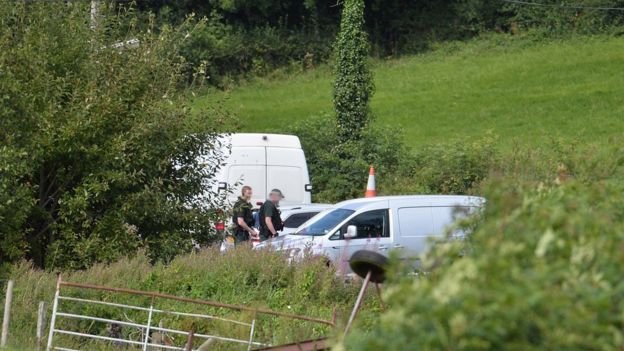
The lethal estrangement between the two sects of Christianity, Protestant and Catholic, behind the carnage, the threats, the murders, the fear, which authorities denied had anything much to do with religion and everything to do with territorial ambitions. In the bombing that took place in County Fermanagh where police were investigating a suspicious device on Saturday discovered to be a hoax, the scene was set for another explosive device nearby exploding at 10:35 a.m.
 |
| Police at the scene of the explosion near Fermanagh Pacemaker |
Timed to go off as an army bomb disposal team -- Ammunition Technical Officers -- along with police were close to the scene. This accords with the recent months of attacks on police in Northern Ireland. Groups opposed to British rule, still seething over the betrayal of their cause by the 1998 peace accord ending decades of sectarian violence. The message: the IRA lives! And remains invested in its life-and-death struggle to reclaim what they feel is theirs alone.
Deputy Police Chief Martin indicated that despite having no intelligence that would link Monday's attack to Brexit, he felt it likely that uncertainty over Britain's departure from the European Union along with Northern Ireland's suspended government impacting on the future added to tensions and precipitated the attacks.
Britain's sole land frontier with the European Union on departure from the EU with or without a transition agreement represents the single most contentious portion of negotiations.
Irish nationalist and pro-British politicians condemned the blast that took place on Monday. But that violence is once again taking centre-stage in Northern Ireland, resurrecting bitter animosities is clear enough, as it was when a New IRA gunman opening fire at police during a Londonderry riot in April saw journalist Lyra McKee shot dead.
 |
| Paul Faith, AFP | Traffic crosses the border into Northern Ireland from the Irish Republic |
Labels: Bombing, Brexit, Britain, IRA, Northern Ireland, Police
United Nations "Responsibility to Protect"
"Yet again, innocent civilians are paying the price for the political failure to stop the violence and do what is demanded under international law -- to protect all civilians."
"Our worst fears are materializing."
Mark Lowcock, UN humanitarian co-ordinator
"Most of the partners [medical facilities, hospitals] will never again share their coordinates with
the UN because it is not working."
“Last year six hospitals were attacked, and this month another
eight hospitals were attacked after their coordinates were shared with
the UN. So most NGOs in Syria decided to stop this process."
Dr Mohamed Zahid, Physicians Across Continents, Syria
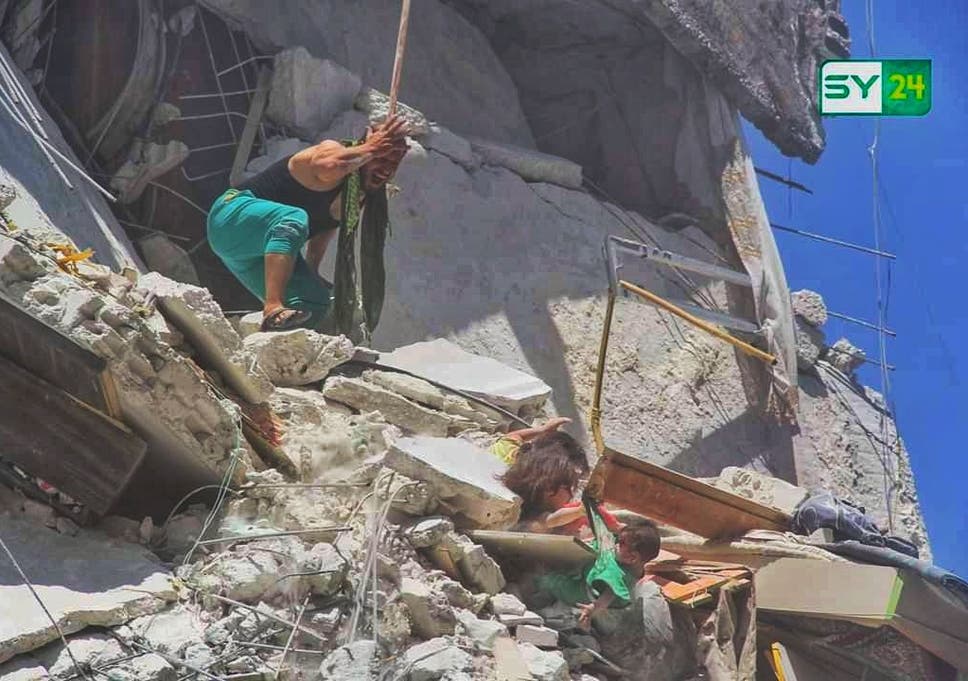 |
| Amjad al-Abdullah reaches for his 7-month-old daughter who hangs from
the wreckage of their family home by a piece of her clothing following a
Syrian or Russian government airstrike in Idlib province
(
SY24
)
|
"There was dust everywhere in the air, and people
were screaming for help. I could see the young children clinging on to
each other."
"The father was screaming ‘Don’t move! Don’t move'!"
"The older child was still clinging on
to the baby. We rushed them to al-Shami hospital but they were running
out of blood supplies and had to take them to Idlib hospital."
"I stayed with the children, praying they would be safe."
Bashar al Sheikh, a photographer from Kafr Nabudah, Idlib
"The injuries we are seeing are horrific. It’s clear
that once again children have been killed and injured in indiscriminate
attacks."
"The children of northwest Syria have been caught
in violent conflict for 80 days with no lull. They have been denied
education, food, healthcare and forced to sleep under the trees in open
fields for months now."
Sonia Khush, Save the Children, Syria
"Some of the dead bodies were torn into pieces or
burnt beyond recognition. Many of the victims were women and children,
some of them suffering the most horrific injuries."
"[The increased violence is] part
of a wave of new attacks on critical civilian infrastructure across
northwest Syria in recent months, including health facilities, schools,
water plants, and bakeries."
Mark Cutts, UN deputy regional humanitarian coordinator, Syria crisis
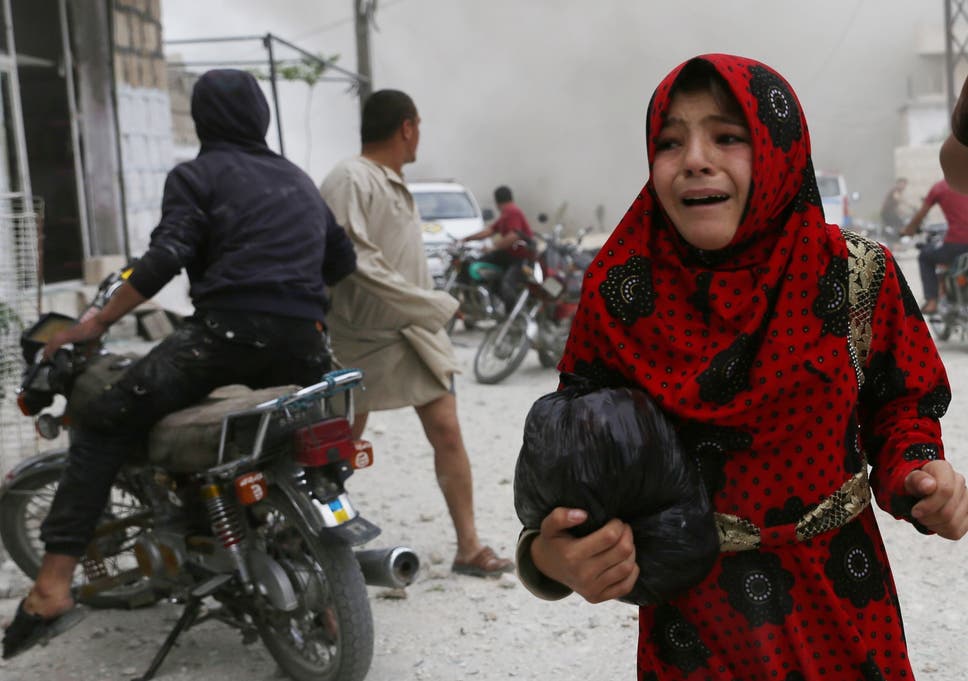 |
| A Syrian girl runs for cover during an airstrike by pro-regime forces on Kfar Ruma last week
(
AFP
)
|
The father, Mr. Abdullah in the first photograph above, proved unable to save all of his children.
A life-shattering, soul-destroying dilemma for a father whose primary responsibility is to protect his children. Who, in their right minds, thinks of a government barrel-bombing its citizens, of a foreign entity operating in that government's airspace, bombing innocent civilians? Seven-month-old Tuqa
survived, but her five-year-old sister Riham died soon after the attack,
as did her mother, Asmaa. Two other sisters were severely injured, one
of them is still in a critical condition.
What a cruel irony that the children's mother shares the same name as the murderous tyrant's Bashar al-Assad's cosseted and protected wife whose own children are safe and secure from the heinous assaults of a mass murderer like her husband. Since 2011 when peaceful Sunni Syrian protesters rallied in protest against their status of inequality, the regime has been responsible for the deaths of a half million Syrians, and that number dated from three years ago; impossible to know how many since have died.
A member of the UN permanent Security Council is actively engaged in bombing innocent civilians of a country not its own, collaborating with a conscienceless tyrant whose response to a popular uprising of a disaffected majority of the country's sectarian-split population with all the deadly munitions, including chemical weapons, at his disposal. Iran's Republican Guard Corps, its proxy terror group Hezbollah, Shiite militant groups have all shored up Assad's military for the singular purpose of mass slaughter.
Russian Foreign Minister Sergei Lavrov speaking of the Syrian governorate of Idlib addressed it as an
"abscess" needing to be
"liquidated". The situation compelled humanitarian organizations to launch an appeal with the United Nations Office for Humanitarian Affairs, warning
"Idlib is on the brink of a humanitarian nightmare unlike anything we have seen this century". Idlib? Syria? Sunni Syrians? Kurds? What does it all mean? Hasn't the issue been settled? Is the rebellion still on? People still being killed?
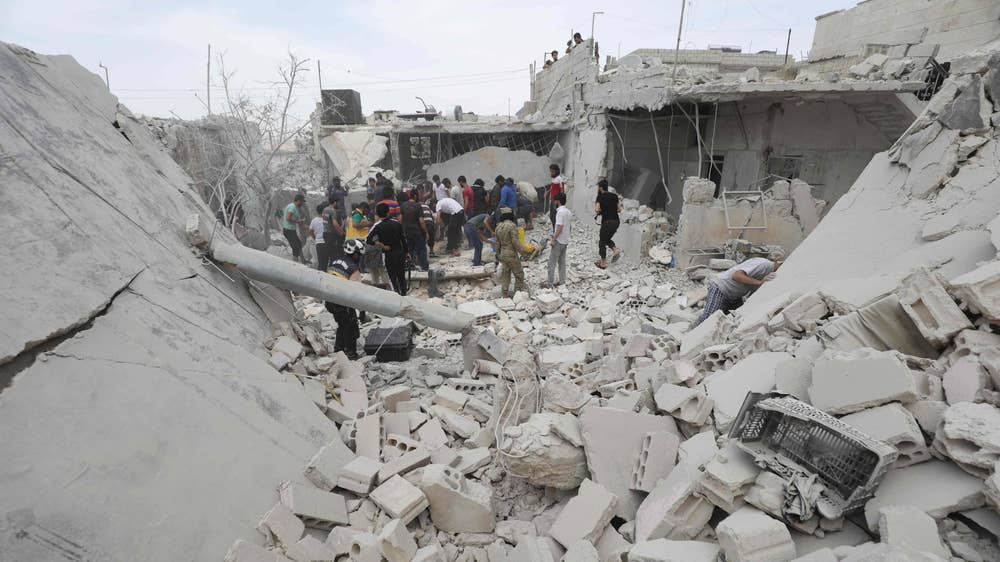
The world is tired of Syria. Disinterested in what's happening there. Outrage has been worn out. Out of sight, out of mind. The Islamic State was defeated, wasn't it? Its caliphate is gone, is it not? What's the problem? The Syrian Observatory for Human Rights has offered the world the figure of 2,641 'casualties' since the end of April, reflecting Idlib's agony under the regime's barrel bombs and Russia's fighter bombers. Bombed buildings are now rubble, upon which lie the dead and injured.
Since April 29 an estimated 25 hospitals and clinics have been destroyed. Deliberately targeted. Over 800 health workers have been killed since 2011 and 570 hospitals and clinics have been bombed. When thousands of Syrian civilians were slaughtered in Aleppo the world was aghast, calling for Assad's removal, but the Kremlin had other ideas. Without Vladimir Putin's helpful alliance with Bashar al-Assad it would indeed have been over, Assad defeated.
Now, it is the Syrian resistance that has been bombed into submission. With Recep Tayyip Erdogan on the sidelines awaiting his opportunity to move in and wreak his vengeance on the Kurdish population. Idlib's population had more than doubled, it became the catch-basin for all the rebels forced out of other surrounding areas, where they sought haven and the chance to recoup their resources. Soon joined by Islamist terrorist groups, including remnants of Islamic State. The presence gives justification cover to Assad and Russia to bomb the innocent.
Syria is absent six million of its population. Millions live in misery in Turkey whose government has begun the process of 'repatriation', ushering them back to Syria because not enough Syrian lives have been destroyed. Ankara can eye its own plans with relative impunity because the agreement with Europe to detain Syrian refugees disallowing them to reach an already-saturated Greece and Italy satisfied both Turkey's demand for payment and Europe's for disabling another potential refugee wave.
Labels: Bombing, Civil War, Crimes Against Humanity, Russia, Syria, Violence
Liberating Mosul
"[The] coalition's goal is always for zero human casualties. We apply rigorous standards to our targeting process."
"Not since World War II has there been an urban assault on a city like Mosul. The only way to liberate the city was to go house by house, and street by street."
"[Iraqi soldiers rescued civilians hoping that security forces reached them] quickly enough before they starved to death or were killed by ISIS while trying to flee."
U.S. Army Col. Ryan Dillon, spokesperson, U.S.-led coalition, Syria, Iraq
 |
Emanuele Satolli
It was my fourth day embedded with Iraqi
Army troops in the al-Zanjili district of western Mosul. In the morning,
the soldiers tried to advance without success as Islamic State
militants kept heavily resisting. At one point, maybe encouraged by the
presence of the soldiers, a few civilians decided to leave their houses
and began walking on a road amid the rubble.
Militants opened fire but the soldiers shot
back to protect the civilians. There, I saw this woman carrying an
exhausted child. She turned back toward where she came from, where the
bullets were coming from, and appeared frightened. When I saw the
picture again, I felt she was giving a last look at her house, her
familiar road, before becoming another of the displaced.
|
The unfortunate residents of Mosul, trapped in the Old City while ISIL fighters used them as handy shields in the thought that Iraqi forces would withhold the level of their assault knowing the plight of the civilian population, can be forgiven for believing that, given their miserable experience, not as much that could have been done to shelter them from ongoing bombing and the inevitable results was actually contemplated on their behalf, much less prosecuted.
But then, the actions of ISIL in identifying the local population a being of great good use in protecting themselves from the onslaught by appealing to the humanitarian nature of those attempting to dislodge the terrorists and retake the city, represents a tried-and-true tactic in the Middle East, obviously popular with Arab fighters. Take advantage of the close presence of innocent civilians; from within their midst lob off munitions, knowing that those targeted will hesitate to respond in the knowledge that unarmed civilians of all ages will be harmed.
This is precisely the most favourite tactic practised by Hamas in Gaza. When Hamas provocations became too bold and too frequent, and the Israel Defence Forces responded by invading Gaza to stop the constant bombardment of rockets into Israel and the abduction of IDF soldiers, it was from within the crowded civilian population of Gaza City and elsewhere that Hamas shot off their munitions. UN-operated schools, hospitals, apartment blocks, all these locations were used as ammunition depots and weapons-launching areas.
Moreover, Hamas urged Gaza's Palestinians to defy the Israeli strikes, to mount protests on the roofs of buildings, to invite the strikes of the IDF in defiance and to declare themselves willing to die. In response the IDF showered the population with printed warnings, urging them to vacate premises slated to be targeted, and even sent initial lesser bombs as warning before launching the heavier more destructive arms. Warnings of attacks were sent via cellphones to alert civilians to vacate target areas.
But every civilian who died represented another arrow in the quiver of Hamas's righteous indignation at the death of civilians by the IDF, and it was that public relations message that went viral internationally, inspiring protests worldwide against the inhumane attacks by Israeli forces against vulnerable Palestinian populations in Gaza. Now, thousands of civilian Iraqis have met their death as a result of U.S.-supported Iraqi troops fighting ISIL to retake Mosul.
Frightened families huddling in their cellars whom air strikes in support of the Iraqi ground forces killed outright. Workers are now going house to house to recover bodies, digging in rubble, to take away the corpses of entire families, victimized by ISIL, who kept them under guard in the houses the terrorists used to launch their strikes from. But Iraqi Prime Minister Haidar al-Abadi is celebrating victory, despite the "blood and sacrifices", so all is not lost.
 |
Cengiz Yar
Out of the desert they walked, trudging through the sand and dust kicked
up by Iraqi special forces Humvees. Some carried small bags of
clothing. Others held sticks with white cloth tied to the end. Mohamed
carried the tiny body of his two-month-old daughter wrapped in bloodied
linen. |
And nor is there an international outcry in condemnation of the direct bombing of houses and other buildings full of cowering, defenceless civilians -- leaving a death toll that cannot by any measure be defended. When Islamic State snipers installed themselves on rooftops to target Iraqi ground forces the result was that artillery fire or airstrikes fell onto those buildings, irrespective of the fact that it was known that their interiors were full of civilians. Survivors attested to this fact.
Civil defence workers have hundreds of prospective locations where bodies are known to be rotting, awaiting recovery and burial. But survivors and relatives of those killed have frequently gone out before the workers to themselves dig frantically in the rubble to attempt to recover the bodies of those they loved. Two refrigerated tractor trailers parked on a lawn close to the main Mosul morgue are full.
"Based on our figures, there are not enough refrigerators [to hold recovered corpses] in all of Iraq", commented an Iraqi official.
"They [the Iraqi forces] had no mercy. A sniper would fall with a bullet or a rocket. But to kill one sniper, seven houses were destroyed", said Mohammed Ali Mahmoud, at one of the Mosul morgues, there looking for seventeen members of his extended family who were hit by an airstrike in the Old City.
 |
Felipe Dana—AP
The two boys were cousins who had escaped after their house had been
hit. They kept screaming, almost hysterically, that their parents were
still under the rubble. Crying inconsolably, they were begging the
soldiers and the medics to go and retrieve their parents but it was too
dangerous to go there. I stayed with them for a while, taking pictures,
even as more injured civilians kept arriving. Soon after I had to leave
but I still wonder what happened to them and their families. |
Labels: Bombing, Civilians, Iraq, Islamic State, Mosul, Violence