A Tale of Two Languages
"The military burn houses, destroys, loots property and kills citizens."
"Separatist fighters attack, kidnap and even kill people they suspect are their enemies."
Cyprain, 41 (surname withheld), Douala, Cameroon Northwest
"The army hasn't been able to take back control of rural areas, and there's an increasing rivalry between separatist militia that fight each other over leadership and territory."
"The roads are either controlled by separatists or by defence forces."
"The population is suffering harassment from both sides."
"The government in Yaounde has taken a few measures but it hasn't fundamentally addressed the root causes of the crisis and remains opposed to an inclusive dialogue."
Hans De Marie Heungoup, analyst, International Crisis Group, Brussels
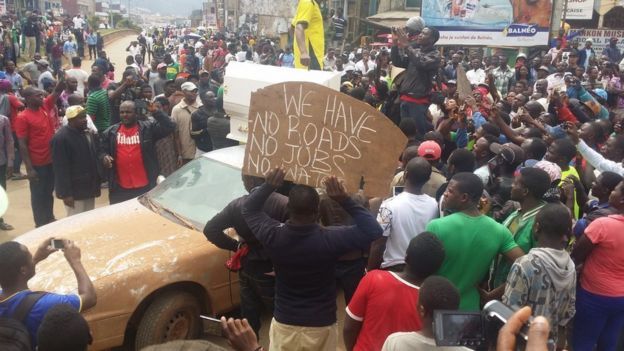 |
| Many English-speaking people complain of being treated like second-class citizens |
The Center for Human Rights and Democracy in Africa saw fit to issue a statement to urge francophones and Anglophones in Cameroon to "exercise restraint and refrain from hate speech and retaliation against one another", in the wake of viral vituperative accusations on social media from Cameroonians, outraged after about three hundred armed men swarmed into the town of Bangourain on December 23, setting houses afire in the largest attack in French-speaking territory since the conflict between Cameroon's insurgents began.
Colonialist powers saw fit to split the nation following the First World War, into a French-run zone and a smaller, British controlled area. Unification took place in 1961, which solved nothing; the English-speaking minority representing roughly a fifth of the population complains equal job and educational opportunities are denied them, hugely favouring the French-speaking majority. Now, roaming gangs of English-speaking insurgents clamouring to break from the majority-francophone nation is roiling the country.
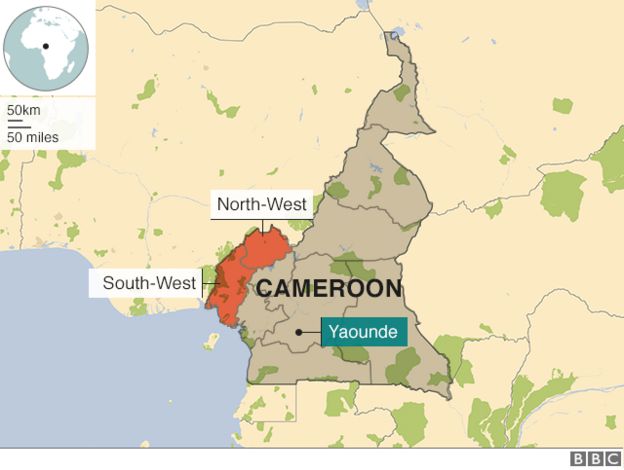
The local economy in the conflict zone is suffering. And according to the United Nations, the ongoing conflict has left hundreds dead, while displacing an estimated 437,000 people. The conflict that began in late 2016 with protests that started out peacefully against the French language dominance in schools and courtrooms of the Northwest and Southwest regions where most people speak English shows no sign of abating.
Fighters who fail to surrender their weapons are warned by President Paul Biya that he's prepared to order the defence forces to "neutralize" all fighters. Biya, 85, Africa's second-longest serving head of state, has extended his three-decade rule in the central African nation, winning a disputed presidential election in October. Journalists have been denied entry to the regions, but images appear almost daily on social media of gruesome events such as a picture of the head of a decapitated soldier left in the middle of a road in the regional capital of the Northwest, Bamenda, by insurgents.
More than half of Cameroon's state-owned agribusiness employees are unable to work as a result of the turmoil and the ongoing threats, leaving 11,000 of the 22,000 employees on the sidelines, as $61-million in exports has been lost. The three main crops of the Cameroon Development Corp. -- palm oil, rubber and bananas -- have dropped hugely, with large swaths of farmland in the two anglophone regions destroyed, according to its general manager.
the military has been accused of summary executions, and of village raids, by advocacy groups such as Human Rights Watch and Amnesty International. Over 150 police and military officials have been killed by separatists, according to government figures. Videos on mobile phones of separatists torturing village chiefs accused of collaborating with the authorities have been circulated. Allegations from residents that the army was responsible for abuses were rejected by the head of communication of the defence ministry who dismissed reports the military has set houses ablaze in the two restive regions.
A spike in violence arose in the two regions fuelling clashes between separatists and defence forces after President Biya pledged to create a committee to disarm and reintegrate fighters. Killian, a 41-year-old carpenter who withheld his surname for fear of reprisals fled the French-speaking areas, escaping as the military burned down his home and dozens of others in the Northwest town of Kumbo. "I barely escaped with my dear life. I hope my wife and my two children are alive", he said.
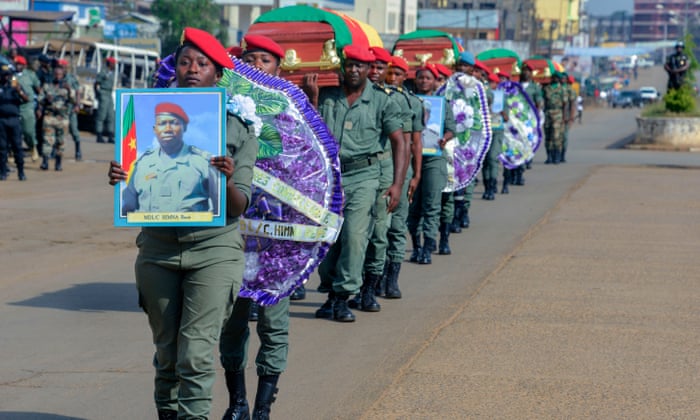 |
| Soldiers in Bamenda carry the coffins of soldiers killed in violence that erupted in the Northwest and Southwest Regions of Cameroon, where most of the country’s English-speaking minority live. Photograph: AFP/Getty |
Labels: Africa, Anglophones, Cameroon, Conflict, Francophones
posted by Pieface @ Tuesday, February 05, 2019