"I've
been harassed. For us, it's not about whether you are
legal or not, and that is why everyone is very careful right now."
"As long as you are a Nigerian, you are profiled and you are stereotyped immediately."
"We are all very careful."
"We
are in the dark because we don't know how our government [in Nigeria]
is going to react if any of us is to be affected or is to be killed."
"[Both Pretoria and Johannesburg have the] biggest [migrant communities]."
Chairman, Nigerian Union in South Africa, Olaniyi Abodedele
"It is not okay because we are blacks, we are brothers... everybody comes here just to survive."
"It's not what we expected as fellow African."
"It's just making us scared - imagine if we're scared in our own African continent - what if we go to Europe?"
Immigrant Security Guard
"[The
president ordered the] evacuation of imperiled Nigerian citizens who
consider their lives at risk by continued stay in South Africa."
"The
price of your peace, and the safety of your children is not worth any
sacrifices you have to make, or any assets you have to leave behind when
fleeing a conflict zone or hate-infested environment."
Nigerian Foreign Minister Bianca Odumegwu-Ojukwu
"[Nigerians] living in South Africa legally [are being dreadfully mistreated]."
"If
there were issues of illegality, that would be determined on a
person-to-person basis. You can't just crown the entire Nigerians living
in South Africa as living there illegally."
Nigerian Humanitarian Affairs Minister Bernard Doro
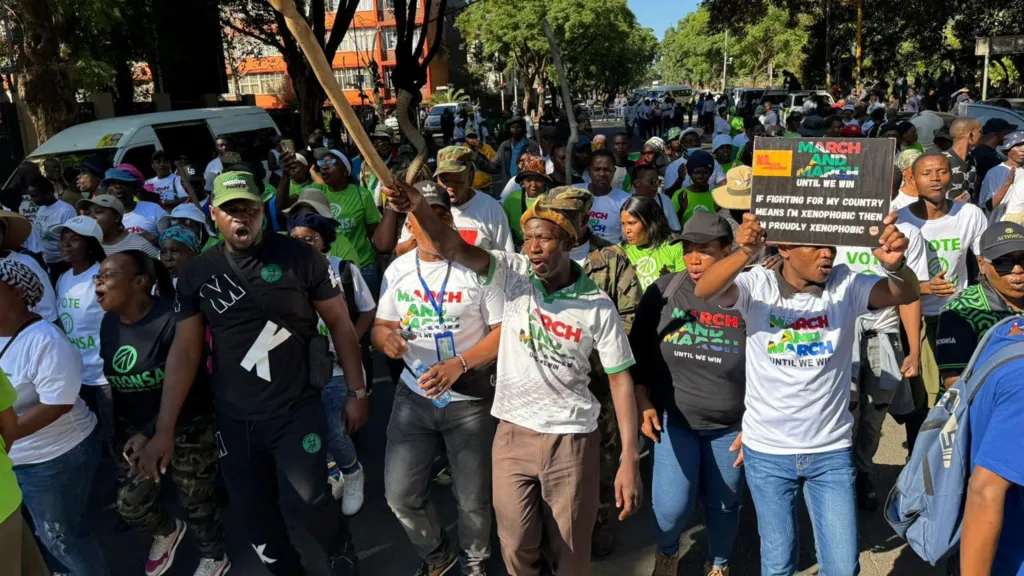
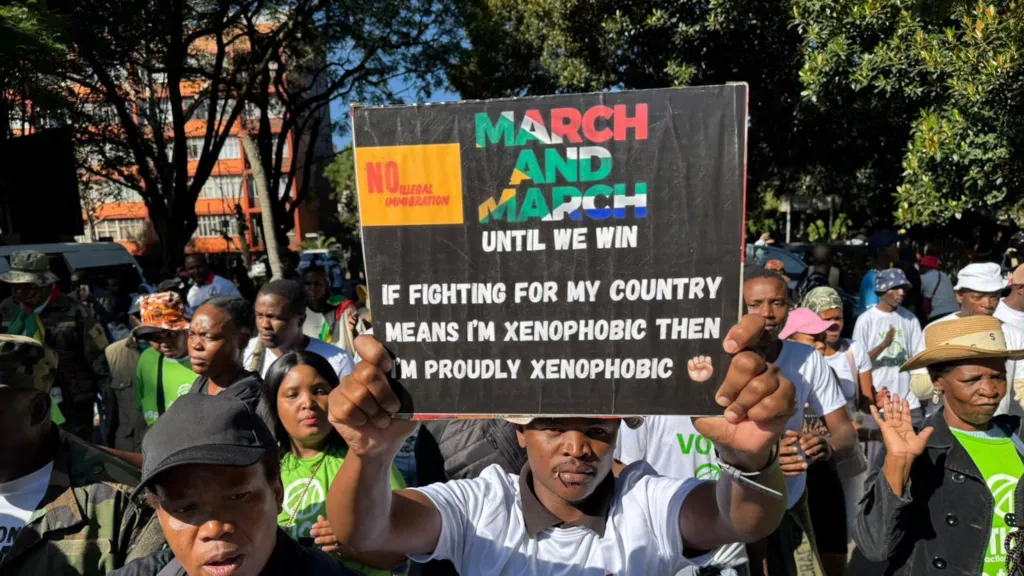
Hundreds took to the streets of Pretoria to protest against immigration BBC / Thuthuka Zondi
"I am very scared and traumatized."
"The
people came to my house and told me: 'You must leave. We don't want you
people to stay here any longer, so you have to go to your country.'
There were 10 and they were carrying weapons [machetes and whips]."
"They
cut my husband on his head and his neck. They were holding his neck
like they wanted to kill him."
"Because of God he still survived, but he's
in the hospital."
Esnat Joseph, 36, Malawian
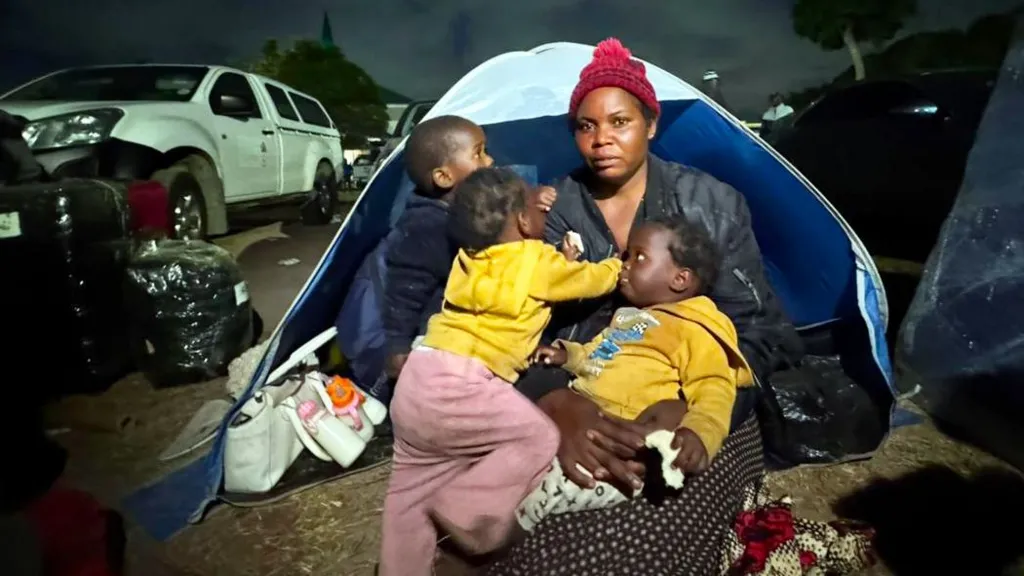
Esnat Joseph said a gang of men came to her home in Durban to threaten the family - forcing her to flee with her triplets Thuthuka Zondi / BBC
"If
you come into South Africa with a passport that allows you to stay for
30 days. When it's 50 days, when it's two years, when it's five years,
you know you're breaking the law."
"We
can't have South Africa being turned into a refugee site for all failed
African states… every country prioritizes its citizens and we want the
South African government to do the same."
March and March leader Jacinta Ngobese-Zuma
Ghana's diplomatic mission told Ghanaians in the country to "place the
highest priority on personal safety... [and] take precautionary
measures" during the protests. BBC / Thuthuka Zondi
Part
of repatriation ordered by the government of Nigeria following violent
anti-immigrant protests, the initial group of Nigerians returned home
from South Africa this week. On board the flight to Lagos was a total of
262 passengers and three officials, according to the Nigerian Ministry
of Foreign Affairs which earlier stated that over 1,000 Nigerians have
registered with them for voluntary return.
According
to authorities in South Africa, those returnees were found to be in the
country illegally, effectively contradicting the Nigerian officials who
had stated unequivocally that Nigerians were fleeing xenophobic attacks
against them by hordes of South Africans who march in the streets,
intimidating migrants as well as legal immigrants with the violent
vehemence of their expressed hatred of the presence of 'foreigners'.
Bearing sticks the marchers chant: "Mabahambe" - a Zulu phrase meaning "They must go".
Such
flights have been organized from South Africa by other African nations
whose nationals have been targeted by hate messages and threats of
violence, including Zimbabwe, Malawi, Ghana, Mozambique and others which
make up the 3 million non-South-Africans in the country, representing 5
percent of the population. Many of whom are there in South Africa,
welcomed for their cheap labour. While South Africa is the wealthiest
and most-developed of the regional African countries, it has a high
unemployment rate.
Countries
like Nigeria have taken note that since April, a series of new
anti-immigration protests have resulted in attacks against some
foreigners in South Africa; protests that highlight tensions between
foreign workers and locals who claim their jobs are being taken by
foreigners. Some South African officials speak of the protests and the
threats inherent in them as acts of xenophobia; words lacking any action
leading to a solution to the anger, resentment and fear.
According
to some returnees questioned by authorities in their home countries,
they lacked proper documentation in South Africa, while others stated
they had been unable to renew their residency papers for years, the
result of immigration bottlenecks imposed on Nigerians by South African
authorities. "I
was in South Africa for 11 years, and I was treated badly/ They did not
give us [Nigerians] resident permits because we were Nigerians", complained Eminaba Beatrice.
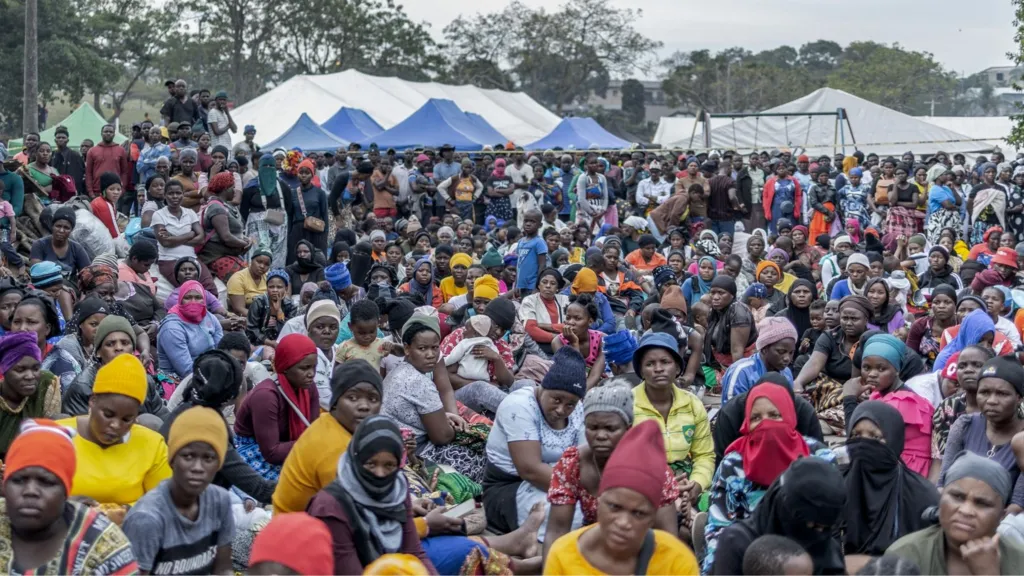
Around 7,000 people have gathered in Durban asking to be repatriated to Malawi AFP via Getty Images
"Political
parties are scraping the bottom of the barrel in trying to lie to
people that all our problems are the migrants, and if we get rid of the
migrants, then we'll have no problems in South Africa."
"This has been an ongoing phenomenon in South Africa and more recently, it has been associated with elections."
Sharon
Ekambaram, human rights lawyer, member, Kopanang Africa
Against Xenophobia movement
"It was more of a riot by a mob of young men and
women who were demanding the release of the two people arrested over the
killing of the Christian student.".
"The crowd which made bonfires on the
streets were also demanding the police stop the manhunt for those
identified to have taken part in the killing."
"Some among the security men deployed to protect the palace tried to ask the protesters to leave but they became unruly."
"Policemen
and soldiers who stood outside the palace hurled teargas canisters and
fired into the air and succeeded in dispersing the crowd."
Ibrahim Arkilla, Sokoto resident
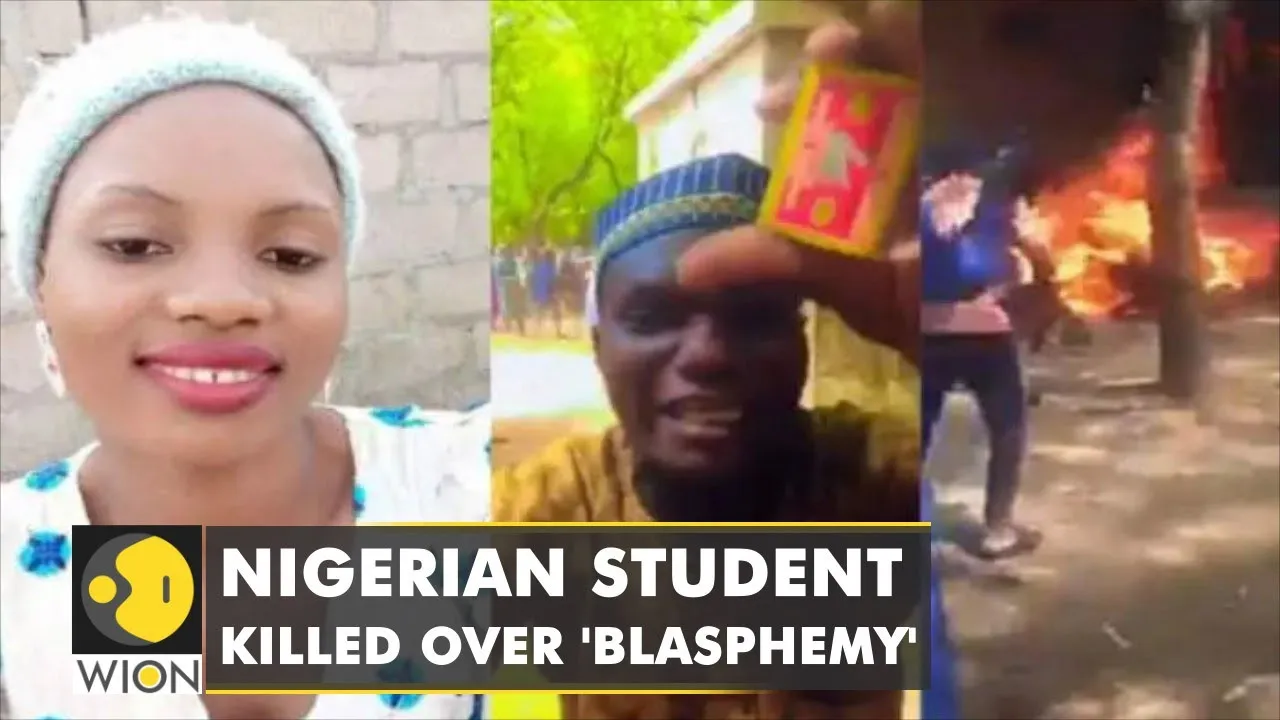
Mob kills female student over ‘blasphemy’ in Nigeria, two arrested
"Students forcefully removed the victim from the security room where she
was hidden by the school authorities, killed her and burnt the
building."
"[Two people have been arrested and] the suspects in the viral video on Twitter were spotted and will be nailed soon."
Sanusi Abubakar, police spokesperson
"Murderers of Christian woman in Sokoto must be arrested & punished!"
"Sadly,
this sort of consequence-free murder of people in the name of avenging
'blasphemy' has been going on for far too long in the North. This must
stop!"
"The monsters in that video are easily
identifiable. The Sokoto State government must immediately apprehend
them and make an example of them. If that doesn't happen, this kind of
murderous barbarism will continue."
Professor Farooq Kperogi, Kennesaw State University
The security post where Deborah Samuel was beaten and burned to death in Sokoto. Photograph: Olu Akinrele/AP
Nigeria is the largest, most populous country on the African continent, its population divided roughly in half; between Christians and Muslims. A female student accused of blasphemy was beaten and burned by other students in Sokoto leading a large group of Christian churches to demand authorities see justice done. Two student suspects in the killing were arrested, connected to the murder of Deborah Samuel. Other students had accused her of posting blasphemous statements in a WhatsApp group about the Prophet Mohammad.
In some Nigerian states strict sharia law that includes death sentences for blasphemy have been adopted. The Christian Association of Nigeria with a Catholic, Anglican, Methodist and Indigenous church membership insisted that those responsible for the death of the young women in the northwestern state of Sokoto must be criminally prosecuted.
"The unlawful and dastardly actions of the perpetrators must not only be condemned by all right-thinking people, but the security operatives must find them out, prosecute them as it is expected of them", stated the Christian Association of Nigeria general secretary. According to witnesses, school security and police tried to rescue the young women but were overwhelmed by the students.
Former vice-president of Nigeria and currently a presidential election aspirant Atiku Abubakar, himself Muslim, condemned the killing, but then deleted it from his Twitter account. After arresting two suspects, police began looking for another two suspects, recognizable from the video footage shared on social media of the murder. In reaction to the arrests Muslim youths lit bonfires on the city streets, demanding release of the two suspects.
Shehu Shagari College of Education in Sokoto, Nigeria
Police were deployed to the city streets to maintain order. The protesters had begun to loot Christian shops until the police put an end to the riot. The sultan of Sokoto, Muhammad Sa'ad Abubakar, the highest spiritual figure in Nigeria among Muslims, had condemned the killing, demanding that those involved must face justice. Leading some among the mob of protesters to besiege his palace.
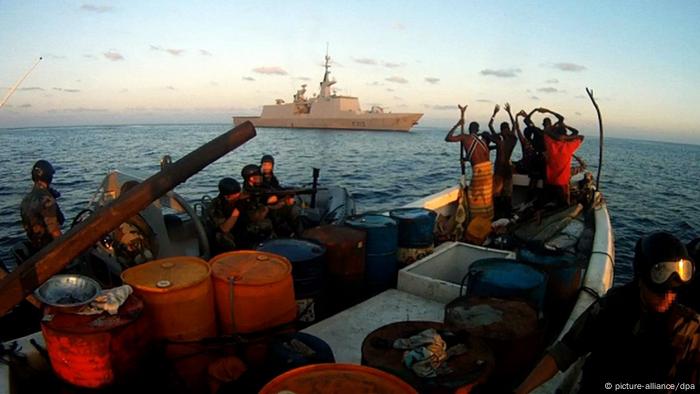
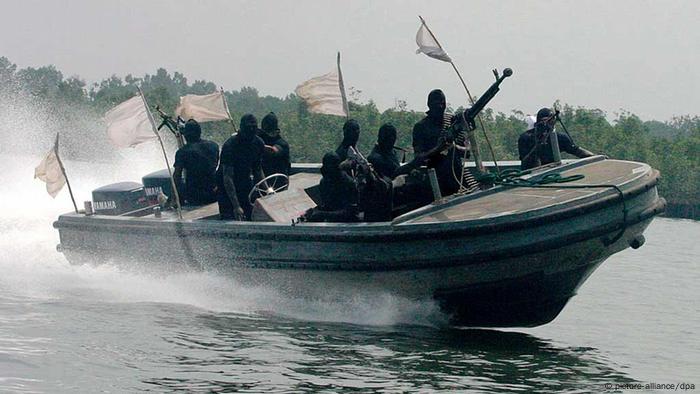
Shipping Piracy in the Gulf of Guinea, West Africa
"The emphasis is now on the kidnapping of multiple crew members, with the attacks taking place much further out to sea and against all types of shipping."
"The risk-reward ratio is very heavily in the favour of the pirates, and it has become a lucrative business model that must be broken. It is a huge sea area to police, and right now, if vessels call for help, there isn't really a timely and effective response."
"The pirates are operating with near impunity and this is an unacceptable situation for innocent crew to be subjected to."
Michael Howlett, director, International Maritime bureau, London
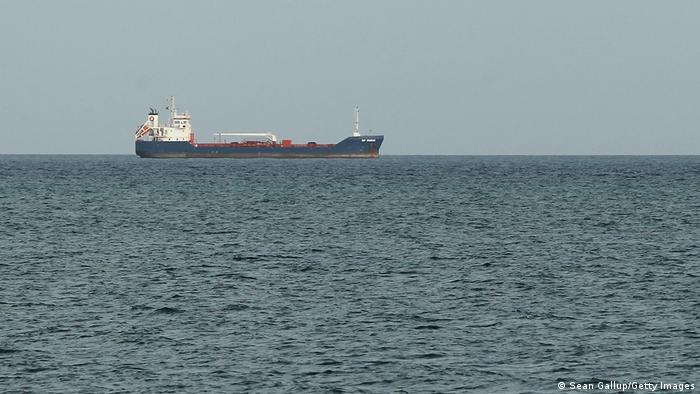
The ship was sailing through the most dangerous sea in the world for piracy when it was attacked
In the Gulf of Guinea, a huge stretch of ocean from Senegal to Angola in West Africa, vessels have been increasingly threatened by violent attacks launched by gangs operating with near impunity in the poorly policed waters. At one time these gangs' oceanic territory was mostly confined to robbing ships sailing close to shore. Now, however, they have branched out ranging hundreds of miles out to sea. Entire crews are taken hostage for weeks to force shipping companies to surrender large ransoms in exchange for their freedom.
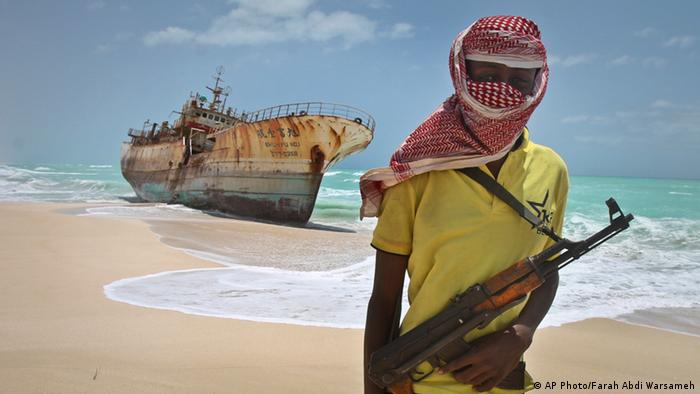
A decade earlier it was the coast of Somalia where the piracy crisis was taking place. During that time over 150 ships had been taken hostage the end result of which was that an estimated total of $500 million in ransom was paid out to the pirates. The European Union and NATO finally launched an international anti-piracy force operating off the Somalia coast to put a stop to the piracy. Matters have since quieted down in that area.
Pirate attacks along the Horn of Africa have decreased since the
international naval presence there was bolstered. In 2012, 35 ships were
attacked by pirates off the coast of Somalia, compared with 163 in
2009. In former piracy hotspots, locals are more concerned about fishing
than capturing cargo ships.
Clearly, a similar type of international deterrence is overdue for the West African coast to deter reward-ravenous gangs for whom piracy has become a lucrative lifestyle. For a similar defence to be launched in that area however, would require full cooperation of West African states, but the general consensus is that they would be averse to welcoming the presence of foreign navies in their oceanic territory.
Which leaves vessels in the Gulf of Guinea unprotected by pirates whose tactics have been worrisome for shipping companies while making the gangs prosperous as they hound and terrorize ships' crews. The latest hijacking was that of a Turkish container ship 300 kilometres off the coast of Nigeria with 15 Turkish sailors taken as hostages. The pirates had clambered over rolls of barbed wire, using an angle grinder to cut through the steel door of a safe room.
West African pirates' methods can be more violent than those off the
Horn of Africa. While Somali pirates know they will forfeit ransom if
their hostages come to harm, pirates in the west are mainly interested
in the oil or valuable cargo on board and less concerned about the
people. Their hijacking methods are similar - approaching large vessels
out at sea in small craft.
The crew of the Turkish container ship Mozart might have felt their hiding place was impregnable, but it proved not to be. The ship's chief engineer Suha Tatligul, described the hijackers as having "worked to break the doors for six to seven hours". So confident that they wouldn't be interrupted, that speed was no problem in gaining entrance to the 'safe room'. When they finally broke through and entered the room they opened fire. One sailor was killed, three others were injured.
In total to date there have been sixteen attacks or attempted attacks this year alone in the Gulf of Guinea identified by Dryad Global, a maritime security consultancy based in Britain. In 2020 there were 130 sailors who experienced the feeling of being held hostage for a hefty fee by their employers. Those kidnappings represented 95 percent of criminal acts at sea. Most are criminal gangs based in the Delta region of Nigeria, a haunt for militant groups engaged in crime mostly targeting the country's oil wealth.
In the West, Nigeria has been exporting oil for the past 20 years, but
most of its people have not benefited from the extensive revenues.
Almost two-thirds of Nigeria's population lives below the poverty line.
To those without livelihoods, the risks of piracy can seem worth it.
Political instability and social conflict have left room for pirate
gangs to consolidate in the Gulf of Guinea.
Earlier, the gangs specialized in illegal tapping of oil pipelines and the theft of ships' oil, until the collapse in world oil prices since 2014 hardly made the effort worthwhile financially. They were forced by circumstances to discover other, more profitable ventures, to diversify and expand their endeavours. The "hostage camps" the gangs operate are located in islets in the Delta's dense forests, mostly accessible only by boat, and difficult to navigate for outsiders.
The Danish shipping giant Maersk called for tough action when two attempted piracy attacks occurred on its ships since December. "The risk has reached a level where effective military capacity needs to be deployed", stated Maersk's head of marine standards.
"If humanitarian agencies are kicked out of north-east Nigeria then
thousands of Nigerian civilians will needlessly die, including many
children – it will be a humanitarian disaster"
"{Someone needs to ask the Nigerians and the UN some serious questions
about how the government of Nigeria is getting away with this while it
sits on stage in New York, presiding over the UN general assembly and
preaching about ending conflict and fighting poverty in the drive to
reach the sustainable development goals." Aid Agency Worker
"Action Against Hunger delivers neutral, impartial and independent
humanitarian aid to millions of people in Borno and Yobe states by
providing basic services to the most vulnerable people, especially women
and children." Action Against Hunger
Soldiers block the entrance of the aid agency Mercy Corps’ office in Maiduguri after closing it down.
Photograph: Audu Marte/AFP/Getty Images
Nigeria, the most populous of African countries and the most wealthy in natural fossil fuel resources, with its population split between Christians and Muslims has been incapable of defending its people and ridding itself of the dominating, murderous curse of Boko Haram, Islamist jihadists. Its military has been underfunded, foot soldiers using decrepit old weapons, corruption in both the military elite ranks and the government itself at every level is legendary. And ordinary people suffer.
For ten years Nigerians have been victimized by the brutality of the Islamists and the fecklessness of the government. The Islamist extremists have declared war and the government has responded half-heartedly. Allocating more funding to the military, acquiring newer weapons, all the while that Boko Haram is arming itself with even better weapons. Some, in fact, from abandoned armouries looted by the vandals when troops retreat, anxious for their own safety, abandoning their posts.
It's a strategy-without-honour seen played out years ago in Iraq when Islamic State marched on Mosul, the Iraqi defence forces scurried off, allowing ISIL to loot the national treasury of almost a billion dollars and take possession of the hastily departing Iraqi military's weapons caches and vehicles, courtesy of U.S. generosity in the fight against terror. President Muhammadu Buhari's re-election had him boasting about making spectacular progress in defeating Boko Haram; "technically defeated".
A term that has little meaning to the farmers and villagers whose livelihoods have been destroyed, villages emptied, men killed, women kidnapped and raped. Despite the government having 'defeated' Boko Haram, they have now control of four of the ten areas in northern Borno State close to Lake Chad. From their jumping off spots they continue to mount raids on an almost daily schedule. So the people living there don't think much of the defeat of Boko Haram.
The Nigerian military is in a congenital state of demoralization. Initially it was because the military was underfunded, the soldiers not well trained or armed. Now they're on the defensive as well as being demoralized, as though they realize they aren't capable of winning in a fight against the terrorists. Some in the military point out their vehicles and weapons have fallen into disrepair; their organizational skills leave much to be desired.
But a new tactic has gained sway, with the military announcing plans to pull back troops from isolated outposts to gather them within fortified settlements called "super camps" installed inside garrison towns where tens of thousands of civilians have been settled. They're there because either Boko Haram ousted them or soldiers burned their villages, rounding them up with claims this would secure the countryside. Trenches ring the garrison towns in hopes of deflecting invasions by the terrorists.
The end result of this bold new direction in military tactics has been to give Boko Haram free reign in the countryside, barren of its inhabitants. When President Buhari was first elected there was headway made against Boko Haram by the Nigerian military, with fighters routed from the state capital of Maiduguri and small cities taken by Boko Haram, pushing them back toward their forest barricades.
The military commanders in the face of criticism over strategy now say the super camps represent a more effective way of dealing with an insurgency whose attacks against the military are more complex. Among some officials the super camps represent an outright retreat, with one federal official characterizing the new strategy as jeopardizing the situation even further with soldiers barricading themselves out of harm's way.
Giving Boko Haram the opportunity to raid the gear soldiers leave behind them while abandoning their posts for the security of the super camps. According to locals, some soldiers have been seen to flee in the face of attacks, preferring not to remain in fighting mettle. Outside the military's reach, people tolerate the presence of militants because they can do nothing else after returning to their farms, preferring to earn a living rather than submit to crowded camps where cholera and other diseases lurk.
The government itself has turned its attention on the presence of humanitarian groups in the country, doing their utmost to provide medical care and food to Nigerians living in dreadful straits. Inexplicably, the government has charged these charitable groups with using their funding in support of Boko Haram. Aid offices have been closed down after being charged with aiding and supporting Boko Harm or Islamic State West Africa Province (ISWAP).
This is a country totally at the mercy of an ineffective government with little idea how to cope with the threats within, and turning instead to outside agencies to blame them for the hopeless inadequacy of their responses to the terror within.
"Previously, our studies showed that the tramadol use was relatively low among our drug users, at about four percent, but as of 2014, about 45 percent of all clients referred to this facility were using it." "We understand that some of those taken captive by Boko Haram or who have fought with the group are given the drug to numb their feelings. We've had soldiers brought in for addiction treatment as well." Dr. Ibrahim Abdu Wakawa, director, Neuropsychiatric Hospital, Maiduguri, Nigeria
"At first, tramadol just makes you feel good and full or energy, taking all your body aches away." "But soon I needed to take it all the time. My family made me come here, but when I realized I wasn't going to be able to get tramadol any more I became very aggressive." "I'm clean now, but I kept a diary of my treatment to remind of how bad things got." Ahmed Muhammed, in-patient, Neuropsychiatric Hospital
"At first they just helped me to forget the trauma of the attack [by Boko Haram in Bama], and how we had to run for our lives." But now I take them for other reasons too: just to blot out the pain of life here in Nigeria, the boredom and hopelessness. My consumption has rocketed." "I could get some right now if I wanted. There is a dealing spot just around the corner." Abel Habila, Maiduguri, Nigeria
Nigeria is facing catastrophic levels of opioid addiction — and no one seems to know how to stop it.
Nigeria is the largest, most populous country in Africa. It has oil wealth. The population is divided between Christians and Muslims. And it is wracked by Islamist terrorism. In northeast Nigeria Boko Haram wreaks havoc, invading villages, burning homes, murdering people, raping, abducting school girls. Despite its wealth and its large military, succeeding governments have been unable to arrest the terrorism. Its soldiers are ill equipped with outdated weapons and are ill trained and poorly motivated.
For a country with a lot of potential to advance on the scale of national achievements in technological progress, economic balance, decent employment and educational opportunities, and above all, national security, corruption reigns supreme, leaving the population insecure and fearful, and riven with sectarian and tribal rivalries. Perhaps it is not surprising that an epidemic of opioid addiction is further roiling the country.
It is, after all, a epidemic of notable proportions making its dreadful way through countries with advanced economies, full employment, excellent public security and national wealth in democratic settings where opioid overdoses have become a public emergency. In Nigeria, the abuse of tramadol, meant as a prescribed pain reliever has become universal. Farm labourers, rickshaw drivers, college students all use it to energize themselves in the belief that its useful properties outweigh any negatives.
The negatives of prolonged use: seizures, psychosis, fatal overdoses -- and withdrawal symptoms can re-introduce the avid user to the very same kind of physical pain that tramadol is meant to treat. There is a wider substance abuse epidemic in Nigeria, with close to 15 percent of its 200 million people reporting a "considerable level" of psychoactive drug abuse, representing three times the global average.
Customs agents seize hundreds of millions of tablets, mostly imported illegally from Asian manufacturers. The black market price for the drug has risen twenty-fold since the Nigerian government ordered tramadol prescription-available only. Even with that, a single 200mg capsule costs under $1.60. The World Health Organization is reluctant to place tighter international controls on the trade in tramadol, arguing it would take out of circulation one of the few inexpensive painkillers hospitals and clinics in Africa can access.
Despite the scale of the crisis, there is little help for opioid addicts in Nigeria The Telegraph
"He is so driven." "He does ten times more chess puzzles than the average kid." "He just wants to be better." Shawn Martinez, school chess teacher
"The U.S. is a dream country." "Thank God I live in the greatest city in the world, which is New York, New York." Kayode Adewumi, Nigerian refugee
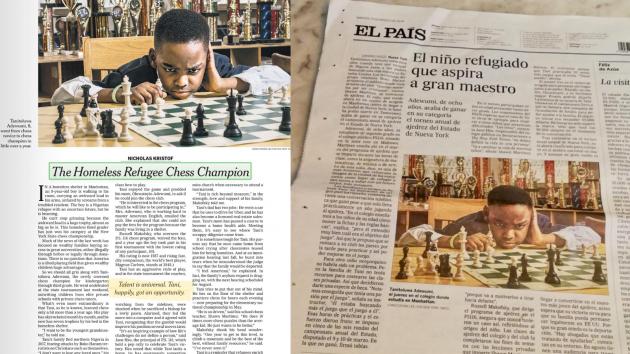
The story of Tanitoluwa Adewumi as covered by the New York Times and El País. | Images by David Llada.
Nigerian refugees Kayode Adewumi and Oluwatoyin Adewumi left their native Nigeria in 2017. As Christians they were targets for Boko Haram terrorists. "I don't want to lose any loved ones", Kayode said. The two, husband and wife, brought their two sons as refugees to the United States. On their arrival, a pastor helped them find haven in a homeless shelter. They are awaiting word on their refugee claim. And in the interim, they live in the homeless shelter, along with others in somewhat the same position as themselves; life held in abeyance.
Not that Kayode has been idle. He has sought work, and has managed to find two jobs. He uses a rental car to drive for Uber. And he has become a licensed real estate salesman, while his wife enrolled in and then passed a course as a home health aide. Their younger son, Tanitoluwa attends a local elementary school with a part-time chess teacher. There Tani and other children were taught to play chess. He enjoyed the challenge of the game so much that he asked his mother to enrol him in the chess club.
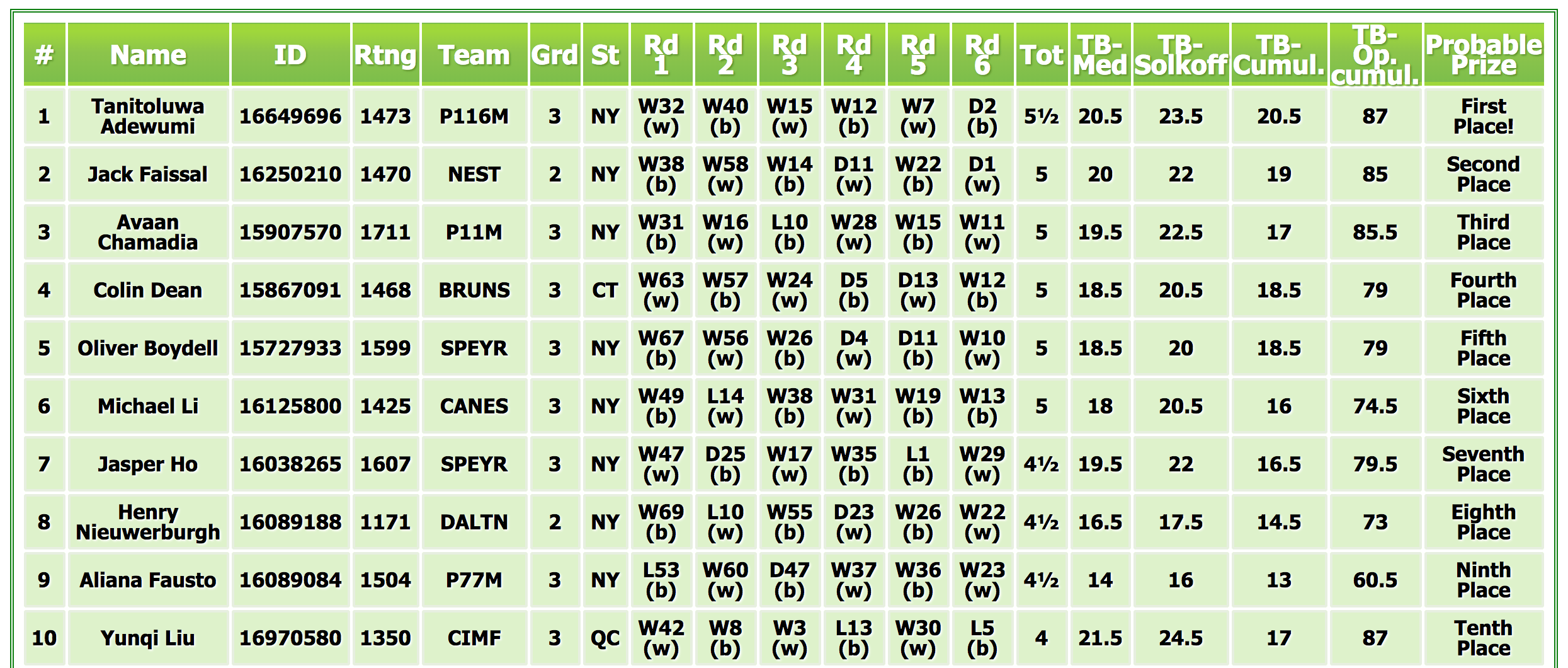
Living in a shelter, and having little money the family was unable to pay the fees. After explaining this to the club, the man overseeing the program waived the fees, and it's been a year since the boy took part in his first tournament. At that event Tani had the lowest rating of any of the participants: 105. His rating now stands at 1587 (the world's best player, Magnus Carlsen has a rating of 2845). As a third-grade student who is homeless, Tani recently won his category at the New York State chess championship and was given a large trophy.
His category, kindergarten through third grade. He was able to outplay children from elite private schools who enjoyed the privilege of learning special moves with the aid of private chess tutors. Tani's knowledge of chess moves dates back a full year, when he was first introduced to chess. Since that time, month by month his play has steadily progressed. Tani now has no fewer than seven trophies standing by his bed in the homeless shelter.
"I want to be the youngest grandmaster", he said. In the state tournament, coaches watched in shock as the boy sacrificed a bishop for a pawn. The play he envisioned was validated by a computer that agreed with Tani when the coaches fed it the move, recognizing that by so doing Tani's position gained greatly by the gambit several moves later. "It's an inspiring example of how life's challenges do not define a person", commented the principal of Tani's school.
Every Saturday, Tani's mother takes him to a three-hour free practice session in Harlem. His parents allow Tani to miss church when there is a conflict in time with a tournament that he wouldn't want to miss, despite that they are extremely religious. Tani is allowed to use his father's laptop in the evenings for practise. "Tani is rich beyond measure" in the emotional support his family gives him, observed Russell Makofsky who runs the chess club.
There are times when the boy feels oppressed and unhappy, such as when classmates tease him about his homeless state. And he was rocked emotionally last fall when during an immigration hearing he thought the judge said the family would be deported. "I feel American", he responded. The family's next hearing for their asylum request is scheduled for August. The uncertainty weighs on the entire family. Tani finds relief in planning for the elementary national championship in May.
"One year to get his level, to climb a mountain and be the best of the best, without family resources. I've never seen it [happen before]", said Mr. Makofsky, with wonder.
Tanitoluwa Adewumi with his New York State Championship trophy. | Photo courtesy Russell Makofsky
"Nigerians in their thousands have been gruesomely dispatched to the Great Beyond by armed Fulani herdsmen who are being protected by the powers that be." Emmanuel Onwukibo, coordinator, Human Rights Writers' Association of Nigeria
"The reverend fathers [Christian priests killed along with parishioners during Mass] were not farmers." "The armed herdsmen have moved the narrative of the current crisis from search for grass to other obvious motives [promoting Islam through jihad to the detriment of Christianity]." Christian Governor Samuel Ortom, Benue State
"[President Muhammadu Buhari is running out of time to convince Christians that a] grand mischievous plan for territorial conquest, ethnic cleansing and religious imposition] by Muslim Fulanis is not in the works]." "The very survival of our nation is now at stake." Catholic Archbishop of Abuja John Onaiyekan, Abuja, Nigeria
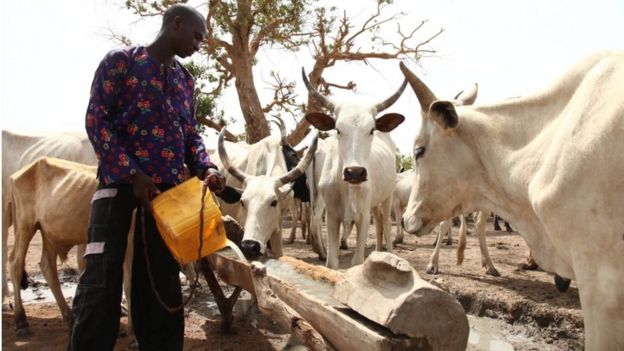
A Fulani herdsman waters his cattle (file picture)AFP/GettyImages
Nigeria is special; it is Africa's largest, wealthiest country and its most populous. It is divided by Christianity and Islam. And it has its very own special deadly radical Islamist terrorist group defying authority and stalking and murdering Nigerian villagers, abducting young girls and creating countless homeless people desperate to escape their depredations. It had a Christian president and now has a Muslim president, both of whom pledged to rout Boko Haram and neither of whom succeeded.
And though Nigeria is one of those rare African countries with great natural resources and has considerable income from petroleum, there isn't much of a trickle-down effect to ensure that the country's wealth is equally shared. There are, throughout Africa, droughts impacting on agriculture and cattle-raising, and since the two enterprises are diametrically opposed, there is great tension between the herdsmen wanting to graze their herds, and the agriculturalists who want their fields unmolested.
Climate change has impacted Africa, bringing stress and deadly hostility between herdsmen and agriculturalists to the fore in South Sudan and the Central African Republic. Muslims and Christians have turned against one another in confrontations for that very same reason in Nigeria. Armed cattle herders, Muslims of the Fulani tribe, have raised militias in Nigeria, just as has occurred in northern Kenya where farmers both white and black have been killed.
In Nigeria, hundreds of thousands of people have vacated farms and villages, leaving their homes to abandonment. Where crops are not being raised, hunger, economic collapse and disease spreading in camps for the displaced looms on the near horizon. Aggression on the part of semi-nomadic cattle herders from the Fulani ethnic group, some 20 million in number, their territory spread across west and central Africa, threatens stability.
Traditional pasturage in the north of Nigeria has collapsed as it has elsewhere in some northern African states where up to 75 percent of grassland has been transformed through desertification. Water sources have been disappearing alongside attacks by Boko Harm to combine circumstances thrusting the Fulani and their herds into the fertile central farmlands of Nigeria; the Middle Belt, home to a Christian majority population.
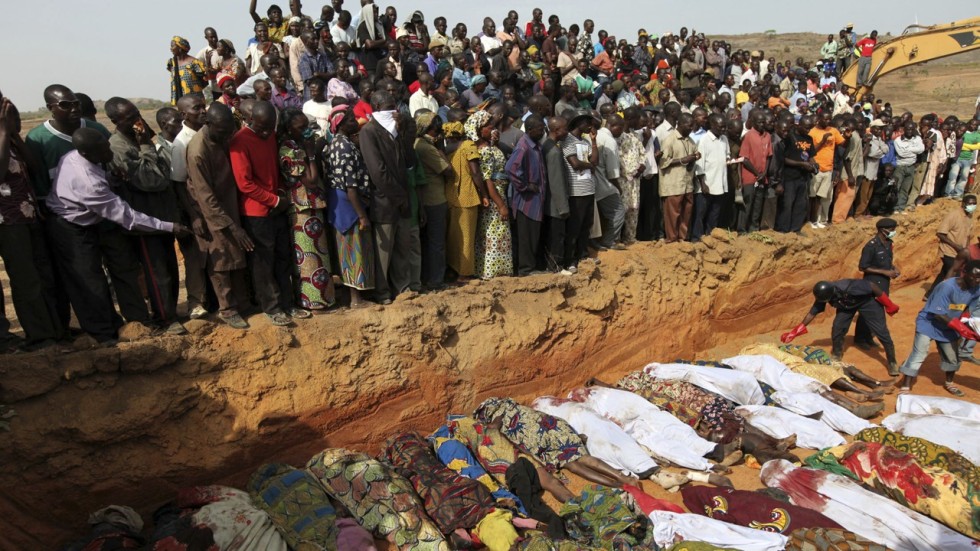
Local authorities and farmers' attempts to protect crops and farmland has resulted in reprisals where farmers tending their crops have had their hands severed, stuffed into their pockets as examples meant to terrify other farmers to abandon their fields. Fulani gangs on motorcycles attack villages and the terrorized inhabitants flee as the gangs open fire, set fire to homes, hack children to death. In a village in Kaduna state last month 71 people were killed.
Even some Fulani have been slaughtered by their fellow tribesmen in this battle between agriculture and herding. But it's not solely herders involved in these attacks. Young gangs of Fulani have organized kidnapping camps in the vast Rugu forest, emerging on their motorcycles to prey on pedestrians walking isolated nearby pathways. As many as a hundred people were kidnapped in two days last month in Kaduna state.
One attack on a church in Benue state in April saw two priests and 17 of their parishioners killed during Mass, persuading many Christian Nigerians that the real intention of the Fulanis is to dispossess them through territorial acquisition and the expansion of Islam through ethnic cleansing of Christians. The result has been that Christian tribesmen felt compelled to form armed vigilante groups to battle the herders during attacks, and to implement reprisal attacks themselves.
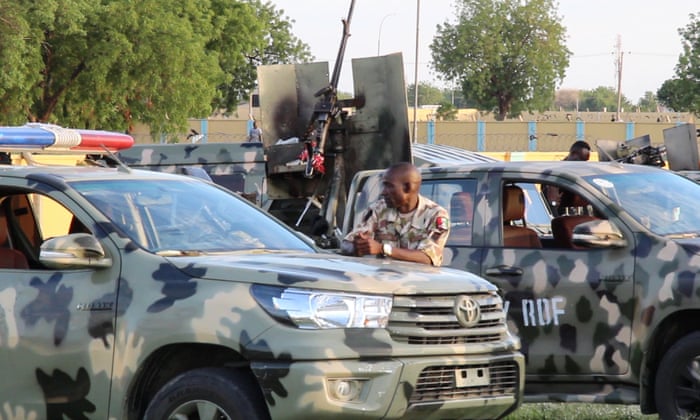
Muslim President Muhammadu Buhari, accused of turning a blind eye to the attacks has ordered the military to restore order. Nigeria's armed forces have been dispatched to do just that, finding their opponents in possession of arms superior to their own, the very situation that prevailed when they went out to rout Boko Haram terrorists.
Nigeria: 86 dead in reprisal attack by Muslim herders on Christian farmers The long-running battle for land and resources is threatening to become the worst security risk in Nigeria 25 June 2018, South China Post
"Her story give[s] us hope, that's why we, too, want to go to school and become something in life." "We have to bear all pains like hunger to go to school.
We barely eat once a day here. We have not eaten since morning because
government people no longer bring us food for about two months now." "I want to become a soldier so that I could help my community to fight and kill Boko Haram, because they are not good people." Fatima Ali, schoolgirl, 15, Maiduguri, Nigeria
"This
is part of my girl power trip, visiting many parts of the world. I am
here now because of the Nigerian girls. Fighting for them and speaking
up for them." "They have lived in the period of extremism." "[I
hope they will] live with their family, live a normal life. And the
government must unite so that they should make sure that these girls are
released [those schoolgirls remaining in Boko Haram captivity]." "Boko Haram themselves should learn that in Islam, such things are unacceptable. This is against humanity, this is against Islam." Malala Yousafzai, Pakistani Nobel Peace laureate
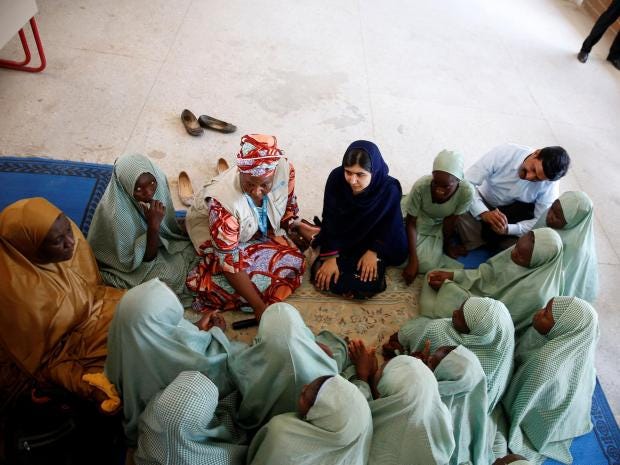
Nobel laureate Malala Yousafzai seen in a group discussion with some of the students of Yerwa Girls school in Maiduguri, Nigeria Reuters/Afolabi Sotunde
The young woman whose experience of being shot in the head by Taliban
tribesmen intending to silence her and make an example of a young girl
whose outspoken criticism of their violence and their misbegotten Islamist determination to keep girls and women out of sight, wearing dark burqas and niqabs
to cover their faces, keeping them in their homes, disallowing music
and celebration, destroying their schools and killing their teachers
became a symbol of heroic resistance in her struggle, championed by the
West.
She has since as she grows into adulthood, become a
spokesperson for the need to see that girls and women in the world of
Islam and where poverty and ignorance resides, receive an education. She
recently toured internally displaced camps in and around the Nigerian
city of Maiduguri, sheltering thousands from the violence that Boko Haram strikes in the country. Their abduction of hundreds of young schoolgirls from Chibok made world headlines.
Some of those girls in their mid-teens were 'married' to Boko Haram militants and bore their children. Some, managing to free themselves and appearing with their children in their villages, have been spurned and isolated and threatened, spurring them to find haven in the refugee camps. Boko Haram
had used some of the schoolgirls as suicide bombers, leading their
former neighbours and family members to view them all with suspicion and
abhorrence.
Malala Yousafzai
is no longer the defiant schoolgirl of 15 who had to undergo emergency
surgery to save her life. She is now a advocate for educating girls and
women, herself now a celebrated young woman of 20. She is intelligent
and forward-looking, courageous and determined. Yet she fails to
recognize that the Taliban who tried to murder her and Boko Haram
which has tormented poor villagers, torching their homes, slaughtering
the men, abducting the women and girls are indeed symbolic in their
actions of Islamic values.
Meeting with over a hundred
girls who were rescued and must remain for their own safety in the
capital in internment camps, she informed the media she was unhappy the
girls have not been permitted to fully reunite with their families.
Their families no longer trust them, their families are shamed that
their village neighbours consider them to be Boko Haram converts, and have defiled tribal and religious dictates that girls remain virgin until marriage.
The normal life that Malala Yousafzai
envisions for these girls has been destroyed by Islamic heritage,
culture and values; they are outcasts. And the government which
administers Africa's largest, most populous country, with an abundance
of natural petroleum resources has failed its population, both Christian
and Muslim whose futures have been darkened by Boko Haram predation.
Nigeria's northeast is home to three million children where 1,400 schools have been destroyed by the Boko Haram insurgency. Over 2,295 teachers in the region were slaughtered by Boko Haram since 2009, according to the United Nations children's agency.
All
the grievous ills, the mass slaughter, the rapes, the dislocation and
the crisis in food scarcity and refugees represent the handiwork of Islamofascists loyal to the core to Islam, the Koran and the Hadiths.
And the governments, like that of Nigeria, whose response is insipid to
the threat of their people are in effect, colluding with the terrorists
by default.
"Poorer countries hosting huge numbers of refugees for many years, such as Kenya, Pakistan and Turkey, have recently pushed back hundreds of thousands of refugees and asylum seekers." Gerry Simpson, migration expert, Human Rights Watch
"I think host governments are getting sort of fed up that a very large proportion of the burden is falling on them, without enough international assistance." Kathleen Newland, co-founder, Migration Policy Institute, Washington
Many returnees are ending up in camps in Borno state AFP
Thousands of Nigerians who crossed the border into Cameroon to find respite from the attacks by Boko Haram were living in crowded refugee camps in the impoverished country that allowed them to find haven, and struggled to support their needs. More recently they were exposed to a concentrated effort on the part of Cameroon authorities to persuade them to return to their own country, with the assurance by those authorities that the situation had returned to normal, their former homes awaited them and peace reigned.
Some, suspecting nothing awry, did return only to find their lives were still endangered, and to discover that little food was available. In the past several months some five thousand Nigerian refugees were summarily rounded up from where they were sheltering in villages in Cameroon and in refugee camps and expelled, forced to return to an area remaining under frequent insurgent attacks. The United Nations feels the number is double that, that in fact ten thousand refugees have been forced to return to the danger from which they had originally fled.
The United Nations High Commissioner for Refugees had been arranging agreements to persuade countries sending refugees home, that they only be returned voluntarily. This followed the mass eviction from Cameroon, one of the world's most indigent nations, inundated in recent years to host over 300,000 people crossing their border from wars in the Central African Republic and Nigeria. Many other refugees bowed to pressure to return to northeastern Nigeria where they were greeted by no housing, severe overcrowding and little food and water.
There are areas of Nigeria that Doctors Without Borders discovered to be close to famine conditions. When they entered Banki last summer once Boko Haram was driven out by the Nigerian military, Doctors Without Borders found a crisis, with over ten percent of children suffering acute malnutrition, and people dying of preventable diseases. While back in Cameroon, residents of northern Cameroon placed the cause of their own food shortages on refugees, even as the Cameroonian government struggled to provide for the refugees.
Refugees are seen gathered at
Minawao Refugee Camp in northern Cameroon, April 18, 2016. The U.N.
refugee agency has called on Cameroon to stop forcibly repatriating
Nigerians refugees on its territory.
"In the beginning, there was no problem. Hunters and insurgents met in the forest and everyone was doing their own business." "We decided right then [when Boko Haram first took its deadly revenge], they won't stop until they kill all of us." "Once you meet it [your prey, as a hunter], there are only two options: you kill it or it kills you." "If you climb a tree you might be safe from an elephant. But not with Boko Haram. If you climb a tree, they'll shoot you." Bunu Bukar, Nigerian hunter
Aisha Gombi Bakari, 38, is one of only a handful of female Boko Haram hunters.
Photograph: Rosie Collyer
Bunu Bukar was throughout his life as a hunter familiar with hunting big game. Hunters traditionally went off in groups, sometimes as many as a hundred people all together, for a major hunt when the bush would be tramped through, on the hunt for prey. More latterly, some Nigerian hunters have been absorbed for their skills in hunting and their intimate knowledge of the bush, by the Nigerian military. Their induction has been useful in the determination to roust the Boko Haram terrorists from bush hideouts.
And while the hunters useful in plying their trade, more accustomed to dealing with the habits of the animals they traditionally hunt, familiar with those who readily succumb, and those like elephants who can be ferocious in fighting back, they recognize there is little comparison with the terrorists who now comprise their prey for they are, like the hunters, armed and dangerous and fully capable of fighting on the same unforgiving terms of either kill or be killed.
The forests of northeastern Nigeria represent the traditional hunting grounds of those now being deployed to rout out the terrorists in Nigeria. Where, as children those hunters were trained to track the prints of wild pigs, antelopes and elephants through thick brush, they now hunt a different prey, one whose spoor is the exhaust of fuel and the tracks of motorcycles. The hunters are members of a century-old association of hunters.
10,000 hunters gather in Nigeria’s North-East, seek clearance to confront Boko Haram in Sambisa Forest
Boko Haram themselves began in their Islamist zeal as hunters, shooting, kidnapping, burning down villages in a wholesale destructive campaign of regional murder. And while large battalions of soldiers have been dispatched in operations to attack the terrorists, their predations continue, even while they retreat to hideouts in remote forest locations. The lack of success in stopping their deadly raids has convinced civilians to involve themselves in forming vigilante groups.
Now the Hunters/Vigilante Association in Borno State has become engaged. A week ago the military managed to release 82 girls from captivity with Boko Haram, who had been abducted among several hundred schoolgirls from the village of Chibok, attending a finishing school for girls, writing their final exams. The forests are familiar territory for the hunting group. Where once they tracked game, occasionally coming across Boko Haram militants, neither bothered the other.
But then the military began entering Boko Haram's forest fastness and followed them, chasing them as they set out on their countryside missions of devastating slaughter. In the unfamiliar terrain, the military asked for assistance of the hunters to guide them to where water could be found. When Boko Haram understood that the hunters were aiding the military, they decided to teach them a lesson. To that end they abducted a village leader of the hunters' group, decapitating him and placing his head neatly on his back.
The hunters responded by moving their families out of the rural villages to the capital, Maiduguri where they would be safe. And then the hunters decided they would integrate their hunting skills in tracking down Boko Haram with the military's missions to do the same. They now on occasion lead the military into battle, using their own long-barrelled guns they are skilled in manufacturing. When the hunters prepare for a forest mission they rub herbs on their bodies to mask their human scent. And they wear a number of protective spirit amulets.
Hunters are doused with a secret potion to grant them immunity to bullets. Photograph: Rosie Collyer
Some of the hunters arm themselves with knives made by their grandfathers, with designs etched on the blades. They have discovered that the winning strategy begins with carving out a hole in a tree to act as a shield to wait for the entry of Boko Haram groups to pass by. Ambushes distinguish themselves by success. Sometimes the hunters recover war booty, taken from Boko Haram hideouts such as mobile phones and cash.
Sometimes the hunters use primitive-appearing weapons on their patrols. For example, a traditional gariyo, a cross between a farmer's sickle and a sword, a long hooked blade, deadly in the hands of someone expert in its use. They carry cellphones so they can be alerted when Boko Haram fighters are travelling in their direction on their motorcycles. When the ambushes succeed, the hunters block their progress, confront and kill the terrorists. To the terrorists, the hunters doubtless have become themselves terrorists.
"I was there when my husband was killed." "We told them [Boko Haram] we would give them whatever they wanted. They didn't want anything." "They wanted his life." "This [tent camp beside Niger's National Route 1] is not like a village. It's just an empty space." Kiari Yamangou, widow, Niger "We can sleep now. Because no one is shooting." Fati Fougou, 40, mother of seven, Niger
"If we live by the road, people will pass by." "If anyone wants to give us something, they'll know we're here, at this first spot." Hadiza Mani, 60, widow, Niger
"They come in the afternoon. They come all night." "It's so hard. Many people come with so many children. But I'm obliged to give them something to eat." Shettima Fougou, village chief, Garin Wanzam, Niger
Lucas Destrijcker, Al Jazeera
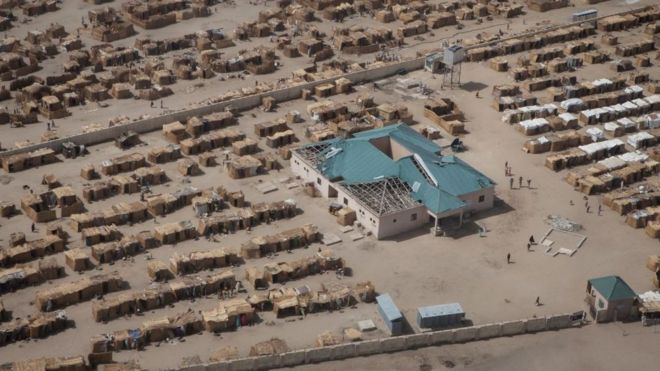
In desperation, they flee Nigeria to enter Niger, hoping to place distance between themselves and the terror that Boko Harm has brought to their country. Over 130,000 desperate refugees have found an improbable home away from home, beside a highway cut straight through the Niger desert. It is a highway that was left unfinished. But to the desperate, the desolate sandy area is their new home, where they imagine themselves to be safe, finally, from the depredations of Boko Haram.
There are not any actual travellers on the highway, since it has a sudden end at nowhere, with the desert all around. A Chinese oil company planning to create a short cut from Niger to its oil fields close to the border with Chad, still has 130 kilometers to go to complete its journey. But construction stopped two years ago after ongoing attacks by Boko Haram. The Chinese are no longer to be seen; in their place are tens of thousands of Nigerians living in huts comprised of grain stalks, fabric scraps, torn flour bags and tarps.
"Sometimes I think they'll come again, even here. I have nightmares -- they're coming to kill me, they're coming to kill me", said 13-year-old Atcha Mallam for whom the roadside has been home for the past year and a half. Boko Haram may have suffered lost battles diminishing their presence, persuading hundreds of thousands of Nigerians to return home to their villages, but there is nothing left of the villages to return to. At least four million people have no access to aid, and an estimated
475,000 children across Lake Chad will suffer from severe acute
malnutrition this year [Lucas Destrijcker/ Al Jazeera]
Over 200,000 people left homeless by the violence have found what they identify as safety in the Diffa region of Niger alongside the border with Nigeria, where National Route 1 was built. A paved highway in the middle of a desert. There are regular patrols by the Niger military along the paved stretch of highway, but thus far Boko Haram is nowhere to be seen, and the refugees living there feel a sense of security.
UNICEF trucks water into the highway community while the International Rescue Committee gives out bags of rice, tins of sardine, and powdered milk, and Doctors Without Borders run medical clinics. The refugees have transformed small roadside villages into refugee towns overwhelming the ground wells in an area of scarce water and where crops cannot endure brutal heat. Some of the refugees arrived with herds and flocks of cattle, goats, donkeys and chickens, all needing food and water.
Former fisherfolk and farmers were forced to leave their livelihoods. Away from the desert, a fertile area exists close to Lake Chad, but this is where Boko Haram has established itself, despite several nations' militaries having made major advances in destroying their territorial gains. The small village of Garin Wanzam where Shettima Fougou is chief, had 20 people twenty years ago, and now tries to provide food and shelter to 13,000 people.
By Oxfam International's estimates 80 percent of the displaced in the area around Diffa adjacent the highway are being fed and sheltered by local communities, communities even in peace that are considered to represent the continent's most indigent. Aid groups offer a number of activity centers in an attempt to alleviate boredom, since labour in the desert is a thin affair with few growing fields. Markets sell wood, fabric, vegetables yet many people have no means of purchase.
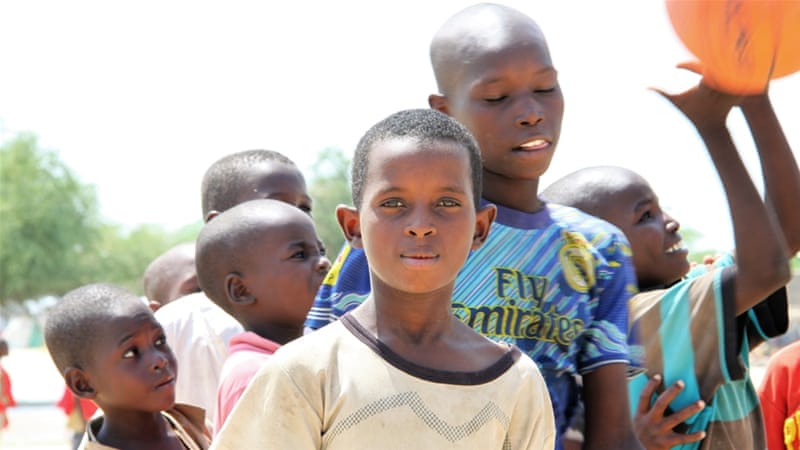
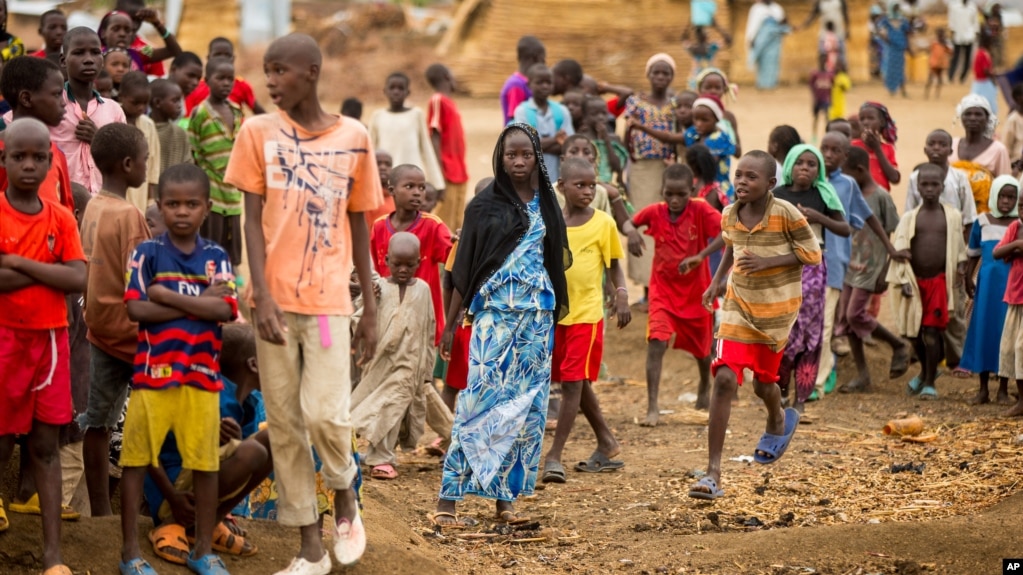
More than 150,000 children found safety in Diffa after they were
uprooted from their homes, but they lack education as schools are closed
[Lucas Destrijcker/ Al Jazeera]
More than 150,000 children found safety in Diffa after they were uprooted from their villages by Boko Haram. Less than half the 137,000 children in the region attend school since village schools scarcely operate as teachers haven't been paid for months by the government, leaving UNICEF to set up 27 small schools along the highway. Children are sent by their families to search among acacia trees for firewood, carrying what they find home on their heads. Soon all the trees will have been depleted.
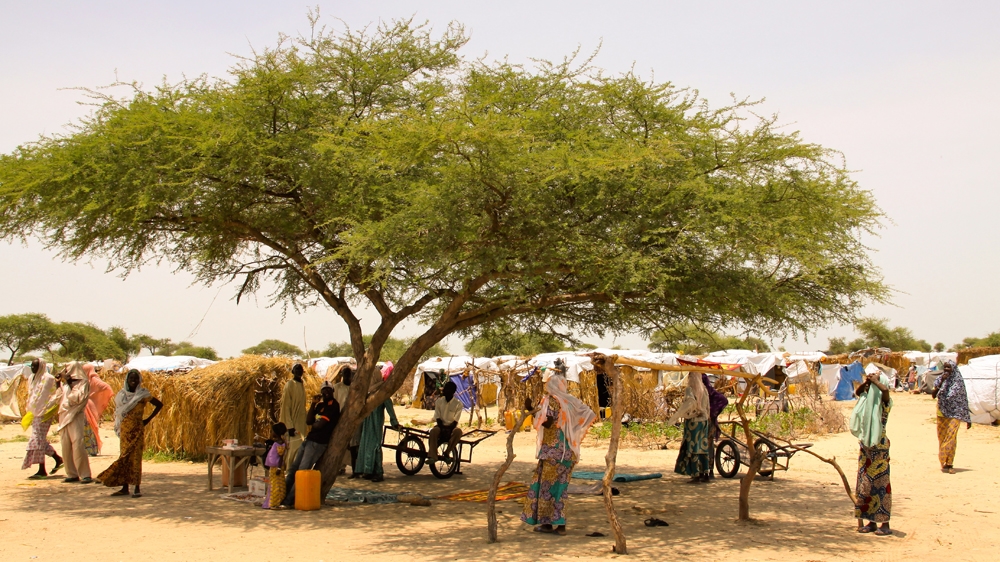
Displaced Nigerians seek some shade in Assaga
settlement. During the dry season, temperatures climb up to 48C [Lucas
Destrijcker/Al Jazeera]
This represents a general opinion site for its author. It also offers a space for the author to record her experiences and perceptions,both personal and public. This is rendered obvious by the content contained in the blog, but the space is here inviting me to write. And so I do.








![More than 150,000 children found safety in Diffa after they were uprooted from their homes, but they lack education as schools are closed [Lucas Destrijcker/ Al Jazeera]](http://www.aljazeera.com/mritems/imagecache/mbdmegaxxlarge/mritems/Images/2016/9/22/f79933d465d54e9fa9e3737f3e198503_9.jpg "Boko Haram refugees in Niger find safety, but lack aid")