Moral Indignation Over Reality Does Not Expunge It
"It
is appalling that the Canadian government could attempt for no good
reason to subject innocent Canadians, their family members and
descendants to public scorn."
"When
the announcement is made, we will have to be ready to go to the Federal
Court challenging the government's authority to ignore Justice [Jules]
Deschenes' [Commission of Inquiry on War Criminals, February 1985]
ruling on confidentiality. To do so, we need to prepare now."
"All
alleged war criminals, regardless of their ethnic, religious, racial or
cultural origin, or where or when they committed their crimes should be
bought to trial in Canada under Canadian criminal law."
"If
evidence of wartime criminality by any person found in Canada exists,
that information must be communicated to the proper authorities for
investigation."
Ihor Michalchyshyn, CEO, executive director, Ukrainian Canadian Congress
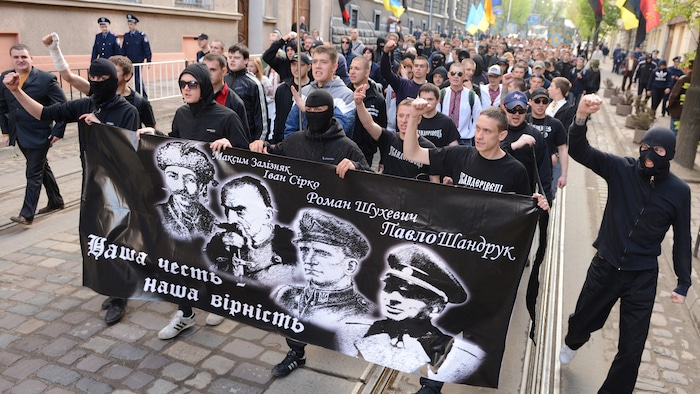
Ukrainian
ultra-nationalists, carrying a banner with a portrait of Ukrainian
Insurgent Army (UPA) Roman Shukhevych (second from the right), march in
the centre of the western city of Lviv on April 28, 2013. The march
commemorated the 70th anniversary of 14th Waffen SS Galicia Division
made up mostly of Ukrainian volunteers. Photo: (YURIY DYACHYSHYN/AFP/Getty Images)
When
then-prime minister Brian Mulroney was lobbied by Jewish groups to
conduct an investigation into the infamously well-known refuge that
Canada had become post World War II for Nazi war criminals, he appointed
Justice Jules Deschenes to head the Commission of Inquiry on War
Criminals, back in 1985. Previous administrations were disinterested in
examining the situation whereby known and unknown war criminals were
living ordinary lives in Canada, protected by their postwar-acquired
Canadian citizenship.
The
Commission created several documents, one titled Master List of Alleged
War Criminals Resident in Canada with a List of Sources. 774 appeared
on the list. Additional names of alleged war criminals, including Nazi
scientists and technicians who arrived in Canada not as fugitives but as
immigrants entitled to entry as landed immigrants simply because the
immigration department appeared to find it unnecessary post-war to
investigate backgrounds for war-incriminating evidence, brought the
total closer to 900 names.
The
documents were labelled secret and conveniently shelved, despite Jewish
groups which had lobbied to have the investigation take place, then
demanding that the result of the inquiry be made public. Justice
Deschenes, having done his duty, felt it appropriate and declared his
studied opinion that the Inquiry documents be withheld from public
scrutiny. Among the large groups of named individuals a smaller number
on the list are believed to be Ukrainian in origin, or people hailing
from other eastern European nations, complicit with Nazi crimes.
Requests
for the release of the documents have never been stilled under Canada's
access to information law. It is Library and Archives Canada which must
make the critical decision to release the documents. Or not. In June a
secret meeting/consultation whose participants were present by specific
invitation to attend; described as a "discrete group of individuals or organizations" were present to offer their opinion whether the list should be made public.
Given
the Jewish communities' urging over the years for the documents'
release, it might have been thought they would be among those receiving
invitations to attend. They were not. Given the reality that it was Jews
in horrendous numbers that were the designated fascist victims of Nazi
Germany's 'Final Solution', that Jewish groups, knowing of the presence
in Canada of their persecutors, had a fully vested interest in having
their presence revealed, thus finally forcing the government of the day
to finally act.
To
divest recognized war criminals of their Canadian citizenship, to
ensure, despite the passage of years, that their crimes, if proven in
law, merited final accounting for.
Neither
Holocaust survivors nor Holocaust scholars all of whom had advocated
for full release of the documents, including the list of alleged Nazi
war criminals, were included to attend the 'consultation' respecting the
potential of releasing clearly incriminating documents. In the lead-up
to Library and Archives releasing its final decision on the matter, the
Ukrainian Canadian Congress, which had been among the invitees, is
seeking funding to finance a legal challenge in Federal Court.
As
a declared representative of the Canadian Ukrainian community
comprising one and 1/3 million people, the organization is encouraging
its contacts within the Ukrainian community to donate to a fund that
would aspirationally be in the neighbourhood of $150,000 to launch their
legal challenge against the release of the documents with the intention
of sparing humiliation, ignominy, harassment and possible charges
against those of the Ukrainian community named in the documents.
Canadians
in general have hugely supported doughty Ukraine in its epic
existential battle against the modern equivalent of the Soviet Union,
against a tyrant who will stop at nothing to achieve his aims at
dominating a smaller neighbour that has no wish to be other than fully
independent of Russia, its ideology and grasping territorial ambitions.
Russia and its president, Vladimir Putin have been recognized in the
commission of war crimes in Ukraine. The conflict continues and so does
Russian disinformation. Yet Ukraine itself and its expatriates must also
recognize reality of the past.
Another
issue identified was the awkwardness of the Soviet involvement in the
Second World War; first as an Axis ally of fascist Germany, and later as
a member of the Allied forces following Moscow's invasion of Russia.
The Soviet Union, loathed by most countries in eastern Europe for its
stranglehold on their sovereignty, capturing them all in a forced wide
web of enforced 'socialism' within the United Soviet Socialist Republic.
During the War and Holocaust years voluntary recruits from some of
those nations augmented the Nazi SS, fighting alongside them,
participating in deathly carnage.
Russia,
before and after its invasion of Ukraine, had infiltrated Canadian news
through social media to sow divisions between various groups in Canada,
particularly through statements both unofficial and official alluding
to Ukraine as 'fascist', and a 'neo-Nazi' state. Since Ukraine had
ousted its former Russian-oriented President who represented the
interests of Russian-Ukrainians in Eastern Ukraine and Moscow, to
release itself from Russia's imposed bondage, a campaign of Russian
propaganda has painted Ukraine as fascist.
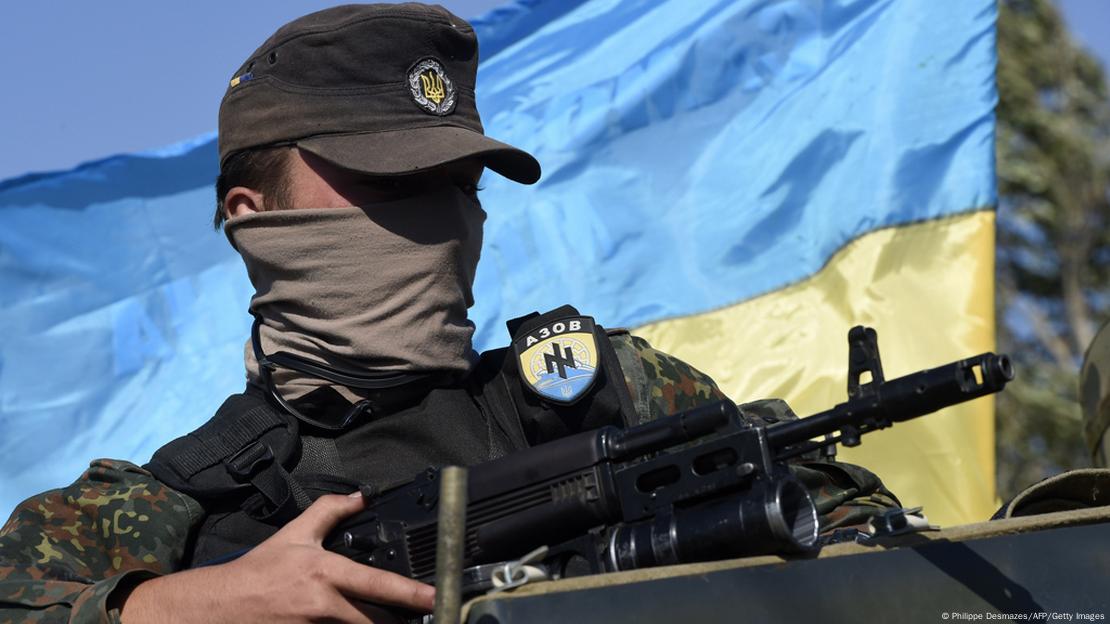
Russia's top prosecutor has asked the Supreme Court to designate the Azov Regiment, seen here in 2014, as a terrorist group
Ukraine
most certainly had its fascism-inclined demographic that saw more in
common with Nazi Germany than its Soviet occupier. And no one could
argue that Ukraine was free from the ancient virus of antisemitism. And
the fact that the infamous Azov Battalion was comprised largely of
fascists infected with the virus of acute antisemitism. Attention was
riveted on the issue of Canadian war criminals when in 2023, Canadian
Members of Parliament offered two standing ovations to a 99-year-old war
veteran, a Ukrainian-Canadian living in North Bay.
Until
it was revealed that Yaroslav Hunka, hailed as a wartime hero in the
Canadian Parliament, had done voluntary service in a Ukrainian Waffen SS
unit, fighting for and with the Nazis. Canada was the involuntary,
disinterested, oblivious recipient of large numbers of soldiers from a
Ukrainian Waffen SS division following the war. Jewish groups and the
Polish government made it clear that Hunka's unit was involved in war
crimes; massacres of women and children.
In
the final analysis, the Commission reached the decision that claims of
large numbers of war criminals entered Canada were exaggerated, yet as a
result of inadequate government screening post-war, it also stated
that: "it would be rash to assume that significant numbers of war criminals and Nazi collaborators did not enter Canada".
Investigations into the hundreds of individuals alleged to have been
war criminals did not fall under the purview of the Deschenes
Commission.
According
to Professor Jared McBride, an American who had been a fellow with the
U.S Holocaust Memorial Museum, his researchers made use of declassified
American government records alongside other materials, to compile a list
of 275 alleged war criminals held to be most likely to be included in
the Canadian records, although his research is expected to add more
names as their own investigation proceeds.
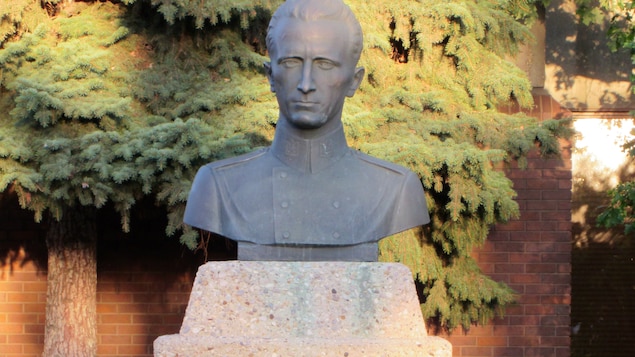
The
monument to Roman Shukhevych, commander of the Ukrainian Insurgent Army
from 1943 until his death in 1950, at the entrance of the
Ukrainian Youth Unity Complex in North Edmonton, Alberta, since
mid-1970s. Critics of the monument say it glorifies a Nazi henchman who sided with
Germany in hopes of winning independence for Ukraine. Photo: (Photo courtesy of John-Paul Himka)
"Whether Library and Archives Canada [LAC] likes it or not, these names are going to be released to the public."
"Instead
of moving toward a path of openness and transparency about its record
on allowing war criminals into the country and its failure to prosecute
them, the Canadian government held a secret meeting to discuss the
secret names from the secret report from 40 years ago that still has not
seen the light of day."
"Moreover, they invited to this meeting the same people who helped to keep the report under wraps four decades ago."
Professor Jared McBride, specialist, Ukrainian Nazi collaborators, UCLA, U.S. Holocaust Memorial fellow
"It
is with deep regret that we acknowledge that Mr. Peter Savaryn was
appointed to the Order of Canada in 1987, and we express our sincere
apology to Canadians for any distress or pain his appointment may have
caused."
"Mr.
Hunka's past involvement with the Waffen-SS and his recognition in the
House of Commons have been a source of great concern to the Governor
General."
"The Chancellery is committed to working with Canadians to ensure our honours system is reflective of Canadian values."
"Historical
appointments to the Order of Canada reflect a specific moment in time
and would have been based on limited information sources available at
that time."
Rideau Hall statement
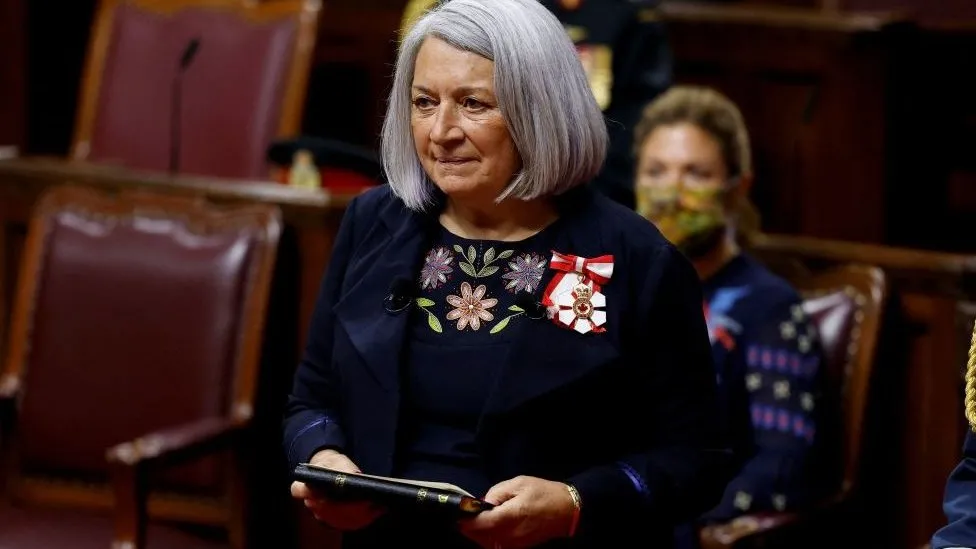
The office of Governor General Mary Simon says it "deeply regrets"
appointing Peter Savaryn to the Order of Canada in 1987. Mr Savaryn died
in 2017, aged 90 Getty Images
"If
subsequently, evidence comes to light of something as grievous as
collaborating with a Nazi regime, that there should be some mechanism
where it's made clear that this individual is rejected by the
institution [a new process should be instituted to formally remove
Savaryn's honour award]."
"It
would be undoing a historical misstep by the Canadian government in
covering that up [Canada's past history of a lax attitude toward
permitting postwar Nazis and war criminals to enter Canada and achieve
citizenship], because it would enable the Canadian public to recognize
how deep this problem goes."
"This would provide much needed sunlight into a very dark period that a lot of people don't know about."
Dan Panneton, director of community engagement, Friends of Simon Wiesenthal Center
It's
somewhat disingenuous at this point to declare that not enough was
known about the background of a person who was permitted to immigrate to
Canada despite being identified as a member of a Nazi SS unit, to
explain away how it could be possible for such a man to flourish in
Canada, build a new persona and future for himself and be recognized as a
credit to the community, and by extension to human endeavours when such
a man's past held the reality of voluntarily serving the Nazi regime,
swearing an oath of allegiance to its Fuhrer, and pursuing the goal of
genocide.
When
former Nazis entered Canada as new immigrants they faced no scrutiny or
roadblock to entry, in the decades following World War II. Jewish
refugees who survived the Holocaust and arrived to Canada, were shocked
to realize that their tormentors and murderers had gained entry to a
country they themselves sought refuge in. Jewish social-cultural groups
petitioned various governments over the years to hold these people
accountable for their war crimes; at the very least to extradite them to
Germany or the country of their origin.
Time
after time these requests were ignored, until one prime minister
consented to look into the matter, striking an enquiry and appointing an
esteemed judge to oversee the resulting investigation. The two reports
that came out of that enquiry have never been released to the public in
their entirety. The Deschenes enquiry reached the conclusion that
individuals should not be held responsible for what the battalions they
were attached to engaged in, despite that the Nuremberg authorities
deemed such SS divisions as being involved in war crimes.
The
1986 Commission of Inquiry on War Criminals in Canada, known as the
Deschenes Commission, interviewed 774 individuals suspected of being war
criminals. The interviews and the names of those involved were never
released, but were held for the succeeding years as secret, classified
documents. One part of the report was eventually released, but was
heavily redacted. Jewish groups are now demanding that both Commission
reports be released in their entirety.
Several
weeks ago, a Canadian parliamentarian invited an elderly
Canadian-Ukrainian citizen to the House of Commons on the occasion of
the Ukrainian President Volodymyr Zelenskyy's visit to Canada where he
was scheduled to address Parliament. The 98-year-old guest was revealed
days after he was feted in the House as a Ukrainian military 'hero' who
had fought with Germany against the Soviet Union in a voluntary ethnic
brigade attached to the Nazi SS -- whose focus was the elimination of
Jews during the Holocaust years -- as a former voluntary enlistee in an
ethnic SS division.
That
embarrassment was compounded mere days later by Canada's Governor
General Mary Simon apologizing to Canadians yet again on the discovery
that a recipient of the prestigious Order of Canada went to yet another
Canadian-Ukrainian who had fought in the very same SS-Galicia Battalion
and had, like Yaroslav Hunka, sworn an oath of allegiance to Adolf
Hitler.
It
somehow escaped the notice of these Members of Parliament that there is
no correlation between Russia's current invasion of Ukraine, and the
Ukrainians that saw fit to align themselves with Nazi Germany against
the Soviet Union, fighting at that time with the Allies against the
Fascist Axis coalition.
Over a week
after Yaroslav Hunka was cheered in the House of Commons, Jewish groups
are calling for Ottawa to release a decades-old report from the
Deschênes Commission containing details about alleged Nazi war criminals
living in Canada. CBC
Once
again, it was not that Rideau Hall -- and the office of the Governor
General, similar to the lack of oversight by Canadian parliamentarians
or the prime minister's office, or the House of Commons' security, to
look into the background of someone invited to the House -- themselves
undertook a simple background check of those they were championing. It
was a Jewish news source, the venerable old Forward that brought the Nazi backgrounds of these two men to the tardy attention of Canadian authorities.
The
International Community, which has a far better memory in Europe of the
horrors of wars fought on their soil, has viewed these compelling
errors of judgement and lack of memory on the part of the government of
Canada with incredulous bemusement. Inexcusable lapses which saw an
event as lunatic as introducing a former Nazi whose battalion was
involved in the roundup and murder of Jews, to a Jewish president of a
nation once again embattled by a territorial-hungry neighbour.
Prime Minister Justin Trudeau arrives for a caucus meeting on Parliament Hill in Ottawa on Wednesday. (Sean Kilpatrick/The Canadian Press)
This represents a general opinion site for its author. It also offers a space for the author to record her experiences and perceptions,both personal and public. This is rendered obvious by the content contained in the blog, but the space is here inviting me to write. And so I do.