"During
the past two years, the pandemic made international travels not easy
and quite a few Chinese nationals found their Chinese ID cards and/or
driver's licences expired or about to expire, and yet they could not get
the ID renewed back in China in time..."
Embassy of China in Ireland
Police
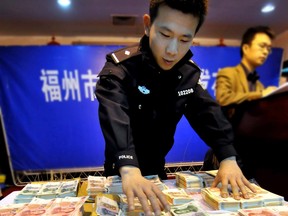
in the Chinese city of Fuzhou show off seized counterfeit money in this
2009 photo. Fuzhou security services have now set up at least three
branch offices on Canadian soil. Photo by STR/AFP/Getty Images
"I thought I'd have a safe, happy life in Canada. But the Chinese Communist Party was already here",
said Sheng Xue, a Chinese Canadian living in Mississauga, Ontario since
her escape from China in 1989, following the Ti8enanmen Square
Massacre. The People's Republic of China has groping tentacles all over
the world, keeping track of expatriate Chinese who sought to find a new
home and with it security and a base where they could begin life anew.
Beijing, however, looks to keep tabs on all Chinese, irrespective of
whether they now live elsewhere than China, and they are particularly
interested in Chinese who oppose their government back home.
Beijing
has also made it quite clear to Chinese living abroad that their first
obligation is to China, not any other country which they have chosen to
live in as loyal citizens. Chinese living abroad with citizenship in
other countries are expected to be compliant with any demands that the
People's Republic makes of them, from defending China from criticism
in their new countries of citizenship, to conveying useful information
to China through its United Front Work Department, which has offices set
up across the world.
Chinese
living abroad are also expected to be cooperative with Chinese
embassies and consulates abroad, representing China's interests. Most
Chinese who emigrate abroad from Mainland China find it expedient to
cooperate in support of the Chinese Communist Party mostly because of
China's coercive policies of harassing family members back in China if
their members living abroad fail to cooperate. Those originally hailing
from Hong Kong tend to be opponents of the CCP, and the long, probing,
intrusive arm of the CCP makes certain they are acutely aware that Hong
Kong is now under direct control of Beijing.
China-dissidents
of the Beijing government based in Canada have warned Canadian
authorities for years of the organized harassment from Chinese
authorities that they face, despite their Canadian citizenship. Now,
investigative reporting has revealed that the People's Republic has
installed what can only be identified as Chinese police stations in
countries abroad, focused on controlling Chinese living as citizens in
countries other than China. In Toronto, Canada, there are three 'service
stations' in operation by the Fuzhou Public Security Bureau, a police
force from the Chinese metropolis of Fuzhou.
The Fuzhou police say it has already opened 30 such stations in 21 countries.
The
Asian human rights group Safeguard Defenders has revealed the presence
of these furtively-operated police stations in a recently published
report. According to China, the stations' existence relates to the need
to give assistance to Chinese expatriates in the completion of
administrative documents like the renewal of driver's licenses. However,
according to Safeguard Defenders, the function of the stations is that
of outposts for "Involuntary Return" policies, a program that compels
Chinese nationals to return to China should the country's security
service consider they have violated Chinese law.
"These operations eschew official bilateral police and judicial cooperations", the report states. Chinese authorities claim that 230,000 expats were "persuaded to return"
as a result of various charges laid against them. Those charged respond
to the persuasion of the threat of extreme sanctions to be visited on
their families in China, including asset seizures and prohibitions
against government health care or education opportunities.
Canada is among several dozen countries that have become outposts of Chinese law enforcement. A report in The Irish Times
highlighted the opening of a Fuzhou Overseas Police Service Station in
central Dublin. In Dublin the Chinese Embassy declared the station to
function as a place for Fuzhou expats to seek assistance in routine
paperwork.
An investigation in Canada by the Globe and Mail newspaper
found that the Association was founded with direct Chinese government
oversight. Leading to the question: why is Canada permitting China to
establish its own police stations in Canada? More to the point, why is
the government of Canada allowing Canadian citizens of Chinese
extraction to be harassed, bullied and terrorized by the People's
Republic of China?!!!
"We support the rule of law and stability in Hong Kong, oppose the violent acts of a small number of extremists, oppose any Hong Kong independence movement ... and support the Hong Kong government maintaining law and order." "Hong Kong is China's inalienable sovereign territory; Hong Kong's affairs are China's internal affairs; and we oppose any foreign interference." Letter signed by over 200 Chinese-Canadian groups, published in Ming Pao newspaper
"These are basically fake organizations ... They are what I call the mouthpieces of the Chinese consulate." "This is a very clearly United Front effort by the Chinese government ... If it's not instituted directly, then indirectly." Cheuk Kwan, Toronto Association for Democracy in China
Several hundred protesters demonstrated at the
Consulate General of of the People’s Republic of China in Vancouver, BC
Saturday, June 15, 2019. The protest was a reaction to controversial
legislation in Hong Kong that allows extraditions to Mainland China. The
proposed extradition bill has led to mass demonstrations in Hong Kong.Jason Payne /
PNG
For months mass demonstrations have taken place in Hong Kong with hundreds of thousands of Hong Kong Chinese residents rallying in protests against a proposed new extradition law making it mandatory that anyone in the semi-autonomous Hong Kong wanted in China for any presumed 'crime' would be handed over to Beijing, bypassing Hong Kong's own system of justice. Although the proposed law has now been put to a final rest, the island state's population remains restive.
The extradition law itself was seen, along with previous moves that also elicited mass protests, as China's closer grip on Hong Kong, despite an agreement when Britain released its former colony back to China, that it would retain all its independent features for a 50-year period and not be forced to integrate completely with China, under direct government rule from Beijing.
Official Canada and its intelligence agencies are well aware that Beijing emissaries have infiltrated the country for the purpose of re-instilling in former Chinese nationals and Canadian citizens of Chinese heritage, an obligation to fully support the Chinese regime. Working to influence the diaspora to report to Chinese consulates whatever they glean about Canada that might be useful to China, including reporting on other Chinese.
Protesters gather before a march to the
West Kowloon railway station, where high-speed trains depart for the
Chinese mainland, during a demonstration against a proposed extradition
bill in Hong Kong on July 7, 2019. Vivek PRAKASH / AFP
The United Front Work Department, an offshoot of the Chinese Communist Party, is heavily involved in monitoring Chinese Canadians, and in fostering trust between Canadian Chinese and Chinese diplomatic missions in Canada. That open letter published in Vancouver and Toronto Chinese-language newspapers appears to be the work of the United Front. The advertisement refers to radicals who cause violence in Hong Kong, defending the "inalienable" right of China to control Hong Kong.
While effort is made to appeal to the ethnic identity of Chinese-Canadians, persuading them to write local letters to the editor in support of China's authority over Hong Kong, and decrying the violence on the streets of the city by a veritable handful of discontents, what is playing out on those streets of Hong Kong is giant masses of residents assembling to declare their rejection of Chinese authority. As many as an estimated million people turning out for a few of the protests.
The protesters fear such legislation could be the thin edge of the wedge, helping Beijing to rid itself of its enemies with the use of a legal system controlled by the Communist Party. Incidental to the main purpose of the massed protests are complaints by Hong Kongers of the difficulty in finding an affordable place to live in the city, priced out of the league of ordinary working people, giving a double thrust to the impetus of their anger.
Although Hong Kong's chief executive Carrie Lam -- who carries out instructions from Beijing -- attempted to quiet the storm of discontent announcing the extradition law scrubbed as a "total failure", most people don't believe that will be the end of it. As a result there seems to be no end in sight of ongoing mass protests. And yet here in Canada where Chinese-Canadians make up a large demographic there is harsh criticism from groups purporting to support Beijing's control of Hong Kong.
Like any other group of people who migrated from their original homes there will always be a sense of loyalty to their roots, and most particularly when there is an ethnic, cultural, historical component involved. There will be some who support their former government and at least an equal number who will not. Chinese have been citizens of Canada for a hundred years. Canada is a democracy and everyone living in Canada has the assurance of equality and a blindfolded system of justice.
According to a spokeswoman for Vancouver's Friends of Hong Kong, the "linguistic craftiness" of the letter appears typical of the United Front. Statements, pointed out Fenella Sung, that Chinese Canadians are "all sons of China and members of the Chinese people", and "blood is thicker than water", resonate with United Front messages. She pointed out that "not a word about being Canadians, as if they have nothing to do with Canada. The text of the ad could be used anywhere in the world".
Protesters march on a street during a rally against China’s extradition law proposal on Sunday, June 9, 2019 in Hong Kong.Anthony Kwan /
Getty Images
This represents a general opinion site for its author. It also offers a space for the author to record her experiences and perceptions,both personal and public. This is rendered obvious by the content contained in the blog, but the space is here inviting me to write. And so I do.