"China's Communist parliament has taken the biggest step so far to obliterate Hong Kong's freedoms and aspirations for greater democracy under the rule of law."
"The Chinese Communist Party [CCP] has ordained that in order to be a Chinese patriot you must swear allegiance to the Communist Party."
"This completely destroys the pledge of 'one country, two systems'."
"[The CCP is] a continuing and brutal danger to all who believe in free and open societies."
Christoper Patten, former colonial governor of Hong Kong
A Chinese propaganda poster showing an enthusiastic celebration after the return of Hong Kong to China in 1997. Fine Art Images/Heritage Images/Getty Images
This is China undoing the legacy of Britain's imperial colonialist past. In countries like India and the vast number of countries forming the British Commonwealth of countries that Great Britain colonized reaping benefit of their natural resources and gifting them with a democratic ideal, it is Hong Kong alone that prospered while under British rule even as the rest of China was mired deep in poverty, that now sees its democracy in end-stage jeopardy. Beijing has deemed it due time to return the former British colony to full Chinese rule. And since China is ruled by the Communist Party of China, Hong Kong too must fall under its complete legislative aegis.
It is, after all, what most countries would do; asserting their full sovereignty over all their territory. The fly in the ointment here is that Hong Kong has long been a territory apart, independent from Beijing's full authority, a giant of industry and trade and proud of its accomplishments, guided toward them by British oversight. The 1997 agreement to return Hong Kong to China held within it a promise to respect Hong Kong's democratic autonomy for a fifty-year period. China had no wish to crush its golden egg.
Protest as they may, the people of Hong Kong, clinging to their vision of the past, and their devotion to Democracy, are now firmly in Beijing's orbit, clasping it tightly and never more will it be allowed the illusion of being differently-oriented and separate in its ideology to the rest of China. And as long as protests continue the firmer will Xi Jinping's resolve be to squelch that dream denied. Another exodus has been complicated by the global presence of the viral pandemic, courtesy of China.
The control of the pandemic in China has given Beijing ample cover for its crackdown on Hong Kong; the world's attention diverted by the presence of a virus hungry for human casualties, and it has found them everywhere across the globe. And there is China, the world's largest producer of medical protective gear and personal protection equipment the world is now so heavily dependent on, as well as several highly effective vaccines the world is clamouring for. Criticize Beijing's largess?
All of which has sounded the death knell for the Sino-British Joint Declaration on Hong Kong, leading from the overhaul of Hong Kong's electoral system. Removing 'choice' of candidates; outlawing any deemed insufficiently loyal to the concept of China's full and complete ownership of Hong Kong, that priceless engine of mercantile commerce. Pro-democracy candidates henceforth reduced to nonentities may no longer aspire to election in Hong Kong. Imprisonment or exile their choice.
The Chinese Communist Party is determined to ensure that 'harmony' exists throughout China. And with the world's largest population base, how better to establish harmony than to erase choices and impose the monoculture of Chinese Communism under its iconic president? The purpose is honourable; "to safeguard national security". What nation doesn't have that top of agenda? Any who threaten China's security are, ipso facto, 'terrorists'.
"We will resolutely guard against and deter external forces' interference in the affairs of Hong Kong", stated the country's premier, Li Keqiang, speaking to the National People's Congress in Beijing as China prepares to put in place a decision to improve Hong Kong's electoral system whereby Beijing will ensure that "patriots:" only are elected to govern the territory. It is more than obvious that opposition politicians are "unpatriotic", therefore disqualified from politics, much less capable of holding public office.
"We
won't be compromising on the fact that we'll set what our foreign
investment laws are, or how we build our 5G telecommunications networks,
or how we run our systems ... that are protecting against any
interference."
"We
will always set our own laws and our own rules according to our
national interests -- not at the behest of any other nation, whether
that's the U.S. or China or anyone else."
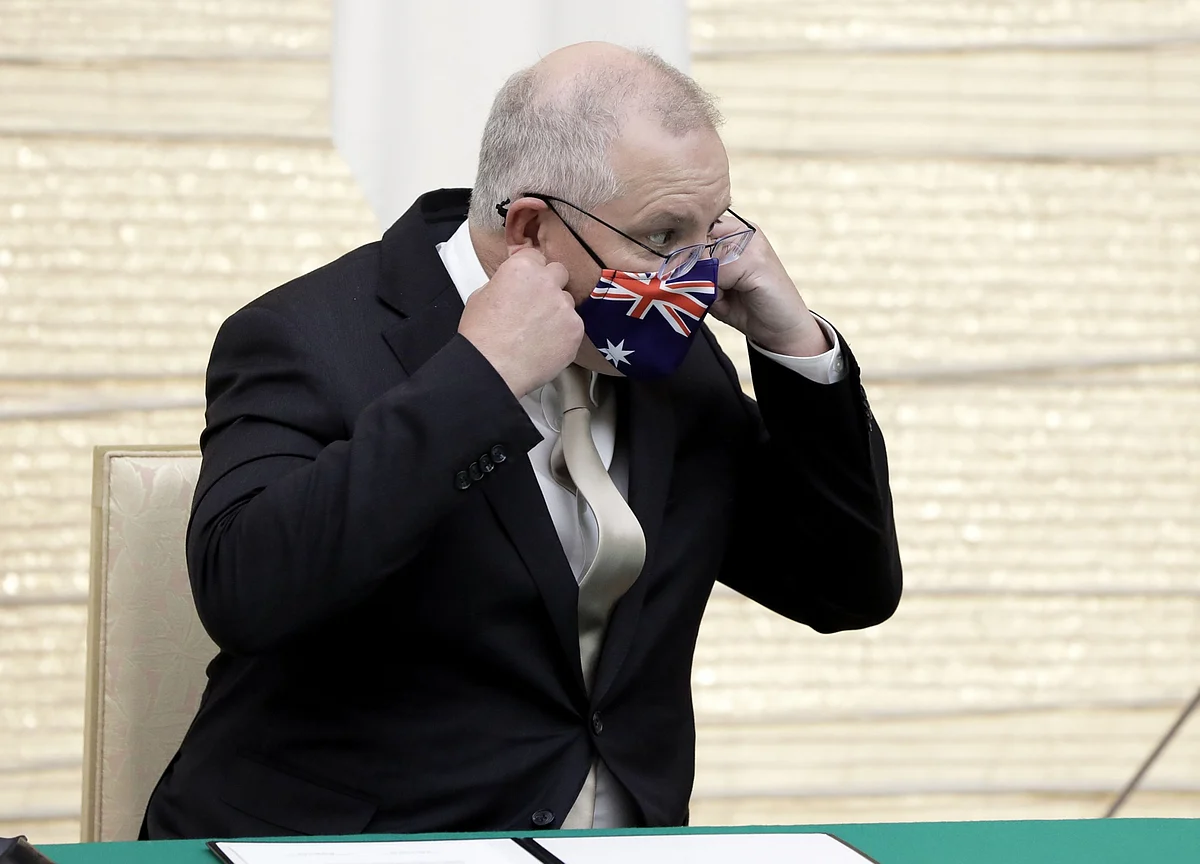
Australian Prime Minister Scott Morrison
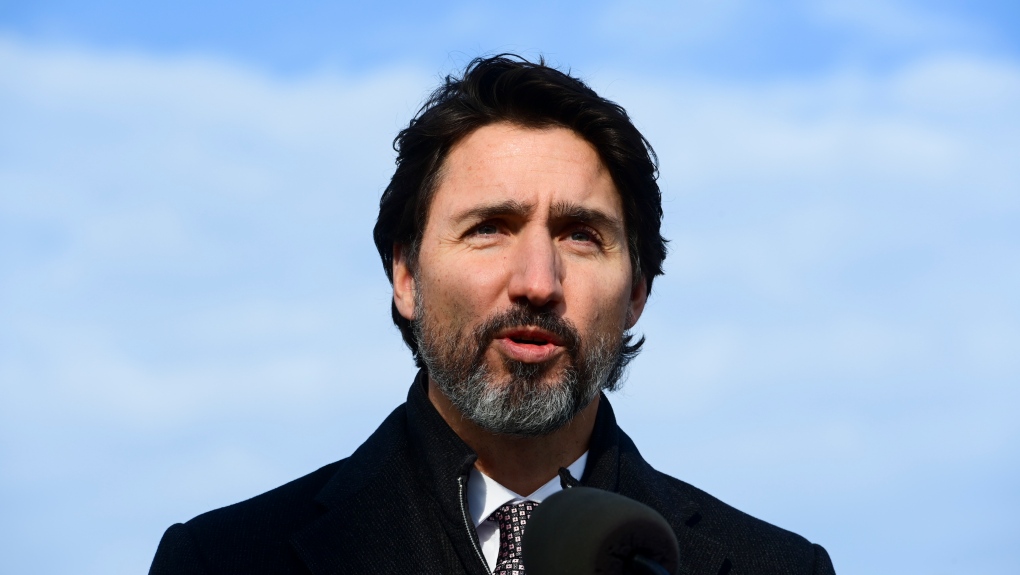
Prime Minister Justin Trudeau CP/Sean
Kilpatrick
"Do
I regret that Canada followed its laws? Do I regret that Canada lived
up to a long-standing extradition treaty with our closest ally?
Absolutely not."
"Canada
is a country of the rule of law. And obeying those laws can't just be
when it's convenient or when it's easy. If you're a country of the rule
of law, if you're a country of values, you need to stick up for those.
And that's exactly what we're doing."
"In
the face of pressure and increasingly coercive moves by one of the
world's great powers, I think that really highlights at which point we
need to be working together as allies, as neighbours, as friends, as
countries."
"Very
few countries could stand up on its own to a superpower, to a great
power. But working together in alignment, we can make sure there is a
recognition that the path that China is choosing to take right now is
probably not going to be as effective -- even for them -- as they think
it will."
Canadian Prime Minister Justin Trudeau
"[The
government must] make a decision on Huawei's involvement in Canada's 5G
network within 30 days [and] develop a robust plan, as Australia has
done, to combat China's growing foreign operations here in Canada and
its increasing intimidation of Canadians living in Canada [within 30
days]."
House of Commons Opposition Conservatives
"We are aware that China is, and will remain, an important commercial partner for Canada."
"China
is also a significant source of tourists and students to Canada, and
brings economic and enriching social benefits across our nation."
Foreign Minister Francois-Philippe Champagne
Sing4DemocracyHK protest outside the Court of Final Appeal in Hong Kong (Anthony Wallace/AFP/Getty Images)
Australia
and Canada have displeased China mightily. China awaits both countries
to come to their senses and that would entail sincerely apologizing to
Beijing for their intransigent wrong-headed views on China regarding
many issues, inclusive of Hong Kong, Uighurs, Huawei, Chinese
benevolence, Chinese cyber espionage, copyright infringement, and above
all, COVID-19. Beijing's release this week of a list of 14 grievances
with Australia put matters out in the open down under when a Chinese
official spoke on record to an Australian reporter: "China is angry. If you make China the enemy, China will be the enemy."
According
to Australian sources the list of grievances includes instigating an
investigation in the United Nations regarding the spread of COVID-19 at
the turn of 2020, cancelling Chinese student visas as a COVID-aversion
safety measure, blocking Chinese investments in Australia, leading
international focus on violation of human rights by China and the
banning of Huawei from contributing to the Australian 5G
telecommunications network upgrade. All hostile actions guaranteed to
poison relations between China and Australia; the latter the aggressor,
the former the victim.
Australia's
Prime Minister made it abundantly clear that Australia's sovereign
decisions are not up for discussion much less explanation or apology to
the world's number one natural resources-hoarder, trade colossus, and
cybertheft expert. Australia puts its words into action and lives with
the consequences, unwilling to be bullied and coerced into pleasing or
pleading with the Chinese Communist Party for concessions and
forgiveness.
G20 Leaders photo, Riyadh on Friday.Getty Images
Canada's
Prime Minister enjoys grabbing the limelight as a victim whose defence
of justice and the rule of law has occasioned Beijing's wrath and
imprisoned two innocent Canadians for the past two years, charged with
threatening China's security, in retaliation for the detention of Meng
Wanzhou, CFO of Huawei, on a U.S. extradition request. Canada has
appealed to other APEC nations to support Canada in a joint rejection of
Chinese bullying in the hopes that Xi Jinping would be confronted at
this weekend's G20 Saudi-hosted virtual gathering.
But
is Canada prepared to go it alone, to stand up for its sovereign
rights as its Prime Minister boasted? It remains the only Five Eyes
intelligence-sharing nation to leave open the question of whether Huawei
will be included in Canada's 5G telecommunications upgrade, fearful of
Beijing's explosive wrath, whereas Australia, New Zealand, the United
Kingdom and the United States have all clearly stated their positions to
shut out Huawei citing obvious security reasons.
Canada,
on the other hand, saw fit to award a standing offer for conveyor-style
X-ray machines to Nuctech, a Beijing based company partially owned by
the Chinese government, once operated by the sun of the former General
Secretary of the Chinese Communist Party. Canadian, American and British
companies all competed for the standing offer, but it was Nuctech who
won the tender including delivery, installation, operator training and
software training at Canadian embassies located world-wide.
It
was only when a national newspaper broke the news of the contract that
the federal government committed to a review once the contract was
exposed, and ultimately decided not to buy Xray machines for Canadian
embassies from the controversial Chinese firm. But it turns out that the
Canadian Border Services Agency had already bought and installed
Nuctech X-ray machines:
"We
have a number of mitigating interventions that we put in place around
this technology. One of the first ones is obviously to keep it
disconnected from our networks and from any Government of Canada
networks ... the second is (anyone) affiliated with any of our suppliers
would be screened through security processes and would be escorted on
site if they were present in our facilities", explained the vice-president of the CBSA;s intelligence and enforcement branch.
Why
go through all this rigamarole necessitated by the use of the machines
to begin with? To do otherwise, it would seem, would be to offend
Beijing. Who could easily retaliate as they have done with holding two
Canadians they've charged with espionage as hostages to force the
release of the Huawei executive. China also flexed its trade muscles
when it refused Canadian pork exports and canola products, both
commodities that enjoyed a heavy trade prior to the Huawei affair.
All
of this in light of Canada's Communications Security Establishment's
Canadian Centre for Cyber Security releasing a new report in which
Russia, North Korea, Iran and China are listed as cybersecurity threats
to Canada. An earlier report by the National Security and Intelligence Committee of Parliamentarians pointed out that China and Russia are using their diaspora, undercover agents and
groups based on Canadian campuses as part of "significant and sustained"
foreign interference campaigns in Canada, according to a redacted
intelligence report.
"The committee believes that these states target Canada for a
variety of reasons, but all seek to exploit the openness of our society
and penetrate our fundamental institutions to meet their objectives."
"They
target ethnocultural communities, seek to corrupt the political
process, manipulate the media, and attempt to curate debate on
post-secondary campuses."
"Each of these activities poses a significant
risk to the rights and freedoms of Canadians and to the country's
sovereignty: they are a clear threat to the security of Canada."
"[This] so-called genocide [is] a rumour and a farce
fabricated by some anti-Chinese forces to slander China."
"Its
groundless statement [committee report] is full of lies and
disinformation. {Parliamentarians would do well to] avoid doing any
further damage to China-Canada relations."
"This is blatant
interference in China's internal affairs and reflects those Canadian
individuals' ignorance and prejudice. China firmly deplores and rejects
that."
"[The installations are] vocational training and education
centres [where religious] extremists [are educated in the] national
common spoken and written language, legal knowledge, vocational skills
and de-radicalization."
"The aim is to eliminate the root cause of terrorism and extremism."
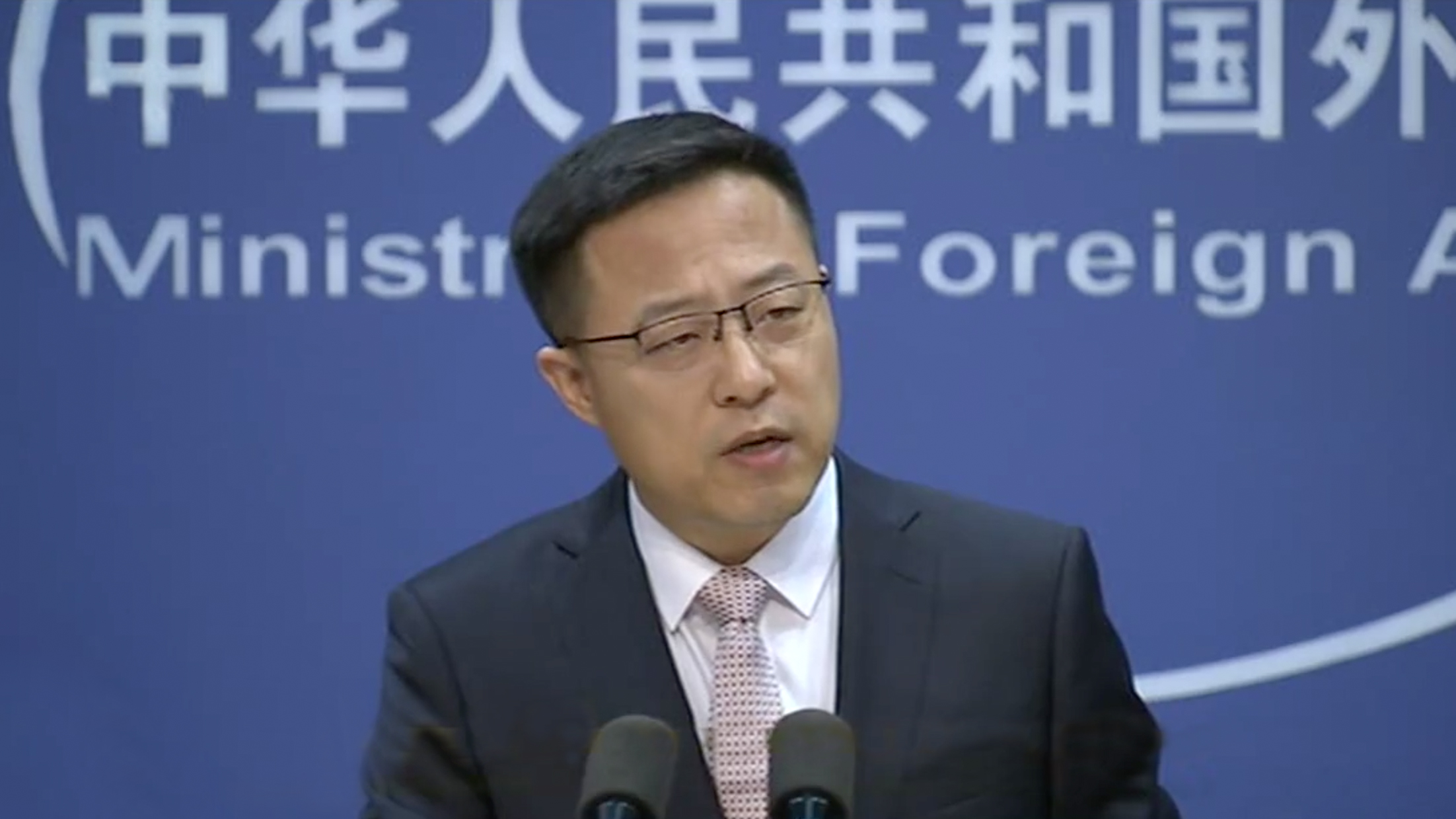
Zhao Lijian, spokesperson, Chinese foreign ministry
In this photo, a guard tower and
barbed wire fence surround a detention facility in the Kunshan
Industrial Park in Artux in western China's Xinjiang region. (Ng Han Guan/AP Photo)
"We strongly urge the Canadian side not to grant so-called political
asylum to those violent criminals in Hong Kong, because it is
interference in China’s domestic affairs, and certainly it will embolden
those violent criminals."
"If the Canadian side really cares about the stability and the
prosperity in Hong Kong, and really cares about the good health and
safety of those 300,000 Canadian passport holders in Hong Kong and the
large number of Canadian companies operating in Hong Kong … you should
support those efforts to fight violent crimes."
"I want to make clear that a stable and prosperous Hong Kong … is not
only in the interest of the vast majority of Hong Kong residents, but it
is also conducive to the majority of those … law-abiding foreigners and
enterprises in Hong Kong."
"[Beijing
would
have a] strong reaction [if Canada's Parliament were to pass any
resolution that
condemned China’s treatment of its Muslim Uyghur minority as] genocide
[referring to the over one million Uyghurs in detention camps in
Xinjiang
province, facilities for] vocational and
education training."
"We
will take resolute measures to safeguard our sovereignty and national
security. [The Uyghurs] live in harmony … and
[China’s] human-rights record is the best in history."
"There is no coercive diplomacy on the Chinese side. The Hong
Kong issue and the Xinjiang-related issue are not about the issue of
human rights. They are purely about internal affairs of China, which
brooks no interference from the outside."
China's
ambassador to Canada, Ambassador Cong Peiwu
China has the temerity to have its envoy to Canada lecture the
government of Canada on how it may and may not represent China, based on
fairly universal knowledge and agreement of China's human rights
situation in reference to its treatment of minority populations within
the country, its belligerent attitude toward 'splittism' and demand for
'harmony', refusing to honour its commitment to Hong Kong's democratic
authority as a semi-autonomous enclave, and its determination to ensure
that Shanghai be returned to Chinese authority, through military means
if necessary.
China's boastful
self-praise over its human rights and respect for the rule of law
evinces itself in other ways, as for example the arrest of two innocent
Canadians in China, held virtually incommunicado, with no access to
lawyers, and charged with espionage. This, in retaliation for Canada
holding the CFO of China's Huawei telecommunications giant on an
extradition warrant from the United States on a charge of illegally
supplying Iran with communications equipment in defiance of
UN/US-imposed sanctions. The implied threats in Ambassador Cong's
statement are evident and reflect the Politboro sentiments.
President Xi JinpingPhoto Fred Dufour/AFP/Getty
"You should focus your minds and energy on preparing to go to war, and stay highly vigilant", a report in the South China Morning Post, a
Hong Kong newspaper, quoted China's President Xi Jinping, as lecturing
to marine corps at a military base in Guangdong province, at a
commemoration of the 40th anniversary of the Shenzhen Special Economic
Zone. Priming his military apparatus for action, at a time when the mood
in China is decidedly nationalist, fed by this government which has
gone out of its way to alienate its neighbours through regional
aggression.
The
Peoples Republic has spent time, energy, and treasury in making friends
and influencing people in some parts of the world, happy to be noticed
by China, delighted at its investment in upgrading their infrastructure
(for its own trade benefit alongside delivering of other countries'
natural resources to feed China's rapacious appetite for energy and raw
materials), while leaving those dependent countries with debts
through infrastructure loans that will ensure they remain
vassals-in-debt for the long-range future.
Elsewhere
in the developed world, Xi and Beijing have soured international
relations, while claiming entitlements and ownership of disputed regions
it plans to swallow, to China's territorial advantage. China insists it
will have jurisdiction over the island democracy of Taiwan off its
southeastern coast, sending Chinese warplanes and navy vessels to harass
Taiwan in the Taiwan Strait. "The
fact that Taiwan is a separate country, democratically elected, they
should be seeing Taiwan as a neighbour, not as a point of conquest", pointed out Margaret McCuaig-Johnson, senior fellow, Institute of Science, Society and Policy, University of Ottawa.
China's
state television recently released a video of military drills with
amphibious landing craft, attack helicopters and missile systems. The
unsubtle warning is that China could attack should Taiwanese President
Tsai Ing-wen who has repeatedly attempted to placate China, continue
maintaining Taiwanese independence, not recognize Taiwan as part of
China. "I believe that regional tension can surely be resolved",
she responded. China is enraged that the U.S. is considering an arms
deal with Taipei with whom the U.S. is establishing a growing
relationship. China warns against any such deal.
According to Reuters seven "major weapons systems"
were undergoing an export process with a mind to equipping Taiwan with
advanced weaponry. Lijian Zhao, spokesman for the Chinese Ministry of
Foreign Affairs, warns that China will retaliate: "The
United States should immediately cancel the planned weapon sales to
Taiwan, stop any arms deals and cut off their military ties."
Gordon Houlden, director of the China Institute at University of
Alberta emphasizes that Xi is satisfying China's growing nationalist
sentiment.
"Taiwan
is a special case. No Chinese president, in my view, would survive a
week if he .. abandoned the goal of reunification. The biggest risk for
China is the intervention of the United States. The language is always
alarming and we should not ignore it, but I don't think there should be
panic about it ... it's not the first time and it shouldn't be
surprising. But also, it's a warning, perhaps to the international
community and to Taiwan that this [unification] is still a Chinese goal,
which they still take seriously and which they intend to complete."
Chinese warships, including an aircraft carrier, in formation during drills in the South China Sea, January 2, 2017.Photo by STR/AFP via Getty Images
"The
finding does not mean taking vaccines will be useless. Immunity induced
by vaccination can be different from those induced by natural
infection." "The patient got re-infected 4.5 months
after the first infection.
Therefore, it shows that for this patient, the immunity induced by the
first infection is short lasting." Dr.Kai-Wang To, University of Hong Kong
"Given
the number of global infections to date, seeing one case of reinfection
is not that surprising even if it is a very rare occurrence." Jeffrey Barrett, consultant, COVID-19 Genome Project, Wellcome Sanger Institute, Britain
"This
case illustrates that re-infection can occur even just after a few
months of recovery from the first infection. Our findings suggest that
SARS-CoV-2 may persist in humans, as is the case for other common-cold
associated human coronaviruses, even if patients have acquired immunity
via natural infection or via
vaccination."
"Patients with previous COVID-19 infection should also comply with
epidemiological control measures such as universal masking and social
distancing,"
Research paper
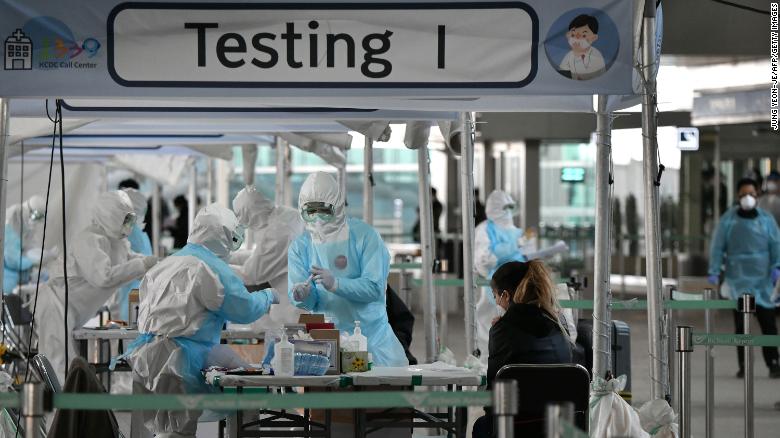
Medical staff wearing protective clothing take test samples for the
Covid-19 coronavirus from a foreign passenger at a virus testing booth
outside Incheon international airport, west of Seoul, on April 1, 2020
"What
I think is really important is
that we put this into context. There's
been more than 24 million cases reported to date. And we need to look
at something like this on a population level. And so it's very important
that we document this -- and that, in countries that can do this, if
sequencing can be done, that would be very, very helpful. But we need to
not jump to any conclusions."
"Even if this is the first documented case of reinfection, it is
possible of course because with our.experience with other human
coronaviruses, and the MERS coronavirus and the SARS-CoV-1 coronavirus,
we know that people have an antibody response for some time but it may
wane." Maria Van Kerkhove, World Health
Organization's technical lead for coronavirus response, head,
emerging diseases and zoonoses unit
"The report from Hong Kong of a
re-infection in a man by COVID-19 that was genetically different from
the first infection should not be too surprising. It is, however,
important that this is documented."
"Of
particular note was that the case was a young and otherwise healthy
person and that the second infection was diagnosed 4.5 months after the
initial episode." "Commentators
have been saying for some time that immunity is unlikely to be
permanent and may only last a few months. Given the different intensity
of the antibody response in people with mild or severe illness and the
subsequent decay in levels, it is likely that those with a mild illness
will have a shorter duration of immunity than those with severe
illness."Dr. Paul Hunter, professor in medicine, University of East Anglia's Norwich School of Medicine, Britain
"Second
infection was asymptomatic.
While immunity was not enough to block reinfection, it protected the
person from disease. Patient had no detectable
antibody at the time of reinfection but developed detectable antibody
after reinfection. This is encouraging. [Since reinfection can occur,
herd immunity by natural infection is unlikely to eliminate the novel
coronavirus.]" "The
only safe and effective way to achieve herd immunity is through
vaccination." "Lastly, while this is a good example of
how primary infection can prevent disease from subsequent infection,
more studies are needed to understand the range of outcomes from
reinfection."Akiko Iwasaki. Yale School of Medicine
There
have been reports from various countries; Israel, the Netherlands, of
reinfections with COVID-19. People who had once contracted the disease
then recovered months later being reinfected with an entirely new
infection, and a new strain of the disease; meaning that the antibodies
their immune system produced after their first infection were perhaps
partially or temporarily effective in warding off new infection, but not
long-lasting enough to prevent a future reinfection. This finding,
should it turn out to be a common occurrence, would blow the effect of
the herd immunity concept out of the water.
A 33-year-old man in
Hong Kong, recovered from a bout of COVID-19, some four and a half
months later was once again infected. His is the first documented case
of human reinfection, and researchers at the University of Hong Kong,
reporting on this case produced a study, published in the international
medical journal Clinical Infectious Diseases. The man had been judged entirely recovered from COVID on his discharge from hospital in April.
He
had later gone on a trip, returning on August 15 to Hong Kong from
Spain through Britain. He appeared to be healthy but was found to have
contracted a different strain of the coronavirus from that he had
previously been infected with. For the second infection he remained
asymptomatic, not knowing he was infected and theoretically passing the
virus on to others with whom he came into contact.
The virus
which causes the disease has led directly to the deaths of over 800,000
people globally. And according to the findings documented in the newly
published paper, COVID may continue to spread around the globe, in spite
of herd immunity. The hope that the more people within any given
population contracted the disease and community antibodies build, the
better the opportunity for the greater, uninfected population to be able
to avoid contracting SARS-CoV-2 causing COVID-19.
Dr. To, the
lead researcher in the study, cautioned that no such predictions can yet
be made with confidence, that results of the vaccine trials would
determine just how effective they will turn out to be in preventing the
further spread of the virus. Mainland China has reported instances of
people having been discharged from hospitals after recovering from
COVID-19 infection, later testing positive for the virus. There was no
clarity however, whether the virus had been contracted following full
recovery as with the patient in Hong Kong or whether these people had
virus remaining in their body from the initial infection.
A man walks past a mural in Hong Kong on Sunday. | AFP-JIJI
"China urges the Canadian side to immediately correct its mistakes and stop interfering in Hong Kong affairs and China's other internal affairs in any way so as to avoid further damage to China-Canada relations." "Their attempt to exert pressure on China under the pretext of Hong Kong-related issues is completely against the trend of time and doomed to fail like kicking against the pricks [struggling in vain against something]." Zhao Lijian, spokesman, China Foreign Ministry
This is, of course, the very same China that has invested heavily in building the infrastructure of roads and bridges in other countries of the world, to gain influence and extract concessions with its "One Belt, One Road" trade and diplomacy initiative to gather to China a greater share of the world's raw materials and trade assets, indebting countries that will eventually have to pay off those loans and whose finances will be strained to the limit. The same country whose claims in the East and South China Seas exacerbate relations with its neighbours over contested territory.
This is China, with its investment in other countries' cultural, arts and academic institutions funding their Confucius Institute in colleges and universities internationally to gain traction on spreading Chinese propaganda as a respectable nation admired for its undoubted heritage and linked to the current Communist Party with its penchant for cyber-espionage, gaining state and commercial secrets to advance its own technological reach without expending time, energy and funding to gain its own original knowledge but building on others'.
This is the China that extends its reach abroad, installing spies and handlers for the Chinese Communist Party, to violate freedoms guaranteed the citizens of other countries when it harasses its expatriates with citizenship in Canada, voluntarily foregoing loyalty to the country of their birth where freedoms are denied. This is the China that claims Tibet as its territory, Taiwan as illegal, and Hong Kong as an indivisible part of China in every respect, with no place for democracy to flourish.
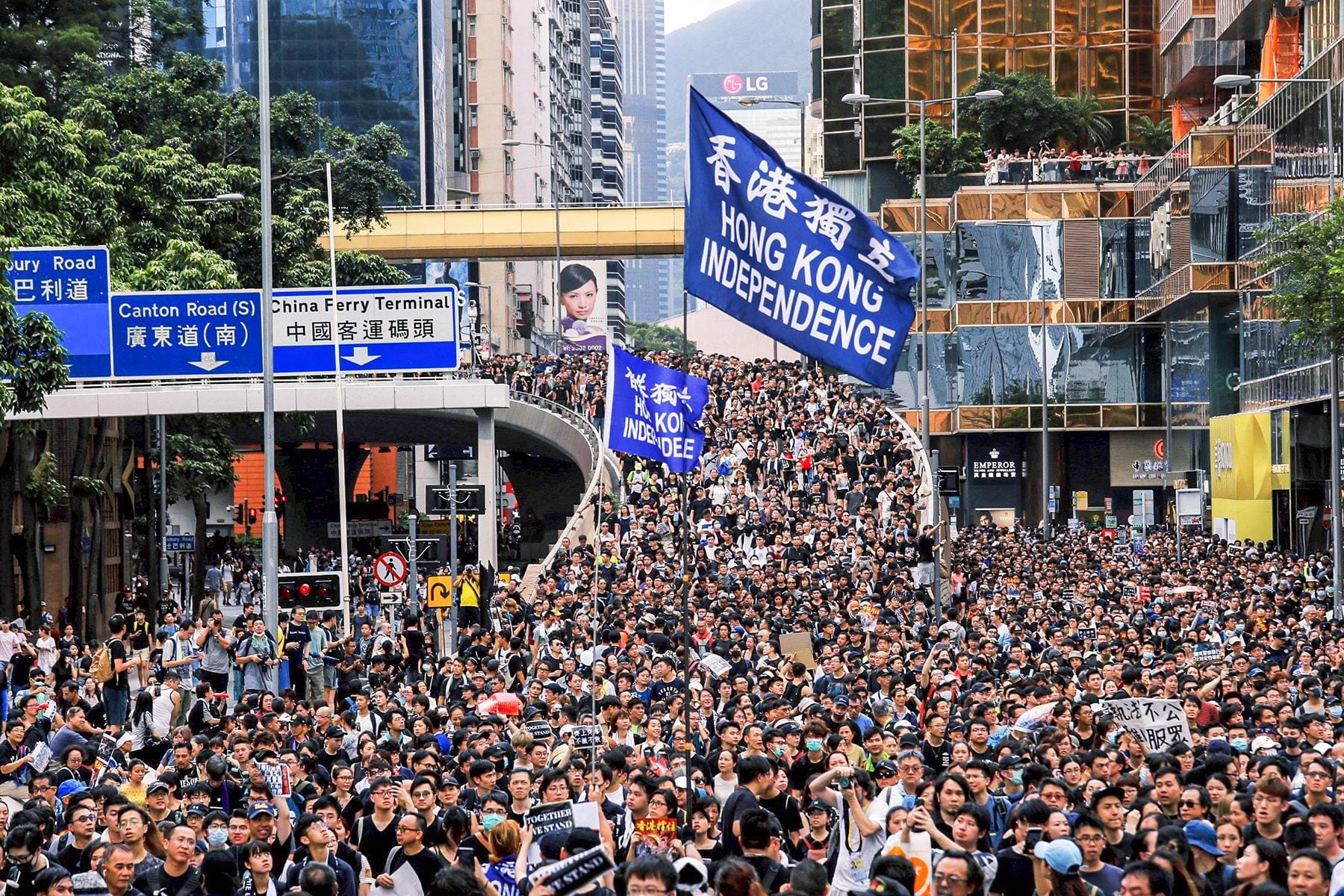
Police detain a protester after he was hit with pepper spray
during a protest in Hong Kong's Causeway Bay before the annual march on
July 1 marking the anniversary of the handover of the city from Britain
to China. (Vincent Yu/The Associated Press)
A half-million Hong Kongers have Canadian citizenship or landed immigrant status, and Canada is interested in their welfare as it would be for any of its citizens anywhere, extending an invitation to welcome back those who have returned to Hong Kong only to live through Beijing deciding to relegate its agreement with Great Britain that recognition of Hong Kong's special semi-independent status would be guaranteed for 50 years, deciding that 23 years is enough, and enacting draconian laws on 'treason' that would entrap democracy supporters in Hong Kong.
Hong Kong police arrested more than 300 people on Wednesday,
including 10 under China's new national security law, as thousands
defied a ban on protests on the anniversary of the city's handover to
China. (Anthony Wallace/AFP/Getty Images)
Just coincidentally, a professor at Tsinghua University who in 2018 denounced the removal of the two-term limit for China's President Xi, allowing him to remain in office well beyond his present second term (just as autocratic regimes like Russia and Turkey have manipulated for their presidents-for-life) has seen Xu Zhangrun, 57, arrested, taken from his home by 20 police who searched his house and confiscated his computer. "He felt that the country was going backwards and that as a public intellectual, he has the duty to speak up", explained He Weifang, a Peking University law professor, of his colleague Xu.
The Liberal government of Justin Trudeau finally found its resolve to join other nations to denounce the new security law imposed on Hong Kong, violating the principle of "one country, two systems", and suspending Canada's extradition agreement with Hong Kong. China, in response, warned its citizens to exercise caution in travelling to Canada, where "frequent violent actions" take place through Canadian law enforcement.
Amid a diplomatic crisis triggered by China's clampdown on Hong Kong, Chinese officials harshly condemned retaliatory moves taken by the UK and Canada
"Hong Kong has flourished as a bastion of freedom." "[The
security law would ] curtail the Hong Kong people's liberties, and in
doing so, dramatically erode Hong Kong's autonomy and the system that
made it so prosperous." Joint statement, United Kingdom, United States, Australia, Canada "This
is the death knell for Hong Kong, make no mistake of it, this is the
end of 'one country, two systems' ...the Hong Kong that we loved, a free
Hong Kong'. Dennis Kwok, pro-democracy lawmaker
Watching a TV news show about the new national security legislation in Hong Kong on Thursday.Credit...Lam Yik Fei for The New York Times
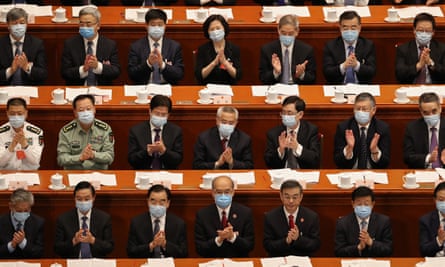
The National People's Congress, voting in the Great Hall of the People,
just west of Beijing's Tiananmen Square, loudly approved and applauded
the vote that took place on Thursday, a tally that indicated 2,878 votes
supported moving forward with legislation, with one vote opposed and
six abstentions. While the world has been distracted and busy attempting
to ward off the worst advances of the SARS-CoV-2 virus, Beijing has
immersed itself in finalizing the death knell of autonomous Hong Kong,
cancelling the formula that recognized its unique status since 1997.
The imposition of a new security law on Hong Kong will now criminalize
any such activities like protesting and criticizing Beijing. Either of
which is analogous in Beijing's opinion to secession and the detested
'splittism'. As the Communist Party elite explain it to any who might
not understand, the purpose of the legislation is to cope with
secession, subversion, terrorism and foreign interference in Hong Kong.
The plan had sufficed to instill fear into Hong-Kong's pro-democracy
factions, triggering large protests.
And those protests brought out the riot police in huge numbers even
while its own lawmakers engaged in debating an entirely other piece of
legislation with a like purpose, to criminalize disrespect of China's
national anthem. Police made 360 arrests while thousands of Hong Kongers
marched in protest in the streets over the anthem bill and the national
security legislation. It is abundantly clear that Beijing is imposing
its authority, eroding the autonomy of Hong Kong in the process.
China’s National
People’s Congress Photograph: Andrea Verdelli/Getty Images
An assurance was issued by China's Premier Li Keqiang, that the "one country, two systems"
formula is meant to remain a national policy, but the new law would
provide for Hong Kong's long-term stability and prosperity. Enactment of
the law is anticipated prior to September, as details are being drawn
up in the coming weeks. But no threat exists to the city's autonomy,
Chinese authorities claim, backed by the Hong Kong, Beijing-approved
government.
According to Hong Kong's leader Carrie Lam, the legislative work would
be completed as soon as possible as she works with Beijing: "The law will not affect the rights and freedoms enjoyed by Hong Kong residents". Somehow, the pro-democracy element finds her statement as reassuring as that emanating out of Beijing.
"We urge China to step back from the brink", stated British Foreign Secretary Dominic Raab.
Britain plans to change the status of British national overseas passport
holders, should China not suspend the new law, enabling such BNO
passport holders to come to the United Kingdom for periods in excess of
six months, an effective pathway to eventual citizenship.
Anti-government demonstrators in Hong Kong scuffle with riot police
Wednesday during a protest as the second reading of a controversial
national anthem law takes place. (Tyrone Siu/Reuters)
"It seems like the lockdowns don't add a whole lot after you've done other social distancing measures." "[On the other hand], the research on isolation and centralized quarantine is extensive and compelling. We know this works." "As
long as your life doesn't require you to be gathered in large groups,
life here is pretty normal [where he lives and works, in Hong Kong]." "Ideas
go viral. When something works people imitate it and it appeared that
the lockdown in Wuhan worked. If you follow the official guidance you
never lose the lawsuit." "Information is the most powerful tool we have. Getting good information out there is important."
Lyman Stone, researcher, American Enterprise Institute, Hong Kong "By
quickly implementing public health measures, Hong Kong has demonstrated
that COVID-19 transmission can be effectively contained without
resorting to the highly disruptive complete lockdown adopted by China,
the United States, and Western European countries." Benjamin Cowling, professor, School of Public Health, University of Hong Kong
"Simulations
show that the overall burden is expected to be similar across
countries, resulting in about 528 to 544 deaths per million." "Unlike
its peers, Sweden is likely to take the hit sooner and over a shorter
period, with the majority of deaths occurring within weeks, rather than
months." Paul W.Franks, professor of genetic epidemiology, Lund University, Sweden
A study published on April 17 in The Lancet medical journal surveyed
people on how they were adapting to the COVID-19 outbreak and found that
85 per cent were avoiding public places voluntarily and almost 99 per
cent were wearing face masks outside.
The world looks toward Sweden for its approach to handling the country's
response to the presence of a high contagious, vicious virus
represented by COVID-19, ravaging populations in Europe, with Italy and
Spain particularly hard hit with the number of cases and subsequent
deaths among their populations, despite going into lockdown. Sweden,
unlike its close neighbours, Denmark and Norway, decided to opt for a
more open approach, closing most schools but otherwise ensuring that
life would go on as normal, depending on the good sense and choices of
Swedes to observe social distancing.
Sweden's high-risk experiment was a gamble the government decided on to
see whether it could succeed in avoiding having its intensive care units
overwhelmed. That outcome would serve as vindication of the
government's decision-making. If matters turned out otherwise, "health care professionals in Sweden will face the fight of their lives", since it was at their scientific promptings the government was led to make the choice for a continued open society..
Sweden permitted bars and restaurants to remain open as well as schools
for younger children. In Hong Kong, all schools were closed and everyone
diligently wore face masks, taking personal responsibility for their
health outcomes with the virus, but not shutting the city down as China
did, and most Western societies as well. Lyman Stone, the American
Enterprise researcher who lives in Hong Kong, is convinced that the
world's response to the novel coronavirus by shutting down everything is
unwarranted, that people should be trusted to observe physical
distancing on their own. "As long as your life doesn't require you to be gathered in large groups, life here is pretty normal",
he explained. Workers have been encouraged to work from home, and
schools have closed, but restaurants remain open and shopping malls are
full of shoppers. Hong Kong, with its population of 7.5 million, in
close proximity to China has seen four people die from COVID-19. By the
end of April there were almost 3,000 deaths in firmly locked-down,
business-and-school-closed-down Canada.
A protester is interviewed as he demands the
removal of the provincial coronavirus disease (COVID-19) restrictions
outside the Ontario legislature in Toronto, Ontario, Canada April 25,
2020.Chris Helgren /
Reuters
People in Hong Kong remember the 2003 SARS outbreak that hit really hard
in Hong Kong. Masks are worn when colds or the flu appear imminent, and
physical distancing becomes second nature every time a new outbreak is
reported. The medical journal The Lancet
published a study which surveyed how people were adapting to the
COVID-19 outbreak, with the result that 85 percent avoided public places
voluntarily, with close to 99 percent wearing face masks when out in
public.
Before school closures and physical distancing in Hong Kong every person
with the flu infected 1.28 people while after the automatic return to
social distancing the infection number was reduced to 0.73. A similar
effect is likely for COVID-19, according to researchers. The Hong Kong
government believes the infection rate for COVID is somewhere below 0.5.
What defines a lockdown is people ordered to remain in their homes other
than for essential trips. Disallowing people to mingle with others
socially, with the exception of their own household and many businesses
in a lockdown are ordered to close, with most social activities of any
kind banned temporarily. The adoption of stay-at-home measures in most
Western countries was based on world Health Organization guidelines,
which in turn based its advice on China's reaction to the coronavirus.
Lyman Stone analyzed the imposition of protective measures in Spain,
France and Italy, finding that deaths attributable to COVID-19 in Spain
plateaued some ten to fifteen days following lockdown. Deaths were
declining in Spain before the lockdowns even started, he found, since it
takes about 20 days for death from the disease to occur, from the day
of infection. People had adjusted their behaviour based on information
about the virus even before government forced them to.
Trusted sources giving information appeared to have a large impact on
people's behaviour in the United States, when for example celebrity
figures confirmed they tested positive for COVID. Such revelations in
tandem with a state of public alarm impacted on people's consciousness.
One of the best methods to fight an epidemic, according to Mr. Stone, is
the closure of schools and keeping children distant from one another,
just as school closures are vital for influenza epidemics since children
become the biggest spreaders.
Travel restrictions between states represent yet another important
tactic in non-lockdown situations, a move readily taken in Asian
countries in close proximity to the early coronavirus outbreak in China
where Vietnam immediately imposed travel restrictions, giving them time
to invest in other measures, the result being that no deaths were
experienced in the country. A ban on large gatherings is another
important measure, affecting 50 to 100 people. And still leaving
restaurants open, where people maintain social distancing.
Centralized quarantine and generalized mask use have been commonplace in
many Asian countries since the outbreak, whereas in Western countries a
gradual approach was common. A sophisticated system to track, isolate
and feed people in a centralized quarantine area in Taiwan, South Korea
and Hong Kong could also have contributed hugely to their successful
battle against the pandemic. People who tested positive or were in
contact with positive-testers would ideally be isolated in a hotel or a
custom-arranged space between seven to 21 days in quarantine. This
requires widespread testing.
On the other hand, with Sweden's non-lockdown 'experiment' in trusting
its population to self-monitor where the borders remain open, people can
still gather in groups of up to 50 people and no one wears masks. One
Swedish doctor has accused the government of playing "Russian roulette"
with its population, with other experts urging on stricter measures,
in response to Sweden's death figures outdistancing those of its
Scandinavian neighbours.
Sweden had about 256 deaths per million people in comparison to 38 per
million in Norway and 75 per million in Denmark by the end of April.
Sweden feels the number of deaths will even out eventually, accomplished
with less strain on their economy and on people's mental health.
Swedish professor Johan Giesecke's position is that few of the measures
used to control COVID-19 in western countries "have a shred of evidence" in support of their choices, in high approval of his own government;'s decision to avoid full lockdown. "How
long in a democracy do you think you can keep a lockdown? After three
or four weeks, people will say I want to go out. I want to go to the
pub."
A person rides a bike with their dog past
closed stores on April 29, 2020 in New York City. New York City has been
on a lockdown of all non-essential businesses since March 23, 2020.Getty Images
"[I was] shocked to learn [of the arrest]. Martin is the elder statesman of Hong Kong democracy. I hope for his immediate release." "Look, Alberta doesn't have a foreign policy, and I don't freelance in foreign policy. But I'll just say this: when a personal friend of mine is arrested as a political prisoner, I can't in good conscience stay silent." "I make no apologies for speaking out in the interests of a great champion of human rights and democracy who was a political prisoner." Alberta Premier Jason Kenney
"Canada is concerned by the arrests of political figures in Hong Kong on April 18 in relation to popular demonstrations that took place last year and believes that this extraordinary measure calls for close scrutiny." Foreign Affairs Minister, Francois-Philippe Champagne, Ottawa
"No one stays out of the law. Ignoring the facts and openly advocating for the rioters can only undermine the rule of law, which is not in Canada's own interests." "Local [Canadian] politicians [should] abide by the basic norms governing international relations -- and immediately stop interfering in China's internal affairs." Chinese Consulate-General, Calgary
"It is feeling very, very much like a lost cause now [democratic movement in Hong Kong]." "The enemy is advancing. We are losing. We are losing at a rate that the international community is not keeping up with as a counter force. It's like we have nothing to fight back with. And it's going to keep getting worse." "We in the pro-democratic people, within the space of nine months, we've pushed the space against Beijing further than they [Hong Kong's older-generation democrats] have in 20 years." "There are a hundred reasons under the sun, all the reasons under the sun, that Hong Kongers want to break free, because look at what we're suffering. So long as there is any hint or trace of Beijing rule in Hong Kong, we will always, always be fighting. We will always be struggling with our flesh and blood, with our lives. There are a hundred reasons why we want to break free." "But where the conflict comes in is that Hong Kongers can't fight alone. We don't stand a chance against Beijing when we're fighting alone. We stand half a chance against Beijing when we have the international support that we really do need, but the international community isn't able to echo what Hong Kongers truly want in their hearts." Catrina Ko, activist, pro-democracy uprising
Protesters standoff with police during a clash at an anti-government
rally in Tsuen Wan district on August 25, 2019 in Hong Kong.
While the world is distracted with the over-arching issue of gaining control over the novel coronavirus, just incidentally unleashed upon it by cultural-cuisine happenstance or sloppy laboratory techniques in research zoonotics, Beijing has taken advantage of a focus elsewhere to advance its long-range plan a little closer to the present through a "supervisory" role in Hong Kong. In the process, dumping the agreement reached between it and Great Britain with the transition of Hong Kong from British oversight to China's benevolent care.
Martin Lee, 81, an elder statesman of democratic Hong Kong, was responsible for co-structuring the mini-constitution setting out the "one country, two systems" arrangement called the "Basic Law" whereby for 50 years Hong Kong's British-inherited democracy would be the law of Hong Kong. President Xi Jinping, however, is impatient with that rule which he seems to feel should be set aside as a useless historical document of no moment. He envisions complete control of Hong Kong; 'one country, one system'.
His agenda was not unknown to Hong Kong's democratic players who began their response of resistance to Beijing for the past several years. The Chinese Communist Party has done all it could to delegitimize, slander, imprison and demoralize the democratic activists. Last August and September large protests came out in the streets against Beijing's interference in Hong Kong, much less its short-term plan to obliterate the long-term plan. Protests drew 1.7 million Hong Kongers into the streets last August, to Beijing's alarm.
Intent on imposing itself in Hong Kong's internal affairs against the Basic Law, almost 8,000 Hong Kongers were arrested and more latterly along with them the older generation leaders of the democratic movement.And when Alberta Premier Jason Kenney's personal friend, the 81 year-old founder of Hong Kong's Democratic Party was arrested and imprisoned, he responded as a friend and fellow democrat should. Drawing the ire of the ever-irascible Chinese envoys to Canada, quick to respond with scathing comments about foreign interference in China's internal affairs.
It would be comic if it were not so peculiarly-Beijing-sinister. The CCP has spent years infiltrating Canada at every level, political, social, academic, to guide Canada's opinion of Beijing and acceptance of its 'basic dictatorship' as an admiring Justin Trudeau described it, for its ability to respond to situations, as totalitarian governments are known to. Canada has been in Beijing's bleak, back books of late, however.
When, in December 2019, police in Vancouver arrested Huawei executive Meng Wanzhou in respose to an extradition request from the United States, Beijing swiftly arrested two Canadians on espionage charges, sentenced two others to death for drug trafficking, and halted all imports of Canadian canola products and pork with the obvious intention of punishing Canada for its lack of adequate humility when it comes to dealing with China. And threatening repercussions should Ms.Meng not be released swiftly, with all due apologies. Oh, and by the way, inviting Huawei to work on Canada's 5G upgrade.
"To say the very least, it was quite a disappointment [the statement issued by Canada's Foreign Affairs Minister Francois-Philippe Champagne calling for dialogue and restraint on 'all sides'; anodyne and weak]." "It was really beyond weak. The Canadian government couldn't even bring itself to utter the word 'condemn'. I am torn -- would it have been better to not even have a statement? I don't know. It was such a joke." Natalie Hui, core member, Canadian Friends of Hong Kong organization
"As soon as the virus started to break out, and people read 'China' and 'coronavirus', people remembered." "The social part is one of the reasons why we've been able to keep the virus cases so low, because in some way the public has been able to make the government take measures." "There is a strong responsibility of people to adhere to social norms and respect the wider community." Nicholas Thomas, associate professor, City University of Hong Kong
"Social distancing becomes more important if there's sustained transmission in the community and we want to slow it down, because at that point, the first two measures won't be as effective." "And hopefully the U.S and Europe and other countries can learn from Hong Kong and Singapore in how social distancing can be applied and how our populations can be aware." Benjamin Cowling, professor, co-director, World Health Organization Collaborating Centre for Infectious Disease Epidemiology and Control, Hong Kong University School of Public Health
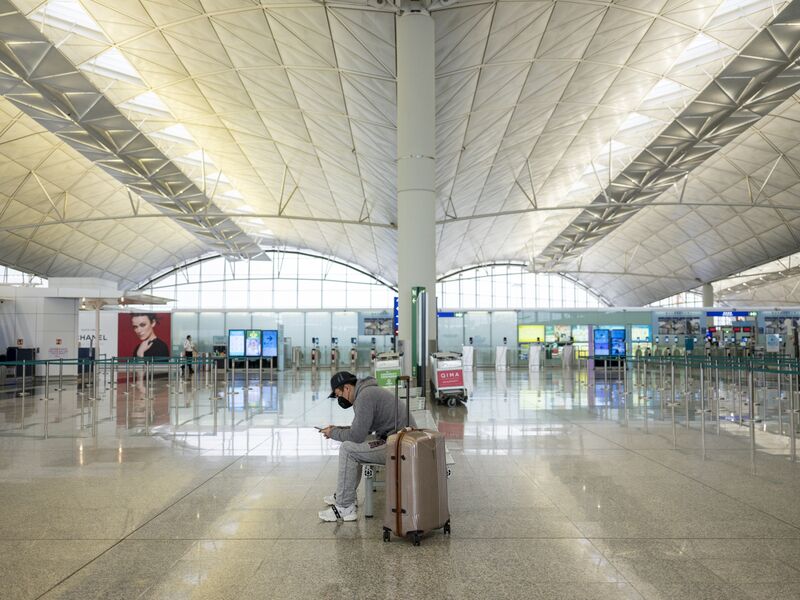
A traveler wearing a protective mask sits in the empty check-in hall at Hong Kong International Airport, March 5. Photographer: Justin Chin/Bloomberg
Almost 300 people were killed out of the 1,700 infected with Severe Acute Respiratory Syndrome (SARS) in Hong Kong; the most outside of mainland China. That event had an impact on the psychology of the city, according to Nicholas Thomas. Residents wore surgical masks, avoided gatherings from the very beginning of the outbreak, and that practise during the more current zoonotic novel coronavirus is still ongoing. Which is just as well, considering that COVID-19 appears to have gathered steam and may be re-appearing for a second wave.
Still, Asia appears to have shed most of the anxiety about the exponential spread of this new and sometimes deadly virus; in a steady state where the number of cases are diminishing and control is being rewarded. Its spread in Europe and the United States as its newer destination has placed them in a similar position to which China and Hong Kong found themselves a month earlier. Now, the need to avoid large gatherings is being recognized where recent high-profile infections -- including the Australian home affairs minister and the wife of Canadian Prime Minister Trudeau have become infected -- has certainly raised awareness of self-isolation.
At the end of January when the world was just being introduced to the fact that a new virus had unleashed itself in China, Hong Kong had already put most of its restrictions in place though there were but a handful of cases there. In total Hong Kong, as a result of its swift reaction to cut off the virus, had a total of 139 documented diagnoses. Of that number four deaths occurred in contrast to South Korea which failed to begin taking measures until a month later, February 23, when hundreds of its citizens had already been infected. It registers over 8,100 people infected, with 75 deaths.
Travellers wearing protective equipment enter the arrival hall at the
Hong Kong International Airport on March 17, 2020 in Hong Kong.
Hong Kong's relative success came despite a devastating 12 months for the economy and where the virus is further curbing growth, in the wake of violent pro-democracy protests that periodically shut down parts of the city during the second half of 2019. Hong Kong's beleaguered Beijing-appointed leader's popularity is in such high dudgeon that even the effective virus response hasn't lifted her approval rating beyond 13 percent. Carrie Lam had initially resisted shutting the border with China, despite public pressure.
Hong Kong ably demonstrated that the deployment of measures early on would have a dramatic effect. Cities that had implemented multiple 'non-pharmaceutical interventions', closing schools and churches, experienced death rates up to 50 percent lower, with less severe outbreaks than those that did not, during the 1918 influenza pandemic, according to research. Now, according to medical researchers, had China implemented non-pharmaceutical interventions -- from containment and isolation to social distancing -- three weeks earlier, the number of confirmed COVID-19 cases could have been reduced by up to 95 percent.
According to a study released this month, funded partly by the Bill & Melinda Gates Foundation, China's cases could have been reduced by 60 percent if those non-pharmaceutical interventions had been undertaken one week earlier. On the other hand, the number could have increased 18 times had such measures arrived three weeks later.Clearly, social distancing measures are to be regarded as a critical part of halting the virus after other containment measures have been implemented by governments.
Governments are required to conduct tests to identify and quarantine infected people and those with whom they had contact while also reducing imported cases from overseas, pointed out Benjamin Cowling. Once an outbreak occurs it becomes increasingly difficult to track down suspected cases, and social distancing measures like closing schools, working from home and voluntarily avoiding crowded areas are key to success in social distancing.
This represents a general opinion site for its author. It also offers a space for the author to record her experiences and perceptions,both personal and public. This is rendered obvious by the content contained in the blog, but the space is here inviting me to write. And so I do.