Friday, November 20, 2020

Cyberthreats ... Target: Canada
COVID-19 Complicates the US-China Cyber Threat Landscape
Illustration by Catherine Putz
"We're facing two pandemics: obviously the one that we all live with every day in terms of our personal health. But then there's certainly a cybercrime pandemic out there."
"[The biggest difference between the 2020 report and the earlier 2018 report is] the intensity and level of sophistication [of the threats]."
"We're certainly not trying to scare people into going off grid by building a cabin in the woods. We're here to say: let's tackle this now ... before it's a threat that can become real in the future."
"A trend that continues is that the basics of cybersecurity continue to be the root of most compromises. We are not taking the basics seriously enough, and we're not doing basic things that need to be done for basic [cybersecurity] hygiene."
"Private information is being targeted, and it's being targeted extensively. We're seeing dossiers being created about us as individuals that are then being used to then further more cyber activity."
"We're seeing private information being a goal of every act and the commercial value to cybercriminals is high and increasing."
"You're seeing cyber threat actors who are able to benefit from what normally in previous years would have been purely in the domain of the state. They have tool sets that are extremely sophisticated."
Scott Jones, head, Communications Security Establishment Canadian Centre for Cyber Security

"The state-sponsored programs of China, Russia, Iran and North Korea pose the greatest strategic threats to Canada."
"State-sponsored cyber activity is generally the most sophisticated threat to Canadians and Canadian organizations."
"Online foreign influence campaigns are almost certainly ongoing and not limited to key political events like elections. Online foreign influence activities are a new normal, and adversaries seek to influence domestic events as well as impact international discourse related to current events."
"Adversaries use on-line influence campaigns to change civil discourse, policy-makers' choices, government relationships, and the reputation of politicians and countries both nationally and globally."
"[States may as well be attempting to] exacerbate existing friction [in societies or even] delegitimize the concept of democracy [should it be contrary to its ideological views]."
2020 edition, biennial report, Canadian Centre for Cyber Security
The Communications Security Establishment Canada (CSEC) complex is pictured in Ottawa. (Sean Kilpatrick/CP)
 
So there it is once again, with greater emphasis in 2020, that foreign threat actors whose purpose is to influence all facets of Canadian activities online have become the 'new normal' representing hackers sponsored by China, Russia, Iran and North Korea, becoming the biggest cyber threats Canada faces, according to the country's cybersecurity agency with the release of the National Cyber Threat Assessment report, with the agency for the first time explicitly naming the countries posing the greatest cyber danger to Canadians.

From individuals to businesses and governments all manner of dangers are posed ranging from ransom ware attacks crippling IT entire systems, to intellectual property theft. There are large data breaches where troves of personal data are taken. There is an increasing risk of cyber threat actors attempting to attack 'critical infrastructure' within Canada, with a particular focus on electrical grids, even though the agency is of the opinion it remains 'very unlikely' there will be an active effort to disrupt, damage or take over critical infrastructure given Canada's lack of engagement in international hostilities.
 
Despite these warnings, the head of the Communications Security Establishment's Centre for Cyber Security laments the fact that many people and organizations fail to take these very real threats as seriously as they should. Not seriously enough, for example to take positive steps in implementing basic cybersecurity measures in protection of their data and systems, as for example, two-factor authentication. 

Sergei Konkov, Getty Images
The increasing interference by foreign actors in American elections and online political discourse has been well documented for years, still Canadians are themselves not immune from these threatening forces. Canadians, in point of fact, should be wary of the fact that foreign efforts in influencing the nation's discourse has become the 'new normal', the report warns. Canadians' personal information, either through direct contact scams like phishing emails or text messages or by targeting companies with large troves of sensitive data are increasingly being targeted by cyber criminals.

The very issue that under COVID, more Canadians than ever before are now working from home, relying on an increasing number of Internet services is responsible for creating more vulnerabilities for hackers and cyber fraudsters to exploit, notes the report. Larger organizations are also being targeted increasingly by cyber criminals, since the growing 'illegal market for cyber tools and services' makes it easier and more affordable to proceed. 
 
In the few months between the fourth quarter of 2019 and the first quarter of 2020, the report notes, the average ransom demand leaped 33 percent to roughly $148,700.


Labels: ,

Friday, July 17, 2020

Beijing, Steamrollering 5G Opposition to Huawei

"Now I would even say this is not only disappointing -- this is disheartening. [Britain had] simply dumped this company [Huawei]."
"The way you are treating Huawei is being followed very closely by other Chinese businesses, and it will be very difficult for other businesses to have the confidence to have more investment."
Chinese Ambassador to Britain, Liu Xiaoming

"Does the U.K. want to maintain its independent status or be reduced to being a vassal of the United States, be the U.S.'s cats paw?"
Chinese foreign ministry spokeswoman Hua Chunying

"We see ourselves as being caught in the middle of the U.S.-China trade war. Canada is also unfortunately caught in the middle of it."
"That is the context in which a lot of announcements and decisions are made, as the Trump administration is demanding that everyone pick a side whether it is actually in their interest to go all in on one side or that other."
Alykhan Velshi, vice-president of corporate affairs, Huawei Canada
Canada is the last Five Eyes nation to make a decision on 5G and China’s Huawei.

Of the Five Eyes intelligence collaborative group, only Britain and Canada hadn't yet made the final decision whether or not to include China's telecommunications giant Huawei in their 5G upgrade networks. Finally, Britain's Prime Minister Boris Johnson took that critical step, ordering that Huawei equipment be purged from Britain's emerging 5G network by 2027. In response China has warned that this decision banning Huawei will have negative consequences for Britain; not the first time the warning was issued, pre-decision.

Canada now is the sole remaining Five Eyes member still prevaricating, after the United States, New Zealand, Australia and now Britain have made it clear their distrust of China's motivations, potential and penchant for indulging in cyber espionage would be given the clear opportunity to spy on those with whom its Huawei networking corporation inclusion would afford it, linked to Five Eyes' telecommunications upgrades. Canada has little option but to join the other four, or risk being disinvited to be part of the group.

China's threats notwithstanding, to both Britain and Canada, and its snarling contempt for New Zealand and Australia, alongside its competitive trade war with the United States, all five agree that their trade dependence on China should be lifted, not deepened. This was a lesson brought home to all countries across the globe in the wake of the global pandemic, desperately seeking to source personal protective equipment and respirators from the country producing the majority of both, just incidentally exporting COVID-19 globally.

China's contemptible kidnapping of two Canadian citizens and holding them as prisoners claiming them to be espionage security risks to China in a bald reaction to an extradition treaty between the U.S. and Canada resulting in the arrest of Huawei's CFO Meng Wanzhou, in exchange for Michael Kovrig and Spavor, alongside hardball trade tactics exercised by Beijing in an effort to force Meng's release is reason aplenty for the Canadian government to deny Huawei access to Canada's 5G upgrade.
Image result for where globally has china invested in belt and oad?
Add caption

For the U.K., China with its immense economic base, global investment outreach and influence-peddling, presents as a formidable antagonist that will not hesitate to flex its trade and investment muscle to the detriment of England, with one-fifth of China's economy. China's trademark persuasion tactics rely on bullying and belittling those it views as antagonistic to its clumsy efforts at prestige and importance in world affairs. China has bought allies and their support throughout Asia, Africa the Middle East and Europe, through investment and loan sharking for infrastructure projects in its One Road One Belt enterprise.

That road appears to halt at the gates of Western democracies. The hesitant Liberal government of Justin Trudeau, fearful of further fallout from a trade giant it originally viewed as an opportunity for a remunerative free trade agreement, convinced that through diplomacy China's human rights record could be gently prodded toward reform was never anything but a transparent move to make it appear that Canada cared about China's abuses, all the while prepared to do business with the economic colossus.

Goods imported from China across the globe have given it a sense of security that building exponentially on increasing trade imbalances and securing greater obligations from emerging economies reliant on China's largess, would allow it to continue steaming forward toward its goal of achieving great power status second to none. If, on the way to achieving that coveted status, China stumbles across a few impediments, it is prepared to shove them out of the way and steam on, confident that those opposing it will be the losers, and its conquest will be assured.

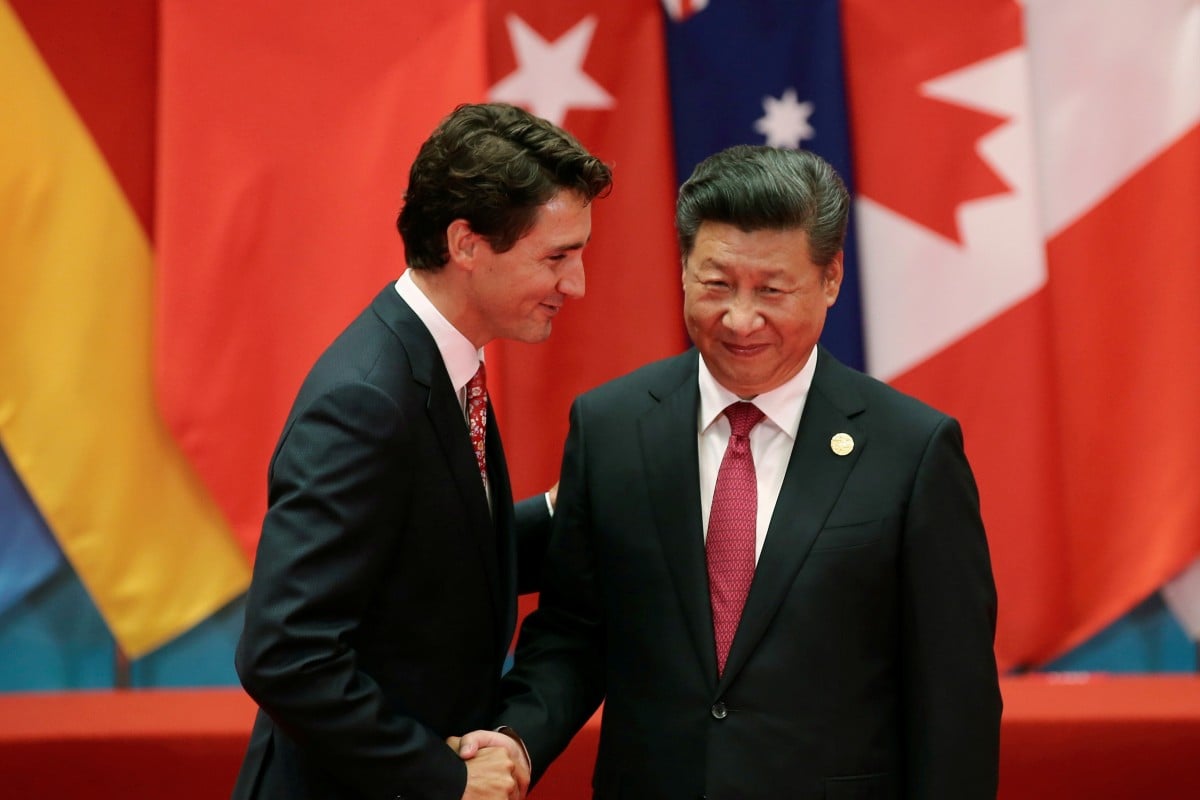
Chinese President Xi Jinping shakes hands with Canadian Prime Minister Justin Trudeau during the G20 Summit in 2016. His government has stalled a decision on whether to ban Huawei from Canada’s 5G networks. Photo: Reuters

Labels: , , , , , ,

Follow @rheytah Tweet