Stopping the Epidemic
"The new protocol is that we just abandon the body."
"They will learn their lesson when they get sick."
Philemon Kalondero, 39, Ebola response team
"Can we stop the epidemic? Certainly we can."
"[But to succeed, a political solution is first required to reduce the violence]."
Mike Ryan, World Health Organization emergencies program
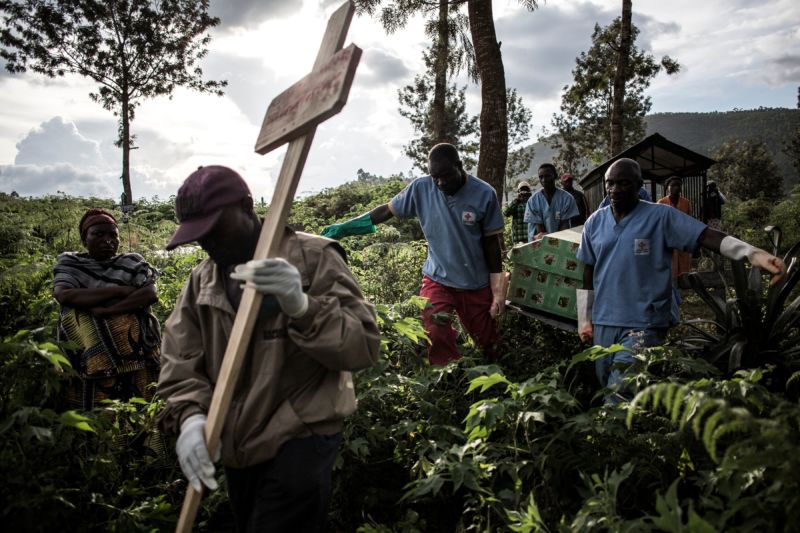 |
| Health workers carry a coffin containing a victim of Ebola virus on May 16, 2019, in Butembo, DRC, a city at the epicenter of the Ebola crisis. |
In Democratic Republic of Congo, in rural Beni, subsistence farmer Janvier Muhindo Mandefu set aside his farming occupation to work instead buying the bodies of Ebola victims, aware of the highly contagious state of the decomposing bodies. He is aware of the possibility of contagion, handling these bodies, but he perseveres. The bodies' threat to his own state of health is one thing, the threat he is equally aware of that he and his burial team could be attacked by relatives of the dead, is more worrying. He has already experienced one such attack.
Mourners accuse burial team members of stealing organs from the corpses, threatening to throw the team members into the open graves. Mr. Muhindo has been attacked by a swinging hoe. On another occasion a mourner had a hand grenade. On that occasion the entire team scattered and failed to return. The three-year-old Ebola victim remained unburied. "Someone like me can be buried alive", Mr. Muhindo said, watching his team hose down the trucks following another day of burials.
It was thought that the Ebola outbreak in eastern Congo was under control. Now, however, it has roared back, and is spiraling out of control mostly because combat efforts have been interfered with by attacks on treatment centers and health workers, making this outbreak the second-largest ever recorded. Growing mistrust of government managing the efforts at eradication, and mistrust of international medical experts struggling to steer patients into treatment centers, have taken their toll.
![Insecurity has significantly complicated efforts to contain the DRC's ongoing Ebola outbreak [File: Al-Hadji Kudra Maliro/AP]](https://www.aljazeera.com/mritems/imagecache/mbdxxlarge/mritems/Images/2019/6/5/bb56a80172034519b7b7685d2ba0b333_18.jpg "ISIL claims deadly attack in Ebola-wracked eastern DR Congo") |
| Insecurity has significantly complicated efforts to contain the DRC's ongoing Ebola outbreak [File: Al-Hadji Kudra Maliro/AP] |
Treatment centers were attacked by gunmen, others set on fire, health workers suspended their work when a doctor was killed. Some international groups have seen fit, given the dangers involved, to pulling some of their personnel out of the situation. Mid-May saw almost 1,150 deaths from Ebola. When the outbreak first occurred, police would remove bodies from homes sometimes at gunpoint. Now, the bodies are left as a result of the violence from relatives of the dead.
The outbreak has occurred in the part of eastern Congo afflicted by armed groups, conflicts over land possession, natural resources, ethnicity and religion motivating them. One of the groups is tied to the Islamic State. When the latest wave of health experts and humanitarian workers arrived they had their previous experience treating Ebola. They had lessons learned from the outbreak across West Africa in 2013 that killed over 11,000 people. And they had recently contained an outbreak in western Congo.
They brought with them medical advances, an effective vaccine, experimental treatments and a transparent enclosure called the "cube", where patients would be placed within, reducing the risk of transmission. Because the outbreak was in a vulnerable region close to the borders of Rwanda, Uganda and South Sudan it was imperative to bring it under control to halt its spread.
The region had been exempt from the presence of Ebola until last year when it manifested in a town called Mangina and by late summer it had shown up in Beni, a city of about 350,000.
In Beni massacres by machete killed an estimated 800 people in recent years. Local politicians speculated the government had imported the disease in a region where an estimated two percent of those surveyed felt mistrust for the national government. "Scientifically, I don't believe that it's possible to first have the killings of people in Beni, and now this disease without them being related", sagely said Crispin Mbindule Mitondo, a national assembly member, his remarks broadcast on local radio.
A tight national election was occurring along with the first transfer of power by ballot in Congo since 1960's independence. But when Ebola arrived Kinshasa suspended voting in Ebola-effected areas claiming that polling places might spread the disease in an area that was an opposition stronghold. A coincidence that persuaded locals that Ebola was part of a government plot to deny them the vote. And a day later an Ebola triage center in Beni was set on fire by protesters.
"When they cancelled the elections, it was a disaster for us", Emmanuel Massari of Doctors Without Borders remarked. Vaccination teams traveled under armed police or military escort, adding to the locals' suspicion, which made it appear as though the Ebola response was in reality an extension of an unpopular national government. Where, during confrontations with grieving family members, police officers and soldiers accompanying medical teams have opened fire.
The city of Butembo, with its million residents is now another disease locale where patients who had Ebola refused to go to treatment centers, viewing them as a place where they would not be cured, but die from the infection. In Katwa, an outlying area of Butembo, operated by Doctors Without Borders the Ebola treatment center was set on fire, the patients fleeing into the night.
Labels: Attacks, Burials, Congo, DRC, Ebola, Epidemic, Medicine, Vaccine, Violence
posted by Pieface @ Wednesday, June 12, 2019


