The Sheer Scale and Scope Of It
We're going away, but we have no idea what will happen when we get there."
"We have no goal. Even if there was a plan what good will it be after this hour?"
"I no longer have my father or my uncle. What do I have left?"
Musa Bozkurt, 25, Adiyaman, Turkey
"Those who have the means are leaving, but we're poor."
"The government says, go and live there a month or two."
"How do I leave my home? My fields are here, this is my home, how do I leave it behind?"
Fuat Ekinei, 55, farmer, Adiyaman, Turkey
"Everyone's saying they're not in charge. We can't find who's in charge."
"I've been begging and begging for just one crane to lift the concrete ..."
"Time's running out. A crane, for God's sake."
Keyser, Antakya, Turkey
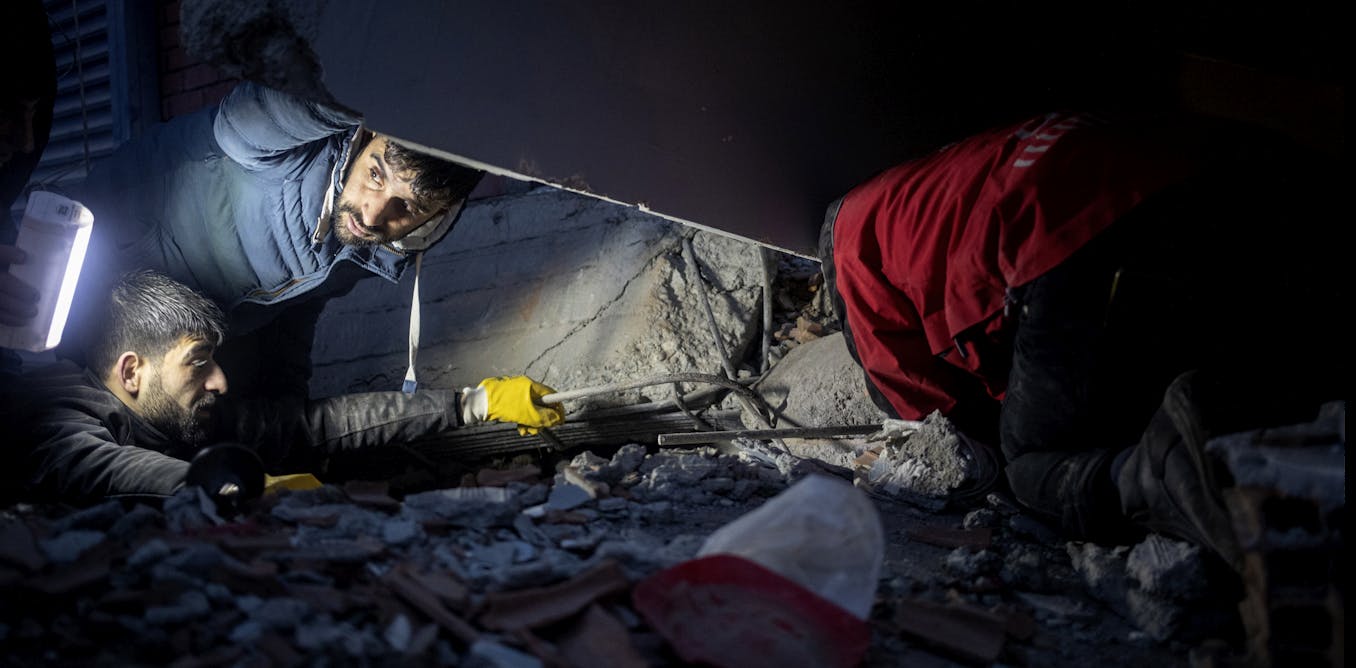 |
People search for survivors beneath the rubble in Diyarbakir, Turkey. February 6 2023.
EPA-EFE/Refik Tekin
|
The woman who gives her name as Keyser in Antakya is desperate, but there is no one to help. Through "the stench of dead bodies waft[ing] through the cold, dusty air",
her two sons, trapped below the rubble of their collapsed apartment
building could be heard crying for rescue. She tried for two days to
approach anyone with a vestige of authority to help rescue her children.
In the end she failed. There was no one available, no emergency
response leader she could make contact with, to order her sons' rescue.
A day later, neighbours reported that there were no more survivors pulled from the building's wreckage. "The general problem here is of organization, especially in the field of health",
observed Onur Naci Karahanci, a doctor working out of Turkey's
southeastern city of Adiyaman. There were not even enough body bags for
the dead, an acute shortage in the first two days following the two
earthquakes.
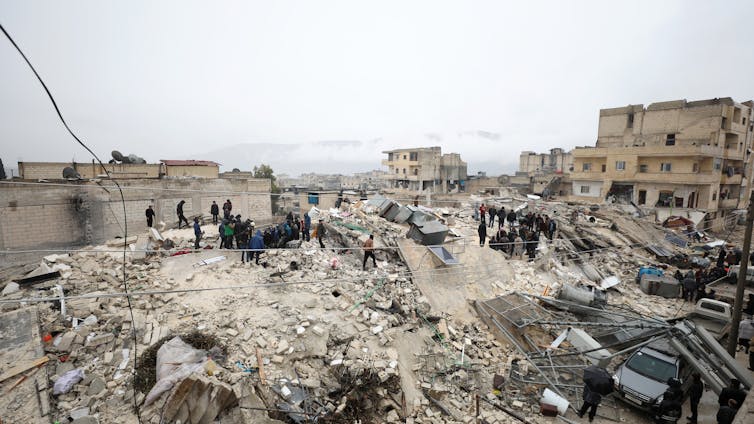 |
| Collapsed buildings in Armanāz, Syria.
EPA-EFE/Yahya Nemah |
The
trembling of the earth collapsed thousands of buildings in countless
towns and cities, leaving rubble under which were thousands of people, a
scant handful of whom were rescued. Antakya in particular, known
historically as Antioch, the capital of Hatay province. The damage
realized in Turkey was estimated by the Turksh Enterprise and Business
Confederation at $84.1 billion. Human life was destroyed to a total of
30,000 in Turkey alone.
Rescue
teams flew in from various countries, both near Turkey and Syria, and
from parts distant. Astonishing stories of survival and rescue have
surprised and encouraged rescue teams, but the total, still growing, and
standing at 36,000 dead is a grim reminder of the force and extent of
the catastrophic natural disaster. On one occasion, a father with a
child in his arms was rescued, in another a baby with its mother's hair
clutched in its fist; a newborn; a 13-year-old boy saved a week after
being buried alive
Over
150,000 survivors have been moved to shelters outside the affected
provinces, according to Turkish authorities. Turkey is now a country
that has been markedly changed, where the massive earthquakes cut a
slash through the landscape shifting roads, bending and breaking rail
lines, smashing buildings to the ground. There are now new canyons
across the East Anatolian Fault running through southern Turkey and
northern Syria.
The
window for finding survivors is fading. Rescue work moving vast
tonnages of steel and concrete to find anyone still alive is now turning
to the need to complete the work of destroying unsafe buildings
partially destroyed. The work of the moving tectonic plates; where the
fault line that slipped to cause the quakes -- the East Anatolian
between Turkeys Anatolian Plate and the Arabian Plate -- moving
northward created a double disaster.
Turkey's
geologic crust was altered in a few seconds when the plates slipped
side to side leaving rail lines bent into S-curves, roads laterally
split. Where an olive grove in Altinozu split in two leaving a
200-metre-wide rocky chasm between trees growing in neat rows, once
side-by-side.
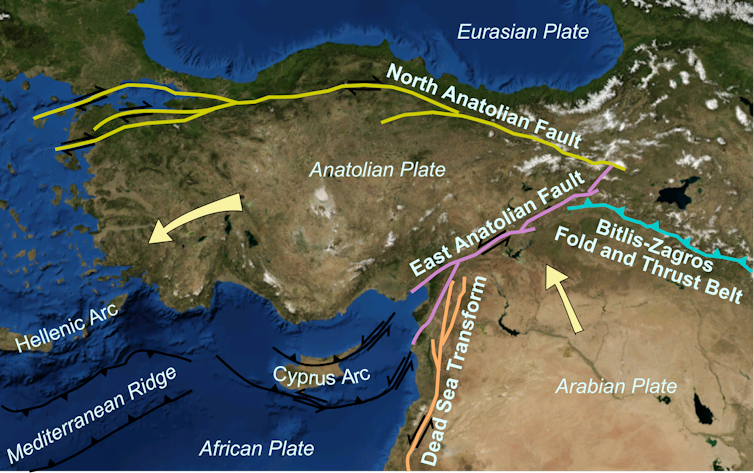 |
| Arabia is bumping into Eurasia and pushing Anatolia
westwards … or to non-earth scientists, Syria is bumping into Europe
and squeezing out Turkey.
Mikenorton/Nasa/wiki, CC BY-SA |
Labels: Death Toll, Earthquake, Natural Disasters, Search and Rescue, Survivors, Tectonic Plates, turkey-Syria
The World Community Has a Right to Know
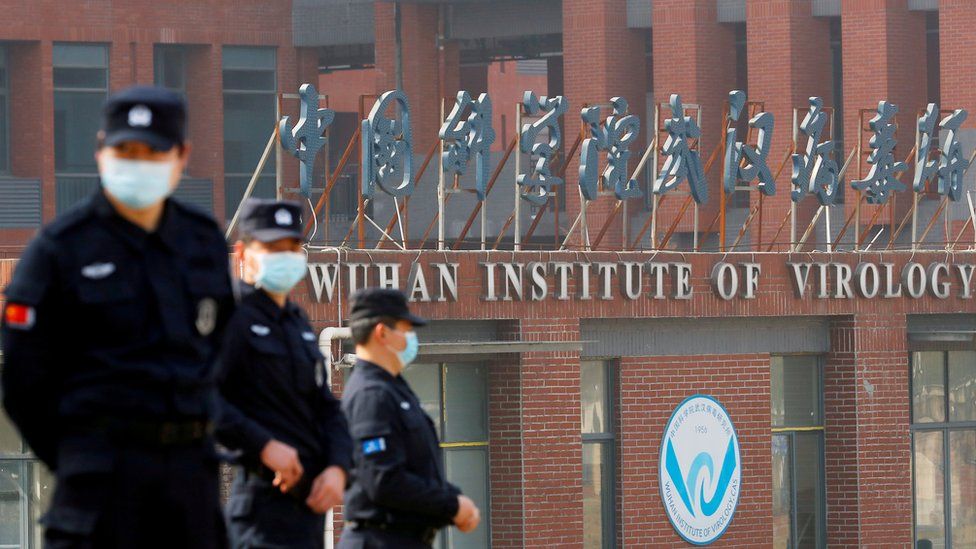 |
Lab-leak theories centre on the Wuhan Institute of Virology Reuters
|
"[Of the lab-leak theory]: That
possibility certainly exists, and I am totally in favour of a full
investigation of whether that could have happened."
"[I am] not convinced [the virus originated naturally]."
Dr.Anthony Fauci, U.S. President Biden's chief medical adviser
"From
day one China has been engaged in a massive cover-up."
"As
the evidence for the lab-leak hypothesis grows, we should be demanding
the full investigation of all origin hypotheses that's required."
Jamie Metzl, a
fellow at the Washington-based Atlantic Council
"We do need to be a bit patient but we also need to be diplomatic."
"We
can't do this without support from China. It needs to be a no-blame
environment."
Prof Dale Fisher, Singapore's National University
Hospital
"I've
read it, [report released by the Washington Post calling into question
when and how the SARS-CoV-2 virus emerged] it's a complete lie."
"Those claims are groundless. The lab has not been
aware of this situation, and I don't even know where such information
came from."
Yuan Zhiming, director, Wuhan National Biosafety Lab, Wuhan Institute of Virology, Wuhan, China
The story in the Wall Street Journal claims
that three laboratory workers at the Wuhan Institute of Virology fell
ill in November of 2019, and were admitted to hospital for treatment. A
month later, China advised the World Health Organization of the sudden
appearance of a zoonotic, a virus transmitted from animal to human, and
that authorities in China felt confident the virus had erupted in a
fresh food market where wild animals were sold and pangolins were the
suspected source.
The
U.S. intelligence report cited by the paper had originally been the
product of an investigation authorized by then-President Donald Trump
who stated his determination to get to the bottom of the matter that he
suspected was Beijing's lack of openness in alerting the world
community of the presence of a galloping new virus with unknown
properties but a surprising level of lethality, initially presenting as a
new kind of pneumonia.
It
was the newspaper's contention and possible purpose of re-visiting the
investigative report and coming away with greater details, that what it
revealed could conceivably bring support to the evidence already in
question, leading to a broader and deeper investigation into what many
in the scientific community suspect -- and many others object to -- that
the COVID-19 virus could have been a lab escapee.
What
is undeniable unless new information arises, is that the first cases of
a strange new pneumonia were being reported toward the end of December
2019 in the central Chinese city of Wuhan where coincidentally two
high-security laboratories for the study of viruses were located. One
laboratory had undertaken studies of viruses collected from bats in
caves and theorized that the bats had infected pangolins and the
pangolins carried the virus with them when they were trapped for sale at
the live animal market in Wuhan.
Although
rumours have circulated widely that the SARS-CoV-2 virus causing
COVID-19 was not a zoonotic that naturally occurred, infecting people
who had come in contact with a vector at the Wuhan market, but rather a
laboratory-produced virus and that inept, insecure methods led to its
escape, China has steadfastly denied any such allegations. Claiming
instead that the lab theory was unproven and nonsensical and simply
represented U.S. paranoia.
Instead
Chinese authorities point to the possibility that the virus may very
well not have originated in China, or Wuhan, at all, and was imported
with frozen food from some other geographic location. Wildlife trading
too was cited as a source, as well as a circulating virus that had
emerged elsewhere and found its way to China by some unsuspected means.
China's foreign ministry rejected the claim that three lab workers had
been hospitalized, characterizing it as a lie.
The
World Health Organization, which had sent an independent team of
researchers to Wuhan months ago to undertake a detailed investigation,
now entertains thought of another investigation, this time perhaps
without Chinese authorities' interference, although without Beijing's
approval for yet another group of scientists arriving in Wuhan there can
be no follow-up of the original which declared its joint opinion that
no lab escape of a virus was a likely explanation for the pandemic.
That
opinion was reached despite that there were no unescorted interviews
permitted where the investigators could privately, without interference
and the presence of Chinese authorities, closely question someone who
might have information critical to the investigation, nor were the
investigators permitted to see collected data directly relevant to the
more immediate Chinese investigation of the market where purportedly the
outbreak was traced to.
According
to Tarik Jasarevic, a spokesman for WHO, the organization's technical
teams were currently making decisions on whether to proceed further and
if so, how. Further study was obviously required into the role of animal
markets, as well as the hypothesis of a lab leak. The issue, after all,
is that of a lethal, minuscule, unseen pathogen seeking out new hosts,
invading body cells and replicating wildly. A virus that has in the space of a year-and-a-half killed three and a half million people worldwide.
Knowing
its true origins could help medical science more fully understand the
nature of the pathogen and how best to control it. It could also lead to
techniques of detection and deterrence that could help avoid future
such global pandemics. As well as teach both the global medical
community and governments how best to anticipate new and perhaps even
more deadly invasions of viruses from wild animal to humanity.
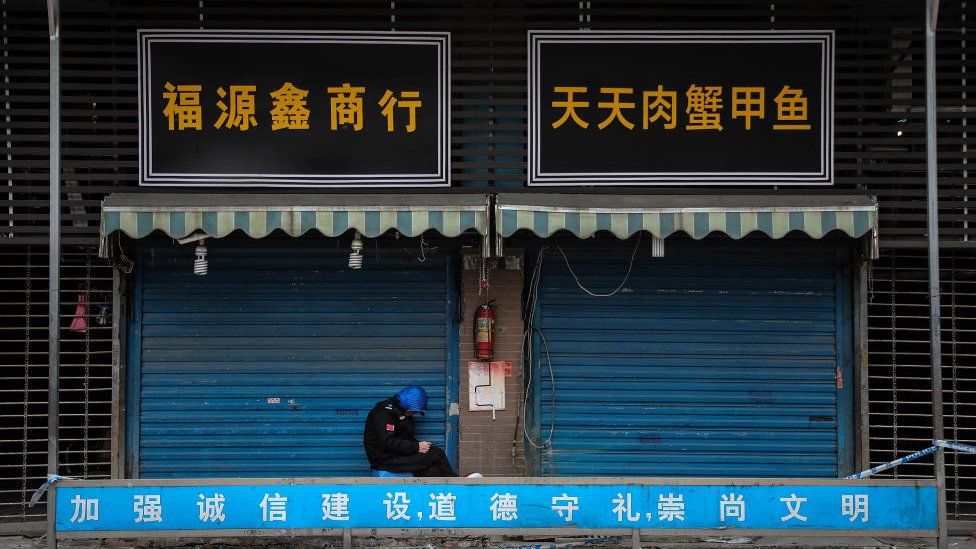 |
The Huanan Seafood Wholesale Market in Wuhan was linked to early Covid cases Getty Images
|
Labels: China, COVID-19, Death Toll, Investigation, SARS-CoV-2, Wuhan
The Global Pandemic Million Death Toll
"Our world has reached an agonizing milestone."
"It's a mind-numbing figure. Yet we must never lose sight of each and every individual life."
"They were fathers and mothers, wives and husbands, brothers and sisters, friends and colleagues."
UN Secretary-General Antonio Guterres
"So many people have lost so many people and haven't had the chance to say goodbye."
"Many, many of the people who died, died alone in medical circumstances where it's a terribly difficult and lonely death."
Margaret Harris, spokeswoman, World Health Organization
"[The] unrecorded [death toll is much higher than a million.]"
"We must not forget that this pandemic is still accelerating and shows no signs of slowing down."
"We must do everything in our power to bring this pandemic, and all its harmful consequences, to an end as quickly as possible."
Jeremy Farrar, director, Wellcome Trust global health charity
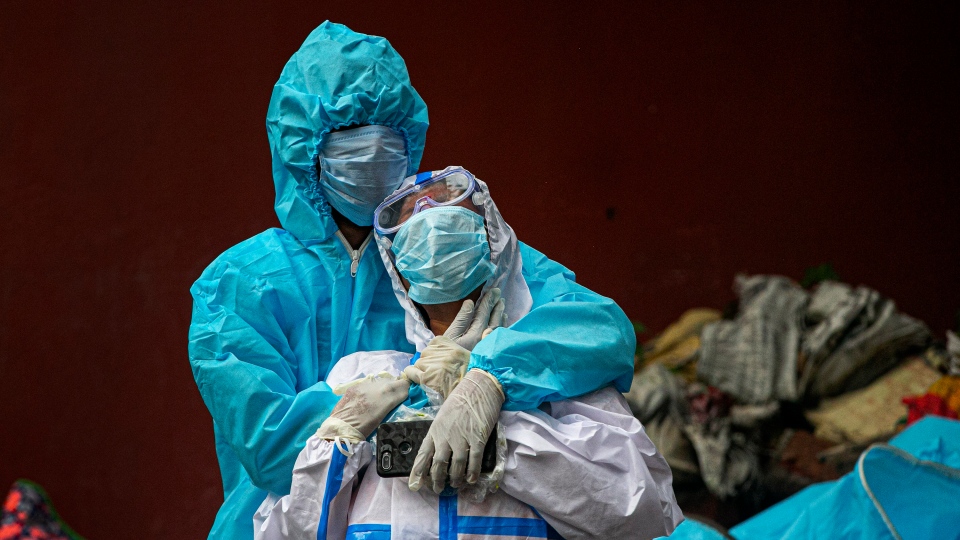 |
| In this Sept. 10, 2020, file photo, a woman wearing white protective
gear, foreground, mourns after taking a glimpse of her husband's body, a
victim of COVID 19, at a cremation site in Gauhati, India. (AP
Photo/Anupam Nath) |
Around the world over 5,400 people die every 24 hours, according to calculations based on September averages. In other words, roughly 226 people every hour, or one person each 15 seconds that go by, dies of the virus that causes COVID-19. The death toll globally has now surpassed a million. A pandemic that has seen the global economy devastated, that has caused national health systems to falter and fail, and that has transformed life from what was seen as 'normal' to completely other.
No other event in recent history has had the magnitude of effect of this coronavirus that arose in China and in an excess of speedy transmission, engulfed the entire world. The first wave that struck most of the world from March to April, after its initial appearance in late December 2019 in Hunan, China, subsided in most countries it has plagued which took immediate shutdown action to reduce the prevalence of human contact in an effort to control the infection rate. That partial success in reducing infections motivated governments to restore a semblance of normalcy.
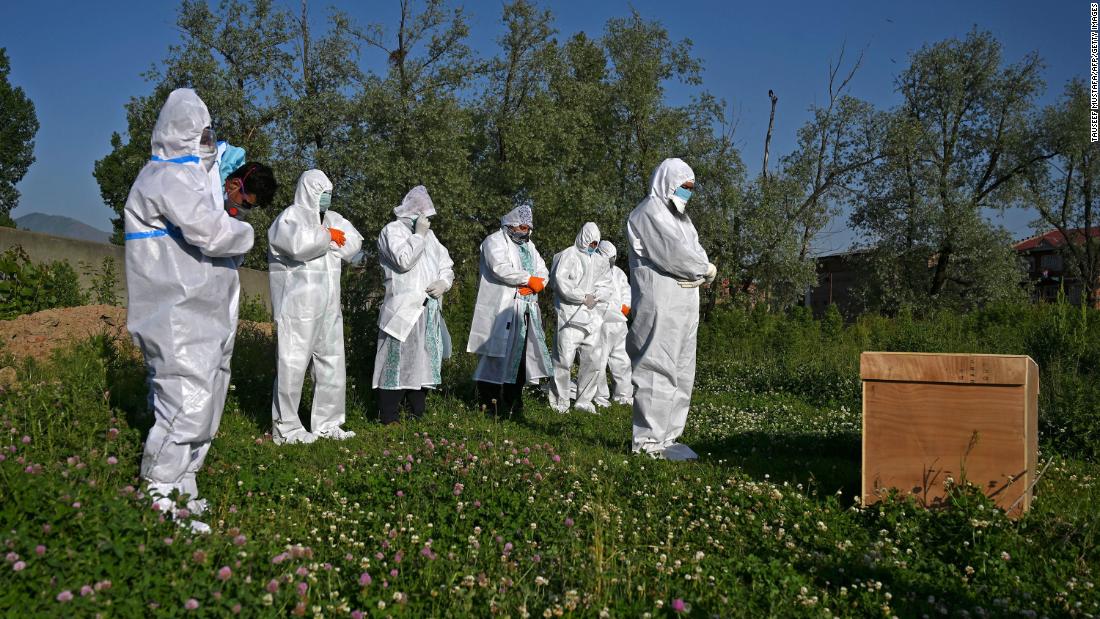 |
| Relatives wearing personal protective equipment offer funeral prayers
for a woman who died from the coronavirus, during her burial at a
graveyard in Srinagar on May 21, 2020. |
Populations, fed up with social isolation, relaxed their inhibitions and fear of contagion as life began returning as close to ordinarily normal as possible while a measure of vigilance was maintained, has led to a creeping return of case numbers that began to accelerate wildly, leading to the dreaded 'second wave' and predictions of more and worse to come. All the while, medical science is frantically searching for a vaccine to establish herd immunity, even as public suspicion grows alongside a backlash against medical and government authority.
Lockdown measures and social isolation are being contested and challenged, and everywhere loud and angry protests take place. Those advocating for lockdowns in the hope of sparing the lives of the elderly and the health-impaired in an effort to control the SARS-CoV-2 virus, knock up hard against those championing sustained politically sensitive economic growth. The damage both to human life and the economy of nations varies, sometimes mysteriously, from country to country. Science desperately looks for answers to the questions surrounding this complex and mysterious disease.
 |
| Medical personnel move a deceased patient to a refrigerated truck
serving as a makeshift morgue at Brooklyn Hospital Center on April 9,
2020 in New York City. |
Ironically, the most advanced country of the world economically, technologically, is the one representing the poorest challenge to the strategies involved in controlling the COVID epidemic. Deaths in the United States stand at over 205,000 and cases at a staggering 7.18 million, while India records the highest daily growth case rate in infections in the world; an average of 87,500 new cases daily, since the start of September. India, should its infection rate continue, will soon overtake the U.S. Both countries are loosening their lockdowns even in the face of escalating case loads.
Close to 25 percent of deaths have taken place in Europe where the World Health Organization warns of a concerning trend in western Europe, spreading the disease, mere weeks from the winter flu season. Major control interventions, warns the WHO, are required to stem the rising cases in Latin America where normal life has resumed in many of the afflicted countries. Asia, on the other hand, the first region the pandemic struck, experiences a lull, past its emergence from its second wave.
In Israel the Muslim custom of washing bodies of the deceased is no longer permitted; corpses wrapped now in plastic rather than the traditional cloth shrouds. Shiva, where in the Jewish religious tradition, people attend the homes of mourning relatives for seven days, has been suspended. Catholics in Italy are now buried without traditional funerals much less a priestly blessing. Former militiamen in Iraq pick up shovels now to dig graves, conducting both Christian and Muslim burials.
New burial sites have had to be opened as cemeteries are no longer able to accept more bodies for burial in the United States, Indonesia, Bolivia, South Africa and Yemen, where not much else unifies those disparate countries, during this historical time of COVID.
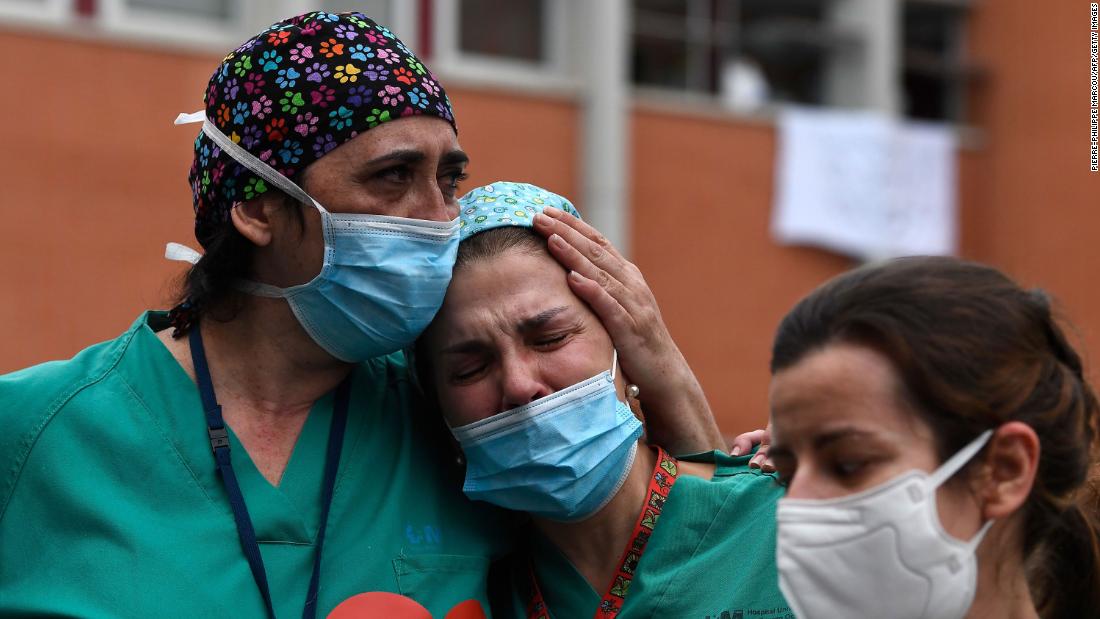 |
| Healthcare workers mourn in memory of their co-worker
Esteban, a male nurse who died of the coronavirus disease at the Severo
Ochoa Hospital in Leganes, near Madrid, on April 10, 2020. |
Labels: Death Toll, Global Pandemic


