"[WDBJ-TV Alison Parker is a] racist. My hollow point bullets have the victims' initials on them. Jehovah spoke to me [spurring to action]." "Alison made racist comments ... EEOC [equal opportunities report filed] ... They hired her after that???" "Adam went to [HR -- human resources] on me after working with me one time!!!" "I filmed the shooting see Facebook." "[I was a] human powder keg for a while ... just waiting to go BOOM!!!" "What I encountered while employed at WDBJ-7 was nothing short of vile, disgusting and inexcusable. Your Honor, I am not the monster here. I get along with my
current co-workers … [T]hat sure doesn’t sound like the monster I was
painted to be." Vester Flanagan, Virginia gunman
"How can this individual have robbed these families, the families of Alison and Adam, of their lives and their happiness and their love for whatever reason?" "After many incidents of his anger coming to the fore, we dismissed him. He did not take that well." "He quickly gathered a reputation as someone who was difficult to work with. Eventually after many incidents of his anger coming to the fore, we dismissed him. We had to call the police to escort him from the building." Jeff Marks, general manager, WDBJ TV "It's like showing those beheadings. I am not going to watch it. I can't watch it. I can't watch any news. All it would do is rip out my heart further than it already is." Andy Parker, father of murdered reporter
"[Flanagan] was a good on-air performer, a pretty good reporter and then things started getting a little strange with him." Don Shafer, former news director, KPIX-TV, Florida
Alison Parker interviewing Vicki Gardner
When Vester Lee Flanagan, 41, worked for WTWC television in Florida he was considered fairly good at his job. Until, in 2000 he was fired as a result of "bizarre behaviour". Mr. Flanagan, however, held that he was a victim of racial discrimination augmented by slurs and discrimination because of his gay status. Two years later he resumed his career as a reporter and producer for WNCT-TV in North Carolina.
In 2012 he was hired by WDBJ, then fired within a year. Paranoia and a persecution complex led him to the conclusion that he was meant to act against the grievous treatment that had been meted out to him, and avenge himself personally on an oppressive situation where he was victimized, incited further by the recent shooting at a historic black church in Charleston, South Carolina. He became a perfect storm, triggered by his own personality and his perceived victimhood.
And he set out to perform a ritual; to video-record his revenge, and to circulate it on social media in expectation of acclaim as a hero in the black struggle against white supremacy. To become that hero he had to select a target in a conspicuous situation where his action would be recognized as boldly audacious, proving himself a man of action and enterprising acumen, using his TV-broadcast skills in the process. His final statement to the unfair world of persecution and indignity would be self-martyrdom.
Adam Ward
Pointing a pistol at reporter Alison Parker as she interviewed a local official at an outdoor shopping mall he called her a "bitch" and shot her, as she reacted in shock and disbelief, attempting to flee, filming the action as it took place, and then he shot cameraman Adam Ward, 27. He posted the ensuing video of the murders and no doubt felt satisfaction at a job well planned and executed. The interviewee, Vicki Gardner, also critically shot, underwent surgery and will survive.
The scenario he sketched out for himself works for social misfits, psychopaths, people who set out to distinguish themselves as murderers, committing atrocities for a 'cause'. The huge attention generated by videos released by Islamic State of Iraq and the Levant has acted as an obvious template for the bitterly self-conscious victim yearning to become a celebrity figure, a martyr to their own cause of self-actualization as a champion of the underdog. Leaving a legacy in the annals of self-described avengers of the wronged.
"The attackers armed with machetes and other crude implements descended on the village and took away Moni Orang from her house and then brutally killed her." "She was decapitated and her limbs were chopped off." Senior Police official Manabendra Dev Roy
"Moni was a witch and had cast evil spells on her enemies. ... There is no place for such sorcerers and so her killing is justified." Villager, Indian state of Assam
"It generally happens in places where there is almost no economic development, with little or no access to basic education and health care." "In this kind of an atmosphere, people tend to develop very strong superstitious beliefs and anything bad that might befall these villagers like a bad crop, diseases, sudden and unexplained death of someone in the family, or drying of a well tends to be considered the work of some evil 'witch'." "Thus begins a witch hunt to locate the person responsible." Rakesh K. Singh, Indian scholar
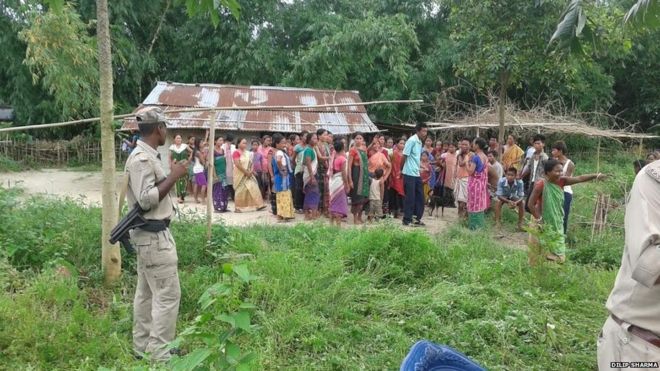
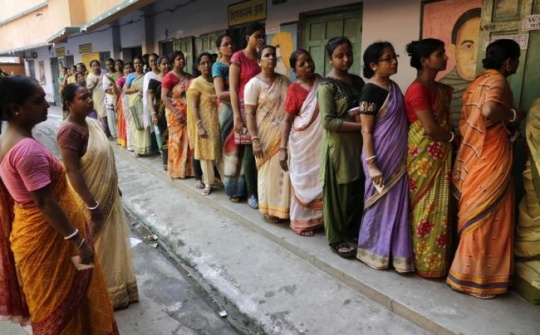
Police say villagers blamed a woman for their illnesses
While in one part of the world, a billionaire Russian high-tech entrepreneur is using a portion of his vast wealth to fund a search for extraterrestrial life in the universe with the blessing of astrophysicist Dr. Stephen Hawking of worldwide renown, harnessing the world's most powerful radio telescopes and millions of computers to create the world's most powerful computing system, in India backward tribal peasants have resorted to witch-hunting to cure their societal ills.
Should there exist in that vast universe intelligent minds they would without doubt consider it abhorrent that their societies in coming in contact with our blighted one might inconceivably be infected with human stupidity. Little wonder years of searching in the vast and timeless space of the universe there have been no signals detected that might alert our anxious searchers to the presence of other life-forms; they would shrink from contact with us.
A self-appointed "goddess" incited a mob in the Indian state of Assam to accuse a woman of 60 of witchcraft. A mob of some 200 barbarians descended on the woman's home, and tore her away from her family. She was beheaded, her body dismembered. She was a member of an ethnic group taken to the province by the British as workers on tea plantations during the British Raj. They are Adivasis people, poor and uneducated. Bahura Bai says: "I keep praying and asking my goddess 'what is my crime?'" [Baba Tamim]As poor and uneducated as they are, their local native counterparts in the province traditionally make them targets of mob violence. Wreaking their vengeance-induced moods in foul, inhumane ways to ensure that there are others existing nearby living in fear and trepidation, who are even more miserable than they themselves are. The Hindustan Times has reported that seven villagers have been arrested.
Witch hunts appear to be on the rise in some parts of India. A year ago a woman in Bihar by the name of Saraswati Devi was beaten to death after having been forced to eat human excrement. The villagers who perpetrated this disgusting atrocity on the woman then found it useful to kill her. A year earlier, in the state of Jharkhand, no fewer than 54 women were accused of witchcraft, and then murdered.
In this latest bewildering instance of human bestiality in the tribal state of Assam, in the village of Bhimajuli, Anima Ronghanti, 35, "who claims to be a goddess", brought people at a temple to the belief that the Adivasi woman was a witch and her presence would bring ill fortune to the village. She had already, claimed the goddess, caused people in the village to fall ill.
That being the case, the people had little option left to them but to murder the woman and to behead and dismember her. The deed done, they could return home confident in the certainty that they had contributed to the village's future increased good fortune.
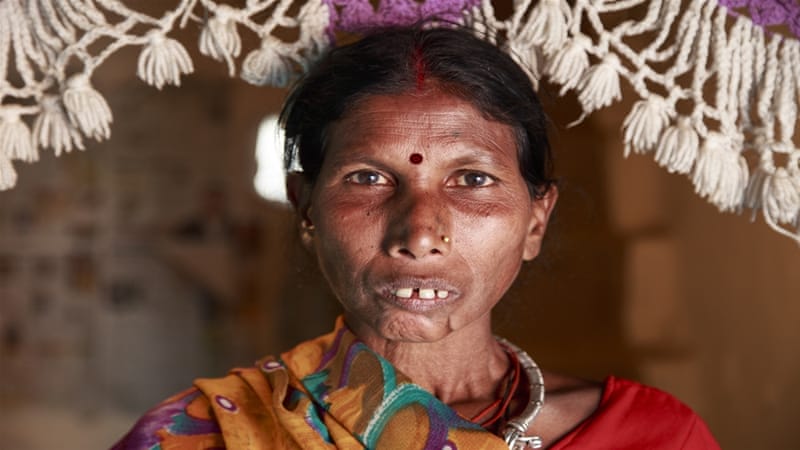
Teerath Sahu was paraded naked through her village and beaten until she
fainted after a witch doctor accused her and two other women of being
witches [Baba Tamim]
"As
we came close, I was shocked. I saw them crammed onto the boat. It left
me speechless, and I broke down in tears as I watched them screaming,
waving their hands and clothes." "I could not let them die, because they are also human beings. Just like me. I am grateful to have saved hundreds of lives." Razali Puteh, fisherman, Aceh, east Indonesia
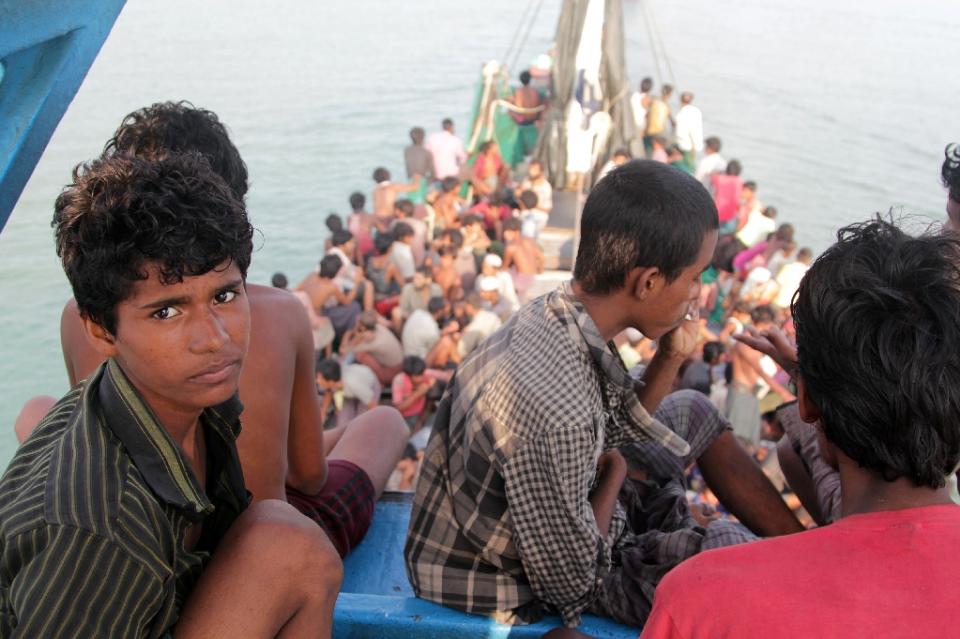
Rohingya migrants sit in a boat as they're
towed closer to land by fishermen, off the coast near the city of
Geulumpang, in Indonesia's East Aceh on May 20, 2015 (AFP Photo/Januar)
"This is not an ASEAN problem. This is a problem for the international community." "[Malaysia
and Indonesia agree to offer temporary shelter] provided that the
settlement and repatriation process will be done in one year by the
international community." Malaysian Foreign Minister Anifah Aman
"A year is the maximum. But there should be international co-operation." Indonesian vice-president Jusuf Kalla
Over
three thousand people representing Rohingya Muslims, persecuted in
Myanmar where they are seen as illegal Bangladeshi economic migrants,
though many have lived there for generations, have boarded overcrowded
boats, landing on the shores of southeast Asian countries. Thousands
more are estimated to be stranded at sea. A crackdown on human
traffickers has led ship captains and smugglers to abandon their boats,
and those aboard, to the mercy of the sea.
Leaving the
desperate migrants fleeing misery, poverty and violence in Myanmar to
fend for themselves, without food, without water, without medical
attention, without hope. Malaysia called an emergency meeting with the
foreign ministers of Indonesia and Thailand. They had already stated
they had no intention of taking in any of the migrants; they provision
the incoming boats with food and water and send them back to sea.
Now
they have agreed to offer temporary shelter. With the proviso that the
international community must take up settlement of the refugees and
alternately undertake repatriation. When these countries were hit with
the tragic disaster of a tsunami in 2004 after a massive earthquake, the
international community was quick to come to their aid; the deaths of
hundreds of thousands of people appalled the world community and
humanitarian aid was swift to appear.
Indonesia in
particular took to charging humanitarian groups customs and duties on
the emergency supplies they were bringing in to help save lives. At that
time the world saw no line of separation between unaffected nations and
those for whom the devastating earthquake-tsunami disaster impacted to
create mass death; foreign government reaction was swift and positive,
with donations pouring in from all over the world.
This,
on the other hand, is indeed an ASEAN dilemma, one which should be
solved regionally, with an uptake of refugees, giving them the
opportunity to settle in countries where their religion, for which they
suffered under Buddhist rule in Myanmar, would not be a discriminatory
issue in Malaysia and Indonesia, two majority-Muslim countries with vast
populations.
The Aceh fisherman who originally came
across the migrant boat holding over 430 weak and hungry people didn't
react by ignoring them in the belief that it wasn't his business to save
them but that of his government's. He urged them to wait aboard their
wood trawler, and left to bring back other fishing boats to pull the
trawler to shore, and its desperate cargo to haven.
"In Nepal too she kept falling in and out of depression. Last year, we finally decided to get her regular treatment." "A friend suggested a doctor in Nainital and since then she was on medication. I had purchased all her medicines when she told me she wanted to live with our sister for a while." Brother of Nepalese rape and murder victim, Haryana State, India
"Notions of revenge and honor have always been intertwined. This can
cause women to end up as collateral, even when they themselves have
committed no wrong. This was the case last year when unelected heads of a
village council in the state of Uttar Pradesh ruled that a 24-year-old woman should be gang-raped to punish her brother, who
had eloped with someone’s wife. In addition to the green light for the
rape, the village council also ordered the woman to marry one of her
attackers." "Just why is rape such a powerful way of seeking
revenge? The reason, again, lies in notions of honor and shame. If you
are raped, the pressures of honor compel you and your family not to
speak about the crime. Unlike murder, which does not carry this stigma,
rape and its perceived shamefulness make it hard for women and their
families to seek justice. Many might not see the point. According to one
common saying, “A girl’s honor is like glass, once it is broken it
cannot be fixed." Amana Fontanella-Khan, feature writer, Mumbai, India
Anindito Mukherjee/Reuters
She was 28 years old, severely clinically depressed. And living with her sister for emotional support in the northwest Indian state of Haryana. Clearly her family was concerned about their sibling. And then, her illness became the last thing on anyone's mind. The woman had been receiving treatment for depression and suddenly on February 1st, she disappeared. Three days later her body, horribly mutilated, was discovered.
An autopsy found that she was missing several of her internal organs. Objects, including stones, blades and a stick had been inserted into her body. No mention made whether that mutilation took place while she was still living, or when she was already dead. Why do these dreadful atrocities, these gruesomely horrible sexual attacks happen in India to vulnerable women?
What is it in the collective cultural code of the country that persuades men that women's lives are casually expendable?
Indian laws forbid naming and identifying victims of rape, living or dead. Indian laws were fairly recently re-written to address the pathology of sexual violence in Indian society. Where news surfaces of atrocities committed against women in urban settings, but the far more prevalent and vicious attacks against girls and women in rural India are so commonplace they are hardly worth a mention, and police fail to respond.
Newspapers do carry those stories when, as happens all too frequently, foreign visitors happen to be the victims. As happened with a Japense student sightseer in northern India who trusted a man who persuaded her he would be happy to guide her around and show her his country. What he did was take the woman by motorcycle to a farming village outside Jaipor in Rajasthan state to rape her and leave her on a highway.
Two months earlier a 22-year-old Japanese researcher had been held captive and repeatedly gang raped over a three-week period in a village close by a Buddhist pilgrimage centre in Bihar state. Several suspects have been arrested by police. A "tourist guide"offering to help the woman was involved in this case, as well. The woman managed to escape and fled to the eastern city of Kolkata.
Visit India? Why would any woman want to?
Leave India? Why wouldn't any woman be eager to?
"I do not recommend this [venturing into no-go suburbs of Paris]. Not even we French dare go there any more." "But nobody talks about this in public, of course. Nor do those who claim, 'long live multiculturalism', and 'Paris is wonderful!' dare enter the suburbs." Laurent Obertone, French crime reporter, author
"The image of Paris has been prejudiced, and the honour of Paris has been prejudiced." "We'll have to go to court in order to have these words removed." Paris Mayor Anne Hildago
MARTIN BUREAU
/ AFP/GETTY IMAGES FILE PHOTO Paris Mayor Anne Hidalgo has threatened to sue Fox News. "The image
of Paris has been prejudiced, and the honour of Paris has been
prejudiced," she says.
"In the wake of the Paris attacks, several guests on this program mentioned 'no-go zones' in France; I didn't challenge them, and twice referred to them as well." "I should have been more skeptical. I won't make the same mistake again." CNN host Anderson Cooper
Taking umbrage that one's pride of place and in place has been pricked by reference to the reality of the presence of hostile banlieues on the outskirt of Paris and elsewhere in Europe where immigrants whose faith leads them to isolate themselves in a protective cocoon of suspicion and contempt for the values, religion, laws of the prevailing culture which plays host to them, evades the truth that countries of Europe are being turned inside out, and wrung of their cultural inheritance.
Europe has absorbed millions of Muslims, escaping oppression and repression, from their own governments and from the conflicts within and without. A humanitarian gesture on the part of the Western democracies who cling to the notion that their even-handedness in offering such migrants safety and freedoms unknown to them in their places of origin will win them over to the Western, liberal-democratic version of life, to be integrated into society as a whole has proven a failure.
And while Europe celebrates its generous diversity, its pluralistic multicultural appreciation of all those who come knocking at their shores, the guests eventually become cranky with disappointment in the freedoms they don't want, and belligerent with expectation and entitlement over the freedoms they do want. They have no wish to assimilate into the larger culture. But they do feel that the prevailing culture should be agreeable to surrendering their heritage, freedoms and laws to Islamic ones, in the interests of making the immigrants completely comfortable in their new surroundings.
Failing that, the result is an underclass that is simmering with resentment, high unemployment, poor educational opportunities, and restive youth eager to return to the adventurous opportunities to explore Islam's basic precepts of Islam's higher callings to its faithful, from helping Islam to prosper and grow by leading in the conversion of non-Muslims to the faith, and alternately and much more attractively, by responding to the call incumbent on all Muslims to jihad.
From Sweden to Holland, Norway to France, Britain to Spain, the ummah is expanding through a birth rate that compensates for the Europeans' singularly unenthusiastic attitude toward family and parenthood, and by ongoing emigration from the world's hot-spots of brutal conflict to safety where compatriots do not seek to slaughter one another in the name of a version of the same religion that one sect or the other holds to be heretical.
When Fox news offended the mayor of Paris by describing the city as dangerous, she was incoherent with rage over the untenable slight on the City of Lights. Claiming that police fear to enter the banlieues was intolerable as far as the mayor was concerned. Perhaps she hadn't read Valeurs Actuelles, a French weekly warning against venturing into the Paris suburb of Trappes: "You will be spotted ... and be stripped and smashed", warned a local police official, Mohammed Duhan.
Muslim youth gangs repeatedly riot through towns in the "no-go" zones.
She must also have slept comfortably through France's TV3 documentary on no-go zones, or TF1 TV channel the most popular in France, with its 90-minute documentary featuring Muslim gangs in the no-go zones of Paris. She obviously never bothered glancing at the Suburbs of the Republic, a 2,200-page report published by the think-tank L'Institute Montaigne, which wrote of the Paris suburbs becoming "separate Islamic societies", commanded increasingly by Sharia law, and given to radical Islam.
No matter, the good mayor was offended, the Fox and CNN news teams were swift to apologize. Heavens, they got it all wrong; no Islamists in France, no terrorizing of its citizens, Charlie Hebdo was an anomaly as was the slaughter at the Kosher grocer, and the other incidents that 'disturbed' individuals undertook to express their frustration with the social order in France which Islamism had absolutely nothing to do with, dear no.
"If you call it a self-defence, it might be a bit radical, but what else can a villager do when he cannot resort to the law, gets no response from the local government and finds it useless to petition the higher authority?" Huang Qi, rights advocate
"It shows the local government has not made effective efforts to resolve the conflict between the developer and the villagers." Beijing Times newspaper editorial
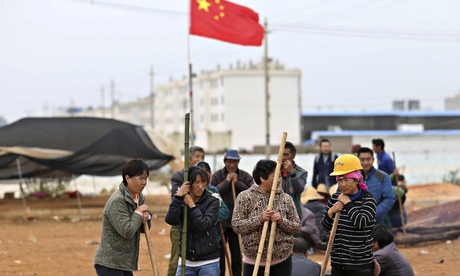
Villagers guard the entrance to
Fuyou village in Yunnan province where the violence took place.
Photograph: Wong Campion/REUTERS
A dispute. One with a deadly message. And the messengers defend their actions. Actions that penalized not the oppressor necessarily, but those hired to carry out the work that infuriated a village. Another instance where in the backwoods of China, villagers have no recourse to the law, since the law is whatever Communist headmen of the village claim it to be, and theirs is the authority supported by Beijing.
In the southwestern province of Yunnan in the village of Fuyou residents complained of no compensation for land taken from them for a warehouse and logistics centre. Because of the standoff which the local government took no effort to come to grips with, the project at hand was delayed by the developer. And then the developer decided to proceed without paying attention to the complaints of the villagers for compensation.
The villagers had lost fertile lands that had provided them with an agricultural living and comfort. Without the use of the communal lands they were bereft of their livelihoods. This is a common enough story in rural China where such deadly confrontations take place. Because they've become so commonplace an alarmed central government is rethinking legal reforms to grant more independence to local courts in the hope of alleviating tensions between residents and local government.
Tension boiled over in the villagers' dispute with a property developer. The municipal government issued a statement describing a village gone amok. Eight people, including two villagers died Tuesday in the violence. Eight construction workers were detained by the villagers when the developer decided to restart work on the site. The villagers tied the workers' hands and feet, beat them, poured gasoline over them and threw them on a road close to the construction site.
With improvised weapons the villagers later stormed the construction site clashing violently with hired hands. According to the party-run Guangning Daily newspaper the villagers became impoverished once the lands were seized. And, asked the newspaper, where did the police equipment including military bags in the hands of those hired on the construction project, come from?
"Criminalization of politics is a bad trend. Earlier politicians used criminals. Now the criminals themselves have entered politics." Rituraj Sharma, 21-year-old first time voter, Lucknow, India
"We deploy additional security forces with the candidates having criminal records. The gangs these politicians are associated with are well known and police will keep an eye on the members of these gangs." Umesh Sinha, chief electoral officer, Uttar Pradesh
Photo: India Times
India, which prides itself as they are so fond of describing it, as the world's largest, most populous democracy, is so democratic that among the politicians running for office can be counted murderers, rapists, and any number of unsavoury characters with criminal records, or whose court appearances on a variety of charges have not yet taken place as a result of an immense backlog of cases facing Indian courts.
Over 1,200 candidates are in the running for 545 seats open in the national election among whom are those facing criminal charges including rape, kidnapping, extortion and murder. This, according to statistics provided by the Association for Democratic Reform. All over India, violence and politics are indivisible. Local thugs are used by political parties to intimidate their political rivals.
The politicians shrug off the charges of criminality among them, labelling such accusations as being strictly politically motivated slanders to discredit their suitability for public office. In the country of 1.2-billion people, the administration seems incapable of rooting out corruption and the presence of a criminal class consonant with the political class.
Indian law can be invoked to bar an individual running for political office only once they have been convicted by a court for an offence, a process that can take years going on to decades as cases wind their weary way through an overcrowded, overtaxed judicial system.
In Uttar Pradesh, the most populous of all states in the country, the fear of violence has compelled the state election commission to identify ten of the fifteen constituencies as "red constituencies", requiring robust proactive measures against violence.
Petty criminals known by police to represent potential trouble, are taken into detention throughout the course of the one-week voting process. Licensed weapons across the polling area are confiscated, while hundreds of thousands of government troops and police spread across India to ensure security where the 814-million registered voters will attend the polls beginning the week ahead.
It is not the case that only one political party is known to host criminal elements. The Samajwadi (Socialist Party) ruling Utter Pradesh has a candidate charged with a rival politician's murder. Lawmaker Atiq Ahmed has been released on bail awaiting a court appearance, previously having spent 18 months in prison before his release. There has as yet been no conviction and the candidate denies the charges he faces.
Aside from the Socialist Party fielding candidates with criminal records, the Hindu nationalist Bharatiya Janata Party's candidate Keshav Prasad Maurya, faces murder charges, and Jitendra Kumar Singh Babloo of the Bahujan Samaj Party, representing India's lowest castes has had 17 criminal charges lodged against him, inclusive of attempted murder.
The world's largest democracy does not exactly present as a template of exemplary democratic process for the world to admire, celebrate and enthusiastically emulate. Though India is by no means alone in corruption and criminality running rampant throughout its political landscape.
One might imagine that there is no conceivable need for Venezuelans to protest against a style of government reflecting the socialist vision of its former Bolivarian liberator, Hugo Chavez. Whose strenuous ideological efforts to bring the country into the orbit of Cuban-type socialism also brought with it political repression of dissent against government policies. For the people have no right to assume that they know what is best for them, and not the duly elected government.
When one presents oneself as a candidate for high government office, persuading the majority of voters who happen to be poor that he is one of them and his first order of office will be to take them from poverty to genteel plenty, there are ample votes to be had. And, in the fashion of democracy those votes brought Hugo Chavez to the presidency where he was enabled to make a shambles of the economy of an energy-rich nation.
But the plight of the poor was somewhat relieved. And Venezuela's generosity to its neighbours less well endowed by natural resources was vastly appreciated. Much as Libya's oil resources aided Moammar Ghaddafi in aiding his North African neighbours whose resources were void of oil, and to whom those neighbours became gratefully indebted. Both, incidentally, found themselves in support of violent anti-government groups plying their trade in other countries.
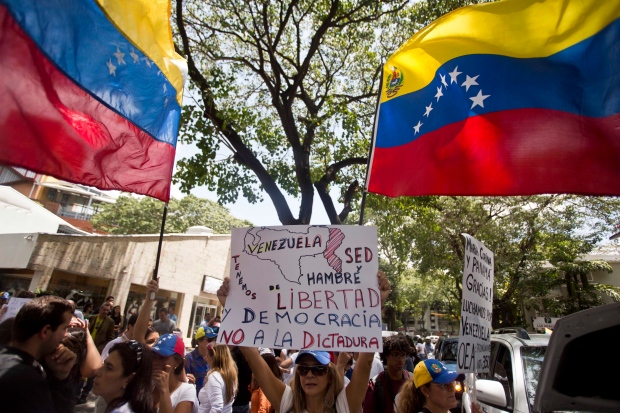
An
anti-government demonstrator holds a poster with a map outline of
Venezuela that reads in Spanish: 'We are thirsty and hungry for freedom
and democracy. No to the dictatorship,' during a protest in Caracas,
Venezuela on March 21, 2014. (AP Photo/Esteban Felix)
Now, Mr. Chavez's hand-picked successor, the redoubtable Nicolas Maduro, who swore to uphold the Bolivarian Revolution of the man he admired who left that legacy in his trust, has tasked his security forces to destroy the ambitions of Venezuelans wanting to see an end to corruption, to violence, to the chronic shortages of ordinary everyday food items. Venezuela's vast fossil fuel resources are failing the country; the infrastructure required to cope in extracting, refining and shipping has never been upgraded.
The five weeks of clashes between protesters and security forces have resulted in the deaths of 30 people, and hundreds more wounded and arrested. The fear of violence however aside, thousands of Venezuelans continue to protest peacefully but vigorously in Caracus and other cities. Demanding an end to the government's violence against dissenters by the Maduro "dictatorship", they demand also that leading opposition leader Leopoldo Lopez be freed from prison, conspiracy and arson charges dropped as the false accusations they represent.
The protests are hysterically dencounced as a U.S. backed fascist backlash against his socialist agenda by President Maduro. Foreign enemies of the country inciting dissent and violence. It is instructive to note how admiring this government is of the governing style of the Islamic Republic of Iran, and how it aspires to become as committed as the government of Cuba in its dedication to the welfare of the people, against all international odds.
Venezuelan intelligence agents have arrested the opposition mayor, Daniel Ceballos, of the city of San Cristobal, a crucible of anti-government resistance, where the current wave of protests originated. The Supreme Court announced that the opposition mayor of San Diego, Enzo Scarano, was to be removed from his post to serve ten months and 15 days in prison. He ignored a court order to ensure protesters did not barricade city streets.
Leopoldo Lopez has company. Agents from the Bolivarian National Intelligence Service arrested Mayor Ceballos in a Caracas hotel, there to attend a meeting of opposition mayors. "This is an act of justice for a mayor who not only did not meet his obligations as required by law and the constitution, but also facilitated and supported all the irrational violence in San Cristobal", explained Interior and Justice Minister Miguel Rodriguez Torres.
Twenty-five kilometres from San Cristobal, National Guardsmen fired plastic shotgun pellets and tear gas in the town of Rubio, wounding sixteen people. Soldiers with rifles stood on street corners. "The situation is terrible here", said Francisco Rincon, vice-president of the Rubio municipal council.
"This Venezuelan right-wing is especially conspiratorial and is trying
to drive a hole through our democracy," complained President Maduro. While his administration continues to drive a chasm in the wobbling Venezuela economy where analysts forecast a recession, with ongoing widespread shortages and an inflation rate that hit 57% in February.
Meanwhile, blaming the fascists trying to overturn the social order of Venezuela serves nicely as a scapegoat for a government whose administration is ruinous to the country.
198 people have been hanged so far in 2014 -- a period of only two and a half months.
"The court told me, 'You are an enemy of God. You must be hanged very
soon.' That was the sum of my entire court process. I don't have any
lawyer to defend me." — Ms. Zainab Jalalian.
Iran's grotesque human rights violations, the rise in executions, or
the fate of three Americans -- Amir Hekmati, Pastor Saeed Abedini and
Robert Levinson -- held as political prisoners inside Iran, were not
even discussed during the historic negotiations between the United
States and Iran in late 2013.
The Kurdish people, one of the largest minorities in Iran, have been
heavily targeted by the Islamic Republic since its 1979 inception when
Ayatollah Khomeini famously declared a "fatwa" [religious decree]
against the province of Kurdistan and crushed opposing unrest by sending
110,000 troops complete with heavy artillery, fighter jets and armed
helicopters. The fighting was so intense that residents were forced to
flee into the harsh mountains. Kurdish men have been executed, dozens at
a time.
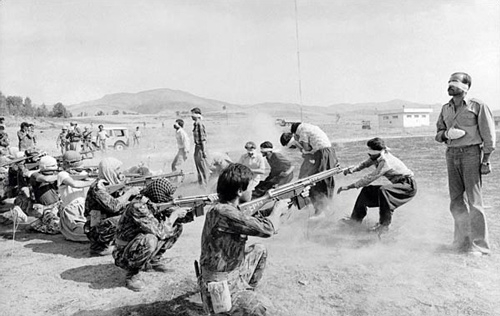
Jahangir Razmi's Pulitzer Prize-winning photograph of the execution of Kurdish men and others in 1979.
As Kurdistan continued its resistance, on September 17, 1992 three
prominent Iranian-Kurdish opposition leaders -- Sadegh Sharafkandi,
Fattah Abdoli, Homayoun Ardalan -- along with their translator, Nouri
Dehkordi, were gunned down by Iranian government agents in the Mykonos
Greek restaurant in Berlin, Germany. From 1988-1998, Islamic Republic
operatives carried out serial assassinations of opposition leaders and
Iranian dissident intellectuals, both inside and outside Iran --
assassinations later dubbed "the chain murders of Iran."
Since the Iranian revolution in 1979, the Kurdish provinces have been
neglected economically by the current government of Iran, an exclusion
that gave rise to rampant poverty. Furthermore, Kurdish political,
social and cultural rights are badly repressed by the present regime,
causing widespread resistance, including armed conflicts, inside
Kurdistan. As such, the majority of Kurds, who sympathize or hold a
membership to Kurdish opposition groups, are viewed as possible "[armed]
combatants," trying to overthrow the regime by the Islamic Republic.
This trend can be seen in the nature of the charges and the sentences
handed down to large numbers of Kurdish political prisoners, who are
systematically tortured, given death sentences or long prison terms.
Although there are many Kurdish prisoners, the exact number is unknown.
The following are two cases where the families or the victims had the
courage to contact human rights organizations, an outreach banned and
punishable by the authorities.
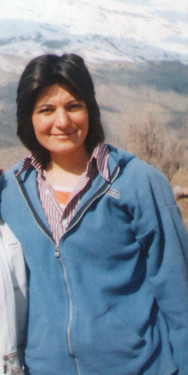
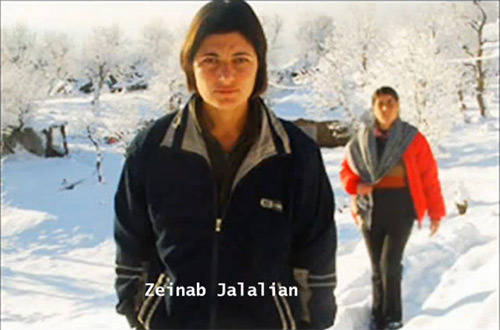
Zainab Jalalian
Ms. Zainab Jalalian was arrested in July of 2007 in the Kurdish
province of Kermanshah for allegedly being a member of a banned Kurdish
opposition group of insurgents. She was initially taken to the detention
center of Ministry of Intelligence, where she was tortured for eight
months. As a result, Ms. Jalalian began to suffer from internal and
intestinal bleeding. Two years after her arrest, in a trial that lasted
only minutes, with no legal representation, she was accused of "waging
war against God" and, at age 27, was sentenced to death. In 2010 she was
transferred to the feared Ward 209 of Evin prison in Tehran, a section
well known for torturing prisoners until they confess. There she was
told that her death sentence would be lifted if she agreed to a
televised confession admitting her "armed" involvement against the
regime. She endured by maintaining her innocence and refused their
demand. She was then transferred back to Kermanshah facilities to await
execution.
In a letter shortly after she was sentenced to death in 2009, Ms. Jalalian wrote the following:
"…I am currently ill because of torture and I don't have
any lawyer to defend me. I want to tell you that my trial took only few
minutes. The court told me: 'You are an enemy of God. You must be hanged
very soon.' That was the sum of my entire court process. I asked the
judge to give me permission to just say good-bye to my mother before my
execution. He told me to 'shut up' and rejected my request." — November 2009, letter obtained by ICAE
The Committee of Human Rights Reporters (CHRR) inside Iran created a
report in 2011 by interviewing Ms. Jalalian's former cellmates. The
report states that Ms. Jalalian was passed around like a soccer ball
between male guards while she was tied up, blindfolded and beaten. In
the first three months of her detention, she suffered such serious head
injuries that her interrogators, in a rare and unusual act, were forced
to transfer her to a hospital outside prison. The report also reveals
that she was also flogged on the soles of her feet until she passed out.
When she finally gained consciousness; she was forced to walk on her
feet and was then flogged again. She was also threatened with rape by
her interrogator; she protested, he then struck her on the head with an
iron rod, which fractured her skull, causing her to bleed profusely. It
is believed it was this blow, along with many more repeated blows to her
head, affected her vision; she was consistently denied medical care for
her injuries, despite many hunger strikes. She became blind in both
eyes.
Between 2009 and 2010, Ms. Jalalian was the subject of an
international campaign against her execution. As a direct result, her
death sentence was commuted to life in prison. Ms. Zainab Jalalian is
presently in agonizing pain due to bleeding and infection of her
intestines. The authorities are deliberately refraining from
transferring her to a city hospital for proper treatment. She has been
given no provisions for her blindness while serving time. Both her
ailments are direct result of torture while in custody.
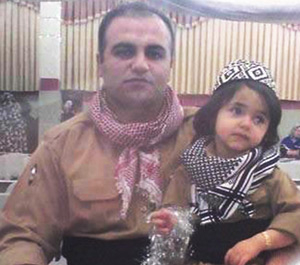
Mansur Arvand
Mr. Mansur Arvand is a Kurdish political prisoner who was arrested in
June of 2011 and sentenced to death in July 2012 on the charge of
"waging war on God" for allegedly being a member of a Kurdish opposition
party.
Mansur Arvand and his daughter.
In an interview with HRANA News Agency in 2013, Mansur's brother,
[Ismail] stated that most of Mansur's toenails were pulled out during
his interrogations and his teeth severely damaged. He emphasized that
Mansur is suffering from kidney infections that appeared only after his
arrest, after torture, and that the authorities are ignoring his
brother's serious medical needs.
In another interview with CFPPI in late 2013, Ismail stated that his
brother was flogged 70-80 times on his back and stomach, that the
torture sessions lasted 7-8 hours. He also added that the authorities
had installed a noise device in Mansur's cell in order to prevent him
from sleeping.
Mr. Mansur Arvand is kept in Orumieyeh central prison in West
Azerbaijan province of Iran. Not only is he in imminent danger of being
executed at any time; the authorities are withholding any medical care
while they continue to torture him. Thus far, human rights organizations
have not been able to overturn Mr. Arvand's death sentence.
Two prominent Kurdish political
prisoners, Mr. Habibollah Golparipour (arrested 2007) and Mr. Shirko
Moarefi (arrested 2008) were hanged respectively on October 26 and
November 4, 2013. According to many international human rights
organizations and various media; there has been a surge in the rate of
executions after President Rouhani's election. 198 people have been
hanged just in 2014 -- a period of only two and half months.
Sadly, Iran's grotesque human rights violations, the rise in
executions or the fate of three Americans -- Amir Hekmati, Pastor Saeed
Abedini and Robert Levinson -- held as political prisoners inside Iran,
were not even discussed during the historic negotiations between the
United States and Iran in late 2013.
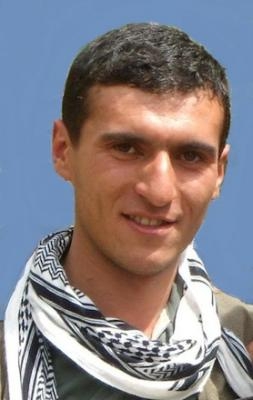
Habibollah Golparipour, Kurdish political prisoner hanged Oct 26, 2013.
Shirko Moarefi, Kurdish prisoner hanged November 4, 2013.
Never a geography of stability, the
Middle East is collapsing in upon itself in utter dysfunction as Islam
generates a new era of fanatically violent jihadists intent on
establishing a worldwide Islamist rule, returning to the concept of the
medieval-era Caliphate. Where Islam is to rule supreme, imposing Sharia
law upon all those shuddering under the weight of its demands of
submission.
Tribalism, clan loyalties, sectarian hatred
and a treasure-house of weapons have led to a vitriolic ideology of the
supreme sacrifice to be sought by the faithful to pure Islam;
martyrdom. The death cult of the martyrs eager to elevate Islam to its
rightful status on the world stage is convulsing the Middle East as one
country after another struggles to contain the appetite of violent jihad
among its young men, idle but for the promise of bloody conquest.
But
there are also other concerns that impinge on the Middle East, besides
the self-defeating hatreds between Shia and Sunni, the shared hatred of
Israel as a Western-Jewish presence on Islamic-consecrated land, and the
hatred of the despised American infidels that have embroiled the
African Maghreb as well. Oil plenitude has led to water scarcity.
Ethiopia
is damming up the Blue Nile, acutely diminishing its flow to Egypt. The
Euphrates and the Tigris rivers are drying up, impacting Syria and
Iraq. Yemen's focus on irrigation for its narcotic qat harvest has left
it limited water supplies, threatening Sana'a's future in the region
with irreparable drought conditions. Saudi Arabia is depleting its
aquifers through its wheat-growing attempts.
The
geography now suffers from increasing electricity blackouts. The birth
rate always celebrated as being among the highest in the world, is
undergoing a collapse. Iran has seen the steepest decline in birth
rates, from 6.6 births per woman in 1977 to 1.6 in 2012, creating in the
country an "apocalyptic panic" that one analyst claims fuels Tehran's
aggressive streak.
Repressive governments, archaic
social-cultural mores, the denigration of women, curriculum-poor
schools, and leaders governing with disdain for those whose lives they
control, all represent a formula for despair and ruin. Polygamy, genital
mutilation, honour killing and burqas relegate women to life in the
most oppressive area of the world. Foreign workers are brought in to do
work that oil-rich citizens disdain, and they are inhumanely exploited
without compassion.
Toronto Star
Biases within the prevailing cultures and
their Islamic overlay focusing on religion, sect, ethnic grouping,
tribal antipathies, skin colour, nationality, gender, sexual
orientation, age, citizenship, and the scourge of slavery mark out the
social conscience of the area. The governments of the states in the
Middle East expend vast amounts of treasury not on the well-being of
their people, but on advanced weaponry.
Of that
weaponry, nuclear weapons are considered the cream that many aspire to
acquire for themselves. Tanks, ships and planes are all very well, but
there is nothing like nuclear weapons to inspire respect in the Middle
East. Even al-Qaeda plots to somehow manage its search for weapons of
mass destruction, an enabling device to the achievement of their
domination goal.
And as those who live miserable lives
deprived of freedom and justice seek to leave and migrate to the world
of the West where freedoms denied them in the Middle East are a way of
life in Europe and North America, they bring along with them the
culture, the religion, the social values that led them to leave their
places of birth in desperation to achieve quality of life elsewhere.
In
the process, settling into their new freedoms, imposing upon the
societies which they join, the burdens of accepting the very issues,
values, priorities and suspicions leading to conflict that infiltrate
their societies, subtly overtaking the indigenous culture, values and
system of justice, kindly enabled through a sense of obligation to the
less fortunate.
"Everyone was looking forward to the Olympics. We just never thought they would leave us bang in the middle of a federal highway!" Alexandra Krivchenko, resident of Akatsy street
"It's a parallel universe that locals to a great extent have no access to. It has very little to do with how Sochi lives every day So far, city streets are all dug up, residents have a lot of problems and it's hard to see a happy ending after all of this construction." Olga Beskova, editor, Sochinskiye Novosti website (Sochi News)
That $634-million highway just outside Sochi right next to a crumbling apartment block with a red "SOS!" banner on its roof assaults the sensibilities of residents of 5a Akatsy street who have lived for years without running water or sewage systems. Their lives have not improved in quality with the construction for the 2014 Winter Games. The highway in particular has cut them away from the city centre. Their communal outhouse was torn down as an eyesore, too close to the new road.
This is definitely not the gleaming Sochi prepared to welcome the world by genial host Russian President Vladimir Putin, eager to show his international guests just how modern and technically acute Russia is, on this lovely tourist-attracting site on the Black Sea. Somehow the fact that a slum sits adjacent the expensive new highway was overlooked. State TV boasts luxury malls, exciting new stadiums and high-speed train links.
In Sochi thousands of people live in squalor and environmental waste with villagers living next to an illegal dump full of Olympic construction waste. And families concerned that their homes are sinking into the earth, while city dwellers suffer ongoing power cuts. Mr. Putin boasted that the Sochi Games would bring investment to this resort city, improving living conditions for its 350,000 residents. Most people have yet to see improvement of any kind in their lives.
In the village of Akhshtyr there are complaints about an illegal landfill used by an Olympics contractor. Their air has been fouled by its presence. A stream feeding the Sochi water supply has also been fouled. Waste from another illegal dump in the village of Loo has slid into a brook flowing into the Black Sea, adding to its pollution.
Just outside the Olympic Park, rumbling trucks have damaged house foundations in the village of Mirny, causing homes to sink. Across the rail tracks from the Akatsy building, a multi-family residence keeps flooding since another Olympics road was built nearby. Sochi residents are anything but thrilled at the destruction of forests and contamination of a river running down to the sea. A sandy beach popular with residents was paved over.
Sochi's mayor is utterly thrilled with all the changes. The gleaming ski resorts are amazing, he boutiques full of international brands, the new shopping malls with a Louis Vuitton store, are all symbolic, he exults, of positive change. Two huge power stations were commissioned for the provision of electricity for the Olympic venues, but power shortages across the city continue.
Thousands of people whose homes were demolished in favour of Olympic construction have been relocated, others remain waiting for new homes. Sochi's slum dwellings appear there to say; Sochi city government issued a written edict that over 100 apartment buildings and private homes have been classified as uninhabitable. But though the people on Akatsy street have petitioned for decades for that uninhabitable classification so new housing could be provided, they've been unsuccessful.
Therefore, the red "SOS!" sign over top of a crumbling building sitting about three kilometres from the Olympic Park. The property is not connected to city water or sewage systems. Residents drill wells and build outhouses. Welcome to Sochi.
In this photo taken on November 27, 2013, a new highway is seen on the fringes of the Olympic park in Sochi.
"You, Mr. President, have the opportunity to resolve this issue. Early elections will change the situation without bloodshed and we will do everything to achieve that. Tomorrow we will go forward together. And if it's a bullet in the forehead, then it's a bullet in the forehead, but in an honest, fair and brave way". Ukraine opposition leader Arseniy Yatsenyuk
Whatever getting a bullet in the head is, it's hard to think of it being either fair or brave to court it. On the other hand, Ukrainians have demonstrated for months against the Russian-favouring rule of President Viktor Yanukovych and they have decided unequivocally that the choice he made of spurning the offer by the European Union for affiliation in favour of arriving at a concord with Ukraine's former masters under the Soviet era, does not express the future they aspire to.
Mr. Yatsenyuk's and Mr. Klitschenko's demands that the president meet with them to hammer out a solution to the problems that are destroying the country's economy and its unity went unmet with a certain degree of contempt thrown in. The meeting accomplished nothing, adding to the frustration. Stimulating them to add to their demands, that the president dismiss the government, call early elections and disown the anti-protest legislation that led to protesters donning helmets and face masks in defiance.
Angering the protesters to the degree that a certain number among them became violently confrontational, but not totally unexpectedly, given that the riot police had taken to mercilessly beating those protesters that they isolated, firing water cannons in the bitter cold, and using rubber bullets fired at the people, including volunteer medics and journalists being arrested and beaten as well.
As for the people shot to death, Prime Minister Mykola Azarof insisted that since police do not use live ammunition it is the opposition that should be held responsible for the five deaths that have occurred so far. Purportedly as well the death of the man who had been abducted, taken to a forest and beaten and murdered there. The gunshot wounds were not by the police, emphatically, and the man who fell from a colonnaded gate survived, claimed the government.
President Yanukovych had initially promised Mr. Klitschko that he meant to create a commission that would settle the crisis. He had even at one point promised Mr. Yatsenyuk they could negotiate their differences. The result, however, was the anti-protest legislation rather than accommodation in any manner to demands. In defiance of which people began to put on gas masks and hard hats, setting police buses on fire, chasing and beating officers.
Stun grenades, tear gas and water cannons responded. And now police have been given permission to use water cannons on the protesters where before the pretense was that their use was only to put out fires. As plumes of smoke rose over the crowd and the blasts of the stun grenades could be heard activists chanted "Shame!" and "Revolution".
The Interior Ministry has opened a criminal case charging mass disorder. Convictions for which will lead to prison sentences of up to 15 years. Despite which, or because of which, take your pick, the protests and the riots are spreading beyond Kiev.
With Russian President Vladimir Putin warning that matter are 'getting out of hand', and the European Union looking on with genuine alarm, threatening to sanction the government.
Turkish Prime Minister Tayyip Erdogan remains the country’s most popular politician. (File photo: Reuters)
Reuters, Ankara
Saturday, 18 January 2014
Turkey has extended a purge of official bodies to the banking and
telecoms regulators and state TV, firing dozens of executives in moves
that appear to broaden Prime Minister Tayyip Erdogan’s backlash against a
corruption investigation.
The authorities have already sacked
thousands of police officers, dozens of prosecutors and some state
television officials in response to the corruption investigation, which
has become the biggest challenge to Erdogan’s 11-year rule.
Investigators are believed to have been looking into allegations of
corruption at a state-run bank and bribery involving big real estate
projects, although details of their charges have not been made public.
The combative prime minister says the investigations, which began a
month ago with arrests of high profile figures including the sons of
three of his cabinet ministers, are part of an attempted “judicial
coup”.
His opponents say they fear a purge of official bodies will destroy the independence of the judiciary, police and media.
Among dozens of officials dismissed in the latest sackings, Turkish
media reported on Saturday that the deputy head of the banking watchdog
BDDK and two department heads had been removed.
Five department
chiefs were fired at the Telecommunications Directorate (TIB), a body
that carries out electronic surveillance as well as serving as telecoms
regulator, and a dozen people were fired at Turkey’s state channel TRT,
including department heads and senior news editors.
Erdogan has
suggested the graft inquiry, which has led to the resignation of three
cabinet ministers and detention of businessmen close to the government,
is an attempt by Fethullan Gulen, a U.S.-based cleric with influence
among the police and judiciary, to undermine his rule.
Many of
the people who have been fired are believed to be associated with the
cleric’s Hizmet movement, which claims more than a million followers and
runs schools and charities throughout Turkey.
Earlier in the week the government reassigned twenty high-profile prosecutors, stepping up the purge of the judiciary.
The government has also prepared a draft bill to tighten its grip on
High Board of Judges and Prosecutors (HSYK), a panel that controls the
appointment of all judges and prosecutors.
There were heated discussions and even fights among members of parliament during talks over the draft bill last week.
Erdogan, who has presided over an extended economic boom that has
transformed Turkey and lifted millions of people from poverty, remains
the country’s most popular politician.
He and his moderate
Islamist AK Party have long battled for influence against the secularist
military establishment that dominated Turkey for a century. His
conflict with the judiciary, police and Gulen followers add to his list
of enemies.
It is still not clear what effect the crisis might
have a local elections approaching in March. Last year saw mass street
demonstrations among Turks who accuse the prime minister of
authoritarianism, but those protests did little to undermine Erdogan’s
support among his conservative base of followers.
Last Update: Saturday, 18 January 2014 KSA 17:54 - GMT 14:54
"If
you do not take care of this reservoir, it will keep threatening other
parts of the country as well. Then the final eradication would be much
more difficult." Elias Durry, head, World Health Organization's Pakistan polio eradication effort
A Pakistani child is vaccinated against polio by a health worker in Islamabad, Pakistan
An
impoverished, backward, religion-ridden area of Pakistan is the locus
of a malicious disease whose devastating effects as a destroyer of
children's health and future has been conquered throughout the modern
world. With the exception of three locations: Pakistan, where in
Peshawar, poliomyelitis thrives as a threat; Afghanistan, where the
virus commutes to; and Nigeria, where the government focuses on
persecuting homosexuals rather than eradicating deadly viruses.
Pakistan, particularly in the Northwest Frontier provinces, in Waziristan
and other mountainous godforsaken areas of the country, is criminally
backward in its government's ability to protect the most vulnerable of
the population, its children.There is an estimated 260,000 children
living in unsanitary conditions, providing the perfect venue for polio
contraction, who have remained unvaccinated, leaving them dangerously vulnerable to the disease.
This
dread disease attacks the nervous system and it is capable of killing
or paralyzing its victims. Those who are infected with the virus bring
the disease with them when they leave the tribal regions of North and
South Waziristan bordering Afghanistan. Many flooded into Peshawar, the capital of Khyber Paktunkhwa province, in fear of the violence associated with the fighting among tribal forces and government troops.
The
WHO and the government take regular test samples of the sewage water in
Peshawar, along with samples from other cities across the country. In
the last six months scientists detected the highly contagious polio
virus in all samples collected from within and around Peshawar. Pakistan
has faced pressure externally to eradicate the disease. Efforts have
been interrupted by deadly attacks against health workers and the police
who are dispatched to protect them.
The UN's
WHO has found that 90% of the polio cases around Pakistan are
genetically linked to Peshawar. If the conditions there that stimulate
the presence of the polio virus are not successfully eradicated they
will continue to infect other areas of the country as well as
Afghanistan. As long as vaccination teams continue to face deadly
opposition reaching children in those areas of the northwest that
represent the polio virus's crucible, the solution will remain evasive.
Pakistani health worker, Nooman Mehboob gives a child a polio vaccine, in Islamabad, Pakistan
And
children will continue to be laid low by the disease, many suffering
lifelong aftereffects, many more never having the opportunity to grow
into the future, struck dead at an early age by a disease the rest of
the world has long since conquered. But as far as the ignorant Islamist fanatics representing the tribal North and South Waziristan are concerned, the vaccine has an entirely other purpose.
It
is used in a nefarious Western plot to sterilize Muslim children. While
their campaign to ensure that Muslim children are not immunized does
indeed sterilize Muslim children, morbidly, mortally.
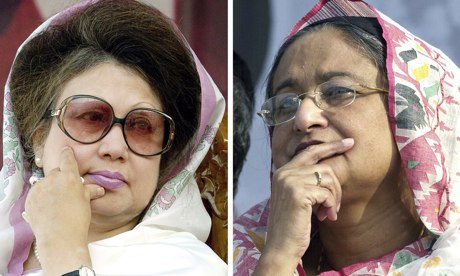
"I called you around noon. You didn't pick up." Bangladeshi Prime Minister Sheikh Hasina
"You have to listen to me first." Khaleda Zia, Opposition leader
Khaleda Zia (left) and
Sheikh Hasina Wajed: the BNP has alternated in power with the Awami
League since democracy was restored in 1991. Photograph: Farjana K
Gohuly/AFP/Getty Images
So much for feminists and other bright minds holding solidarity with feminism, believing that if women ruled the world there would be no factionalism, the Sisterhood would see to that; there would be no conflict, for women are peace-makers, enablers, accommodationists, dedicated to harmony and goodwill among all people, bringing reasonable debate to issues of contention.
Another Muslim country, one with a considerable population of some 160-million people -- mostly impoverished, like the country itself -- at war with itself. Petulantly, aggressively, tribal, clan and tooth and claw. India did itself a great favour when it agreed to partition, giving Pakistan its own geography, although the relations between the two haven't forestalled wars between the two nuclear countries and terrorist attacks from Pakistan over Kashmir.
The butchery that took place between the hordes of Muslims moving into the new Pakistan geography and the Hindus eager to see them leave, and the Hindus and Sikhs leaving the new Pakistan territory and the Muslims entering it was wholesale slaughter on a gruesome scale. And that was repeated when Bangladeshis decided it was their turn to gain their ethnic community partition with Pakistan to achieve their own sovereign country.
So now that the three countries have divided themselves, all is well. Throw in Afghanistan, Iran and the 'Stans and the viral admixture of suspicion, blame, tribal hatred, religious disunity and territorial imperatives -- a guarantee of ongoing conflict of one kind or another, and the Islamist hordes intent on jihad always to the fore. In Bangladesh, however, it's a feud between two opposing ranking dynasties vying for power in their poisonous multi-generational rivalry.
Prime Minister Sheikh Hasina's Awami League party won the Monday elections. Which was replete with street fighting, a low voter turnout and the fact that the opposition Bangladesh Nationalist Party had instituted a boycott. A tactic most puzzling, since it of course guaranteed the re-election of the very party and leader that Khaleda Zia was opposing. The logic is stunning.
"The economy is declining, democracy is being weakened and Bangladesh's march toward development is faltering. The latest election and the opposition violence linked to it shows how they could not care less about the people they say they want to serve", said Hassan Shahriar, a demoralized political analyst, in Bangladesh.
Eighteen people were killed as police fired at protesters, and opposition activists torched over one hundred polling stations on Sunday during voting. Three other people were killed on Monday. Opposition activists staged attacks, strikes and transport blockades to emphasize their demands. Those demands and the issues they have raised and the attacks emanating from them have been responsible for the deaths of 300 people since last February.
Bangladesh has been ruled for almost twenty-two years by either of these ruthlessly opposing women from powerful political families and opposing political parties. Ms. Hasina, the daughter of Bangladesh's founding leader Sheikh Mujibur Rahman, assassinated in 1975. Ms. Zia was the wife of another leader, military ruler Ziaur Rahman, who was assassinated in 1981.
And while Begum Hasina has suspicions that Begum Zia helped to plot the military coup that took her father from power in 1975 and engineered the killing of most of his family, forcing her to remain in exile in India while Ms. Zia's husband was in power, Ms. Zia suspects that Ms. Hasina was involved in her husband's removal and assassination.
So much for the presumption of grateful appreciation to one's mentor's who step forward during times of great personal stress and sorrow to carefully guide the needy into a recuperative emotional state of equilibrium and stability. Being that guiding mentor, at the very least, was the perceived role of Kim Jong Un's uncle, Jang Song Thaek, after the death of the older Kim.
Always seen as the second most powerful figure in the current Kim-dynasty of North Korea, Mr. Jang is suddenly no more, his memory degraded by having plummeted from a figure of great respect to one reviled as "despicable human scum".
Having skilfully led Kim Jong Un through a transition period when he assumed power after the death of Kim Jong Il in December 2011, Mr. Jong embraced the responsibility of helping to guide North Korea toward economic stability with enhanced political and economic ties with China, North Korea's steadfast protector on the world scene. Now, however, North Koreans have been instructred that the 67-year-old had been designing a take-over of power for himself.
Accused of corruption, womanizing, gambling and drug-taking, Mr. Jang must have understood that his life was in direct peril. Two of his close aides had already been arrested and summarily executed. For months, Mr. Jang must have been keenly aware that he was no longer being honoured to be seen in the close presence at official events with his nephew, the all-powerful great leader whose egocentrism he had helped, along with his wife, Mr. Kim's aunt, to sharpen to perfection.
The confidently smug and smiling Kim Jong Un now has new, reliable confidantes he can depend upon. Having ruthlessly struck from power and excised from life the man who had been his guide and mentor, a relative whom he had trusted, he has delivered the message that no one is immune to the fate of expendability. Placed on a pedestal of responsibility and power alongside that the great leader one day, and the following day recognized as a mendacious conniver, and destined for death.
Little wonder that anyone Mr. Kim now appoints to high office will be scrupulously loyal.
Kim Jong-un has been shown in a series of
images released by North Korean state media touring a military
institute surrounded by loyal military officers, in an apparent show of
his grip on power
The incendiary, explosively unexpected changes in the political climate, the high tension, the volcanic eruptions of high dudgeon and instant reprisal has the international community on edge. This is, after all, a hugely irascible, nuclear-armed state at perpetual war with the world with few exceptions, one being yet another regime, stridently religious as opposed to North Korea's fervent ideology of threatening hubris. Just as the Islamic Republic of Iran has celebrated the tractability of the West under pressure, so too has the Peoples Republic of North Korea.
What next, wonders the world, and most particularly South Korea toward which neighbour the North's truculently threatening belligerence has been a Sword of Damocles. While North Korea has taken steps to summon back home business people working out of the north-eastern Chinese cities of Shenyang and Dandong, South Korea waits to see whether Pyongyang will once again suspend operations at the Kaesong joint factory complex that employs 53,000 North Korean workers.
Meanwhile, the enhanced bilateral trade and investment program that Mr. Jang had worked to effect with China is being dismantled.
Jang Song-thaek
All North Korean officials and their staff placed in China by agreements arranged by Mr. Jang to strengthen ties between Pyongyant and Beijing, and accelerate a move toward economic advantage for North Korea will be recalled, along with workers. It seems sufficiently clear to some observers that the purge that began with two top officials aligned with Mr. Jang, embracing Mr. Jang himself, will now progress to all those perceived to have been loyal to the once-trusted Mr. Jang.
His Chinese-style economic reform has been rebuffed. Mr. Jang having been accused of "selling off precious resources of the country at cheap prices", opposing the "development of the industries of Juche iron, Juche fertilizer and Juche vinalon". The development of indigenous industries, it is charged, was held back in favouring trade with China in basic resources; one of the only income sources for North Korea.
Chinese authorities are nonplussed and more than a little uncertain about how to react. Non-interference in internal North Korean affairs, however, is the mantra. Despite that even China has been forced to attempt restraining tactics with Pyongyang at the alarm their defiant rocketry and threats, nuclear tests and belligerence have caused within the international community. A definite diplomatic cool-down between Beijing and Pyongyang has been seen to have taken place prior to the execution of Mr. Jang.
Kim Jong-un's uncle's once honoured and prestigious presence in official photographs has been expunged. From presenting as North Korea's sole ally in the Security Council and the United Nations, resentment and suspicion have emerged. Each time Mr. Kim's strident belligerence has surfaced, Beijing appears to have winced a little more. Their strategic alliance of student-mentor-states was coming asunder. China's recalibrated policy with an avuncular attitude toward a restive state has been noted.
Pyongyang was no longer receiving the cash infusions it depended upon from China. The high-ranking Communist Party which had formerly dealt with Pyongyang on policy had turned to the Ministry of Foreign Affairs to deal more sternly with North Korea. A list of items China had formerly routinely delivered to North Korea now gained the hands of Chinese customs officials with instructions to prevent delivery.
President Xi Jinping welcomed a state visit to Beijing by President Park Geun-hye of South Korea, and President Xi plans to reciprocate, to visit Seoul. This unforgivable snub to North Korea, where President Xi has expressed no interest in visiting Pyongyang, nor inviting Kim Jong-un to visit Beijing has stung, and the response appears to be what the world has seen publicly revealed in the downgrading of relations and the execution of North Korea's chief envoy to China.
Reports out of South Korean intelligence sources of movements of helicopters and rockets close by the maritime border with South Korea may presage preparation for another nuclear test, and an increasingly turbulent future for the area. China's only friendly, if overly-wrought relationship with a neighbour in the geography is in deep jeopardy at the very time when China's relations with the balance of its neighbours in the South China Sea and beyond are deeply fractious.
This represents a general opinion site for its author. It also offers a space for the author to record her experiences and perceptions,both personal and public. This is rendered obvious by the content contained in the blog, but the space is here inviting me to write. And so I do.