The Drums of War
"This drone was in international waters, clearly. We have it all documented. It's documented scientifically, not just words."
"[Someone] loose and stupid [in Iran shot down the drone'; this country will not stand for it, that I can tell you."
"[It made] a big, big difference [that a U.S. pilot was not threatened. The use of force is] always on the table until we get this solved."
"I don't want to kill 150 Iranians ... I don't want to kill 150 of anything or anybody unless it's absolutely necessary [by launching a retaliatory strike]."
"We very much appreciate [that Iran's Revolutionary Guard decided not to shoot down a U.S. spy plane carrying over 30 people]."
U.S. President Donald Trump
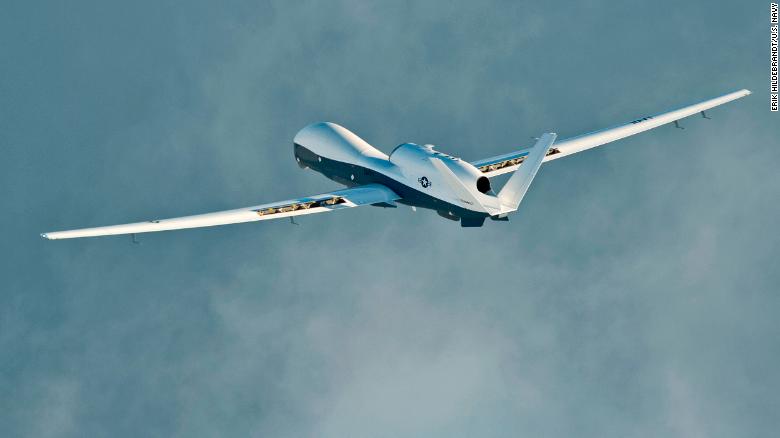
"[The drone] was shot down by an Iranian surface-to-air missile system while operating in international airspace over the Strait of Hormuz."
"This was an unprovoked attack on a U.S. surveillance asset at international airspace."
U.S. Central Command
"At 00:14 U.S. drone took off from UAE in stealth mode and violated Iranian airspace."
"We've retrieved sections of the U.S. military drone in OUR territorial waters where it was shot down."
Iranian Foreign Affairs Minister Mohammad Javad Zarif
American national security officials and White House congressional leaders debated an urgent military response last Thursday over a retaliatory strike related to the shooting down of a U.S. surveillance asset when Iran launched a missile from the Iranian coastline along the Gulf of Oman. A robust military response was favoured by Secretary of State Mike Pompeo and National Security adviser John Bolton; not so much, it appears by high-echelon military officials concerned over a spiralling escalation, trapping U.S. forces in the region.
That the drone strike took place a short while after previous Iranian disturbances which they deny but which left two damaged oil tankers that were traveling through the Strait of Hormuz, the oil world's vital waterway -- following hard on the heels of an earlier incident, and the declaration by the Islamic Republic that it planned to breach the key limits on its uranium enrichment of the 2015 pact which the U.S. withdrew from a year ago, spelled a constellation of disagreeable prospects. None of which ignored the necessity to keep Iran from possessing nuclear weapons.
 |
|
The
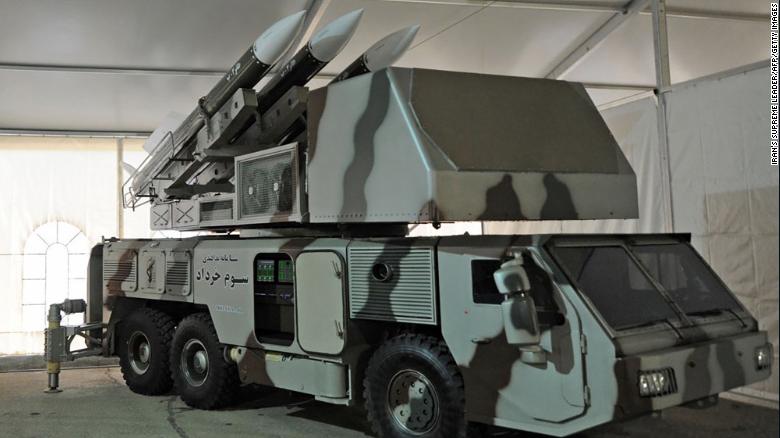
IRGC said it used a "3rd of Khordad" surface-to-air missile system,
images of which have been circulating now on social media as a symbol of
Iranian prowess
|
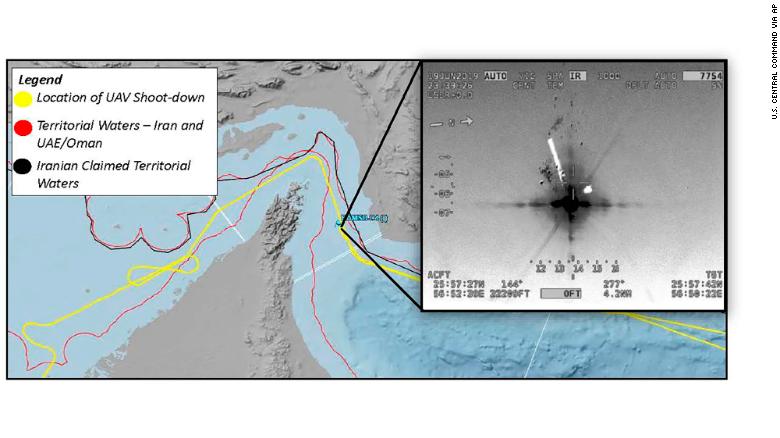
Iran released its own GPS coordinates, placing the drone 8 miles off its coast and within the 12 nautical miles from shore claimed as Iranian territorial waters. The high altitude RQ-4 Global Hawk made by Northrop Grumman was no toy, about the size of a 737, costing a cool $100 million, and developed to evade the surface-to-air missile that brought it down, serving as a wake-up call to U.S. Defense officials.
The event gave Iran cause to accuse the United States of committing
"a very dangerous and provocative act", in a dry reversal of what the U.S. most certainly could have described Iran's actions. According to a Pentagon official the drone was no closer to the coast of Iran than 21 miles, placing it firmly in international airspace. Iran's ambassador to the United Nations, helpfully explained that Tehran
"does not seek war", but
"is determined to vigorously defend its land, sea and air", and so it did...
Labels: Attacks, Drone, Gulf of Oman, Iran, Shipping, Strait of Hormuz, United States
Threat Escalation : Israel/Iran
"This is indeed a dangerous escalation that raises the spectre of direct conflict between Israel and Iran in Syria -- a far more serious situation than the drawing of red lines and tit-for-tat exchanges that have occurred before."
Robert Satloff, executive director, Institute for Near East Policy, Washington
"We are ready to exact a very heavy price from whoever acts against us. But we are not seeking an escalation."
Brig.Gen.Ronen Manelis, chief spokesperson, Israeli military
"[The downing of the Israeli F16 jet by the Syrian army marks] the start of a new strategic phase [limiting exploitation by Israel of Syrian airspace]."
"Today's developments mean the old equations have categorically ended."
Hezbollah statement
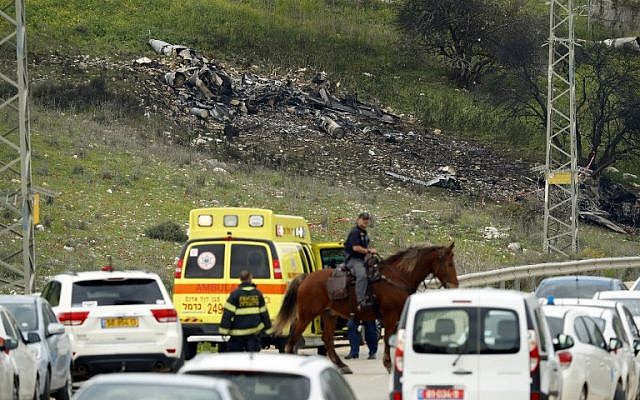
A picture taken at the northern Israeli
Kibbutz Harduf on February 10, 2018, shows the remains of an Israel F-16
that crashed after coming under fire by Syrian air defenses. (AFP
Photo/Jack Guez)
In the Arab world any perceived or imagined sign of weakness in an enemy's defence capability is a sign of victories certain to be realized. Israel's obvious capacity to meet violent challenges threatening its stability and its past record of victories in defence when faced with the implacable urgency to fend off the combined forces of surrounding Arab military groups intending to destroy the Jewish State have built a reputation of dominant force giving pause to repeat performances.
Instead of Middle East Arab states continuing their resolute plans to form large coalitions with which to attack Israel -- given the decisive wins to Israel's credit -- it is now an Aryan Persian Shiite theocracy that is threatening Israel's existence. A regime so ideologically dedicated to itself as the new arbiter of power and authority in the Middle East that its conquest plans have made its Arab neighbours fearful of their sovereign stability.
A regime whose search for nuclear weapons production paired with technologically advanced rocketry in medium- and long-range ballistic missiles has given the international community fears over Iranian aspirations and potential threats to world peace. Fears and concerns which led the United States and the European Union to hope to forestall Iran's completion of its quest by a weak and merely stalling agreement to slow its nuclear program, but leaving no doubt of its intentions.
Intentions that have been clearly and unambiguously stated that would begin with the elimination of the State of Israel from the geography of the Middle East. A situation which has latterly led to a semi-acceptance by the leaders of Arab countries of Israel's presence as the single nation among them with the reliable intelligence and fighting skills along with advanced weaponry to challenge the Islamic Republic of Iran's aspirations.
Iran has managed to consolidate its hold over Shiite-ruled Iraq, Hezbollah-run Lebanon, and Alawite-led Syria. Yemen and Qatar complete the sectarian support of Iran's plans for the future of the Middle East, and even Sunni Hamas includes itself in that nefarious scheme as far as Israel's destruction is concerned.The Israeli Defence Forces know very well that an Iranian drone unchallenged over Israeli airspace is an admission that increased traffic of this intelligence-gathering kind will increase.
It was left with no option but to destroy the intruder. And its destruction led to the understanding that this drone's blueprint was based on a technologically advanced American model that Iran had shot down and studied, enabling it to transfer that technology to a made-in-Iran model, now shattered by an Israeli helicopter. The response from Israel was to mount a series of cross-border strikes hitting the command-and-control centre where the drone had been launched from, near Palmyra.
One of Israel's F-16 fighters, returning to northern Israel, came under heavy Syrian anti-aircraft fire
(technology given to Syria from Russia), leading the two pilots to bail out before the jet crashed. Another wave of Israeli strikes followed, hitting a dozen Syrian and Iranian targets within Syria; three aerial defence batteries, four Iranian positions described as
"part of Iran's military entrenchment in Syria", and eight Syrian targets.
Effectively leading Israel to engage in direct engagement with Iranian forces for the first time. Iran's interest in securing its bases in Syria and Lebanon directly involve its plans to confront Israel. In a prolonged and agonized period of time for anti-regime forces in Syria, Russia, Turkey and the United States involved in conflict in Syria with their multiple fronts and factions, including ISIL and other Islamist jihadi groups have transformed the country into a giant battlefield.
Apart from the Israeli F-16 fighter now having been shot down, a Turkish helicopter was shot out of the sky while attacking Kurdish militias; a morale-building exercise for the Kurds, along with a Russian plane days earlier over Idlib, while bombing rebel-held territory. While Syria has claimed in the past to have shot down Israeli jets, it has not, until this current situation evolved. In response, Syrian pro-government forces have been jubilantly celebrating.
Lt. Col. Jonathan Conricus, spokesperson for the Israeli military, was neutral over whether the Israeli F-16 had been directly hit by Syrian anti-aircraft fire, other than to comment that an early assessment suggested that to be the case, not yet officially confirmed. Of the two pilots who bailed out, one sustained light injuries, the second was critically wounded, but his condition has been updated to moderate, as he regained consciousness and was removed from a respirator.
Labels: Conflict, Drone, Hezbollah, Iran, Israel, Syria, Threats


