Tuesday, December 08, 2020

COVID Vaccines: Production, Approval, Distribution, Vaccination Take-Up

Vaccine
Challenge of distribution for COVID-19   (AFP)
"We need to be absolutely  transparent about what is known and what is not known about each vaccine in order to allow people to weigh the risks and benefits of these novel vaccines."
"We must be utterly clear about who the vaccines were tested on, what kinds of safety issues we might expect -- even when they are typically very rare in vaccines -- how long the immunity from the vaccine can be expected to last, and whether or not the vaccine stops you from being able to transmit the virus." 
"Messaging around these vaccines should be fairly neutral and stick to the facts as we know them at the time."
"There simply isn't enough vaccine supply to achieve this [herd immunity] -- and we don't even know yet if these vaccines will halt transmission of COVID-19. So the choice to get the vaccine or not will be a personal health decision in the early days of immunization programs and people need to have the facts in order to make informed choices about whether and when to get vaccinated."
Allison Thompson, researcher, University of Toronto
"We can plan, but at this point  it's unknown which of the vaccines will be approved first and what quantities will come to Canada."
"The military has significant expertise in logistics, especially in medical and health service support. They will be skilled in quickly setting up places where vaccines could be administered to patients, set up processes for administration, plan logistics, routes for shipping and transport if needed."
Mahesh Nagarajan, professor of supply chain management and health care operations, Sauder School of Business, University of British Columbia

"This is a completely new platform [messenger RNA in both the Pfizer and Moderna vaccines] for a vaccine."
"The public has to understand how they work. We already have people who are worried about standard vaccines. These are even newer." 
"Many of the larger hospitals have that [sub-zero-plus] capability. But then you have to figure out how to get it out [safely to the end-user]."
"Fridges will break down. If we work hard and we're diligent, that wastage can be kept to a minimum."
Dr.Gerald Evans, chair, division of infectious diseases, Queen's University

"What we are doing is unprecedented in scale."
Dr.Kate O'Brien, director, department of immunization, vaccines and biologicals, World Health Organization
© GettyImages/Natalia Kokhanova
Getty Images  Natalia Kokhanova

The WHO's Dr. O'Brien spoke at the Canadian Immunization Conference that took place last week, addressing the complex logistics health professionals will be facing in the effort to roll out approved vaccines, taking into account measures to safeguard their efficacy, and inoculating billions of people across the globe. Public health officials have a need to identify those in the public to be given priority status, she stressed, those most in need of immediate protection from the virus simply because they represent the demographic most at risk of serious complications, often death.
 
The three vaccine front-runners still awaiting final approval destined to be distributed in Canada; Pfizer/BioNTech, Moderna and Astra-Zeneca, are two-dose vaccines. Transport and storage of the Pfizer vaccine is in and of itself a challenge since it must be stored under ultra-chilled conditions requiring freezers able to keep products at -70C. To further complicate matters it's highly likely that multiple types of vaccines will be delivered simultaneously across the country, including those to be delivered to remote and isolated parts of the Canadian geography.
 
To develop a vaccine and market it typically takes between ten and fifteen years, under normal circumstances. The advent of the novel coronavirus is anything but typical, and this is an abnormal circumstance the world is now living in -- on tenterhooks to obtain a reliable, effective and safe vaccine. And because the scientific community took heed of the desperate need and worked feverishly in many countries of the world to develop a suitable vaccine, these COVID-19 vaccines took under a year for development, now contemplating distribution.

Having to be transported over long geographic distances, vaccines undergo many transfers and types of transportation, requiring constant cold temperatures to ensure their viability. Should a vulnerability occur in the transportation link and the integrity of their ultra-cold stability be interrupted, potency can be affected and the vaccine rendered unusable. Additionally, when vials are lost, damaged or have expired and when doses are left over in multi-dose vials, a certain percentage of vaccine is wasted.The average of spoilage and waste sits at around  fifteen to 20 percent.

Due to its need of ultra-cold storage, the Pfizer vaccine -- which must be maintained at -70C and administered within five days after transfer to a refrigerator -- it is likely to be used in large cities. Having reached its destination, a dilutant is added to each vial containing vaccine to produce five doses which gives the solution six hours of effectiveness. In large cities, hospitals and research institutions equipped with suitable freezer units are to be found, whereas towns and small cities are unlikely to have these ultra-cold freezers in use which come with a price tag of $15,000 and $20,000 apiece.

Wastage occurs for the most part when the vaccine is sent to providers such as physicians' offices and clinics, unlikely to possess the refrigeration type whose quality is a requirement for vaccine efficacy preservation.  According to Dr.Halperin, central and regional storage depots are monitored and alarmed, the type of equipment not generally to be found in the offices and clinics of the end-users. The Canadian military has been tasked to work with private companies with their own competent logistical systems and delivery trucks.

 As an example, McKesson, a medical logistics provider, is able to ship, store, transport, plan and control inventory and resources for freezing and refrigeration.Vials of Pfizer's vaccine are to be shipped in large thermal boxes containing dry ice -- with companies like UPS and FedEx -- from its manufacturing site in Kalamazoo, Michigan. Moderna manufactures its vaccine in New Hampshire, Pennsylvania and Indiana, shipping through McKesson's Irving, Texas distribution centre where the hub of the U.S. government's Operation Warp Speed is located as a public-private vaccination initiative with the aim of producing and delivering 300 million doses beginning in December.

The shipping temperature for Moderna's vaccine is -20C, a temperature that will keep the vaccine stable for six months. Thawed, the vaccine can be refrigerated for up to 30 days and as such may be a more suitable candidate for dispatch to remote areas. Typically, people are required to wait for fifteen minutes post-injection, just in case an allergic reaction to the vaccine occurs. For the COVID vaccines, that wait time may be a little longer, during which time physical distancing must be maintained.

To the present, only short-term efficacy results are known. Unknown as yet is whether COVID vaccines will require boosters, and when, if required. There can be no expectation that immunity from vaccines will last longer than does natural immunity, and even that is an unknown at the present time. And then the issue of take-up presents; how many in the public will immediately agree to vaccinate. According to an Ipsos/Radio-Canada Internet poll of 3,001 people last week, 64 percent indicated they would likely or certainly get vaccinated; 16 percent that they definitely would not, and 21 percent were uncertain.

High rates of coverage always present a challenge. To achieve herd immunity for COVID, between 65 to 75 percent of the population would have to be immunized, lower as it happens than is required for infections like measles which requires substantially over 90 percent coverage. Data on long-term safety and effectiveness has been elusive outside the controlled atmosphere of clinical trials. Once it is clear a protective effect can be achieved for the community with higher uptake rates, messaging may need to change, observed Dr.Thompson. "People need to be reassured, not have their concerns dismissed as baseless." 
"For the two vaccines that require very low temperature storage, this likely means there will be less wastage because the vaccine will be more centrally controlled."
"Natural immunity lasts at least three to six months. We need to follow how people who recover from the disease do over time and we just haven't had long enough follow-up to know how long protection does last."
"If protection lasts only a year, then we will need annual vaccination like with flu vaccines."
"We need high levels of confidence and low levels of refusal."
"Some say they will [get vaccinated] but don't, others say they won't but after a few months when they see that the vaccine is well tolerated, they will."
Dr.Scott Halperin, director, Canadian Center for Vaccinology, Halifax
A person in Mainz, Germany gets a dose of the Pfizer/BioNTech vaccine as part of the product's clinical trial. Public health officials said as many as three million Canadians will be vaccinated in the first three months of 2021 (Reuters)


Labels: , , , , , ,

Friday, November 22, 2019

Embracing The Arctic

"[The Arctic is a region of] concentration of practically all aspects of national security -- military, political, economic, technological, environment and that of resources."
"[Shipping through the Northern Sea Route would increase from 20 million metric tonnes today to 80 million tonnes by 2035; this is] a realistic, well-calculated and concrete task ahead for Russia."
"[The new National Security Strategy explicitly aims to increase the] competitiveness and international prestige of the Russian Federation [in the Arctic]."
Russian President Vladimir Putin
People attend the float-out ceremony of the nuclear-powered icebreaker Ural at the Baltic Shipyard in St. Petersburg, Russia,  (Anton Vaganov/Reuters)

"Global warming in recent years has accelerated the melting of ice and snow [posing a security threat to China and the world."
"[China is] a near Arctic State, an important stakeholder in Arctic affairs."
"[China is prepared to include Arctic states in its] Belt and Road Initiative."
White paper on China's Arctic Policy
The Chinese research vessel Xue Long surrounded by ice
The Chinese icebreaking research vessel Xue Long – or Ice Dragon – has played a key part in Chinese capacity building in the Arctic since the 1990s. Photo: dracophylla

"All that's been stated before [Issues of health, sustainable development and sovereignty over the Northwest Passage]."
"What's not being stated here is any idea of how the [Canadian] government is going to address these well-known issues."
Rob Huebert, Arctic specialist, University of Calgary


President Putin's commitment to the Arctic is obvious; by 2035 Russia plans to add four nuclear icebreakers to its Arctic fleet for a total of 13 heavy icebreakers, nine nuclear. In the Arctic, Russia is a superpower, and has been since the days of the czars. Russia has its eye on the untold wealth of natural resources, both mineral and fossil fuels known to lie on and under the seabed, and Russia is eager to take possession of its generous share of that wealth, not to mention ownership of an impressive, albeit contested share of its geography.

And then there is China which despite being nowhere near the Arctic Circle -- over 7,000 kilometres' distance in fact -- considers itself a shareholder, an 'important stakeholder' with goals to explore and deepen knowledge of the Arctic, including protection of the environment, making use of Arctic resources, and actively taking part in governance of the Arctic. China joined the Arctic Council as an 'observer' in 2013, innocent enough at the time, but with long-range future consequences.

In the Spitsbergen archipelago, China built the Arctic Yellow River Station and carried out eight scientific explorations by the end of 2017. Like Russia, China is expanding its Arctic fleet as well, planning on building a second heavy icebreaker to join its first which transited the Northwest Passage in 2017. Tenders have gone out for the construction of a nuclear icebreaker to bring China in line with elite Arctic capabilities.

And Canada? It has produced a document with input from twenty-five Indigenous organizations, the territories of Nunavut, the Northwest Territories and Yukon and the provinces of Manitoba, Quebec and Newfoundland and Labrador. A wide-ranging yet unfocused document addressing the issues of climate change, melting sea ice and great power interest in the Arctic; objectives that may or may not be realized, but likely not under the current government.

What is known and anticipated is that melting ice will permit for shipping use of the Arctic sea routes connecting China and Europe. An estimated 20 days' voyage  would be sliced off the 48 days currently taken from Rotterdam to China via the Suez Canal. But the severe climate threat mandates that science must be focused along with technology to be developed and enhanced adaptation to counter the growth in greenhouse gases. Only possible through international co-operation.

Labels: , , , , , , , , ,

Saturday, July 20, 2019

One Free, Two To Go ...

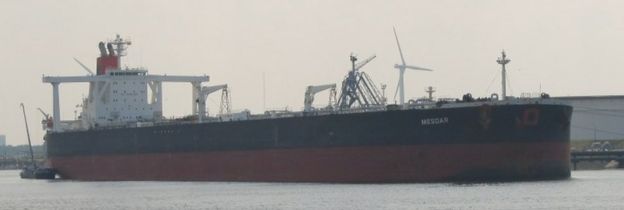
"Communication has been re-established with the vessel and Master confirmed that the armed guards have left and the vessel is free to continue the voyage."
"All crew are safe and well."
Mesdar's manager, Norbulk Shipping UK

"In a bid to identify and fight organized smuggling ... the patrol boats of the Guards' naval forces abruptly stopped one of the foreign vessels which carried 1 million litres of smuggled fuel."
Iranian Revolutionary Guard Corps
The Stena Impero
The Stena Impero
"[The ship was making an entry from the exit point of the Strait of Hormuz in the south], disregarding the established procedures that require all entries be made through the northern pass." "[The ship has been escorted to Iranian coastal waters for further legal procedures and investigations'."
Fars news agency
Britain is advising that all maritime activity in the Strait of Hormuz should be suspended for the time being, citing the piracy being engaged in by the Islamic Republic of Iran. Earlier in the week a foreign ship, accused of "smuggling fuel" was intercepted south of Larak Island, Iran, in the Strait of Hormuz, its crew of a dozen arrested. Now they've been freed. "Our analysis right now is that nothing has actually happened" reported TankerTrackers on Twitter.

According to the best guess of experts closely monitoring events the amount of onboard cargo of the ship was insignificant, that it would appear Tehran towed the vessel for the purpose of drama, a show of strength, in the wake of Britain having impounded an Iranian supertanker off Gibraltar earlier in the month. And subsequently warning Britain of consequences to come. Those consequences appear to have arrived.

The Guards' seizure of the British-tagged tanker Stena Impero is yet another risky chess move by the Republic in its undeclared war with the West. In obvious angry desperation at its inability to export Iranian oil as previously with the added U.S. sanctions that followed President Trump's withdrawal of American support for the 2015 Iranian nuclear agreement, last year, Tehran is hitting out at one of the European countries that has been at the forefront of attempting to mediate and find a way to circumvent U.S. sanctions.

It appears that a second British ship has now also been detained. This is a high stakes game Tehran is playing. All its previous provocations have mostly targeted ships belonging to its Middle East Sunni rivals. The issue of tangling with the U.S. in the matter of shooting down a U.S. drone, and the U.S. more latterly destroying an Iranian drone buzzing a U.S. naval carrier has increased tensions. Europe had attempted to remove itself from entanglement in disputes between Washington and Tehran.

British Prime Minister Theresa May has called for an emergency meeting to discuss the urgency of escalating confrontations. The meeting, explained British foreign secretary Jeremy Hunt is to determine “what we can do to swiftly secure the release of the two vessels". Later he said further, "We’re not looking at military options; we’re looking at a diplomatic way to resolve the situation. But we are very clear that it must be resolved."

The Mesdar tanker
Norbulk Shipping   The Mesdar Tanker

Labels: , , , , ,

Thursday, June 27, 2019

The Drums of War

"This drone was in international waters, clearly. We have it all documented. It's documented scientifically, not just words."
"[Someone] loose and stupid [in Iran shot down the drone'; this country will not stand for it, that I can tell you."
"[It made] a big, big difference [that a U.S. pilot was not threatened. The use of force is] always on the table until we get this solved."
"I don't want to kill 150 Iranians ... I don't want to kill 150 of anything or anybody unless it's absolutely necessary [by launching a retaliatory strike]."
"We very much appreciate [that Iran's Revolutionary Guard decided not to shoot down a U.S. spy plane carrying over 30 people]."
U.S. President Donald Trump
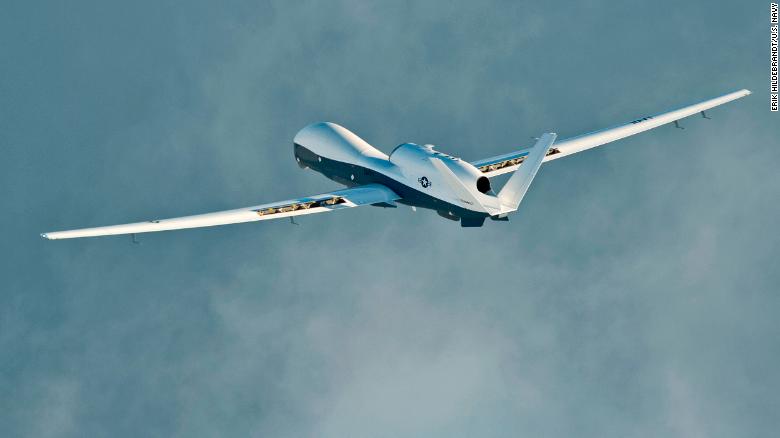
The MQ-4C Triton unmanned aircraft system completes its inaugural cross-country ferry flight at Naval Air Station Patuxent River, Maryland.
"[The drone] was shot down by an Iranian surface-to-air missile system while operating in international airspace over the Strait of Hormuz."
"This was an unprovoked attack on a U.S. surveillance asset at international airspace."
U.S. Central Command

"At 00:14 U.S. drone took off from UAE in stealth mode and violated Iranian airspace."
"We've retrieved sections of the U.S. military drone in OUR territorial waters where it was shot down."
Iranian Foreign Affairs Minister Mohammad Javad Zarif
American national security officials and White House congressional leaders debated an urgent military response last Thursday over a retaliatory strike related to the shooting down of a U.S. surveillance asset when Iran launched a missile from the Iranian coastline along the Gulf of Oman. A robust military response was favoured by Secretary of State Mike Pompeo and National Security adviser John Bolton; not so much, it appears by high-echelon military officials concerned over a spiralling escalation, trapping U.S. forces in the region.

That the drone strike took place a short while after previous Iranian disturbances which they deny but which left two damaged oil tankers that were traveling through the Strait of Hormuz, the oil world's vital waterway -- following hard on the heels of an earlier incident, and the declaration by the Islamic Republic that it planned to breach the key limits on its uranium enrichment of the 2015 pact which the U.S. withdrew from a year ago, spelled a constellation of disagreeable prospects. None of which ignored the necessity to keep Iran from possessing nuclear weapons.

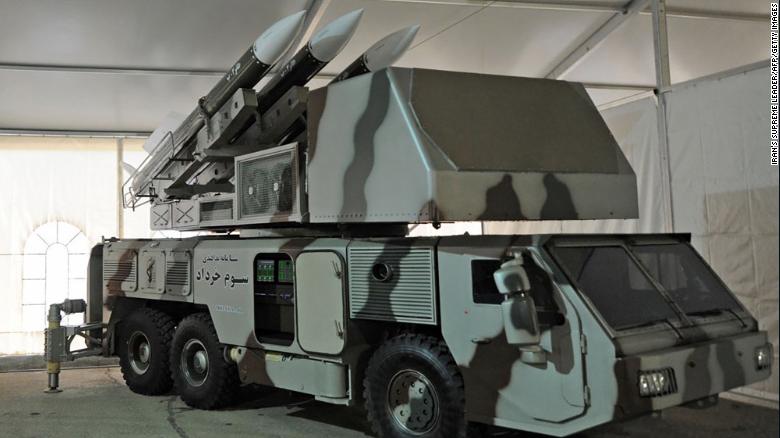
A Khordad-3 air defense system.
The IRGC said it used a "3rd of Khordad" surface-to-air missile system, images of which have been circulating now on social media as a symbol of Iranian prowess

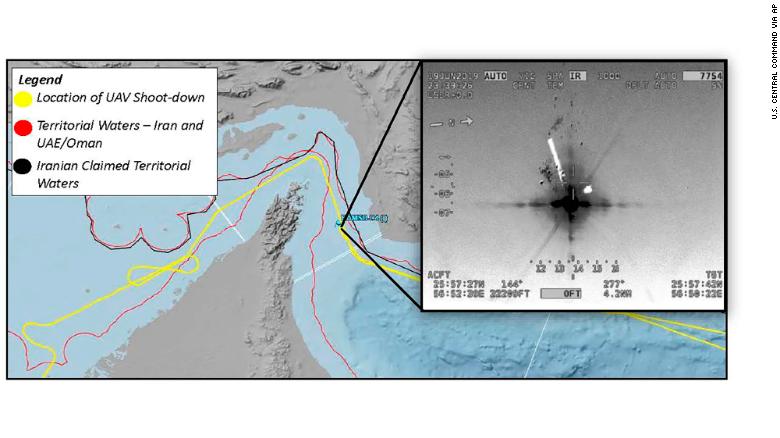
Iran released its own GPS coordinates, placing the drone 8 miles off its coast and within the 12 nautical miles from shore claimed as Iranian territorial waters. The high altitude RQ-4 Global Hawk made by Northrop Grumman was no toy, about the size of a 737, costing a cool $100 million, and developed to evade the surface-to-air missile that brought it down, serving as a wake-up call to U.S. Defense officials.

The event gave Iran cause to accuse the United States of committing "a very dangerous and provocative act", in a dry reversal of what the U.S. most certainly could have described Iran's actions. According to a Pentagon official the drone was no closer to the coast of Iran than 21 miles, placing it firmly in international airspace. Iran's ambassador to the United Nations, helpfully explained that Tehran "does not seek war", but "is determined to vigorously defend its land, sea and air", and so it did...

This image released by the U.S. military's Central Command shows what it describes as the flight path and the site where Iran shot down a US drone in the Strait of Hormuz on Thursday, June 20, 2019.

Labels: , , , , , ,

Monday, May 20, 2019

Iran's Destabilizing Influence

"Although Iran likely has no intention to target civil aircraft, the presence of multiple long-range, advanced anti-aircraft-capable weapons in a tense environment poses a possible risk of miscalculation or misidentification, especially during periods of heightened political tensions and rhetoric."
U.S. Federal Aviation Administration warning

"[The warning represents America's] psychological war against Iran."
"One cannot forget the fact that it was indeed a U.S. warship that wantonly targeted an Iranian civilian passenger aircraft [1988 accidental shooting down of an Iran Air passenger plane flying from Tehran to Dubai, mistaken for an Iranian F-14 jet-fighter during the Iran-Iraq war]."
"The U.S. has yet to apologize for that act of terrorism against Iranian civilians."
Iranian mission to the United Nations
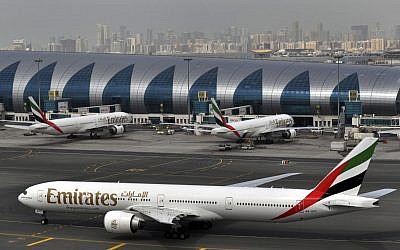
An Emirates plane taxis to a gate at Dubai International Airport at Dubai International Airport in Dubai, United Arab Emirates. (AP Photo/Adam Schreck)

What the Iranian mission to the United Nations was referring to was a 30-year-old incident when the USS Vincennes was engaged in a chase of Iranian speedboats that had opened fire on a helicopter as they fled into Iranian territorial waters.The ship mistakenly identified an Iran Air passenger jet on its way to Dubai, as an Iranian F-14 fighter jet and fired two missiles at it, resulting in the death of all aboard the flight. A tragedy in the field of combat during the Iran-Iraq war.

Young boys, aged 12-17 years, wore red headbands with the words 'Sar Allah' in Farsi (Warriors of God) and small metal keys that the Ayatollah declared were their tickets to Paradise if they were martyred in their mission
During a deadly war between two neighbours; Iran and Iraq. A war where Iranian teens were sent into minefields convinced to become martyrs whose deaths would clear the way for seasoned Iranian military troops to enter the field of combat without fear of being blown up by the mines. The Iranian teens were each given a 'key' to Paradise to take with them, a talisman that would ensure they would be rewarded for their courageous act of heroism in the greater interests of the Islamic Republic of Iran.

The current tensions in the Gulf have resulted as a stand-off between the Iranian Republic and the United States initiated with the White House pull out of the nuclear deal that President Trump cancelled, imposing fresh sanctions on Iran and the theistic regime responding that nothing would now hold them back from refining uranium to weapons-grade material. That, added to Iran's continual threats to close the Gulf to all shipping but their own and recent disabling of three ships by Hezbollah, near the United Arab Emirates coast, and a Houthi strike on Saudi Oil refineries.

More than ample provocation. And despite Iran's continual challenges to its Sunni Middle East rivals and by extension to the United States; threats aside, Iran claims to be disinterested in engaging in a full-scale war with the United States. At the very same time its Islamic Revolutionary Guard Corps heads snarl their own warning to the U.S. that should any effort be made on their part to contest Iran the costs to the United States would be beyond consequential. If there is anything that Islamic nations both Arab and Persian excel at, it's hyperbolic intimidation.

Iran feels it should be able to impose threats and intimidate its neighbours, complete with sabotaging their oil tankers and bombing oil pipelines without repercussions. They simply have to shrug and state they weren't involved, despite giving imperative orders to their affiliated terrorist groups. The hubris of the Iranian ayatollahs is beyond impressive, though it does stray into the territory of rabid fanaticism typical of fundamentalist psychopaths.

Iraq is discombobulated that ExxonMobil has abandoned ship, so to speak, evacuating their staff from Basra; obviously heeding all the warning signs of impending clashes should impetuosity continue partnering with oblivious disregard for penalties. Bahrain has ordered its citizens to leave Iraq and Iran given "the recent escalations and threats". Iraq's oil minister, Thamer al-Ghadban states:
"The temporary withdrawal of employees has nothing to do with security in southern Iraqi oil fields or any threats.The reasons are political and probably linked to tensions in the region." Well -- 'probably'.
Workers walk in the Nihran Bin Omar field north near Basra, Iraq, in 2017. An Iraqi oil official says employees of energy giant ExxonMobil have started evacuating an oil field in the southern province of Basra amid rising tensions between the United States and Iran. | AP

The White House response to the Iranian challenges to the European partners of the nuclear deal and allied threats has been to order an aircraft carrier and B-52 jet bombers into the area. Perhaps a trifle more ominous is the order for all non-essential U.S. staff to remove themselves from diplomatic posts in Iraq. A move that Iraq views with considerable alarm; pitting it between its two allies, the Islamic Republic of Iran and the United States of America. A most uncomfortable position it has no wish to occupy.

Yet neither is U.S. President Donald Trump "seeking war". Still the 60-day warning deadline for new terms whose absence will hasten the enrichment of uranium to weapons-grade for a Tehran that has no interest in nuclear weapons, much less the building of atomic warheads to sit atop those more technologically advanced Intercontinental Ballistic Missiles Iran has boasted could reach the continental U.S. mainland... Oh, and Israel, the lesser of the two targets in difficulty in achieving Iran's goal, but the greater of its ambitions.

Aircraft flying in the region, warning aside, noted the FAA in its heads-up to Airmen, cautions that all commercial aircraft in flight over the Persian Gulf and the Gulf of Oman must be aware of Iranian weaponry and fighter jets; that aircraft might conceivably experience navigation instruments interference and jamming of their communications systems "with little to no warning".

"There has never been a threat or risk to civilian air traffic in the Persian Gulf from Iran" responded Alireza Miryousefi, Minister and head of Media office, Iranian Mission to the United Nations.

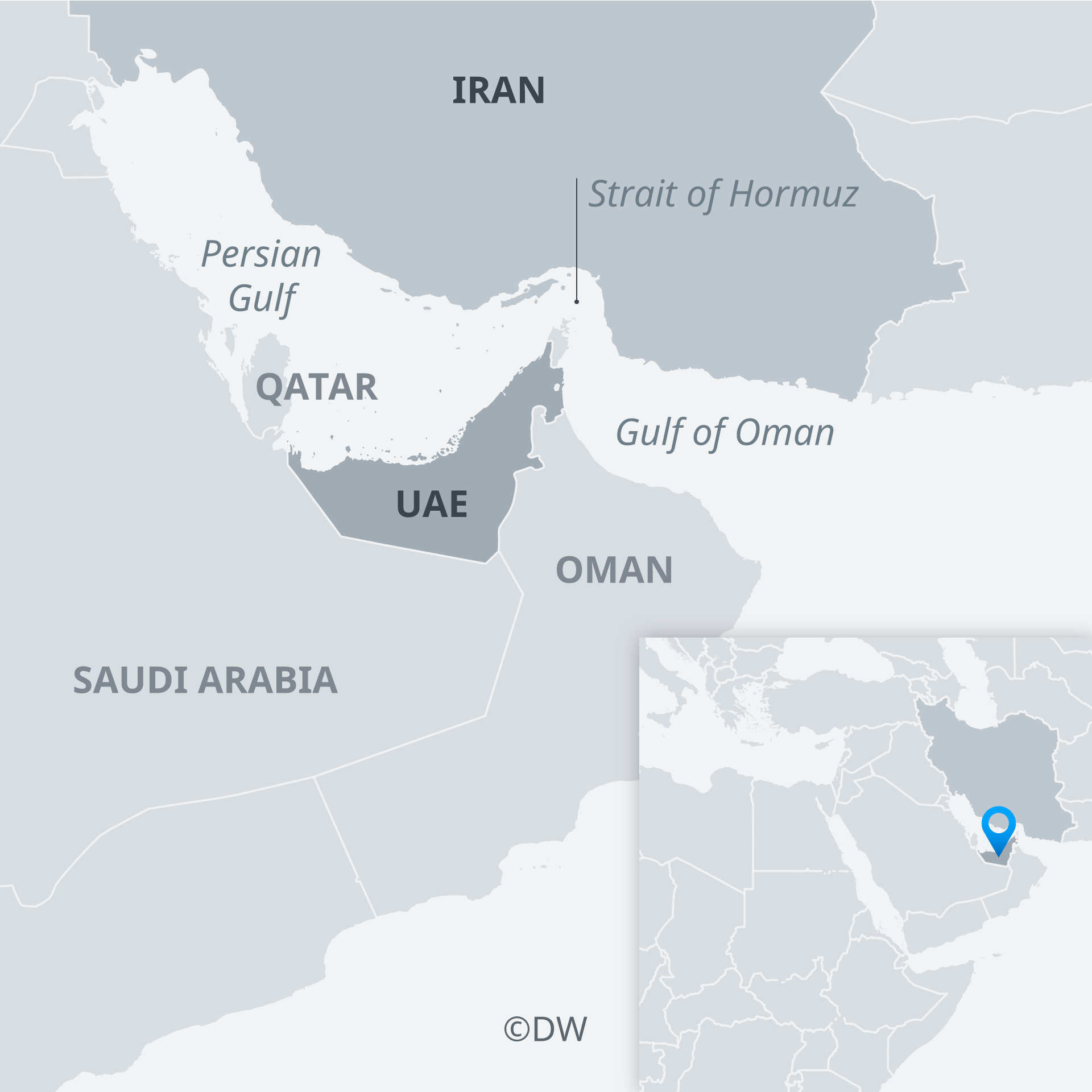
Map showing Iran, United Arab Emirates, Saudi Arabia and the Gulf of Oman


Labels: , , , , ,

Follow @rheytah Tweet