Friday, April 07, 2023

Pakistan, Teetering on Insecurity Stilts


"Pakistan is facing a triple crisis. It's facing a threat from the Pakistani Taliban. A collapsing economy; And, polarization and political chaos on the street."
"Pakistani leaders seem woefully unprepared for tackling the challenge and continue to fight each other rather than finding solutions for the country"
Farahnaz Ispahani, former Pakistan parliamentarian

"Looking at the seven years from FY16 to FU22. Pakistan's cumulative current account deficit was $74.5 billion, while the State Bank's forex reserves fell by $3.6 billion during this period."
"This means Pakistan needed financing of $70.9 billion, and borrowed $65 billion."
"Foreign investment barely financed the external deficit, so the government just kept borrowing."
"Since foreign creditors are reluctant to continue lending, Pakistan's external sector has become unsustainable."
Dawn, Pakistan's leading English language newspaper
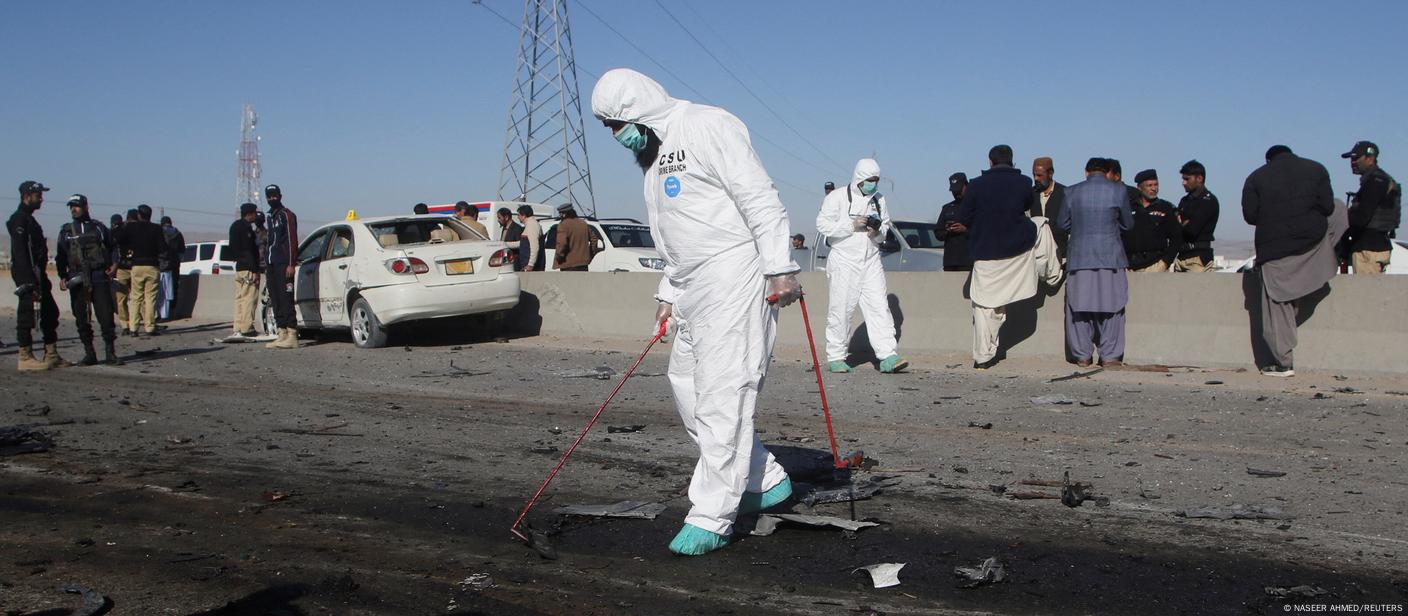
A member of a crime scene unit surveys the site after a suicide bomb blast on a police patrol in Quetta on November 30, 2022
The banned militant group Tehreek-e-Taliban Pakistan (TTP) has ended a cease-fire agreement with the government, and vowed to launch attacks across Pakistan. What will this mean for the country's economy?  DW.com
 
Pakistan, one does best to recall, is a seething cauldron of backward Islamists. Violence and uninhibited threats percolate on the streets of Pakistan's cities when fiery-throated Islamists go about preaching jihad while deploring the presence of western-style shops selling music, and where male and female friends congregate together in restaurants. A country where the minority Christian population is threatened and persecuted when haters can accuse Christians of denigrating the Prophet Mohammad and face a death penalty.

The successive governments of Pakistan plotted against Afghanistan, anxious their neighbour not form an alliance with India. Pakistan invested itself in forming, training and arming the Afghan Taliban, giving its leaders haven at a time that US. forces led an international, UN-NATO force to dislodge the Taliban and al-Qaeda's Osama bin Laden who took credit for planning the aerial attacks against the World Trade Center in New York, the Pentagon in Washington.

Osama bin Laden himself had sanctuary in Pakistan where his family compound was discovered in Abbottabad, not far from an elite military academy. A Pakistani doctor whose own home was next to the bin Laden compound, a secret location for an 'unknown' occupant, helped the CIA identify that unknown occupant whom Navy Seals subsequently dispatched. The Pakistani doctor was arrested, held responsible as a traitor, and incarcerated.

Pakistan's military with its embedded Intelligence Agency, was well infiltrated by their own Taliban, as radical a group of hardcore Islamists as the Afghan Taliban. As a nuclear nation the very prospect of these terrorists potentially having access to Pakistan's nuclear arsenal is mind-boggling. The Taliban threat that Pakistan now faces is one that emerged many years ago, its growth to the point where it challenges the government of Pakistan, just as Afghanistan experienced with the viperous group Pakistan bequeathed to its neighbour.

Now, the Islamic Republic of Pakistan with its immense population of close to 233 million. occupying a land mass of 881,913 square kilometres faces an existential crisis brought about by its own incapacity to govern itself wisely and well. Its focus on its hostility with India from which it broke away in 1947 following British rule leading to a cataclysmic separation and the retaliatory deaths of countless Muslims and Hindus has kept the threat of resurgent conflict alive, over the mutually contested Kashmir.

Pakistan's army has been the traditional fount of emerging leaders. Since its independence there have been three military coups and four military rulers. One of its non-military rulers, Benazir Bhutto, was assassinated by raging fanatical Islamists. Pakistan is currently in a state of political and financial collapse. Former prime minister Imran Khan whose tenure came to a forced halt in April 2022 through a non-confidence parliamentary vote imprisoned other politicians including one of his predecessors, Nawaz Sharif, along with Maryan Nawaz Sharif, the daughter.

Now presiding as Prime Minister of Pakistan is younger brother Shehbaz Sharif. A turf war between Khan's Pakistan Tehreek-e-Insaf political party and a coalition of opposition parties, the Pakistan Democratic Movement, has Pakistan at a political standstill. The Pakistani army sides with the U.S. State Department, and Khan was leading the country into a Russia-Chinese camp. Unseated from power he encourages supporters to violent encounters with the law.

Inadequately governed, Pakistan's institutions are collapsing; educational institutions in particular. High unemployment, poverty and an increase in the Consumer Price Index of 31.5 percent has sent more families into poverty. What the country desperately needs is guidance from a secular-minded, seriously capable leader who can lead it toward normalization with India and the establishment of diplomatic relations with Israel. 

And what the world needs from Pakistan, is the accepted presence of an internationally designated body of specialists to manage Pakistan's nuclear arms in the assurance that should its condition further destabilize those nuclear arms will not be seized by the fanatics crawling about in huge disruptively threatening numbers in Pakistan.
<strong>With Pakistan’s economy in freefall, Chinese economic and military influence is likely to grow in the country</strong>
In the midst of yet another economic crisis, Pakistan is currently facing significant upheaval in the political, economic, and security domains. Amplified by near-historic polarization among ruling elites, the rapidly deteriorating situation has significant implications on near- and long-term Chinese influence in the country.  Atlantic Council

Labels: , , , , ,

Friday, January 04, 2019

Collegial Relations in Fair Weather and Foul

"[The equipment installed on the ships will be Chinese, demonstrating aptly China's] progress in the industry and the Pakistani Navy's confidence in our technology and capability."
"I believe the reason they chose our type is that ours is one of the few that can carry out all of the air-defence, anti-ship and anti-submarine tasks."  
"The service of Type 054APs will double the combat power of the Pakistani Navy's surface fleet."
Cao Weidong, researcher, PLA Naval Military Studies Research Institute, China
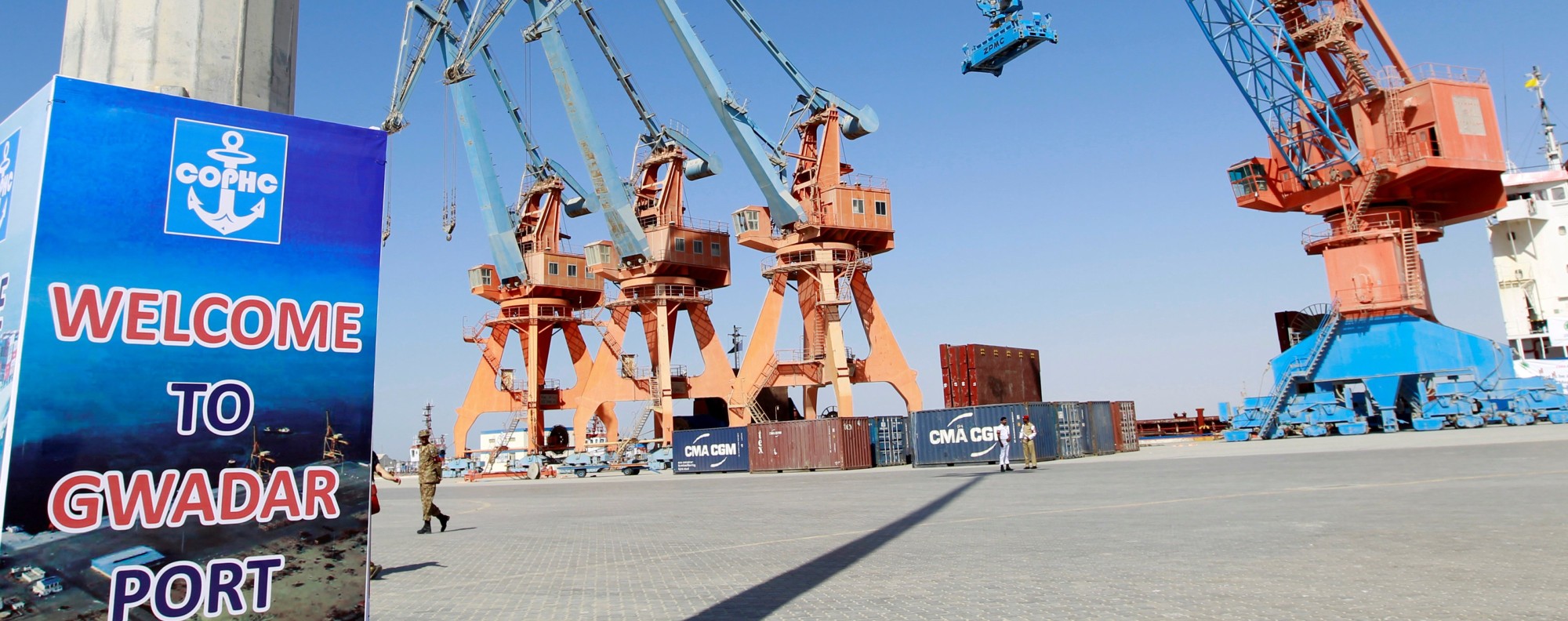
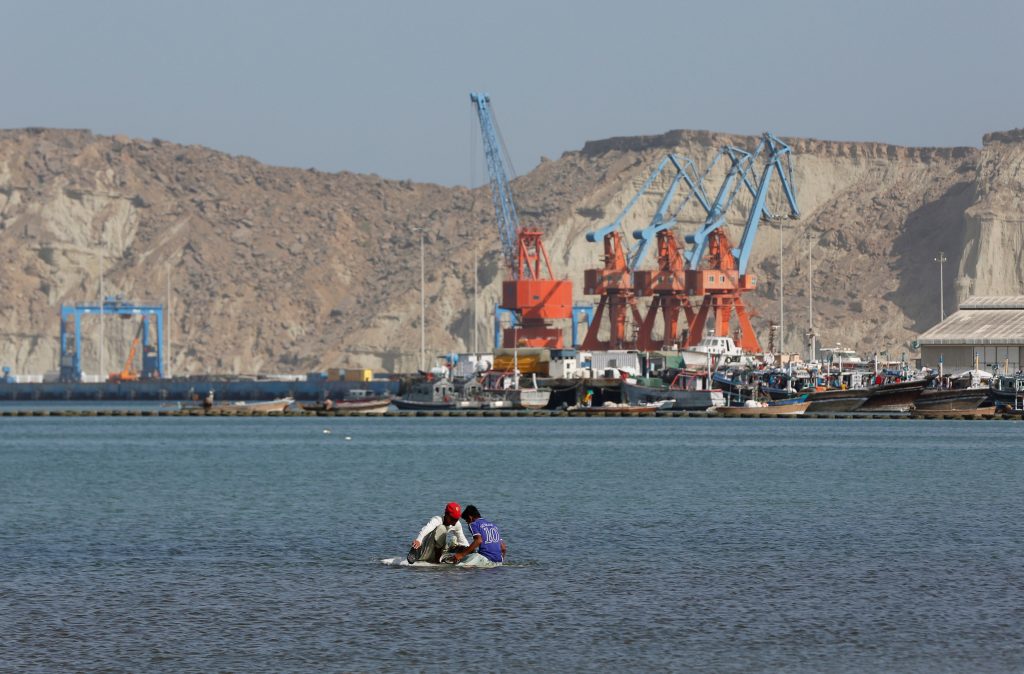
A general view of the port before the inauguration of the China-Pakistan Economic Corridor port in Gwadar. Photo: Reuters
The BLA [Baloch Liberation Army] has deemed China an “oppressor” and alleges that the country is taking benefit of Balochistan’s geostrategic location for its own benefit. Photo: Reuters

“The Chinese side has offered and will continue to offer its best through assistance, trade, investment and all-around practical cooperation to support and boost Pakistan’s economic and social development."
"[Pakistan and China are] all-weather strategic partners [and both have been] in close communication with each other on the relevant cooperation."
Chinese foreign ministry spokesman Lu Kang

The vessel exported to Pakistan is said to be based on Type 054A, pictured above. — Photo courtesy China Daily
Photo: Courtesy China Daily
The final touches on a secret proposal -- evidently no longer secret -- to expand Pakistan's role in building Chinese military jets, weaponry and other hardware have been concluded between the Pakistani Air Force and Chinese officials whereby the cooperation between the two nuclear-armed countries is deepening even while the Pentagon feels that Beijing's ultimate goal is the militarization of space, playing catch-up in its own inimitable way.

Now that the U.S. has declared through a Trumpian announcement that it will no longer pay billions to sponsor Pakistan's military and secret service, all is not lost for Pakistan for here is China, filling the financial gap with military projects ostensibly representing part of China's Belt and Road Initiative representing a whopping $1 trillion infrastructure development chain to stretch across 70 countries, financed and built, courtesy of Beijing.

The Belt and Road project is, of course an economic initiative, nothing more, nothing less. Unless of course it is also more or less partly military in nature, as most things China is interested in tend to be at their core. Some transparency has evolved, however, linking economics and the military vision with China tying a Belt and Road project to its very own military ambitions, which just happen to tie in with Pakistan's. Not all in Pakistan are delighted, however, and revolt at the presence of China.

Pakistani security personnel take position near the compound of the Chinese consulate in Karachi after it was stormed in an attack reportedly claimed by the Baloch Liberation Army. Photo: EPA
Pakistani security personnel take position near the compound of the Chinese consulate in Karachi, after it was stormed in an attack claimed by the Baloch Liberation Army. Photo: EPA

An estimated $62-billion  in projects have been planned for the China-Pakistan Economic Corridor, it seems, with China lending funding to Pakistan in its time of dire financial need and nothing quite binds as does the transfer of money. A seaport built by China and a special economic zone in the town of Gwadar in Pakistan while rooted in trade allowing China a swifter route to the Arabian Sea, also gifts Beijing with a strategic game against India and the U.S. should tensions increase toward the possibility of naval blockades.

Furthermore, China's Beidou satellite navigation system in direct competition with the American military-operated GPS network is in play with Pakistan representing the only country granted access to the system's military service to allow more precise guidance for missiles, ships and aircraft. If nothing else, this cooperation between the two will consolidate the final cleaving of Pakistan's reliance on American funding.

The two countries' shared borders alongside a history of cooperation where a hedge against India also is realized, Pakistan represents a large market for arms sales and trade, alongside a wealth of natural resources to be exploited, an enterprise beloved of resource-hungry China. Foreign investment in Pakistan has been scarce resulting from terrorist attacks and corruption, so China's inauguration of Belt and Road was welcomed back in 2013.

Pakistan's central bank revealed an overall debt and liability burden of close to $215-billion held externally and Pakistan currently owes China $23-billion with close to half of the projects in completed state. A larger figure of $62-billion under the plan for Belt and Road expansion, however, is what Pakistan will end up owing China, inextricably linking the two; one a dependent, the other in charge. A special economic zone is to be created to produce new fighter jets in Pakistan.

Factories in the country will be set to produce navigation systems, radar systems and onboard weapons, expanding the two countries' cooperation on the JF-17 fighter jet assembled at the military-operated Kamra Aeronautical Complex in Punjab Province, allowing Pakistan an alternative to the U.S.built F-16 fighters increasingly more difficult to obtain in reflection of the fraying relations with Washington.
Pakistani President Mamnoon Hussain, Chinese President Xi Jinping, and Pakistani Prime Minister Nawaz Sharif, at Nur Khan air base in Islamabad on April 20, 2015.
Pakistani President Mamnoon Hussain, Chinese President Xi Jinping, and  then-Pakistani Prime Minister Nawaz Sharif, at Nur Khan air base in Islamabad on April 20, 2015. (Press Information Department/Government of Pakistan)

Labels: , , ,

Follow @rheytah Tweet