Sincerely Ingenuous
Sincerely Ingenuous
 |
| Prime Minister Justin Trudeau (The Canadian Press/Sean Kilpatrick) |
"I
knew there would be perception issues around this [family ties to a
charity his government chose to distribute a $912-million student
disbursement for volunteerism to]."
"At
the same time, delivering a grant program to students who volunteer
across the country has absolutely nothing to do with any work my brother
or mother did with WE [WE Charity], and that's why there was no
conflict of interest."
"We [Cabinet] pulled the item from the agenda so that we could be doing the right thing, the way."
"I wanted to push back and really make sure that everyone could say
without a shadow of a doubt that this was…the way to deliver the program
recommended by our outstanding and professional public servants."
"As
Mr. Morneau [Finance Minister] himself highlighted, he apologized and
he should not have accepted the elements of that, that were gifts."
"The idea that someone on their personal vacation would choose to
support a good cause or get involved in helping make the world a better
place is not something that we should reject or turn away from."
Prime Minister Justin Trudeau
"Multiple ministers and senior officials have testified at the finance committee."
"Not
one of them said that the prime minister pulled the WE proposal from
the May 8 cabinet meeting and sent it back for further scrutiny."
Conservative Leader Andrew Scheer
The
Parliamentary finance committee in conducting their investigation into
the highly unusual situation whereby a sole-sourced contract for a
proposed Canada Student Service Grant was granted to a
charity that happened to be supported and hugely favoured by the prime
minister, his family, the minister of finance and his family, had
invited quite a few individuals to appear before them in friendly
question-and-answer settings (through remote video connection).
Among others, a number of senior civil servants. From whom came the
information that the connection between the Trudeau family and the WE
Charity was widely known among them.
That, in
fact, this specific charity and none other, catering to youth, inspiring
youth to reach out and give aid to other youth in the international
community much less fortunate, as well as speaking out against child
labour and investing in educational opportunities for children living in
abject poverty in developing countries, would be hugely favoured as a
result, to be named the beneficiary of a lucrative contract. This was
important because the prime minister insisted repeatedly that it was not
he who arranged for the contract to be sole-sourced to WE Charity, but
the civil service, and he was completely ignorant of their choice.
Until
he no longer was, when he was finally apprised of his most favoured
charity for which he had himself attended well publicized, popular and
crowd-thick inspirational meetings, speaking to the adoring throngs of
youth, taken with the message of dedicated volunteerism. Dedicated
volunteerism is what the public witnessed when they listened to an
enthusiastic Margaret Trudeau speak on numerous occasions to spellbound
WE Charity supporters. As did her son, Alexandre, Justin Trudeau's
younger brother.
However, they did so to the
tune of remuneration totalling a third of a million dollars, where
Margaret Trudeau herself banked $250,000 for her 28 inspiring speeches.
The prime minister's wife, Sophie Gregoire Trudeau, was another enthused
volunteer and spokesperson for the charity. The finance minister's two
daughters were also heavily involved with WE Charity, one a contract
employee, the other a speaker. This is a charity that has, besides its
charitable purpose, a for-profit arm, a real estate arm, a tourism arm,
and an associated contract-signing arm separate from the charity itself,
but signing for it.
WE Charity excels in
extending invitations to wealthy donors for all-expense-paid trips to
some of its overseas ventures. Mr. Morneau and his family accepted two
such trips in 2017, one to Ecuador, the other to Kenya. By all accounts
quite wonderful trips to see the good work of the charity in action, and
to stay at luxury accommodation in a truly unique environment for a
feel-good purpose. Mr. Morneau is a multi-millionaire. The trips his
family took were estimated to the value of $93,000. Mr. Morneau
suddenly recalled, on the eve he was to appear before the finance
committee, that he 'owed' WE Charity $41,000 in connection with those
trips, and he speedily wrote a cheque, albeit 3 years after the events.
When
he responded to questions at the finance committee investigation, Mr.
Trudeau gave what he considered to be perfectly valid, explicable
responses; among the most salient that his 'talented' family generously
gave of their time, and that the connection between their being paid by
this charity and the charity being chosen for a prestigious,
high-profile vote-getting program was completely above-board. Nothing to
see here, folks move on, because the prime minister insists there was
nothing unethical; the cause unassailable, everyone involved
well-meaning.
There are other Parliamentary
enquiries into this situation in the offing. The Parliamentary Ethics
Commissioner has committed to investigating Justin Trudeau and Bill
Morneau, both for the third time, for ethics violations. On the two
previous occasions, both men were found to have gone afoul of
Parliamentary ethics. The entire situation is nothing more, nothing
less, than business-as-usual for this Liberal government. A finance
minister handling Canada's finances and handing out tens of billions of
treasury for Liberal government COVID-19-related support to business and
the unemployed and students, who cannot keep abreast of his own
personal finances.
A prime minister who feels
entitled to believe that anything he decides would be in the best
interests of the country should go unquestioned, and to that end
manipulated a situation whereby a second-tier opposition party agreed to
support a motion to suspend Parliament for the duration of the
SARS-CoV-2 pandemic roiling the world, until such time as a vaccine is
discovered and widely available. Setting the stage for this prime
minister to govern like a true autocrat whose decisions cannot be
questioned. Had Parliament been fully restored, opposition parties would
have been able to intervene in this situation.
The
fact that the charity was in deep financial trouble would have been
noted and questioned. Its real estate holdings, unusual in size and
breadth for a charity would have been noted and questioned. Its default
on its banking obligations would have been noted and questioned. Its
firing of 400 employees would have been noted and questioned; after all,
how could such an ambitious program such as the student grants be
administered short-handed? Most telling of all, the resignation of the
chair of the WE Charity board of directors would have been noted and
questioned.
/https://www.thestar.com/content/dam/thestar/politics/federal/2020/07/28/i-was-told-to-quit-for-asking-about-financial-records-says-former-we-charity-board-chair/michelle_douglas.jpg) |
Former WE Charity Board Chair, Michelle Douglas 'testifying'
|
That
most other members of the board chose to leave along with the chair
should certainly have been a flapping red flag. Michelle Douglas too
appeared before the finance committee to respond to questions put to
her. She described feeling uneasy and puzzled that upon request and even
after pressing, she and the board were unable to obtain copies of WE
Charity finances. She was troubled by the precipitate firing of 400
employees which she felt to be completely inappropriate and unnecessary.
When, in a telephone conversation with the Kielburgers she insisted on
seeing financial records, the line went dead.
Subsequently she was requested to hand in her resignation. “It was our view that you don’t fire
hundreds of people without very strong demonstrable evidence, and even
then should explore mitigation measures to save jobs", she explained to the
committee. "Instead, the executive team were dismissing employees with great speed and in large numbers." As for payment to speakers, she and the board had been led to believe that all speakers did so voluntarily. "The WE Charity board always understood that speakers were not
paid by the charity or the related organizations to speak at WE Day. The
board made direct inquiries on this issue."
 |
| Co-founders of WE Craig (left) and Marc Kielburger (right) are seen on
stage during WE Day California in Inglewood, California, U.S. April 25,
2019. The brothers spent four hours in front of a committee of MPs today
answering questions about their role in the federal government's
student grant program. (Mario Anzuoni/Reuters) |
Marc
and Craig Keilburger, co-founders of WE Charity and all its stunningly
complicated arms initiated work on administering the controversial
Student Volunteer Grant program well before it had been approved to
proceed by Cabinet. They had, they explained, been advised by
departmental officials that they could feel free to incur expenses
related to the disbursement program prior to to being informed the
agreement had been formally awarded to WE Charity. Their haste, they
explained, had nothing whatever to do with anticipating the $43-million
profit that would come their way; they were assiduous in starting for
the simple reason that delay would harm the program.
The idea was to get as many university students unable to find summer jobs during the COVID
pandemic involved as soon possible, to enable them to have the
financial wherewithal to pay for their forthcoming tuition when the
university year commenced. And so, they overlooked the possibility that
the agreement would not come through and they stood a chance of
forfeiting any expenditures on their part, for the greater good of the
country, because this is what they're all about; making the world a
better place.
"That
was a decision that they took because they knew how important it was to
get this program going and they assumed certain risks in going forward
and starting to spend on a program that hadn't yet been approved by
cabinet and would not be approved for another few weeks", explained Mr. Trudeau, in their defence and his own. Ungenerously, the leader of the opposition, Mr. Scheer, responded "Why
was WE so sure that they were going to be approved? Why were they told
they could start charging expenses before the program was even
approved?"
As for
Justin Trudeau's forgiving attitude over Bill Morneau's ill-advised
acceptance of an all-expense-paid trip hosted by a charity he and his
family have generously supported, it's hardly surprising. Given that
Justin Trudeau and his family were pleased to accept just such a trip
whose invitation was extended by the Aga Khan for them to enjoy
Christmas at his private island in the Bahamas. Justin Trudeau
innocently described the trip as a gift from a family friend, and
couldn't see what the fuss was all about. That was the first time that
the Ethics Commissioner issued a rebuke for trangressing Parliamentary
ethics when he was found to have violated sections 5, 11, 12 and 21 of the Conflict of Interest Act.
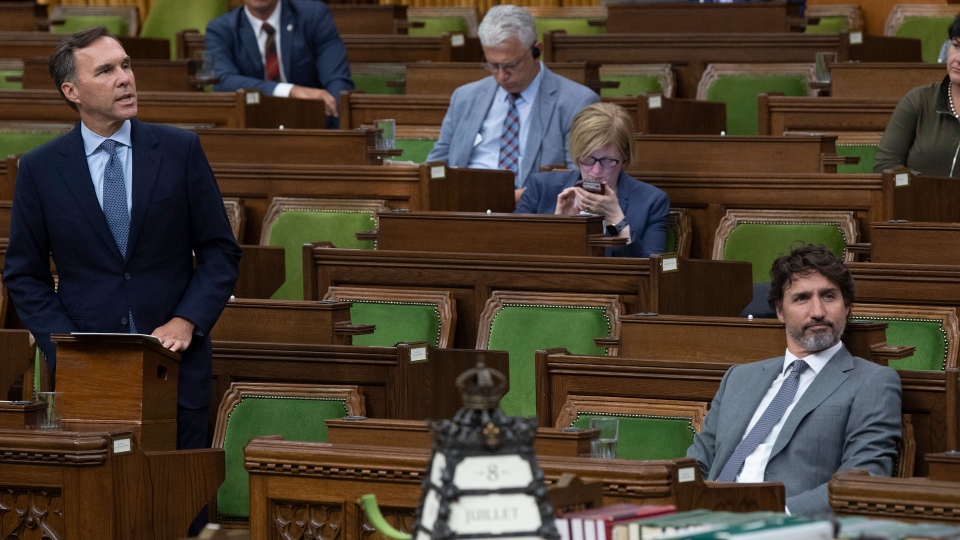 |
| Minister of Finance Bill Morneau rises in the House of Commons to
deliver a fiscal snapshot as Prime Minister Justin Trudeau looks on,
Wednesday, July 8, 2020 in Ottawa. THE CANADIAN PRESS/Adrian Wyld |
Labels: Egotism, Ethical Failures, Ethics, Ethics Commissioner, Government of Justin Trudeau
The Meaning of Life
"[With brain organoids], the closer the proxy gets to a functioning human brain, the more ethically problematic it becomes."
"Given these constraints, the possibility of organoids becoming conscious to some degree, or of acquiring other higher-order properties, such as the ability to feel distress, seems highly remote."
"But organoids are becoming increasingly complex."
Report, journal Nature
"Health Canada should issue public guidance regarding how the AHRA [Assisted Human Reproduction Act] applies to SHEEFs [synthetic human entities with embryo-like features] to avoid an unnecessary chill on promising avenues of research while ensuring scientists are not risking criminal liability for work in currently ambiguous areas."
Panel of ethical, scientific policy and legal experts paper
 |
| A donated human embryo is seen through a microscope at the La Jolla IVF Clinic February 28, 2007 in La Jolla, California.
Sandy Huffaker/Getty Images |
"We actually have to think substantively about exactly what it is about
these different anatomical features — or the different stages of
development that we’re worried about."
"And how do we draw really clear and distinct
lines so that we can unlock the scientific potential of this research,
while also respecting moral limits on what we should do."
Jonathan Kimmelman, bioethicist, McGill
University
It could be a nightmare scenario in the near future. One that morality, ethics and scientific care must heed. Scientists at California's Salk Institute, as an example, announced they succeeded in transplanting human brain organoids into the brains of lab rodents. What this means is that laboratory-produced organoids -- balls of stem cells forming an organized cohesion -- have now been exposed to a blood supply, crucial to their further development.
Without a blood supply organoids are capable of dividing and developing only in a limited manner. Grafted into mice brains the human brain tissue has been enabled to develop further, with new neurons firing in synchronized patterns. Imagine the complications and consequences of a human brain trapped within a rodent brain housed in a rodent head and body and this is a nightmare scenario of potentially untold proportions.
Scientists are inordinately curious about what can be accomplished in a laboratory. Producing miniaturized human brains in a petri dish considered to be lab-grown "synthetic" embryos represent another potential combination whose consequences wreak havoc with the imagination. A potent human brain within a hybrid, synthetic body that acts and reacts for all intents and purposes just like a human body designed by nature -- and what is the final result?
Scientists in laboratories precipitate balls of stem cells to gather themselves into organized groups to become structures accurately mimicking the natural process whereby eyes, livers, brains develop in mice. Now that it's been done with mice curiosity wants to bell the cat further by achieving similar results with human stem cells to produce embryos. The goal ostensibly is a noble enough one, to produce proto-organs for the study of diseases, to screen new drugs, to eventually produce new tissues and organs for transplant purposes.
The concern for many ethicists, scientists and philosophers in this issue is what happens when the first human embryo created from stem cells develops? To this point in the experimental process brain organoids are minuscule in size, the largest about four millimetres in diameter, containing two to three million cells in contrast to an adult brain measuring about 1,350 cubic centimetres, comprised of 86 billion neurons alone.
The future of these experiments may not be too far ahead as organoids do become increasingly complex. Neural activity, in fact, was seen in an organoid when a light was shone on the region where retina cells had formed along with cells of the brain, demonstrating that
"an external stimulus can result in an organoid response". Now SHEEFs are also being experimented with as more complex and organized assembljes. Rather than producing one organ, SHEEFs combine several.
These synthetic human entities with embryo-like features produce unnatural combinations such as a human-like form and a beating heart, absent a brain. Though early in development, the question arises whether they fall into the category of experiments requiring protection around their use. A panel of ethical, scientific, policy and legal experts urging reforms to Canada's Assisted Human Reproduction Act feel current prohibitions banning embryo creation for research should not extend to synthetic forms
"and likely incapable of developing into a human being".
The panel recommended that SHEEFs be
"explicitly excluded" from prohibitions under the Act, that an oversight committee be struck to determine limits on their creation or their use. Published in the journal
Healthcare Policy, the paper is one among a series to come out of a workshop funded by the Stem Cell Network.
"The law clearly when it was made in 2004 did not contemplate anything like this", health law professor Ubaka Ogbogu at the University of Alberta and the paper's senior author stated.
Scientists argued in a paper published in
eLife last year that SHEEPs not be tied to the 14-day rule where research is limited by prohibition to the period before the appearance of the
"primitive streak" (a band of cells that mark the beginnings of a central nervous system), scientists should list a catalogue of features aligning with
"moral status", yet it remains unclear which features could qualify and how to test for their presence.
Labels: Bioscience, Controversy, Embryo, Ethics, Research


