Sunday, October 24, 2021

Morbid Distaste Over Medical Advance in Xenografting ...?

"...But then I thought, 'Well, why not use someone who is now dead due to brain death, and we know they're dead' -- that's absolutely clear. We could minimize the risk to the first human that we're really going to try to transplant."
"I asked our docs, could you learn from this? And they said, you're right. We could." 
"The family was very enthusiastic. I certainly would not want to be doing it without the family saying, 'This is something my loved one would want to do, and we fully support it."
"The answer is, they are really dead, and you can do experiments because we have the means artificially to keep major body organs and cells working even when the person has passed away."
Arthur Caplan, medical ethicist, NYU Langone Health, New York City

"If the public gets the impression that organ donation could lead to something like this, people may find this very disturbing."
"There are many people in our society that would not consider someone that is brain-dead and still with a heartbeat and perfusing and blood flowing as being completely dead."
"But I also see the potential is there to save a lot of lives if it were successful."
"Some people would say this is as disrespectful of the dead as anything can be and others would say it's not. I think the yuck factor -- I'm using a very unscientific term here -- would be quite high with the public."
Kerry Bowman, medical ethicist, Family and Community Medicine, University of Toronto
A genetically engineered pig kidney appears healthy during a transplant operation at NYU Langone in New York, US, in this undated handout photo. — Reuters

There are laws and regulations that cover ethics in medical practise in specific focus on the living. None exist of a similar nature to govern research on humans that apply to the brain-dead. People are urged to sign organ-donor cards, permitting their organs on death to be harvested and used for human organ transplant, a vital life-saving program that gives new meaning to 'saving a life'. But there are never sufficient numbers of volunteered organs to supply the urgent needs of people awaiting organ transplant and many die during that agonizing wait period.

The question being raised is whether those same people who so generously see their organs being used to extend the lives of other seriously ill people, could ever foresee and be comfortable with the prospect that their own dead body might be maintained in an organ-functioning state despite their having departed that body, for research and experimental purposes. Whether they might differentiate 'saving a life' with their organs used in desperate medical straits, or their entire body and its in situ organs being used to advance medical science.

In September at NYU Langone, surgeons incised the upper leg of a brain-dead woman to attach a pig kidney to her blood vessels. An experiment in the potential of using a genetically modified pig in lieu of a human organ to extend a life when a person's natural kidneys stop functioning. Transplanting an organ from another species -- even so a pig whose genetics are so close to that of humans -- would normally result in the body's immune system instantly rejecting the intruder organ and death would quickly follow.

In this case, the pig's genetic makeup had been altered to exclude a triggering sugar molecule, called alpha-gal to prevent rejection. It  took three days while the kidney was attached to the brain-dead subject's blood vessels where researchers had access to it outside the body, and no "hyper-acute" rejection occurred. Maintained on a ventilator for 54 hours, surgeons watching for symptoms of rejection. The kidney functioned like a normal human kidney, producing urine, cleansing blood.
 
A surgical team at the hospital in New York examined a pig kidney attached to the body of a brain-dead recipient for any signs of rejection.
   Credit...Joe Carrotta/N.Y.U. Langone Health, via Associated Press
Dr.Caplan's theory that the use of a brain-dead body for a brief experiment in pig organ functionality transplanted into a human body without rejection resulting, which he discussed at length and intimately with surgeons at his medical facility proved a success. Dr.Caplan published a paper in 2019 with a colleague, who is an attorney and medical ethicist, along with other members of the NYU Medical Ethics Working Group on Research on the Recently Deceased.

Writing that the procedure "can seem frightening or abhorrent", raising complex ethical challenges "It is appropriate for experimentation to be done in humans due to the potential for cross-species complications, if they were to be studied in other animals." The understanding that for some people transplanting animal organs into people is not an agreeable prospect, aside from the fact that some people find it difficult to accept that brain death equals total body/brain death. 

Yet we eat pigs as part of our normal diets. We are what we eat. In consuming animals something of them is integrated within ourselves; we are sustained physically by ending their lives to continue ours. Materials derived from pigs have long been used in furthering human life, from the production of insulin to heart valve replacements, the choice of which can be pig tissues or carbon-material valves. Biological or mechanical heart valve replacement...
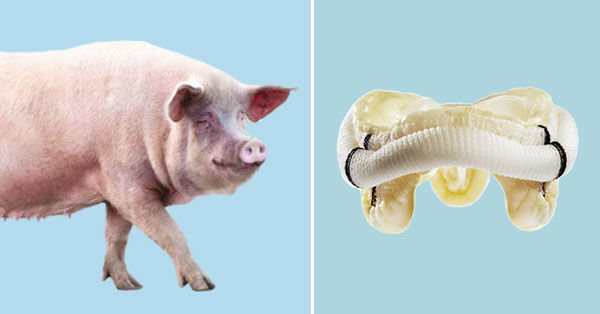
Epic Pig Valve Replacement (Abbott)
Epic Pig Valve Replacement (Abbott Laboratories)


Labels: , , ,

Sunday, February 21, 2021

Will Wonders Never Cease? NASA's Perseverance!

"In the days to come, engineers will pore over the rover’s system data, updating its software and beginning to test its various instruments. In the following weeks, Perseverance will test its robotic arm and take its first, short drive. It will be at least one or two months until Perseverance will find a flat location to drop off Ingenuity, the mini-helicopter attached to the rover’s belly, and even longer before it finally hits the road, beginning its science mission and searching for its first sample of Martian rock and sediment."
"A primary objective for Perseverance’s mission on Mars is astrobiology research, including the search for signs of ancient microbial life. The rover will characterize the planet’s geology and past climate and be the first mission to collect and cache Martian rock and regolith, paving the way for human exploration of the Red Planet."
"Subsequent NASA missions, in cooperation with ESA (European Space Agency), will send spacecraft to Mars to collect these cached samples from the surface and return them to Earth for in-depth analysis."
"The Mars 2020 Perseverance mission is part of NASA’s Moon to Mars exploration approach, which includes Artemis missions to the Moon that will help prepare for human exploration of the Red Planet."
NASA Science 
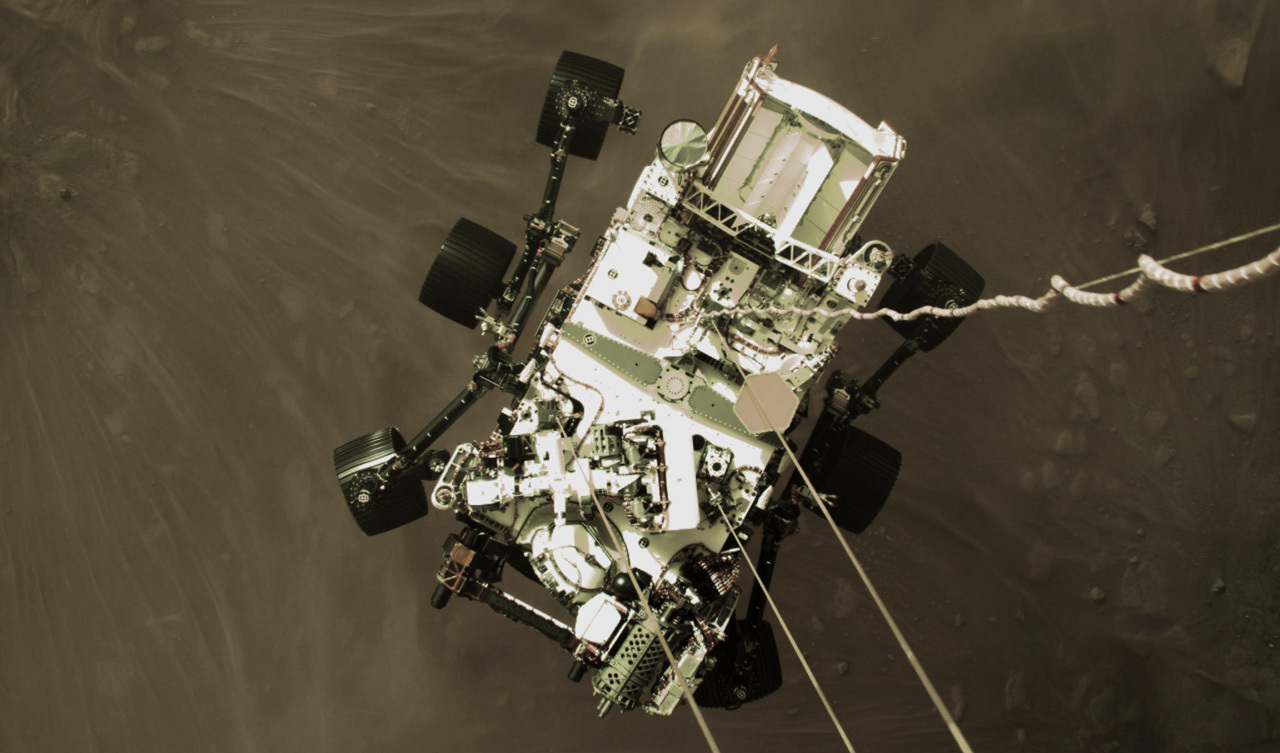
An image of the Perseverance rover as it touched down on Mars

This is a high-resolution still image, part of a video taken by several cameras as NASA’s Perseverance rover touched down on Mars. A camera aboard the descent stage captured this shot. Credit: NASA/JPL-Caltech.

Truly, it boggles the mind. he technological marvel that is this machinery enabling a launch into outer space to a far distant planet within our galaxy; oh, perhaps not so distant, at a mere 209 million kilometers. NASA has succeeded wondrously in sending its newest science rover Perseverance through the Martian atmosphere to land right where its designated set-down spot was determined to be most advantageous to the search for an ancient prospective biological footprint.The floor of a vast crater that was once a lake.
 
Perseverance is a laboratory, an advanced astrobiology lab, and it is now in another world destined to continue making cosmic history for humanity as it sets out to search for traces of microbial life, as it has been exquisitely programmed to do. When radio signals confirmed that the rover survived its gripping descent to arrive within the target zone inside Jezero Crater, NASA's Jet Propulsion Laboratory burst into applause with relief and jubilation. 
 
Mars 2020 Map
 
It took the robotic vehicle close to seven months zooming through space as it covered 472 million kilometres to penetrate the Martian atmosphere, doing so at 19,000 km/hr as it approached touchdown. Touchdown accomplished, Perseverance beamed its initial images from the Martian surface. Radio waves take 11 minutes to travel between Mars and Earth; signals relayed to Earth from a satellite orbiting Mars informed the NASA lab of the success of the landing.

A complex series of manoeuvres had resulted in the self-guided descent and landing; representing the most elaborate, technologically challenging choreograph ever designed and succeeding in robotic space flight. "It really is the beginning of a new era", exulted NASA's associate administrator for science, Thomas Zurbuchen, of the event that represented the riskiest portion of the two-year, $2.7-billion investment with the aim to search for any potential fossilized signs of microbial life once having flourished three billion years ago on a warmer, wetter, hospitable-to-life Mars.
 
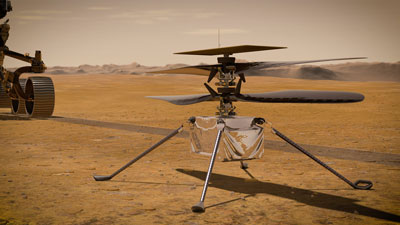
Mars Helicopter, Ingenuity
The Mars Helicopter, Ingenuity, is a technology demonstration to test powered flight on another world for the first time.

The hope is that samples of ancient sediments extracted from Martian rocks for analysis on Earth at a future date will contain biosignatures embedded there, informing scientists of the presence -- or absence -- of evolutionary biology, however primitive, on the red planet. There will be two Mars missions to follow with a goal of retrieving the samples to return them to NASA, within a decade. Perseverance is packed with instruments to enable the craft to build on previous findings.

There is a device meant to convert carbon dioxide in the Martian atmosphere into oxygen via a box-shaped tool, the first of its kind to extract a natural resource for use by humans from an extraterrestrial environment -- a prospective assurance that future manned expeditions can be assured a source of oxygen, one that will also be used to produce rocket propellant for returning astronauts to Earth. A miniature helicopter, weighing 1.8-kilograms is designed as a test of the first powered, controlled flight on another planet.

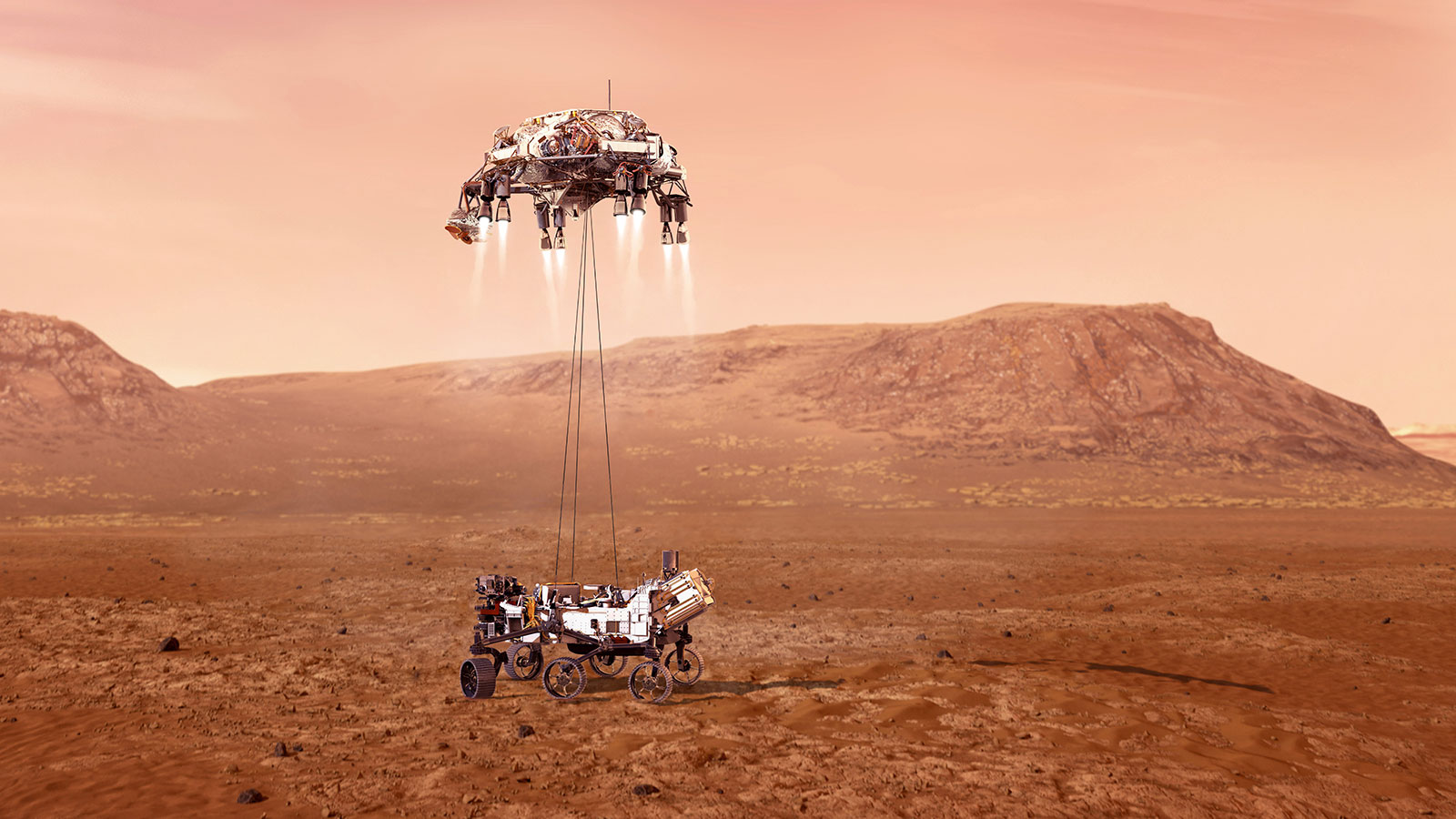
To gain its position within the designated landing stage, the multistage spacecraft hoisting the rover soared to the top of the Martian atmosphere at close to 16 times the speed of sound on Earth, an aerodynamic lift that jet thrusters then adjusted in its trajectory followed by a supersonic parachute inflation to slow the descent. Deployment of a rocket-powered "sky crane" vehicle then flew to a landing spot to lower the rover on tethers. And the deed was done!

https://mars.nasa.gov/layout/mars2020/images/09_Touchdown-web.jpg
Mars Perseverance, Landed February 18, 2021  NASA Science

Labels: , , , , ,

Follow @rheytah Tweet