"The cultivation of poppy was so that your kids could go to school, so you could buy clothes, so you could get something extra." "Because of that, the poppy became a magic plant: It permitted you to breathe economically. The fact that it was an illegal crop didn't matter." Abel Barrera, director, Tlachinaollan, La Montana human rights group "I don't know what happened and suddenly the price fell." "We could no longer buy a lot of things: corn, all the necessities." Ricardo, 19, San Miguel Amoltepec Vicjo, Montana region, Guerrero state, Mexico
"We're taking care of this situation." "Many are being taken care of and they will all be taken care of." President Andres Manuel Lopez Obrador, Mexico
A Guerrero community police member stands guard at an illegal poppy
field in Heliodoro Castillo, Guerrero state, Mexico, on March 25, 2018. PEDRO PARDO/AFP/Getty Images
"We ask that they give us everything we need—the equipment, the seeds,
the temporary employment—to support us to produce the crop [fruit trees]." "Otherwise, we don’t even have enough here to eat." Community Commissioner, Ruperto Pacheco, La Sierra
Farmers in a poor region of southwest Mexico were able to earn money growing poppies, bleeding the milk latex from the pods that developed after the beautiful blossoms bloomed and profiting from the raw material for opium consumed mostly in the United States. The farmers were focused on poppy as a paying crop, not on poppy as a drug that was illegal, shattered lives and profited drug cartels, keeping police agencies busy trying to stop a trade that was unstoppable, as seemed the gang murders and targeting of police, lawyers, journalists who opposed the trade.
It was a living, however illicit, as the raw material for opium. And then suddenly it was no longer a means by which a family could depend on making a living. At the peak of the 2017 market, farmers were able to sell their opium resin for up to $1,300 per kilogram. Then there was the mysterious slide in its saleability when the same product in the same amount brought in a mere $110 per kilogram and suddenly that living evaporated. A 90 percent drop in earnings meant farms collapsing and families separating with young men seeking employment elsewhere, across the border into the U.S.
The bread and butter economy for about 50,000 people regionally coincided with the steady importation from China of the laboratory-produced opioid synthetic fentanyl, and opium use declined accordingly, for there was no need for opium gum when cheap and plentiful fentanyl was available. An already impoverished society became even more needy. And since the war on drugs continued as the U.S. pressured Mexico, Army helicopters continued to destroy a thousand hectares of poppy crops.
In La Sierra, community leaders representing nine areas petitioned the national Senate for funding in the planting of a thousand hectares of fruit trees regionally, to help kickstart the process of raising legal, sustainable produce so farmers could continue to till the land, grow crops, provide for their families. Nothing is ever simple, and abandoning poppy growing for other passably lucrative crops would take time, patience and funding the farmers didn't have. The soil had to be repaired, farm plots redesigned for trees to grow alongside beans and corn for family use. And then the wait for the trees to mature.
Farmers near the village of San Miguel Amoltepec Viejo clearing a field of dead poppy flowers so it can be planted with corn.Credit Brett Gundlock for The New York Times
Income from poppy resin allowed farm families to remain together, putting an end to migration so parents had the comfort of having their children grow up on the farm, making for a strong community. With the evaporating of income from opium poppy nothing was left to secure the family unit, leading to another, large-scale migration from the region, some of the migrants heading to more prosperous regions than the Montana area to find work in agricultural fields and factories in Mexico.
Others kept on moving, heading to the United States, to agricultural communities in California where previous migrants from Guerrero had put down roots in Mexican enclaves. Despite their president's acknowledgement of the crisis for Guerrero poppy farmers, none of the promised financial aid and crop substitution programs heralded by President Obrador has yet materialized.
Growing poppies was for many years a source of good and stable income in the La Montaña region. Credit Brett Gundlock for The New York Times
"Nigerians in their thousands have been gruesomely dispatched to the Great Beyond by armed Fulani herdsmen who are being protected by the powers that be." Emmanuel Onwukibo, coordinator, Human Rights Writers' Association of Nigeria
"The reverend fathers [Christian priests killed along with parishioners during Mass] were not farmers." "The armed herdsmen have moved the narrative of the current crisis from search for grass to other obvious motives [promoting Islam through jihad to the detriment of Christianity]." Christian Governor Samuel Ortom, Benue State
"[President Muhammadu Buhari is running out of time to convince Christians that a] grand mischievous plan for territorial conquest, ethnic cleansing and religious imposition] by Muslim Fulanis is not in the works]." "The very survival of our nation is now at stake." Catholic Archbishop of Abuja John Onaiyekan, Abuja, Nigeria
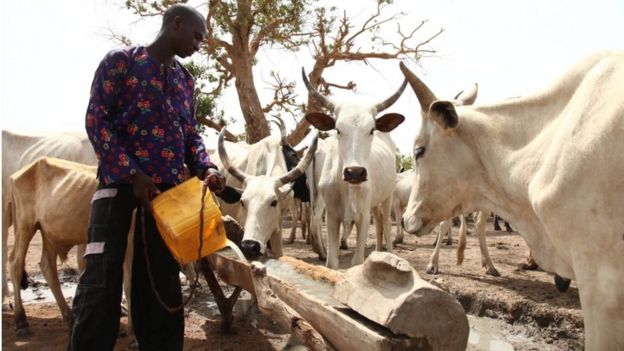
A Fulani herdsman waters his cattle (file picture)AFP/GettyImages
Nigeria is special; it is Africa's largest, wealthiest country and its most populous. It is divided by Christianity and Islam. And it has its very own special deadly radical Islamist terrorist group defying authority and stalking and murdering Nigerian villagers, abducting young girls and creating countless homeless people desperate to escape their depredations. It had a Christian president and now has a Muslim president, both of whom pledged to rout Boko Haram and neither of whom succeeded.
And though Nigeria is one of those rare African countries with great natural resources and has considerable income from petroleum, there isn't much of a trickle-down effect to ensure that the country's wealth is equally shared. There are, throughout Africa, droughts impacting on agriculture and cattle-raising, and since the two enterprises are diametrically opposed, there is great tension between the herdsmen wanting to graze their herds, and the agriculturalists who want their fields unmolested.
Climate change has impacted Africa, bringing stress and deadly hostility between herdsmen and agriculturalists to the fore in South Sudan and the Central African Republic. Muslims and Christians have turned against one another in confrontations for that very same reason in Nigeria. Armed cattle herders, Muslims of the Fulani tribe, have raised militias in Nigeria, just as has occurred in northern Kenya where farmers both white and black have been killed.
In Nigeria, hundreds of thousands of people have vacated farms and villages, leaving their homes to abandonment. Where crops are not being raised, hunger, economic collapse and disease spreading in camps for the displaced looms on the near horizon. Aggression on the part of semi-nomadic cattle herders from the Fulani ethnic group, some 20 million in number, their territory spread across west and central Africa, threatens stability.
Traditional pasturage in the north of Nigeria has collapsed as it has elsewhere in some northern African states where up to 75 percent of grassland has been transformed through desertification. Water sources have been disappearing alongside attacks by Boko Harm to combine circumstances thrusting the Fulani and their herds into the fertile central farmlands of Nigeria; the Middle Belt, home to a Christian majority population.
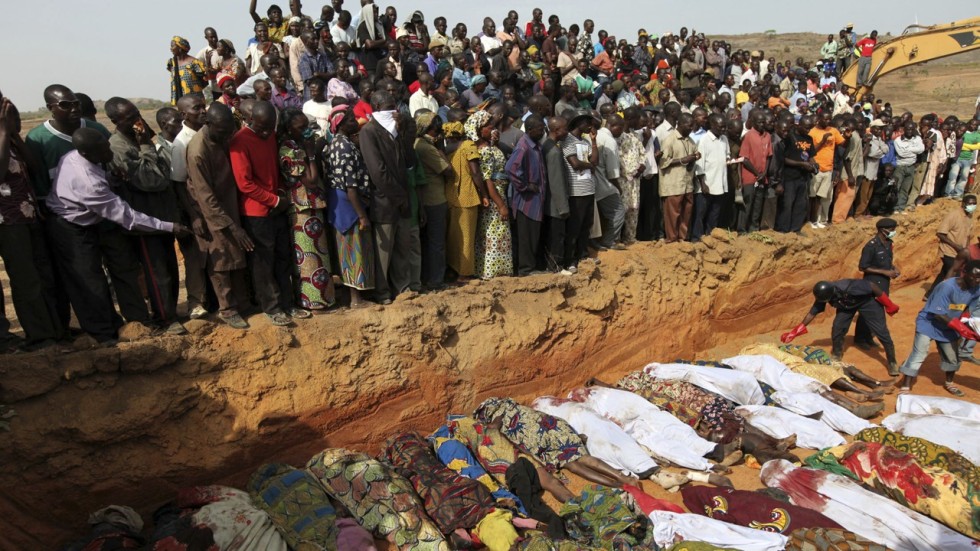
Local authorities and farmers' attempts to protect crops and farmland has resulted in reprisals where farmers tending their crops have had their hands severed, stuffed into their pockets as examples meant to terrify other farmers to abandon their fields. Fulani gangs on motorcycles attack villages and the terrorized inhabitants flee as the gangs open fire, set fire to homes, hack children to death. In a village in Kaduna state last month 71 people were killed.
Even some Fulani have been slaughtered by their fellow tribesmen in this battle between agriculture and herding. But it's not solely herders involved in these attacks. Young gangs of Fulani have organized kidnapping camps in the vast Rugu forest, emerging on their motorcycles to prey on pedestrians walking isolated nearby pathways. As many as a hundred people were kidnapped in two days last month in Kaduna state.
One attack on a church in Benue state in April saw two priests and 17 of their parishioners killed during Mass, persuading many Christian Nigerians that the real intention of the Fulanis is to dispossess them through territorial acquisition and the expansion of Islam through ethnic cleansing of Christians. The result has been that Christian tribesmen felt compelled to form armed vigilante groups to battle the herders during attacks, and to implement reprisal attacks themselves.
Muslim President Muhammadu Buhari, accused of turning a blind eye to the attacks has ordered the military to restore order. Nigeria's armed forces have been dispatched to do just that, finding their opponents in possession of arms superior to their own, the very situation that prevailed when they went out to rout Boko Haram terrorists.
Nigeria: 86 dead in reprisal attack by Muslim herders on Christian farmers The long-running battle for land and resources is threatening to become the worst security risk in Nigeria 25 June 2018, South China Post
This represents a general opinion site for its author. It also offers a space for the author to record her experiences and perceptions,both personal and public. This is rendered obvious by the content contained in the blog, but the space is here inviting me to write. And so I do.