"Nigerians in their thousands have been gruesomely dispatched to the Great Beyond by armed Fulani herdsmen who are being protected by the powers that be." Emmanuel Onwukibo, coordinator, Human Rights Writers' Association of Nigeria
"The reverend fathers [Christian priests killed along with parishioners during Mass] were not farmers." "The armed herdsmen have moved the narrative of the current crisis from search for grass to other obvious motives [promoting Islam through jihad to the detriment of Christianity]." Christian Governor Samuel Ortom, Benue State
"[President Muhammadu Buhari is running out of time to convince Christians that a] grand mischievous plan for territorial conquest, ethnic cleansing and religious imposition] by Muslim Fulanis is not in the works]." "The very survival of our nation is now at stake." Catholic Archbishop of Abuja John Onaiyekan, Abuja, Nigeria
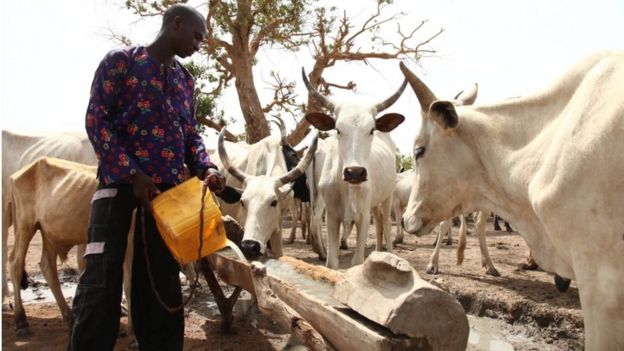
A Fulani herdsman waters his cattle (file picture)AFP/GettyImages
Nigeria is special; it is Africa's largest, wealthiest country and its most populous. It is divided by Christianity and Islam. And it has its very own special deadly radical Islamist terrorist group defying authority and stalking and murdering Nigerian villagers, abducting young girls and creating countless homeless people desperate to escape their depredations. It had a Christian president and now has a Muslim president, both of whom pledged to rout Boko Haram and neither of whom succeeded.
And though Nigeria is one of those rare African countries with great natural resources and has considerable income from petroleum, there isn't much of a trickle-down effect to ensure that the country's wealth is equally shared. There are, throughout Africa, droughts impacting on agriculture and cattle-raising, and since the two enterprises are diametrically opposed, there is great tension between the herdsmen wanting to graze their herds, and the agriculturalists who want their fields unmolested.
Climate change has impacted Africa, bringing stress and deadly hostility between herdsmen and agriculturalists to the fore in South Sudan and the Central African Republic. Muslims and Christians have turned against one another in confrontations for that very same reason in Nigeria. Armed cattle herders, Muslims of the Fulani tribe, have raised militias in Nigeria, just as has occurred in northern Kenya where farmers both white and black have been killed.
In Nigeria, hundreds of thousands of people have vacated farms and villages, leaving their homes to abandonment. Where crops are not being raised, hunger, economic collapse and disease spreading in camps for the displaced looms on the near horizon. Aggression on the part of semi-nomadic cattle herders from the Fulani ethnic group, some 20 million in number, their territory spread across west and central Africa, threatens stability.
Traditional pasturage in the north of Nigeria has collapsed as it has elsewhere in some northern African states where up to 75 percent of grassland has been transformed through desertification. Water sources have been disappearing alongside attacks by Boko Harm to combine circumstances thrusting the Fulani and their herds into the fertile central farmlands of Nigeria; the Middle Belt, home to a Christian majority population.
Local authorities and farmers' attempts to protect crops and farmland has resulted in reprisals where farmers tending their crops have had their hands severed, stuffed into their pockets as examples meant to terrify other farmers to abandon their fields. Fulani gangs on motorcycles attack villages and the terrorized inhabitants flee as the gangs open fire, set fire to homes, hack children to death. In a village in Kaduna state last month 71 people were killed.
Even some Fulani have been slaughtered by their fellow tribesmen in this battle between agriculture and herding. But it's not solely herders involved in these attacks. Young gangs of Fulani have organized kidnapping camps in the vast Rugu forest, emerging on their motorcycles to prey on pedestrians walking isolated nearby pathways. As many as a hundred people were kidnapped in two days last month in Kaduna state.
One attack on a church in Benue state in April saw two priests and 17 of their parishioners killed during Mass, persuading many Christian Nigerians that the real intention of the Fulanis is to dispossess them through territorial acquisition and the expansion of Islam through ethnic cleansing of Christians. The result has been that Christian tribesmen felt compelled to form armed vigilante groups to battle the herders during attacks, and to implement reprisal attacks themselves.
Muslim President Muhammadu Buhari, accused of turning a blind eye to the attacks has ordered the military to restore order. Nigeria's armed forces have been dispatched to do just that, finding their opponents in possession of arms superior to their own, the very situation that prevailed when they went out to rout Boko Haram terrorists.
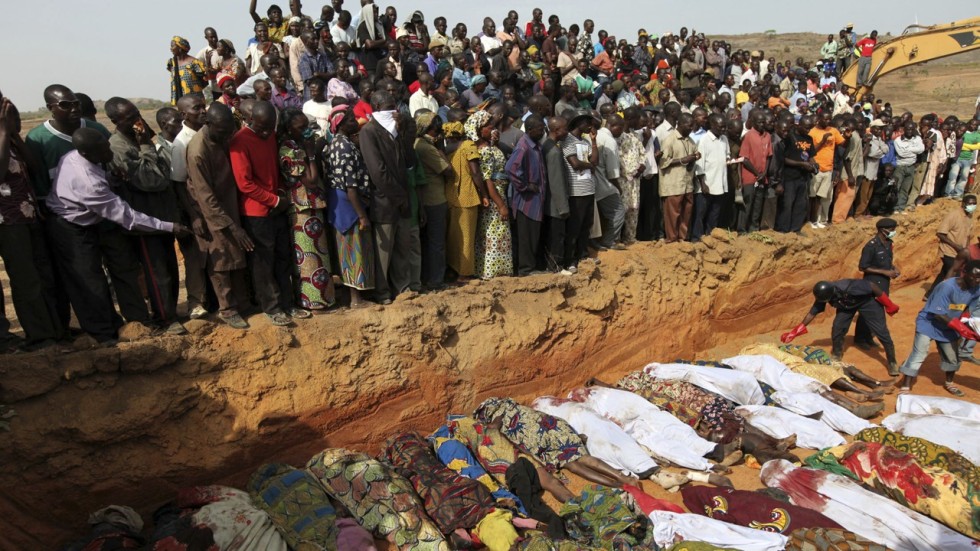
Nigeria: 86 dead in reprisal attack by Muslim herders on Christian farmers The long-running battle for land and resources is threatening to become the worst security risk in Nigeria 25 June 2018, South China Post
Food Cultivation/Animal Herding Competition in Africa
"There are going to be some serious food-security issues." "More and more countries will be reliant on food imports. You'll increasingly see the international community come into more rescue-type situations." Zachary Donnenfeld, researcher, Institute for Security Studies, South Africa
Quora Africa's land mass is slightly bigger than
the U.S., China, India, the U.K., Japan, Eastern Europe, Italy, Germany,
Switzerland, Spain, France, Belgium, Portugal, the Netherlands and a
few other countries put together.
Africans traditionally involved themselves in agriculture. Small-scale farming has produced foods on tracts of arable land that has succeeded in the past in serving the continent's needs in feeding its populations. Agricultural pursuits represent seventy percent of Africa's lifestyle, a percentage higher than what is seen n any other continent, according to the World Bank, with an average farm size of less than a hectare. In some areas, small-scale farming is reduced to a parcel of land comparable to the size of a tennis court.
Because of the intensity of the farming, the land is never given a rest, allowed to lie fallow for soil nutrients to be replenished. The result is that in many areas the soil becomes so compacted and dry it is nutrient-exhausted to the point where even when the weather cooperates with sufficient rain, crop harvests are utterly dismal. An emerging complicating factor is the growing tendency of herd animals where grasslands are grazed down to the nub, with nothing left to grow, apart from growing desertification.
International Development Research Centre
As Africans become more wealthy they are more demanding with their newfound affluence, in their diets, wanting more meat and in the process consuming greater amounts of energy and water, growing the pressures on an already-depleted land source. The demand for beef in Kenya and the prevalence of cows has increased by 60 percent, all driving a need for grazing lands. The result is overgrazing leaving large areas of bare earth. Competition between farmers and herders is continually intensifying.
Resulting in violent raids by herders carrying weapons on ranches, killing farmers, looting their homes and destroying their belongings, including the homes. Food prices increase with the strain on availability. Small landholders can no longer afford to maintain their land; facing eviction as large commercial farms begin to move in, leading to conflict in places like Malawi. Housing tracts and shopping centres are also displacing farmland.
Where areas are set aside as wildlife preserves, in responsible management of protected wildlife areas, farmland is further cut away. Fertile land has been identified by scientists but that land is located in rainforests where, if the trees are cut down to make way for farming, serious consequences will most certainly arise as the environment becomes more vulnerable to degradation and climate change proceeds.
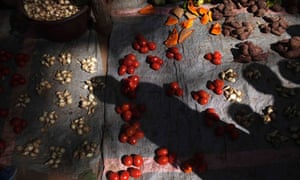
Tomatoes for sale in the central market in Mali, 2013. Could sustainable
intensification increase crop yields in Africa? Photograph: Joe
Penney/Reuters
North of Nairobi there is a natural stage setting encompassing all of the challenges featured across the continent, with a mix of herders, landowners, farmers, cattle ranchers, tour operators, wildlife activists, elephants, lions, hyenas, cows, goats and zebra, competing in a narrow, crowded geography for the space they all need. An estimated eighty people have been killed in violence so far this year when herders have attacked. And nor are police officers dispatched to maintain order safe from the violence; they too are under attack, ambushed, their weapons taken.
Young men herding animals move in groups carrying AK-47 assault rifles to invade farms and ranches, herding thousands of underfed ragged cows out of drought-stricken areas in search of pasturage. Ranches on their way come under siege, with police responding using military grade mortar rounds on the invaders. The herders and the ranchers and he police lose their lives over their challenges of the land they all compete for.
Soldiers in bulletproof cars and Humvees dispatched to respond by the government, view such areas as "dangerous and disturbed".
This represents a general opinion site for its author. It also offers a space for the author to record her experiences and perceptions,both personal and public. This is rendered obvious by the content contained in the blog, but the space is here inviting me to write. And so I do.