Monday, November 10, 2025

Widespread Atrocities in Darfur, Sudan

"Our main concern is that though we have seen approximately 5,000 people coming out of El-Fasher toward Tawila, we don't know where the other hundreds of thousands have gone."
"That is worrying given the ethnic nature of targetting of violence toward civilians by the RSF."
"I've never seen anything so shocking in all my 15 years of my work." 
MSF President Javid Abdelmoneim
https://static.wixstatic.com/media/b74bf7_5b69bf73319d4c45bc2179bd6c438dcf~mv2.png/v1/fill/w_740,h_493,al_c,q_90,usm_0.66_1.00_0.01,enc_avif,quality_auto/b74bf7_5b69bf73319d4c45bc2179bd6c438dcf~mv2.png
This image grab taken from handout video footage released on the paramilitary RSF's Telegram account on October 26, 2025, shows RSF fighters holding weapons and celebrating in the streets of el-Fasher in Sudan's Darfur region [AFP]
 
The fate of hundreds of thousands of Sudanese in flight from ethnically targetted violence in the western Sudanese city of El-Fasher remains unknown in the wake of satellite images indicating suspected mass graves. At war with the Sudanese military since 2023, with which it was once allied, the Paramilitary Rapid Support Forces (RSF) seized control of the strategic city of Al-Fasher in the Darfur region following a brutal 18-month siege.
 
Emerging reports of executions, sexual violence and abductions in and around El-Fasher has alarmed aid groups and the United Nations to the fate of ethnic minorities in yet another impending disaster rivalling the slaughter in Darfur when the RSF were known as the Janjaweed, Arab horsed tribesmen who attacked and raped and murdered hundreds of thousands of Fur, Masalit, and Zaghawa minorities mostly engaged in farming, as opposed to the Arab herdsmen, competing for territory.
 
New satellite imagery analyzed by Yale researchers suggest that mass graves are appearing in the city from which thousands have fled. Survivors in the town of Tawila, some 70 kilometres west of El-Fasher recounted to Medecines sans Frontieres 'harrowing' stories of "ethnically targeted torture, rape and summary executions", revealed a Sudanese-Iranian national.
 
Paramilitaries have taken full control now of all five state capitals in Darfur with the fall of El-Fasher, raising troubling concerns that Sudan could be partitioned along an east-west axis. The Humanitarian Research Lab at Yale University has revealed its finding of evidence consistent with "body disposal activities", leading to the worst fears being realized. "At least two earth disturbances consistent with mass graves - were identified -- at a mosque and at the former Children's Hospital."
 
Tens of thousands of people have been killed, millions have been displaced in the Sudan civil war which has also led to the largest displacement and hunger crisis in the world today, where both sides have been accused of widespread atrocities. 
“It’s been almost a year since the State Department determined that the RSF is committing genocide in Sudan.
"These harrowing images from Yale University’s Humanitarian Lab demonstrate that the genocide continues unabated and largely ignored by the international community."
"The testimony of refugees from el-Fasher also leaves no doubt that ethnically targeted killings are the order of the day.” —  
Clifford D. May, Founder and President, Foundation in Defense of Democracies
 
https://media.newyorker.com/photos/690d3a8cba786830de8b7b0c/master/w_1920,c_limit/NIARCHOS---EL-FASHER--GettyImages-2244375701.jpg
Niarchos -- El-Fasher--Getty Images
 

Labels: , , , , , ,

Friday, September 11, 2020

Greece's Migrant State of Emergency

"Some people do not respect the country that is hosting them, and they strive to prove they are not looking for a passport to a better life."
"They will not leave [the island] because of the fire."
Greek government spokesman Stelios Petsas 
A German charity group at the scene said a protest had earlier erupted at the camp over lockdown measures.
 
"Under the stars, I'm going to sleep under the stars like all these people here."
"[I've] nowhere to go since everything burned so we slept outside and we'll continue here."
Leonie Raymon, refugee from Cameroon
 
"In the past few days we've been living through unprecedented situations with daily fires."
"We've reached our limits. We're anxious, we feel insecure, we're fed up, we don't know how to act anymore."
Moria's municipal community leader Yiannis Mastroyannis
 
"There is a terrible reality with these fires. Many children, women, men are in these camps in absolutely terrible conditions. We want to show solidarity with Greece that lives up to European values."
French President Emmanuel Macron 

"I recognize the difficult conditions. However, nothing can become an alibi for violent reactions to health checks. And, much more, for riots of this magnitude."
"The situation in Moria cannot continue because it is a matter of public health, humanity and national security at the same time."
Greek Prime Minister Kyriakos Mitsotakis
moria camp fire
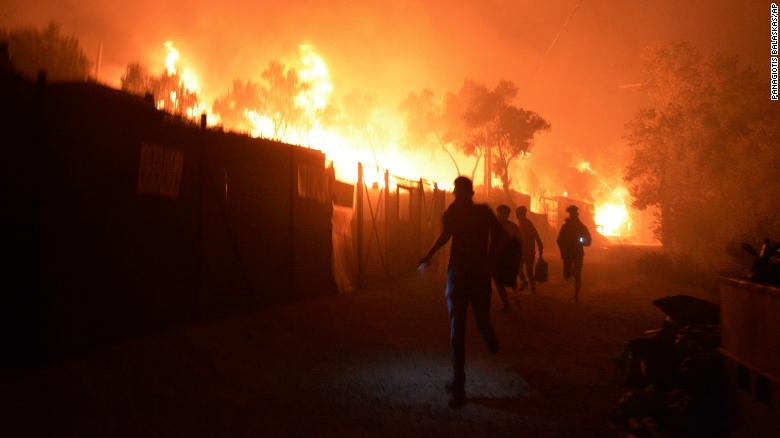
Migrants flee from the Moria refugee camp during second a fire, on the northeastern Aegean island of Lesbos, Greece, on Wednesday, Sept. 9, 2020. (AP Photo/Petros Giannakouris)

During a huge migration wave that swamped Europe in 2015-16, with migrants from the Middle East, Africa and Asia who left the nearby Turkish coast with the intention of entering Europe by way of Greece and Italy, the camp at Moria on the Greek Island of Lesbos was set up to accommodate several thousand people. It ended up with many more than it was intended to service, becoming a sprawling squalid camp, condemned by human rights groups. For those who flooded into Greece, the intention was to move on to wealthier European countries.

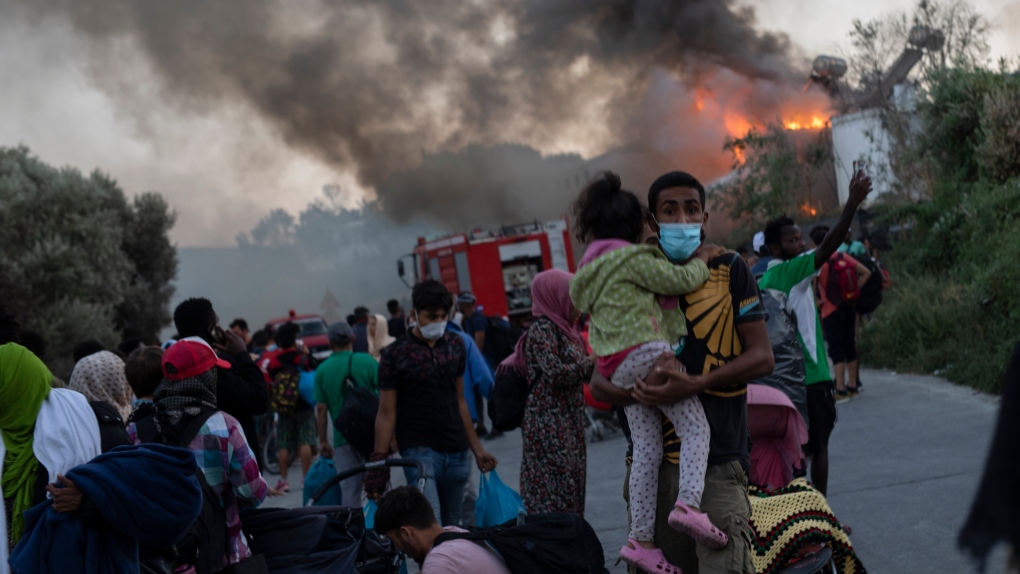
https://cdn.cnn.com/cnn/.e/interactive/html5-video-media/2020/09/09/Moria_camp_fire_780px.pngSome, like Germany, the destination of many of the migrants who knew of German Chancellor Angela Merkel's willing absorption of a million migrants was their target, but the state, under growing pressure from alarmed German citizens along with violent incidents emanating from a proportion of the migrants, reversed its earlier stance. Countries of the European Union mandated to accept a share of the migrants to relieve the burden on Italy and Greece, finally felt they had reached the limits of their absorption capacity and balked at accepting additional migrants.
 
Now, in the wake of a massive fire in the largest migrant camp for asylum seekers in Europe, 12,500 migrants formerly placed under coronavirus quarantine are without shelter. Authorities were faced with a humanitarian crisis that eclipsed the one that existed prior to the fire. At the same time Greek investigators are trying to figure out whether a connection existed between the conflagration and anger on the part of the migrants over an erupting camp outbreak of coronavirus.
 
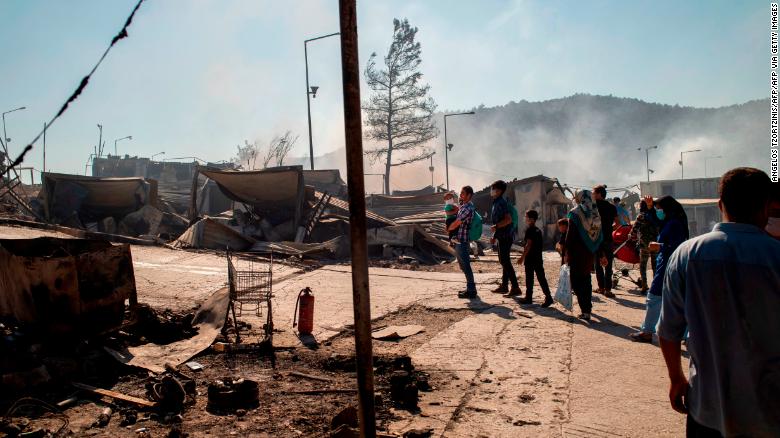
Smoke rises at the burnt camp of Moria on the island of Lesbos on Wednesday the morning after a major fire broke out.
 
According to three eyewitnesses the fire began as a protest against mandatory new quarantine measures. The blaze broke out after migrants who tested positive for the virus or were exposed, refused to go into isolation, according to a semi-official Greek news agency. Arson is being investigated as a possible cause of the blaze. Overnight, people fled the camp, as tents and shipping containers became engulfed in flames. There were no injuries or deaths reported. But police surrounded the camp attempting to ensure that the migrants remained within the vicinity of the camp.

Moria had been a site where protests, fatal fires and chronic sickness took place, filled well beyond capacity, cited by international aid groups as being unsafe and inhumane. It remained in operation not because Greece wanted to continue hosting the migrants, but because there was simply nowhere else for them to go. They kept arriving because the previous waves had succeeded in distributing themselves around Europe. And more latterly, Turkey used them as a threat to coerce Europe to fund its own refugee camps.
 
"Events in Moria last night are unthinkable but, tragically, predictable as the dire situation on the islands has gone on for far too long", the Greece country director for the International Rescue Committee -- Dimitra Kalogeropoulou noted of the residents that had fled from the fire, but are "now left with nothing"
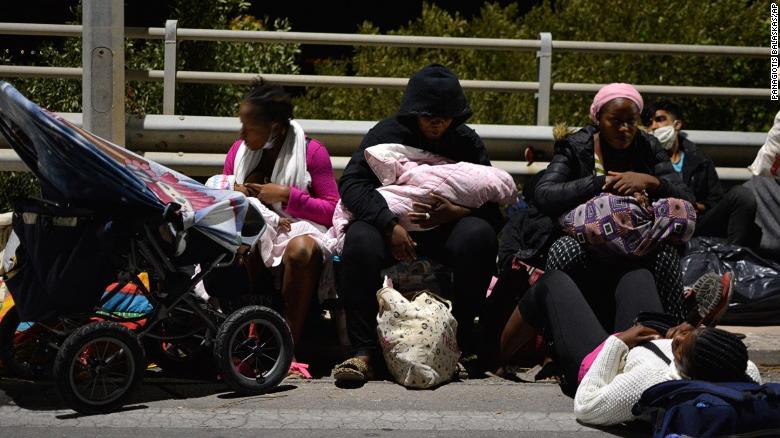
Refugees and migrants with their children gather on a bridge on Wednesday after the fire at the camp.

Last week officials visiting the camp had identified the first three positive cornavirus case and a testing campaign that followed detected another 35 positive cases, leading to the camp being placed under lockdown. The new Greek government devised a blueprint to close Moria and other island centres to create more permanent structures, in the face of local resistance where the new permanent structures might be placed.
 
Some asylum seekers have been gradually transferred to the mainland. Other European Union countries have agreed to accept some of the most vulnerable among the migrants, unaccompanied minors in particular, to rescue them from a camp that ended up holding ten times the number of people it was originally designed to house.
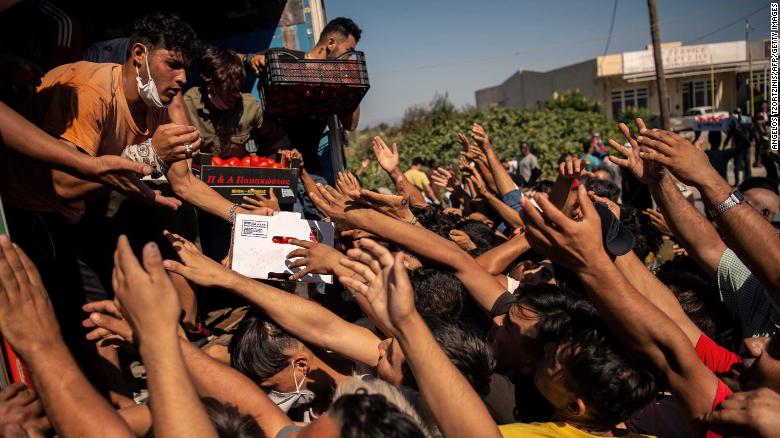
People jostle for food on Thursday, September 10, after fires destroyed the Moria migrant camp on the Greek island of Lesbos.
People grasp for food on Thursday, September 10 after fires destroyed the Moria migrant camp on the Greek island of Lesbos


Labels: , , , ,

Wednesday, April 11, 2018

Whither/Wither Europe

"There was no electricity in the container last night. It was like a fridge."
"I want to go to Athens. If you don't want me, I want to go to another country."
"Why am I here [in a refugee camp on the Greek island of Lesbos]?"
Jahangir Baroch, Pakistani refugee

"Even if you are healthy, in Moria you'll get a problem."
"That's not a place to put people in. The police cannot control the camp."
Amir Ali, 27, Afghan migrant

"You're thinking about the future."
"Yes [I have hope]. Tomorrow is another day, yes?"
Isaac Hielo, 29, Eritrean refugee
Asylum seekers gather around the only wifi-hotspot inside Moria camp. With just emergency cases allowed to travel to Greece's mainland, where conditions are generally better, many have to wait for more than 12 months until their claims are processed. [Kevin McElvaney/Al Jazeera]
Asylum seekers gather around the only wifi-hotspot inside Moria camp. With just emergency cases allowed to travel to Greece's mainland, where conditions are generally better, many have to wait for more than 12 months until their claims are processed. Kevin McElvaney/Al Jazeera

The Moria refugee camp is meant to house refugees that Greece has no intention of absorbing. Most of those making their way to Greece, in any event, likely plan to forge on elsewhere in Europe. The vital thing for them was to gain a foothold. Some of the refugees have lived in the camp for up to two years since the deal the European Union struck with Turkey slowed down passage across the Aegean Sea for asylum seekers.

Wars in Syria, Iraq and Afghanistan convinced many people to leave and seek opportunities elsewhere. Thousands of people remain stranded on Lesbos. They have the option of returning back to the countries they left, but few choose that path. They want a new, fresh start in life. Opportunities that cannot be met in the countries they've left. Muslim countries mired in tribal and sectarian violence, where peoples' needs are ignored because of corrupt politicians.

Some among them strike it lucky when their applications for asylum are accepted and they're permitted to go on to the Greek mainland. The greater number by far whose applications are rejected are then sent back to Turkey as agreed in that deal that Turkey bargained for to give its citizens greater visa-free access to the EU, and eventual acceptance into EU membership, though that hope is fading fast given Recep Tayyip Erdogan's viral rants.

Piles of discarded life vests are scattered around the camp, testament to the desperate voyage the migrants were willing to undergo to reach their eventual, hoped-for final destination. The Moria camp was designed to accommodate about 2,500 people but it currently holds 5,500. There is no comfort, with rain soaking tents, a lack of electricity and hot water to shower. The food is bad but even so there is rarely enough.
An improvised shelter can be seen inside and outside Moria camp. Often just provided with summer tents, people try to make those fit for winter and the harsh weather conditions. [Kevin McElvaney/Al Jazeera]
An improvised shelter can be seen inside and outside Moria camp. Often just provided with summer tents, people try to make those fit for winter and the harsh weather conditions. Kevin McElvaney/Al Jazeera

Accidents occur resulting from men chopping up wood and lighting fires in their tents in an effort to keep warm. Last year three people were killed by one of those accidents. Ali Zaid, 23, left Iraq fleeing the Islamic State and has been living in a makeshift camp on the fringes of Moria located in an olive grove. "Very cold, very cold, very cold", he said of the outdoor shower, a hose in the open despite the cold of an Aegean winter.

"Every day I'm here", trying to smuggle himself off the island in trucks loaded for Athens, said 20-year-old Algerian Anas. "Sometimes I try, sometimes not. It's hard to leave", he said. For women it's worse, much worse. When a 30-year-old woman from Afghanistan lost her way in the dark one night she was raped. The police, when she reported the crime, sent her back to Moria. "I wanted to kill myself", she said.

Muslim countries fester in dysfunction, violence, fear and conflict, spewing out their citizens in hopes of finding a better life for themselves. In the process, Europe feels helpless in the throes of a crisis of humanitarian proportions, guilty if they refuse to accept this tide of human cast-offs looking for a future and for freedoms not found in their native countries, and helpless to defend themselves, their heritage, culture, values from the influx of strangers from strange lands whose religion, culture and values are gradually stifling their own.

These are people for whom the alternative of returning back home is no option whatever. However miserable are the conditions they find in refugee camps in Europe, the misery they live through in their countries of birth are more soul-destroying, with no hope for the future, while Europe, though balking at accepting them, still offers them the hope for a better future. The cost, in the final analysis, will be Europe's identity.

At night, there are many open fires inside the camp. The wood comes from the forest and olive grove surrounding the area, which leads to tensions with the local farmers. [Kevin McElvaney/Al Jazeera]
At night, there are many open fires inside the camp. The wood comes from the forest and olive grove surrounding the area, which leads to tensions with the local farmers. Kevin McElvaney/Al Jazeera

Labels: , , , ,

Friday, December 09, 2016

Russia Oblivious to Condemnation in Syria

"We condemn the actions of the Syrian regime and its foreign backers, especially Russia, for their obstruction of humanitarian aid."
"[Hospitals and schools have been targeted] in an attempt to wear people down."
Joint statement, Canada, U.S., Britain, Germany, Italy, France

"Diplomacy has not delivered for the people of Aleppo, that's for sure."
"[The U.S. would] never give up [attempting diplomatically to sway Syria and Russia to take part in negotiations with the opposition to arrive at a solution, abandoning bombing missions and anti-humanitarian siege tactics]."
"It is not us that walked away from diplomacy. It is Syria and [the] Russian Federation."
Samantha Power, U.S. Ambassador to the United Nations
Syrian rebels reject withdrawal plan amid Russia's chilling warnings
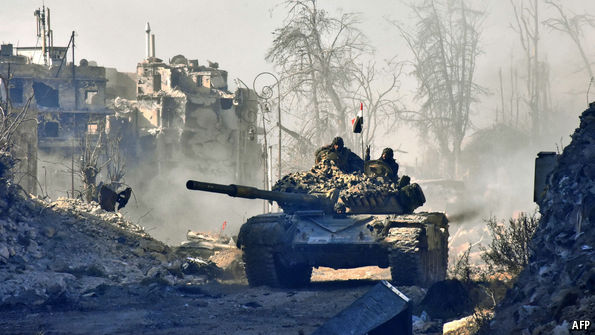
The Syrian army has seized two-thirds of east Aleppo [AFP]
The six Western powers that issued the joint condemnation of Syria and Russia have called upon both to execute an immediate ceasefire in Aleppo. While at the same time accusing Russia of blocking efforts to alleviate the anguish of the hundreds of thousands of Syrian Sunnis who remain trapped in the rebel-held eastern portion of the city. For its part, Russia seems immune to accusations, blandly ignoring them and carrying on as they have done in deliberately destroying schools, hospitals and hope for the besieged residents while denying they would engage in such tactics.

The critics of Russia warn that if they have their way the United Nations would investigate reports of war crimes committed in Syria by the regime and by their Russian helpers. There remain hopes that another five-day ceasefire might be agreed upon for eastern Aleppo to permit civilians to leave the destroyed eastern half of the city, even as rebel forces facing certain defeat, themselves debated whether to withdraw from their stronghold, now a shattered vestige of its former status.


Three-quarters of east Aleppo is now in the hands of the Syrian army and its Iranian-backed Shiite militias. If no other blatant symbol of sectarian hatred breeding atrocities come readily to mind, the allied factions of Hezbollah, Iranian Republican Guard, Shiite militias and Alawite regime military aligned to destroy the majority Syrian Sunni population's hope for equality status in a restructured Syria stands as testament to realities in the Middle East.

According to the Syrian Observatory for Human Rights monitoring the situation, forces loyal to Syrian President Bashar al-Assad took possession of the Old City in the centre of Aleppo, with Sunni rebels withdrawing -- demonstrating practicality as the better part of valour in the situation confronting them -- into what remains of their territory. Even while negotiations leading to full withdrawal from the rebels' vital stronghold are underway.

The White Helmets: The beating heart of Syria's revolution
The White Helmets - The New Arab

Labels: , , , , ,

Friday, May 06, 2016

Nature's Inferno Unleashed

We humans have a tendency to go where we should not, particularly. We love the challenge of living in unsustainable areas; floodplains, for example, and far too close to forests, making our lives and the infrastructure that has such meaning in our lives vulnerable to nature's idiosyncratic weather systems that can impact so disastrously on what we think, in our naivete, is permanence.

"Fire itself is always going to occur in these forest ecosystems. But we try and come up with solutions as far as mitigating the impact of those fires on communities."
"[FireSmart Canada's function is to help homeowners, industry and communities living at the intersection of the] wildland urban interface [cope, to protect themselves]."
"It keeps the fire [clearing out dead brush, pruning trees] on the ground, so there's a higher likelihood of success for firefighters on the ground of suppressing the fire."
"The first ten metres, we really focus on trying to significantly reduce the fuels, period. We really discourage the presence of conifer trees within the first ten metres and flammable vegetation, like junipers, within the first ten metres of homes, as well as sheds, wood piles, fences -- anything that can burn and help transition a fire towards the structure."
"Unfortunately ... with climate change and our forest health conditions, these fires are burning in conditions that we've never seen before. And they're burning hotter, bigger, faster and more aggressively than the fires that we've seen in the past and they're becoming a big challenge."
Kelly Johnston, executive director, Partners In Protection Association, FireSmart Canada

"It's important for people to understand that all the air tankers, all the suppression equipment, people, when conditions line up and that fire's ripping, it's going to do what it wants to do. You won't put it out, unless  you do that work with the fuels."
Larry Fremont, wildfire education and prevention co-ordinator, Ministry of Environment, Saskatchewan
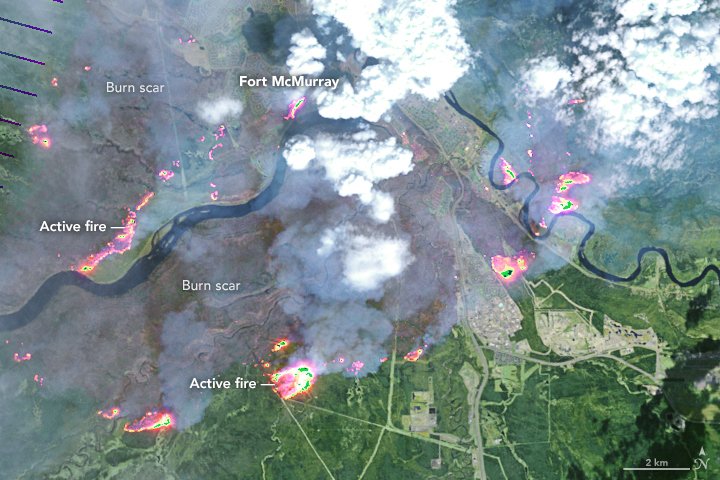
NASA Earth

Alberta forestry authorities cleared out strips of forest around eleven northern communities last fall, removing what was seen as potential fuel to encourage forest fires. Wildfire prevention co-ordinator Larry Freemont cautions, that despite that preemptive work, he has himself seen fires jump breaks, including rivers or lakes. And now he can also include six-lane highways, because the situation seen now in Fort McMurray is quite exceptional. And science tells us these conditions are here to stay.

On their way, perhaps to becoming even more flagrantly lethal to people placing their trust in the skills and courage of firefighters and the equipment that has been developed in the past to fight fires that no longer reflect the types of fire situation now seen in northern Alberta and forecasted to increase in numbers, depth and capacity, given climate change and the ferocious alterations in climate moisture, winds and heat.

A report produced in the wake of a devastating blaze that took place in Kelowna, British Columbia in 2013, warned that past protocols no longer work and indeed add fuel to the fire. A buildup of trees, brush and other dry vegetation in forests -- everything that a fire depends on to help it grow and sustain its impact -- left lying on the forest floor because of past fire suppression protocols, has helped to produce the perfect firestorm. That biofuel that has been built up represents the potential for more severe wildfires and greater numbers, where people and the forest intersect.

And because people live, and work and spend their leisure time in and around those intersections of human habitation and natural surroundings of dense forests there is a certain vulnerability quotient that can be triggered. Where, though many forest fires are set by lightning strikes, many more result from human carelessness. And experts evaluating this fire that has consumed Fort McMurray tend to believe that something as mundane and yet as dangerous as a flicked cigarette butt, or a campfire not adequately put out, might have triggered this blaze.

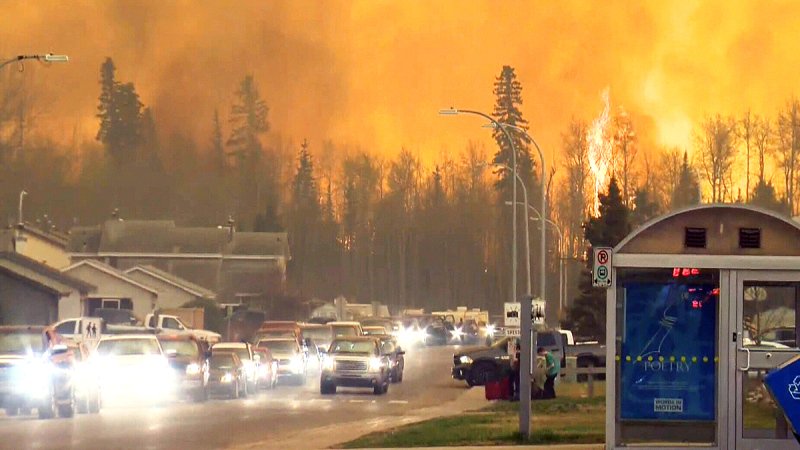
This current wildfire raging through northern Alberta, destroying Fort McMurray and the hopes and dreams of the tens of thousands of Canadian living there fits the pattern of the dire new expectations. Tens of thousands of people using the only highway permitting entry and departure north and south from Fort McMurray have found themselves stranded. They've had to drive through dense, dark smoke so thick at times visibility was almost nil. They've seen, as they've driven, the fire up close and very personal. They've been stuck in stop-and-stall whenever the highway is closed for safety reason, as when fire jumps across and fears become even starker.

Sara Peats: Praying I have a home to go back to. Fire isn't over officials say the worst is yet to come.

Some families have had to remain on the highway, stuck in a traffic line-up that will not begin again any time soon, for a day, for 36 hours, desperately awaiting the start-again. And Good Samaritans have set out from their comfortable and safe homes elsewhere in Alberta to truck in food, water, and gas in a convoy determined to do what they can to ensure that the residents of Fort McMurray who have lost everything they own but the clothes on their backs, their lives and those of their children -- and sometimes their pets, will know they're not forgotten. Some families fleeing the fire have taken shelter in communities north of their destroyed city, only to find the fire is tracking them there, too.

This fire, which looked serious on Monday, looked as though it might be under control by Tuesday, and then hot winds helped it grow tenfold from its Tuesday status, and mandatory notices went out to communities to flee. In one day it grew in size and ferocity 750 percent to encompass 850 square kilometres. People have taken the evacuation orders seriously. Although they will have lost everything they ever worked to own, none have yet lose their lives to the fire. Fort McMurray resembles a war zone, nature's own scorched-earth vendetta on humans who become too comfortable with themselves and their aspirations.

CTV News

Labels: , , , , ,

Monday, January 25, 2016

Exploiting Besieged Syrians

"They have provided detailed information on shortages of food, water, qualified physicians, and medicine. This has led to acute malnutrition and deaths among vulnerable groups in the town."

"Siege tactics, by their nature, target the civilian population by subjecting them to starvation, denial of basic essential services and medicines."
"Such methods of warfare are prohibited under international humanitarian law and violate core human rights obligations with regard to the rights to adequate food, health and the right to life, not to mention the special duty of care owed to the well-being of children."
Paulo Pinheiro, chairman, UN commission of inquiry documenting war crimes in Syria

"We saw people who are clearly malnourished, especially children, we saw people who are extremely thin, skeletons, that are now barely moving." 
"We saw people that are desperate, people that are cold, people that angry, people that have almost lost hope that the world cares about their plight." 
"Many more will die if the world does not move faster."
Yacoub El Hillo, UN resident and humanitarian coordinator, Syria
"You could see many were malnourished, starving. They were skinny, tired, severely distressed. There was no smile on anybody's face."
"The children I talked to said they had no strength to play." 
Elizabeth Hoff, WHO representative, Damascus
Residents, who say they have received permission from the Syrian government to leave the besieged town, walk past Syrian Army soldiers as they depart after an aid convoy entered Madaya, Syria January 11, 2016. Reuters/Omar Sanadiki
"Twelve people died last week, six of them children. There are 1,500 patients here suffering chronic diseases which require treatment or medicine which is not available. People are eating grass, and rice of it's available."
Dr. Omar Hakim, Moadhamiya, Damascus

Aid was finally able, through the agreement of the regime authorities, to reach desperate people in Madaya northwest of Damascus. This is where government forces have been starving out the residents, viewing them as supporters of the Syrian Sunni rebels. It was from Madaya that photographs of skeletal residents reached the notice of the international public, evoking outrage that such medieval tactics of siege warfare were taking place. 

But, in fact, this is what Bashar al Assad's forces have been engaging in, among other atrocities of barbarism throughout this conflict. It is all about punishing Syria's Sunni majority for criticizing their Shiite Baathist government in its elevation of the Alawite minority, as members of Assad's own tribal-sectarian community. 

Those workers with the United Nations who brought humanitarian aid through their convoy to Madaya two weeks earlier described horrendous conditions of severe malnutrition leading to death. While Madaya's population of 42,000 is suffering gravely, there is an estimated 400,000 people living in siege conditions, according to the United Nations.

An additional four million Syrians whose situation is tenuously existential as a result of "hard to reach areas", also pose a problem for which a solution is nowhere to be seen. Other than miraculously removing the source of all the problems, the Alawite government of Bashar al Assad and liberating Syria from its malign influence and bloody attacks on civilians who happen to practise the 'wrong' form of Islamic allegiance.

Madaya was not even on the list of the "besieged" communities whom aid groups estimate total in excess of a million, effectively doubling the number that the United Nations claims to have been affected by the government siege tactics. In the UN's humanitarian plans for Syria the language has been altered to remove the words "siege" and "besieged", for the obvious purpose of mollifying Assad. 

The softened language perhaps a bit of bait to bring him to a negotiating table for peace talks. Even though his officials have as good as stated they will be present to listen, and nothing more.

The UN plan stresses that ISIL and other rebel groups are also engaged in laying siege to Shiite towns. However the numbers of regime-surrounded populations vastly outnumber by 49 to 52 those under siege by rebels. Moreover, the regime's planes fly on missions to drop relief supplies to those besieged by ISIL or rebel groups. Something that the rebels obviously have no resort to.

Stockpiles of aid are planned to be delivered by Care International to areas being attacked by the regime. "We have to fill warehouses so that if routes are closed, people inside have a chance to survive for as long as it takes for the international community to negotiate", explained Abu Fares, a volunteer using contact networks to bring supplies into areas of Homs province surrounded by regime forces.

Syrians on Monday outside the rebel-held town of Madaya, which is besieged by pro-government forces including the Lebanese militia group Hezbollah. Louai Beshara/Agence France-Presse — Getty Images
Hezbollah has denied that its siege on behalf of the regime has resulted in deaths or starvation. They claim that rebels have taken possession of humanitarian aid rather than distribute the food and other supplies equally among the residents. Their purpose, it was claimed, was to sell to those who had the wherewithal to buy what was available. And the entire controversy was completely contrived, they charged, with the population of Madaya exploited in a propaganda campaign to discredit the Syrian regime.

Labels: , ,

Friday, September 18, 2015

Gatestone Institute


  • Although the rape took place in June, police kept silent about it for nearly three months, until local media published a story about the crime. According to an editorial comment in the newspaper Westfalen-Blatt, police are refusing to go public about crimes involving refugees and migrants because they do not want to give legitimacy to critics of mass migration.
  • A 13-year-old Muslim girl was raped by another asylum seeker at a refugee facility in Detmold, a city in west-central Germany. The girl and her mother reportedly fled their homeland to escape a culture of sexual violence.
  • Approximately 80% of the refugees/migrants at the shelter in Munich are male... the price for sex with female asylum seekers is ten euros. — Bavarian Broadcasting (Bayerischer Rundfunk).
  • Police in the Bavarian town of Mering, where a 16-year-old-girl was raped on September 11, have issued a warning to parents not to allow their children to go outside unaccompanied. In the Bavarian town of Pocking, administrators of the Wilhelm-Diess-Gymnasium have warned parents not to let their daughter's wear revealing clothing in order to avoid "misunderstandings."
  • "When Muslim teenage boys go to open air swimming pools, they are overwhelmed when they see girls in bikinis. These boys, who come from a culture where for women it is frowned upon to show naked skin, will follow girls and bother them without their realizing it. Naturally, this generates fear." — Bavarian politician, quoted in Die Welt.
  • A police raid on the Munich refugee facility found that guards hired to provide security at the site were trafficking drugs and weapons and were turning a blind eye to the prostitution.
  • Meanwhile, the raping of German women by asylum seekers is becoming commonplace.
A growing number of women and young girls housed in refugee shelters in Germany are being raped, sexually assaulted and even forced into prostitution by male asylum seekers, according to German social work organizations with first-hand knowledge of the situation.
Many of the rapes are occurring in mixed-gender shelters, where, due to a lack of space, German authorities are forcing thousands of male and female migrants to share the same sleeping areas and restroom facilities.

Conditions for women and girls at some shelters are so perilous that females are being described as "wild game" fighting off Muslim male predators. But many victims, fearing reprisals, are keeping silent, social workers say.

At the same time, growing numbers of German women in towns and cities across the country are being raped by asylum seekers from Africa, Asia and the Middle East. Many of the crimes are being downplayed by German authorities and the national media, apparently to avoid fueling anti-immigration sentiments.

On August 18, a coalition of four social work organizations and women's rights groups sent a two-page letter to the leaders of the political parties in the regional parliament in Hesse, a state in west-central Germany, warning them of the worsening situation for women and children in the refugee shelters. The letter said:
"The ever-increasing influx of refugees has complicated the situation for women and girls at the receiving center in Giessen (HEAE) and its subsidiaries.
"The practice of providing accommodations in large tents, the lack of gender-separate sanitary facilities, premises that cannot be locked, the lack of safe havens for women and girls — to name just a few spatial factors — increases the vulnerability of women and children within the HEAE. This situation plays into the hands of those men who assign women a subordinate role and treat women traveling alone as 'wild game'.
"The consequences are numerous rapes and sexual assaults. We are also receiving an increasing number of reports of forced prostitution. It must be stressed: these are not isolated cases.
"Women report that they, as well as children, have been raped or subjected to sexual assault. As a result, many women sleep in their street clothes. Women regularly report that they do not use the toilet at night because of the danger of rape and robbery on the way to the sanitary facilities. Even during daylight, passing through the camp is a frightful situation for many women.
"Many women — in addition to fleeing wars or civil wars — are also on the run for gender-related reasons, including the threat of forced marriage or genital mutilation. These women who face special risks, especially when they are on the run alone or with their children. Even if they are accompanied by male relatives or acquaintances, this does not always ensure protection against violence because it can also lead to specific dependencies and sexual exploitation.
"Most female refugees have experienced a variety of traumatizing experiences in their country of origin and while on the run. They are victims of violence, kidnappings, torture, rape and extortion — sometimes over periods of several years.
"The feeling to have arrived here — in safety — and to be able to move without fear, is a gift for many women.... We therefore ask you...to join our call for the immediate establishment of protected premises (locked apartments or houses) for women and children who are travelling alone....
"These facilities must be equipped so that men do not have access to the premises of the women, with the exception of emergency workers and security personnel. In addition bedrooms, lounges, kitchens and sanitary facilities must be interconnected so that they form a self-contained unit — and thus can only be reached via lockable and monitored access to the house or the apartment."
After several blogs (here, here and here) drew attention to the letter, the LandesFrauenRat (LFR) Hessen, a women's lobbying group that originally uploaded the politically incorrect document to its website, abruptly removed it on September 14, without explanation.
The problem of rapes and sexual assaults in German refugee shelters is a nationwide problem.

In Bavaria, women and girls housed at a refugee shelter in Bayernkaserne, a former military base in Munich, are subject to rape and forced prostitution on a daily basis, according to women's rights groups. Although the facility has separate dorm rooms for women, the doors cannot be locked and men control access to the sanitary facilities.

Approximately 80% of the refugees/migrants at the shelter are male, according to Bavarian Broadcasting (Bayerischer Rundfunk), which reports that the price for sex with female asylum seekers is ten euros. A social worker described the facility this way: "We are the biggest brothel in Munich."

Police insist they have no proof that the rapes are taking place, although a police raid on the facility found that guards hired to provide security at the site were trafficking drugs and weapons and were turning a blind eye to the prostitution.

On August 28, a 22-year-old Eritrean asylum seeker was sentenced to one year and eight months in prison for attempting to rape a 30-year-old Iraqi-Kurdish woman at a refugee shelter in the Bavarian town of Höchstädt. The reduced sentence was thanks to the efforts of the defense attorney, who persuaded the judge that the defendant's situation at the shelter was hopeless: "For a year now he sits around and thinks about — about nothingness."

On August 26, a 34-year-old asylum seeker attempted to rape a 34-year-old woman in the laundry room of a refugee facility in Stralsund, a city near the Baltic Sea.

On August 6, police revealed that a 13-year-old Muslim girl was raped by another asylum seeker at a refugee facility in Detmold, a city in west-central Germany. The girl and her mother reportedly fled their homeland to escape a culture of sexual violence; as it turns out, the man who raped the girl is from their country.

Although the rape took place in June, police kept silent about it for nearly three months, until local media published a story about the crime. According to an editorial comment in the newspaper Westfalen-Blatt, police are refusing to go public about crimes involving refugees and migrants because they do not want to give legitimacy to critics of mass migration.

Police chief Bernd Flake countered that the silence was aimed at protecting the victim. "We will continue with this policy [of not informing the public] whenever crimes are committed in refugee facilities," he said.

Over the weekend of June 12-14, a 15-year-old girl housed at a refugee shelter in Habenhausen, a district in the northern city of Bremen, was repeatedly raped by two other asylum seekers. The facility has been has been described as a "house of horrors" due to the spiraling violence perpetrated by rival gangs of youth from Africa and Kosovo. A total of 247 asylum seekers are staying at the shelter, which has a capacity for 180 and a cafeteria with seating for 53.

Meanwhile, the raping of German women by asylum seekers is becoming commonplace. Following are a few select cases just from 2015:

On September 11, a 16-year-old girl was raped by an unidentified "dark-skinned man speaking broken German" close to a refugee shelter in the Bavarian town of Mering. The attack occurred while the girl was walking home from the train station.

On August 13, police arrested two Iraqi asylum seekers, aged 23 and 19, for raping an 18-year-old German woman behind a schoolyard in Hamm, a city in North Rhine-Westphalia.

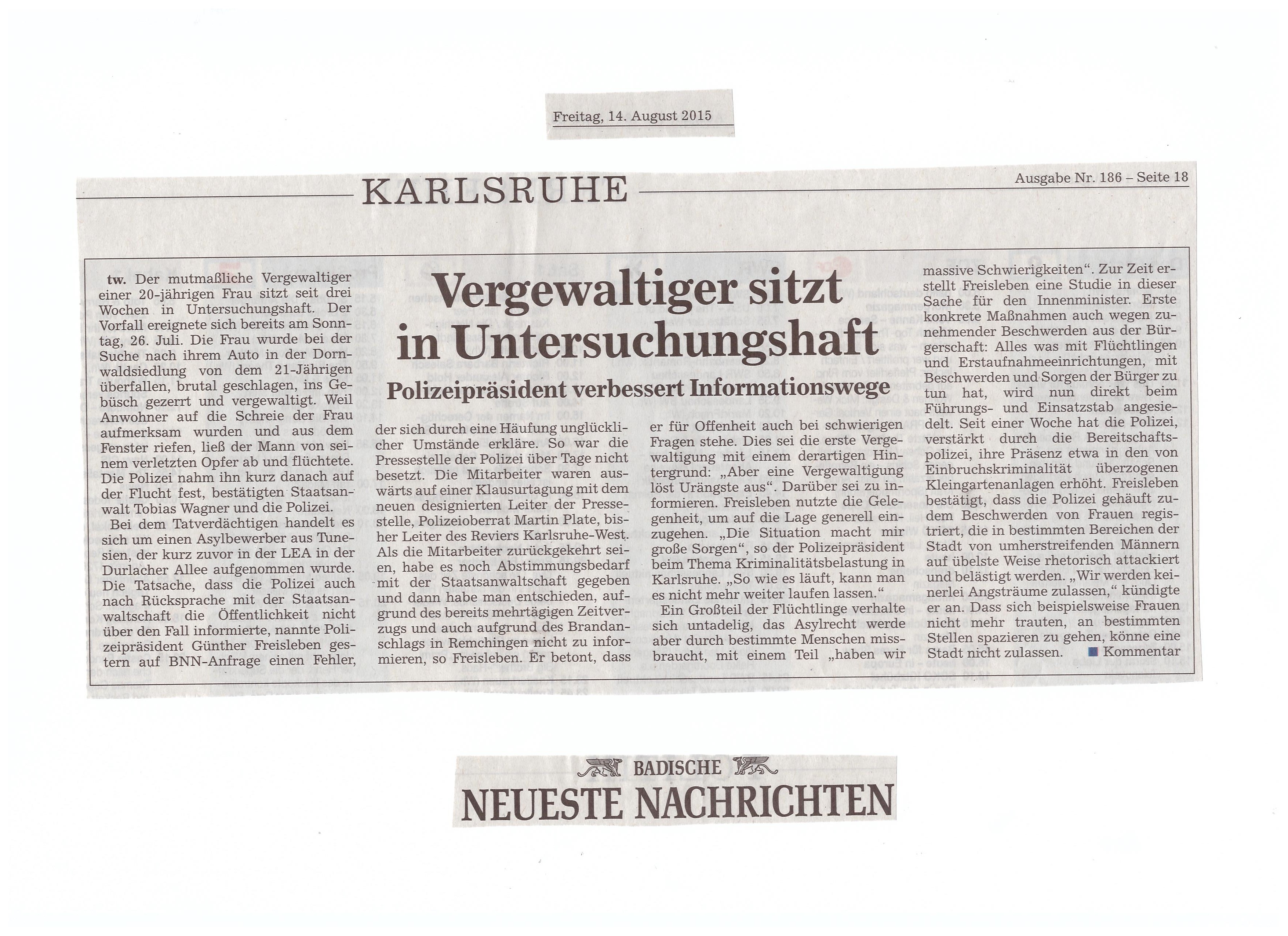
On July 26, a 14-year-old boy was sexually assaulted inside the bathroom of a regional train in Heilbronn, a city in southwestern Germany. Police are looking for a "dark skinned" man between the ages of 30 and 40 who has an "Arab appearance." Also on July 26, a 21-year-old Tunisian asylum seeker raped a 20-year-old woman in the Dornwaldsiedlung district of Karlsruhe. Police kept the crime secret until August 14, when a local paper went public with the story.

On June 9, two Somali asylum seekers, aged 20 and 18, were sentenced to seven-and-a-half years in prison for raping a 21-year-old German woman in Bad Kreuznach, a town in Rhineland-Palatinate, on December 13, 2014.

On June 5, a 30-year-old Somali asylum seeker called "Ali S" was sentenced to four years and nine months in prison for attempting to rape a 20-year-old woman in Munich. Ali had previously served a seven-year sentence for rape, and had been out of prison for only five months before he attacked again. In an effort to protect the identity of Ali S, a Munich newspaper referred to him by the more politically correct "Joseph T."

On May 22, a 30-year-old Moroccan man was sentenced to four years and nine months in prison for attempting to rape a 55-year-old woman in Dresden. On May 20, a 25-year-old Senegalese asylum seeker was arrested after he attempted to rape a 21-year-old German woman at the Stachus, a large square in central Munich.

On April 16, a 21-year-old asylum seeker from Iraq was sentenced to three years and ten months in prison for raping a 17-year-old girl at festival in the Bavarian town of Straubing in August 2014. On April 7, a 29-year-old asylum seeker was arrested for the attempted rape of a 14-year-old girl in the town of Alzenau.

On March 17, two Afghan asylum seekers aged 19 and 20 were sentenced to five years in prison for the "particularly abhorrent" rape of a 21-year-old German woman in Kirchheim, a town near Stuttgart, on August 17, 2014.

On February 11, a 28-year-old asylum seeker from Eritrea was sentenced to four years in prison for raping a 25-year-old German woman in Stralsund, along the Baltic Sea, in October 2014.

On February 1, a 27-year-old asylum seeker from Somalia was arrested after attempting to rape women in the Bavarian town of Reisbach.

On January 16, a 24-year-old Moroccan immigrant raped a 29-year-old woman in Dresden.
Dozens of other cases of rape and attempted rape — cases in which police are specifically looking for foreign perpetrators (German police often refer to them as Südländer, or "southerners") — remain unresolved. Following is a partial list just for August 2015:

On August 23, a "dark skinned" man attempted to rape a 35-year-old woman in Dortmund. On August 17, three male "southerners" attempted to rape a 42-year-old woman in Ansbach. On August 16, a male "southerner" raped a woman in Hanau.
On August 12, a male "southerner" attempted to rape a 17-year-old woman in Hannover. Also on August 12, a male "southerner" exposed himself to a 31-year-old woman in Kassel. Police say a similar incident occurred in the same area on August 11.

On August 10, five men of "Turkish origin" attempted to rape a girl in Mönchengladbach. Also on August 10, a male "southerner" raped a 15-year-old girl in Rinteln. On August 8, a male "southerner" attempted to rape a 20-year-old woman in Siegen.

On August 3, a "North African" raped a seven-year-old girl in broad daylight in a park in Chemnitz, a city in eastern Germany. On August 1, a male "southerner" attempted to rape a 27-year-old woman in downtown Stuttgart.

Meanwhile, parents are being warned to look after their daughters. Police in the Bavarian town of Mering, where a 16-year-old-girl was raped on September 11, have issued a warning to parents not to allow their children to go outside unaccompanied. They have also advised women not to walk to or from the train station alone because of its proximity to a refugee shelter.

In the Bavarian town of Pocking, administrators of the Wilhelm-Diess-Gymnasium have warned parents not to let their daughters wear revealing clothing in order to avoid "misunderstandings" with the 200 Muslim refugees housed in emergency accommodations in a building next to the school. The letter said:
"The Syrian citizens are mainly Muslim and speak Arabic. The refugees have their own culture. Because our school is directly next to where they are staying, modest clothing should be worn in order to avoid disagreements. Revealing tops or blouses, short shorts or miniskirts could lead to misunderstandings."
A local politician quoted by Die Welt newspaper said:
"When Muslim teenage boys go to open air swimming pools, they are overwhelmed when they see girls in bikinis. These boys, who come from a culture where for women it is frowned upon to show naked skin, will follow girls and bother them without their realizing it. Naturally, this generates fear."
The increase in sex crimes in Germany is being fueled by the preponderance of Muslim males among the mix of refugees/migrants entering the country.
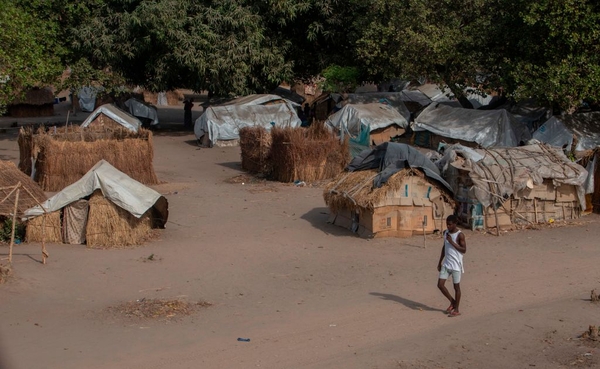
Where are the women?
Of the 411,567 refugees/migrants who have entered the EU by sea so far this year, 72% have been male. Above, some of the hundreds of migrants who arrived in Munich on September 12, 2015.

A record 104,460 asylum seekers arrived in Germany in August, bringing the cumulative total for the first eight months of 2015 to 413,535. Germany expects to receive a total of 800,000 refugees and migrants this year, a four-fold increase over 2014.

At least 80% of the incoming refugees/migrants are Muslim, according to a recent estimate by the Central Council of Muslims in Germany (Zentralrat der Muslime in Deutschland, ZMD), a Muslim umbrella group based in Cologne.

The asylum seekers are also overwhelmingly male. Of the 411,567 refugees/migrants who have entered the European Union by sea so far this year, 72% have been male, 13% women and 15% children, according to calculations by the United Nations Refugee Agency. Information about the gender of those arriving by land remains unavailable.

Of the asylum seekers arriving in Germany in 2014, 71.5% of those between ages 16 and 18 were male; 77.5% in the 18-25 age group were male; as were 73.5% of those between 25 and 30, according to German migration statistics. Data for 2015 is not yet available.
Soeren Kern is a Senior Fellow at the New York-based Gatestone Institute. He is also Senior Fellow for European Politics at the Madrid-based Grupo de Estudios Estratégicos / Strategic Studies Group. Follow him on Facebook and on Twitter.

Labels: , , , , , ,

Monday, October 20, 2014

Aiding The Terrorism of Choice

"The PYD is for us, equal to the PKK. It is a terror organization."
"It would be wrong for the United States — with whom we are friends and allies in NATO — to talk openly and to expect us to say `yes' to such a support to a terrorist organization."
President Recep Tayyip Erdogan
People gather on a hilltop on the outskirts of Suruc, at the Turkey-Syria border, to watch in the distance the fighting between Syrian Kurds and ISIS militants in Kobani, Syria, on Sunday.
People gather on a hilltop on the outskirts of Suruc, at the Turkey-Syria border, to watch in the distance the fighting between Syrian Kurds and ISIS militants in Kobani, Syria, on Sunday. (Lefteris Pitarakis/Associated Press)

Turkey's President Recep Tayyip Erdogan, who with his Justice and Development Islamist party led Turkey away from its almost-century of Ataturkian secularism, to a more classical fundamental Islamist reality, was confident that with him at the helm Turkey was preparing to move from the 17th largest economy in the world to rise to take its place among the economically advanced countries of the world in the 10th place.

He was also more than a little pleased with himself and his diplomatic skills to have been able to persuade the Turkish-Kurdish Kurdistan Worker's Party to sign an initial peace treaty, bringing the country's decades of conflict in which 40,000 lives were claimed, to a close. And then things began to fall apart in the neighbourhood, when Syria became embroiled in a deadly civil war with its government choosing to bomb its own civilians.

Turkey's stability under the emotionally volatile and religiously-motivated Erdogan was carried off in an unintended direction when Ankara decided to support the Syrian Sunni rebels against their Shia-Alawite government with its murderous bent. Perhaps President Erdogan failed to calculate that Syria would become an irresistible magnet for terrorist groups, even though he has a functioning love affair with the terrorist group Hamas.

President Assad remains firmly in power thanks to the assistance of yet another terrorist group, Hezbollah, and its sponsor, the Islamic Republic of Iran and the Al Quds section of the Republican Guard. Still, Syria has been irremediably fractured religiously, geographically, and the hated Syrian Kurds have declared their full autonomy. A situation that infuriates and frustrates Mr. Erdogan; on the one hand that Bashar al-Assad still rules Syria, on the other that a Kurdish group whose past includes aiding his own PKK Kurdish opposition has declared itself independent.

A looming threat of emulation suddenly raised the spectre of Turkey's PKK becoming restive once again, and violently agitating for independence in Mr. Erdogan's back vision. The growing presence of ISIS which now controls a large portion of the Turkish-Syrian border another chink in Turkey's armour, though not nearly as troubling to Mr. Erdogan as the PKK in eastern Turkey, and to which he addressed himself by bombing Kurdish PKK fighters near Hakkari in southeastern Turkey.

The softening relations between Ankara and its Kurdish population has now been fired into rebellion caused by Turkey's contentious decision to defy its NATO membership and responsibility as a neighbour to aid the Syrian Kurds battling ISIS intent on taking the Kurdish city of Kobani, to take possession of the entire border area, and unsettle Syrian Kurds' plan of their own continuous geography. Better not to worry about the future of ISIS on the border than a Kurdish state, for Turkey.


APTOPIX Turkey Syria
Thick smoke and flames from a fire rises following a strike in Kobani, Syria, during fighting between Syrian Kurds and the militants of the Islamic State group, as seen from a hilltop on the outskirts of Suruc, at the Turkey-Syria border, Sunday, Oct. 19, 2014. (Lefteris Pitarakis/Associated Press)

The violent protests against the Turkish Islamist government by its Kurdish population as a result of the government's stance on Kobani has seen 37 people die, and hundreds injured. The jailed leader of the PKK, Abdullah Ocalan, has stated that peace talks with Ankara would come to a finish if the Kurdish city of Kobani falls, while it is within the power of Mr. Erdogan to allow humanitarian supplies to reach the Kurdish fighters, a situation he has allowed to fester as a result of his pathology of hatred for the Kurds.

Hatred so vibrant that Turkey spent over a trillion dollars in the past thirty years fighting the Kurds in a war that could have been settled with the decision to surrender a small portion of the country's geography to the Kurds, deserving of a country of their own. That was a trillion dollars far better spent developing the economy, rather than subjecting Turkish Kurds to systematic, brutal assimilation, leading to the rise of the PKK.

Now, Turkey's political equilibrium is once again under internal threat, its economic plans for the future in doubt because it will likely have to indulge in yet another costly conflict with the Kurds, newly infuriated and resentful at President Erdogan's attitude as evinced in ordering his troops to remain poised on the border, to watch and do nothing to aid the Syrian Kurds, nor permit Turkish Kurds to cross to their aid.

Labels: , , , , ,

Tuesday, August 26, 2014

Report: Over a Dozen Hamas Terrorists Admit to Use of Hospitals, Kindergartens and Mosques for Military Activity

August 25, 2014 6:30 pm 
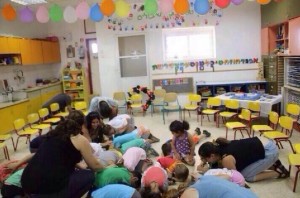
Israeli children sheltering from a rocket attack. Photo: IDF.

A number of Hamas operatives who were arrested and detained by Israel during Operation Protective Edge admitted to the use of civilian establishments, such as mosques, schools and hospitals, as covers for terrorist activity, according to a report released on Monday by the Israel Security Agency (ISA).
The report cites extensive and detailed testimony from the Hamas members to support Israel’s long maintained assertion that the group operates behind human shields, which often accounts for civilian casualties as it exchanges blows with the Jewish state.

The report came as the Hamas controlled Gaza religious affairs ministry claimed Israeli fire throughout Monday destroyed four mosques, raising to 71 the alleged total number of mosques targeted over the past seven weeks.

Detained militants Muhammad Ala’a and Muwaz Abu Tim told ISA they were recruited for Hamas military activity at the Alabrar and Khaled Ben Alulid mosques in Khan Yunis and Bani Suheila, respectively. Another militant, Abdel Rahman Balousha, said the Alsafa and Alabra mosques in Khan Yunis serve as meeting points for Hamas terrorists. He added that in the Alabra mosque the assembly point is in an underground shelter.

Iyad Abu Rida said that the Hamas-affiliated Jamaat Asnad association is located on the second floor of the Altikva mosque in Hazara while another Hamas operative said terrorists used the same mosque to pass along orders regarding where to plant improvised explosive devices to target Israelis.

Another pair of Hamas terrorists said armed police activity was carried out adjacent to the Uthman ibn Ifan and Abdallah ibn Masoud mosques in the Alkheif junction area, the Hassan Albana and Abu Dir mosques, and the Haroun Alrashid school.

Another detainee, Muhammad Ramadan, told ISA that in February 2014 he trained as an anti-tank fighter in a hall located underneath the Alshafi mosque in his hometown of Khan Yunis. He added that the hall is also used as a training and instruction facility for the Izzadin Al-Qassam Brigades, Hamas’s military wing.

Another Hamas operative revealed that Izzadin Al-Qassam Brigade terrorists monitor Israel Defense Force (IDF) movements from the Abad Alrahman mosque, and said that two home-made explosive devices were hidden in the Altoheid mosque.

Khan Yunis native Muhammad Alqadra told ISA that mosques in his hometown were used to conceal war material such as RPGs, heavy PKC machine guns and AK-47s. Additionally, he confirmed that local schools and hospitals, including the Nasser and Halal hospitals, are used as weapon arsenals. It is also well known that senior Hamas leaders and their armed bodyguards, who usually wear police uniforms, use hospitals as hideouts, he said.

According to Alqadra, guards are stationed at the admission department in the Nasser hospital in Khan Yunis. He also believes the Hamas leadership in the Gaza Strip, including senior official Ismail Haniyeh, is hiding in Gaza City’s Shifa hospital in an area closed off to civilians and guarded by plainclothes armed men.

One operative remembered delivering food to his brother, who works for a local terrorist organization, while the latter was hiding in the Nasser hospital.

A different Hamas operative told ISA he believes terrorists are hiding in the Alnajar hospital. He claimed that in July 2013 he saw many terrorists in the three-story hospital building, adding that civilians who needed medical treatment were turned away from the medical facility. Yet another operative said that since the start of the current Israel-Gaza conflict, many armed policeman have been blocking off certain sections of the same hospital and not allowing anyone, including members of patients’ families, to enter.

The ISA report also included testimony from Hamas operative Marad Amr who said he saw a Hamas military vehicle parked outside the European hospital in Khan Yunis.

The report also cited terrorists admitting to digging terror tunnels and rocket launch sites, and placing arsenals near kindergartens in the Gaza Strip. Muhammad Abu Daraz, from Greater Ibsan, said he was stationed in a tunnel that started next to a clinic adjacent to a residential dwelling. He added that there is a kindergarten in Hazara, next to a clinic, to where he was ordered to bring prisoners in the event of a kidnapping.

ISA said information it gathered from the various Hamas terrorists was passed on to the Israel Defense Forces, including warnings about launch sites, attack tunnels and infiltrations, arsenals and booby-trapped access routes.

The report is among the most extensive yet on Hamas’s endangering of civilians in combat and use of civilian structures for military purposes.

Throughout Operation Protective Edge, media reports of the Hamas tactics trickled out of Gaza, but were often later retracted for fear of retribution from Hamas.

After journalists began to leave Gaza a more complete picture began to emerge, with some outlets reporting on rocket launchers in densely populated civilian areas and the Foreign Press Association condemning Hamas’s intimidation of foreign journalists.

In conclusion ISA said: “It is clear from the foregoing that Hamas knowingly and intentionally operates in and adjacent to civilian areas, including in kindergartens, hospitals and mosques in order to carry out military activity. Hamas thus endangers the civilian population even in times of calm given that munitions are liable to go off and put lives at risk. During fighting, Hamas deliberately operates in these locales, thus turning the civilian population into human shields on the assumption that Israel will be blamed for any injury and loss of life.”

Labels: , , , , ,

Follow @rheytah Tweet