India: Rescued by Herd Immunity
"It was totally overwhelming. November was the worst. We could only accommodate the number of patients we could discharge.""We were managing very, very sick patients in the ward, as there was no room in the ICU.""To our relief and surprise, the number of cases have started to come down drastically.""If the situation continues like this for a month, we can say we have achieved sustained low numbers because of immunity and vaccination.""But we have to keep our fingers crossed. These good times may not continue forever."Dr.Sushila Kataria, Medanta hospital, New Delhi
 |
A mural in New Delhi is part of public health messaging in India. The country has seen a dramatic decline in new cases since the fall, but researchers aren't sure why. Sanchit Khanna/Hindustan Times via Getty Images |
"What we seem to have done is let the virus run its course. By not flattening the curve in the beginning, India went through the herd immunity threshold and the epidemic seems to be naturally coming down.""We will never know how many people died -- no one is counting."Jacob John, virologist, retired professor, Christian Medical College, Vellore, Tamil Nadu state"I am hopeful the worst is over. In certain areas, like large cities, we may have come close to achieving a good amount of immunity -- if not herd immunity, close to it.""The estimates are that 30 to 50 percent of individuals may have had asymptomatic or mild infections and not gotten tested. Many who had developed mild symptoms may have had COVID-19 without realizing it."Dr.Randeep Guleria, director, All India Institute of Medical Sciences"We are seeing a lot less severe disease than the rest of t he world, and a lot more asymptomatic infections.""Part of the reason might be prior exposure to lots of other pathogens. We live in an environment where we are exposed to all kinds of pathogens all the time and we learn not to react too much.""It looks like the virus has really spread widely in the country. Maybe the reason the numbers are crashing is that most people have been infected and infection gives you at least 80 percent protection for months at a time.""If you look at the places that did well with control early on, they are the ones [that] have a high level of infection now.""And if a variant comes along that escapes immune responses, then everyone is in play again."Gagandeep Kang, microbiologist
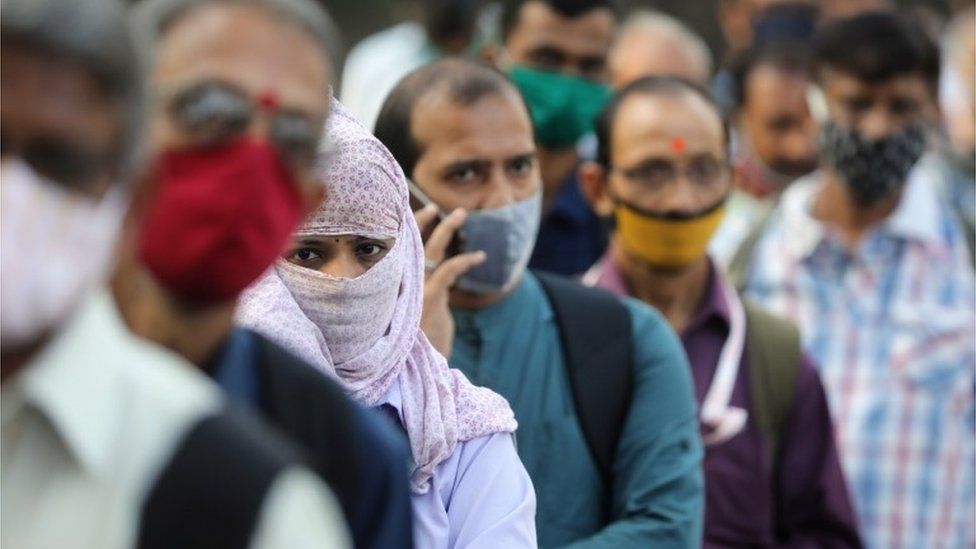 |
| India has recorded some 10.7 million Covid-19 infections so far Reuters |
Exhausted
doctors in New Deli whose non-stop reaction to the COVID pandemic left
them overworked, isolated for fear they would transmit a virus to their
families, and anxious to see the end of the nightmare of the SARS-CoV-2
viral epidemic are incredulous but thankful to recognize that daily new
infections in India's capital have seen a sharp drop in recent weeks.
This is a trend that has extended well beyond New Delhi where India's
new confirmed coronavirus infections nationally have fallen suddenly
from a peak of close to 100,000 new infections daily in September to an
average of 13,000 to 14,000 each day at the present time.
Health
surveys reveal that much higher public exposure to the virus than was
previously understood to have occurred was the reality. While many other
countries all with infinitely smaller populations are struggling
through second and third waves and recognizing the emergence of
troubling new variants of the coronavirus, India's precipitous drop in
infections seems to indicate that their version of the pandemic is well
on its way to burning out in India.
Speculation
has led to the conclusion that this is the result of the nation's
crowded cities and that the level of communication of the virus has led
to natural "herd immunity" having arisen even before vaccines have been
widely used in mass inoculations. The most reasonable hypothesis to the
surprise drop in infections is seen to focus on the virus spread losing
steam, a situation leading to cautious optimism that the pandemic's
shadow is slinking off, allowing the country to begin repair of its
collapsed economy resulting from a strict lockdown, restrictions and
public fear.
The
Reserve Bank of India recently issued a bulletin alerting to the
"increasing probability" of a stronger-than-anticipated economic rebound
in lock step with COVID receding.
"Barring the visitation of a second wave, the worst is behind us. The
recovery is getting stronger in its traction, and soon the winter of our
discontent will be made glorious summer", the bulletin poetically crowed.
Back
in March when India began reeling under the certainty that the first
few hundred coronavirus infections would soon balloon out to hundreds of
thousands, a draconian nationwide lockdown was imposed by Prime
Minister Narendra Modi, for which he apologized as a necessity to avert
complete disaster. The purpose, he explained, was to break the chain of
viral transmission. Public transport was suspended for months, people
could only buy food, medicine and cleaning products while India's
economy contracted 24 percent year on year.
In
a country where millions live in tight proximity sharing community
toilets and water taps in congested slums, lockdown failed to accomplish
its purpose. The pathogen spread from the cities into the hinterlands
carried by laid-off migrant workers who returned to their far-off
villages. Over 10.7 million confirmed coronavirus infections were
reported in all of India, the second-highest number following that of
the U.S. Even so, experts feel the real case total to be much higher;
most infections not recognized nor recorded.
 |
| Photo: PTI |
"The
reported cases are not even remotely a reflection of true cases -- they
only reflect people who got tested. For reasons that we don't fully
know, the virus has spread like wildfire in India -- more than in any
other country in the world", stated Vikram Patel,
professor of global health at Harvard Medical School. Over half of
residents in cities like Delhi, Mumbai and Pune have been exposed to the
virus according to seroprevalence studies. An estimate of 31 million
infections by mid-August in Karnataka state, included 44 percent of the
rural population and 54 percent of the urban population.
Over
154,000 COVID-19 deaths were reported in India, but the actual death
count may never be known, since most Indians tend to die at home without
a cause of death ever formally determined. Some researchers, despite
that reality, feel that India's COVID mortality rate has in all
probability not been as high as many other regions given the relative
youth of the country's population with just 6.5 percent over 65 years of
age in comparison to Europe's one-fifth.
Health
economist Rijo John, based in Kerala, feels the virus strain that has
swept through India is a less virulent one than has inundated
populations elsewhere. "It's pretty generally accepted that in India, we have a very mild form of the virus. But the future is hard to predict."
For the meanwhile, however, India's pandemic appears to be in steep
decline.Most of the country's 270 million schoolchildren have been out
of class since March. White-collar professionals work from home and have
done so for almost a year, with most elderly people remaining
exclusively at home, susceptible to infection.
An
ambitious vaccination campaign has been launched by the government with
an aim to inoculate 300 million Indians by August's end. A number that
includes health-care workers and the elderly. Roughly 3 million people
have been vaccinated once the drive began two weeks earlier indicating
that reaching the total of 300 million will probably become a slow,
protracted process.
"A lot of this is in the rear-view mirror but that doesn't mean we are done and dusted yet.""We have an artificial situation in which we've reached an equilibrium, but if we went back to normal, there is still a lot of room for cases going up."Ramanan Laxminarayan, director, Center for Disease Dynamics, Economics & Policy
 |
Cumulative severity of COVID-19 and proportionate mortality from top causes (percent) Source: Johns Hopkins University; World Health Organization. |
Labels: Herd Immunity, India, Novel Coronavirus
posted by Pieface @ Monday, February 08, 2021