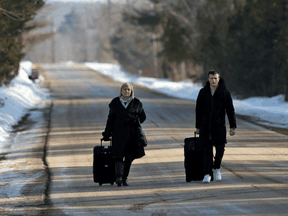
Growing Canada's Population : Reducing General Quality of Life
"Everyone deserves a safe place to call home ... And Canada is stepping up: In 2022, for the fourth year in a row, we were the top country in the world to resettle refugees.""Today, we come together as Canadians to keep our country a welcoming place and help build a safer world for everyone."Prime Minister Justin Trudeau, World Refugee Day"Only ten people are allowed to shower each day and washroom access is one at a time.""Menstruating women told us how difficult it was for them to stay clean under these conditions.""Washroom/shower access is also only between 8:am and 8:pm."Diana Chan McNally, homelessness advocate, Toronto
 |
| Asylum seekers line up as volunteers from the Black Coalition for AIDS Prevention hand out food, water and supplies. (Patrick Swadden/CBC) |
Canada
has taken in -- and allegedly absorbed -- a whopping huge one million
immigrants, students on study visas, refugees and illegal migrants in
the year before this. Vastly in excess of any G7 country. A measure of
the current Liberal government's commitment to grow the Canadian
population as befitting a huge geographic area that is Canada, from the
Atlantic to the Pacific to the Arctic. Canada's population has swelled
to 40 million people.
Some
of whom are fortunate and prosper in the country north of the United
States with its population ten times that of Canada's on a slightly
smaller territory. Many of whom live in poverty or close to it, in an
economy hit hard like all others around the world during the years of
desperately coping with a world coronavirus pandemic. Now, the country
is short of labourers and workers of all kinds, from construction sites
to hospitals.
The
cost of living has strained peoples' budgets, and those who can no
longer cope have joined the legion of the homeless, living in shelters
or on the streets. The once-vaunted universal
hospitalization/medical-care system that Canadians were so proud of is
being strained beyond its ability to cope with an ageing population, one
that is growing even while facilities to look after their health
problems are diminishing. Many Canadians cannot find a primary
health-care physician.
Housing
has become enormously expensive as the national housing stock cannot
keep up with demand and building costs rise. Rental rates have expanded
even as the number of rentals available to meet the demand have declined
proportionally. Food Bank use has skyrocketed; more people than ever
before using the Food Banks as stop-gaps between paycheques, while
others cannot afford nutrition at the best of times.
 |
| Some asylum seekers outside the city’s shelter intake office at Peter and Richmond streets downtown have been sleeping on the street for over a month waiting for shelter. (Patrick Swadden/CBC) |
Into
this sorry mess steps economic migrants from Central America, Haiti and
Africa, lured to a First World country advertising itself as open to
refugees. Illegal border crossers from the United States into Canada
have been welcomed in the sense that if they declare themselves as
refugees seeking haven, they are permitted to fill out application forms
and to enter the country to await a formal decision by the Canada
Immigration and Refugee board. A decision that could take up to several
years.
The
illegal migrants gravitate to the country's cities where the social
welfare system is expected to care for their needs; housing, schooling,
medical care. While waiting for decisions on a refugee claim, the
claimant may apply for a work permit, allowing them to take employment.
In the interim, they become wards of the municipality where they settle.
Toronto, Canada's largest, most populous city, takes the brunt of the
migrants' presence.
Many
are temporarily housed in hotels and motels, and when none are
available, directed to a City of Toronto assessment and referral centre
for the homeless. Toronto's homeless shelters are full, housing mostly
Canadians who have fallen on ill times, but fully a third are
represented by migrants, some of them entire families. Since there is no
room at the city shelters, they wait indefinitely in the open,
unsheltered until such time their need can be addressed.
They
sleep in the outdoors regardless of weather, and many are unable to
access sufficient food and water. They have started to set up urban
encampments with the use of tarps, sleeping bags and blankets brought
along by charitable volunteers. The situation is so fraught with
discomfort of rough living that some are taken to hospital emergencies
suffering physical and psychological afflictions reflecting their
plight. They are in essence, abandoned by any level of government.
Municipalities
have asked the federal government for funding and assistance, but to no
avail. Those considered refugees are the responsibility of the federal
government, under Immigration, Refugees and Citizenship Canada. The same
federal government that allows record numbers of refugee claimants to
enter Canada, but which has failed to distribute funding to
municipalities, or to build additional shelters for refugees.
 |
| Momodou Sumbumdu, left, Prosscovia Namusisi of Uganda, centre, and Asuman Najib Ssali, have been sleeping on the street in front of a Toronto shelter for weeks. (Patrick Swadden/CBC) |
"That system [dedicated refugee system] has 2,000 spaces and is currently full. Up until June 1, to address the persistent demand, refugee claimants were also being admitted into the base shelter system. There are currently an additional 1,000 refugees in the base system.""The City had hoped not to have to make this change, [to no longer house refugees in non-refugee shelters] but after more than a year of requesting urgent funding assistance and logistical support, we had to make difficult decisions.""The City has been meeting with the Federal government for over a year, stressing the need for urgent funding and asking for a long-term strategy and logistical support for the current surge of new arrivals. The Federal government need to allocate the appropriate resources to ensure people have support when they arrive.""Hundreds of millions [are required to support the surge of new arrivals accessing the city’s shelter system].""Currently, the City has funding to support 500 individuals but is using reserve resources to support over 3,000 refugees who are using the system per day. Operating these 2,500 unfunded spaces requires $157 million."Toronto’s Shelter, Support and Housing Administration
Labels: Canadian Municipalities, Economic Migrants, Illegal Border Crossings, Migrant Social Services, Resettling 'Refugees', Strained Universal Welfare, Trudeau Government
posted by Pieface @ Friday, July 14, 2023