Wednesday, March 11, 2026

Hospital Emergency Rooms Dysfunction

https://www.iedm.org/wp-content/uploads/2025/09/large-note-economique-102025-570x416.jpg
Too Many Canadians Are Leaving Emergency Rooms Untreated 

"[Needless, avoidable deaths are recurring] with unsettling regularity, not randomly, not rarely [in Canada's hospitals; a function of choked and overwhelmed emergency departments]."
"[The dark reality is a] hidden pandemic [of excess deaths, higher than] citizens of a highly developed country have a right to expect."
"A patient waits for hours in a Canadian emergency department, deteriorates quietly, sometimes visibly, then dies before being assessed, [most often from a heart attack, stroke or sepsis]."
Report published in the Canadian Journal of Emergency Medicine  
"People are despondent. They're scared that there are going to be bad outcomes and they're going to feel responsible. But they don't see any respite."
"[Emergency departments are now in a] chronic disaster state; [the capacity required to care for patients] patently inadequate."
"It's got completely out of control and meets the formal definition of disaster -- a serious disruption of functioning, that exceed the ability of available resources and results in excess harm -- on a daily basis."
"When there is crowding all over the hospital, it leads to chaos in the ED and bad things predictably happen in that setting."
"Eventually our system will just be seen by the public as unsustainable. I've got many friends who once believed that our health system was a defining feature of being Canadian, who are losing faith in the system."
"Until we are able to translate the real lives lost in this hidden pandemic into terms that will resonate emotionally with the public -- that will make them say this is untenable -- we won't get anywhere."
"We are failing to deliver on a defining national priority. The feds have to do something."
Dr. Alecs Chochinov, professor of medicine, University of Manitoba 
https://smartcdn.gprod.postmedia.digital/nationalpost/wp-content/uploads/2026/03/ER-over-crowding-1.jpg?quality=90&strip=all&w=564&h=423&type=webp&sig=N0LyzBthh5vliouDBNPbag
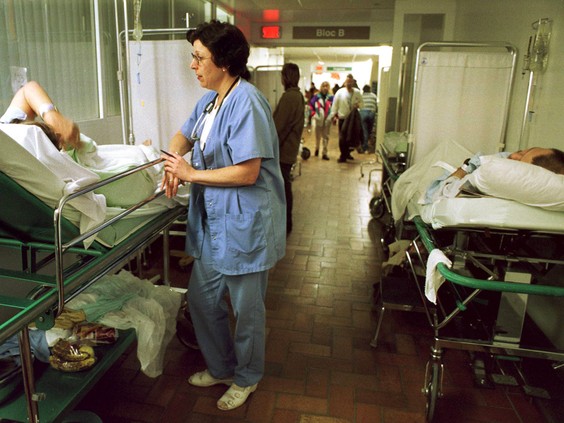
Across Canada, emergency rooms are routinely operating beyond 100 per cent capacity. Photo by John Mahoney/Postmedia/File
 
In actual fact, the feds have 'done something'. They have helped to destroy that 'defining national priority' which they fail to recognize as one of their most vital responsibilities. The federal government -- the Liberal government, in all its successions -- views immigration as a far more important national priority than national security, much less the social benefits in health and welfare that any responsible government, particularly that of a recognized 'first-world' economy must see as its primary function. 
 
The Liberal government is obsessed with trade and prosperity for the nation, to be sure, alarmed at the falling birth rate, determined not to exploit the country's natural resources, and eager for a workforce that will continue to labour mightily to feature its special green and social welfare programs that appear to exclude the well-being of its population in its focus on promoting Critical Race Theory, DEI and wokeism. Where transgender rights and economic migrant intake reign supreme.
 
Under Canada's Liberal governments immigration, refugee intake and migrant acceptance have ballooned to the point where the government departments responsible for administering the programs along with verifying the status of applicants with background checks for undesirable affiliations and actions have gone by the board. Where due to indifference and lax attitudes toward security, Canada is a great place to launder financing of terrorism abroad.
 
Where on the streets of Canada operatives of the very terrorist groups that have made their deserved presence on the federal government's own proscribed terrorist lists walk about freely to harass and threaten Canadians. Where an estimated 600 agents of the Islamic Republic of Iran's government, its Islamic Revolutionary Guard Corps and Basij police have a presence, enjoying Canada's comfortable way of life. Where members of Hezbollah and Hamas have integrated themselves, along with the Muslim Brotherhood through infiltration of the country. 
 
Where they engage in the illicit drug trade, human smuggling, money laundering and the presence of illegal cryptocurrency shops that illegally send money abroad, funding terrorist groups as well as Iran's IRGC itself. Refugees brought in from Syria and the Palestinian territories to Canada so overwhelm the system of verification and application approval that scant attention is given to background checks resulting in Canada hosting as permanent residents and citizens, individuals highly connected with terrorism.
 
The fallout of the immense numbers of immigrants, refugees, migrants and foreign students on study visas that added millions to the Canadian population in just the last few years has had the added effect of straining the country's social welfare system, its public schools, housing, and hospital-medical facilities. There is a dire shortage of medical personnel; doctors, nurses, specialists, technicians and hospital beds. Schools are burdened with children learning English, and bringing with them the cultural attitudes of their home countries. 
 

"A review is launched, a statement is issued. Regret is expressed, perhaps a policy adjusted."
"Then the system resumes its normal operation."
"When patients stop moving, they accumulate. And the place where they accumulate is the only part of the system that cannot refuse entry [the Emergency Room]."
Report published in the Canadian Journal of Emergency Medicine  
 
Professor Alecs Chochinow and his colleagues produced a commentary on the state of Canada's health care system, stressing the stories behind media reports of people dying after waiting long hours for care in hospital emergency rooms. Their report was published in the Canadian Journal of Emergency Medicine. In it, they produce startling figures and statistics as well as individual examples of the hapless failure of the country's universal medicare system.
 
As a result of emergency department crowding, they point out, an estimated 8,000 to 15,000 Canadians die each year. Deaths take place in the ED, on the wards or following a patient's release from  hospital prematurely to the patient's actual need for continued hospitalization. A 55-year-old woman died of cardiac arrest after waiting 11 hours in an emergency department in Winnipeg, awaiting admission to a hospital room. Another 44-year-old man died after spending 8 hours with chest pains in an Edmonton emergency room.  
"[It's not uncommon to have people in] 10-out-of-10 abdominal pain with no pain medication, no comfort and nowhere to sit for 12 hours in our emergency department because we can't them them in."
Alberta physician Dr. Paul Parks 

 A list of at least six potentially preventable deaths occurring over a two-week period was compiled in Alberta, including a 50-year-old man who perished from a bacterial blood infection causing multiple-organ failure. Emergency rooms across Canada routinely operate beyond 100 percent capacity; 30 to 40 stretchers and cubicles occupied by people assessed and 'admitted' to hospital are placed there awaiting an empty bed on a ward; beds filled with patients no longer requiring care, but nowhere to go to; in long-term care, or home care, or rehab.

Staff burnout, delayed diagnoses, errors and excess deaths result from this kind of crowding, with crowded emergency departments seen as proxies for crowded and dysfunctional hospitals. The federal government shrugs; health is a provincial matter. Yet the Canada Health Act points to timely access to care as a priority.

A red emergency sign sits on top of white building.
The emergency department of the Rockyview General Hospital is pictured in Calgary. (Jeff McIntosh/The Canadian Press)


Labels: , , , , , , , ,

Wednesday, August 23, 2023

Crossing the Border From Yemen To Saudi Arabia -- Don't!


"The shooting went on and on."
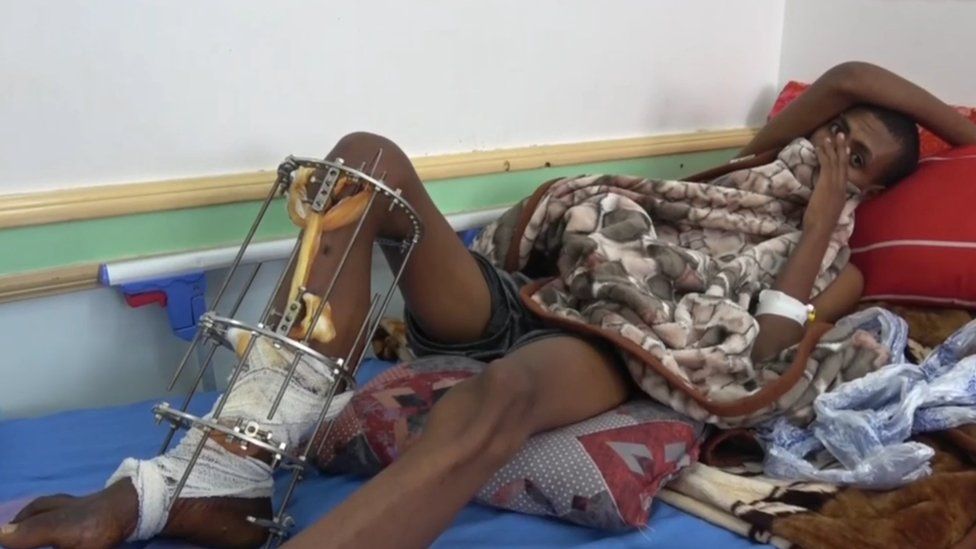
"I didn't even notice I was shot but when I tried to get up and walk, part of my leg was not with me."
"I went to Saudi Arabia because I wanted to improve my family's life but what I hoped for didn't materialize. Now my parents do everything for me."
21-year-old Mustafa Soufia Mohammed   
 
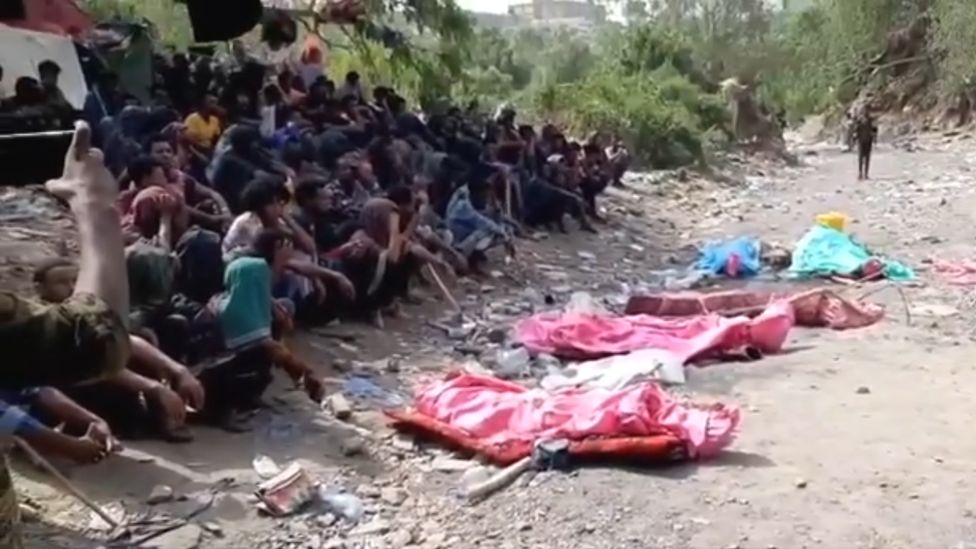
"They beat us, killed some and took those who survived to the hospital. The bodies of those killed were left scattered on the ground." 
"I was shot between my thighs near my groin, and my legs are paralyzed now. I can't even walk. I thought I would die." 
Ibsaa, Ethiopian migrant
A migrant with an injured leg lies on a hospital bed in the Yemeni city of Saada
Ethiopian migrants say they were shot when they tried to cross from Yemen into Saudi Arabia BBC
"What we documented are essentially mass killings."
"People described sites that sound like killing fields - bodies strewn all over the hillside."
"We say a minimum of 655 [killed], but it's likely to be thousands. We have factually demonstrated that the abuses are widespread and systematic and may amount to a crime against humanity."
Human Rights Watch report's lead author, Nadia Hardman

"I saw people killed in a way I have never imagined."
"Immediately after we arrived [at the border], they [Saudi Border guards] fired on us."
"A lot of people were dying. In a group of 200 migrants only fifty people survived."
"It wasn't a bullet they were shooting. It was thrown from the back of a car, like a bomb. It kills a lot of people. They fired on a lot of people."
Dahabo, 20, economic migrant
From personal accounts of migrants crossing from Yemen toward the Saudi Arabian border, rockets were fired by Saudi border guards, according to a newly published investigation. Fleeing turmoil in the Horn of Africa, hordes of migrants were shot with rifles and blown up with rocket-launcher-like weaponry as they attempted to cross by land into the Kingdom of Saudi Arabia.

Border guards were charged with forcing teenagers to rape other migrants. Victims were forced to select which of their own limbs they preferred to be shot in, according to testimony evaluated from 42 survivors that Human Rights Watch collated and published in their report. It is a graphic, 79-page report claiming that Saudi border guards "systematically fired mortar and rocket launcher type weapons" on Ethiopian migrants.

The situation is one of a background of neighbouring Yemen's civil war overlapping into Saudi Arabia, Houthi terrorists, funded by the Islamic Republic of Iran to transform Yemen into a Shi'ite stronghold aligned with Iran, just as Syria, Iraq and Lebanon have become political satellites of Iran in its plan to subjugate the Sunni majority in the Middle East to Iran's quest to become its regional powerhouse. Saudi Arabia formed a coalition of other Gulf states to intervene in Yemen to restore its rightful government.

An offensive stalemate was reached, the coalition unable to unseat the Houthi rebels from the half of Yemen they took by military force. The Houthis have attacked Saudi Arabia's oil infrastructure on occasion and the war in Yemen grinds on. Simultaneously a surge in migration into Saudi Arabia has taken place at its border with Yemen. Although the Houthi leadership denies Saudi claims that they have been collaborating with human smuggler groups to guide migrants into Saudi Arabia, this is what is occurring.

The ageless hostilities between between Saudi Arabia and Iran, the latter believing it should control Medina and Mecca, not Saudi Arabia, came to a surprising pause when the two countries recently signed an agreement presumably of regional cooperation. Despite which there has been no pause or cessation of the Iran-sponsored Houthi attacks on Saudi Arabia.

The report issued by Human Rights Watch notes that the Houthis in Yemen were aiding in the smuggling of mostly Ethiopian migrants arriving by boat from Africa to the border with Saudi Arabia. It was also outlined that "widespread" attacks by Saudi Arbia on the migrants have been a reality since 2022, their deaths numbering in the hundreds, potentially in the thousands; under international law, a crime against humanity.
 
Migrants look at covered bodies during a burial on the Saudi-Yemeni border
The report says it is impossible estimate how many migrants have been killed along the border   Social Media
 
There have been overtures to Saudi Arabia for years, prosecuted mostly by the United States, for a new alliance between Saudi Arabia and Israel, to become a partner in the Abraham Accords, an initiative for regional peace formalized at long last, but Crown Prince Mohammed bin Salman, the de facto ruler of Saudi Arabia has continued to balk at that commitment. While the Islamic Republic of Iran continually threatens Israel with destruction, its decades-long goal of nuclear devices geared to that threat.

The issue of Saudi Arabia and other gulf states forming closer relations with China is one that perturbs the United States and its allies. Human Rights Watch has shown graphic video footage and photographs of survivors of Saudi attacks complete with atrocious injuries to the limbs and faces of the migrants. The migrants' injuries appear consistent with those sustained by explosive ammunition and gunshots, according to consulted weapons experts.

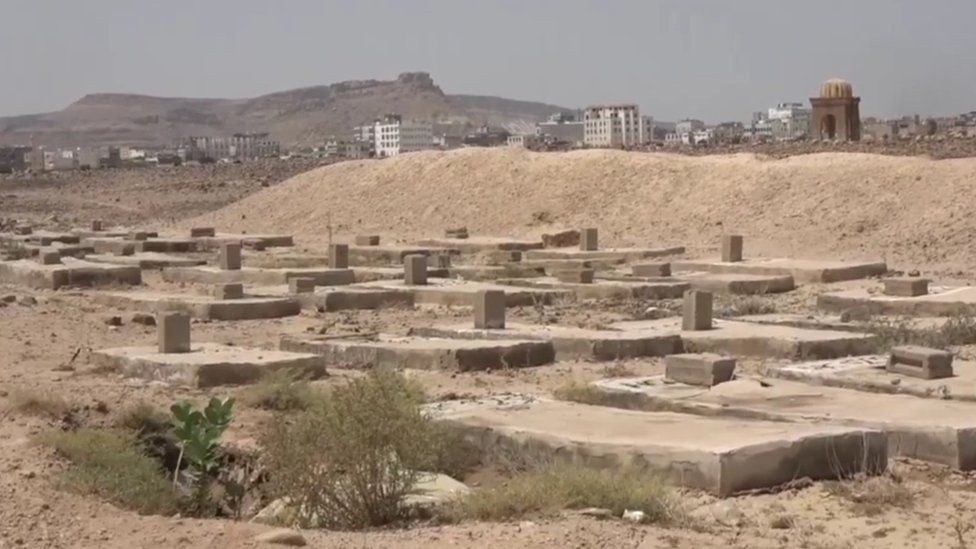
Human Rights Watch declares the most recent attacks killing migrants "appear to be a deliberate escalation in both the number and manner of targeted killings" that have taken place near the Yemen border since 2014. Through its research the human rights group used satellite imagery to locate large numbers of grave sites where victims were buried following the massacres.
"Saudi officials are killing hundreds of migrants and asylum seekers in this remote border area out of view of the rest of the world."
"Spending billions buying up professional golf, football clubs, and major entertainment events to improve the Saudi image should not deflect attention from these horrendous crimes."
Nadia Hardman, researcher, Human Rights Watch
A row of graves in the Yemeni city of Saada
Migrant routes in Yemen are littered with graves  BBC

Perhaps the real mystery here is that of human nature itself. That a mind-chilling reality of a nation that is notoriously xenophobic, one that does not welcome those in whom it has no interest other than as temporary labourers toward whom citizenship or civil rights will never be given, prefer to be oblivious to the reality that the violent reception at the border meted out to unwanted migrants fails to dissuade them. The knowledge of the hostility with which they are met has not dampened the ardour of young men to intrude where they are not wanted.

The imagined lure of financial success should they access a country's limitless resources for advancement propels them to continue testing fortune. Penetrating the border when they cannot hope for any kind of official status as immigrants and potential citizens of a wealthy country motivates them to ignore the reality of the violent reception they will be exposed to. That is the puzzle of human nature just as much as the unwillingness to accept the presence of those that are unwanted and to emphasize the resistance to be forced to accept them by simply dispatching them from life.


Labels: , , , , , ,

Friday, July 14, 2023

Growing Canada's Population : Reducing General Quality of Life


"Everyone deserves a safe place to call home ... And Canada is stepping up: In 2022, for the fourth year in a row, we were the top country in the world to resettle refugees."
"Today, we come together as Canadians to keep our country a welcoming place and help build a safer world for everyone."
Prime Minister Justin Trudeau, World Refugee Day

"Only ten people are allowed to shower each day and washroom access is one at a time."
"Menstruating women told us how difficult it was for them to stay clean under these conditions."
"Washroom/shower access is also only between 8:am and 8:pm."
Diana Chan McNally, homelessness advocate, Toronto
Asylum seekers line up as volunteers from the Black Coalition for AIDS Prevention hand out food, water and supplies.
Asylum seekers line up as volunteers from the Black Coalition for AIDS Prevention hand out food, water and supplies. (Patrick Swadden/CBC)

Canada has taken in -- and allegedly absorbed -- a whopping huge one million immigrants, students on study visas, refugees and illegal migrants in the year before this. Vastly in excess of any G7 country. A measure of the current Liberal government's commitment to grow the Canadian population as befitting a huge geographic area that is Canada, from the Atlantic to the Pacific to the Arctic. Canada's population has swelled to 40 million people. 

Some of whom are fortunate and prosper in the country north of the United States with its population ten times that of Canada's on a slightly smaller territory. Many of whom live in poverty or close to it, in an economy hit hard like all others around the world during the years of desperately coping with a world coronavirus pandemic. Now, the country is short of labourers and workers of all kinds, from construction sites to hospitals.

The cost of living has strained peoples' budgets, and those who can no longer cope have joined the legion of the homeless, living in shelters or on the streets. The once-vaunted universal hospitalization/medical-care system that Canadians were so proud of is being strained beyond its ability to cope with an ageing population, one that is growing even while facilities to look after their health problems are diminishing. Many Canadians cannot find a primary health-care physician.

Housing has become enormously expensive as the national housing stock cannot keep up with demand and building costs rise. Rental rates have expanded even as the number of rentals available to meet the demand have declined proportionally. Food Bank use has skyrocketed; more people than ever before using the Food Banks as stop-gaps between paycheques, while others cannot afford nutrition at the best of times.
 
Asylum seekers wait outside a shelter in Toronto's downtown core.
Some asylum seekers outside the city’s shelter intake office at Peter and Richmond streets downtown have been sleeping on the street for over a month waiting for shelter. (Patrick Swadden/CBC)
 
Into this sorry mess steps economic migrants from Central America, Haiti and Africa, lured to a First World country advertising itself as open to refugees. Illegal border crossers from the United States into Canada have been welcomed in the sense that if they declare themselves as refugees seeking haven, they are permitted to fill out application forms and to enter the country to await a formal decision by the Canada Immigration and Refugee board. A decision that could take up to several years.

The illegal migrants gravitate to the country's cities where the social welfare system is expected to care for their needs; housing, schooling, medical care. While waiting for decisions on a refugee claim, the claimant may apply for a work permit, allowing them to take employment. In the interim, they become wards of the municipality where they settle. Toronto, Canada's largest, most populous city, takes the brunt of the migrants' presence.

Many are temporarily housed in hotels and motels, and when none are available, directed to a City of Toronto assessment and referral centre for the homeless. Toronto's homeless shelters are full, housing mostly Canadians who have fallen on ill times, but fully a third are represented by migrants, some of them entire families. Since there is no room at the city shelters, they wait indefinitely in the open, unsheltered until such time their need can be addressed.

They sleep in the outdoors regardless of weather, and many are unable to access sufficient food and water. They have started to set up urban encampments with the use of tarps, sleeping bags and blankets brought along by charitable volunteers. The situation is so fraught with discomfort of rough living that some are taken to hospital emergencies suffering physical and psychological afflictions reflecting their plight. They are in essence, abandoned by any level of government.
 
Municipalities have asked the federal government for funding and assistance, but to no avail. Those considered refugees are the responsibility of the federal government, under Immigration, Refugees and Citizenship Canada. The same federal government that allows record numbers of refugee claimants to enter Canada, but which has failed to distribute funding to municipalities, or to build additional shelters for refugees. 
 
Three asylum seekers seek shelter outside 129 Peter Street.
Momodou Sumbumdu, left, Prosscovia Namusisi of Uganda, centre, and Asuman Najib Ssali, have been sleeping on the street in front of a Toronto shelter for weeks. (Patrick Swadden/CBC)
"That system [dedicated refugee system] has 2,000 spaces and is currently full. Up until June 1, to address the persistent demand, refugee claimants were also being admitted into the base shelter system. There are currently an additional 1,000 refugees in the base system."
"The City had hoped not to have to make this change, [to no longer house refugees in non-refugee shelters] but after more than a year of requesting urgent funding assistance and logistical support, we had to make difficult decisions."
"The City has been meeting with the Federal government for over a year, stressing the need for urgent funding and asking for a long-term strategy and logistical support for the current surge of new arrivals. The Federal government need to allocate the appropriate resources to ensure people have support when they arrive."
"Hundreds of millions [are required to support the surge of new arrivals accessing the city’s shelter system]."
"Currently, the City has funding to support 500 individuals but is using reserve resources to support over 3,000 refugees who are using the system per day. Operating these 2,500 unfunded spaces requires $157 million."
Toronto’s Shelter, Support and Housing Administration 

Labels: , , , , , ,

Friday, June 15, 2018

Migrant and Refugee Exhaustion in Europe

"Evidently raising  your voice, something Italy did not do for years pays. Victory -- 629 migrants on board the ship Aquarius heading for Spain. First objective [of the new government] achieved."
"Malta is not acting, France rejects them and Europe doesn't care. I've had enough."
"Italy has stopped bowing its head and obeying. This time there is someone who ways no. Enough!"
"Saving lives is a duty, but transforming Italy into an enormous refugee camp isn't."
"We will not change [our position] on ships belonging to non-governmental organizations. Ships belonging to foreign organizations and flying foreign flags cannot dictate Italy's immigration policy."
Matteo Salvini, head, League party, Italian interior minister
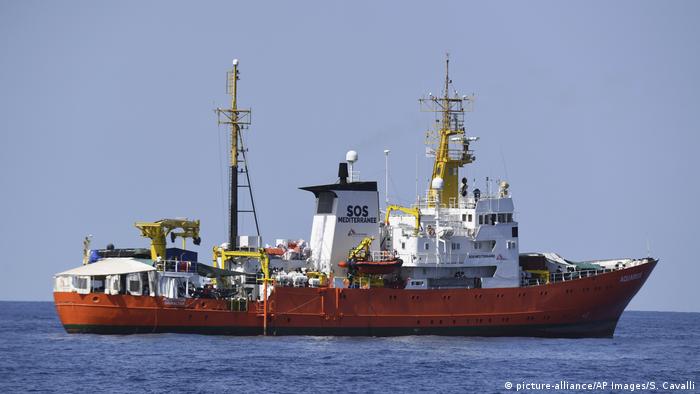
Französisches Schiff Aquarius im Mittelmeer (picture-alliance/AP Images/S. Cavalli)


Europe is suffocating under the weight of illegal economic migrants and those declaring themselves refugees, flooding across the Mediterranean, forcing countries in the European Union to adhere to the directives they've been given to absorb the impossible numbers who despite dangers at sea and the ongoing loss of life due to smuggling mishaps, continue to try their luck at reaching Europe. And they do this through accessing Greece and Italy, with the intention originally of moving on to more prosperous European nations ready and willing to accept them, like Germany, Austria, Norway and Sweden.

Germany having originally declared its willingness to absorb a million of the migrants finds itself struggling with their accommodation, and facing the fallout of German citizens who declared themselves healed of the erroneous belief that absorption would be painless and the grateful migrants would disport themselves civilly at all times. Social customs and religious dictates have intervened to make their presence, however, less than the perfect fit visualized and crime has risen notably.

Italy's new government is a coalition that includes a party resistant to immigration, valuing their nation's unique and proud traditions and rejecting a huge influx of foreigners bringing with them many undesirable traits and customs, and the threat of religion-based challenges to Italian law and justice and social contracts in dispute with the presence of such large numbers of migrants who evince entitlement, not gratitude for a foreign haven in the storm of their home countries' abject failures.

As one of the first nations faced with an unwanted deluge of haven-seekers and economic migrants Italy has already accepted roughly 700,000 in the last five years, leading the interior minister to declare his resistance to transforming his country into "an enormous refugee camp", as he declared that the NGO-operated ship carrying over 600 new would-be migrants into Italy, would not be permitted to land. Leading France to raise a  hue and cry over Italy's heartlessness. And Spain to offer acceptance for the ship to dock in Valencia.

"It's our duty to avoid a humanitarian catastrophe and offer a secure port for these people" avowed Socialist premier of Spain, Pedro Sanchez, taking office a scarce week earlier. Rome has repeatedly informed the European Union parliament that its resources are being stretched to the limit with the number of migrants and refugees it has already been committed to absorbing, appealing for help and for funding. Requests that have largely been ignored. And now that a boatload of 600 has been refused, the rest of the EU rejects Italy's stance.

Yet only several days later the Italian coast guard ship Diciotti with 937 migrants aboard docked at the port of Catania -- the migrants rescued through a number of rescue operations off the coast of Libya. That very episode was cited by Italian Transport Minister Danilo Toninelli as evidence enough that his government was not in the least bit "inhumane or xenophobic", not that Italy has anything to apologize for, much less any explaining to do.

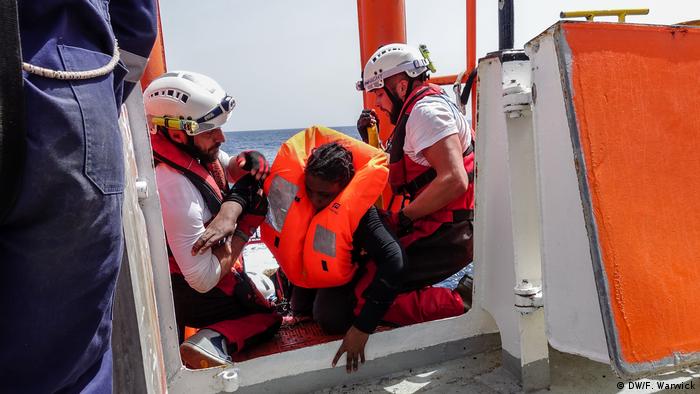
Two men help an exhausted rescued woman on board the Aquarius (DW/F. Warwick)

With no Libyan coastguard in sight, the Aquarius was able to convince the IMRCC and the Libyans to allow them to rescue children, women and families. They evacuated 39 vulnerable people. They had to leave the remaining 80-90 men on the rubber boat to the Libyan coastguard. The Aquarius has the capacity to carry 500 rescued people.

Labels: , , , ,

Follow @rheytah Tweet