Monday, November 04, 2024

Failed Canada-India Diplomatic Relations

"To remain somewhat viable and respectable in the eyes of the United States and Canada and Britain -- the Western world -- he claims to be non-violent."
"And if he didn't [the media] wouldn't give him a nano-second of coverage."
"I think he has bamboozled all of you for a long time."
Ujjal Dosanjh, Sikh, former B.C. premier/federal cabinet minister

"We are just trying to tell India and the world that it's a ticking time bomb which could detonate due to India's constant policy of violently crushing even the peaceful initiative of a referendum."
"The [Prime Minister Narendra] Modi regime's constant policy of crushing the Sikh peoples' initiative of ballots with bullets may, against our wishes, push this purely political conflict into a cycle of violence...SFJ's videos are not inflammatory but rather informatory."
"People under occupation from Punjab to Palestine will react and violence begets violence. If India is going to keep occupying Punjab, there will be a reaction."
"SFK believes in ballots, SFJ believes in votes. The liberation of Punjab is on the cards. India, the choice is yours: ballot or bullet."
Gurpatwant Singh Pannun, exponent, Sikh independence movement: Khalistan
https://npr.brightspotcdn.com/dims3/default/strip/false/crop/4900x3268+0+0/resize/1200/quality/85/format/webp/?url=http%3A%2F%2Fnpr-brightspot.s3.amazonaws.com%2Fa0%2F93%2F74c7429a4c0cae23612a6b398470%2Fnpr-jeenah-0002.JPG
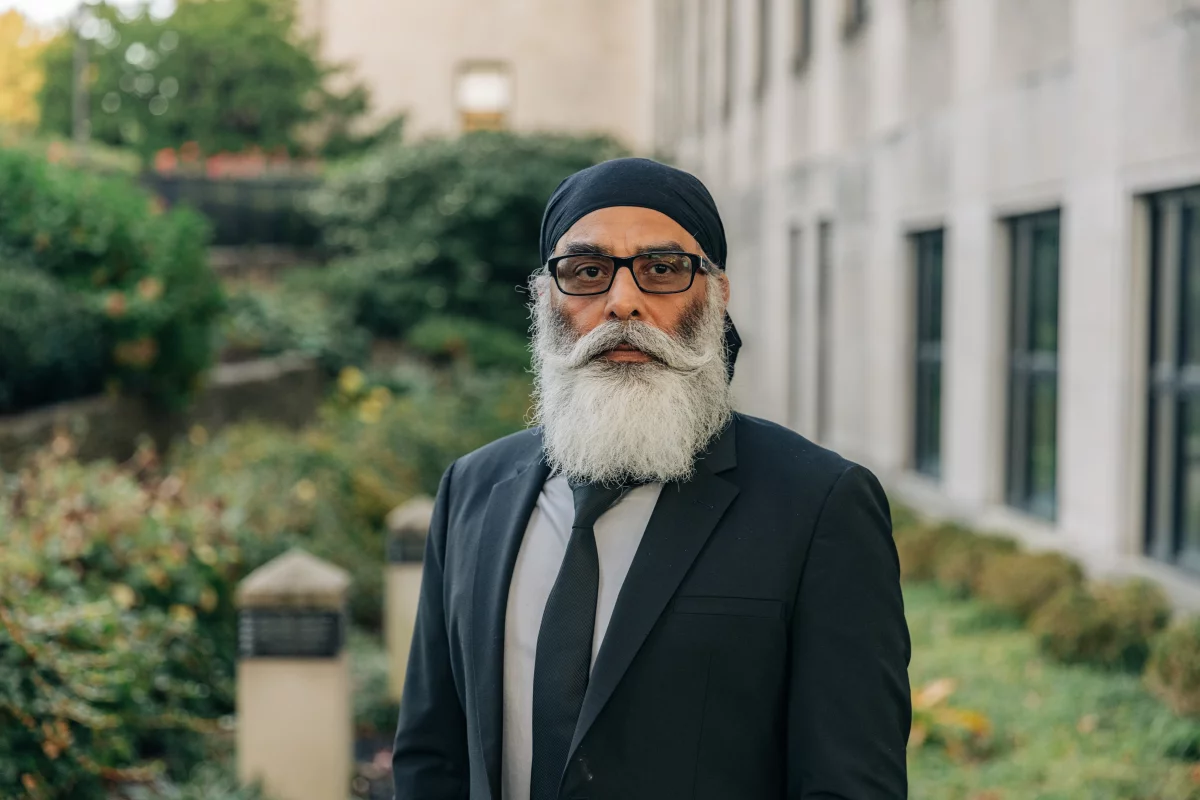
Sikh activist Gurpatwant Singh Pannun stands for a photograph in New York City on Oct. 25. Jeenah Moon for NPR
 
Pannun is a Canadian-American lawyer who has raised an issue of a global referendum to verify the Sikh independence-from-India movement, in a call to split India for the purpose of dividing the Punjab as a gift to Sikhs who view it as their homeland, one they call Khalistan. He is at great pains to deliver the message to Western democracies that his is the voice of reason, and his movement is one of moderation, wanting nothing other than recognition of the right of Sikhs to become a sovereign nation free of India.

He heads the group Sikhs for Justice. And in his online presence speaking for Sikhs for Justice, Pannun's rhetoric is volatile, his social-media posts appear to promote violence. Based in New York, Pannun speaks of the need to "balkanize" India in his mission to carve Punjab away from India's 'occupation', and includes support for other independence movements as well. Including common cause with Chinese President Xi Jinping, recommending he forcefully seize a disputed corner of Indian territory.
"President [Xi] Jinping -- now is the time to order the Chinese army to take Arunachal Padesh back."
"By 2047, the current boundaries and borders of India will be redrawn, and the current borders and boundaries will be wiped out from the world map."
"2024, one India. 2047, none India."
Gurpatwant Singh Pannum
https://cdn.wionews.com/sites/default/files/styles/story_page/public/2024/05/06/429546-khalistan.png?imwidth=400
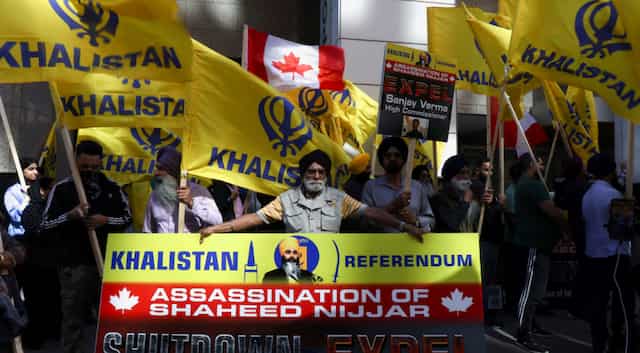
Protesters hold yellow flags with the word Khalistan, as well as a banner with the picture of Sikh separatist leader Hardeep Singh. Photograph:(Reuters)
 
"Violence begets violence" he warns; India has a choice between his referendum and possible armed rebellion: "ballots or bullets", comparing Palestinians to Sikhs in Punjab. In November, Sikhs, he said, should boycott Air India; those who fly on November 19 could endanger themselves. The shadow of 1985's bombing of an Air India flight by Sikh terrorists in Canada. Present at a Calgary rally for Sikhs, he led a chant: "Liberate Punjab, Kill India", a mild display of 'moderation'.

The non-binding referendum run by Sikhs for Justice asks whether Sikhs in Canada, Europe and anywhere the Sikh diaspora exists, asks whether there is support for making Punjab an independent country. Within India itself the issue appears to be of no moment. It is among the large expatriate Sikh community outside India -- particularly in Canada where the largest expatriate community lives -- that the issue of Sikh separation from Hindu India resonates and where Sikh fanatics overwhelm the Sikh-Canadian population uninvolved in the movement.

New Delhi, for which the prospect of such a separation is a non-starter, views Pannum as a terrorist. Interpol has been asked by India to issue a "red notice" for the arrest of the man. After deeming the request political or religious, not criminal, Interpol refused. Canada's large and influential Sikh population -- some 800,000 in number -- does not support political Sikhism/Khalistanis, but they are threatened and silent, harassed and fearful. Canada's Liberal government, however, appears to cater to the Khalistanis; some high-ranking Cabinet members who are Sikh are sympathetic to the Khalistan cause.
 
https://www.ctvnews.ca/content/dam/ctvnews/en/images/2024/4/30/justin-trudeau--khalsa-day-1-6867249-1714483527642.jpg
Prime Minister Justin Trudeau waits to speak to a crowd during Khalsa day celebrations at City Hall in Toronto, Sunday, April 28, 2024. THE CANADIAN PRESS/Cole Burston
 
Narendra Modi's government is fiercely opposed, needless to say, and disappointed and frustrated with the Trudeau government's response to its request for extradition of a number of Sikh-Canadians who have been found guilty of violent criminal activities in India. Justin Trudeau's public accusation of the government of India's involvement in the assassination of a committed Khalistani, denied by India, has caused a diplomatic rift in relations between the two countries, each expelling the others' diplomats.

Pannum, from his social media pulpit speaks of "genocidal violence" against Sikhs. In particular memory of the 40 years that have passed since a massacre of Sikhs by Hindus enraged after Indira Ghandi was assassinated by her Sikh bodyguards. Sikhs for Justice, he announced in a video, was in support of independence movements in the Indian states of Assam, Nagaland, Manipur and Kashmir. Another, earlier video had him connecting the Palestinian-Israeli conflict to the situation in Punjab: "People under occupation from Punjab to Palestine will react and violence begets violence".
 
https://akm-img-a-in.tosshub.com/businesstoday/images/story/202405/663a54f4a9872-canadas-justin-trudeau-and-pm-narendra-modi-062044391-16x9.jpg?size=948:533
   
"We have repeatedly raised our strong concerns regarding the violent imagery being used by extremist elements in Canada against our political leadership. Display of posters of Indian diplomats have also been put out across Canada threatening violence against them."
"Celebration and glorification of violence should not be a part of any civilized society. Democratic countries which respect the rule of law should not allow intimidation by radical elements in the name of freedom of expression."
"[We are concerned over the] security of our diplomatic representatives in Canada. [Ottawa should stop giving space to] criminal and secessionist elements."
Randhir Jaiswal, spokesperson, India’s foreign ministry


Labels: , , , , ,

Thursday, September 21, 2023

How To Make Friends And Influence People Trudeau-Style

"Any involvement of a foreign government in the killing of a Canadian citizen on Canadian soil is an unacceptable violation of our sovereignty."
"Canada declared its deep concerns to the top intelligence and security officials of the Indian government last week at the G20. I brought them personally and directly to Prime Minister Modi."
"Canada is a rule-of-law country. The protection of our citizens and defence of our sovereignty are fundamental."
Prime Minister Justin Trudeau
Prime Minister Justin Trudeau says any foreign government involvement in the killing of a Canadian citizen on Canadian soil is 'an unacceptable violation of our sovereignty.'   CBC

So 'fundamental' that the investigation undertaken by Canada's federal police failed, in investigating the source and cause of the Air India Bombing where hundreds of innocent Canadians and others lost their lives when the aircraft blew up in midair thanks to a bomb placed aboard in a scheme cooked up by a group of extremist Sikh Canadians agitating against India in secessionist plots to divide India's Punjab and create a Sikh 'homeland', 'Khalistan'.  

A bungled investigation led to a trial with an inconclusive result, the guilty parties to the plot failing, due to lack of evidence despite credible witness testimony, to be held responsible for that act of pure terrorism aimed at India and at Indian Hindus that led to the death of 329 people, 280 of whom were Canadian, mostly Indo-Canadians. A substantial, shocking loss of life with no one held accountable, though it was well known the catastrophe resulted from Sikh Khalistan separatists.

The death by assassination of Hardeep Singh Nijjar, president of a Surrey, B.C. Sikh Gurdwara, shot dead by masked gunmen in the parking lot of Guru Nanak Sikh temple could have been carried out by two thugs seeking revenge for the Air India bombing, since he was an important member of the Khalistani movement, and a colleague of the principal suspect in the Air India bombing. If, as prime minister Trudeau asserts, the government of India was involved in this murder, an investigation that is still ongoing, his decision to release this bombshell of an accusation against India was done to serve his own interests; a grudge against Indian Prime Minister Narendra Modi. Hardly how one democracy treats another on the basis of a 'suspected' involvement.
"We have seen and reject the statement of the Canadian prime minister in their Parliament, as also the statement by their foreign minister."
"Allegations of Government of India's involvement in any act of violence in Canada are absurd and motivated".
India Foreign Ministry
People entering a gurdwara in Surrey, B.C., with a giant poster by its entrance featuring two slain Sikh men and below them photoss of three other people from the High Commission of India and it reads: assassination wanted.
Members of the Sikh community are pictured on Monday at the Guru Nanak Sikh Gurdwara where Hardeep Singh Nijjar was murdered in Surrey, B.C. (Ben Nelms/CBC)
 
Canada's leader of the official opposition, while in support of denouncing a presumed act of extreme violence by a foreign government on Canadian soil, criticizes the prime minister for failing to divulge credible evidence implicating India in the killing of a "Canadian citizen". The fact is that Canada has been badly remiss in its responsibilities to another nation with which it has always had amicable relations, one whose expatriate citizens make up a sizeable proportion of the Canadian public. Sikh-Canadians represent 2% of the Canadian population, while Hindi-Canadians make up 2.4%. In his wisdom, charging India with conspiracy to murder, the prime minister who excels at dividing Canadians, has created another schism between Canadian Sikhs and Hindus.

The murdered man lied on his application for refugee status, and he was denied entry as a refugee. He chose an oft-practised ruse, marrying a Canadian citizen who then sponsored him for legal entry to Canada; that practise is now on the radar of Immigration officials. He established himself finally as a Canadian citizen, and has worked tirelessly to rouse Canadian Sikhs to the controversial and troubling cause of a proposed Sikh homeland, to carve a 'Khalistan' out of India's geography in Punjab. Mr. Nijjar organized protests, some of which fulminated against Indian diplomats in Canada, going so far as to recommend their deaths, while celebrating 'martyrs' to Khalistan.
"Diaspora groups bring grievances from their home countries. Even though many Sikh Canadians are first-, second- or third-generation Canadians, that issue [secessionism] resonates."
"There's a lot of history there."
"There's no serious insurgency in Punjab the way there was in the 1980s. I think most Sikhs in India are very pragmatic and know it would never allow one of its major provinces to separate."
Vivek Dihejia, associate professor, Carleton University, Ottawa
Two men sitting in ornate chairs, with flags of their respective countries behind them.
Prime Minister Justin Trudeau takes part in a bilateral meeting with Indian Prime Minister Narendra Modi during the G20 Summit in New Delhi on Sept. 10. (Sean Kilpatrick/The Canadian Press)
 
India has pleaded with Canada not to permit Sikh Canadians to openly and flagrantly protest against India, threatening violence and in fact often committing violence. Justin Trudeau has turned a deaf ear to India's overtures and has instead left the indelible impression of his complete sympathy with those Canadian Sikhs who are extremists. When India was beset with large and vocal protests by farmers -- mostly Sikhs -- who protested against plans by the Indian government to modernize its agricultural system in food conglomerate payments to farmers, Trudeau openly supported the striking farmers, a clear interference in another country's internal affairs.

Militant Sikhs in the UK which has a Sikh-British population substantially fewer than Canada's, and in the United States, cannot launch the kind of wild protests that Canada sees with its provocative outlines and its celebration of Khalistanis who have run afoul of the law and who have committed deadly crimes, that are seen in Canada. There is legislation to prevent this type of grave propaganda assaults against another country with whom the West has otherwise good relations. Trudeau's motivations are politically charged, to gain the approval and support of a sizeable voting bloc, as though all Sikh Canadians approve of his tolerance for Sikh extremism.

Canada is to India what Pakistan is to the United States, where Osama bin Laden, the architect of the 9/11 attacks, was hosted by and shielded from US vengeance in his Abbottabad compound, located in close proximity to a Pakistani military command compound. A Pakistani medical doctor whose compound was next to the bin Laden compound had cooperated with the US secret service in establishing the identity of bin Laden, and for his part in the drama, he was arrested and imprisoned as a traitor to Pakistan. Canada has done nothing to ratchet down the threats of violence emanating from extremist Sikh Canadians, despite New Delhi asking Ottawa to take the required measures to outlaw them.
"The prime minister hasn't provided any facts. He provided a statement and I want to emphasize that he didn't tell me any more in private [than] he told Canadians in public, so we want to see more information."
"[There would be] real [risk if Trudeau refuses to provide more information or if the allegations turn out to be inaccurate]."
"[Trudeau] said nothing and did nothing [regarding Chinese interference in Canadian affairs for years, even while two Canadians were imprisoned, as compared to his action on allegations against India for the extrajudicial killing]."
Conservative leader Pierre Poilievre, House of Commons
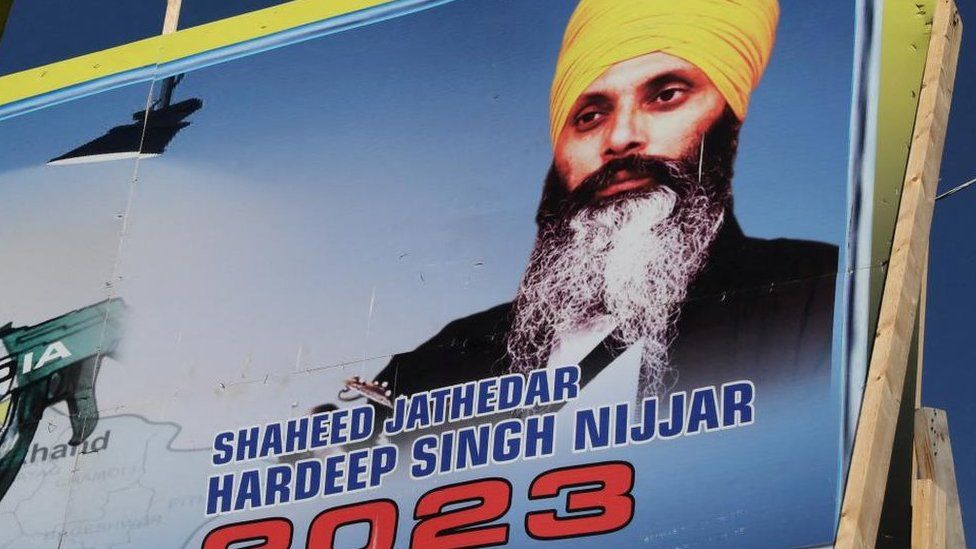
A mural of Hardeep Singh Nijjar outside the Guru Nanak Sikh Gurdwara in Surrey, BC.
Hardeep Singh Nijjar was a leader of a Sikh temple in Surrey, British Columbia  Reuters

Expressing Indian government growing frustration with anti-India sentiments taking place in Canada, PM Modi pointed to a poster produced by a Canadian pro-Khalistan group which featured "KILL INDIA" in block lettering. Hardeep Singh Nijjar who arrived in Canada in 1997 was accused by the government of India of terrorism. The country's Central Bureau of Investigation issued a warrant against him, charging him with attempting to cause an explosion, making or keeping explosives with intent to endanger life or property, and making or possessing explosives under suspicious circumstances. There was an Interpol notice issued for Mr. Nijjar.


Labels: , , , , ,

Saturday, July 16, 2022

Terrorism in Canada


"[He was found] suffering from gunshot wounds. The man was provided first aid by attending officers until Emergency Health Services took over his care. The injured man succumbed to his injuries on scene."
"This appears to be a targeted shooting. A suspect vehicle was located in the 12200-block of 82 Avenue fully engulfed in fire."
"The investigation is in the early stages and police are still looking for the suspects and a second vehicle that may have been used as a getaway vehicle."
Constable Sarbjit K. Sangha
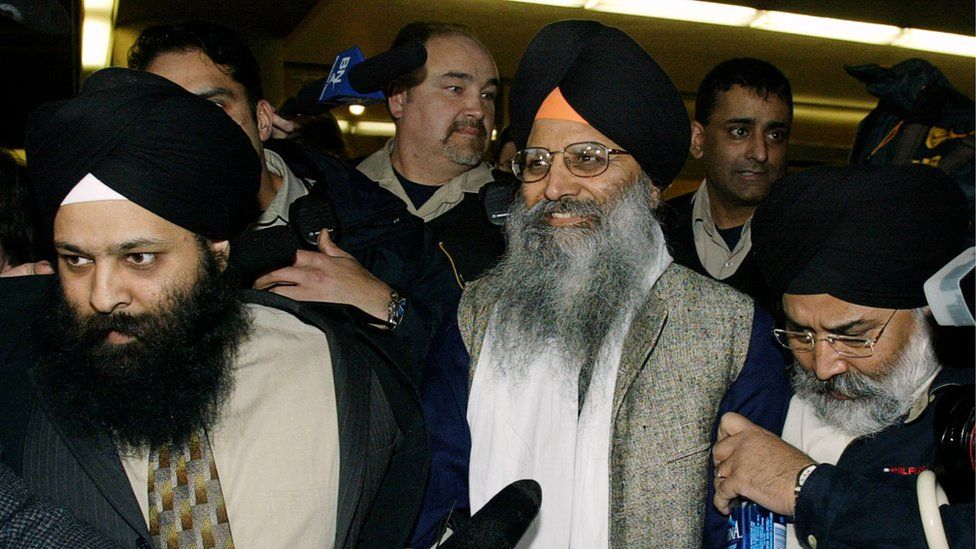
Sikh activist Ripudaman Singh Malik (centre) smiles as he leaves a Vancouver court March 16, 2005, after being found not guilty in the 1985
Sikh activist Ripudaman Singh Malik (centre) was found not guilty in the 1985 bombing of an Air India flight   Reuters
 
Back in 1985 a dreadful terrorist attack took place that took the lives of hundreds of Canadian citizens of East Indian origin. Two suitcase bombs had been planted on two Air India passenger jets. One detonated prematurely and took the lives of two Japanese baggage handlers at Narita Airport in Tokyo. The other exploded over the Atlantic and all 320 passengers and crew of Air India Flight 182 were killed. That was June 23, 1985. This pre-dated the 9/11 attack that took thousands of lives as the handiwork of al-Qaeda.

At the time, there was an active anti-India group in British Columbia comprised of Canadian Sikhs who campaigned (illegally in India) for a separate homeland they called Khalistan. After 1948's partition when Pakistan broke away from India to become a Muslim state, and then Bangladesh broke away from Pakistan, it's likely that India felt it had surrendered more than enough of its territory. There is simmering resentment between Hindus and Muslims in the region. 

The breakup of the territory that India claimed as its own gave rise to horrendous slaughter as Hindus and Muslims both lost tens of thousands in virulent bloodshed as Muslims streamed out of India to gather in Pakistan and Hindus left Pakistan to live among their own. Pakistan has the second largest Muslim community in the world, and India still ranks as the third largest home for Muslims in the world, after Indonesia, the most populous Muslim nation. 

India has untold numbers of ethnic groups, religions and languages represented within her vast population. As a democracy it is not spared the universal conflict that occurs when tribal, ethnic, sectarian groups conflict with one another. The Khalistan movement representing the yearning for a Sikh homeland is one of those conflicts. A man living in Vancouver, Inderjit Reyat, was convicted of manslaughter in both bombings.

The mastermind behind the plot was thought to be Ripudaman Singh Malik. And his associate in the bombing Ajaib Singh Bagri. At the time in Canada, other Canadian Sikhs were aghast at the militant violence being expressed by the Babar Khalsa group. Those who publicly condemned them, including a Sikh B.C. newspaper editor, became victims of violence. One of those victims later became premier of British Columbia, and later yet a Member of Parliament; Ujjal Dosanjh.

It took until 2005 before the two accused in the bombings were to stand trial. Ultimately after a controversial trial, both men were acquitted by a provincial Supreme Court justice, cleared of murder and consp8ircy charges. After the assassination of Indian Prime Minister Indira Gandhi by two of her Sikh bodyguards in retaliation for the Indian military entering the Golden Temple of Amritsar, Sikhism's most holy gurdwara, to roust out militant Sikhs from using it as a weapons depot and headquarters.

Ripudaman Singh Malik was a free man, able to go about his business and he had many businesses, including schools for Sikh-centric education that he founded as a highly respected member of his community. At his trial, it was decided that the harrowing testimony of guilty involvement given by a former member of the group detailing Malik's role in the bombing could not be trusted, leading to his acquittal. 

Yesterday a rather rough justice took centre stage, with Ripundaman Singh Malik's assassination. Just outside one of his businesses he was attacked, three gunshots rang out, an ambulance arrived to take him to hospital and he was pronounced dead. There will be an investigation. There will be an effort to discover the killers' identities and the reason for his assassination at this late date. The RCMP in its original investigation following Air India's bombing was unable to gather evidence to convict the man due to investigative incompetence. There may be a replay of that incompetence.

Labels: , , ,

Friday, March 16, 2018

Canada's NDP Championing Khalistan?

"I condemn all acts of terrorism in every part of the world, regardless of who the perpetrators are or who the victims are."
"Terrorism can never be seen as a way to advance the cause of any one group. It only leads to suffering, pain and death."
"It wasn't by chance that Sikhs were the most sacrificed, or the people who died the most for the freedom of South Asia."
"I absolutely think it's a fundamental right of all people to be able to self-govern, to have sovereignty. It's something that's recognized by the United Nations, and there should be no fear to expressing your position on that. I support the referendum, absolutely."
Jagmeet Singh, leader, New Democratic Party, Ottawa
 NDP Leader Jagmeet Singh has been on the defensive this week after videos emerged suggesting his association with advocates of an independent Sikh state called Khalistan.
NDP Leader Jagmeet Singh has been on the defensive this week after videos emerged suggesting his association with advocates of an independent Sikh state called Khalistan.  (Justin Tang / THE CANADIAN PRESS file photo)

"One [perception of Sikh identity] is about sovereignty, explicitly and uncompromisingly. It endorses the superiority of our culture, our language and our ideals. It is about Sikh spaces and Sikh institutions."
"And it endorses violence as a legitimate form of resistance and survival."
"[The other embraces conformity and] commodification of our culture."
"It's an unfortunate reality and it's something that is distressing to us as a community, because the Sikh community is a peace-loving community. But at the same time, we're not a pacifist community."
"If you want self-determination, you're going to have to take up arms ... and that's the only route to independence."
Shamsher Singh, National Sikh Youth Federation (NSYF) London

"These are people who still advocate violence. They're trying to disturb the peace in India's Punjab state."
"So the focus is on a very, very tiny minority. That's the sad part."
"[Jagmeet Singh's presence at Sikh separatist events will] haunt him."
Shinder Purewal, professor of political science, Kwantien Polytechnic University, British Columbia

The new leader of Canada's federal New Democratic Party is a Canadian Sikh and apparently a Sikh who is firmly ensconced in the religion, but more than that, an advocate of Sikh autonomy. When India underwent partition and Pakistan was created out of India, followed by Bangladesh breaking away from Pakistan, it was a vicious, violent and bloody event with Hindus and Sikhs, Hindus and Muslims assembling in raging mobs against one another. The Punjab region was divided between India and Pakistan. And it seems that the holiest site in Sikhism was left in Pakistan.

Yet it is upon India that giant democratic nation of 1.3-billion people comprised of many ethnic groups, languages, cultures and religions against whom Sikh nationalists with their dream of achieving a separate, sovereign Khalistan have turned their anger and demands. India has accepted the Sikh presence as an integral part of the Indian sub-continent, absorbed as it has so many others. But a violent, fringe group of Sikh extremists keep the raging fires of anger and resentment alive, plotting conspiracies and engaging in violence.

The federal NDP notorious for its pro-Palestinian, anti-Israel stance appears to have found itself a new leader with a pro-Khalistan, anti-Indian adversarial approach such that he lends his presence and his support to the Khalistan movement, a violent one that threatens, coerces and destroys, both property and lives. Even as Jagmeet Singh condemns violence and terrorism he is present at events which plot and celebrate both. He has lent his voice to the chorus of anti-Indian sentiment.
Jagmeet Singh at a 2015 rally in San Francisco. Sikh Roots

He has attended meetings such as that of the U.K.-based National Sikh Youth Federation in London, one event titled Sovereignty and Polity, advocating for an independent Khalistan. He has deliberately refused to condemn the Sikh Canadian known to have been behind the Air India terrorist attack that killed 326 people, most of them Canadians, on a flight to India. A new video has come to light of his attendance at a rally in San Francisco calling for the creation of Khalistan.

Clips of Jagmeet Singh have been obtained with his speech before an audience relating to Sikh principles of equality and "independence, of sovereignty". Shamsher Singh of the NSYF has explained that "Sikhs do not accept that [Talwinder Singh Parmar, the Sikh Canadian known to have been the mastermind of the Air India bombing] was responsible for the Air India bombing", that Jagmeet Singh's comments indicated that he "understands the complexity of the issue", and nor "should he be criticized for his support for Khalistan or voicing his dissent against India".

An absurd assertion on the face of it, and virtually meaningless considering the source. Since elected leader of the federal NDP, Singh has refused to stand down from his position of self-determination being a basic right. The reality is that although he is leader of the NDP, and Sikhs are proud of their political smarts and that their large presence in Canada has resulted in quite a few among them being elected as Members of Parliament and chosen by the Trudeau government for Cabinet positions, it is Canadian interests and politics that should be consuming the attention of Canadian Sikhs, not their quarrels with India.

Left to right: Harwinder Singh, Shamsher Singh and Jagmeet Singh at an event hosted by the National Sikh Youth Federation, which advocates for an independent Khalistan.YouTube

Labels: , , , , ,

Follow @rheytah Tweet