Sunday, March 19, 2023

Retrospective Latent Thoughts

"Our inability, unwillingness to put the hammer down in terms of security in the country allowed chaos to ensue, which gave rise to ISIS."
"]The invasion] might be as big a strategic error [as Hitler's invasion of the Soviet Union in 1941 which served to help bring Germany to defeat during the Second World War."
Richard Armitage, former deputy secretary of state, U.S.

"It was worth it because the decision was not simply: 'Does Saddam pose a WMD threat in 2003'?"
"Another question was: 'Would he pose a WMD threat five years later'? To which I think the answer clearly was 'yes'"
"The worst mistake made after the overthrow of Saddam ... was withdrawing in 2011."
John Bolton, Trump administration era National Security Adviser

"We just decided we didn't want to do this stuff anymore. That began ... with president Obama declaring ... he was going to pull all forces out."
"These were U.S. decisions not forced by a collapsing economy, not forced by demonstrators in the streets."
"Our leadership just decided we didn't want to do it any more. And that started the alarm bells ringing ... in the Gulf."
Ryan Crocker, U.S. ambassador in Iraq
 
"The net result ... has been bad for U.S. leverage, bad for U.S. influence, bad for our ability to partner with countries in the region."
Jim Steinberg, deputy secretary of state, Obama administration
https://static.reuters.com/resources/r/?m=02&d=20130314&t=2&i=712718619&r=CBRE92D1AX900&w=1024
Lesleigh Coyer, 25, of Saginaw, Michigan, lies down in front of the grave of her brother, Ryan Coyer, who served with the U.S. Army in both Iraq and Afghanistan, at Arlington National Cemetery in Virginia in this March 11, 2013, file photo. Coyer died of complications from an injury sustained in Afghanistan. REUTERS/Kevin Lamarque/Files UNREST OBITUARY)
 
There was the American withdrawal from VietNam as a national trauma, the withdrawal from Afghanistan as a national shame, and there was the invasion and eventual withdrawal from Iraq that had unforeseen and unanticipated consequences that time has been incapable of healing. American intervention in foreign situations, particularly that of violent conflict has often left it tired and uninspired, demoralized, its determination moribund, leading to inglorious withdrawal. 
 
Hindsight is meant to be helpful in teaching lessons, but some lessons simply fail to resonate, to caution that similar outcomes in dissimilar situations may repeat themselves endlessly. When the United States decided to invade Iraq and remove a tyrannical mass murderer little did the invading forces' executive politicians who made that decision imagine that the ultimate empowering would be to the Islamic Republic of Iran's advantage.
 
And nor did the Bush administration comprehend that in a tribal, sectarian Arab landscape ancient enmities would be violently unleashed with the removal of the tyrant that kept them in check under his clenched fist. And never would any American administration believe that occupying Iraq for no other choice left to them to continue attempting to tamp down Islamist terrorism, would eventually cost them both a loss of face and of influence.
 
When Saddam Hussein's minority Sunni rule came to its final stumbling end to be replaced with a majority Shi'ite government, Iran's Ayatollahs beamed with pleasant anticipation of the removal of an enemy with whom a sustained and deadly war was fought, to be replaced by a regime compatible with its own. Iran's plans to influence states across the Levant was given a good head-start for which they will be eternally grateful, expressed by admiring shouts such as "Death to America!".
 
https://static.reuters.com/resources/r/?m=02&d=20130314&t=2&i=712718618&r=CBRE92D1AXA00&w=1600
Iraq war widow Sheryl McIlvaine visits the grave of her husband, U.S. Marine Sgt. James R. McIlvaine, in Section 60 at Arlington National Cemetery in Virginia, in this October 19, 2009 file photo. REUTERS/Larry Downing/Files
 
When U.S troops were withdrawn in 2011 a vacuum was left in Iraq quickly entered by the Islamic State militants who seized a third of both Iraq and Syria for their Caliphate. Gulf Arab states shuddered when they realized with reluctance they could no longer rely on the protective arm of the United States. In 2014 former President Obama returned some troops to Iraq, A year later he deployed to Syria; at present 2,500 U.S. troops remain in Iraq and 900 in Syria. Mired, as good a word as any.
 
There to continue opposing Islamic State terrorists active as well from North Africa to Afghanistan, steeply, deeply entrenched as Islam's most fervent and vicious jihadists. And then there are the considerable, actually massive costs resulting from U.S. involvement in Iraq and Syria. Estimates published by the "Costs of War" project at Brown University put the price tag for America for the wars in Iraq and Syria at a whopping $1.79 trillion. That includes Pentagon and State Department spending, veterans' care and interest on debt financing for the conflicts.

American military deaths for the past two decades are put at 4,599, with an estimated total death of Iraqi and Syrian civilians, military, police, opposition fighters, media and others coming in at a total of 5500,000 to 584,000; staggering numbers no price can be placed on. This number does not include indirect deaths from disease, displacement or starvation. 

As for American credibility, the decision taken by President Bush to invade based on exaggerated, ultimately erroneous intelligence of weapons of mass destruction was a grave error in judgment. According to war advocate John Bolton, even though errors were made by Washngton, by failing to deploy sufficient troops and administering Iraq rather than swiftly handing that over to Iraqis, removing Saddam justified the costs.

The 2003 invasion didn't immediately undermine American influence in the Gulf, according to Ryan Crocker, but the 2011 withdrawal pushed Arab states in part to begin hedging their bets. Waning U.S. influence can be seen most latterly in China brokering the re-establishment of relations between Iran and Saudi Arabia two bitter regional antagonists in terms of power and sectarian rivalries.

Whether President Obama's decision to withdraw tracking a timeline laid out by the Bush administration, reflected an American inability to secure immunity for American troops backed by the Iraqi parliament is a debate raging still among former officials. According to John Bolton, removing Saddam was value given to the cost. Armitage on the other hand responded "FUBAR", a military acronym standing for "Fouled up beyond all recognition", when he was asked the first word coming to mind relating to the invasion and its aftermath.

https://static.reuters.com/resources/r/?m=02&d=20130314&t=2&i=712681015&r=CBRE92D151T00&w=1600
U.S. Navy Hospital Corpsman HM1 Richard Barnett, assigned to the 1st Marine Division, holds an Iraqi child in central Iraq in this March 29, 2003 file photo. REUTERS/Damir Sagolj


Labels: , , , , ,

Monday, February 13, 2023

The Sheer Scale of the Tragedy

“We have so far failed the people in north-west Syria."
“They rightly feel abandoned. Looking for international help that hasn’t arrived."
"My duty and our obligation is to correct this failure as fast as we can."
Martin Griffiths, UN relief chief
 
"We will follow this up meticulously until the necessary judicial process is concluded, especially for buildings that suffered heavy damage and caused deaths and injuries."
Turkey’s vice-president, Fuat Oktay
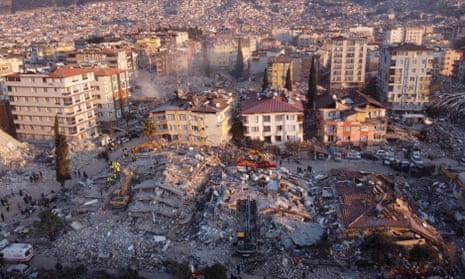
Collapsed buildings in Antakya, Turkey
Collapsed buildings in Antakya, Turkey. Photograph: Hassan Ayadi/AFP/Getty Images

The disastrous earthquake that struck Turkey and Syria has brought out the best and the worst in both people and their national representatives. The international community responded quickly, almost 30 countries sent search-and-rescue teams in a desperate bid to save as many people as possible, trapped under the rubble of thousands of collapsed buildings in towns and cities all over northeast Turkey and across the border into Syria where 4 million Syrians, displaced in the ongoing civil war sought refuge in a crowded area with only one cross-border site, blocked by Russia.
 
In Syria, the White Helmet rescue group did their best with inadequate, basic tools to try to extract as many still-living people trapped and crying for help. UN aid trucks finally managed to get through several days following the series of quakes, and to the intense disappointment of the White Helmets no life-saving equipment better than the picks and sledgehammers they were using were made available to them. Hundreds of thousands of quake survivors, now homeless, are sleeping rough, hungry and fearful.
 
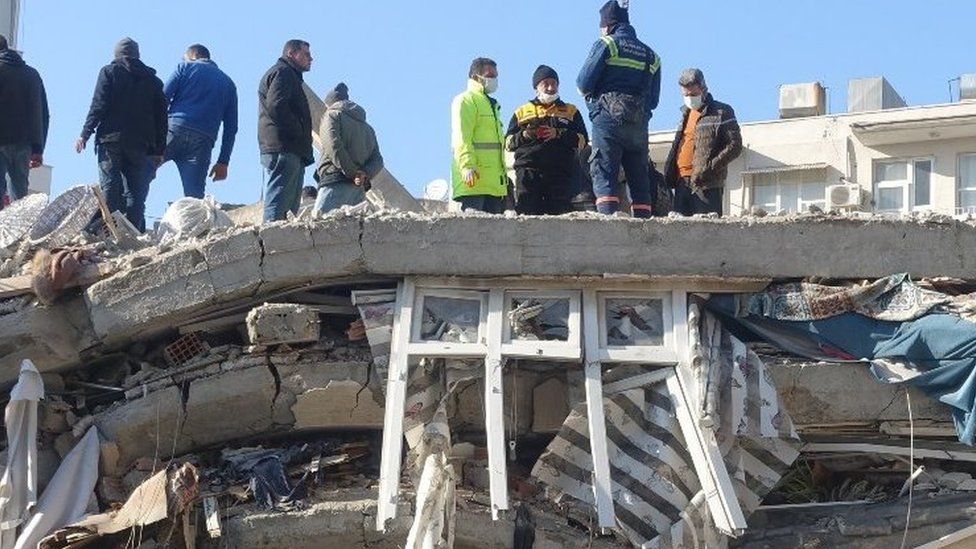
People stand on top of rubble. An intact window is visible in the layers of rubble.
 
The Turkish military is still bombing border sites in Syria against the Kurds they mark as terrorists. Military personnel that could more usefully be deployed to rescue missions in both countries. The governments of both countries are facing accusations from their populations of a tardy, insufficient response to the urgency of the tragedy. President Erdogan's popularity has taken a tumble and like most autocrats looking to place blame has started legal action against building contractors, holding them responsible for poor construction.
 
Over 100 arrest warrants resoectung collapsed buildings have been issued by Turkish authorities amid warnings that the death toll from the earthquake that struck parts of Turkey and Syria could double from the current total of 33,000.  A dozen people are in custody; contractors, architects and engineers with links to some of the tens of thousands of buildings collapsed or seriously damaged in the 7.8- and following 7.6-magnitude quakes.

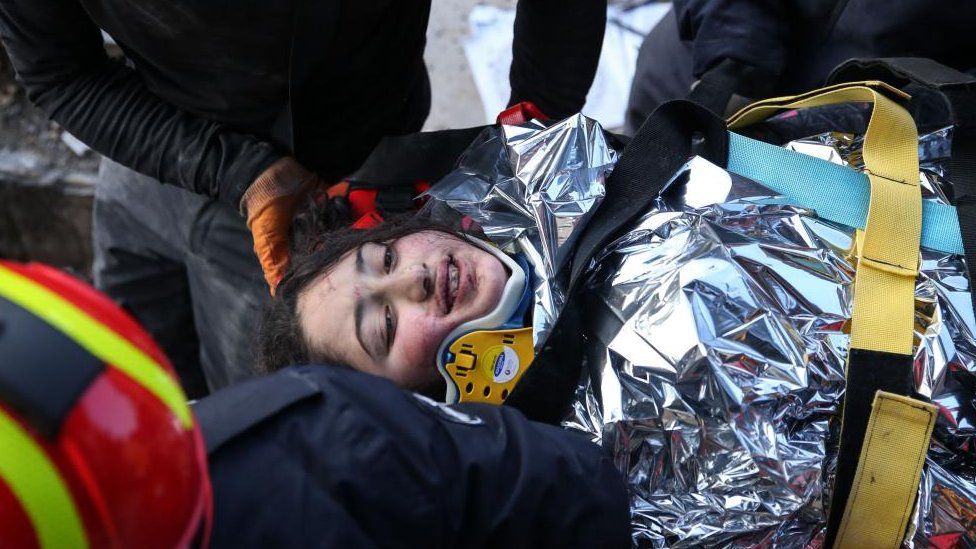
A girl on a stretcher
Rescuers carry 12-year-old Cudie from the rubble of a collapsed building, in Hatay, southern Turkey, 147 hours after the quake    EPA

Rescue teams from Austria and Germany withdrew temporarily to a base camp used by international volunteers, citing the dangers they've come across from firepower in the conflict between Turkey and Kurdish militias. Not far from the search-and-rescue areas, there was an attack on civilians, leaving 11 dead, at the hands of Islamic State terrorists. Because of threats, one of the Israeli search-and-rescue teams was forced to withdraw.

Beside collapsed buildings, others standing whole are experiencing looting. Some stores have begun to empty their shops of merchandise to keep them from being looted. Contrast that behaviour with that of desperate bystanders using their bare hands in the first three days after the tremblors to try to rescue trapped victims under steel and concrete.  In Hatay province several days ago rescuers crouched under concrete slabs as they carefully reached into the rubble to rescue a ten-day-old newborn. His mother, also alive, they were carried to a field hospital.

This is winter, extreme cold and snow blankets the area. People trapped under the collapsed buildings would die from exposure as much as from their wounds. Those too exhausted and in pain to continue calling for  help, would never see help arrive. In time their bodies would be exhumed and they would be identified, and buried. Miraculous recoveries of victims were still sporadically taking place days after the initial earthquake, but hope of finding more diminished as time consumed hope.

Now, attention turns to the struggle of survivors, homeless and traumatized, trying to maintain body heat in the winter weather, looking for food and water. "Especially in this cold, it is not possible to live here. If people haven't died from being stuck under the rubble, they'll die from the cold", said survivor Ahmet Tokgoz, calling for his government to evacuate people from the Turkish city of Antakya. Chances of finding anyone else yet alive are fast dwindling.

Winter weather, road and airport runway damage all conspired to hamper emergency responses. Both governments will have much to answer for; the Syrian regime in its fracturing of the country, the plight of the millions of Syrians who fled government attacks on its citizens whom Bashar al Assad called terrorists, and Turkey's Recep Tayyip Erdogan for the lacklustre response to the catastrophe that struck his country."Such things have always happened," he said. "It's part of destiny's plan."

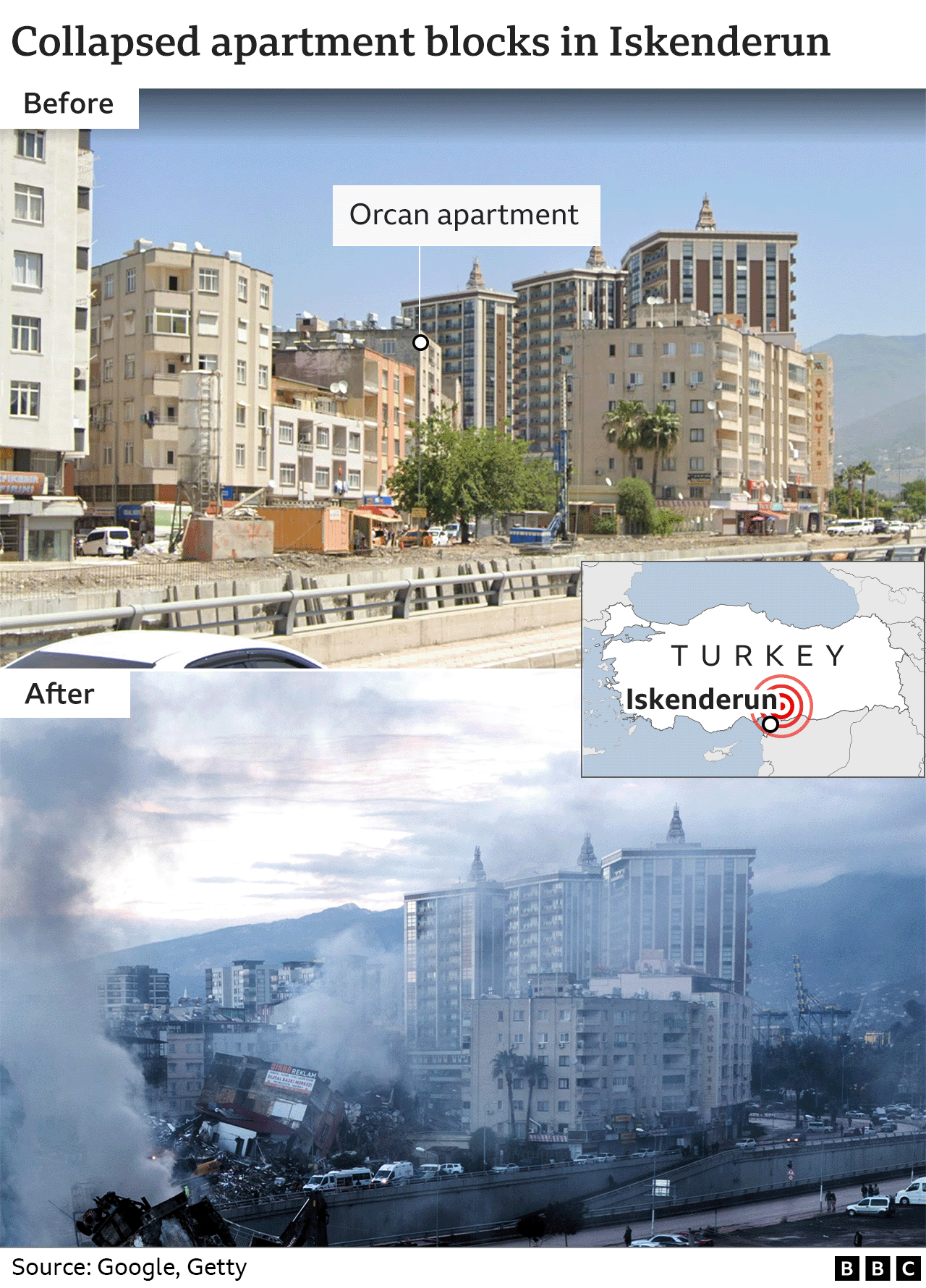
Before and after images show apartment blocks which have collapsed in Iskenderun, Turkey as a result of the earthquake


Labels: , , , , ,

Follow @rheytah Tweet