Monday, February 13, 2023

The Sheer Scale of the Tragedy

“We have so far failed the people in north-west Syria."
“They rightly feel abandoned. Looking for international help that hasn’t arrived."
"My duty and our obligation is to correct this failure as fast as we can."
Martin Griffiths, UN relief chief
 
"We will follow this up meticulously until the necessary judicial process is concluded, especially for buildings that suffered heavy damage and caused deaths and injuries."
Turkey’s vice-president, Fuat Oktay
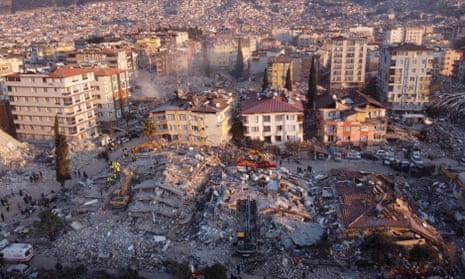
Collapsed buildings in Antakya, Turkey
Collapsed buildings in Antakya, Turkey. Photograph: Hassan Ayadi/AFP/Getty Images

The disastrous earthquake that struck Turkey and Syria has brought out the best and the worst in both people and their national representatives. The international community responded quickly, almost 30 countries sent search-and-rescue teams in a desperate bid to save as many people as possible, trapped under the rubble of thousands of collapsed buildings in towns and cities all over northeast Turkey and across the border into Syria where 4 million Syrians, displaced in the ongoing civil war sought refuge in a crowded area with only one cross-border site, blocked by Russia.
 
In Syria, the White Helmet rescue group did their best with inadequate, basic tools to try to extract as many still-living people trapped and crying for help. UN aid trucks finally managed to get through several days following the series of quakes, and to the intense disappointment of the White Helmets no life-saving equipment better than the picks and sledgehammers they were using were made available to them. Hundreds of thousands of quake survivors, now homeless, are sleeping rough, hungry and fearful.
 
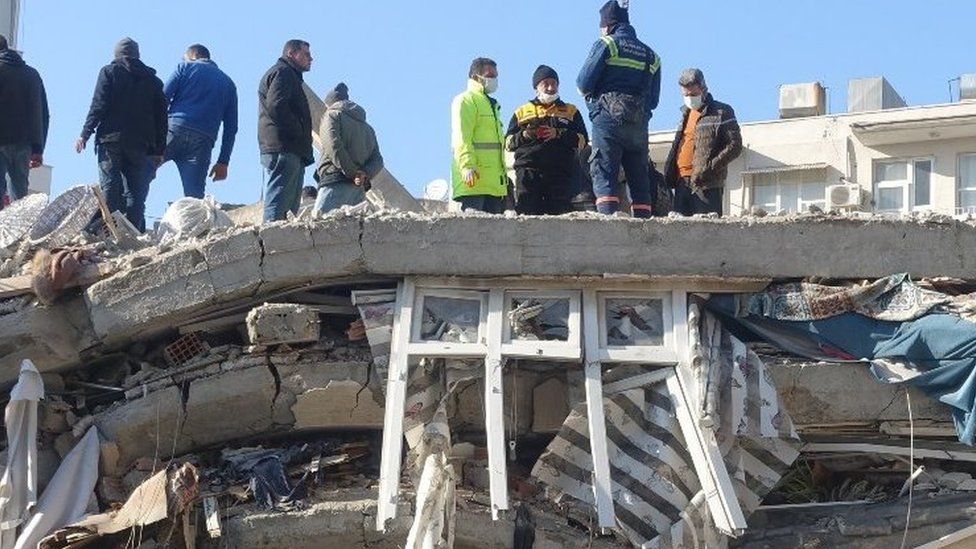
People stand on top of rubble. An intact window is visible in the layers of rubble.
 
The Turkish military is still bombing border sites in Syria against the Kurds they mark as terrorists. Military personnel that could more usefully be deployed to rescue missions in both countries. The governments of both countries are facing accusations from their populations of a tardy, insufficient response to the urgency of the tragedy. President Erdogan's popularity has taken a tumble and like most autocrats looking to place blame has started legal action against building contractors, holding them responsible for poor construction.
 
Over 100 arrest warrants resoectung collapsed buildings have been issued by Turkish authorities amid warnings that the death toll from the earthquake that struck parts of Turkey and Syria could double from the current total of 33,000.  A dozen people are in custody; contractors, architects and engineers with links to some of the tens of thousands of buildings collapsed or seriously damaged in the 7.8- and following 7.6-magnitude quakes.

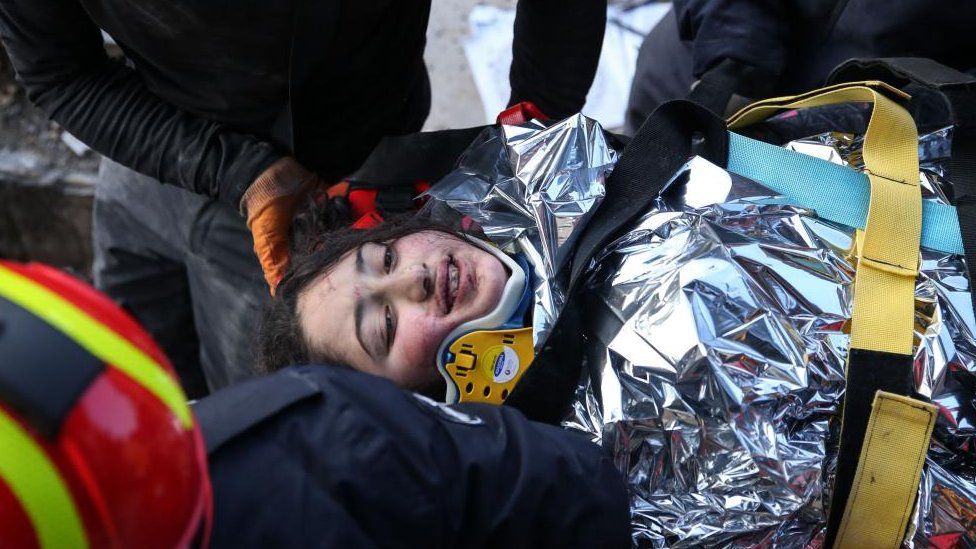
A girl on a stretcher
Rescuers carry 12-year-old Cudie from the rubble of a collapsed building, in Hatay, southern Turkey, 147 hours after the quake    EPA

Rescue teams from Austria and Germany withdrew temporarily to a base camp used by international volunteers, citing the dangers they've come across from firepower in the conflict between Turkey and Kurdish militias. Not far from the search-and-rescue areas, there was an attack on civilians, leaving 11 dead, at the hands of Islamic State terrorists. Because of threats, one of the Israeli search-and-rescue teams was forced to withdraw.

Beside collapsed buildings, others standing whole are experiencing looting. Some stores have begun to empty their shops of merchandise to keep them from being looted. Contrast that behaviour with that of desperate bystanders using their bare hands in the first three days after the tremblors to try to rescue trapped victims under steel and concrete.  In Hatay province several days ago rescuers crouched under concrete slabs as they carefully reached into the rubble to rescue a ten-day-old newborn. His mother, also alive, they were carried to a field hospital.

This is winter, extreme cold and snow blankets the area. People trapped under the collapsed buildings would die from exposure as much as from their wounds. Those too exhausted and in pain to continue calling for  help, would never see help arrive. In time their bodies would be exhumed and they would be identified, and buried. Miraculous recoveries of victims were still sporadically taking place days after the initial earthquake, but hope of finding more diminished as time consumed hope.

Now, attention turns to the struggle of survivors, homeless and traumatized, trying to maintain body heat in the winter weather, looking for food and water. "Especially in this cold, it is not possible to live here. If people haven't died from being stuck under the rubble, they'll die from the cold", said survivor Ahmet Tokgoz, calling for his government to evacuate people from the Turkish city of Antakya. Chances of finding anyone else yet alive are fast dwindling.
Winter weather, road and airport runway damage all conspired to hamper emergency responses. Both governments will have much to answer for; the Syrian regime in its fracturing of the country, the plight of the millions of Syrians who fled government attacks on its citizens whom Bashar al Assad called terrorists, and Turkey's Recep Tayyip Erdogan for the lacklustre response to the catastrophe that struck his country."Such things have always happened," he said. "It's part of destiny's plan."

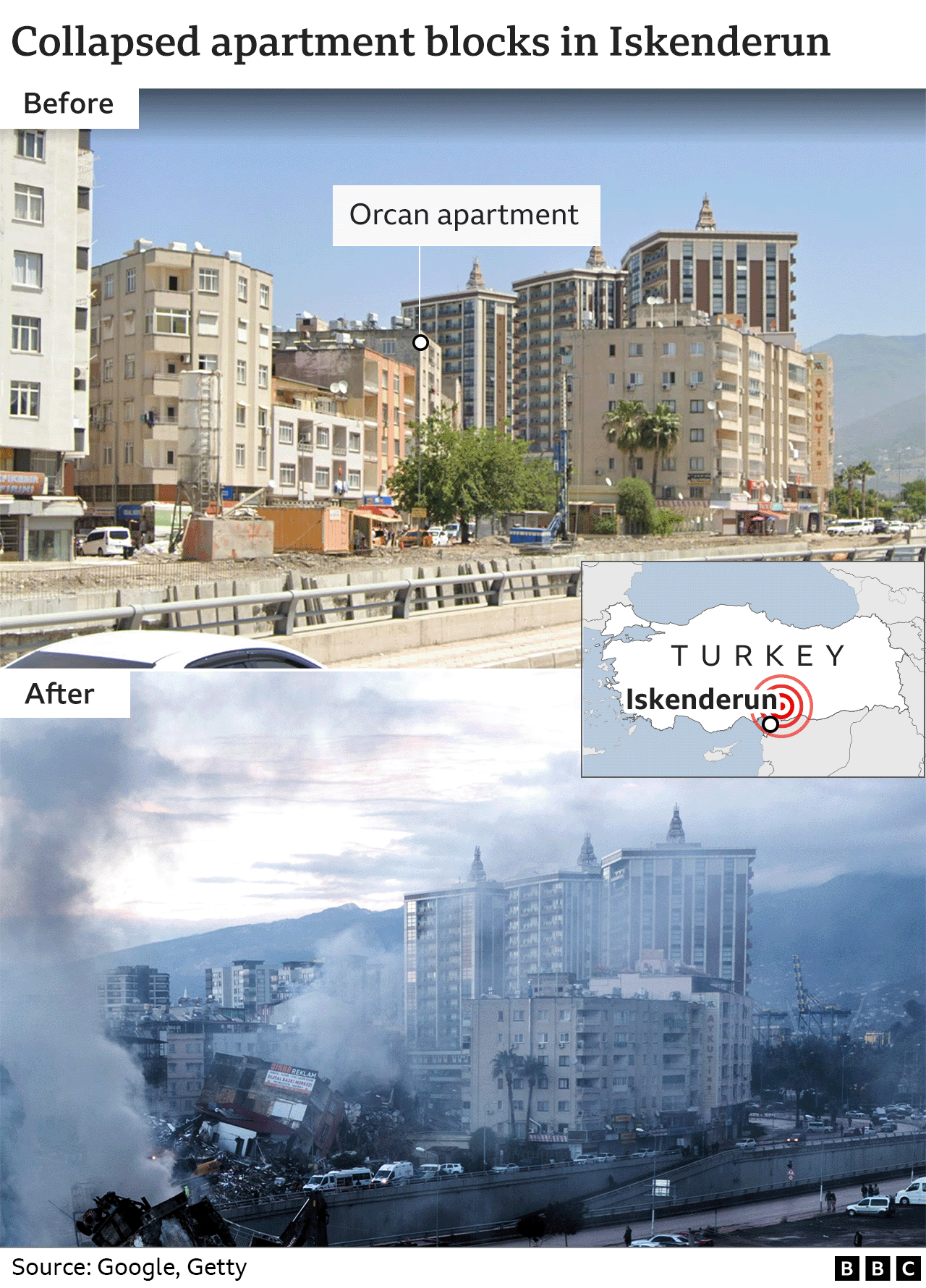
Before and after images show apartment blocks which have collapsed in Iskenderun, Turkey as a result of the earthquake


Labels: , , , , ,

Thursday, February 13, 2020

Idlib's Homeless in Syria, Russia, Turkey Confrontation

"There is no house of concrete or of mud or even a chicken coop that is not inhabited."
"People are in dire need of any shelter. Even a tent sometimes is not available."
Maad al-Khalaf, 41, Sunni Syrian homeless exile

"I could not reach the helicopter crash location because the whole area is being bombed."
"The attacks on Idlib itself make it clear that nowhere in this area is safe."
Abd Albaset, 32-year-old refugee from Ma'arat al-Nu', freelance war photographer
Syrian government helicopter is shot by a missile in Idlib province, Syria, Tuesday, Feb. 11, 2020. Syrian rebels shot down a…
Syrian government helicopter is hit by a missile in Idlib province, Syria, Feb. 11, 2020.  AP


"Our teams documented the killing of 208 people in January, including 60 children and 28 women."
"In February, we retrieved the bodies of 127 people, 12 of them were today, after regime airstrikes on Idlib city."
"Northwestern Syria is witnessing the largest military campaign to date by [the Syrian] regime, Russian and Iranian forces."
Sayeed Mousa Zaidan, spokesman, White Helmets

"The recent deployment of Turkish military has significantly increased in the last two weeks both in terms of equipment and ground troops."
"This is the biggest build-up of force by Turkey so far, but it still seems within the defensive mode in terms of preventing the further advance of the regime into Idlib."
"They are trying to keep this zone out of [Syrian President Bashar al-] Assad's hands until after the implementation of a political process for Syria."
Ammar Kahf, executive director, Omran Center for Strategic Studies, Syrian affairs research organization, Istanbul

"We count up the assault on civilian infrastructure, and it's unprecedented. In the past month alone, 11 medical facilities, 28 schools, seven refugee camps and nine groceries were bombed or shelled in northwest Syria. The regime also targeted five civil defense White Helmet centers, four bakeries, 19 mosques, three water stations, and two power plants."
"As a result, our group made the tough decision to cease its education and anti-extremism programs after our staff fled for safety."
Isam Khatib, director, Kesh Malek, local mutual aid organization
Civilians flee from Idlib to find safety inside Syria near the border with Turkey, Tuesday, Feb. 11, 2020.  Syrian opposition…
Civilians flee Idlib for safety near the Turkish border, 11 February 2020

Displaced Syrians, looking for haven once the overcrowded tent cities reached maximum, sought refuge in mosques. Then the mosques became crowded and the refugees strove to put together flimsy shelters in the olive groves. Winter arrived, trees lost their foliage and the shelters offered little in protection from the cold. Maad al=Khalaf is forced to share a tent with his wife and children along with another family. Once a landowner, before the civil war destroyed their lives, they live now on abandoned farmland adjacent the border with Turkey.

The family is but one among over a million people forced to leave their homes since the Syrian offensive began last April when Russian planes gave air cover to Syrian regime troops determined to retake all of Syria from its Sunni Syrian rebels. Of the total million, about 700,000 have been displaced n the last ten weeks alone after a ceasefire collapsed in December. This number is believed to represent the greatest number of displaced people in a single period in the last 9 years in Syria where now an estimated 3.6 million Syrian Sunni civilians remain forced up against the closed Turkish frontier.
A man wails after a government airstrike in the city of Idlib, Syria, Feb. 11, 2020.
A man wails after a government airstrike in Idlib, 11 February 2020

"Syra has the world's largest concentration of displaced people and it urgently needs a cessation of hostilities", Jens Laerke from the United Nation's Office for the Coordination of Humanitarian Affairs warned. Rebel militias numbering several thousand fighters, are defending their last bit of territory. The Syrian regime backed by its Russian allies have continued to blast the province with airstrikes. Over 60 hospitals and other civilian structures have been hit in deliberate efforts to coerce civilian populations to leave.

Leave they have, but there is nowhere for them to turn to. Turkey shut its border after the 2015 migrant crisis, housing some 3.5 million Syrian refugees in squalid refugee camps so Turkey now refuses to permit any more entrants. Moscow, the European backer of Bashar al-Assad, wields veto power in the United Nations Security Council, forestalling an emergency summit called by the United Kingdom, leaving the UN hamstrung in its wish to act.

"The numbers are enormous", Mercy Corps, an NGO aid group working in Syria said of the recent exodus, struggling to provide basic aid to the refugees. "The worst part is that we saw this coming. The UN, the international community, the governments -- they all knew that we were  here and that this was going to happen. And  yet nothing has been done", the Mercy Corps spokesman said in frustration over their powerlessness in the desperate situation.

The question is, why would they expect anything to be done by the United Nations? It represents a wholly dysfunctional institution managed by the world's foremost human-rights abusing nations for whom corruption is an established government tool. And it is these failed nations that refuse to dignify human life that take command of the UN's focus and actions. And their focus happens to be on Israel, a country at peace with itself and its neighbours, whom Syria, Iraq, Lebanon, Turkey and Iran would, given the chance, destroy.

Yet Syria, Iraq, Lebanon, Turkey and Iran sit on many of the UN administrative arms. And the Human Rights Council chooses to overlook the countless human rights abuses, war crimes, crimes against humanity committed by all of them, preferentially focusing on Israel, accusing it of crimes they, not Israel commits, and doing their utmost to isolate and delegitimize the Jewish State.


Labels: , , , , , , ,

Follow @rheytah Tweet