"In normal times, businesses would probably take it in their stride." "But coming off the back of the pandemic, it's devastating." Neil Saunders, retail analyst, Global Data Retail
"Since we opened our doors, Target has operated with love and opportunity for all." "And
in that spirit, we commit to contributing to a city and community that
will turn the pain we're all experiencing into better days for
everyone." Brian Cornell, chief executive, Target, Minneapolis "We are as a group, by and large, not people of colour [but are prepared to commit to diversity and inclusion goals]." "Another black man in America died senselessly on Monday, and it happened only miles from where many of us live." Best Buy, senior leadership team
"You're not protesting anything running out with brown liquor in your hands and breaking windows in this city." "So when you burn down this city, you're burning down our community." Mayor Keisha Lance, Atlanta
"Every single rebellion and uprising has included it [looting, vandalism]." "I was shocked there wasn't more looting. We're dealing with an economic crisis." UCLA historian Robin Kelley
"Many
of these protests, at least those motivated by the killing of George
Floyd, should be understood as black people's refusal to stand by while
their brothers and sisters are murdered by the state." "If
the history of this country is any guide, protests like these are often
necessary to bring about positive, transformative social change." Stanford sociology professor Matthew Clair
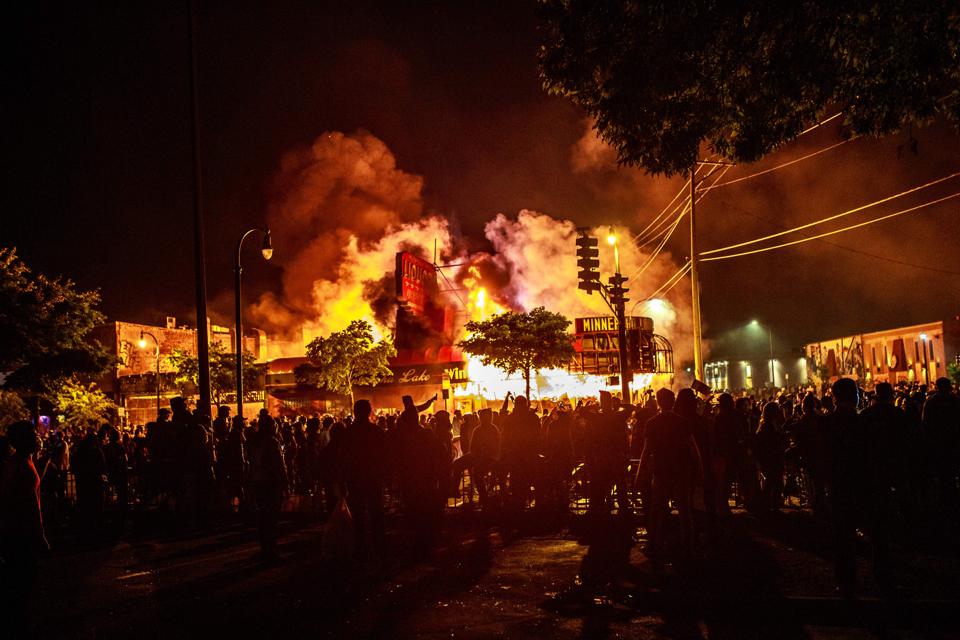
Protesters gather around a liquor store in flames near the Third Police Precinct on May 28, 2020, in ... Minneapolis AFP via Getty Images
Businesses in American cities, devastated by the lockdown that
accompanied the rushing swoop of infections caused by the SARS-CoV-2
virus, breathed a tentative sigh of relief, hoping for the best, that
consumer confidence would return and so would their business and they
would be able to sidestep the forced choices circumstances of lost sales
performance, financial incentives and collapsed plans taking them
entirely out of contention into bankruptcy.
Lockdown finally lifted. Mere days later, the catastrophe that is
COVID-19 became the backdrop to a national uprising in rage at the death
of yet another black man at the hands of a municipal police force.
There are no acts now so obscure that they cannot be caught by a
passerby in a world where everyone is armed with an iPhone the better to
document anything and everything that occurs, public and private and
combinations thereof.
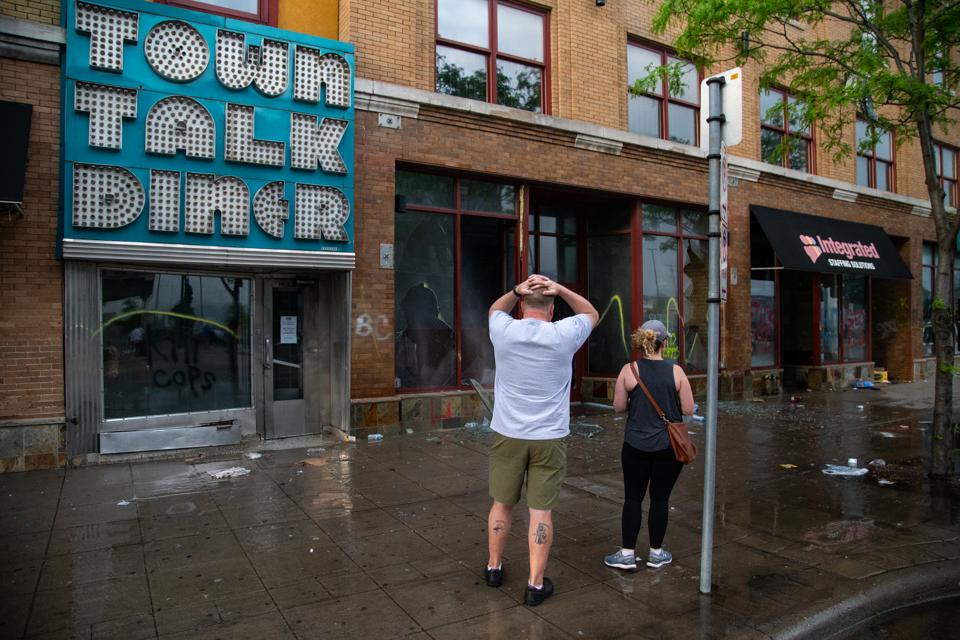
Charles Stotts and his wife, Kacey White, owners of Town Talk Diner on Lake Street, Minneapolis, watch as water seeps out of the restaurant on Thursday. The building had been looted the night before.
MediaNews Group via Getty Images
This time it was the private agony of a man whose life-force was being
squeezed out of him through the very public physical pressure of a
police officer's knee squeezing the man's neck, ending in a violent
agony of asphyxiation, and suddenly, George Floyd's name has a ring of
familiarity all over the world. The raging refusal to allow the death of
another black man to go unnoticed began with silent protests and
signage declaring no excuses for sudden death too often visited on black
Americans.
From Minneapolis to states all over the U.S.A. protests erupted,
beginning their peaceful, law-abiding journeys toward raging violence
and chaotic destruction, and finally looting, orchestrated by those
forces for whom anarchic defiance of law and order and hatred of
government is paramount and purposeful. The looting is the reward
offered for those who assent to departing from civility and embracing
sociopathy.
Brick-and-mortar businesses, the retail, very visible service industry
and all small business owners hoping to pay their way through the
American lifestyle, seriously wounded by COVID-19's shutdown, has taken a
direct hit by 'protesters'-cum social deviants who see no reason to
avoid opportunities to wreak wreckage and disorder, victimizing those
who don't resemble them nor echo their opportunistic rampage.
COVID took J.C.Penney and Neiman Marcus out of business, now 'protests'
over George Floyd's killing have closed in on both small business and
big business across the U.S. Pleading with those marching in their
sanctimonious rage over inequity and injustice as a tool to further
their ideological scaffolding, the anger of those impacted by inequity
and injustice hijacked, business America quails.
Atlanta's mayor tried to shame the rioters and looters emphasizing that
over half of the city's business owners, like anywhere else in America
represent minority groups. Vandalism and destruction of property is not
the work of the demonstrators, those protesting the death of a man that
rogue police felt justified in viciously beating for an alleged crime of
passing a counterfeit $20 bill.
Protesters in downtown Atlanta on Tuesday. Credit...Alyssa Pointer/Atlanta Journal-Constitution, via Associated Press
Looting T-shirts, computers and food, destroying plate-glass,
fire-bombing buildings, unmercifully beating small business owners in
their futile attempts to beg the marauding thugs to bypass their small
business is not the work of mourners of lives lost, but that of
conscienceless opportunists using any tools at their disposal to score
their goal of upending society and the rule of law.
National, state and municipal lawmakers reflecting their responsibility
to those they represent through the ballot box, plead for common sense
and a stop to outrage expressing itself as mob violence. Academics who
profess to study the history of a nation built on slavery still
struggling to overcome its original human rights abuses, analyze the
situation through the lens of 'progressive' studies in righting ancient
wrongs.
In a country deeply divided on the avenues to take advantage of in
advancing those sometimes elusive rights, content to view themselves as
contrite white imperialists, urging everyone to acknowledge their
inherited status of white privilege for which no amount of contrition
and efforts for rights-restitution will ever be sufficient unto the day.
Downtown Atlanta Photo: Jenni Girtman/ALYSSA.POINTER@AJC.COM
"Due to the tension created by the attacks, the Government of Nigeria wished to advice [sic] Nigerians to avoid travelling to high risk and volatile areas [specifically, South Africa] until the situation is brought under control." Nigerian Ministry of Foreign Affairs -- travel advisory
Tiwa Savage
@TiwaSavage
"I refuse to watch the barbaric butchering of my people in SA. This is SICK. For this reason I will NOT be performing at the upcoming DSTV delicious Festival in Johannesburg on the 21st of September. My prayers are with all the victims and families affected by this."
Nigerian superstar
"The issue of foreign nationals, blaming them for many things which are
not going well in the country and also the law enforcement and the
economic conditions in the country, all of these combined, if not
managed well, then create this cyclical tension between foreign
nationals and locals, especially those who are in the margins because
the middle class and those who are in the upper class, you hardly ever
hear of such tension getting into this level."
Somadoda Fikeni, policy and political analyst. University of South Africa, Pretoria
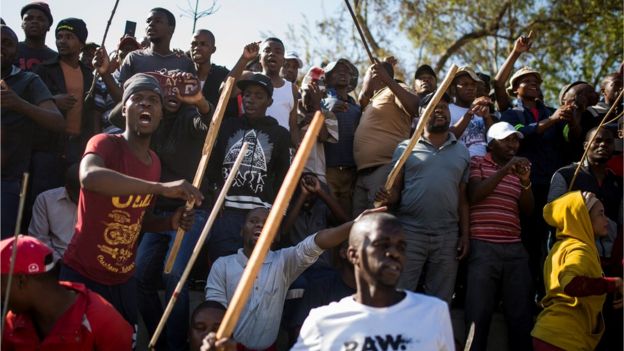
A group of South African men gathered in Johannesburg for a second night of anti-foreigner rioting on Tuesday Getty Images
Cyril Ramaphosa, president of South Africa, is condemning the "xenophobic violence" exhibited by South Africans against the presence in the country of their neighbours from Mozambique, Zimbabwe, Malawi and Burundi. But it is largely people from Nigeria who have been a target of South African violence, accused of drug trafficking. Pakistan too has been a source of foreign residents in South Africa. This is a country that is no stranger to xenophobia and violence arising from it.
In the latest, three-day rampage of rioting, five foreign residents of South Africa have thus far lost their lives. In previous years there were also lives lost when South Africans, whose unemployment rate is astronomical at about 28 percent, have rioted against the presence of other Africans whom, they claim, will work for less than South Africans and who are taking away their job prospects, a timeworn trope of hostility to the presence of foreign elements.
Is this racism? Of which Africans everywhere claim has led to the slow pace of development on the continent, still suffering from the days of colonialism when European powers eviscerated the continent, hauling off its natural resources, including its people for slave labour to enhance, advance, and benefit the future wealth of the West. Seldom mentioned of course is that Arab traders and sometimes black Africans themselves led and fed the slave trade, and countries like Mali still honour slavery.
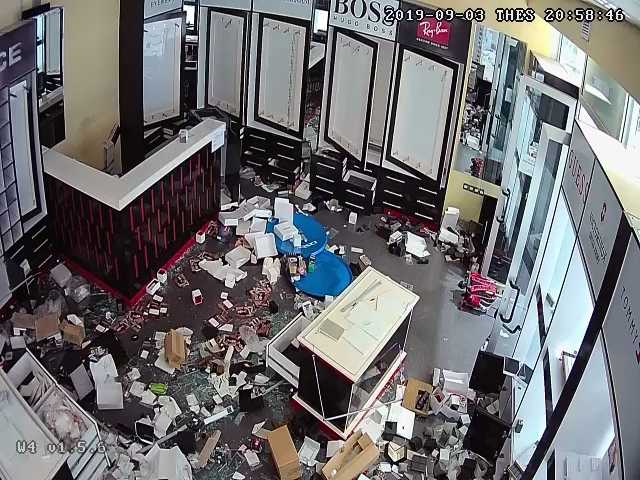
My store at Novare, Timekeepers Novare mall, Sangotedo, Lekki, has been broken into, looted and goods worth millions has been carted away with, this is getting out of hand, this happened this evening, am so sad.. Plz share this
Police have been dispatched to restore order, with the help of rubber bullets, where sections of Johannesburg hoping to avoid the violence appear abandoned, the wealthy and connected remaining out of sight, as the labouring demographic vent their fury at foreigners. Mobs plundered Alexandra, burning and looting foreign-owned shops, with police officers futilely firing rubber bullets in the hopes of dispersing the crowds.
The thousands of South Africans rioting through urban areas in an expression of their anti-foreigner fury must blame someone for their plight when one government after another, corrupt and incompetent has done little to improve the economic prospects of its citizens. Shop owners were set upon indiscriminately by the crowds, beaten insensible. The word was that they were in particular "going for Nigerians as they do drugs".
The past weekend saw South African truckers on strike, blockading roads to protest the employment of foreign drivers. According to police estimates, about 200 drivers were injured or killed on the highway between Johannesburg and Durban last year, with over 2000 trucks attacked.
Violence and looting of immigrant-owned shops broke out in South Africa Sunday and has sparked angry reactions across the continent.
"On Sunday, the International Consortium of Investigative Journalists announced
the collaboration of more than 100 publications worldwide to report on the biggest electronic leak in history: the Panama Papers.
These documents from Panamanian law firm Mossack Fonseca total 11.5 million
separate items spanning 40 years, and take up 2.6 terabytes of information—more than 1,500 times the size of
the WikiLeaks State Department cables. Among the most explosive revelations from
the leak are $2 billion in payouts to Vladimir Putin’s friends, family
members, and allies, and that global soccer superstar Lionel Messi and his
father set up an offshore company to which they are the only beneficiaries...." Slate Magazine online, April 4, 2016
Handout TV grab from Telemetro Panama showing Ramon Fonseca, one of the founders of
Panama's Mossack Fonseca law firm, in Panama City, on April 4, 2016Credit:
AFP PHOTO/TELEMETRO PANAMA
"[Revealing unauthorized details of the offshore
structures of wealthy clients is a] crime [an] attack [on
Panama]."
"This is a crime, a felony. This is an attack on Panama because certain countries don’t like it that we are so competitive in attracting companies."
Ramon Fonseca, one of the founders of Mossack Fonseca
View
of a sign outside the building where Panama-based Mossack Fonseca law
firm offices are placed in Panama City on April 3, 2016. (AFP PHOTO /
RODRIGO ARANGUA)
But according to Dmitri Petrov, spokesman for Russian President Vladimir Putin, the revelations represent a conspiracy cooked up by Russia's Western enemies to smear Mr. Putin and Russia. "It’s clear that the level of Putinphobia has reached a level at
which it is impossible a priori to speak well of Russia, and it’s
required to speak ill of Russia", he stated, denying at the same time that his wife is another owner of a beneficial company to evade taxes.
"My wife does not
and has never owned any offshore companies. Based on this I am inclined
to doubt the authenticity of other claims." But hold on there a minute; Mr. Peskov's wife, former Olympic ice skater Tatiana Navka is shown to have set up Carina Global Assets Ltd., in 2015, using agents on the Isle of Man to aid her in her investments portfolio, according to documents from the Panama Papers, including a copy of her own passport for identification purposes.
One might ask what do Sigmundur Davio Gunnlaugsson, prime minister of Iceland, the offspring of Pakistan's Prime Minister Nawaz Sharif, Prime Minister David Cameron's father, Mauricio Macri, president of Argentina, Syria's Bashar al Assad, Salman bin Abdulaziz bin Abdulrahman Al Saud, king of Saudi Arabia, Ayad Allawi, former prime minister of Iraq; Bidzina Ivanishvili, former Georgian prime minister, Ali Abu al-Ragab, former prime minister of Jordan, Hamad bin Jassim bin Jaber Al Thani, former prime minister of Qatar, Sheikh Hamad bin Khalifa Al Thani, former emir of Qatar, Ahmad Ali al Mirghani, former president of Sudan, Sheikh Khalifa bin Zayed bin Sultan Al Nahyan, president of UAE, and Pavio Lazarenko, former prime minijster of Ukraine have in common?
Well, for starters, their complicated names, their 'former' status in a great many instances, and their obvious desire to escape notice for taxation purposes and in the process become the recipient of untold additional riches to add to their existing considerable wealth. And all kept out of the public eye. No longer away from the public's notice, there will be a lot of explaining to do, and many will lose face, let alone their political positions, albeit not those in the Middle East.
The information dragnet is voluminous to a fault, an incredible scoop of data released for public scrutiny and private shame. But apart from the inconvenience of revelations best kept hidden, many of these people have no shame, just an overweening entitlement, and the grasping desire to become more wealthy than they already are, and if the looting of public treasury and the white-washing of ill-gotten gains through corrupt transactions are involved, that's just the way the elite world of wealth making more wealth operates.
Russian state media itself reveals that $2-trillion in state assets have left the country in the past few years ... to end up, where? Among the unsavoury elements being revealed is the background of one of the founders of the Panamanian law firm Mossack Fonseca; there is the appalled Ramon Fonseca, attempting fruitlessly to divert attention from the criminal aspect of the firm's business, expressing frustration and innocence and criminality on the part of the International Consortium of Investigative Journalists who leaked the revelatory documents.
And then, there is the other partner whose father, Erhard Mossack, was one of the law firm's co-founders. The current partner, Jurgen Mossack, has been silent so far. His father had been a member of the armed wing of Germany's Nazi party, known as the Death Heads, whose insignia was just that. U.S. Army intelligence files verify his status in that dread World War Two Nazi elite group whose function was to administer the death camps where millions of Jews, political prisoners, gays, gypsies, met their deaths.
It is the still-murky connection of Vladimir Putin and how he has benefited personally that will be of greatest interest, a man who has amassed a staggering fortune as president, prime minister and again president of the Russian Federation. Whose good friend Sergei Roldugin, director of the St. Petersburg Conservatory is directly responsible for managing massive amounts of money through shell companies.
But Mr. Putin is, of course, innocent of any wrongdoing, his press secretary attests to that: "Here we see no intent to conduct objective investigations, we see just an intention to publish a hatchet job", he complained in defense of his boss.
"Islamic State operates like a diversified criminal business. They think like business people." Louise Shelley, author Dirty Entanglements: Corruption, Crime and Terrorism, Turkey
"They bring in their own trucks, their own bulldozers, hire their own work crews and pay them salaries." "The trafficking industry in Iraq and Syria is like what Hollywood is for Los Angeles. Just like everyone is an aspiring actor in L.A., everyone in Syria and Iraq is a dealer in some trafficked goods." "The people won't stop hustling until the war ends." Amr Al Azm, anthropology professor, Shawnee State University, Ohio
"Shady dealers sit on smuggled items for years to launder the provenance before trying to sell them for lump sums. There's enough awareness among major auction houses such as Sotheby's and Christie's to avoid handling any antiquity believed to be from Iraq or Syria." "But the challenge is monitoring private sales, which are driving the global antiquities market. I'm pretty confident those pieces from Iraq and Syria are being sold to locals in the region -- wealthy Saudis, Emiratis, Iranians." James McAndrew, formerly with U.S. Customs and Department of Homeland Security
"The best way to stop this is by intercepting the items before they end up in the freeports." Daniel Brazier, U.S. Homeland Security "If we can hold the material inside Syria and Iraq, ISIL can't get the money for it and it will make it easier for the world to repatriate the antiquities when the conflict ends." Michael Danti, adviser, U.S. State Department
"Any terrorist organization or rogue state, even going back to the Nazis, who are looting and trafficking art, are looking for quick cash." "The ultimate destination for valuable antiquities is the West, and people here are more aware now than they were in the 20th Century." Christopher Marinello, chief executive, Art Recovery
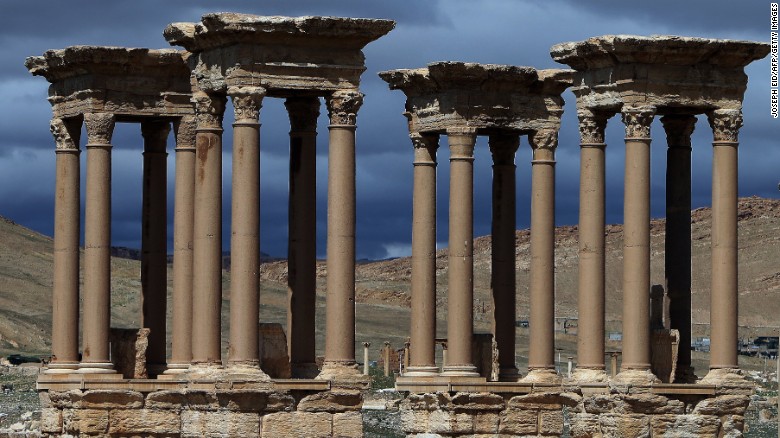
The Tetrapylon, Palmyra, Syria
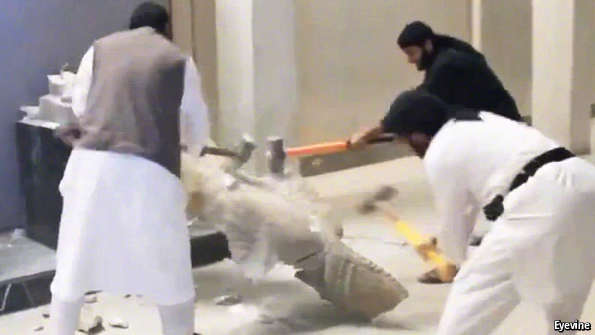
Well, it's a problem of global dimensions; how to safeguard priceless heritage objects of antiquity. For some of those antiquities it is too late; Islamic State jihadis took immense pleasure in loosing their savagely barbaric destructive impulses on many irreplaceable objects of human history, and recording themselves in the process of destroying world heritage items, as though the very act of doing so validated their credentials as world-class psychopaths for whom nothing is sacred.
But then, second thoughts kicked in with the realization that the vast sums earned through the black market trade in petroleum resources with the capture and possession of oil fields in Iraq began to dry up as a result of the U.S.-led coalition bombings. So that it made sense to an otherwise-senseless campaign of ruination to preserve the objects and transport them for illegal sale in an underground economy trading in antiquities. In both of these enterprises, Turkey proved itself invaluable to Islamic State as a passage-intermediary.
The sophisticated public relations arm of Islamic State knows all about the use of social media, using WhatsApp and iPhones to transmit photos of ancient Mesopotamian objects of high value to prospective buyers prepared to smuggle them transiting Turkey or Lebanon in the process. Iraq and Syria have proved to be excellent sources of these peerless goods, so the sledgehammers and drills have been put aside for the greater goal of funding Islamic State pursuits. EBay and Facebook are also helpful in this regard for ISIL.
To the caliphate, the billion-dollar global antiquities market is a godsend, with eager buyers lining up for ownership of sought-after antiquities; some aware of the black market and ISIL connection, others perhaps not. Originally, a 20 percent tax was exacted and collected from diggers and dealers, and then ISIL realized they were sitting on a gold mine and began their own operations, cutting out the middlemen.
According to Michael Danti who advises the U.S. State Department on matters related to plundered antiquities emanating from Iraq and Syria, a complex chain involving a handful of brokers and dealers is complicit with ISIL, supplying them with these rare heritage objects. And, he points out the jihadis are themselves linked closely to Turkish crime networks. Smuggled into Turkey, artifacts are taken by a broker to cash them for resale to dealers.
Archaeologists Rene Teigjeler and Isber Sabrine look for looted antiquities at a market in Gaziantep, Turkey The Wall Street Journal
Archaeologists have estimated that some $300-million worth of antiquities are in the process of flooding the market through Turkey, Lebanon and Jordan to benefit Islamic State of Iraq and the Levant. Cuneiform tablets, stamp seals, Greco-Roman coins are turning up in photos on the Internet. According to the U.S. International Trade Commission, between 2012 and 2013, declared antiquities from Iraq imported into the U.S. increased by 672 percent, and from Syria by 133 percent.
The United Nations Security Council adopted a resolution to ban the sale of antiquities from Syria and Iraq in response to the situation, while the U.S. House of Representatives passed legislation effectively ensuring it has become illegal to sell looted artifacts from Syria. UN diplomats were informed by chairwoman Deborah Lehr of the Antiquities Coalition that Archaeologists Without Borders will be in operation by September to centralize efforts to handle the situation.
Damage caused by looting and vandalism at a museum in Aleppo. (UNESCO and Professor Abdulkarim)
This represents a general opinion site for its author. It also offers a space for the author to record her experiences and perceptions,both personal and public. This is rendered obvious by the content contained in the blog, but the space is here inviting me to write. And so I do.

.JPG)