"I've
been harassed. For us, it's not about whether you are
legal or not, and that is why everyone is very careful right now."
"As long as you are a Nigerian, you are profiled and you are stereotyped immediately."
"We are all very careful."
"We
are in the dark because we don't know how our government [in Nigeria]
is going to react if any of us is to be affected or is to be killed."
"[Both Pretoria and Johannesburg have the] biggest [migrant communities]."
Chairman, Nigerian Union in South Africa, Olaniyi Abodedele
"It is not okay because we are blacks, we are brothers... everybody comes here just to survive."
"It's not what we expected as fellow African."
"It's just making us scared - imagine if we're scared in our own African continent - what if we go to Europe?"
Immigrant Security Guard
"[The
president ordered the] evacuation of imperiled Nigerian citizens who
consider their lives at risk by continued stay in South Africa."
"The
price of your peace, and the safety of your children is not worth any
sacrifices you have to make, or any assets you have to leave behind when
fleeing a conflict zone or hate-infested environment."
Nigerian Foreign Minister Bianca Odumegwu-Ojukwu
"[Nigerians] living in South Africa legally [are being dreadfully mistreated]."
"If
there were issues of illegality, that would be determined on a
person-to-person basis. You can't just crown the entire Nigerians living
in South Africa as living there illegally."
Nigerian Humanitarian Affairs Minister Bernard Doro
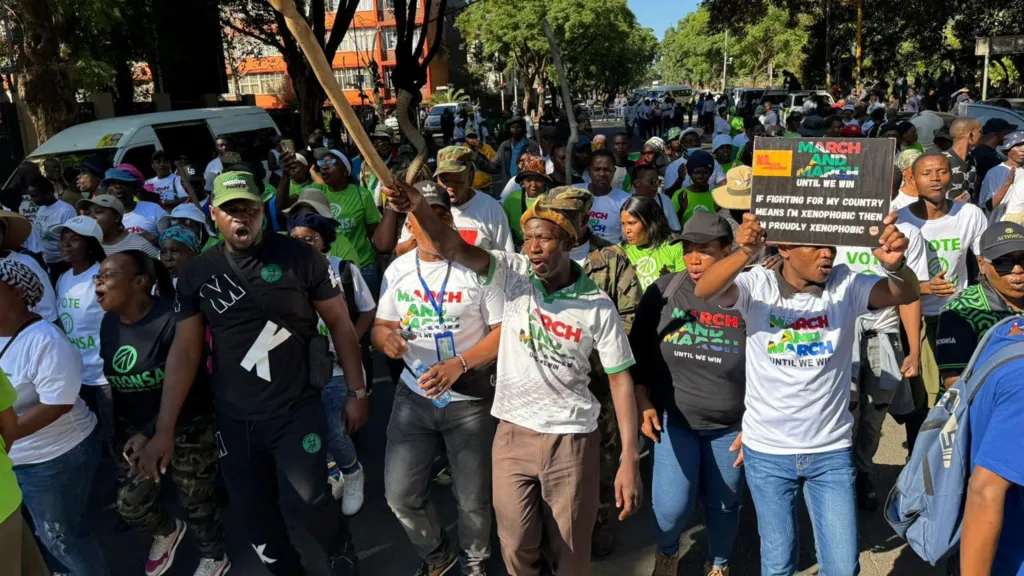
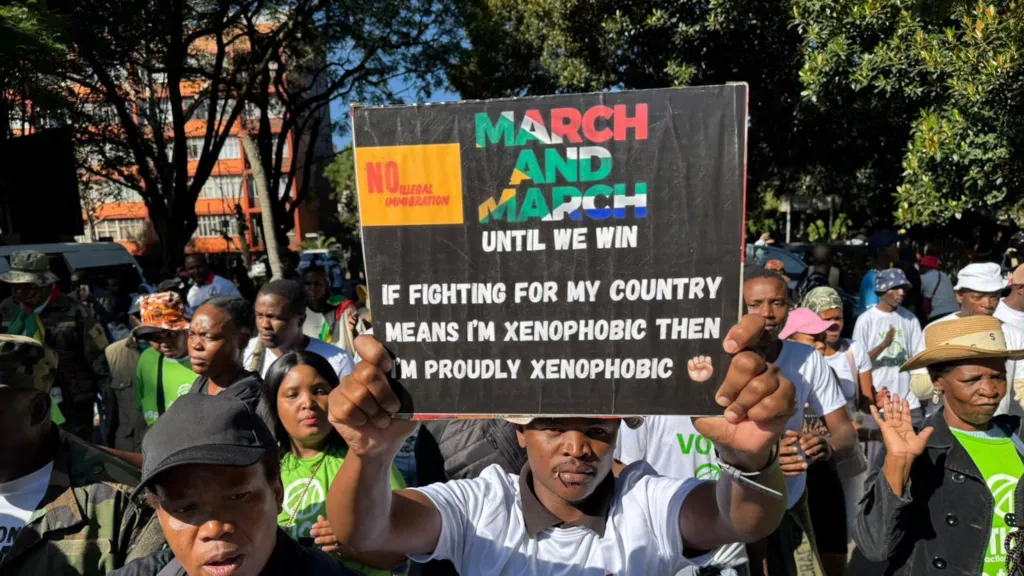
Hundreds took to the streets of Pretoria to protest against immigration BBC / Thuthuka Zondi
"I am very scared and traumatized."
"The
people came to my house and told me: 'You must leave. We don't want you
people to stay here any longer, so you have to go to your country.'
There were 10 and they were carrying weapons [machetes and whips]."
"They
cut my husband on his head and his neck. They were holding his neck
like they wanted to kill him."
"Because of God he still survived, but he's
in the hospital."
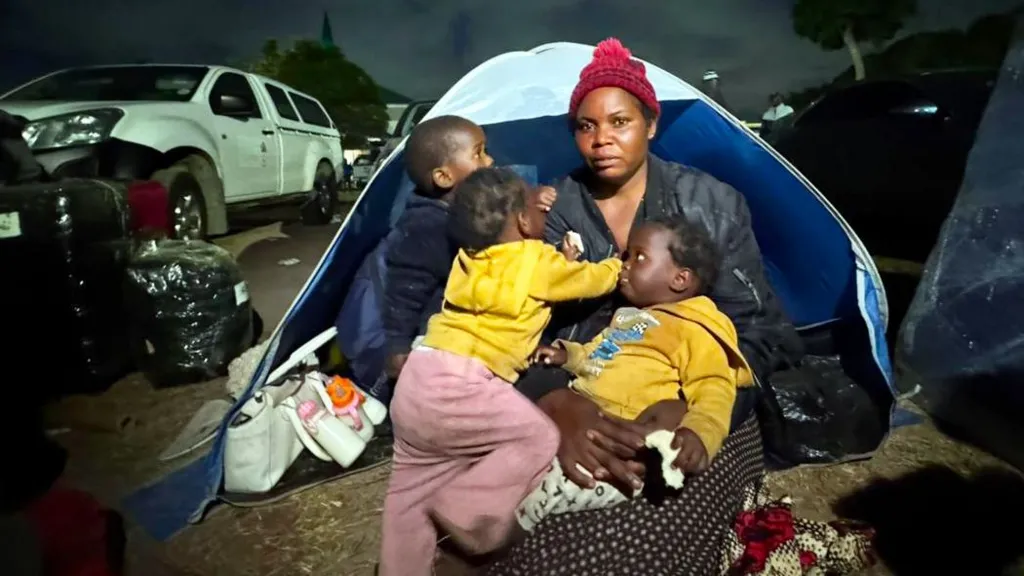
Esnat Joseph, 36, Malawian
Esnat Joseph said a gang of men came to her home in Durban to threaten the family - forcing her to flee with her triplets Thuthuka Zondi / BBC
"If
you come into South Africa with a passport that allows you to stay for
30 days. When it's 50 days, when it's two years, when it's five years,
you know you're breaking the law."
"We
can't have South Africa being turned into a refugee site for all failed
African states… every country prioritizes its citizens and we want the
South African government to do the same."
March and March leader Jacinta Ngobese-Zuma
Ghana's diplomatic mission told Ghanaians in the country to "place the
highest priority on personal safety... [and] take precautionary
measures" during the protests. BBC / Thuthuka Zondi
Part
of repatriation ordered by the government of Nigeria following violent
anti-immigrant protests, the initial group of Nigerians returned home
from South Africa this week. On board the flight to Lagos was a total of
262 passengers and three officials, according to the Nigerian Ministry
of Foreign Affairs which earlier stated that over 1,000 Nigerians have
registered with them for voluntary return.
According
to authorities in South Africa, those returnees were found to be in the
country illegally, effectively contradicting the Nigerian officials who
had stated unequivocally that Nigerians were fleeing xenophobic attacks
against them by hordes of South Africans who march in the streets,
intimidating migrants as well as legal immigrants with the violent
vehemence of their expressed hatred of the presence of 'foreigners'.
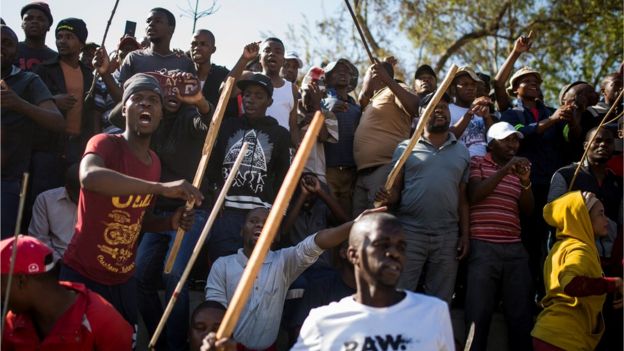
Bearing sticks the marchers chant: "Mabahambe" - a Zulu phrase meaning "They must go".
Such
flights have been organized from South Africa by other African nations
whose nationals have been targeted by hate messages and threats of
violence, including Zimbabwe, Malawi, Ghana, Mozambique and others which
make up the 3 million non-South-Africans in the country, representing 5
percent of the population. Many of whom are there in South Africa,
welcomed for their cheap labour. While South Africa is the wealthiest
and most-developed of the regional African countries, it has a high
unemployment rate.
Countries
like Nigeria have taken note that since April, a series of new
anti-immigration protests have resulted in attacks against some
foreigners in South Africa; protests that highlight tensions between
foreign workers and locals who claim their jobs are being taken by
foreigners. Some South African officials speak of the protests and the
threats inherent in them as acts of xenophobia; words lacking any action
leading to a solution to the anger, resentment and fear.
According
to some returnees questioned by authorities in their home countries,
they lacked proper documentation in South Africa, while others stated
they had been unable to renew their residency papers for years, the
result of immigration bottlenecks imposed on Nigerians by South African
authorities. "I
was in South Africa for 11 years, and I was treated badly/ They did not
give us [Nigerians] resident permits because we were Nigerians", complained Eminaba Beatrice.
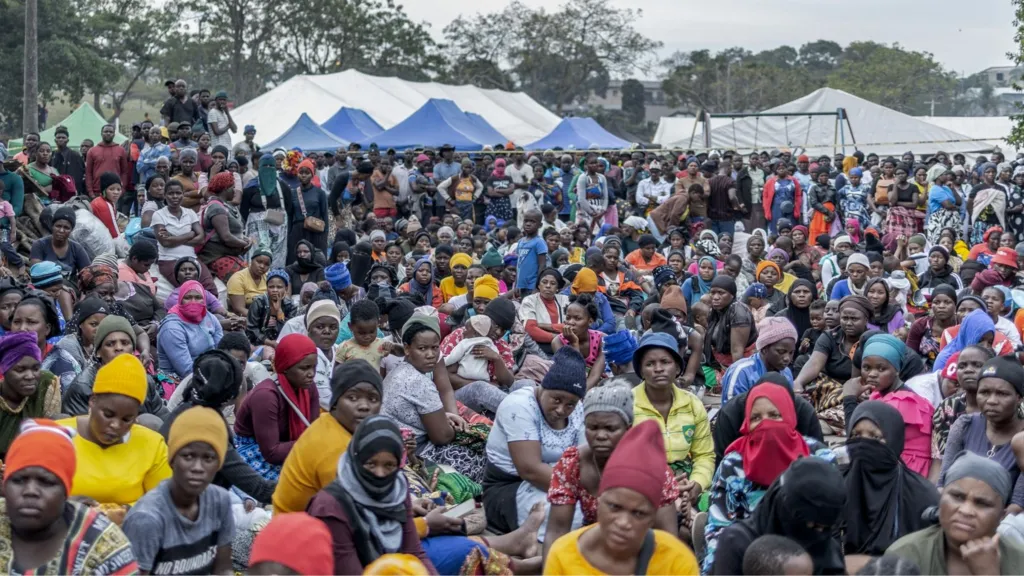
Around 7,000 people have gathered in Durban asking to be repatriated to Malawi AFP via Getty Images
"Political
parties are scraping the bottom of the barrel in trying to lie to
people that all our problems are the migrants, and if we get rid of the
migrants, then we'll have no problems in South Africa."
"This has been an ongoing phenomenon in South Africa and more recently, it has been associated with elections."
Sharon
Ekambaram, human rights lawyer, member, Kopanang Africa
Against Xenophobia movement
"I felt like I have some bad luck because I had only been underground for two weeks when the operation started. That is when things started going bad, we stopped receiving food and we lost contact with the outside world, that could only mean that the police have arrived and probably arrested or scared off the people lowering the food."
"By September, things were really bad. People started getting hungry they started getting sick, some started dying. We started having dead bodies. There is nothing worse than seeing somebody die and there is nothing you can do about it."
(Name withheld) illegal miner
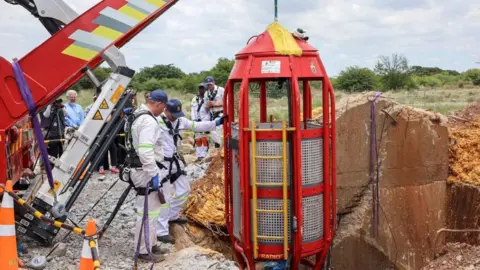
Rescuers lowered in a cage into the mine AFP
Noxious odours permeated the area; whether from the corpses wrapped in fabric and twine, laid out in rows, or emanating from the unwashed bodies of emaciated, starving miners, or stenches from the damp rock of the environment. Emaciated from lack of food since police had cracked down on illegal mining and had put a stop to the delivery of food supplies, water, fuel and other life-saving necessities. Their usual diet while underground was meat, bread and porridge cooked over propane-heated camp stoves.
They had been reduced to eating rough salt to try to staunch hunger.
While they still had those supplies, they smoked cigarettes and marijuana, until they ran out. Cellphone videos and miners' testimonies shed light on the horror that hundreds of men suffered underground in an abandoned mine in South Africa following a police operation that cut off food and supplies in a strategy to "smoke them out", because authorities considered the 2,000 men working deep underground in one of South Africa's largest and deepest mines, to be criminals, illegally mining for gold.
Eventually police were forced by a court order to launch a rescue effort early in the week. When the mission was completed, they reported that no one had been left underground. Dozens of bodies had been pulled out, with a minimum of 87 confirmed dead. One miner speaking on condition of anonymity fearing reprisals, had surfaced Christmas Day, months after he entered the shaft in July. One among the two thousand who ventured there, he experienced extreme hunger and witnessed fellow diggers expiring from starvation and illness.
In August of last year when police targeted the mine near the town of Stilfontein as part of an operation aiming to tackle widespread illicit mining, the man, 40 years of age, father of six children, eventually exited the mine through a separate shaft clambering up and out laboriously on steep steel stairs extremely difficult to navigate, upon which he badly bruised his hands climbing out.
"As we were climbing out we saw dead bodies of other guys who had attempted to exit the same way. Others had fallen down, others were full corpses but there were also lots of bones, almost like skeletons."
"It's not easy to exit there, many people died trying to do that."
(Name withheld) illegal miner
Illegal mining represents one of the largest sources of income for poor families in townships located nearby an estimated 6,100 disused mines country-wide. And this is where illegal mining tends to be rife. Persuaded when he was told he could earn about $5,300 for working a few weeks to a month in one of the country's deepest gold mines no longer officially operating, he took up the offer in a country with one of the highest unemployment rates in the world.
Many of the miners arrive searching for employment from neighbouring countries like Mozambique, Zimbabwe, Lesotho, Malawi and Congo as illegal arrivals in South Africa where their presence is generally held in contempt. Also working in the mine were 13 children.
Mmastona Mbizna explained that two of her sons were engaged in illegal mining as a result of poverty and steep unemployment. Her 22-year-old son was arrested when he left the mine in December. Another son was arrested at the same mine working as a runner on the surface, lowering supplies down to the miners. He was convicted for involvement in illegal mining. "Out of the blue the police came, firing rubber bullets and tear gas. The tear gas blinded me and I fell, broke my leg and collapsed", he said.
The government maintains what though the deaths were tragic, illegal mining is a criminal activity detrimental to the country's economy. "The people who must take responsibility for the deaths that have happened here are those who are benefiting from illegal mining", said Mines Minister Gwede Mantashe, in Stilfontein.
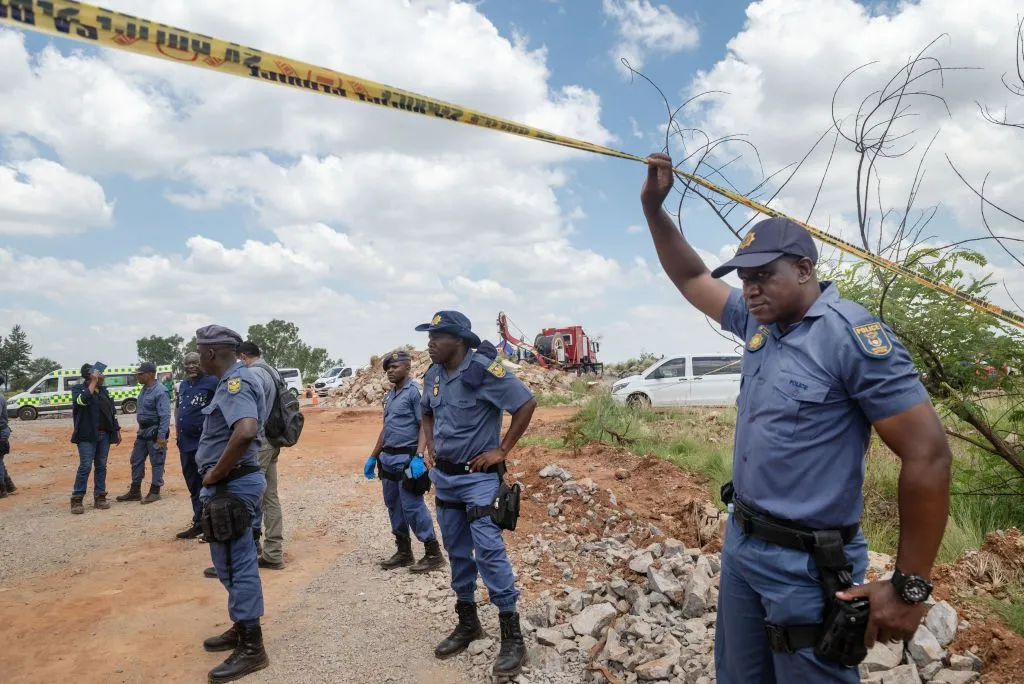
The police have defended the operation at Stilfontein, saying it was about dealing with criminality Getty Images
"I heard from somebody in the neighbourhood that he [her 22-year-old younger son] had gone underground."
"His father died last year and he was not even here for the funeral because he was underground for months."
Capital Punishment by Decree for Illegal Miners in South Africa
"If the police had acted earlier, we would not be in this situation, with bodies piling up."
"It is a disgrace for a constitutional democracy like ours."
Johannes Qankase, local community leader, Stilfontein, South Africa
"It has been a tough few days, there were many people who [we] saved but
I still feel bad for those whose family members came out in body bags."
"We did all we
could."Mandla Charles, volunteer rescuer
Forensic service workers carry dead miners in blue body bags out of the mine AP
South
African authorities have come under fire for their decision to cut off
food and supplies to illegal miners operating in the Buffelsfontein
Gold Mine, a tactic meant to "smoke them out". It is the South African
mining union that has condemned the government for its pitiless decision
not to come to the aid of the illegal miners who were trapped in an
abandoned gold mine. The miners, in a desperate situation, were left to
their own devices to try to save themselves.
Finally
local community groups took action on their own to launch rescue
attempts after government authorities declared they had no intention of
assisting the hundreds of miners trapped far underground under
conditions that would lead to their deaths, stating their decision was
based on the fact that as far as the government was concerned, the
illegal miners were 'criminals' not worthy of being saved from their own
folly.
The
standoff between the miners and government authorities have been
ongoing for months, with no solution on the near horizon. The situation
is dire, and has to the present cost the lives of 87 miners trapped in
the gold mine. Athlenda Mathe, a spokesperson for the national police,
affirmed that 78 bodies had been retrieved, resulting from a
court-ordered rescue operation.
Forensic Service workers carry bodies in blue body bags taken out of the mine on January 14, 2025 AP
Another
246 survivors were pulled out of the mine since Monday when the
operation was initiated. Nine additional bodies were recovered prior to
the rescue operation forced by court order on the government.
Those
of the miners whose lives were lost are thought of as having died of
starvation and dehydration, although no causes of death have yet been
officially released.
But
the fact is that South African authorities cut off food and supplies to
the miners last year in the Buffelsfontein Gold Mine. Accusations have
been levelled against both police and mine owners of having dismantled a
pulley system whose function was to enable entry to the mine and to
send supplies down to the miners.
Close
to 2,000 miners were thought to be working
illegally in the mine near the town of Stilfontein, southwest of
Johannesburg, since August of last year. Many resurfaced on their
own over the last few months, according to police. All of the survivors
were arrested as they emerged. They were exhausted, emaciated and could
barely make their way unassisted to waiting ambulances.
Aside from
the ambulances to convey the barely functioning survivors, a convoy of
mortuary vans arrived at the mine to carry away those who had succumbed.
Prior to the court-ordered official rescue operation, over a dozen
children exited the mine on their own. Most of the illicit miners are
foreign nationals living illegally in South Africa. They come from
Mozambique, Zimbabwe and Lesotho, and their presence is deeply resented
by South Africans.
Cage used to rescue miners from abandoned mine AP
Once
more a court ordered authorities to allow food and water to be provided
to the miners, last year. Just a week ago, another ruling forced
authorities to launch a rescue operation. The South African government
is the very entity that brought a case against Israel to the
International Criminal Court, accusing the Jewish State of violence
bordering on 'genocide' against Palestinians in Gaza, following a
massacre of Israelis by the Gaza-ruling Hamas terrorist group.
Israel
stands accused of failing to provide the necessities of life to the
Gaza Strip's population under fire as a result of the Hamas terror group
installing their command centres, weapons depots and launch sites
directly within heavily populated civilian enclaves in Gaza. Ironically
this is the height of sanctimony by South Africa's government in view of
their lack of humanity in addressing the trapped miners, choosing to
deprive them of life as fitting punishment for their illegal mining
operations.
Hamas Charter and the International Criminal Court
"Today,
we were witness to one of the greatest shows of hypocrisy in history,
compounded by a series of false and baseless claims [brought by South
Africa acting as the] legal arm of the Hamas terrorist organization."
"[South
Africa] utterly distorted the reality in Gaza following the October 7
massacre and completely ignored the fact that Hamas terrorists
infiltrated Israel, murdered, executed, massacred, raped and abducted
Israeli citizens ... in an attempt to carry out [a] genocide."
"[Pretoria's
case at The Hague] seeks to allow Hamas to return to commit the war
crimes, crimes against humanity and sexual crimes they committed
repeatedly on October 7, as its leaders have stated."
Israeli Foreign Ministry spokesman Lior Haiat
"Israel
has transgressed article two of the [Genocide] Convention, committing
acts that fall within the definition of genocide. The actions show a
systematic pattern of conduct from which genocide can be inferred."
"Nothing will stop the suffering except an order from this court."
South African attorney Adila Hassim
"The violence and the destruction in Palestine and Israel did not begin on October 7, 2023."
"The Palestinians have experienced systematic oppression and violence for the last 76 years."
South African Justice Minister Ronald Lamola
Police officers disperse protesters during a demonstration outside the
Peace Palace in The Hague on Thursday, where Israel is facing
allegations before the International Court of Justice launched by South
Africa of 'genocidal acts' in Gaza. (Robin Utrecht/ANP/AFP/Getty Images)
Violence
in South Africa is rife, and incitement to violence by Black South
Africans afflicting the White population follows a trajectory that
brought ruin to Zimbabwe in the early 2000s by Robert Mugabe and which
South Africa now sees fit to follow suit. Zimbabwe, once known for its
land production was able to export its agricultural products abroad.
When its 'land reform' operation went into full swing and white farmers
saw their heritage farms expropriated and their properties handed out to
friends and colleagues of the administration, agriculture failed and
the country faced food shortages, while inflation soared and its
currency became worthless.
On
a bare hillside near Polokwane, in South Africa's Limpopo Province,
stand more than 2,000 white crosses. Crosses on a hillside have
memorialized farmers killed in raids. Seventy-five were added last year.(Foreign Correspondent: Alex Barry)
Corruption
is rife in South Africa. There has been an epidemic of murder by Black
South Africans against White SA farmers. This is the government that
chose to align itself with a Palestinian terrorist group further
solidifying its known hostility toward Israel. The lavish slander that
South Africa's government has embarked upon in its zeal to see the
Jewish state humbled and shamed by bringing a charge of genocide against
Israel to the United Nations' court of justice turns reality inside
out, naming the victim as the aggressor and the aggressor as the
wronged-against.
Lawyers
for South Africa demanded of the International Court of Justice (ICJ)
that it order an immediate cessation of the Israel Defense Forces'
operation in the Gaza Strip aimed at destroying the Hamas terror group.
That
the South African Justice Minister would refer to the re-establishment
of a formal, sovereign, world-recognized Israel on its ancient ancestral
Judaean land as a threat against the existence of 'Palestinians' by its
very established presence speaks volumes about the corrupted morals of
the African country's executive administration.
Palestinians
who refer to themselves as 'victims' of the establishment of Israel,
their 'nakba', have consistently threatened and violently attacked
Israel; the 'oppression' of which they speak is Israel's self-defence
against their lethal violence. A forced, constant vigilance to deter
further attacks.
For
Israel, the past 76 years have necessitated constant guard against
ongoing Palestinian violence, incited by their leadership. For
Palestinians those 76 years have been lost opportunities to finally
establish their own sovereign nation alongside that of a neighbour.
Their
leaders refused their portion of the Partition plan offered by the
United Nations, and at every meeting since then to negotiate a peace
agreement between Israel and the 'Palestinians' their leaders have
refused despite Israeli concessions; refusing as well to offer any
concessions of their own in exchange.
Outside
the 'Peace Palace' in The Hague, Netherlands, where the ICJ court sits,
thousands of pro-Israel supporters of Israel took part in a protest
organized by local Jewish and Christian groups who waved flags and held
posters of the Israelis who were taken hostage or murdered during the
Hamas/Islamic Jihad/PFLP/civilian Palestinians orgy of mass rape,
slaughter, mutilation and destruction on October 7, 2023 the aftermath
of which was the IDF's invasion of Gaza for the direct purpose of
exacting justice, through destroying the ability of terrorism out of
Gaza to repeat such horror.
The
ICJ's purpose as the principal judicial offshoot of the United Nations
is to deal with disputes between states. The International Criminal
Court (ICC) on the other hand, prosecutes individuals. It is anticipated
that the full proceedings are likely to go on for years; even so an
interim order could be issued in a matter of weeks although the ICJ has
no enforcing ability. A judgement ruling against Israel would have the
effect of increasing international pressure to withdraw from combat
operations in Gaza.
South
Africa's initiative to charge Israel with violations of its obligations
under the 1948 Genocide Convention by its intention "to destroy Palestinians in Gaza as a part of the broader Palestinian national, racial and ethnical group",
was highly praised by Hamas. Irony of ironies, the 1948 Genocide
convention was drafted following the Holocaust for the purpose of
prevention; the destruction or intent to destroy "in whole or in part, a national ethnical, racial or religious group".
The very intention, needless to say, expressed by the Hamas charter.
Israel supporters take part in a demonstration outside the ICJ. (Robin Utrecht /ANP/AFP/Getty Images)
"The
IDF is doing its utmost to minimize civilian casualties, while Hamas is
doing its utmost to maximize them by using Palestinian civilians as
human shields."
"Israel
is fighting Hamas terrorists, not the Palestinian population, and we
are doing so in full compliance with international law."
"[The
Israel Defense Forces drops leaflets, makes phone calls urging
civilians to leave conflict zones] providing safe passage corridors,
while Hamas prevents Palestinians from leaving at gunpoint and often
with gunfire."
"Our
goal is to rid Gaza of Hamas terrorists and free our hostages. Once
this is achieved, Gaza can be demilitarized and de-radicalized, thereby
creating a possibility for a better future for Israel and Palestinians
alike."
Islamist MPs Nibbling Away At Canada's Moral Compass
"I
call on Canada to support South Africa's application to the
International Court of Justice regarding the current conflict between
Israel and Hamas and the impact this conflict is having on the people of
Palestine."
Member of Parliament Salma Zahid, Toronto area MP
"[The
International Criminal Court prosecution of Israel, brought by South
Africa claiming that Israel was engaged in a genocidal war against
Palestinians is] an outrageous and cynical abuse of the principles
underlying the international legal order that was set up after the
Second World War."
Former Canadian Supreme Court Justice Rosalie Abella
"Just last year, President Cyril Ramaphosa was preparing to host
Russia’s President Vladimir Putin at the BRICS (Brazil, Russia, India,
China, and South Africa) summit in Johannesburg following frequent
one-on-one meetings between the two."
"When it became clear that a
court would rule that South Africa would have to arrest Putin in terms
of a warrant issued by the International Criminal Court (ICC) for crimes
related to his invasion of Ukraine, the government relented, and Putin
attended the summit virtually."
"Prior to that, South Africa had refused to arrest then Sudanese
President Omar al-Bashir, who was charged with a litany of war crimes.
Among these were, to quote the ICC, 'five counts of crimes against
humanity: murder, extermination, forcible transfer, torture, and rape;
two counts of war crimes: intentionally directing attacks against a
civilian population as such or against individual civilians not taking
part in hostilities, and pillaging; three counts of genocide: by
killing, by causing serious bodily or mental harm, and by deliberately
inflicting on each target group conditions of life calculated to bring
about the group’s physical destruction, allegedly committed at least
between 2003 and 2008 in Darfur, Sudan'."
The Brenthurst Foundation: Ray Hartley, Greg Mills
Supporters of Hamas demonstrating outside the International Court of
Justice in The Hague, Netherlands. Photo: Reuters/Jehad Shelba
Member
of Parliament Zahid, known as a longtime critic of Israel was one of a
number of Liberal Members of Parliament who a month ago managed to
convince Prime Minister Justin Trudeau to join forces with others who
sat fit in the United Nations General Assembly to call for a ceasefire
in the Israel-Hamas conflict. Clearly the message of a ceasefire was
aimed directly at Israel; Gaza is not an established 'state' and nor
would the terrorist group that rules Gaza be bound by an humanitarian
urge to cease and desist. Israel's agreement to a ceasefire would not
put an end to the Hamas rocket bombardments, a well-known reality.
But
that's the direction that the Liberal government under Justin Trudeau
chose to take, marking an extraordinary move by Canada, to abandon its
allied relationship with the Jewish State to satisfy elected Muslim
Members of Parliament who make no secret of their bias against Israel.
While the current government has not yet expressed any position on the
ICC case which began today, both the Palestinian 'ambassador' to Canada
and South Africa's high commissioner in Ottawa publicly urged Canada to
support the argument of genocide.
| JOHANNESBURG Ties bound in struggle image: AFP
South
Africa's argument is that the widespread bombardment of Gaza by the
Israel Defense Forces and Israel's siege on Palestinians in Gaza "are genocidal in character".
Israel's bombardment of Gaza has a direct and distinct purpose; to
eliminate any future opportunities for the Hamas terrorist group, along
with that of Palestinian Islamic Jihad to ever again commit atrocities
against Israelis as they did on October 7 when both, along with
Palestinian civilians surged across the border into southern Israel in
the thousands to rape, torture, mutilate and murder.
Committing
atrocities so foul it's difficult to imagine human minds even imagining
them, much less engaging in them to exact pain and remorseless anguish
on vulnerable girls, women, children, and entire families burned to
death in their homes. That deadly pogrom and the abduction of 250
elderly people, infirm and ill, residents of border towns and kibbutzim,
infants and teens, foreign farm workers and other civilians, along with
Israeli soldiers constituted a crime against humanity, not the response
by Israel to extinguish terrorism in Gaza geared to Israel's
destruction.
Others
in the Liberal caucus, including MPs Marco Mendicino and Anthony
Housefather describe the court application by South Africa as "baseless and unconscionable"
for the very reason that Israel's offensive is a defensive one, in its
efforts to prevent terrorists out of Gaza from repeating such horrendous
attacks -- murdering over 1,200 people in a single day -- leaving the
remains of so many dead bodies strewn about that identification of the
dead is still being processed, three months later.
South
African, in the meantime, sees nothing amiss itself in maintaining
friendly contact and support by those responsible for a magnitude of
killing amounting to genocidal slaughter condemned by the same ICC. Soon
after launching the ICJ proceedings against Israel, South African
President Cyril Ramaphosa welcomed the leader of the Sudanese Janjaweed
Arab group responsible along with the Sudanese government for the
genocide that took place in Darfur two decades ago, once again under the
Rapid Support Forces perpetrating crimes against humanity in Sudan,
massacring Black Sudanese farmers, and committing sexual violence.
"Hypocrisy has,
it would seem, no limits when it comes to South Africa’s foreign
policy. Exactly a week before the country was due to accuse Israel of
genocide before the International Court of Justice (ICJ)
on January 11th, President Cyril Ramaphosa played host to Muhammad
Hamdan Dagalo, a Sudanese warlord whose Janjaweed militia and its
successor are accused of genocide and war crimes in Darfur. Adding to
the insult, Mr Dagalo, also known as Hemedti, later visited the genocide
museum in Kigali, Rwanda."
"Just
as jarring was a ceremony on December 5th marking ten years since the
death of Nelson Mandela, a man seen by the world as a symbol of
reconciliation and peace. A Hamas delegation led by Bassem Naim, a
senior official, joined Mandela’s grandson, Mandla, in a march through
the streets of Pretoria, the capital. At their destination—the statue of
Madiba (as Mandela is honorifically known) that stands proudly outside
the president’s office—they laid a wreath with Lindiwe Zulu, the
social-development minister."
The Economist
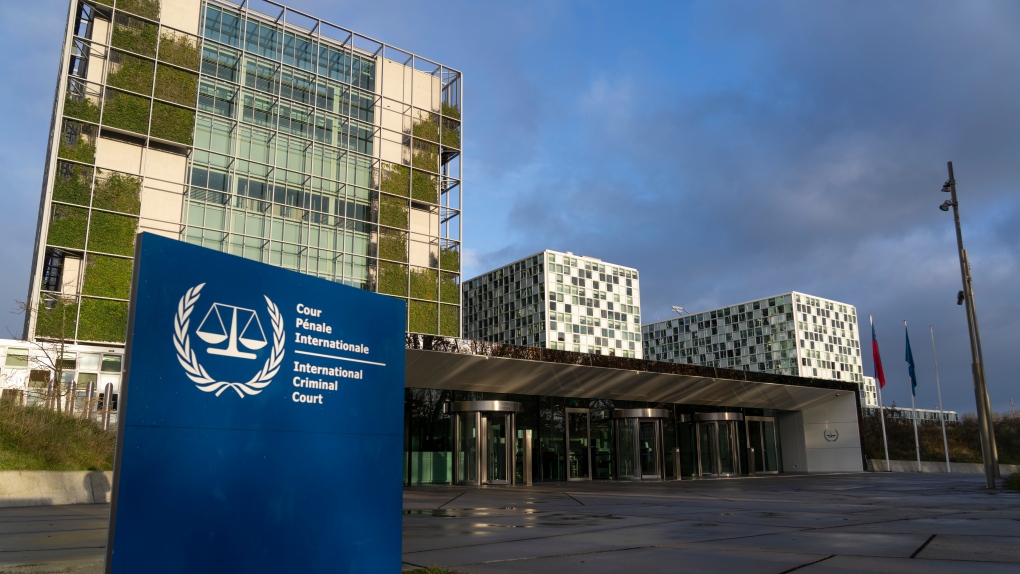
Exterior view of the International Criminal Court in The Hague, Netherlands. (AP Photo/Peter Dejong)
"Against
this backdrop of rising infections, rising hospitalizations and rising
numbers of people dying from coronavirus, it is absolutely vital that
we act."
"We simply cannot have the kind of Christmas that we all yearn for."
"This
virus [a new mutation of COVID-19 appearing in South Africa] is highly
concerning because it is yet more transmissible and appears to have
mutated further than the new variant that's been discovered in the
U.K."
"Thanks to the impressive genomic capability of the South Africans,
we’ve detected two cases of another new variant of coronavirus here in
the UK."
"Both are contacts of cases who have travelled from South Africa over the past few weeks."
"This new variant [from South Africa] is highly concerning, because it is
yet more transmissible, and it appears to have mutated further than the
new variant that has been discovered in the UK."
British Health Minister Matt Hancock
"[The new variant in the
UK] is very different to the variant in South Africa, it’s got different
mutations."
"Both of them look like they’re more transmissible. We have more
evidence on the transmission for the UK variant because we’ve been
studying that with great detail with academic partners. We’re still
learning about the South African variant."
:[Vaccines that have already been
developed should be effective] because the vaccine produces a strong
immune response and it’s broad and acts against lots of variation in the
virus."
Susan Hopkins from Public Health England
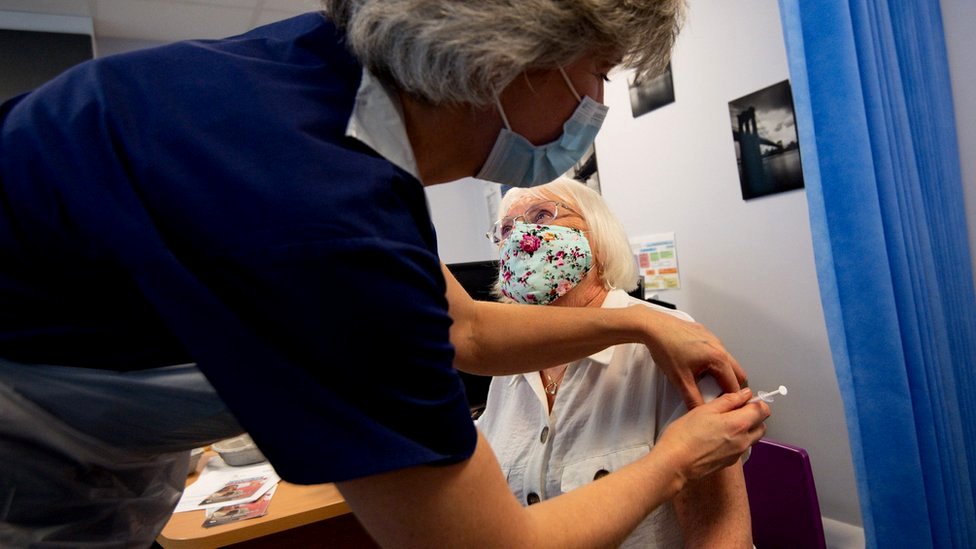
There is no current evidence to suggest that the new variant is affected any differently by vaccines Reuters
The
SARS-CoV-2 virus that causes COVID-19 appears incorrigibly immune to
every human-inspired effort to bring it under control. The virus almost
appears to taunt scientific efforts to better understand its viral
properties, much less to invent new protocols that might have the effect
of diminishing its predatory advances. All viruses mutate over time; it
is why vaccines produced annually for the seasonal flu can only
partially address all the altered elements of any season's flu virus;
the vaccine producers wait until the last possible moment to assess as
accurately as possible all of the most current flu viruses' qualities
before finalizing their vaccine for distribution for that year.
Experts
were aware of a number of SARS-CoV-2 mutations, tracking them and
evaluating their effects. The two issues of greater infectability and
more potentially serious effects of infection uppermost concerns. At
least one of those concerns has now been realized in a new strain that
has hugely accelerated infectiousness in the U.K. Authorities are trying
to cope, just at a time when it was hoped that measures could be eased
for the holiday season; instead areas of high infection have had to
return to lockdown.
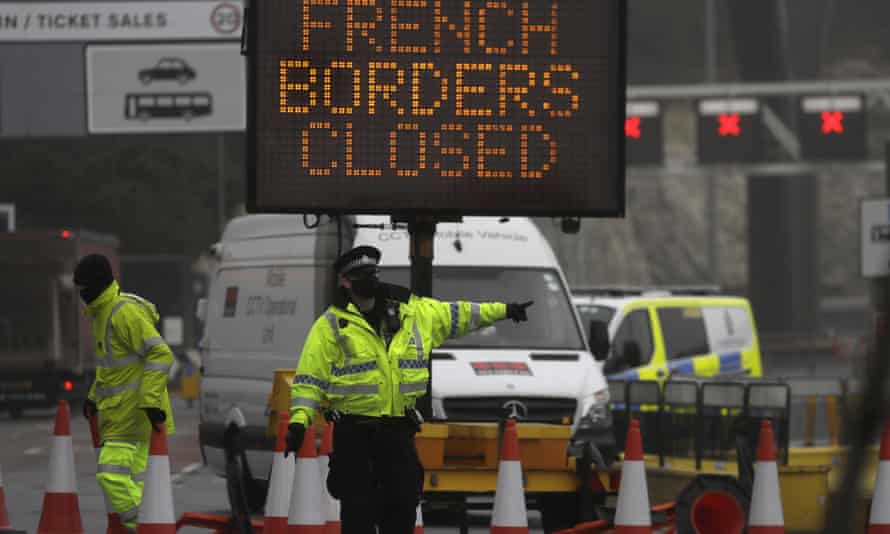
The UK has now been effectively placed in quarantine by the international community.’ The closed ferry terminal at Dover. Photograph: Kirsty Wigglesworth/AP
Countries
in Europe and North America and Asia have closed off flights and other
modes of travel from Britain in light of the current situation; the
nightmare of all countries already coping with desperate numbers of
infections, hospitalizations and deaths is an exacerbation caused by
another viral strain brought in from an outside source. Ironically,
Britain, struggling to contain its own mutant strain, now realizes that
an even more seriously infectious mutant strain has already infiltrated
the country, one that originated in South Africa.
Leading
to huge swaths of Britain being placed under strict COVID-19
restrictions responding to a highly infectious virus variant now
sweeping the country, raising infection cases to record levels. Almost
40,000 new infections of the mutated variant of the coronavirus,
estimated to be up to 70 percent more transmissible, has been
responsible for case numbers and hospitalizations to soar. Deaths,
numbering 744, also represents the highest figure since April.
London,
southeast England and Wales are now seeing tight social mixing
restrictions, reversing plans to ease curbs over Christmas across the
nation. From December 26, additional parts of southern England are set
to be among those added to the highest level of social mixing
restrictions where 16 million already have been placed in Tier 4
restrictions. Those parts of the country locked into lower tiers are
also slated to face tighter curbs.
Passengers
wait in line at the Eurostar terminal at St Pancras International,
amidst the spread of the coronavirus disease (COVID-19) pandemic, in
London [Hannah McKay/Reuters
Nearly
everyone in Scotland and Northern Ireland has seen their governments
announce entire populations to be subjected to the highest level of
restrictions following Christmas. On average, according to the health
minister, 1,909 COVID hospital admissions take place every
day, with 18,943 people in hospital with the virus at the present time,
levels rivalling the situation in April when the coronavirus took Europe
by storm.
All
this, and coincidentally the discovery by British scientists of
another, more virulent variant having arrived leading Britain to place
new restrictions on visitors from South Africa, calling on those who
recently had been in the country or in contact with anyone recently
arrived, to self-isolate immediately. The public being assured that all
such measures are temporary until such time as officials are better able
to understand the variant and what it portends.
Last
week, officials in South Africa announced the detection of a new
variant by their scientists, appearing to be fuelling a rapid rise in
infections in the country. Now, even as Britain is grappling with a
steadily increasing outbreak linked to a variant originating in England,
they must as well turn their attention to a South African variant. One,
Minister Hancock announced, that might be more contagious even than the
U.K. variant, both of which are "out of control" in the country.
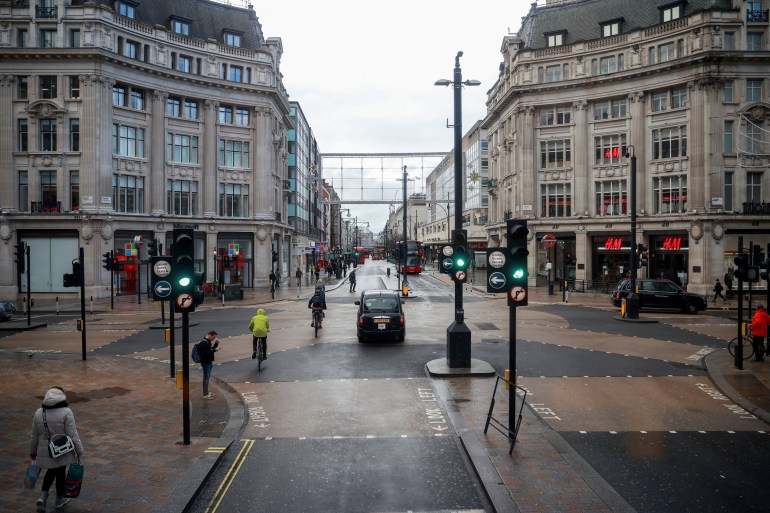
People walk and cycle in London [Hannah McKay/Reuters]
"Due to the tension created by the attacks, the Government of Nigeria wished to advice [sic] Nigerians to avoid travelling to high risk and volatile areas [specifically, South Africa] until the situation is brought under control." Nigerian Ministry of Foreign Affairs -- travel advisory
Tiwa Savage
@TiwaSavage
"I refuse to watch the barbaric butchering of my people in SA. This is SICK. For this reason I will NOT be performing at the upcoming DSTV delicious Festival in Johannesburg on the 21st of September. My prayers are with all the victims and families affected by this."
Nigerian superstar
"The issue of foreign nationals, blaming them for many things which are
not going well in the country and also the law enforcement and the
economic conditions in the country, all of these combined, if not
managed well, then create this cyclical tension between foreign
nationals and locals, especially those who are in the margins because
the middle class and those who are in the upper class, you hardly ever
hear of such tension getting into this level."
Somadoda Fikeni, policy and political analyst. University of South Africa, Pretoria
A group of South African men gathered in Johannesburg for a second night of anti-foreigner rioting on Tuesday Getty Images
Cyril Ramaphosa, president of South Africa, is condemning the "xenophobic violence" exhibited by South Africans against the presence in the country of their neighbours from Mozambique, Zimbabwe, Malawi and Burundi. But it is largely people from Nigeria who have been a target of South African violence, accused of drug trafficking. Pakistan too has been a source of foreign residents in South Africa. This is a country that is no stranger to xenophobia and violence arising from it.
In the latest, three-day rampage of rioting, five foreign residents of South Africa have thus far lost their lives. In previous years there were also lives lost when South Africans, whose unemployment rate is astronomical at about 28 percent, have rioted against the presence of other Africans whom, they claim, will work for less than South Africans and who are taking away their job prospects, a timeworn trope of hostility to the presence of foreign elements.
Is this racism? Of which Africans everywhere claim has led to the slow pace of development on the continent, still suffering from the days of colonialism when European powers eviscerated the continent, hauling off its natural resources, including its people for slave labour to enhance, advance, and benefit the future wealth of the West. Seldom mentioned of course is that Arab traders and sometimes black Africans themselves led and fed the slave trade, and countries like Mali still honour slavery.
My store at Novare, Timekeepers Novare mall, Sangotedo, Lekki, has been broken into, looted and goods worth millions has been carted away with, this is getting out of hand, this happened this evening, am so sad.. Plz share this
Police have been dispatched to restore order, with the help of rubber bullets, where sections of Johannesburg hoping to avoid the violence appear abandoned, the wealthy and connected remaining out of sight, as the labouring demographic vent their fury at foreigners. Mobs plundered Alexandra, burning and looting foreign-owned shops, with police officers futilely firing rubber bullets in the hopes of dispersing the crowds.
The thousands of South Africans rioting through urban areas in an expression of their anti-foreigner fury must blame someone for their plight when one government after another, corrupt and incompetent has done little to improve the economic prospects of its citizens. Shop owners were set upon indiscriminately by the crowds, beaten insensible. The word was that they were in particular "going for Nigerians as they do drugs".
The past weekend saw South African truckers on strike, blockading roads to protest the employment of foreign drivers. According to police estimates, about 200 drivers were injured or killed on the highway between Johannesburg and Durban last year, with over 2000 trucks attacked.
Violence and looting of immigrant-owned shops broke out in South Africa Sunday and has sparked angry reactions across the continent.
Soaring South African Murder Rates via Criminal Gangs
"As soon as the army leaves, a lot of these gangs are going to uncover their weapons and drugs and go back to business as usual." John Stupart, military analyst
"This is what we need [the intervention of armoured military trucks patrolling the township]." The people are shooting here every night." "This is how we're living [gangsters murdering people at will, spraying bullets at homes]." "For us, this is normal." Nasser Myburgh, radio technician, Cape Town, South Africa
"The gangs still feed on state neglect and social dysfunction." "But the territorial control, the profits and the violence are vastly greater than they have ever been before." Simone Haysom, Global Initiative Against Transnational Organized Crime
Members of the South African Police Services (SAPS) are shown in
November 2018 after the launch of a new SAPS anti-gang unit in the Cape
Town suburb of Hanover Park. Now the country's Defence Ministry has
approved a battalion to deal with the city's crime spike. (Rodger Bosch/AFP/Getty Images)
"Everybody was elated when they heard the news that the army was going
to come in because the situation was so dire that anything to improve
the situation would have helped." "[People had expected a roll-out of large-scale lockdowns with specific
targeting of well-known criminal hot spots and gang leaders, but ] there’s been none of this."
"The people aren’t seeing any major changes or improvements in the area." Kader Jacobs, head,
community policing forum, Manenberg township
"They send in the army but the army can’t do anything."
"The army is here but I don’t know how far they can go to minimize the killings on the Cape Flats." Sally-Anne Jacobs, 50, mourning son and cousin to gang violence
Cape Town, South Africa Picture: Matthew Jordaan/African News Agency (ANA) Archives
Police recorded over 2,800 murders in 2018 in Cape Town, making it one of the most dangerous cities in the world, approaching numbers seen in the most violent cities in Latin America. Escalating turf battles between gangs trafficking in drugs, weapons, illicit goods like abalone, prized by poachers, are cited as the precipitating points. On July 12 South Africa's President Cyril Ramaphosa, in recognition of the crisis, ordered military intervention to try to put a halt to the escalating murder rates.
He was warned that the military could accomplish little when the underlying issues of corruption and unemployment that spurred gang affiliations to reign over the townships remain unsolved and unaltered. The Cape Flats, an expanse on the border of the city where black and mixed-race people during the apartheid era were forcibly moved, represents one of the worst-hit areas for violence. The neighbourhood is divided into gangs.
The very presence of military patrols on the first weekend of action resulted in a noticeable drop in the murder rate on the Cape Flats where the Hustlers, Rude Boys, Ghetto Kids, Spoilt Brats, Hard Livings and Americans all vie for gang territory. On the weekend that followed, 46 people were murdered, and a few weeks afterward bloodshed had returned to its normal pace.
Mitchells Plain saw killings less than 48 hours after a military patrol had vacated the area. A young man who lived in a Hard Living area visited his girlfriend and their son on the turf of the Americans gang, and was shot to death while walking between the two homes. Nyanga, also in the Cape Flats, had 308 murders, as the police precinct with the highest number of killings in South Africa.
According to the mayoral committee member for security, the last year, the murder rate was "about twice as bad as what we've seen before" with officials claiming the military deployment named Operation Prosper would help stabilize Cape Town's ten most dangerous neighbourhoods. There are supporters of Operation Prosper who are members of local community policing forums, happy that the central government is taking their concerns under serious consideration.
Mr. Myburgh locks his family indoors each evening, taking as his cue gangsters spraying a nearby house with bullets the night before the military arrived. The gangs began their appearance in the 1960s and 70s, when families in their thousands were evicted to make way for whites in neighbourhoods so designated. Now, in Mitchells Plain, fewer than 37 percent of the population is employed.
Following apartheid, gangs morphed into crime enterprises, consolidating their power structures. "You know how it is, you hurt me, I hurt you back", said Ronald Hermanus, 28, whose brother's funeral took place on a recent Saturday only a few hundred meters from where the funeral of another man belonging to another gang other than his brother's took place.
President Cyril Ramaphosa sent soldiers to patrol areas where gang violence has surged. Joao Silva, The New York Times
"I want you to know where I come from so you can tell where I am headed. I'm like thousands of women in South Africa who lost their men to cities and prisons ... I stand defiant, tall and strong." "We had our textbooks, naturally written by white men, and they had their interpretation. Then [her father] would put the textbook aside and say: 'Now, this is what the book says, but the truth is: these white people invaded our country and stole the land from our grandfathers." "There is an anger that wakes up in you when you are a child and it builds up and determines the political consciousness of the black man." "We have no guns -- we have only stones, boxes of matches and petrol." "Together, hand in hand, with our boxes of matches and our necklaces, we shall liberate this country."
Nomzamo Winifred Zanyiwe Madikizela, Soweto, South Africa
"Without condoning her misdemeanours, we must acknowledge that she is a victim, she is damaged and hurt." "When someone is subjected to the kind of consistent persecution and harassment she suffered from the apartheid system, something is bound to snap. We understand that and will always be there for her." Kgalema Motlanthe, then-ANC Secretary General
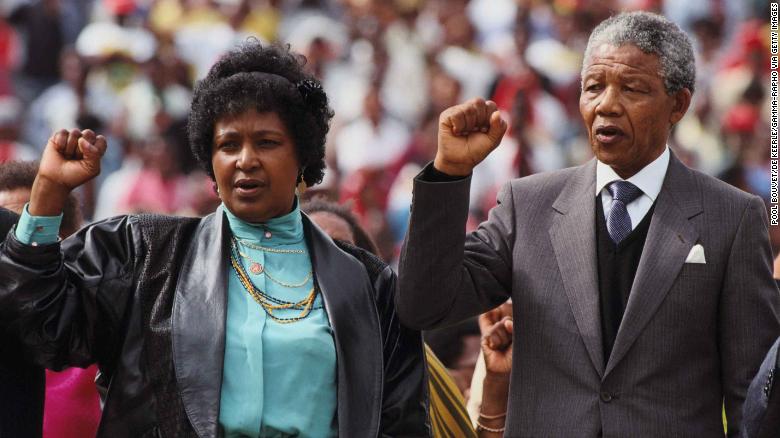
Winnie and Nelson Mandela in Soweto, South Africa in February 1990.
Winnie Mandela lived in 'interesting times', reflecting that old Chinese curse. She had no wish to live in 'interesting times', but they were imposed upon her, her family, her village, her people of South Africa by white-settler rule. She was born with a genetic inheritance of resilience, intelligence, determination and physical beauty. She was also married to one of the world's most renowned Black Africans who rebelled against apartheid in his country, suffered 27 years of imprisonment, and eventually became the country's first elected indigenous president.
Her name became synonymous with the black ghetto of Soweto during the years of resistance against white rule in a black nation. She returned to the black township located southwest of Johannesburg, but it was in Johannesburg that she died at age 81, a celebrated member of the African National Congress which had once disowned her as having disgraced them with her violent rhetoric and her involvement in a violent football group of thugs. The death of a 14-year-old boy was said to have been instigated by her.
For her part, she criticized the political party she once characterized as her "family". She was a fighter, and a fighter not only for black equality, but equality among blacks, railing against fraud, corruption and that after the fall of apartheid and the rule of the ANC in power, black South African poverty was never solved, housing was inadequate, and the elite looked after themselves exceedingly well. She chose never to herself live in the privileged enclaves, choosing instead to remain in Soweto.
She had worked toward a social-work degree from the Jan Hofmeyr School in Johannesburg, soon afterward meeting Nelson Mandela, and became part of the resistance movement that eventually led to present-day South Africa. In 1960 the attention of the world focused on the police killing of dozens of unarmed protesters, the Sharpeville Massacre. Nelson Mandela became a defendant in the Treason Trial of people involved in the evolution of the Freedom Charter, a blueprint for a future South African democracy.
Nelson Mandela had organized the group's defence, denying it had plotted a violent overthrow of the white government, was taken into custody and though found not guilty, was forced to go into hiding. During that time his wife Winnie was arrested, harassed and banned, unable to perform social contacts to keep herself involved a a time when she became the target of police informers. In 1969 she spent 18 months in solitary confinement, interrogated endlessly, forced to sit upright night and day without breaks.
"The whole experience is so terrible, because I had left little children at home in bed and I had no idea what had happened to them", she later explained. The food she was given was in unrinsed sanitary pail lids, covered often in bird droppings while she lived in a five-by-ten-foot concrete cell, sleeping on the floor. Eventually she was exiled to a shack in a remote town. In lock-step with her enforced isolation she became an international figure of interest.
Winnie Mandela and her two daughters, Zenara left, and Zindzi, at Cape Town airport in 1985.
At the same time, she began a daycare in Brandfort, the little town she was exiled to near Johannesburg, and she taught women there to plant vegetable gardens to feed their families. She also began drinking and had numerous extramarital relationships. And there was curiosity rising over international donations to her social welfare programs in the town; what happened to the money?
Returning to Soweto in 1984 she found gangs and police brutality, and she promoted "necklacing".
Suspected police informants were killed by placing a gasoline-soakjed tire around their body and lighting it afire. She was an ardent proponent of "necklacing". On New Year's, 1989, 14-year-old James Moeketsi Seipei (Stompie) suddenly disappeared. He had been living in Mandela's house and rumour had it that she had set her football gang to kill him. She was charged in connection with the boy's murder, and convicted of kidnapping and being an accessory to assault. Her sentence was suspended.
When her husband was finally freed after 27 years of imprisonment, Nelson Mandela, suing his wife for divorce said "I was the loneliest man during the time I stayed with her". The divorce was granted. The Truth and Reconciliation Commission condemned her in 1998 for human rights violations when 30 witnesses gave evidence against her. Her followers remained faithful to the woman they called the "Mother of the Nation".
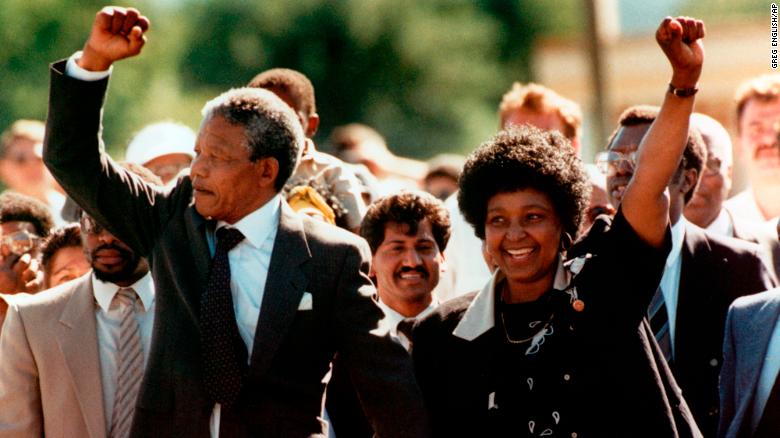
Nelson and Winnie Mandela raise clenched fists to supporters upon Nelson's release from jail in February 1990.
This represents a general opinion site for its author. It also offers a space for the author to record her experiences and perceptions,both personal and public. This is rendered obvious by the content contained in the blog, but the space is here inviting me to write. And so I do.




![Passengers wait in line at the Eurostar terminal at St Pancras International, amidst the spread of the coronavirus disease (COVID-19) pandemic, in London [Hannah McKay/Reuters]](https://www.aljazeera.com/wp-content/uploads/2020/12/2020-12-23T083158Z_664854073_RC2VSK91L7X7_RTRMADP_3_HEALTH-CORONAVIRUS-BRITAIN.jpg?resize=770%2C513)