The Russian Public's View of Russia's Invasion of Ukraine
"We ate from the same plate, fed from the same table . . . Now we are soullessly bombarding each other.""Streams of dirt are pouring from both sides."Elena, 40, insurance clerk, Moscow"Would a normal person go up in arms against his brother? . . .""What if the red button is pressed.""Do you think they won't press it?"Tokhir, 39, janitor, Moscow"What can be the feeling when you see entire systems falling apart before your eyes?""The scale and seriousness of the crisis is distressing.""Less contacts, less chance of running into another clash of opinions. Less chance that they will get into your soul and stab you in the back."Yuri, 59, university lecturer"Our people could have bought the Donbas, given everyone citizenship and still had money left over for black caviar.""What was the point of striking first?""1,300 people worked at the U.S. embassy in Ukraine before the start of the special operation. Who are these people?""I don't want this fate for my country. And I don't want it for Ukraine. It truly hurts for every victim."Kristina, 55, financial analyst, Moscow
 |
| A view shows an apartment block with a mural depicting Russian President Vladimir Putin in Moscow, Oct. 6, 2022. (Evgenia Novozhenina/REUTERS) |
Some
experience heartfelt regrets of two nations with intertwining cultures,
religious devotion, history and pride at war with one another. Few
would question the interpretation of the expressed propaganda reasons
given by their president to justify the unprovoked invasion. In their
collective opinion it was an event that was provoked by the underhanded
actions of the United States and NATO, seeking to -- as
President Vladimir Putin put it -- destroy Russia, a competitor for
power as Russia takes its rightful pride of place as one of two global
superpowers.
To
these Russians those of their compatriots who have fled their country
of origin are contemptible, rather than be forced into a combat role as
a dispensable conscript, dying daily by the hundreds on the field of
battle. Some were initially incensed by the invasion of Ukraine, that
kinship had been set aside for aggression. They take care to suppress
their emotions for fear of drawing attention. They may fear the Kremlin,
but they loathe the United States' influence on the world community.
Not
for them the principle that led other Russians, in the arts and
sciences, those whose names are well known at home and abroad, to
condemn their country for its brutality and illiberalism. They feel
genuine regret and shame at the position their country now holds in the
regard of the world community. They cannot express their outrage while
in Russia, and cringe at the thought of how they are regarded as Russian
nationals by civilized nations of the world.
Public
disclosures of their sympathies ensures they cannot return to their
country of birth as long as Vladimir Putin is president. None have a
wish to join Alexei Navalny in prison under laws that justify
imprisonment for 'traitors' or those who criticize their government's
decision-making in non-stop bombing of a country they value kinship
with.
There
is no complete concensus within the Russian population, itself
comprised of a minority of close to a million Ukrainians, with another
2.9 living in Russia as refugees. .There are wide-varying views on the
situation among Russians, revealed in part by a recent poll of the
Levada Centre. Among the population there are many who live with fears
of an escalating situation with the potential of a world war looming.
Mobilization
in both Russia and Ukraine has raised Russian anxiety levels.
Ukrainians are shrugging at the excesses of Russian attacks on civilian
enclaves to demoralize Ukrainians to apply pressure on the Ukrainian
government to stand down, vastly underestimating Ukrainian civilian
resolve to resist the violence forced upon them by the Kremlin.
In-person interviews have revealed that half the Russian population
oppose their president's conflict in Ukraine, but are constrained by
fear of speaking publicly.
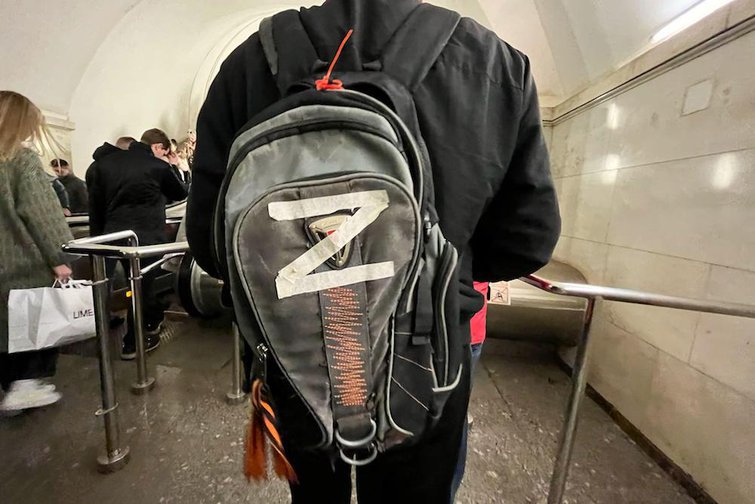 |
The letter "Z" has come to symbolize Russia's brutal military invasion of Ukraine Alamy Photo |
The
suffering of the Ukrainian people is affecting those in opposition to
the war. But even while they silently contest their country's aggression
in Ukraine, they are completely averse to the opposition of the West
and in particular the United States, to their country's war initiative.
Doubling the actual number of U.S. embassy employees in Kyiv to have it
appear a more sinister presence related to the U.S. Secret Service
spying on Russia convinces Russians that Russia was forced to act to
counteract American plans.
There
are also fears from within Russia itself that their government could
make use of nuclear weapons if a breakthrough with conventional weapons
fails. Older Russians see their retirement years stressed by conflict
and an inevitable decline in economic stability. Some who have the means
required to leave Russia hesitate in concern that they will be viewed
as a pariah in a world that has become anti-Russian. "Run away to feel like a third-class person? The whole world hates us", said 36-yer-old sports equipment retailer Sergey, whose western-made products have been sanctioned.
 |
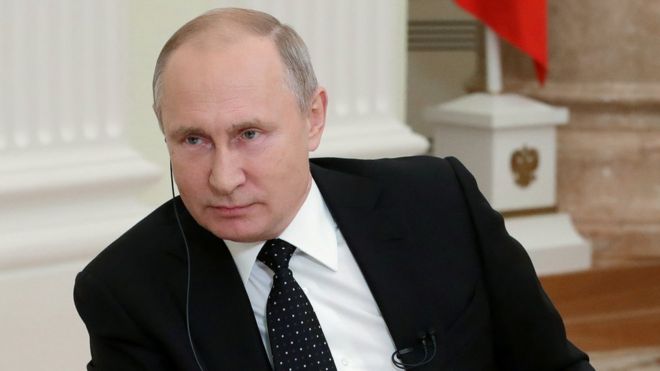
| Russian President Vladimir Putin announced plans to call up 300,000 reservists to fight in Ukraine, a sign of how much Russia’s military is struggling. A Moscow-based student who got his draft notice says he was shocked by the massive mobilization. |
"The war was necessary, to shove U.S. interests far away.""There was no other way out, nothing."Denis, 42, car sales manager"The United States want to maintain world dominance.""We are taking them for a ride on their own roller-coaster."Rodian, 41, loan adviser, Moscow
Labels: Opinion, Russian Civilians, Russian Invasion of Ukraine
posted by Pieface @ Saturday, February 25, 2023