Streets
in downtown Ottawa are quieter after a massive police operation cleared
protesters and convoy trucks demonstrating for weeks in the city's
core. Ottawa Police Service says it would maintain a police presence and
continue to identify and charge protesters. CBC
The
Truckers Freedom Convoy that has paralyzed the capital city of Canada
for three weeks has been dispersed. Canadian truckers were outraged
when the Trudeau Liberal government mandated that all truckers, beyond
the 90 percent of Canadian truckers already vaccinated, must be
inoculated against COVID-19, or their licenses would be suspended. There
was already an acute shortage of truckers employed in the industry
before the mandate. With delivery delays and supply lines impacted by
the pandemic, the mandate would mean increasing the shortage of drivers,
impacting on the reliability of deliveries even more seriously.
Truckers
were outraged and vowed they would drive to Ottawa from all points of
the Canadian geographic compass. As they drove to their destination,
other Canadians came out to cheer the convoys on, sharing with them an
anger over years of lockdowns and government control at all levels,
particularly laws that seemed to make little sense. Above all, mandates
that deprived people of t heir livelihoods. People were tired of being
harassed, of a lack of normalcy in their lives. Many people understood
what the truckers were protesting.
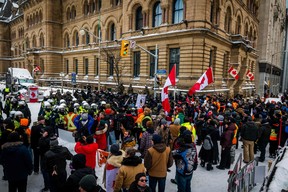
Police enforce an injunction against protesters, some who
have been camped in their trucks near Parliament Hill for weeks, on
Saturday. (Evan Mitsui/CBC)
As
always with any protests, they were joined by groups having nothing to
do with delivering the truckers' message; nationalists, far-right
groups, racist groups and provocateurs. Other, shiftless louts came
along to party as the Parliamentary Precinct became locked in with
semi-trailers and other large trucking rigs, alongside smaller vehicles,
blocking major streets and extending blockages to nearby residential
areas. No one in authority at the municipal, provincial or federal level
met with the organizers to discuss their grievances.
So they
stayed on, capturing the centre of the city, blaring horns, keeping
their rigs running continually, fouling the atmosphere with diesel fumes
and loud noise. There were alcohol-infused night street parties and
during the day harassment of locals. Public statements from the prime
minister characterized the truckers as a 'fringe group' of 'racists,
homophobes and fascists'. He had no intention of speaking with them, of
making any effort at defusing the situation. Finally, he chose to bring
in the Emergency Act, designed to deal with extraordinarily dangerous
situations threatening government and society.
Police continued their efforts on Saturday to clear parts of
downtown Ottawa of protesters. The Ottawa Police Service tweeted
Saturday that officers at the scene would be wearing helmets and
carrying batons for their safety. (Blair Gable/Reuters)
He
did this at a time when protest blockages at major international
crossings impeding vehicular passage serving trade between Canada and
the U.S. were being broken up by law enforcement and normalcy was
returning, even as Canada's trucking protest had served as an example,
igniting similar protests elsewhere around the world. In New Zealand,
Reuters reported Police Commissioner Andrew Coster saying that
negotiations and de-escalation were the only safe ways to resolve the
protest there.
Canada's prime minister, Justin Trudeau, is on
record as having criticized other world leaders dealing with protesting
citizenry, urging them to 'listen to the people'. A message that fit
snugly with his public persona of a crusader for justice and equality, a
feminist and champion of the underdog. Indian Prime Minister Modi was
chastized by Trudeau for not 'listening' to the protests launched by the
farming community over new legislation being brought in that was meant
to modernize the industry in India, but which farmers felt would
disadvantage them. That protest was a year long in New Delhi and led to
the legislation ultimately being withdrawn, the protesters returning to
their farms.
In May 2021 there was conflict in Israel with Gaza,
where rockets were being launched by Hamas and Palestinian Islamic Jihad
at civilian enclaves in Israel. Prime Minister Justin Trudeau saw fit
to issue a statement urging Israel to practise "restraint", "to act in accordance with international law".
This, at a time when 3,500 rockets were being shot off into Israel and
the Israel Defense Forces were engaged in self-defence. Trudeau added a
week later that "peace-building initiatives" to "support dialogue and co-operation between Israelis and Palestinians" had his ongoing support. Whose support would those expedients not have? Terrorists.
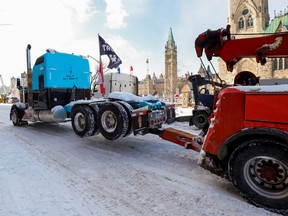
A
truck is towed from in front of Parliament Hill as police work to
restore normality to the capital after trucks and demonstrators occupied
the downtown core for more than three weeks to protest against pandemic
restrictions. Photo by Patrick Doyle / Reuters
Canadian
truckers are not terrorists. Trudeau steadfastly expressed his contempt
for the protesters. And instead of acknowledging the complaints of
people protesting in Ottawa and elsewhere across Canada, he continued to
use pejorative language in referring to them. Portraying the protesters
as despicable misfits and dangerous fascists and racists, the prime
minister of Canada accelerated the momentum of the protest, convincing
other Canadians to join in a raucous disavowal of their trust in
government.
What was a deplorable situation in Belarus when
citizens mounted large protests against their dictator's faux
re-election and the violence unleashed by government security forces
against the populace, was a sight commonly seen in dictatorships when
people rebel and they're pushed back harshly with maximum penalties
involved for those who challenge such governments, but unusual-to-rare
in democratic societies. Canada's example has inspired similar protests
elsewhere in democratic societies. We can only hope that other countries
handle their peoples' dissatisfaction in a manner befitting
democracies.
Canada's government did not.
Demonstrators continue their protest as police deploy to remove them on Feb. 19, 2022.Photo by ANDREJ IVANOV/AFP via Getty Images
In Myanmar Protesting the Coup is a Criminal Offence and a Death Sentence
"I begged them not to hurt the protesters, but to treat them kindly like family members."
"I told them that they can kill me, I am not standing up until they give their promise that they will not brutally crack down on protesters."
"We heard loud gunshots, and saw that a young kid's head had exploded, and there was a river of blood on the street."
"Our clinic floor became a sea of blood. We need to value life. It made me feel so sad."
Sister Ann Rose Nu Tawng, northern Myanmar
Sister Ann Rose Nu Tawng said she begged the authorities 'not to shoot and torture the children.' (AFP)
Sister Ann Rose Nu Tawng operates a clinic in her town in northern Myanmar. She had received assurances from senior police officers who had entered the town of Myitkyina on Monday. They were there solely for the purpose of clearing the road of protesters. Their intention was to quietly do so. They had no orders to commit violence on the townspeople. She could relax about their presence. They would fulfill the purpose of their assignment and leave quietly.
In her white robe and black habit she knelt on a town street speaking the while to two policemen who were kneeling as well, in respect of her Buddhist status as a respected religious figure. A video showed their interaction. She pleaded with the men to stop shooting protesters who were agitating against the military junta's coup a month ago, arresting and detaining the country's leader Aung San Suu Kyi and members of her National League for Democracy.
The nun and one of the policemen are seen in the widely circulated video, touching their foreheads to the ground, an act of piety, a prayer for better times to come. Imploring the police to respect the human rights of the people to gather and to protest and to protect them from violence no doubt moved some of those present, but they followed orders, and soon afterward the gunfire began.
Two of the protesters were killed, others wounded. Sister Tawng attempted to carry some victims to the clinic, and then she was blinded by tear gas. Last month she had placed herself between protesters and police, pleading for peace. All together so far, more than sixty people have died, over 1,800 detained in the crackdown on protests against the February 1 coup.
Another official from deposed Myanmar leader Suu Kyi's party has died in custody after his arrest early on Tuesday, becoming the second figure of the National League for Democracy to be arrested and to die while in detention in the past two days. Arrested in Yangon, the NLDs Zaw Myat Linn died in custody..."He's been participating continuously in the protests", explained one of his colleages Ba Myo Thein.
"[The goal is to return Ukrainian prisoners of war and] forbid all kinds of trade except humanitarian aid, urgently needed goods, and food."
"[And] to adopt a law which regulates occupied territories -- to call them occupied officially and to call Russia an aggressor."
Ukrainian protestors' demands, Bakhmut, east Ukraine
"Putin wants us to finance the war he started."
"He wants the republics [self-styled Luhansk, Donetsk] to finance themselves, by selling coal."
Volodymyr Parasiuk, Ukrainian member of Parliament
Dozens of people block the railways in Bakhmut city, the police opened
criminal proceedings. The correspondent of TV channel 112 Ukraine
reported this.
In eastern Ukraine, volunteers in camouflage have been blocking train tracks for the purpose of stopping any vestige of trade across the front line through to the territories the Russian-backed separatists control. The protesters see themselves confronting Ukraine's oligarchs, its corruption, revolving from the original Maidan square revolution removing Viktor Yanukovych, the Russia-backed president, to turning their attention to the accommodation reached by the government with Russia and the separatists.
Ukraine, beset by traditional corruption, is also in dire financial straits. Anything that will further erode its economy would be seen as anathema. Trade with Russia has always been an economic lifeline for Ukraine, and now the irony is that the 'republics' in the east bank on coal to finance themselves. The volunteer protesters see no reason why the ethnic Russian separatists should profit by their hijacking Ukrainian territory and making use of its natural resources.
The Government of Ukraine sees things in a different, more rounded light; during this period of instability but inactive conflict, it sees its financial prospects endangered with the stoppage of trade between its neighbour whose hostile actions and intentions have robbed it of the Crimean Peninsula, its deep-sea port, and parts of its eastern territories, with aspirations to seize even more through annexation. All of it deeply vexatious, threatening more to come.
But Ukraine is feeling the trade blockade impacting on its energy sector imperilling the country with rolling blackouts, job cuts and halted production at mills, factories and coal mines. The entire country is being impacted by the blockade with estimates of $2-billion a year losses for the country should it continue. According to some economists, the loss could rise to $3.5-billion to Ukraine's economy.
The protesters are adamant that their patriotic duty is to defy both the separatists' aspirations and to deny the oligarchs continuing to enrich themselves at the expense of ordinary Ukraines. "We have one enemy on this side, and one behind our back", said a special forces police officer, in reference to the Kyiv political establishment.
"I lose something as well, but we should have (stopped trade) in the first days (of the war). If we had done it in the beginning of the war, (the conflict) would have ended a long time ago", said a local from Donetsk, a train driver who had run coal from separatist territories to Ukraine since the conflict began. The Donbas has been polarized as a result of the protest, where ordinary Ukrainians feel resentful of the Kyiv establishment, while they remain separate, in the east.
Though the protesters in Bakhmut, a city taken back from separatists by pro-Ukrainian forces several years earlier, have succeeded in isolating the regions held by separatists, reintegration reflecting the Minsk II peace agreement becomes more remote, and generalized frustration with the impasse assumes greater proportions. "The future of Ukraine is being decided ... at the blockade in Bakhmut", remarked a musician on the front line entertaining volunteers and soldiers.
This represents a general opinion site for its author. It also offers a space for the author to record her experiences and perceptions,both personal and public. This is rendered obvious by the content contained in the blog, but the space is here inviting me to write. And so I do.