"We're really not clear on the scale of the destruction at this stage."
"They were talking about a town near Mandalay where 80 percent of the buildings were reportedly collapsed."
"But it wasn't in the news because telecommunications have been slow."
Lauren Ellery, deputy director of programs, Myanmar, International Rescue Committee
"Water, both in quantity and in quality, is immensely lacking in the
whole country and most specifically in the regions affected by the
earthquake."
"The lack of
water is creating an issue in terms of immediate survival, but could
also create an issue in terms epidemics in the future that we definitely
want to avoid."
Field Coordinator for Médecins Sans Frontières (MSF) Mikhael De Souza
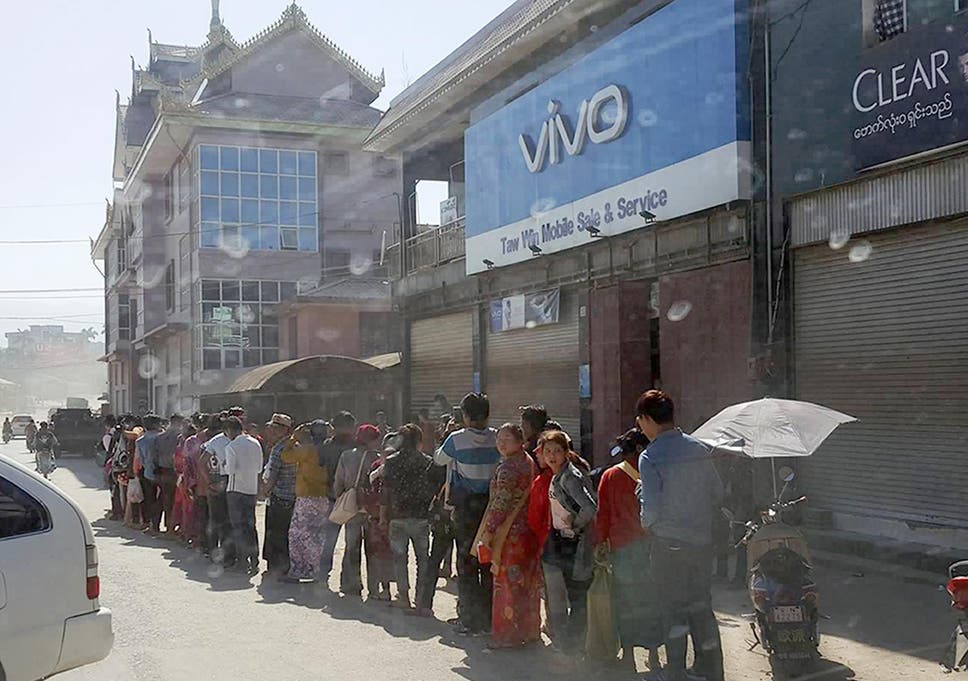
People queue for relief supplies after a strong earthquake near the earthquake's epicenter, in Sagaing, Myanmar, March 31, 2025. Reuters
"With USAID
effectively gutted and critical staff receiving their final notices in
the midst of an emergency, the US Government's ability to respond to the
humanitarian crisis in Myanmar and future crises is severely
compromised."
"Speed, collaboration, and resources are life and death
matters when disaster strikes. The illegal decision to dismantle USAID
means the U.S. will be unable to show up like it has in past
emergencies."
"The
U.S. has already missed the first urgent window to help find survivors.
The second wave of crisis is the millions of people displaced who will
soon face threats of disease, hunger, and more without access to clean
water, food, shelter and other resources."
"The Trump administration must
step up and continue the U.S. legacy of providing partnership and
leadership right now for the communities who need urgent support."
Abby Maxman, president and CEO, Oxfam America
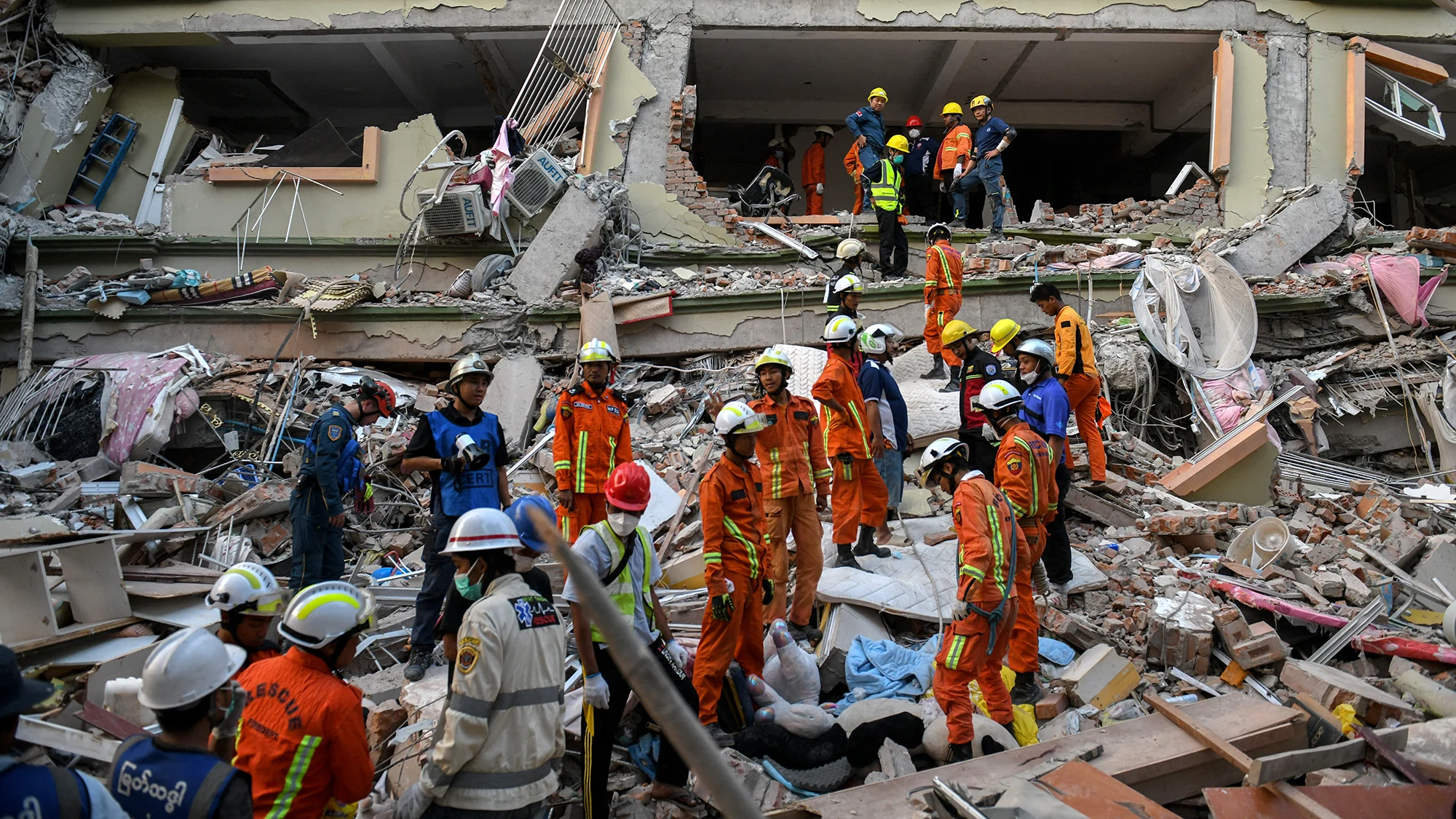
Rescue teams work to evacuate residents trapped under the rubble of a collapsed building in Mandalay, Myanmar, on Sunday. Sai Aung Main/AFP/Getty Images
Last week's massive earthquake in Myanmar has seen the death toll well past 2,000, according to state media. Rescuers spoke of several hundred Muslim, praying at mosques during Ramadan, were crushed to death when the mosques collapsed. A collapsing monastery crushed 200 Buddhist monks.
"The straight nature [of the fault]
means earthquakes can rupture over large areas - and the larger the area
of the fault that slips, the larger the earthquake."
"To accommodate all of this motion, [the Indian plate moving beneath the Burma microplate], faults - cracks in the rock - form which allow tectonic plates to 'slither' sideways."
"There have been six magnitude 7 or greater earthquakes in this region in the last century."
Dr Rebecca Bell, reader in tectonics at Imperial College London
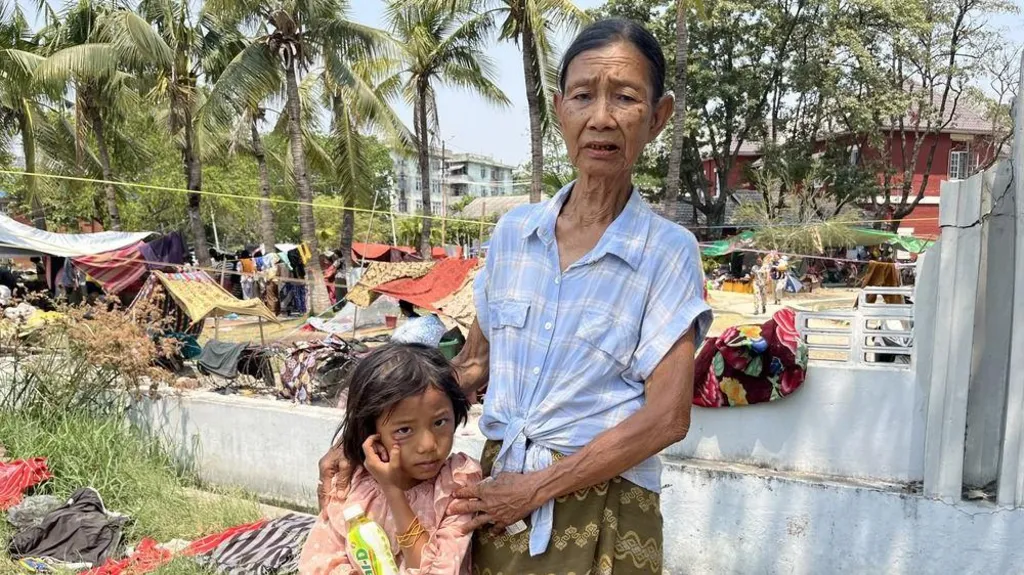
Daw Khin Saw Myint, 72, and her granddaughter are among thousands sleeping outdoors after losing their homes BBC
Bangkok is an impoverished country, a country embroiled in a civil war, where humanitarian organizations are already challenged in their efforts to respond to the needs of the civilian population. The effects of the earthquake are predicted to exacerbate the outbreak of hunger and disease.
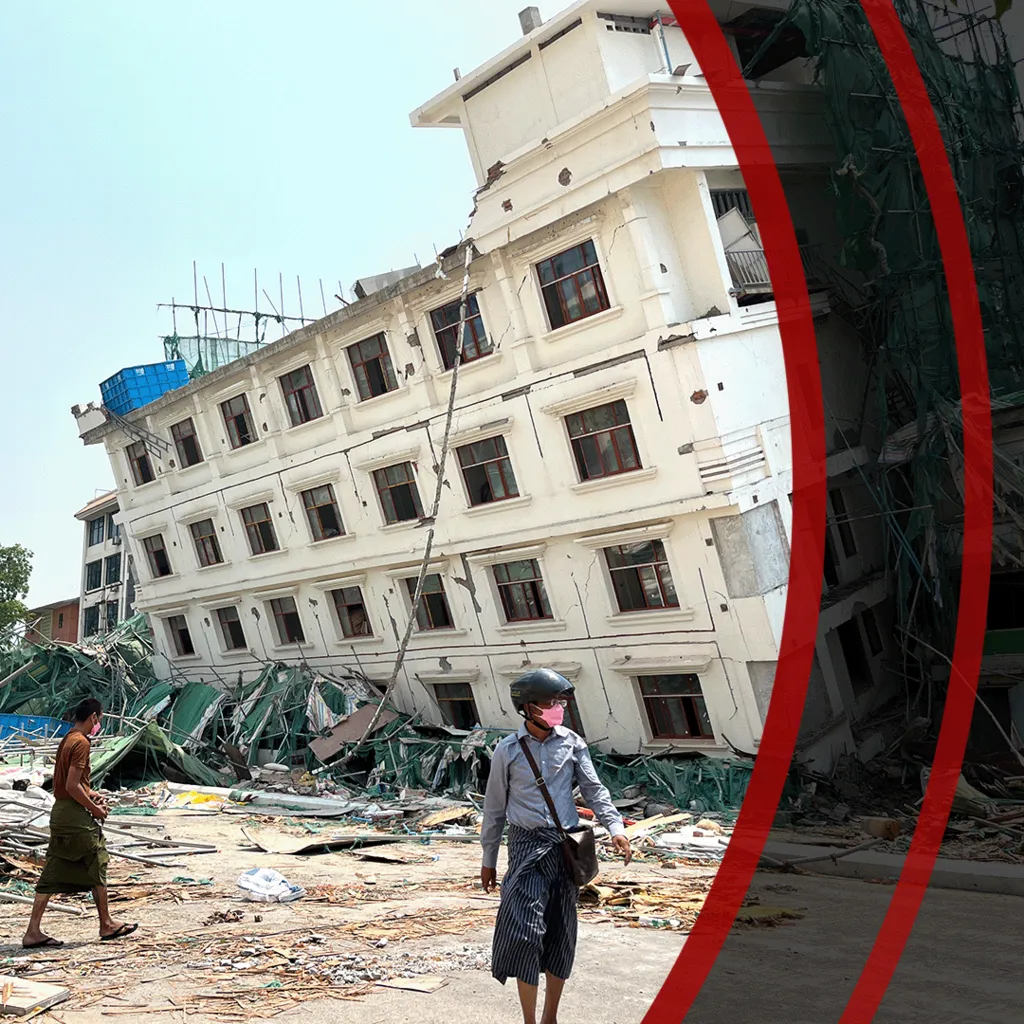
The 7.7 magnitude quake's epicentre on Friday hit close to Myanmar's second-largest city, Mandalay, damaging the city's airport. The tremor buckled roads while hundreds of buildings along the country's central area collapsed. Power outages have hampered relief efforts, as have shortages of fuel and problematic communications.
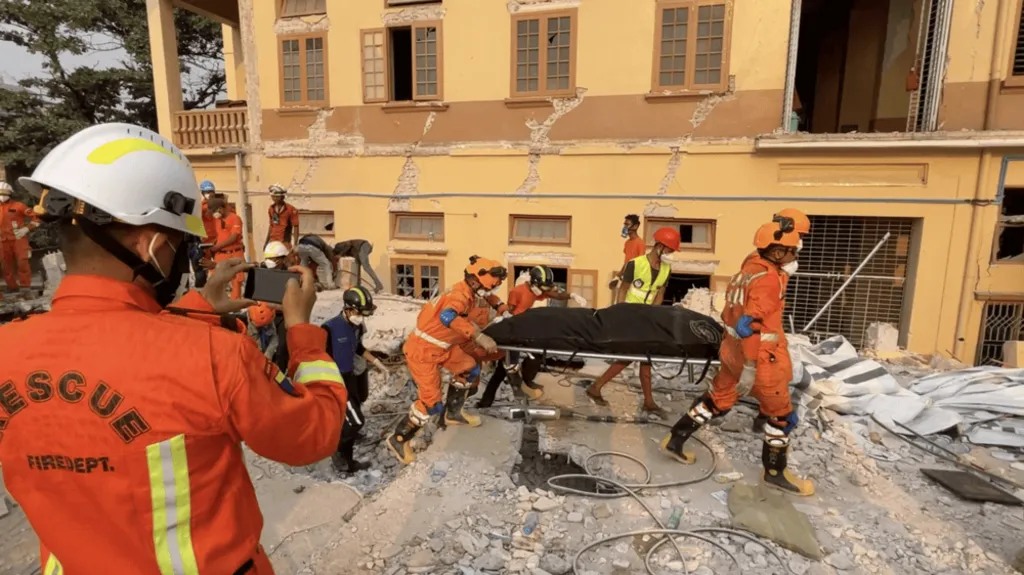
Search-and-rescue operations have been hampered by a lack of heavy machinery. The result of which has been rescuers without tools using their bare hands to remove rubble in their search for survivors. Daily temperatures in the region register 40 degrees celsius. At Mandalay's collapsed U Hla Thein monastery rescuers were still searching for some 150 of the dead monks.
Rescuers face tough conditions to retrieve the bodies of victims, with temperatures reaching nearly 40C BBC
Approximately 700 Muslim worshippers at Friday prayers were trapped and killed when mosques collapsed. According to a member of the Spring Revolution Myanmar Muslim Network, 60 mosques were damaged or destroyed. Several mosques were seen toppling, on videos posted on the Irrawaddy online news site.
Senior Gen. Min Aung Hlaing, leader of the military government, informed the prime minister of Pakistan that 2,065 people had died in the earthquake, and over 3,900 were injured, while some 270 people remain missing. Numbers that relief agencies expect to rise sharply in reflection of slow access to remote areas where communications are non-operational.
According to the World Health Organization, three hospitals were destroyed, with 22 others partly damaged in the region. A number of countries have sent rescue teams to the scene; Israel, Russia, China, India and a few southeast Asian countries. Millions of dollars in aid have been promised by the European Union, Britain, Australia, New Zealand, South Korea and others.
"I
last spoke with the boat's captain on December 18 and he told me that
at least 17 people on board had died due to a lack of food and water."
"They have only been able to drink water when it rains."
"Please
tell me, I just want to know if my family is alive or dead. We all want
to see our families, that is all we request from the world. Just help
us."
Sham Shur Alom, Rohingya refugee in Malaysia
"Several
reports indicate dozens of people have already died during this ordeal,
while survivors are hungry and thirsty without access to food and water
and suffering from sickness."
United Nations' refugee agency
"Father,
please send a boat or I will jump into the ocean. I can't tolerate the
pain and struggle anymore. There is no food or water to drink. People
are drinking salt water. People are close to dying and mental breakdown.
They're going to bite each other."
"Baba.
I don't know why I am here. My teeth are dry from the lack of drinking
water. Please do whatever is humanly possible for you."
Mosharrof Ullha, to his father Ata Ullha, Rohingya, Cox's Bazar Refugee Camp, Bangladesh
"We
urge the Government of India to urgently coordinate and cooperate with
other regional governments on the search and rescue operations of
Rohingya refugees who are currently stranded in Indian waters with no
medical support, food and water" Amnesty India
The
world of the unwanted homeless is ever on the move, hoping to find
surcease from their stateless status, their unwanted presence, their
suffering and their timeless dilemma. They aspire to live, to have a
future, they are not economic migrants but refugees. As it happens,
refugees who are Muslim, whom the Myanmar military expunged violently
from the country where they were living. Originally from Bangladesh, the
Rohingya lived for generations in Myanmar. But Buddhism and Islam
oppose one another.
Living
for years since their expulsion from Myanmar on the border in
Bangladesh in an immense squalid refugee camp teeming with refugees whom
no one wants responsibility for, there are those who dream of escape,
of finding a new life and opportunity elsewhere in the world where they
will be accepted, where human aspirations to belong and to succeed in
life can be found. And in following that dream they sacrifice themselves
to chance and fortune, and sometimes lose.
A
boat stranded for close to three weeks in the Indian Ocean is desperate
for rescue. So far a dozen of the Rohingya refugees populating the
wooden craft open to the air, directionless, have died. With no
humanitarian intervention from nearby nations fears are that more people
will die in the next few days. And the unthinkable, that the hopeful
refugees on board will all perish from neglect by those who could mount a
rescue. Indonesia, the nation with the largest Muslim population
globally has seen fit not to respond.
Predictably,
India, with the world's third largest minority population of Muslims
has no wish to acquire more people of the faith its own majority Hindu
population is hostile to. Late November saw the open wooden boat set off
from Bangladesh for Malaysia, yet another majority Muslim population,
with over 150 asylum seekers aboard. On December 4 its engine failed,
leaving the vessel to drift at sea, its food and water supplies steadily
diminishing.
Most
of the people on the ship had set out to meet family in Malaysia,
anxious to flee the sprawling Cox's Bazar refugee camp in Bangladesh
with its hundreds of thousands of hopeless people languishing there for
the past five years. The boat captain refused to allow those who have
managed to make contact with the boat by satellite phone, to speak with
their relatives. Open to the elements, conditions on the boat are
unspeakably urgent.
The
Indian navy and coast guard say no information about the adrift ship
has reached them; wide-spread media coverage of the crisis aside. "We have no information about the issue",
a spokesperson for the Indian navy responded, to a query. To the
present, it is believed that approximately two thousand Rohingya
refugees have opted to risk a sea voyage in 2022 as conditions in the
refugee camps both in Myanmar and Bangladesh continue to deteriorate.
Although
Sri Lanka's navy rescued a boat of 104 Rohingya a week ago, other
nations have no wish to encourage the mass flow of people by intervening
to offer support. Bangladesh, the Muslim country from which the
Rohingya originated has not seen fit to integrate them back into its
society as a Muslim-to-Muslim responsibility. Nor have Indonesia or
Malaysia recognized their religious responsibility to embrace fellow
Muslims.
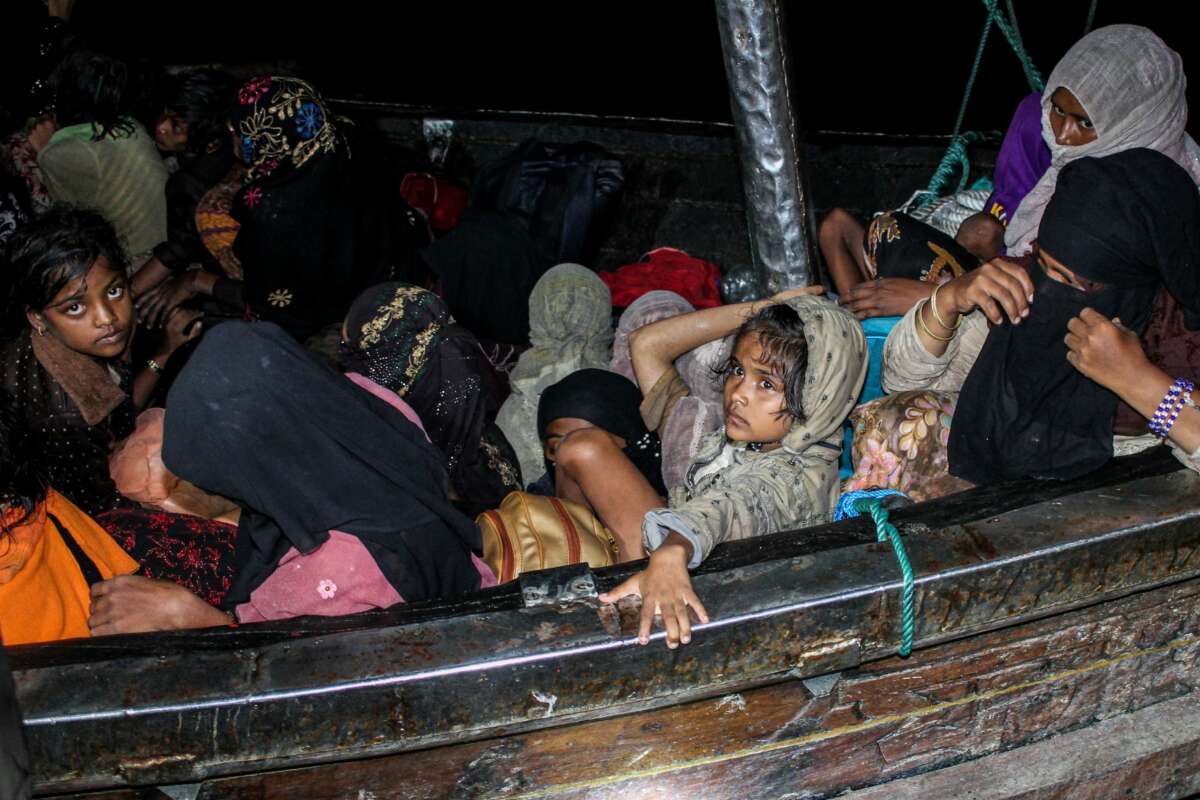
Rohingya
refugees sit on a wooden boat as Indonesian officials conduct
evacuation at the Krueng Geukueh port in Lhokseumawe, Aceh, Indonesia,
on December 31, 2021.Fachrul Reza / Xinhua via Getty Images
"Many more will die soon if they are not rescued, due to dehydration."
"We have approached the Indian coast guard and the Thai and Indonesian governments."
"None of them responded."
Mohammed Rezuwan Khan, Rohingya refugee, Cox's Bazar
"This is the time for our citizens to test their resistance against the dark moments."
"In
order to form a federal democracy, which all ethnic brothers who have
been suffering various kinds of oppressions from the dictatorship for
decades really desired, this revolution is the chance for us to put our
efforts together."
"Despite our differences in the past, this is the time we must grip our hands together to end the dictatorship for good."
Mahn Win Khaing Than, acting head, Committee for Representing the Union Parliament
Despite
repeated demands of the international community, including South Korea,
there are an increasing number of victims in Myanmar due to violent
acts of the military and police authorities."
South Korean Foreign Ministry
"This accusation [against Suu Kyi of minor charges] is the most hilarious joke."
"She might have other weaknesses but she doesn't have weakness in moral principle."
Lawyer Khin Maung Zaw
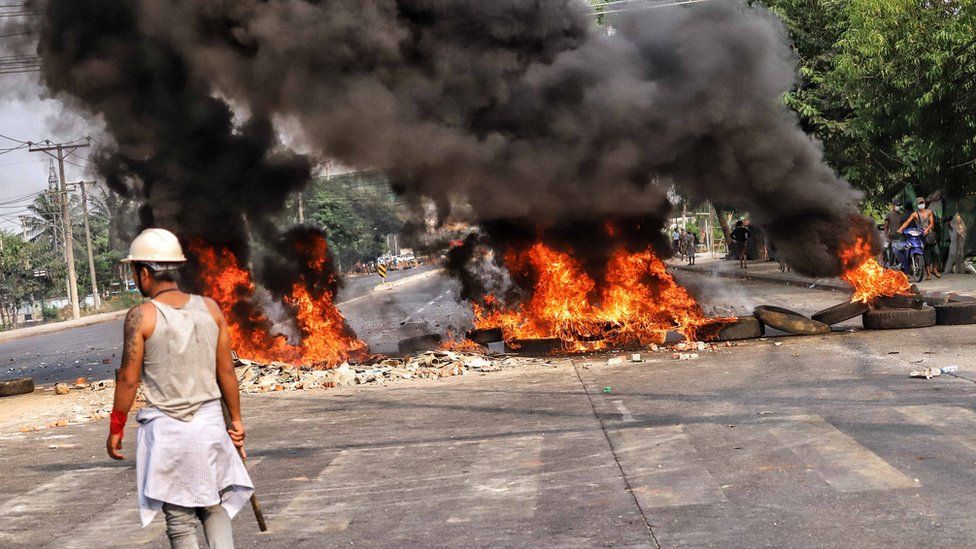
Protesters lined roads with car tires and set them alight to separate themselves from the security forces Getty Images
In
view of the military junta's violent crackdown on the relentless
protests roiling Myanmar following the February 1 coup that removed Aung
San Suu Kyi and her elected government on February 1, restoring her to
house arrest while arresting member officials of her National League for
Democracy party (several of whom have died in custody), Britain has urged its citizens to leave the country.
New
charges have been levelled against Suu Kyi behind the trifling
accusations of having sidestepped coronavirus rules and having in her
possession illegal radios. According to Brigadier-General Zaw Min Tun, a
junta spokesman, Suu Kyi had accepted gold and illegal payments to the
value of $600,000 while in government.
Security
forces in the troubled country continue to crack down on protesters
refusing the pleas of the military junta to convince them that the
military administration is best for the country, that when matters
settle down there will be a return to elections and 'democracy'. Clearly
the November election that swept the polls returning the National
League for Democracy and its leader Aung San Suu Kyi to power was
unsatisfactory in the opinion of the military.
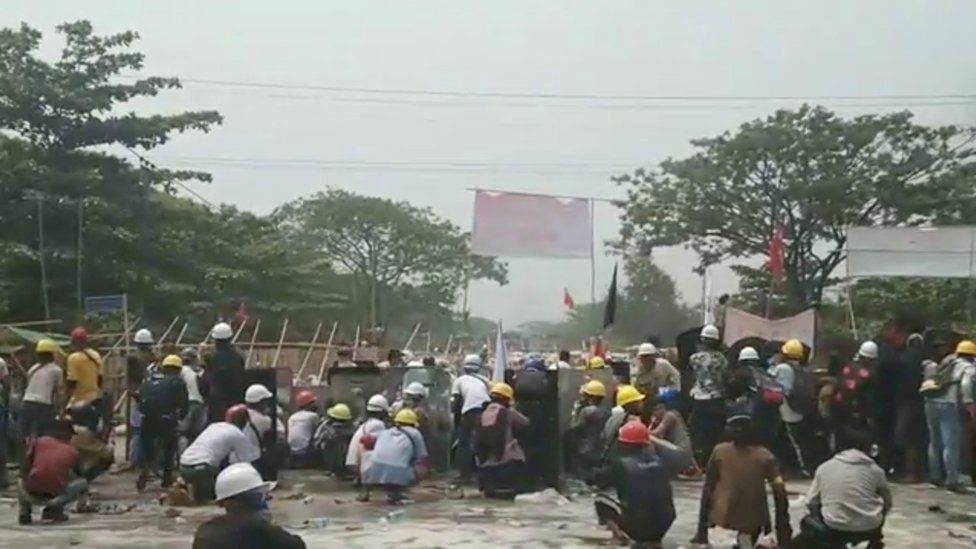
Security forces used live rounds against protesters in Hlaing Tharyar Reuters
More
violent and bloody days this weekend, with an estimated additional 38
people having been killed. The British foreign office gave warning that "political tension and unrest are widespread since the military takeover and levels of violence are rising."
South Korea, in view of the turmoil and violence, has stated its
intention to suspend defence exchanges. It will reconsider development
aid to Myanmar.
By
Friday, over 70 protesters were killed since the military seized power,
according to the Assistance Association for Political Prisoners
advocacy group. Friday saw memorials held for some of the victims. Seoul
plans the suspension of defence exchanges and to ban arms exports,
limit exports of other strategic items, reconsider development aid and
grant humanitarian exemptions permitting Myanmar nationals to remain in
South Korea until such time that the situation improves.
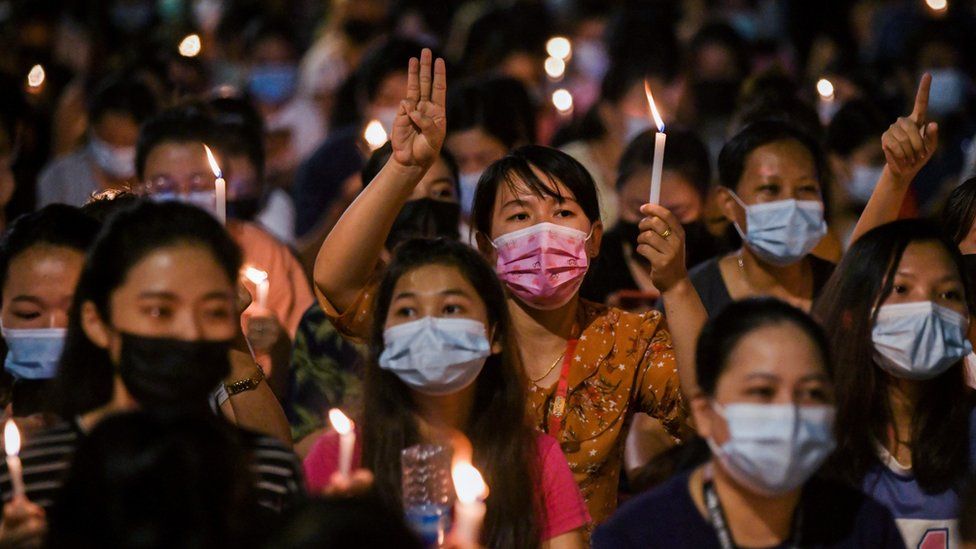
A night protest took place in another part of Yangon on Sunday Reuters
In
Yangon and a number of other cities and towns witnesses posted
photographs on social media and news organizations of riot police and
armed soldiers confronting the protesters with violent responses. A
Polish journalist was arrested and a Japanese journalist was held
briefly while reporting on a protest. A hospital in Hakha, Western Chin
state saw riot police and armed soldiers forcing 30 patients to leave,
evicting staff from on-site housing.
Hospitals
and universities across Myanmar have seen occupations by soldiers as
attempts are made to crush the civil disobedience movement that arose
when government employees such as doctors and teachers began responding
to the coup, and following violence. The movement has expanded toward a
general strike paralyzing many sectors of the economy, infuriating the
military.
Suu
Kyi, 75, faces four mischievous charges, such as illegally importing
six walkie-talkie radios and flouting coronavirus curbs. The addition of
corruption charges is being read as a plan to see that harsher
penalties accrue, to send her to prison for years, and out of the way of
the military junta with which she had practised an at-arms-length
cooperative administration.
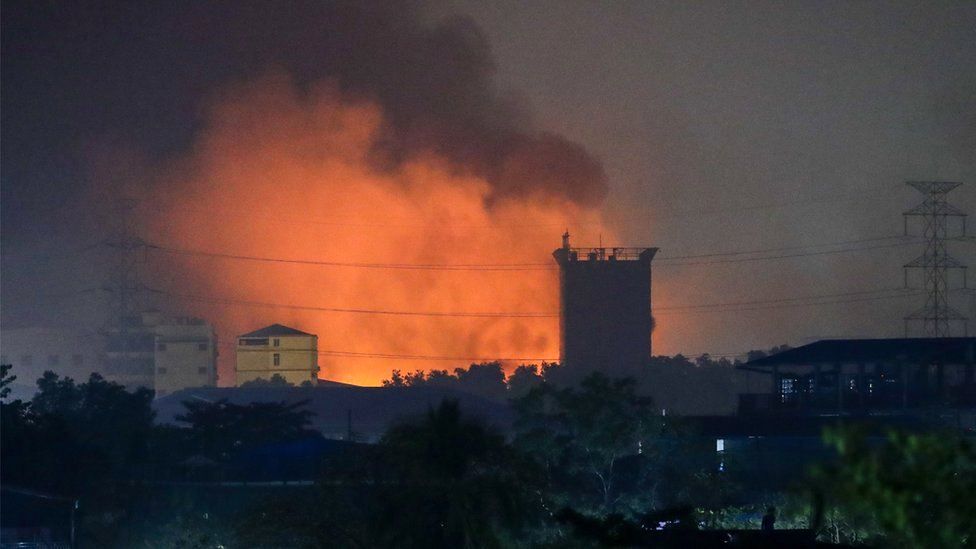
Property set ablaze in Yangon's industrial neighbourhood of Hlaing Tharyar lights up the night sky EPA
The
protesters believe that China has been encouraging the military junta
in its crackdown on the peaceful protests. China did in fact ensure that
there would be no official censure of Myanmar's military junta for the
coup and the following violence in reaction to the people's rejection of
the coup against their legitimately re-elected choice of state head.
The
protests have deliberately chosen to target Chinese-owned businesses as
a direct state of their rejection of Chinese interference in the
country's affairs. According to Beijing reporting sources, people armed
with iron bars, axes and petrol had set alight
and damaged 10 Chinese facilities - mostly clothing production or
storage factories - in Yangon where a Chinese hotel was also attacked.
"[Some
Chinese] factories [in Hlaing Tharyar and neighbouring Shwepyitha]
were looted and destroyed and many Chinese staff were injured and
trapped."
"[Myanmar must] take further effective measures to stop all
acts of violence, punish the perpetrators in accordance with the law and
ensure the safety of life and property of Chinese companies and
personnel in Myanmar."
In Myanmar Protesting the Coup is a Criminal Offence and a Death Sentence
"I begged them not to hurt the protesters, but to treat them kindly like family members."
"I told them that they can kill me, I am not standing up until they give their promise that they will not brutally crack down on protesters."
"We heard loud gunshots, and saw that a young kid's head had exploded, and there was a river of blood on the street."
"Our clinic floor became a sea of blood. We need to value life. It made me feel so sad."
Sister Ann Rose Nu Tawng, northern Myanmar
Sister Ann Rose Nu Tawng said she begged the authorities 'not to shoot and torture the children.' (AFP)
Sister Ann Rose Nu Tawng operates a clinic in her town in northern Myanmar. She had received assurances from senior police officers who had entered the town of Myitkyina on Monday. They were there solely for the purpose of clearing the road of protesters. Their intention was to quietly do so. They had no orders to commit violence on the townspeople. She could relax about their presence. They would fulfill the purpose of their assignment and leave quietly.
In her white robe and black habit she knelt on a town street speaking the while to two policemen who were kneeling as well, in respect of her Buddhist status as a respected religious figure. A video showed their interaction. She pleaded with the men to stop shooting protesters who were agitating against the military junta's coup a month ago, arresting and detaining the country's leader Aung San Suu Kyi and members of her National League for Democracy.
The nun and one of the policemen are seen in the widely circulated video, touching their foreheads to the ground, an act of piety, a prayer for better times to come. Imploring the police to respect the human rights of the people to gather and to protest and to protect them from violence no doubt moved some of those present, but they followed orders, and soon afterward the gunfire began.
Two of the protesters were killed, others wounded. Sister Tawng attempted to carry some victims to the clinic, and then she was blinded by tear gas. Last month she had placed herself between protesters and police, pleading for peace. All together so far, more than sixty people have died, over 1,800 detained in the crackdown on protests against the February 1 coup.
Another official from deposed Myanmar leader Suu Kyi's party has died in custody after his arrest early on Tuesday, becoming the second figure of the National League for Democracy to be arrested and to die while in detention in the past two days. Arrested in Yangon, the NLDs Zaw Myat Linn died in custody..."He's been participating continuously in the protests", explained one of his colleages Ba Myo Thein.
"It is found that protesters have raised their incitement towards riot
and anarchy mob on the day of 22 February."
"Protesters are now inciting
the people, especially emotional teenagers and youths, to a
confrontation path where they will suffer the loss of life."
State
Administration Council -- military junta
"[Authorities are] exercising utmost restraint through minimum use of force [when
dealing with the protests.]"
"[Statements and remarks made
by some foreign countries are] tantamount to flagrant interference in
internal affairs of Myanmar."
"[The ministry calls on diplomats to] respect the laws and regulations of
the receiving state."
"[A] free and fair general
election [will take place]."
"[Despite] unlawful demonstrations, incitements of unrest and violence, the authorities concerned are exercising utmost restraint through minimum use of force to address the disturbances."
Myanmar's Foreign Ministry
Protesters hold signs featuring Aung San Suu Kyi as they take part in a
demonstration against the military coup in Yangon on February 22.
"Today we have decided the set of targeted measures with ministers in
response to these events."
"Then we took the political
agreement to apply sanctions targeting the military responsible for the
coup and their economic interests."
European Union's foreign affairs chief Josep Borrell
"[I am] horrified at more loss of life [as the military] escalates its brutality in Myanmar."
"From
water cannons to rubber bullets to tear gas and now hardened troops
firing point blank at peaceful protesters."
"This madness must end, now!"
UN
Special Rapporteur for human rights in Myanmar, Tom Andrews
"Us young people have our dreams but this military coup has created so many obstacles."
"That's why we come out to the front of the protests."
Ko Pay, protester, Yangon
Protesters gather for a demonstration against the military coup in Yangon on February 22.
Sunday saw huge crowds in Myanmar out once again to denounce the military coup that took place on the first of February. Defiant even following the bloodiest episode of the campaign that occurred the day before when security forces fired on protesters, killing two people in the crowd. The demonstrations, despite warnings from the military, have been ongoing, leading to a civil disobedience campaign of strikes protesting the coup -- alongside the detention of leader Aung San Suu Kyi and others in her cabinet.
The military's promise of new elections has been less than convincing to those marching out in protest shouting their right to a democratic government. In Mandalay, tens of thousands of people massed peacefully, seemingly unafraid of consequences and the warning of the military, despite the two deaths of the day before. "They aimed at the heads of unarmed civilians. They aimed at our future", one young protester said, speaking to the crowd.
People were laying down flowers in a memorial for the dead protesters, as large crowds continued marching in the central towns; south, east and northeast. Buddhist monks in a flotilla of boats held aloft portraits of Suu Kyi alongside signs reading "military coup -- end". Over two weeks of protests had been carried out peacefully and then came Saturday and violence ensued. "The number of people will increase ... We won't stop", claimed protester Yin Nyein Hmway, in Yangon.
It all began with a confrontation between security forces and striking shipyard workers -- with video clips posted on social media showing security force members firing at protesters. The strikers, according to state-run Global New Light of Myanmar newspaper, sabotaged boats at the city's river port, attacking police with sticks, knives and catapults leaving eight officers and several soldiers injured. "Some of the aggressive protesters were also injured due to the security measures conducted by the security force in accordance with the law", commented the newspaper ... managing to overlook the deaths.
Including that of Mya Thwate Khang, a young female protester who was the first to be killed during Friday's demonstrations; shot in the head, in the capital of Myanmar, Naypyitaw. All this in defence of democracy. A democracy that strangely enough saw minority Rohingya butchered by the military, hounded from their homes, their villages put to the torch, producing 700,000 refugees fleeing over the border into Bangladesh; a minority population of an estimated million Muslims in a Buddhist country.
The unaddressed plight may have signalled a green light to the Chinese Communist Party to pursue its genocidal agenda against the Turkic Muslim Uyghurs in Xinjiang. Now, all that's missing is Beijing's outraged condemnation of Myanmar's human rights abuses from China's pedestal on the UN Security Council.
A protester waves the National League for Democracy (NLD) flag while
others take part in a demonstration against the military coup in Yangon
on February 22.
"We trusted them. I had a sense I was being sold, but I could not escape." "I said I didn't want to get married. I wanted to go home." "When I saw Burmese letters on the signs, I was so happy [on her return to Myanmar]." Phyu, 17, Burmese trafficked to China as a 'bride'
"The families of the husbands are mad about the case because they spent a lot of money but lost their wives." Niu Tianhui, spokesman, Xiangcheng police bureau
"Bride trafficking is very common here in Shan State." Zaw Min tun, member, anti-human-trafficking task force, northern Shan
"[Her baby, 9 days old, looks] like her father. The same lips. Chinese." "I wanted to give her away but I looked at her and I loved her." "Even with that Chinese animal's lips." Nyo, 17, Burmese trafficked to China as a 'bride'
The Human Rights Watch report found vulnerable young women from
Myanmar’s conflict-ravaged northern Kachin and Shan states are being
trafficked into sexual slavery in China
(
AFP/Getty
)
Two schoolgirls, good friends, lured by a neighbour, Daw San Kyi, promising them well paid waitressing employment if they would travel to the border with China. He knew a wealthy villager who would assist them, so early one morning a year ago, a van arrived to pick them up and take them to the identified destination. There was a long drive on a mountain road that made Phyu nauseated. Four pills given her by Ms. San Kyi helped, leaving Phyu disoriented, but she recalled that someone used a syringe to inject her arm with a substance.
Her friend Nyo, also 16 years old, refused pills and she recalls some of what occurred but her memory too is confused. There were guesthouses along the border where they stopped and there they were informed that heavy rain had closed the area and the roads closest to the restaurant where work awaited them. A boat ride ensued and then additional car travel. They were a full ten days in transit and by then it seemed that the restaurant promise was nowhere in sight. The girls attempted to free themselves and run home but failed.
They were in a strange place with a strange language and had no idea where they were, where they could run to. Chinese-speaking men arrived to look at them. Some of them pointed at Phyu, others at Nyo. When Phyu began crying, the trafficker said she must stop otherwise she would not look pretty enough to attract a potential husband. The girls were taken separately and paired each with a 'husband'. They thought they might be in Beijing.
Phyu was locked into a room by her 'husband' Yuan Feng, 21. Yuan would arrive in the evenings, inject something into her arm and force sex on her. Nyo was also locked in a room by her 'husband' Gao Ji; she was beaten. Once he began to trust her he allowed her to use social media and that is how she discovered that she was in Xiangcheng County, Henan Province, one of China's most populous provinces, with 100 million people, double the population of Myanmar.
Henan Province has one of the widest gender disparities in China, thanks to the gender-based abortions forced on Chinese for 30 years with their one-child policy, with the emphasis on boy babies, and where female babies were aborted or abandoned. Now that the boy babies are grown there are no female counterparts for them, leading Chinese men to import wives from countries nearby, forcibly if need be.
Phyu, it turned out was in Xiangcheng as well. A Shan Chinese woman who helped to rescue girls such as Nyo and Phyu from sexual slavery in China alerted a police officer and two months after the girls' arrival in Xiangcheng, police knocked on their husbands' doors. The law mandated that Mr. Yuan and Mr. Gao be detained for 30 days. Giving the girls the opportunity to leave and weeks later they returned to Mongyai, Myanmar.
Nyo was pregnant, and she decided the child would be given up for adoption. And when the baby was born she was unable to part with the tiny girl.
A group of Rohingya refugees after crossing the Bangladesh-Myanmar border, September 1, 2017.
Mohammad Ponir Hossain/Reuters
Rakhine Province in Myanmar (Burma) continues to be cleansed by the Burmese military of the presence of Rohingya. This, even while the Myanmar government, desperately self-defensive over worldwide condemnation of the persecution of the minority Muslims they characterize as 'Bengalis' and originally from Bangladesh, promise that they will allow the fearful refugees taking refuge in Bangladesh -- which doesn't want to keep them, as an impoverished nation with its own problems -- to return to their homes.
Their homes, unfortunately, no longer exist, in large part. Their homes have been torched by mobs of Burmese Buddhists who hate the presence of the Muslim Rohingya and fear them as interlopers whose religion is geared toward conquest. Their villages were destroyed even as the Burmese military killed many inhabitants and caused villagers to flee in panic for their lives. There is nothing to return to. Even if their villages and homes had been left intact they would return to the same aura of hatred and persecution which was brought to a head the summer of 2017.
Nobel Laureate Aung San Suu Kyi's lack of contrition, let alone denunciation of the situation has earned her condemnation from around the world. Although she is viewed as the political leader of the nation she loves, she has no control over the Burmese military, that same military that kept her a house prisoner for years, for her humanitarian efforts to democratize Myanmar, and whose resistance to the brutal military rule won her the Nobel Peace Prize.
Rohingya
Muslims carry their young children and belongings after crossing the
border from Myanmar into Bangladesh on Nov. 1. Canada's special envoy
Bob Rae released his final report on the crisis today. (Bernat Armangue/Associated Press)
Canada tasked Liberal politician Bob Rae, a former foreign affairs minister, as Special Envoy to Myanmar, to assess the situation by personally embarking on a fact-finding mission to Myanmar. The United Nations had dispatched its own Special Rapporteur on human rights to Myanmar who concluded the atrocities borne by the Rohingya "bear the hallmarks of genocide". Mr. Rae met with survivors and humanitarian workers, he travelled to Rakhine State -- where over 670,000 desperate Rohingya were forced to flee fire, mass rape and murder -- to form his assessment.
"I think we're living in a world without adult supervision at the moment. We got into the habit after 1945 of looking to the Americans for leadership, or others, for a long time the British and so on. Those days are gone -- it's a different world", he assayed in an interview with the Canadian broadcaster, CBC. "Our first obligation is to protect lives" he wrote in his report. And he has proposed that Canada should increase its $46-million relief contribution for the region to $150-million to include the "necessary work on accountability and the gathering of evidence" for potential prosecution of the bloody pogroms and expulsions.
"This evidence has to be collected, and we need to find a way to move forward to bring those responsible for these crimes to justice", he wrote. The UN General Assembly several years ago established the International Impartial and Independent mechanism to investigate war crimes taking place in Syria. The head of that investigative body to look into mass murder in Syria pointed out in her report that it lacks regular budget funding, the regime refuses to permit investigators into the country, and her researchers are incapable of maintaining track of all war crimes committed on an ongoing basis.
So, would it be of any value to construct just such a committee to investigate the humanitarian situation yet unfolding in Myanmar? Mr. Rae feels Canada should work with the UN High Commission on Refugees so that Rohingya can be processed for resettlement, and in his opinion Canada should welcome Rohingya refugees. According to the assistant seretary-general for human rights of the UN, "The government of Myanmar is busy telling the world that is ready to receive Rohingya returnees, while at the same time its forces are continuing to drive them into Bangladesh". Now that is a problem.
But why isn't it a problem for the Organization of Islamic Cooperation, which was formed for just such a purpose; to protect and come to the aid of embattled Muslims worldwide. Next month the Council of Foreign Ministers of the OIC is meeting in Dhaka, Bangladesh. Why isn't this item top of their agenda? Why haven't any Muslim countries opened their doors to the Rohingya? Why haven't the wealthy Gulf States emptied their pocket books in support of the Rohingya, aiding penurious Bangladesh to pay for nurturing those poor refugees? Why is it the West that always steps forward with its personal humanitarian solutions. Such as Bob Rae's:
Canada should continue to pursue a policy of active
engagement with the government of Myanmar and should continue to provide
development assistance focused on the needs of all communities in that
country.
Canada should increase development assistance to
Rakhine State and all of Myanmar, focusing on the needs of women and
girls, reconciliation, security and human rights.
Canada should work with allies to initiate an investigation into crimes against humanity and genocide.
Canada
should establish a Rohingya Working Group within the government,
chaired by a senior deputy minister, to ensure a "whole-of-government"
response.
Canada should urge allies to establish an international working group to pursue joint efforts.
While the West musters outrage, the 50 Muslim-majority nations of the world sit on their hands, protecting their turf, minding their own business, hands firmly shutting off their wealth. A total of 57 Muslim nations are part of the Organization of Islamic Cooperation, none of them appearing to be the least bit troubled by the plight of the Rohingya. Just as the Middle East nations are in constant conflict and wait for the West to intervene to sort things out, sacrificing their own military personnel and national wealth in the process while the Arab League does nothing, here too the OIC awaits the West's action.
The truth is out there; it represents what the facts are to be reckoned with, that the Rohingya are nothing but human fodder to advance the fundamentalist ideology of Islam. There is a reason why Myanmar Buddhists are fearful of the presence of Rohingya; Islam is well known for its determined penchant to encourage its umma to grow, to have influence, to make demands, to eventually overcome resistance and to dominate by any means possible; population growth, invidious political interference, violent terrorism. All in the name of a dominating religion of conquest.
The Rohingya in general may be innocent of plotting any of this; they simply want to be able to live their lives in security free of threats and fear just like anyone else. But the inherent threat in Islam dominates the minds of those among whom they live, setting them apart. Islam has a mission and that is one that originated with its founding; that of conquest. It is what the Prophet Mohammad embarked upon, taught his followers and succeeded in proselytizing by the sword. The great academic institution of Islamic scholastics, Al Azhar in Cairo can not, will not condemn Islamic State, for it exemplifies all that the Koran ordains.
"There were so many bodies in so many different places." "They couldn't hide all the death." Mohammed Lalmia, 20, Rohingya farmer
"The Myanmar government will not deny any human rights violations and
will investigate if there is strong evidence. And if there are human
rights violations after an investigation, prosecutors will take actions
according to the law."
"[In regard to Gu Dar Pyin village], the preliminary result of the examination has proven that AP's report is wrong," Government of Myanmar statement
"There were dead bodies everywhere, bones and body parts, all
decomposing, so I couldn't tell which one was my husband. " "I was weeping while I was there. I was crying loudly, 'Where did you
go? Where did you go?"' "I have lost everything." Rohima Khatu, 45, Rohingya Muslim refugee, Bangladesh refugee camp
This combination of May 26, 2017, left, and Dec.
20, 2017, satellite images provided by DigitalGlobe show the village of
Gu Dar Pyin, Myanmar before and after destruction. The Associated Press
has confirmed more than five previously unreported mass graves in the
village through multiple interviews with more than two dozen survivors
in Bangladesh refugee camps and through time-stamped cellphone videos.
The Myanmar government regularly claims massacres like Gu Dar Pyin never
happened, and has acknowledged only one mass grave containing 10
“terrorists” in the village of Inn Din. (DigitalGlobe via AP)
No outside agency is able to approach Gu Dar Pyin, in Myanmar's western Rakhine state. It is where villagers who survived a military attack on their village describe what occurred there. There is nothing left of the village; all the homes have been reduced to ash. There are hastily-dug 'graves', large holes in the ground into which bodies were pitched. Some are mass graves, others, smaller and shallower hold only several corpses apiece. Many of the corpses' faces were destroyed by acid, defying identification. The clothes they wear, however, can be recognized.
Associated Press has interviewed the villagers now occupying space in the bare haven of the refugee camps that Bangladesh hosts. Most of the interviewed villagers describe three large mass graves at the northern entrance to Gu Dar Pyin. It was where, close to the main road, soldiers herded together and killed many of the Rohingya from the village.
According to survivors, the military planned the attack on August 27 and attempted to screen the slaughter. They arrived armed with rifles, knives, rocket launchers and grenades. Bringing with them as well, shovels to dig the pits they hurled the bodies into, and acid to burn faces and hands to make them unidentifiable. Days previous to the attack, said villagers, soldiers were observed with a dozen large acid containers at a market in a nearby village.
Several hundred soldiers moved into Gu Dar Pyin from a Buddhist village to the south, firing weapons as they entered the village. Those who could react ran swiftly toward the north or to a river to the east, according to the testimony of 37-year-old Mohammad Sha, a farmer and shop owner. She had concealed herself in a grove of coconut trees close to the river along with over a hundred others and witnessed soldiers searching Muslim homes.
From neighbouring villages, dozens of Buddhists partly covering their faces with scarves, took possession of items from the homes before they were torched, loading them into pushcarts and taking them away to their own village, their actions observed by the hidden villagers. Those who hadn't fled were summarily shot by the soldiers, while another group of soldiers came in from the north to encircle the village, trapping those whom they could.
Buddhists from surrounding villages were seen to move through Gu Dar Pyin, using knives to cut the throats of injured Rohingha, according to survivors. They worked alongside the soldiers to toss small children and the elderly into the fires. "People were screaming, crying, pleading for their lives, but the soldiers just shot continuously", Mohammad Rayes, 23, a schoolteacher who had climbed a tree and witnessed the events, stated.
For days afterward, Rohingya from the surrounding area made their way stealthily into Gu Dar Pyin to rescue any they could, who had been left for dead. Thousands remained hidden deep within the jungle, where infants and toddlers died from lack of food and water. A day later, Gu Dar Pyin was completely put to the torch.
Rohingya Muslim refugee Mohammad Karim, 26, centre, shows a
mobile video of Gu Dar Pyin's massacre to other refugees in Kutupalong
refugee camp, Bangladesh, on Jan. 14. (Manish Swarup/Associated Press)
"Then they shot the men and boys. I saw them kill my husband and son. I was screaming." "They took my baby and cut his throat." "One soldier held me down, and another raped me." Dilbar Begum, Tula Toli, Myanmar
"I saw everything." "My father was the best man in the world. We were a good team." Noor Kalima, ten, Southeast Bangladesh
"I was trying to hide my baby under my scarf, but they saw her leg. They grabbed my baby by the leg and threw her onto the fire." "When I fall asleep, I look for my baby. I wake up screaming." "They killed my family members, and they killed my world. When I tell my story, I feel terrible, and afterward I go cry to myself. But we need justice, and maybe this will help." Hasina Begum, 21, Southeast Bangladesh
"I was unconscious, so I don't know what they did to me." "I want to tell the whole world my story. I want to tell what happens in Myanmar." Shafika Begum, 15, Southeast Bangladesh
Rahima, 15, fled Myanmar in September. She
was gang-raped by soldiers, one of whom bit her cheek, leaving a scar.
“I don’t know why he bit me,” she said. “There are many things I don’t
understand.”Credit
Tomas Munita for The New York Times
All of the women who recounted the horrors they had survived came from one small village in Myanmar called Tula Toli. They are among the survivors of their village; no men, only women and children. They speak of witnessing the most obscene brutalities that human beings could ever visit on one another; soldiers of the Myanmar military brutalizing, raping, slaughtering the Burmese minority Rohingya. They are safe now, living tenuously in refugee camps in Bangladesh, a Muslim country that does not want them.
The denied ethnic cleansing that has taken place, is still taking place, has resulted in countless deaths and dislocations and hundreds of Rohingya villages burned to the ground, but not before individual homes were torchedm often women and children locked inside for good measure, representing, according to the U.S. Holocaust Memorial Museum along with a human rights group called Fortify Rights, "growing evidence of genocide". Myanmar rejects the presence of Muslims living for generations among its Buddhist population.
The intention was to return them to Bangladesh, the country where they originated generations ago. Burmese leader Daw Aung San Suu Kyi, Nobel Laureate, spoke of "a huge iceberg of misinformation" on what has been happening to the Rohingya. Citing the attacks by Rohingya militant groups on Burmese military encampments, the killing of members of the military and of Buddhist Burmese being the cause of the backlash, where the military were simply responding, seeking out the attackers, doing no harm to the ordinary civilian Rohingya who were themselves torching their own homes.
Women and children make up a
majority of Rohingya who have settled in camps in Bangladesh. Thousands
of Rohingya men were killed in Myanmar, while others may have stayed
behind to fight.Credit
Adam Dean for The New York Times
There is a kind of raw organization among the military of Myanmar in responding to the perceived threat of the existence of the Rohingya in a nation that despises them and wants to rid itself of their presence. Soldiers enter the villages, isolate the men from the women and children, lead the men away to their deaths if they aren't killed on the spot, then order the women into huts to rape and murder them along with their children. Commonly, the women and children are locked into the huts which are then set ablaze.
Some escape and take their still-living children with them. Young girls do not escape rape and attempted murder. An estimated 345 villages have been burned. According to Doctors Without Borders, an estimated 9,000 Rohingya, among them a thousand children, have been killed in devastatingly brutal attacks of gruesome savagery. While it remains guesswork how many women and girls have been raped, refugee camp doctors report an surge in pregnancies.
In the vast refugee camps in Bangladesh at the border with Myanmar, the Rohingya, shaken, traumatized, injured and ill, live in tents and shacks with inadequate food, water, toilets and medical care. Bangladesh will not permit aid organizations to teach Bengali, its national language, to the children, nor provide an education beyond primary school. China has proposed that the refugees be returned to Myanmar, meaning that the nation that has so viciously persecuted them can repeat the performance.
Kutupalong, in Bangladesh, is
the world’s largest refugee settlement, part of a network of camps that
has taken in more than 655,000 Rohingya from Myanmar since August.Credit
Adam Dean for The New York Times
"These women were claiming they were raped, but look at their appearances -- do you think they are that attractive to be raped?" Rakhine [Burma] minister for border affairs, Phone Tint
"What we uncovered was staggering, in terms of the numbers of people who reported a family member had died as a result of violence, and the horrific ways in which they said they were killed or severely injured." "The numbers of deaths are likely to be an underestimation, because we have not surveyed all refugee settlements in Bangladesh and because the surveys don't account for families that never made it out of Myanmar." "We heard reports of entire families who perished after they were locked inside their homes and set on fire." "With very few independent aid groups able to access Rakhine, we fear for the fate of Rohingya people who are still there. The signing of an agreement between the governments of Myanmar and Bangladesh over the return of refugees is premature. Rohingya should not be forced to return, and their safety and rights need to be guaranteed before any such plans can be seriously considered." Sidney Wong, Medecins Sans Frontieres
A Rohingya woman and child walk through the Jamtoli refugee camp in
Bangladesh. More than 640,000 Rohingya people have fled Myanmar.
Photograph: Tracey Nearmy/AAP
When we think Buddhist, we think the Dalai Llama, who preaches peace, thoughtfulness, kindness, respect and who urges humankind to make the choice to consider well of one another. A man of quiet diplomacy and humour, who most certainly finds no humour in the fact that Buddhist-majority Myanmar (Burma) has gone berserk over the presence of minority Muslims in their midst. There are other minority ethnic and religious groups in Myanmar who live among the Burmese Buddhists, but it seems only the Muslims are so loathed and feared.
In a sense, perhaps that is not entirely surprising. From Al-Shabaab to Islamic State, Boko Haram to the Taliban, Hezbollah to Hamas and al-Qaeda, the sectarian violence continually erupting in the Middle East between Sunni and Shiite, the incidents of Muslims living in Europe and North America who have taken Islam to the extremes of violent jihad, slaughtering non-Muslims for the sake of the Koranic injunction to engage in jihad, the non-Muslim world has good reason to view Islam and its faithful with a certain level of suspicion.
In Myanmar there is no social stigma in being accused of "Islamophobia"; that kind of reverse psychology is effective only in socially-conscious leftist circles of liberal democracies wallowing in the guilt of overplayed responsibility for colonialism. The Rohingya, originally squeezed out of Bangladesh, one of the poorest of Muslim countries, found a haven for themselves across the border in Burma, but it was not to last. Though they accommodated themselves there for generations, living under less than ideal conditions, they were evidently an improvement over Bangladesh.
Bangladesh has no wish to accept the 600,000 Rohingya who were forced to flee the campaign of ethnic/religious slaughter and rape and the torching of entire villages, leaving people nowhere to return to. If some of the lavish wealth wasted by oil-rich Middle East countries were shared with Bangladesh alleviating a degree of its poverty perhaps it would have the effect of welcoming the Rohingya back to the country, but Bangladesh hasn't the wherewithal to establish permanent places for the returned Rohingya.
Sending them back to Myanmar where they are scorned and detested and where they face ongoing discrimination even if the current military campaign to decimate their numbers, degrade and humiliate them, violate their women and victimize their children is put to a halt, there is still no solution to the situation that currently prevails where a genuine humanitarian crisis is still unfolding and there is no remedy for what these people have suffered and lost.
Myanmar security forces deliberately targeted the Rohingya in mass atrocities. The military explained that it was simply engaged in driving out the terrorists, Rohingya militias who had attacked a number of army bases, killing Burmese soldiers in the process, and which sparked this latest campaign of slaughter and rape, upgrading the tormented lives the Rohingya are usually exposed to in a country that doesn't want them and conspires to expunge them from their territory.
This represents a general opinion site for its author. It also offers a space for the author to record her experiences and perceptions,both personal and public. This is rendered obvious by the content contained in the blog, but the space is here inviting me to write. And so I do.