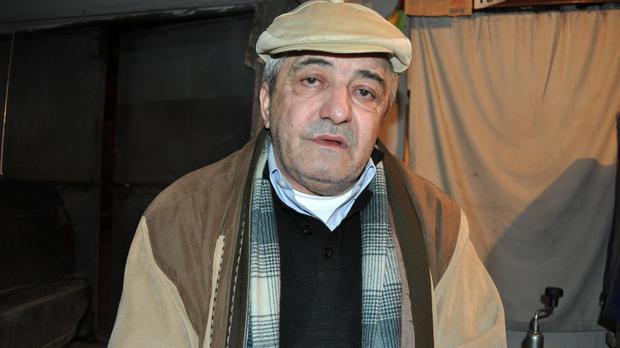
"I am officially dead. I have no income. I spend my days going back and forth between governmental agencies, the police station, the courts. I have diabetes, without papers I can't go for a medical checkup." "At the airport in Bucharest I was surrounded by customs officials. They said, 'You're dead'. I thought they were joking." "I'm a living ghost. My daily routine has been waiting around, going to fix my mother's bandages, going to check with the tribunal to see if anything has changed." Reliu Constantin, Romanian returnee
Constantin Reliu, 63, is pictured at his place in the eastern town of Barlad, Romania, on March 16, 2018. Adrian Arnautu/AFP/Getty Images
A death certificate was issued in 2016 for this man who was missing after having travelled to Turkey in 1992. He would be there still, if Turkish authorities hadn't discovered he was living and working there, though he had no official permission to do so. For close to two decades he lived illegally in Turkey, working first on a construction site, then as a cook. In his first few years there he would return back to his home town in Romania where he had family, and a wife and child.
After his last visit home, in 1999, he convinced himself there was no purpose in returning to his unhappy marriage. He left for good, returning to Turkey and no longer forwarded money in support of his wife and young daughter. He claimed his wife was a heavy drinker, and had affairs with other men. And nor was he immune to the same habits. And that was the end of the marriage, and in fact, the end of his life, for not having heard from her husband in years, his wife asked a Romanian court to declare him legally dead.
And when he returned home to Romania in January of 2018 only to discover that as far as authorities were concerned he was dead, a different court in the country refused to overturn his death certificate. He has no official status, no ID, and without that he cannot obtain work to support himself. His extended family helps him out with what they can afford.
"I cut off ties with everyone, as I didn't want them tracking me down. I knew it was hard for my daughter, but I felt it would be better for her", he explained of his absence and determination to discontinue contact with his family. He had been jailed for 28 days in Turkey for his illegal presence there, before returning to Romania. Before then, in 2013, not having heard from her husband for 14 years, his wife took steps to have him declared dead.
And everyone was convinced he was dead, having no idea he was alive and well and working in Turkey. His daughter is now in her late 30s, is not sympathetic to her father's escapade. She is married with three children and living in Spain. When his mother saw him for the first time on his return to Romania the shock was so great she collapsed and was hospitalized for three days.
He now has the help of a lawyer on a pro bono basis, to help him recover his status as a live person.
And once that happens and he is legally declared among the living, he plans to return to Turkey. "I want to be buried in Turkey. My life is there", he declared.
The town of Barlad, eastern Romania. Photo: SludgeG/Flikr
"Our
civilians do not really understand why the Canadians are here, but they
support their presence as something that is good because we are part of
NATO. "But
our high-level people make the direct connection with the political
situation in Ukraine. We are member of NATO so we do not worry for
ourselves but for Moldova. "The Canadians are here at the direction of NATO to help with security so that a peaceful solution can be found." Commander Marian Petrus, Campia Turzil fighter base
"We learned our lessons from Haiti, Aviano and Libya. We need to deploy quickly and we need people with experience to do it. That is our raison d'etre. It is a concept that has been developed over the years." Lt.-Col. Luc Girouard, Canadian lead on Royal Canadian Air Force 2 Air Expeditionary Wing
"It
is a great experience for us because the Canadians have flown in war
zones. I had only seen F-18s fly in videos. It is a dream come true for
me to fly next to one. "We've flown exercises with American F16s but
that is more of an air-to-air aircraft. The F-18 is more multiple role
with air-to-ground missions, too. Having two engines, the F-18s have
more power. It's a fantastic opportunity because Canada has some of the
best pilots in the world." Major Alin Cuchit, Campia Turzil, Romania
"It is a way to save lives and get Canada in the game fast. It is the first time I have seen us be so quick. "The MiG-21 is an icon. To train with them is an experience we would never get at home. "That
has been a decision made by the government of Canada with NATO and the
government of Romania. As you know, it is a very delicate situation over
here at this time. We're aware of that." Lt.-Col. David Pletz, fighter pilot commander of 425 Squadron
Colonel
Darcy Molstad, Canadian Air Task Force Commander, Lieutenant General
Ştefan Dănilă, Romanian Chief of General Staff and Commander Marian
Petrus, base Commander, discuss international cooperation on the
airfield in Câmpia Turzii, Romania during NATO reassurance measures.
(Photo: MCpl Patrick Blanchard)
When NATO requested of its member nation militaries
to become more involved in the standoff reflecting a Cold War scenario
with Moscow ordering 40,000 Russian troops, helicopters, tanks, planes
and other assorted mechanized war machines to deploy on the border
between Russia and Ukraine and infiltrating eastern Ukraine with its
special intelligence agents to foment unrest and encourage secession,
Canada responded, assigning its special air units to Romania.
This
occasion represents the first time the Royal Canadian Air Force has
deployed its 2 Air Expeditionary Wing, purpose-built to efficiently
respond, flying in more swiftly than ever before to respond to distant
emergencies to which Canada is engaged. Moldova, a Romanian-speaking
former Soviet satellite on the northeastern border with Romania,
situates a permanent base for Russian troops in eastern Europe.
Hornet
fighter jets break out of formation while doing a familiarization
flight of the region in Câmpia Turzii, Romania during NATO reassurance
measures. (Photo: Corporal Patrick Blanchard)
With
Russia's swift annexation of Crimea after having engineered
social-political-ethnic dissent that led to a declaration of
independence from Ukraine resulting from a questionable affirmative poll
among the peninsula's large Russian-speaking residents, including
Russian officers of the country's Black Sea Fleet, the concern in NATO
now is not only how they can manage to have Moscow return Crimea to
Ukraine, but how to prevent it from scooping up Moldova as well.
And
while Moscow and President Vladimir Putin in particular will never,
under any conceivable circumstances agree now to surrendering Crimea
back to Ukraine, with sufficient push-back from NATO and its allies, it
is possible that the following annexation of Moldova can yet be averted.
Even while the Kremlin feels belligerently entitled to recapture what
it can of its former holdings, and even as it spends billions in
upgrading its war machinery, neither Russia nor NATO would welcome an
active confrontation.
Lt.-
Col. Luc Girouard is responsible for logistics and Lt.-Col. David
Pletz, runs the fighter jet component of Canada’s open-ended CF-18
Hornet deployment to Romania. It is the first time that the RCAF has
operated from a base in eastern Europe, creating unique logistical and
operational challenges. MATTHEW FISHER/POSTMEDIA NEWS
In the meanwhile, the CF-18 Hornets from Bagotville
Quebec have been flying close to Ukraine's southern border and in other
places around Romania for the past three weeks, flying on occasion
alongside Soviet-Era Romanian MiG-21s over Transylvania. The exercises
providing ample opportunity for Canadian pilots and their Romanian
counterparts to assess the capabilities of each aircraft and the flying
skills of their pilots. An extraordinary exercise in
'getting-to-know-you'.
Six
CF-18 Hornets from 425 Tactical Fighter Squadron take off from
Bagotville, Quebec to fly to Romania as part of Canada’s contribution to
NATO’s reassurance measures in order to promote security and stability
in Eastern and Central Europe. (Photo: Corporal Jean-Roch Chabot)
A
comradely introduction for the Romanians, newly inducted into NATO,
with the privileges involved in being part of that international
military coalition, particularly in an area of the world where the past
and its enforced political-national unions have been a matter of regret
and determination that sovereign nationals will never again be coerced
into similar arrangements.
This represents a general opinion site for its author. It also offers a space for the author to record her experiences and perceptions,both personal and public. This is rendered obvious by the content contained in the blog, but the space is here inviting me to write. And so I do.