"Racism is a poison; hate is a poison." "This poison exists in our society and it's to blame for too many tragic events." "Everything will be done to investigate the circumstances of these
terrible murders. [The government] and every state institution would] stand up with all our strength and decisiveness to those people
who try to divide Germany." German Chancellor Angela Merkel
"If people are silent for long enough, then things like this will
happen." "You could have set the clock by this attack. People tell us
they have learnt from Auschwitz, but this shows that sort of talk is
just ‘blah, blah’." Mehmet Daimagüler, lawyer for victims of far-right
terrorism
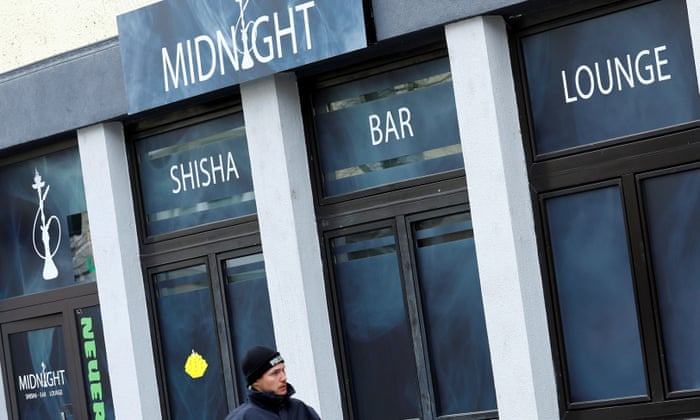
A police officer outside the Midnight shisha bar in Hanau.
Photograph: Ralph Orlowski/Reuters
A country divided. Where once it was united. But that was under the Third Reich of 'National Socialism', when everyone adored Hitler and was eager to do his bidding. Even the Protestant and Catholic Churches were silent and held their counsel at a time when their voices raised high in condemnation of a murderously racist public national agenda based on an Aryan ideal meticulously planned and carried out the mass murder and extermination of Jews, Roma, Gays, political dissenters and the occasional cleric who would not countenance that agenda.
German citizens have now, for the most part, turned their backs on that odiously shameful history. But within their psyches burns a social exclusionary devotion to heimat and all things Germanic. The mass presence of peoples from another heritage, religion, customs and values and legal system does not sit well with most people, anywhere in the world, when their own becomes degraded and a competition ensues between theirs and those who arrive who set no store by the indigenous laws and culture.
Fuelled in no small part by the stern unwillingness of a religious political system that spurns theirs and demands the foreign one be elevated to official status. Add to that the culture of oppression and repression that Islam represents, its hostility to other religions, politics, cultures and values along with the prevalence among Muslim youth of violent tendencies and the vulnerability of women in Islamic culture and there is a perfect storm brewing.
Two hostile sentiments in an arena where sparks of rage set off a firestorm of reaction. The German tendency to fascism is reborn within a society viewing itself as hard-pressed to maintain its culture and respect for its heritage. The left and the right, both of which tend in their extremes toward totalitarianism, yet despising one another, are in the process of clashing as they do periodically. Violence is always on the cusp of an explosion.
National Socialism demonstrated the extent that fascistic extremism could descend to in its mass extermination of European Jewry. That same population that devoured their Fuhrer's words of national superiority and scorn for all others, has now divided itself. Half driven by remorse and willing to accept migrants and refugees whatever their source, the other half resentful of the presence of strangers and reverting to the racist ideology that gave birth to the Holocaust.
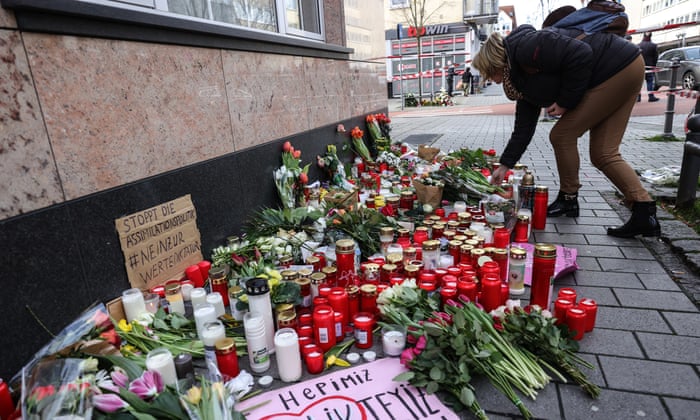
Those killed in Hanau, by a white supremacist in two hookah bars were targeted because they were not German nationals, and the irony is that though some of the victims were Turkish in origin they were also Kurds, oppressed by Turks, seeking haven from that oppression in a Germany that declares itself open to refugees and migrants. There is injustice everywhere and anywhere. The tragedy is that human nature incessantly turns on itself, ravenous and hateful.
A woman leaves flowers at a makeshift memorial for the nine people killed in Hanau.
Photograph: Armando Babani/EPA
Taliban Committee for the Promotion of Virtue and the Prevention of Vice
"We don't want a peace that will make the situation worse for women's rights." "Come
that time [should the Taliban be given a share of government power in
Afghanistan], they will complete their incomplete dreams and they will
be crueler than in the past." Robina Hamdard, head, legal department, Afghan Women's Network "We don't want to be the victims of the peace process with the Taliban." "But the Afghan government totally ignores Afghan women on the peace process." Laila Haidari, Afghan businesswoman
"[I
well remember during the years of Taliban rule being] forced to be
inside a dark cage when out of our houses -- I mean the burqa." "I have been an M.P. twice and a university professor, but no one has ever asked me about peace talks with the Taliban." "We
have had 40 years of war and everybody is tired of fighting, but that
peace should not be at the price of losing our rights and freedom as
women." "We want the Taliban to accept women's rights and publish a statement where they guarantee women's rights." Shukria Paykan, Kundiz, Afghanistan
"Acute
misogyny in Afghanistan goes way beyond the Taliban. Without a strong
U.S. hand there, it is not looking very good for Afghan women." "They [Afghan government and the Taliban] can do as they like to them [women] after we leave." Ryan Crocker, former U.S. ambassador to Afghanistan
"When
we heard that U.S. troops will leave Afghanistan in 18 months, we girls
were asking each other, 'Now what will become of us'?" "People already think we are bad girls for dancing. What will happen to us if the Taliban become part of the government?" Qadria Azarnoosh, Hazara traditional dancer
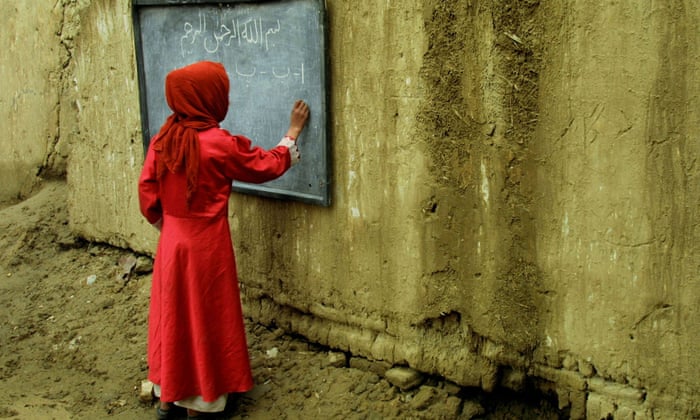
In March 2002 in
Kabul, an Afghan girl learns the Dari alphabet during a lesson in an
outdoor classroom. Girls who the Taliban banned from education were
attending classes for the first time in six years. Photograph: Natalie
Behring-Chisholm/Getty Images
Women in Afghanistan who were freed from the Taliban insistence that
they appear in public only in the presence of a male guardian and only
totally enveloped in a black burqa, to be enabled to become students
once again from primary grades to university, will obviously revert back
to the time when music was disallowed, girls and women were not
permitted to attend school, to work or to celebrate weddings should the
Taliban return to power.
Without the civilizing presence of the U.S.-led NATO countries' presence
as NGOs, military, civilian monitors and foreign civil infrastructure
guides the advantages that women in Afghanistan were able to access
finally would never have occurred under the Afghan government.
The Taliban are merely the most fundamentalist of the Islamist clerics
and males in Afghanistan, most other Muslim males are only moderate by
comparison; conventionally, traditionally, women have had no place in
the public sphere, in the workforce, within the educational system.
Women requiring medical help had to attend to female-only hospitals
where all staff were women, and even they were required under the
Taliban to be fully geared in Burqas within the hospital environs, even
surgeons performing surgery. This is what awaits women in Afghanistan.
The United States fully realizes that the only way they will be able to
pull their troops out of Afghanistan is to convince both the government
and the Taliban -- all most of the Pashtun majority tribe -- to make
peace by sharing governance. This would be a face-saving device for the
Americans while at the same time performing a similar function for the
Islamist adversaries. The position of Afghan women is purely
co-incidental to the process. This is, after all, with or without the
ideological fundamentalism of the Taliban, an Islamist society.
Within Islam it is entirely permissible to appear to be agreeing with an
adversary until such time as opportunity presents to pursue the
original agenda. The Taliban has been unwilling to meet with the Afghan
government despite the government's willingness, even eagerness to reach
an agreement with their ideologically pure counterparts. A peace
agreement would simply be the initial step in 17 years of conflict for
the Taliban to resume their former control of the country. And the fate
of the women of Afghanistan will once again be dismal beyond belief.
For a woman as liberated as Shukria Paykan, parliamentary member, and
one-time university professor, the concern is that her daughter's school
will once again be forced to close. "Women need to raise their voices so they are not forgotten",
Habiba Sarabi, deputy of the High Peace Council in Kabul, one of 14
women on the 75-member council stated. All previous efforts at peace
talks had excluded women. "We came a long way to achieve the rights we have now", said Saira Sharif, a politician from Khost. "Just to lose them after a peace deal."
As for the Taliban, they do have a stated position on women's rights in
Afghanistan. Their spokesmen have pointed out that the Taliban is more
than willing to assure Afghan women that their rights will be fully
respected. Those rights the Taliban speak of, they emphasize, represent
all the rights that Islamic script guarantees them. Those are the rights
the Taliban recognize and are fully committed to, just as they were in
the days of their rule when al-Qaeda and Osama bin Laden were honoured
in Afghanistan as one among them in the faith.
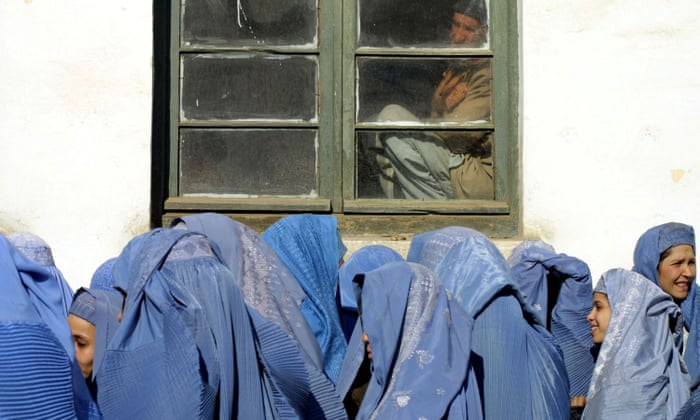
In February 2002, a
man looks at Afghan women waiting to apply for jobs at Kabul’s Ministry
of Women, which initiated a drive to encourage professional women to
re-enter the workforce after the demise of the Taliban. Photograph:
Natalie Behring/Getty Images
"This is nuts. It has changed my entire outlook about people, my outlook about people has skyrocketed. It's the best Thanksgiving that I've ever had." "He [homeless man Johnny Bobbitt, 35] will never have to worry about a roof over his head again!!" Kate McClure, Philadelphia
"Giving him [Johnny Bobbitt] all that money, it's never going to happen. I'll burn it in front of him." "[Giving an] addict [the money would be like] giving him a loaded gun." Mark D'Amico, Philadelphia
"From what I can see, the GoFundMe account raised $402,000 and GoFundMe
charged a fee of approximately $30,000." "Mark D'Amico and Kate McClure
gave Johnny about $75,000. There should be close to another $300,000
available to Johnny." Bobbitt's lawyer Chris Fallon
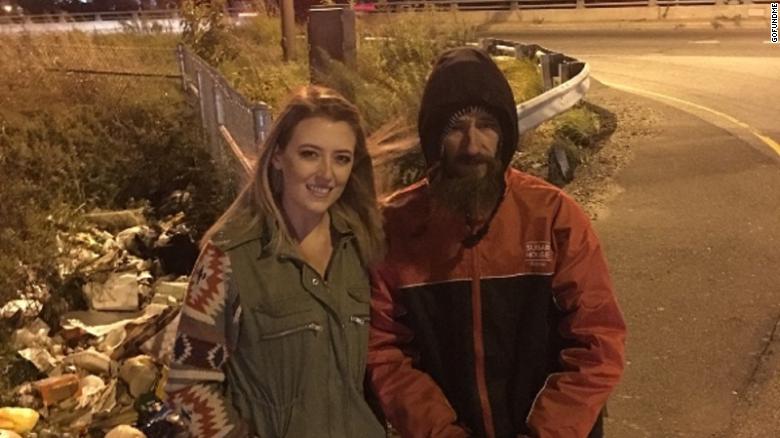
Kate McClure helped raise more than $400,000 for Johnny Bobbitt Jr., a homeless man, to repay his kindness.
Stranded on the Interstate 95 in Philadelphia, out of gas, and with no money to pay for the fuel, a stranger approached Kate McClure, handed over his last $20 to help her out of her dilemma. The grateful young woman and her boyfriend, Mark D'Amico decided to track down the homeless man and do something to help him, in turn. They turned to GoFundMe and began a fund-raising campaign for him, explaining what he had done, though homeless, for a complete stranger, depriving himself for someone else. The fund went viral.
People responded in astonishing numbers; by the time it reached $65,000, Kate McClure was expressing her amazement at people's compassion and generosity. The fund kept growing until it reached a truly impressive $400,000 from contributors all over the world who were themselves impressed by the selfless reaction of the homeless man to the temporary plight of a young woman. Bobbitt, an ex-Marine and firefighter began living on a camper on land owned by McClure's family.
He had a place to live, but he was penniless, with no money to buy food, seek medical attention or any other necessity of life. And he began wondering how it was that a young woman who worked as a receptionist could possibly afford to buy a new BMW and go to California, Florida and Las Vegas for vacations with her boyfriend, taking a helicopter ride over the Grand Canyon for good measure. He knew that D'Amico, working as a carpenter, was a gambler.
DAVID SWANSON / File Photograph
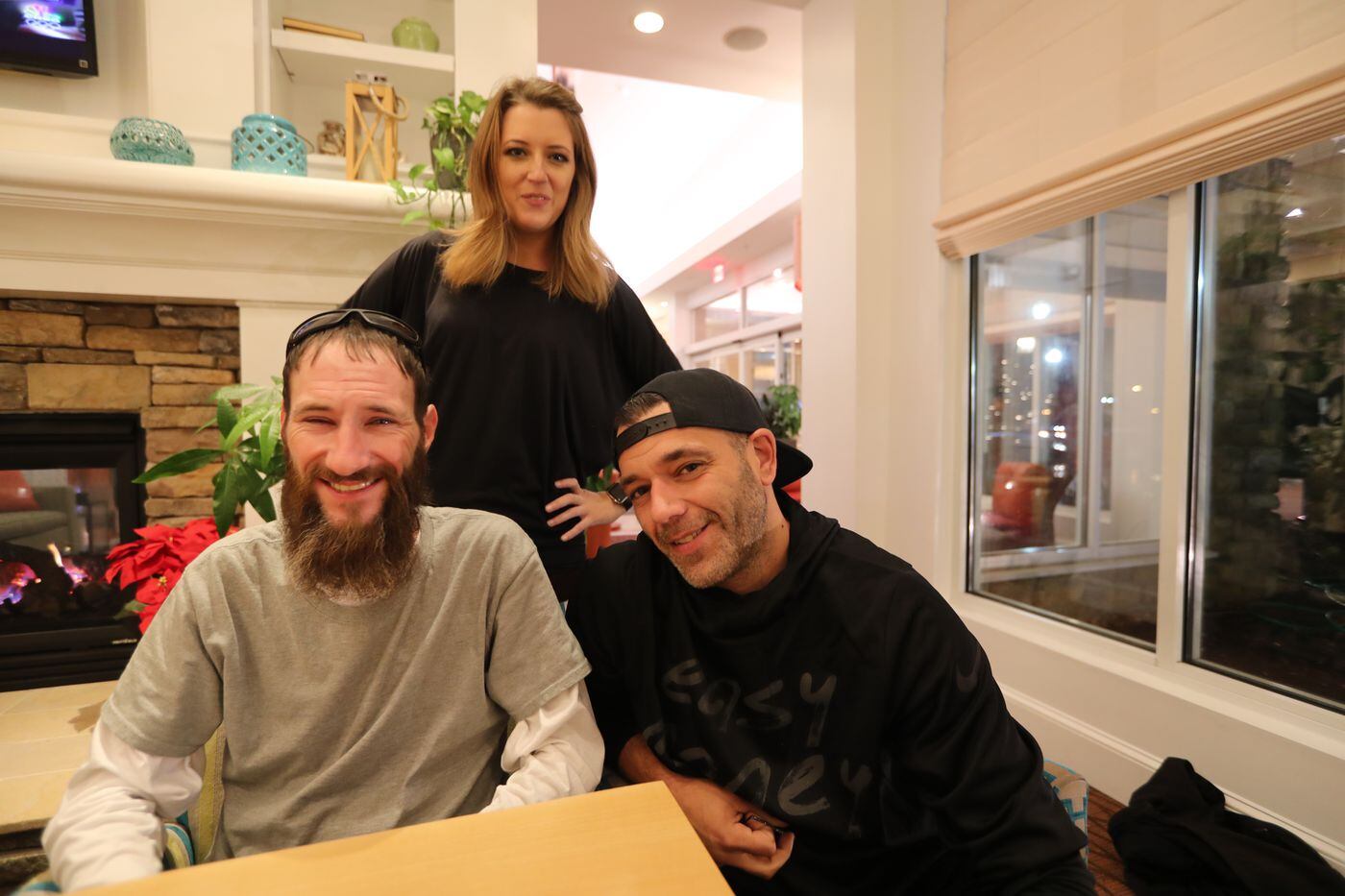
Johnny Bobbitt with Kate McClure and Mark D’Amico last year.
The funds that had been gathered through the GoFundMe campaign weren't released to the man they were supposed to give prospects for funding a new life to, other than an initial amount used to buy that camper. D'Amico confessed to having used five hundred dollars of that total collected for gambling, but stated he had restored that money to the total. McClure said none of the money meant for Bobbitt had funded her vacations or her vehicle; it was all her own money.
GoFundMe is prepared to investigate whether the $400,000 was mismanaged and it plans to ensure that Bobbitt "receives the help he deserves and that the donors' intentions are honoured". Strangely enough, only $200,000 remains in the fund of the total donors raised of $400,000 and Bobbitt no longer has that camper. Still, McClure insists she and her boyfriend did all they possibly could to aid the homeless man. "I think it might have been good intentions in the beginning, but with that amount of money, I think it became greed", speculated Bobbitt.
Pro bono lawyers with whom Bobbitt had been put in touch by homeless advocates are determined to see justice done. "I think he is just a genuine, sincere person who has been the victim of so many bad circumstances", said Jacqueline Promisio, one of the lawyers working on Johnny Bobbitt's behalf. She and her colleague Chris Fallon are representing Bobbitt's interests.
DAVID SWANSON / Staff Photographer
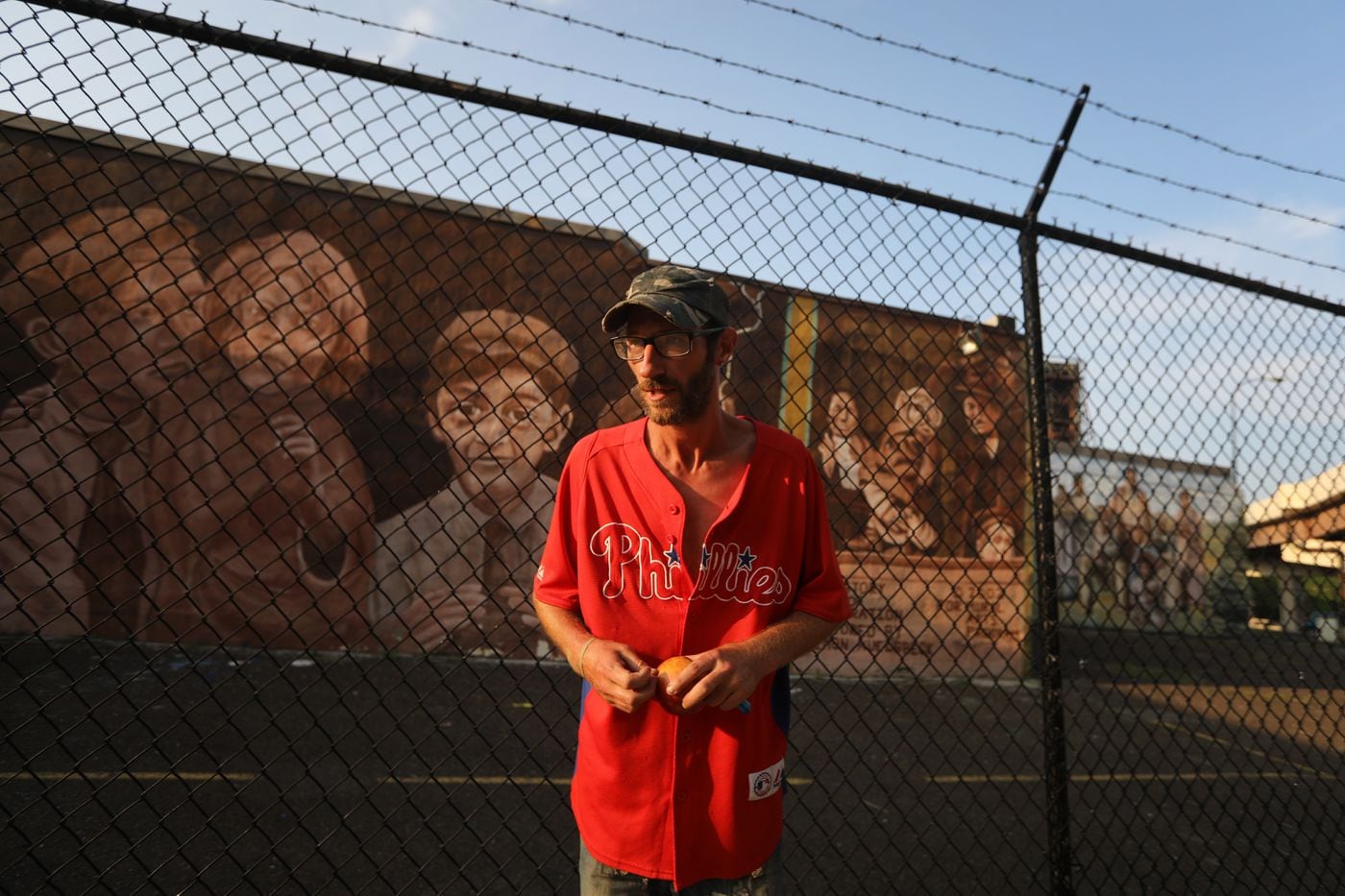
Johnny Bobbitt returned to Philadelphia, homeless and broke despite the generosity of donors.
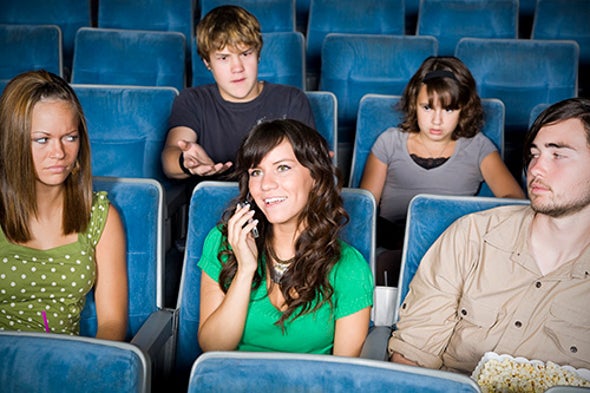
"When someone is uncivil to you, it forces you to spend a lot of mental energy trying to figure out what's going on, what caused the rudeness, what it means." "All that thinking lessens your capacity for impulse control. So you become more prone to be rude to others ... People in a way 'pay it forward'." "When you experience incivility, it's important to take a step back and not act on your impulses. Do things that help you recover your ability to self-regulate, like exercise or taking a break." "Our research shows people are often not even aware of their reactions and the way they spread negativity. So some of these recommendations for how to stop it are easier said than done." Christopher Rosen, organizational scientist, University of Arkansas
"When it comes to incivility there's often a snowballing effect. The more you see rudeness, the more likely you are to perceive it from others and the more likely you are to be rude yourself to others." "Rudeness is interesting in that it's often ambiguous and open to interpretation. If someone punches you, for example, we would all agree that it's abusive. But if someone comes up to you and says in a neutral voice 'nice shoes', is that an insult? Is it sarcasm or something else?" "[The more someone has witnessed rudeness] the more likely you are to interpret 'nice shoes' as deliberately rude." "What is so scary about this effect is that it's an automatic process -- it takes place in a part of your brain that you are not aware of, can't stop, and can't control." Trevor Foulk, researcher, organizational behaviour, University of Maryland
The virulent nature of rudeness and the speed with which its presence grips society has been demonstrated of late since the election of Donald J. Trump to the U.S. presidency. This is a man with a fairly coarse vocabulary and thought process, who speaks before thinking and whose thoughts are all too often not worth expressing, much less hearing, since they mark him as an individual whose grasp for the jugular reveals a not very nice character. The depth of his reasoning leaves much to be desired. His disdain for others and his casual dismissal of other people's values reveal his barbaric manners.
In 2016 a study undertaken by Christopher Rosen saw him along with fellow researchers track employees through their work days to conclude that individuals experiencing a perceived insult at some point in their working day would tend at a later time to reciprocate in a similar manner at their co-workers. With the use of psychological tests, researchers made a link that unconscious reaction to ill treatment tends to lower one's level of awareness of self-control.
The rise in recent years of incivility, condescension, dismissiveness and the issuance of insults have led social scientists and psychologists to invest in time and effort leading to increasing research on the matter. Experimental research has pointed out that the more frequently that people are exposed to rudeness either by witnessing it or becoming the target of it, the more possessed they become with their own need to act in kind, to be as rude as others, venting frustration and courting the satisfaction of dealing to others as they have been dealt with.
A new study has found experiencing rudeness in the office makes people
more likely to perceive rude behaviour in others, and exhibit impolite
behaviour in return spreading like a 'virus'
Even when workers in one study were exposed to videos demonstrating an uncivil interaction, it meant that in turn they themselves were likelier to perceive interactions throughout the course of their day as rude; and the stage has been set. Other studies yet conclude that when supervisors or managers behave in an uncivil manner this has a tendency to influence uncivil behaviour in those working under them in a chain reaction of rudeness.
Increasingly, research demonstrates how deeply rudeness can affect people in causing employees to experience chronic distractedness, to be less productive and less prone to creativity. Incivility has the potential to decrease trust, to spark anger, fear and sadness, becoming the cause of depression. Incivility in the workplace, according to one study's conclusion, had implications for one's personal life interactions and could potentially lead as well to marital dissatisfaction.
In 2015 and 2017, two studies found doctors and nurses in neonatal intensive care units who had been criticized by an actress role-playing as the mother of an ill infant reacted to her excoriating criticism by performing inadequately in comparison to those of their medical cohorts who hadn't been exposed to the scolding. They ended up misdiagnosing the medical condition of the infant in question. Which led one of the researchers to comment on the result and its consequences as a serious breach of professionalism.
"The results were scary. The teams exposed to rudeness gave the wrong diagnosis, didn't resuscitate or ventilate appropriately, didn't communicate well, gave the wrong medications and made other serious mistakes."
"I am officially dead. I have no income. I spend my days going back and forth between governmental agencies, the police station, the courts. I have diabetes, without papers I can't go for a medical checkup." "At the airport in Bucharest I was surrounded by customs officials. They said, 'You're dead'. I thought they were joking." "I'm a living ghost. My daily routine has been waiting around, going to fix my mother's bandages, going to check with the tribunal to see if anything has changed." Reliu Constantin, Romanian returnee
Constantin Reliu, 63, is pictured at his place in the eastern town of Barlad, Romania, on March 16, 2018. Adrian Arnautu/AFP/Getty Images
A death certificate was issued in 2016 for this man who was missing after having travelled to Turkey in 1992. He would be there still, if Turkish authorities hadn't discovered he was living and working there, though he had no official permission to do so. For close to two decades he lived illegally in Turkey, working first on a construction site, then as a cook. In his first few years there he would return back to his home town in Romania where he had family, and a wife and child.
After his last visit home, in 1999, he convinced himself there was no purpose in returning to his unhappy marriage. He left for good, returning to Turkey and no longer forwarded money in support of his wife and young daughter. He claimed his wife was a heavy drinker, and had affairs with other men. And nor was he immune to the same habits. And that was the end of the marriage, and in fact, the end of his life, for not having heard from her husband in years, his wife asked a Romanian court to declare him legally dead.
And when he returned home to Romania in January of 2018 only to discover that as far as authorities were concerned he was dead, a different court in the country refused to overturn his death certificate. He has no official status, no ID, and without that he cannot obtain work to support himself. His extended family helps him out with what they can afford.
"I cut off ties with everyone, as I didn't want them tracking me down. I knew it was hard for my daughter, but I felt it would be better for her", he explained of his absence and determination to discontinue contact with his family. He had been jailed for 28 days in Turkey for his illegal presence there, before returning to Romania. Before then, in 2013, not having heard from her husband for 14 years, his wife took steps to have him declared dead.
And everyone was convinced he was dead, having no idea he was alive and well and working in Turkey. His daughter is now in her late 30s, is not sympathetic to her father's escapade. She is married with three children and living in Spain. When his mother saw him for the first time on his return to Romania the shock was so great she collapsed and was hospitalized for three days.
He now has the help of a lawyer on a pro bono basis, to help him recover his status as a live person.
And once that happens and he is legally declared among the living, he plans to return to Turkey. "I want to be buried in Turkey. My life is there", he declared.
The town of Barlad, eastern Romania. Photo: SludgeG/Flikr
"Officers in schools, in uniform, create a safer learning environment and foster relationships between the police and young people." "Partnerships like the ones we develop with schools are at the core of the service's modernization efforts to move toward a neighbourhood-centric model of policing." Meaghan Gray, spokeswoman, Toronto Police Services
"In the face of this data [report from staff at Toronto District School Board] we have a clear duty to act on behalf of our students, and address the concerns they have brought to our attention." "Staff will continue to work with police in order to build a partnership [with police] that honours the voices of all students." "[It is the board's priority] to mitigate against the differentiated and discriminatory impact of the School Resource Officer [SRO] program." Toronto District School Board "When someone sees you talking to the police, they think you are a snitch. "And that's if. Your life is over." Unnamed student "It's good [to have uniformed police in the school] in case there is a serious situation where someone could get dangerously injured." "SROs don't really harass people in the school. They ask you what is the problem." Unnamed student
The School Resource Officers program was launched in 2008,
one year after Grade 9 student Jordan Manners was shot and killed at
C.W. Jeffreys Collegiate. He was 15. (Nathan Denette/Canadian Press)
The problem is that there is a problem and the solution that appeared to work very well, has been rejected by the very students that represent the problem, while the students who benefit from the presence of police have had their opinions stifled. All it takes is one dissenting voice, irrespective of the obvious that the dissenter represents a minority whose actions have brought the police presence into the schools as a preventive measure, to begin with.
This is the era of political correctness. So the fact that among the black community gangs and illicit activities and anti-social behaviour is a threat to the majority of students' safety requires mediation of a type that will influence the outcome toward safety for both potential malefactors and their victims can be set aside in deference to the complaints of the aggressors, ignoring the needs of the victims, appears to give the appeasers great sanctimonious satisfaction.
No segment of any community appreciates being singled out as appearing to be a potential threat to the larger community.And because of course it is a group within a group in that the sociopathic action of a small percentage of the target group that is at fault, the entire group feels ill done by, through default association. In the black community of Toronto there is a penchant among youth to gravitate toward gangs, guns and drugs.
Violence erupts on occasion, sometimes lethal violence, and the black community in its entirety seems to close ranks instinctively. Not only are witnesses not available for police investigative aid, but the greater community is aggrieved that public attention is focused on them. Safety for students in the schools is an obvious concern for parents. And when an initiative was undertaken years ago to have uniformed police monitor schools and make themselves available in a preemptive capacity, tensions declined.
The police made an effort to present themselves as social peacemakers and intermediaries. They were there to help, to befriend, to offer advice and alternatives. The reason for their presence acknowledged, and inevitably a level of resentment occurs. A 15-year-old student was shot and killed at C.W. Jeffreys Collegiate Institute in 2007; a year later the School Resource Officer program was initiated. It has served as an effective preventive service since then.
A Toronto police officer chats to students at North Albion Collegiate in
2008, during the early days of the program to place officers in
schools. (STEVE RUSSELL / TORONTO STAR FILE PHOTO)
It gave comfort and support to parents, it offered substantive assurances to students concerned about the proclivities of some students to anti-social activities. Threats declined, and a kind of truce was put in effect. Now, complaints from a number of students and general agreement from the black community to put an end to the program has resonated with the largest school board in the greater Toronto area, anxious to respond to criticism.
Rodney Diverlus of Black Lives Matter Toronto averred that his group, aggressively promoting action favourable to what the black community deems is equal treatment in the greater community, was "cautiously optimistic" school board trustees acceding to the report's recommendation that the SRO program represents a "reactionary measure" in response to a single incident. "This report has really corroborated many of the claims that parents, that youth and students in our community have been saying since the introduction of the SROs", he said. As far as Black Lives Matter is concerned, social workers, child behaviour therapists, hall monitors and increased faculty engagement with students would result in greater effectiveness responding to student needs.
On the other hand, the Toronto District School Board staff report declared their review had found the majority of those they surveyed held a positive impression of the program. Some, it notedm felt intimidated by the presence of a police officer in their school, while many others were unaware of the program and were completely unaffected by it. They still felt impelled to 'mitigate' what is perceived as a discriminatory program.
"[The decision to stop the SRO program] followed recommendations
earlier this month from TDSB staff, who called for termination of the
program based on results of a six-week review and input from thousands
of students, staff, parents and community members. It included surveys
completed by 15,500 students with police in their schools." "While a
majority of teens reported being satisfied with the SRO program, or had
no opinion, staff concluded the thousands who did say that having
officers at school made them feel uncomfortable, intimidated and
targeted were far too significant to dismiss." "While 57 per cent
said having police in school made them feel safer, 46 per cent said they
weren’t sure they wanted the program to continue. But 1,715 (11 per
cent) said the presence of an officer intimidated them and 2,207 — or 14
per cent — said they felt watched and targeted as a result." "The
staff report, applauded by groups like Black Lives Matter, the Urban
Alliance on Race Relations and others who wanted officers removed from
schools, was unanimously endorsed
by the TDSB’s planning and priorities committee last week following a
parade of delegates who appeared before them to support the move." "They
argued the presence of armed police was detrimental to many Black
youth, undocumented teens who felt threatened even though they have a
legal right to education, and other marginalized groups. Many proposed
that instead of having police on school property, the board should put
more resources toward hiring youth counsellors, social workers and
launching anti-racism programs." the star.com
Toronto Board Removing Police Officers From Schools -- Huffington Post
"I think the low number of Canadians who celebrate the fact that we have religious freedom is very troubling and really speaks to the forces of secularization that are at work in Canadian society." "It really is time for the religious communities in this country to set aside some of their doctrinal differences and look at coming together to communicate better with Canadians on the role of religion and faith in Canada." Angus Reid, founder, president, Angus Reid Institute
"I don't think the people answering this poll are answering from the consequence of day-to-day experience. I think what we're talking about is a public narrative." "[Might it be that those religions receiving negative views are distinguished by the hijab and turban] is a discomfort with the particulars of their faith? Or is it a discomfort with the fact that they're different than us?" "Ray Pennings, executive vice-president, Cardus
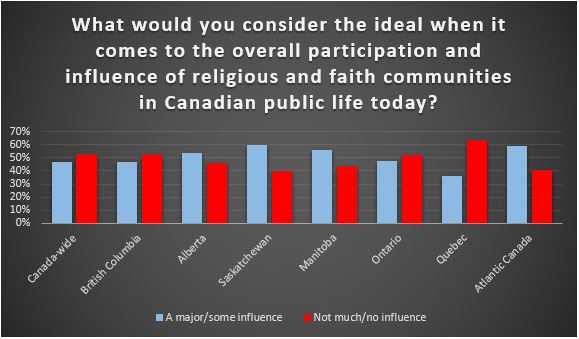
These statements resulted from an online poll of just under two thousand Canadian adults, conducted from October 15 to the 23rd of this year. The poll result gave evidence that Canadians, traditionally fairly comfortable with the presence of visible minorities among them, in an essentially immigrant-based society as a whole long accustomed to living and working among people originally from all parts of the world, have now grown restive with the concept of a multicultural society.
To anyone with an ounce of brains, it would be obvious why, as Mr. Pennings points out, a level of suspicion has been evident among respondents to the poll with respect to Sikhs and Muslims. Canada's most horrific terrorist experience came out of a Sikh plot among Canadian Sikhs living in British Columbia to strike a blow for Khalistan, a wished-for separation from India for Indian Sikhs.
Explosives aboard an Air India flight full of Indo-Canadians was blown up over the Atlantic. The perpetrators were put on trial, but the result was inconclusive and they were never fully held to criminal account for the devastating horror of 329 innocent people losing their lives, in 1985. Little wonder the memory of that dreadful event still shapes peoples' thoughts about Sikh-Canadians. But reasonable people know that the actions of a handful if malcontents with malicious intentions do not represent all those who share a common background.
Jagmeet Singh, the newly minted leader of the federal NDP: An Angus Reid
poll explores the attitudes of Canadians to the idea of a Sikh leader.(Chris Young / THE CANADIAN PRESS file photo)
On the other hand, the simple fact is Sikh-Canadians are an integral part of Canadian society. So much so that under the current government, Canadians now have a Sikh as their Minister of Defence, and another Sikh Canadian lawyer has been elected as leader of of the federal New Democratic Party. As for suspicions of Muslims being high on peoples' minds, the reasons are obvious enough. Most of the terrorist groups bedevilling world society are Muslim.
Muslims have been attacking one another in bloodthirsty violence reflecting sectarian hatred -- and Muslim countries have spectacularly failed to govern their populations, instead exploiting and visiting violence on them. The world's premier terrorist groups are Muslim, threatening not only their own, but destabilizing and terrorizing the West, from Europe to North America and beyond. Little wonder Muslims are held in suspicion. They are the latest source of the most virulent anti-Semitism.
In Quebec which has just adopted a law prohibiting women wearing niqabs from receiving or giving government services, 26 percent of respondents accepted religious diversity while 23 percent rejected it and 44 percent agreed diversity represents a mixture of good and bad. Anti-Islam sentiment however, stands at 46 percent claiming Islam damages Canada.
This poll was a joint venture between Angus Reid and Faith in Canada 150.
"...If Islam is involved, a significant segment of Canadians will react negatively", an analysis of the numbers by the Angus Reid Institute clarified. Generally, Catholicism, Protestantism, evangelical Christianity and Judaism all received positive ratings overall. With the exception of Quebec where 55 percent claim Islam is damaging and 22 percent claimed the same for Judaism.
Overall, a slight majority of 55 percent of respondents felt freedom of religion results in Canada being a better country. Angus Reid perceives the results reflecting a "potential for intolerance toward those of faith, in particular toward adherents of minority religions". On the other hand several groups stood out for growing influence, representing Islam, Sikhism and Hinduism, where the established, traditional religions in Canada appeared to have a dimished influence.
"Back in 1975, the year when politicians decided that Sweden was to
become multicultural, the Swedish population stood at 8,208,442. By 2014
it had grown to 9,743,087 -- an increase of 18.7%. This growth is
entirely due to immigration, as Swedish women on average give birth to
1.92 children compared to the 2.24 average of immigrant women. One
should, however, keep in mind that in the statistics, second-generation
immigrants are counted as Swedes." "Sweden's recent population growth is without parallel. Never before
in the country's history has the number of inhabitants increased so
fast. Sweden is now the fastest growing country in Europe." "Over the past 10-15 years, immigrants have mainly come from Muslim
countries such as Iraq, Syria and Somalia. Might this mass influx
explain Sweden's rape explosion? It is difficult to give a precise
answer, because Swedish law forbids registration based on people's
ancestry or religion. One possible explanation is that, on average,
people from the Middle East have a vastly different view of women and
sex than Scandinavians have. And despite the attempts by the Swedish
establishment to convince the population that everyone setting foot on
Swedish soil becomes exactly like those who have lived here for dozens
of generations, facts point in an altogether different direction." Ingrid Carlqvist and Lars Hedegaard, Gatestone Institute
Sweden's transition to a haven for Muslim emigrants from countries of the Middle East and North Africa, has led to its almost complete transformation. The customs and practises of an entirely alien population have been mass-imported into a formerly homogeneous society. And now it is the indigenous population of Sweden who appear to be the aliens, crowded out by the presence of an often-hostile enclave where Muslims now resent the presence of Swedes among them, and if they happen to be Jews, the threats are very real.
If Sweden had decided to welcome people fleeing conflict and the general unrest with violence in the Middle East, it is amazing that they failed to focus on the plight of the most vulnerable of those people; Christians, Yazidis, Kurds eager to escape the existential threats they live under in the malign presence of oppressive Muslims who deem them disposable human beings. At the very least, the focus could have been on women, women and children, and families. Instead, the vast majority taken in appear to be men and mostly young men.
And then there are people streaming in from Afghanistan. Like the family of eleven people with their 106-old grandmother, Bibihal Uzbeki, a frail, disabled women whose son and grandson exercised enormous physical effort to carry her out of Afghanistan to a hoped-for opportunity for a new life in Europe. And whom, most unfortunately, the Swedish Migration Agency chose to turn down her request for asylum.
106-year old Afghan refugee Bibihal Uzbeki lies in bed in Hova, Sweden, on Sept. 3, 2017.David Keyton—AP
"[They had ] taken a decision regarding an expulsion in the case; generally speaking, high age does not in itself provide grounds for asylum", the Migration Agency had elaborated when questioned about this decision, that the family attempted to hide from their grandmother who, when they finally informed her, evidently suffered a stroke as her health began to deteriorate from the stress it caused to be told she was not welcome there.
"My sisters were crying. My grandmother asked, 'Why are you crying'?' "If I knew who was the enemy [in Afghanistan], I would have just avoided them." Mohammed Uzbeki, Bibihal's grandson
Evidently many European countries routinely deny asylum to Afghans coming from areas of the country that the Europeans deem to be safe. "The reasoning from the migration agency is that it's not unsafe enough in Afghanistan", explained Sanna Vestin, head of the Swedish Network of Refugee Support Groups.
And Mohammed Uzbeki acknowledges the difficulty in proving his family would face a specific enemy if they were all to be expelled from Sweden. They are all awaiting word whether or not their asylum applications will be accepted or rejected. Those whose applications are rejected may appeal, a lengthy process for their applications in various stages of appeal, apart from the rejection of the grandmother's application.
Mohammed cites the presence of the Islamic State group, the Taliban, al-Qaeda, the Pakistan Haqqani network and suicide bombers all of which present to him and his family ample reason why they fear returning to their country of birth when they would much prefer remaining where they are, in the small village of Hova, in central Sweden. They had lived in temporary exile in Iran, but Iran, a Muslim country, failed to offer them permanent security.
106-year-old
Afghan refugee Bibihal Uzbeki rests in bed attended by her son
Mohammadollah and daughter-in-law Ziba, in Hova, Sweden, on Sept. 3,
2017. David Keyton—AP
On the other hand, perhaps they have arrived in a country whose dangers eerily reflect those of Afghanistan, as pointed out in this recent article on gang violence in Sweden which fails to mention that Malmo in particular has been overrun by Muslim immigrants. Typically, the language of such events is delicately evasive of mentioning any involvement of Muslims in gangs and violent incidents:
"In 2016, some 250 shootings (random, fatal and non-fatal) were
registered by police in Stockholm, Gothenburg and Malmö. In 2014, that
number came to 200, indicating that Sweden is experiencing a drastic rise in such incidents."
"We don’t really know why yet, but what we can see is that the increase
comes as we also see a rise in gang-related crimes and a growing number
of criminal networks,” Manne Gerell, a criminologist at Malmö
University, told The Local, after Swedish public radio first wrote about new research he is involved in."
"One study which is yet to be published suggests that Sweden experienced
four to five times as many fatal shootings per capita as Norway and
Germany in 2008-2014, two otherwise similar countries. Previous figures
have shown that deadly violence in general is going down in Sweden, but gun violence has gone up." Gerell also singled out Malmö, Sweden’s third-largest city, as the one place where shootings are becoming particularly common."
"Malmö stands out,” he said, noting that the southern city is somewhat
more exposed to social problems and poverty in comparison to both the
capital and Gothenburg." The Local, Swedish news
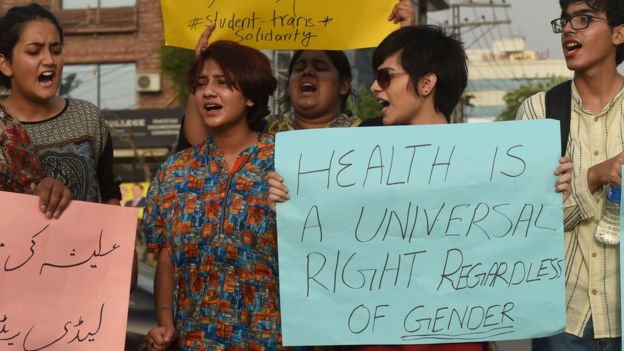
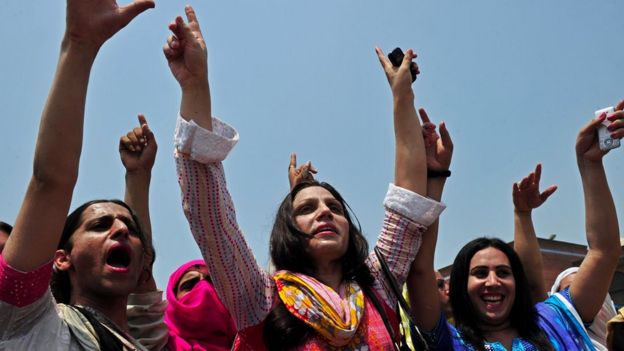
"We are pushing for this bill because it is the right of these people, not only a right as human beings but as citizens of this country." "There is overwhelming support from other major political parties. No one has opposed it." Naeema Kishwar Khan, Pakistani member of Parliament
"[As a result of historical and cultural perceptions, Pakistanis tolerate transgender people, because the group represents] a minority that doesn't threaten anyone." "They have this status as God's chosen people. In the South Asian imagination, there is this idea that they have powers to bless and curse people, which is why you see people from this community at wedding ceremonies or when children are born." Nadeem F. Paracha, columnist, Dawn Newspaper, Pakistan
"We are overwhelmed by how supportive the state has been to this law -- we have so much hope." "I jumped off the bike and started running while he came after me swearing and screaming that he would shoot me. But as traumatizing as that experience might seem, it's a very common thing in our lives -- that even a policeman thinks we are fair game." "So after this bill passes, what the government really needs to do is start a campaign to sensitize the masses, government officials, policemen, everyone." "That's the real challenge." Mehiab Jameel, 25, anthropologist, feminine expression transgender person
Bhasker Solanki The transgender community faces discrimination in Pakistan and finding employment is a challenge
With the very most sincere of wishes, good luck on that one! On the other hand, perhaps transgender people in Pakistan -- a religiously straitened country where Christians are threatened with the full force of the law that can see them imprisoned and even face capital punishment if they are perceived to be blaspheming Islam or the Prophet, and those Muslims who dare to defend Pakistani Christians are just as likely to be assassinated for their troubles as Christians are to be slaughtered by mobs of bloodthirsty Muslims -- really do stand a chance of acceptance.
After all, if indeed there is a tradition of tolerance for transgender people in a society where women are to be sequestered, kept out of the public eye, tethered to home and child-bearing, it is entirely possible that this law which seems so out of joint with Pakistan's virulent detestation for any religion other than Islam, and deep suspicion and contempt for foreigners, particularly of the Western variety, the way could be made for security to entitle these people to protection under the law.
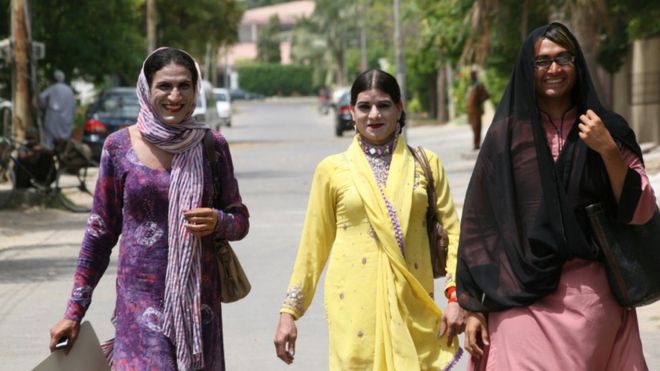
The experience of 35-year-old Nadeem Kashish, currently the leader of Pakistan's She-Male Association for Fundamental Rights, was not that of a respected person in the community, as described so delicately by Mr. Paracha: "God's chosen". She speaks of herself as a child viewed as effeminate earning her ridicule and violence and her experience of humiliation made to perform in a circus as a teenager of decided oddity. Attempting to live as an adult man, she married but the woman who bore his/her son died in childbirth, before she/he finally accepted herself as a transgender woman.
She spent years living in a community of "Khawaja siras", third sex, the community inclusive of cross-dressers, eunuchs and intersex people along with the transgendered. Their families would have nothing to do with them, they were routinely subjected to discrimination in society and to violence. Living among adoptive families of like people these communities have a mother-figure, a guru providing shelter and protection in exchange for earnings being handed over from sex work, dancing or begging.
Ms. Kashish eventually had enough of this kind of enforced servitude, of being taken advantage of, opening a small shelter of her own in Islamabad for transgender people shunned by their families and attempting to avoid the Khawaja sira system that exploits young transgendered people having nowhere else to turn for comfort and security.
Under these conditions and circumstances it hardly seems likely that an entire population where families shun and disengage completely from their transgendered relatives, leaving them to cope on their own, to be exploited and to experience contempt and violence as their just desserts, would be amenable to a wholesale turnabout in social attitudes.
A transgender activist, Alisha, died last month after delays in treatment at a local hospital Getty Images
The real challenge of which Ms. Jameel speaks does not arrive from a top-down approach, in any event, but from a bottom-up transition. And under the prevailing conditions where all Middle East and Asian mostly Muslim societies view other-gendered people as unclean and beyond contempt, acceptance will be a long time coming, unfortunately.
To the credit, surprisingly enough, of the Supreme Court, a 2012 declaration was issued declaring equal rights for transgender citizens that included the right to inherit property and equal opportunity in education and employment. They were granted voting rights in 2011. Transgendered people were included in the country's national census for the first time and in June the government issued passports including a category for the transgendered.
Finally, and astonishingly, a group of Pakistani clerics issued a religious edict last year stating that people with "visible signs" of male or female atttributes could marry someone of the opposite sex. Societal attitudes, however, for the most part remain etched in stone. The transgendered remain shunned and abused. Unable to find employment they are forced to become beggars or prostitutes.
A social worker said the fatwa was a
good step, but that issues would still remain until transgender marriage
was officially legitimised Getty Images
"I also had an opportunity to have a deeply personal and wide-ranging, thoughtful conversation with the leader of my own faith." "He reminded me that his entire life has been dedicated to supporting marginalized people in the world." "We talked about how important it is to both highlight the scientific
basis of protecting our planet, with the moral and ethical obligation to
lead and to build a better future for all people on this earth." Canadian Prime Minister Justin Trudeau
Prime Minister Justin Trudeau presents a gift with wife Sophie Gregoire
Trudeau when meeting with Pope Francis for a private audience at the
Vatican on Monday.(Sean Kilpatrick / THE CANADIAN PRESS)
Pope Francis holds what may arguably be called the highest office of any individual in the world, as hierarchical representative of the world's most followed religion, Roman Catholicism. This Pope in particular is a man of humble origins and great tact. The Canadian Prime Minister is a man who was born to wealth and privilege, and he exhibits the arrogance of entitlement in both his private and his public life while never failing to congratulate himself on his liberal social open-mindedness.
As a member of the Roman Catholic religion, and seemingly proud to call himself such, he has deliberately and calculatedly chosen to flout the most basic of Catholicism's trusts and beliefs. The Church abhors abortion, euthanasia and the diminishment of the covenant of marriage between a man and a woman by the introduction of same-sex marriage. Whereas Justin Trudeau, self-proclaimed feminist and promoter of a woman's right to choose, defends these anti-Church social alternatives.
Pope Francis has habitually deferred kindly to his visitors; welcoming them and listening carefully to what they have to say. Justin Trudeau had much to say in the sense of setting out to teach the Pope how he should view the obligations of the Roman Catholic Church to its adherents in Canada, in particular members of the Indigenous community of First Nations in Canada. They are owed, maintains Mr. Trudeau, an abject apology from the Pope asking forgiveness for the Church's part in establishing residential schools for First Nations children in the last century and beyond.
Residential schools, established by order of the Government of Canada in association with Canadian church councils, Protestant and Anglican and Catholic, to teach Aboriginal children the basics of self-care along with academic lessons taught in any other public school are in stark disrepute in Canada. Blamed for separating children from their families, families which were often dysfunctional. The purpose was to guide children into the mainstream of Canadian culture and values.
In the process, First Nations language, culture and values were discouraged in the hopes that the children would cleave instead to mainstream Canadian values, becoming proficient in English in preparation for joining the wider society. Great Britain has a long tradition of residential schools for the privileged. Children become homesick for what is more familiar to them and the absence of their family members from their lives becomes painful to them.
Moreover, in these schools punishment was often harsh and physically violent. Also prevalent in the schools was incidents of abuse, both physical punishment from teachers and sexual advances from other students and sometimes teachers. Children in residential schools were well fed, clothed and housed and had access to medical treatment. Despite which when diseases of the early and mid 19th Century and early 20th Centuries played havoc in communities throughout the land they did not fail to visit misery and sometimes death on the residential schools.
All the positive features of those schools; the bulk of the well-meaning and caring school personnel and teachers, the advantages given to the First Nations children in preparing them for living in a more generalized society, the capacity to look after themselves, the awareness of the importance of good hygiene and dietary information for proper health along with discipline in their lives has been overlooked in the blame cast upon a system that deprived children of their families and families of their children.
Many wrongs have been suffered by Canada's Indigenous populations. The residential schools were not necessarily among them, however. But a culture of victimization has evolved to full throttle by First Nations groups battling the scourges of alcoholism, drug abuse, lethargy, welfare dependence, family dysfunction, and the most dire, violence directed from within against their own, where women and girls are abused violently, and children have no respect for anyone, nor hope for their own futures.
Persuading Pope Francis that it would be in the best interests of the Church and the Church's First Nations flocks in Canada to have him apologize for the Catholic Church's role in the residential schools in Canada is no solution to the complex and wretched situation of First Nations in Canada. And for Canada's Prime Minister to suggest that it is, represents an absolutely misdirected arrogance of the first water.
Pope Benedict did, on one occasion, express anguish and sorrow over the outcome of the residential schools being a disaster as claimed by First Nations who use it as an excuse for everything that goes wrong in their communities, rather than examining their own culture's lack of values and the kind of devotion to the emotional and practical needs of the young to prepare them for their futures. Instead, First Nations communities face an epidemic of suicides among the young, drowning in hopelessness.
Rather than addressing their failed responsibilities, the thought that an apology from the Pope for a situation he had nothing to do with, on behalf of a Church which followed the initiative of the-then Government of Canada, First Nations communities simply continue their trajectory of victimhood and blame directed toward others, failing the introspection and dedication required to delve into the origins and to solve problems that bedevil their communities.
"People trust us because we don't use the people as customers or voters." "Every failure of the system proves the idea of the anarchists to be true." "They [refugees in dire need] are living organisms: Kids go to school, some wee born in the squat, we've had weddings inside." Tasos Sagris, 45, Void Network anarchist group, Athens, Greece
"We decided to do
something in Athens about the refugee crisis. We had a full summer of experience under our belts and felt that
refugees needed a safe space when they get to Athens, especially as the
weather gets worse. From Athens, they still have a long journey ahead of
them." "The act of squatting in this building was a message to the government:
It is failing everywhere and we are putting a spotlight on it." "We are anti-authoritarians. We reject the assistance of the
state, NGOs, charities and businesses." "This is a project by the people. We believe that these are the key
principles of self-organisation, and we want to take the struggle into
our own hands." Mimi, 34, anarchist, squat member
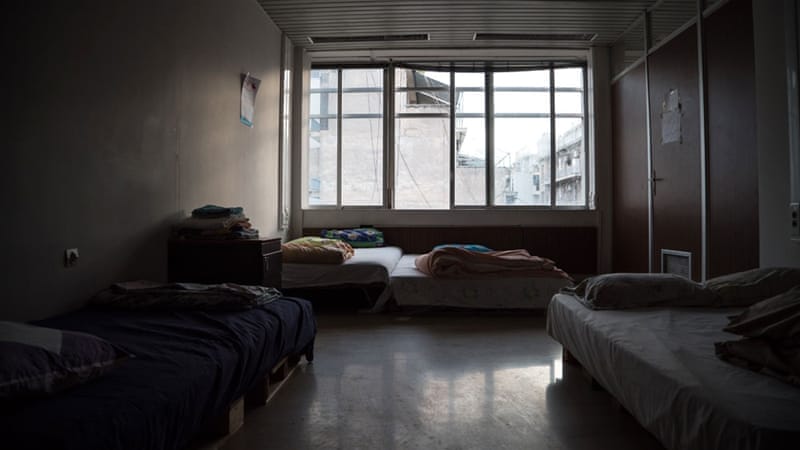
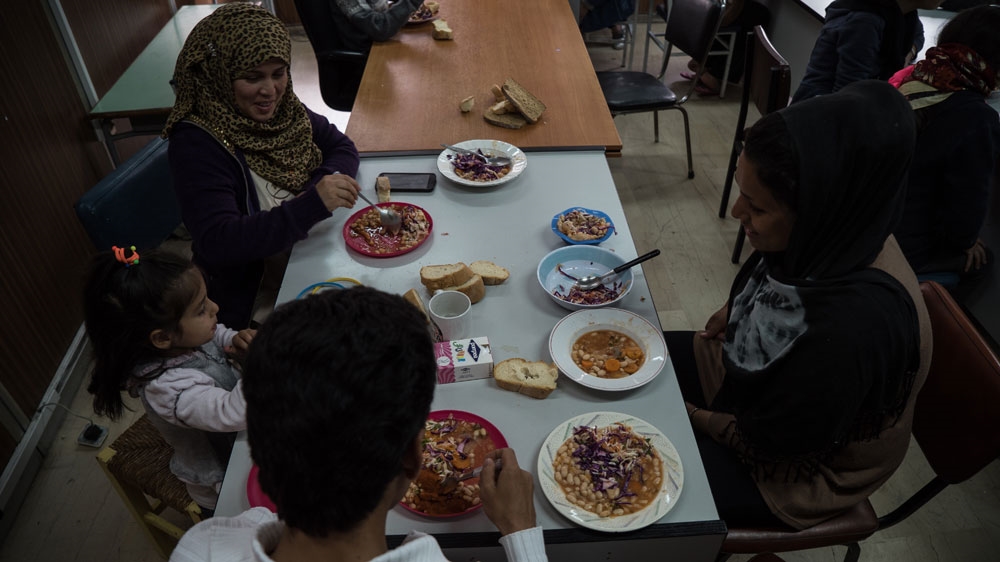
Greek anarchists provide a shelter for refugees at an abandoned government building in Athens [Sorin Furcoi/AL Jazeera)
Greeks may be living in parlous economic times, as one of the European Union's most financially troubled states, forced to live in a kind of austerity that harms Greek pride leading the population to wonder whether they'd be further ahead out of the EU, yet the country is also challenged with a huge influx of refugees and migrants from the Middle East and North Africa, and is doing what it can to cope. Even so, there are some among its citizens who are critical of what the state provides for the refugees.
State-run refugee camps are cramped and crowded, holding over 60,000 migrants and asylum seekers. They are seen to be hugely inadequate, so much so that human rights groups have condemned the camps, characterizing them as squalid and unsafe. A situation which has led Greek's anarchists to take action of their own. And that action has resulted in the anarchists responding to the plight of the refugees by providing food and shelter.
Shelter that has arisen out of their propensity to defy the norms of civil law by occupying buildings no longer in use and transforming them into squats that they now operate as abodes for refugees, alongside catering to their own needs. Refugees who are grateful for the generous space they are given and the dignity they are afforded by the privacy and concern for their well-being that the anarchists have devoted themselves to.
Austerity policies forced upon Greece by global circumstances whose recession in 2008 left the country in worse shape than many of its EU counterparts has left a government with scarce resources, where dwindling social benefits offered to citizens fail their needs. In that failing many citizens no longer have faith in their government. And so, the ranks of the anarchist class have swelled as people decide to take matters concerning them into their own hands.
Among concerns they have is the well-being of people worse off than they happen to be. Social activism perhaps serves as a restorative balm for people who discover that their dreams and aspirations have been compromised by circumstances beyond their control. And what they can control, they are dedicated to. Citizen action has now resulted in "self-managing social centers" cropping up across the country supported through private donations, from the proceeds of concerts, exhibitions and bars open to the public.
Some 250 of these "self-managing social centers" have now been established across Greece. Some of those involved have focused their attention on the provision of food and medicine handouts to alleviate poverty and the collapse of public services. Leftists and anarchists have found common cause in focusing on housing refugees which Greece became host to in 2015 since the European Union and the Balkan nations tightened their borders, leaving refugees stranded.
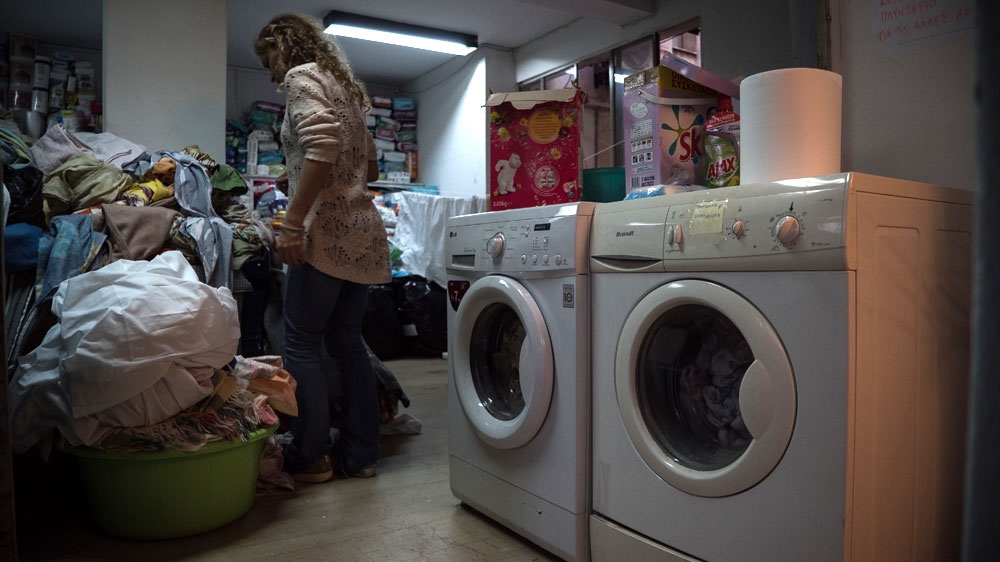
Even volunteers' duties at Notara are divided up
according to anarchist principles and everyone participates in the
work [Sorin Furcoi/AL Jazeera]
But living in 15 buildings, abandoned and now under the charge of anarchists in a burst of citizen action, the role of the anarchists has changed in reflection of what the times require. And at the present time Greeks have developed a deep distrust of authority, mostly thanks to the austerity imposed on the country wracked with debt to international creditors.
So in Athens, the centre of much of the anarchists' attention, in the bohemian neighbourhood of Exarchia squats have bee developed. Police do raid some of those squats operated by anarchists in Thesaloniki, on the Isle of Lesbos and in Athens, but not destructively, stopping short of a full crackdown, reflecting the Syriza party of leftist Prime Minister Alexis Tsipras's values.
The anarchists contend their squats are badly needed as a humane alternative to the state-operated camps. One of the Exarchia squats, a former state secondary school abandoned as a result of structural problems, is home now to 240 refugees from Syria. A chicken coop has been established on the roof. The squats become self-organized communities independent from any state enterprise and nongovernmental organizations.
Notara 'is far more organised than the camps run by the government', say volunteers [Sorin Furcoi/AL Jazeera]
This represents a general opinion site for its author. It also offers a space for the author to record her experiences and perceptions,both personal and public. This is rendered obvious by the content contained in the blog, but the space is here inviting me to write. And so I do.