Canadian Justice: Ease off on Abusers, Leave the Abused to Fend for Themselves
"The only way to make myself feel safe was to remove myself and get as far away from the threat as possible."
"I feel safer here [Mexico] because the person that attacked me does not live here. That's just basic common sense."
"I feel safer because I'm very far away. ... It could have been Germany, it could have been Peru, it could have been the USA."
Anne Welyki, The Elevate Report
"All eight charges, five in the provincial and three in the federal were stayed against my ex."
"I can't say his name, because it will forever be known as 'alleged' abuse."
"I can't live in Canada anymore, because it's not safe for me."
Cait Alexander, now resident in California
The caption for this photo posted to X on June 5 reads: "Thank you
Pierre Poilievre for taking the time to chat. I would have loved the
opportunity to share in detail why I left Canada and how I believe it
can be fixed." (Credit: Lioness0817/X)
The
infamously intractable issues of violence against Canadian aboriginal
women has been a matter of shame, but not much mystery in the matter of
'Missing and Murdered Aboriginal Women' in Canada. With government
vowing time after time that this tragic civilizational assault against
the most basic of human rights for women of Indigenous heritage must
stop. This is an issue well enough known, that for the most part
injuries and deaths and absences of aboriginal women are the result of a
cultural abomination, when they are victimized by none other than their
intimate partners, aboriginal men.
In
Canadian jurisprudence it has become a fait accompli that when judging
aboriginal men for crimes they must be viewed through the prism of
colonialist trauma. Prison sentences meted out to aboriginal men who
commit crimes and are convicted of those crimes must take into account
their aboriginal backgrounds and the assumption that they are victims of
racism, poverty and lack of opportunities in the white society that
colonized Canada thus victimizing the Indian tribes already settled in
the country. In penalizing Indigenous men to a lesser degree than their
crimes warrant, Indigenous women are doubly victimized.
Assembly of First Nations
But
this uneven application of the law has also been extended to include
people of colour as well as migrants without status. Indigenous men and
Blacks are over-represented in Canadian prisons despite that they
represent a minority in Canada. Their penchant for committing crimes
against society is higher than other groups in society, including the
majority. That their numbers are over-represented in comparison to their
minority numbers within the population is viewed as a fault in Canadian
society, rather than as a possible reading that these groups tend to
gravitate in greater numbers to the commission of crimes.
To
sentence a migrant, refugee or undocumented person in Canada to a
prison term long enough for them to be incarcerated in a federal prison
is to consign them to a removal order by Canadian Border Services,
leading judges to opt for lesser sentences through the compassionate
lens of 'fairness' to a presumed underdog. Invariably all too frequently
those who commit criminal acts tend to take advantage of the situation,
where bail is also readily available, enabling them to return to the
commission of criminal acts resulting in minimal punishment.
Conservative
leader Pierre Poilievre happened to describe an encounter he had with a
woman from Vancouver who left the country for her personal safety under
duress. At Vancouver International airport the woman had approached Mr.
Poilievre to briefly inform him that she had left Canada to escape from
an attacker. "You're my favourite Canadian", she told him. Then she described her reason for leaving Canada. "I said I'd like to come home, and he said, in return 'We're going to get you home'," she later explained during an interview on the podcast The Elevate Report.
For
his part, Mr. Poilievre mentioned the encounter with an anonymous woman
when he responded to a question during a Vancouver press conference
about public safety. "I met a lady at the airport the other day who told me that she moved from Vancouver to Mexico so that she would feel more safe",
he stated. Online mockery over the statement was quick to follow.
Flavio Volpe, president of the Automotive Parts Manufacturers'
Association wrote on social media: "Of all the things that did not happen, this one did not happen the most."
Doubts
over the veracity of Mr. Poilievre's statement was raised again when a
reporter, after speaking to World Cup fans in Vancouver relayed to him
that they felt "pretty safe"; that "data shows that Mexico is far more unsafe than Vancouver". Mr. Poilievre was not to be shaken; he responded that the encounter at the airport really had occurred, that "there
are a lot of women who frankly feel very unsafe in Canada today. And
there are cases we've had of women testifying before parliamentary
committees that they have left Canada because their partner, their
violent partner, has been released from prison despite crime after crime
after crime."
End Violence Everywhere
Cait Alexander who had testified to the Status of Women Committee in 2024, founded the group End Violence Everywhere.
She had been brutally beaten by an intimate partner who was freed on
bail the following day. She lives now full-time in California.
"I left the country for certain reasons and I'm upset about it. I love my country."
"Do you think this would be my first choice. Or do you think I would rather be at home with my friends and family?"
"Two weeks after a panel for the B.C. College of Nurses and Midwives ruled that I was guilty of unprofessional conduct for sharing my views on sex and gender ideology, Vancouver Coastal Health authority fired me from my job as a registered nurse of 13 years. I was given zero severance pay."
"I have never once had a patient complaint. Echoing the language of the BCCNM ruling, my former employer accused me of 'erasing' and 'denying' the existence of transgender identified persons -- including via my writings for National Post. The decision to fire me was bolstered by the BCCNM ruling."
"Also like the BCCNM, Vancouver Coastal Health has completely lost touch with reality -- biological and otherwise. In their confidential investigation report: they used scare quotes to insinuate that I was sharing incorrect facts: such as: only women give birth, and women do not have penises."
"Sharing such 'facts', they wrote, 'den[ies] the reality of trans people without surgical interference'."
Amy Hamm, veteran registered nurse and journalist
"Over 75 percent of incarcerated women have been victims of some form of physical, sexual, emotional or psychological abuse, primarily at the hands of men."
"[Some prison inmates are] so traumatized by their experiences that they are unable to deal with men at all."
Expert testifying at the 2001 Canadian Human Rights Tribunal
"Many of these women are psychologically damaged, as a consequence of the physical, psychological and sexual abuse they have suffered at the hands of men."
"Like transsexuals, female inmates are a vulnerable group, who are entitled to have their needs recognized and respected."
Human Rights Tribunal report
In Canada, under the Liberal government of Justin Trudeau, a champion of the LGBT2+Q social/cultural movement, Parliament passed Bill C-16 to fully recognize the human rights of gender-differential individuals, leading to women's prisons becoming open to the presence of transgender males: "Offenders will be placed according to their gender identity or expression in a men's or a women's institution, if that is their preference, regardless of the sex (anatomy)." Doors of women's prisons have been opened to trans-identifying male inmates with fully intact male genitalia.
Translated, that means female inmates face risk of sexual assault by trans inmates, risk sexually transmitted infections and must cope with stalking, where women are followed to the bathroom and showers; trans-identifying males standing directly outside private stalls.Women in prisons lodge complaints of being subjected to sexual comments, they experience anxiety, anger, depression, hopelessness, post-traumatic stress disorder and suicidality. They experience flashbacks of stressful, violent, emotionally disturbing events with men.
Canadian Women's Sex Based Rights (CAWSBAR), a women's advocacy group, filed a Charter challenge of the policy in Federal court, claiming harms, if proven in court, that constitute a violation of female inmates' Charter right to security of the person. Forcing female inmates to share intimate spaces with trans-identifying men undermines the privacy and human dignity of women, argues CAWSBAR; cruel and unusual punishment prohibited by the Charter.
Prior to Bill C-16, preoperative males were not permitted into women's prisons. The Canadian Human Rights Tribunal in 2001 heard testimonies from numerous experts, that most male-to-female transsexual inmates remain sexually attracted to women, posing risk of preying on female prisoners.
Re: Brief submitted by Lara Forsberg, member of the Canadian Women’s Sex Based Rights (CaWsbar) initiative Dear Parliamentarians, The Correctional Service of Canada (CSC) has implemented an interim policy of placing male prisoners in women’s prisons if these prisoners identify as women1. This policy has resulted in violent prisoners being transferred from men’s to women’s institutions. It also runs counter to the Geneva Convention that female prisoners should be confined in separate quarters from male prisoners. As such, we are asking that CSC respects female prisoners’ rights to dignity and safety.
While the total size of the male prisoner population in women’s federal prison system is currently unknown, violent individuals in men’s institutions have been requesting transfers to women’s institutions since the interim policy’s implementation. For example:
Between June 1, 2017, and December 3, 2018, 7 of 8 individuals transferred from a federal penitentiary for men offenders to a federal institution for women offenders, had been convicted of violent crimes, including two prisoners convicted of sexual offences (see Attachment B). Given that there are currently less than 700 women housed in Canada’s federal prison system, even a handful of transfers will have a deleterious impact on women’s security - especially since considerations of the safety of female prisoners seem to rarely influence a decision to house a male prisoner in the female estate.
"Nothing less than that is going to protect the safety of Indigenous women, girls and members of the 2SLGBTQQIA communities." "Otherwise, the criminal justice system is seen to further devalue their safety." "We're looking at many pieces of legislation, and not just federal, but provincial and territorial as well. We're also looking at band governance under the Indian Act." "Too often ... we heard from family members and survivors that an accused individual was released back into the community without proper protection for the complainant and her family." "It's to recognize the importance of the individual who has been killed and the importance of their life. That tells all of Canada that if you kill one of these women, it's murder in the first degree, the strongest penalty and the strongest offence that we can impose." "The sentence has to reflect not only the gravity of the offence but also the circumstances of the offender. And so does that mean criminalizing Indigenous men? Well, it means criminalizing all men who commit violence against Indigenous women, girls and 1SLGBTQQIA people. What's wrong with that?" Marion Buller, chief commissioner, National Inquiry Into Missing and Murdered Indigenous Women
Marion Buller, Chief Commissioner of the
National Inquiry into Missing and Murdered Indigenous Women and Girls,
speaks during a news conference at Haida House at the Museum of
Anthropology, in Vancouver on Thursday, July 6, 2017. Darryl Dyck/The Canadian Press
"I think that's a slippery slope that's quite dangerous when considering the appropriate penalty for murder." "You're perpetuating the over-incarceration of Indigenous people." "The answer is not punishing people more, full stop." Tony Paisana, defence lawyer, Vancouver
What's wrong with that? Well, the single most glaring issue perhaps should be that violence against all girls and women irrespective of their origins, their ethnicity, their religion, their ideology, their affiliation, should be treated alike, as horrendous human rights abuses for which the penalty of committing murder should be similar. Marion Buller, testifying before a parliamentary committee, obviously has her opinion on the matter, informed by the project she has been tasked with.
Indigenous women live in communities where a culture of male violence perpetrated against women and girls -- and against other males as well -- is all too common. It is the culture that requires changing, not the law that governs how all Canadians must act in respect to the security and safety of society in general and women and girls in particular. But to her, homicides affecting Indigenous women must be given automatic first-degree murder status, as is done when police officers are killed.
Judges, according to her world view, must identify the complainant as an Indigenous woman and automatically convert their view of justice accordingly as an aggravating factor in the sentencing meted out to an offender. The thing of it is, the 'offender' is in most instances another member of the Indigenous community for whom judges already must consider special treatment taking into account the propensity to alcoholism, drug addiction, poverty, discrimination and the cries of victimhood relating to the residential school system.
The Senate Committee on legal and constitutional affairs studying a wide ranging justice reform bill was given the benefit of Ms. Buller's studied opinion on the root causes of violence against Indigenous women. She had mounted cross-country study sessions inviting Indigenous input on the issue of violence from those who had suffered it and those concerned over its prevalence. Her own report is soon to be unveiled. Not that it is by any means the first; previous such reports have all concluded that the violence suffered by Indigenous women by and large is perpetrated by Indigenous men.
Under current Canadian criminal law a charge of first-degree murder requires evidence a killing had been "planned and deliberate" before the harshest sentence under Canadian law can be mandated as a consequence. Currently, the murder of a police officer or prison employee qualify for the designation of first-degree. Killing committed in the course of a sexual assault, aircraft hijacking, kidnapping or hostage-taking also qualify automatically as first-degree murders as well as terrorist or organized criminal activity leading to murder.
Ms. Muller seeks to 'level the playing field' where crimes against Indigenous women are treated, she feels, less seriously than those against non-Indigenous people. "Let's make it equitable in terms of sentencing", she claims. And therein lies the dilemma. Her solution is anything but equitable, given that Aboriginal women will automatically call up first-degree murder charges, while non-Aboriginal women will not.
At the same time, most of the perpetrators of violence and murder against Indigenous women and girls being Indigenous men and boys, harsher penalties against an already over-represented penal community becomes the result.
The question is, why is Canadian society faced with changing laws meant for the protection of all society in an effort to change the dynamics of a culture that seems unwilling to begin the laborious process of transforming itself from an inward-looking, victimized society to a fully self-supporting part of society willing and determined to take its rightful place within the larger Canadian identity?
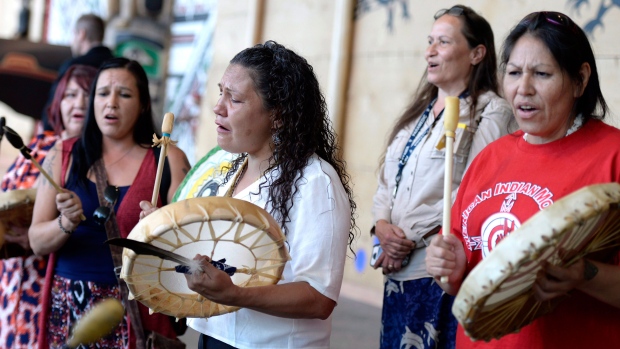
Women drum following the announcement of the inquiry into Murdered and
Missing Indigenous Women at the Museum of History in Gatineau, Quebec on
Wednesday, Aug. 3, 2016. (THE CANADIAN PRESS/Justin Tang)
Violence Committed Against Aboriginal Women : Whose Violence? The Solution to End it Lies Within
"When
we're hunting moose, we're also looking for human remains because there
are so many missing and murdered women along that highway. A lot of
those logging roads we go down are exactly the same kinds of places
where those women's remains are found." "We
got a moose that morning [In 2001]. We had been talking about the
Highway of Tears [Highway 16, northern British Columbia] and Raven said,
'You know Dad, I wish there was a way that we could wipe away some of
those tears'." "Like
a lot of guys in this country, I grew up in the home of a violent,
alcoholic father. That's the story of so many guys who are in jail or
who are struggling. When they were little, their dad would drink and
beat them up." "It's almost as simple as it gets for some of the domestic violence cycles in Canada." Paul Lacerte, Yinka Dene, Carrier First Nation, northern British Columbia
"It's
a reality for a young Indigenous woman like me that life is not as
safe. I've heard the stories of murdered and missing Indigenous women
all my life." "Our family is close and connected. I knew that we could get together and make something happen and make a difference." Raven Lacerte, northern British Columbia
Raven had been out moose-hunting with her father Paul when she was 16,
seven years ago. They had been talking about the dread menace hanging
over aboriginal girls and women of violence and violence that at times
becomes lethal. The pair travelled along the infamous 'Highway of
Tears', Highway 16, where the reality is that up to thirty Indigenous
women are known to have disappeared, never seen again alive. And this
tragic reality was in teenage Raven's mind while she was cleaning the
moose they had bagged.
The thought occurred to her while cleaning the moose hide that it could
be made into a symbol of a new awareness campaign they would launch.
They called their campaign the Moose Hide Campaign and it couldn't have
been more grass rooted in origin than in the mind of a 16-year-old
haunted by the thought of psychopathic violence that harms, injures and
kills women like herself. Raven and her three sisters cut the hide into
small squares and set to work producing 25,000 cards they hand-lettered,
explaining the significance of the hide squares.
Their campaign has swept into the consciousness of Indigenous people
with its initiative to persuade boys and men, Indigenous and non-Native
to commit themselves to taking a personal position to prevent violence
against women. The Lacerte family recently brought awareness of their
campaign to Parliament Hill in Ottawa, a yearly ritual. In the space of
seven years they had managed to proliferate over 1.2 million of the
moose hide patches distributed in over 350 communities.
They engaged with local Ottawa and area high school and post-secondary
students, who set out to pledge themselves to upholding a day-long fast
in a demonstration of their own commitment to see an end to violence
committed against women. Their campaign led politicians, as they are
wont to do, in supporting obvious public-good campaigns to show their
'progressive' bona fides, to come out in support of this initiative of
awareness, education and commitment.
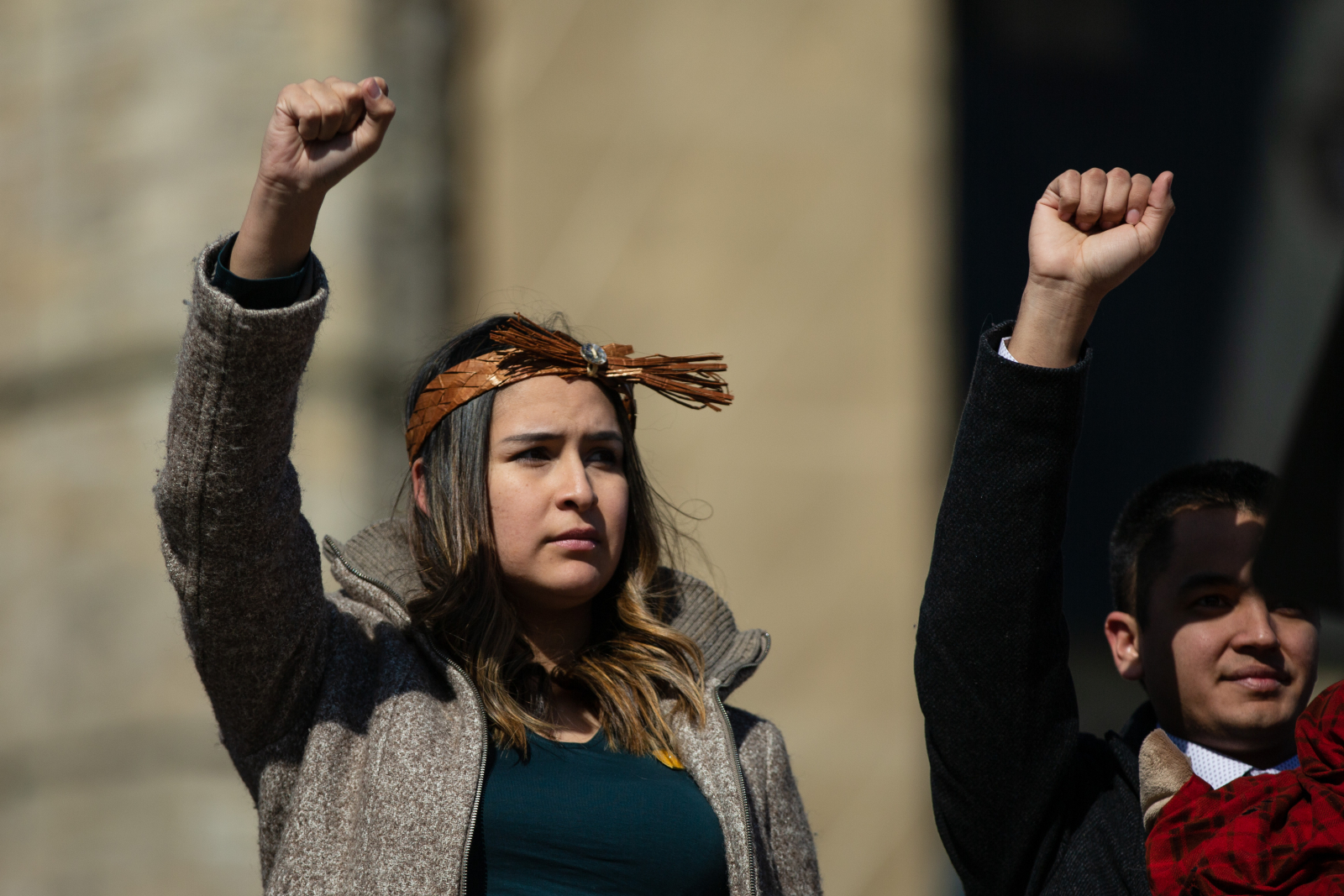
Raven Lacerte, co-founder of the Moose Hide Campaign, raises her fist on
Parliament Hill in Ottawa on Oct. 18, 2018. Photo by Alex Tétreault
And so, Minister of Crown-Indigenous Affairs Carolyn Bennett, addressed a
crowd of several hundred on Parliament Hill, speaking of the
inter-generational phenomenon of violence against women, and inevitably
linking it to the legacy of the residential school system now a topic of
incendiary condemnation against the-then colonialist 19th century
government that had initiated a project to remove aboriginal children
from their families and educate them in the ways of the white folk at
custodial schools. Much like, in fact, the upper-crust British 'public'
school system.
Absolutely everything recognized as First Nations troubles, from
addiction to child neglect, criminal activity to an inherited welfare
syndrome, all the malfunctions and dysfunctions of a people seemingly
incapable of adjusting to ordinary life in a democratic system, to be
responsible for their own well-being, to respect the law, to engage in
generalized social life, to be gainfully employed, to be responsible for
raising healthy, educated children -- is now attributed to the 'trauma'
imposed by the residential schools system.
Sage Lacerte, national youth ambassador for the Moose Hide Campaign, on Parliament Hill on Oct. 18, 2018. Photo by Alex Tétreault
A trauma that has lingered and festered generation after generation,
explaining why it is that more First Nations children are removed from
the bosoms of their incapacitated family to be given shelter and
presumably opportunities by public welfare agencies, and that
aboriginals are over-represented in Canadian prisons in comparison to
their numbers in the general population, and that alcohol and drug
addictions consume too many First Nations lives, all attributable by
default to their grandparents having been placed in residential schools.
The violence committed against Indigenous women is commonplace and
horrendous. And although there is the prevalence of hostility and
discrimination from wider society against First Nations people, a human
rights crime in and of itself, much of the contempt in which they are
held would without a doubt dissipate were they viewed as willing and
able to integrate into general society. First Nations people have a
proud past and they should regard that with pride and dignity. There is a
way to fight bigotry and seek the justice owing them through their own
efforts.
But as long as their communities, with the support of a sympathetic
broader public continue to deny that most of the violence committed
against girls and women come from within their own communities, not
those outside them, and insist on attributing that violence to the
lingering after-effects of the residential school systems and the
degrading loss of self-esteem, nothing will be accomplished. They have
indeed suffered viral discrimination. But they have also spurned
opportunities to shed the past and embrace a presence as unhyphenated
Canadians.
The transition from a dependent people insisting they represent an
entirely different set of "nations" within the greater nation of Canada
which does them no favours, is past due. Victimhood and resentment
cannot forever mark their destiny, but it will unless they take the
mature steps required to shed the dependency of federal handouts to
finally assume their rightful place in the Canada that has prospered by
absorbing people whose goal is simply to be Canadian and in the process
take advantage of all opportunities that status offers them.
Our Goal is to end violence towards women and children. To help
achieve this, the Moose Hide Campaign will distribute 10 Million Moose
Hide squares across Canada.
We will stand up with women and children and we will speak out against violence towards them.
We will support each other as men and we will hold each other accountable.
We will teach our young boys about the true meaning of love and respect, and we will be healthy role models for them.
We will heal ourselves as men and we will support our brothers on their healing journey.
We encourage you to Take Action, Make the pledge, and Stand up to end violence towards women and children.
This represents a general opinion site for its author. It also offers a space for the author to record her experiences and perceptions,both personal and public. This is rendered obvious by the content contained in the blog, but the space is here inviting me to write. And so I do.