"The aim was to prevent any association with Adolf Hitler, so as to
strip it of that mystique."
"[That mystique was encouraged by the Nazis'
cult of personality around Hitler, under whose rule the] Fuehrer birth
house [was an art museum. Hitler only lived there for a few weeks in
1889 before his family moved out]."
Stephan, Mlczoch, head, history department, Austrian interior
ministry
"I think on the whole, the people of Braunau have accepted it and can live with it."
"I think it isn't a bad approach but whether it works as we all hope and expect, we'll have to wait and see."
Braunau Mayor Johannes Waidbacher
"Every year at the Mauthausen concentration camp memorial there's a
ceremony to say: never again. And in Braunau they're saying: let's
forget as soon as possible."
"The world won't forget where the worst mass murderer in history was
born. Wikipedia won't change its entries."
"[There will
be no reduction in the number of neo-Nazis making] the pilgrimage to
Braunau."
Robert Eiter, Mauthausen
Committee/Network Against Racism and Right-Wing Extremism
A new police station will be officially opened in Adolf Hitler's birth
house in Braunau am Inn, Austria, on Wednesday. A memorial stone outside
reads 'for peace, freedom and democracy, never again fascism, million
dead remind.' (Matthias Schrader/The Associated Press)
Austria,
the country that gave the United Nations one of its successive
Secretary Generals, and when it finally became public that he had joined
the Hitler Youth during WWII, his reputation plummeted. That didn't
stop Austrians from electing him to its presidency in defiance of
reports of his Nazi past. Because the United States in its follow-up
investigations determined that he might have been involved in war
crimes, he was declared persona non grata in the U.S.; an awkward
position for a man who from 1972 to 1981 was present in New York,
presiding over the United Nations. Nor later in 1986 to 1992 when the
president of a purported ally of the U.S. wasn't permitted entry to the
United States.
Adolf
Hitler, born in Austria, led Germany to 'occupy' Austria in the 1938
Anschluss and the Germany army was welcomed with huge Austrian public
enthusiastic displays of joy at their annexation. The 17th-century
building near the German border where the Fuehrer was born in 1889 has
undergone a transformation, at a cost of $32 million refurbishment to
turn it into a police station in the town of Braunau Am Inn. The stated
purpose was to deter Austria's ascendant far-right from pilgrimages to
the Nazi dictator's birthplace.
The
once-yellow roughcast walls were whitewashed under contract by the
Austrian architecture firm Marte. Above the entrance now hangs a police
sign. A memorial stone with the inscription: "For Peace, Freedom and Democracy. Never Again Fascism, Millions of Dead Warn", remains dutifully in its place on the pavement before the renovated building.
Austrian police officers stand in front of the new station. (Matthias Schrader/The Associated Press)
Following
Hitler's annexation of Austria, 65,000 Austrian Jews were murdered,
130,000 forced into exile. The far-right political party FPOe founded by
former Nazis is currently Austria's most popular political party. The
political party has about 37 percent backing by Austrian voters, reveals
polling aggregator Europe Elects.
The
house was owned by the same family from 1912 onward, leased in 1972 to
the Austrian state, where it became a centre for disabled people. Its
last private owner, Gerlinde Pommer, vetoed any transformation of the
house, contesting its expropriation by the state, despite that neo-Nazis
frequently flocked to the place where their worshiped hero had been
born.
Finally,
the Supreme Court approved purchase of the 800-square-metre property,
three years after a law was passed in 2015 to take control of the
dilapidated building. Demolishing the site as an option was out of the
question for historians who urged Austria to acknowledge its role in the
slaughter of over six million Jews, as well as Roma, gays, the disabled
and mentally unfit and political prisoners.
Turning
the building into a historical memorial risked the likelihood that
extremist fascists would continue to visit the site, as to a sacred
memorial to the greatness that was the Nazi conquest of Europe. In the
end, an commission of experts guided a final decision to make it into a
police station insisting the permanent police presence would "clearly show" -- stated the Austrian government -- that no commemoration of Nazism would be acceptable, the site would be "neutralized".
"But that's absurd: humanity will not forget where the worst mass murderer in history was born", charged Robert Eiter, representing an association of escapees from the concentration camp, Mauthausen Committee Austria.
Vehicles are parked outside the building where Adolf Hitler was
born, which has been converted into a police station by Austria's
government in hopes of preventing it from serving as a place of
pilgrimage for neo-Nazis, in Braunau am Inn, Austria, July 16, 2026.
REUTERS/Angelika Warmuth
"Within the context of Roman acts of war, there are no comparable finds of fighters."
"There
are huge battlefields in Germany where weapons were found. But finding
the dead, that is unique for the entire Roman history."
Michaela Binder, leader of archeological dig
"They have various different battle wounds, which rules out execution. It is truly a battlefield."
"The
most likely theory at the moment is that this is connected to the
Danube campaigns of Emperor Domitian -- that's 86 to 96 AD."
"In the Roman Empire, there were strict burial rituals and precise
rules had to be observed even for the time after death."
"Since cremations were common in the European parts of the Roman Empire
at the time around 100 AD, body burials are an absolute exception. Finds
of Roman skeletons from this period are therefore extremely rare."
Kristina Adler-Wolfl, head, Vienna City Archeological Department
"In
Vienna, you are always prepared to encounter Roman traces as soon as
you open pavement or soil: after all, Vindobona [the ancient Roman-era
name for what would later become Vienna] laid the foundation
stone of our city."
"Thanks to numerous archaeological excavations in
the area of today's Vienna, a great deal of knowledge is already
available, and yet finds always lead to new and surprising findings."
Vienna’s Councillor for Culture and Science,
Veronica Kaup-Hasler
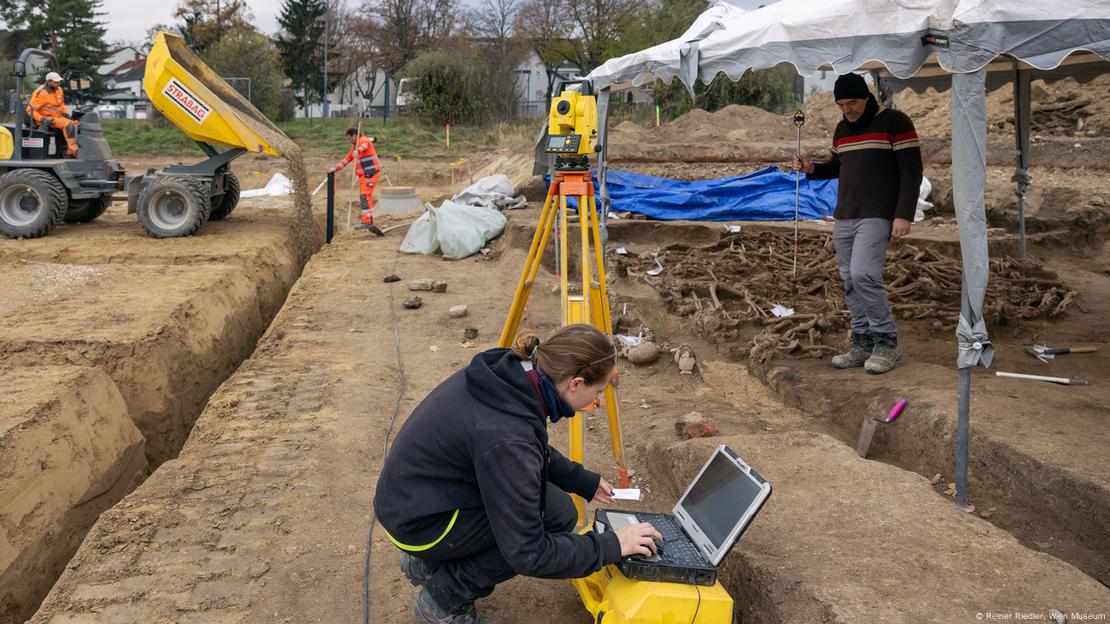
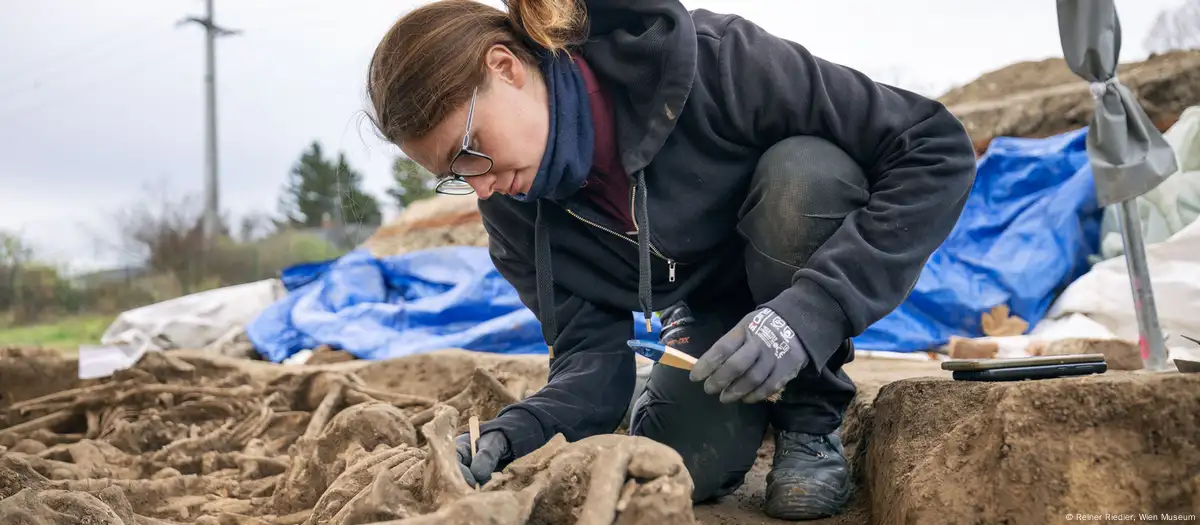
People work on the excavation of a Roman
mass grave from the end of the 1st century AD, in the Simmering district
of Vienna, Austria, Nov. 7, 2024.A. Slonek/Novetus / AP
This
archaeological find dating back to the 1st Century, will take its place
alongside spectacular archaeological findings of ancient Troy, thanks
to the 19th Century perseverance of German
businessman-turned-archaeologist, Heinrich Schliemann who succeeded in
uncovering the presence of Troy, Mycenae, and Tiryns in Turkey and
Greece, against all odds when he was determined to prove that the poet
Homer knew of what he wrote and those minutely-described sites existed.
In
Vienna, Austria, construction crews were busy renovating a soccer field
in October of 2024, when they came upon an unexpected and quite
unprecedented discovery through their excavations. There, before them,
lay a pile of intertwined skeletal remains. They had uncovered a mass
grave that dated to the 1st-century Roman Empire.
Following
archaeological analysis, experts from the Vienna Museum offered a
public presentation of the gravesite -- that they linked to "a catastrophic event in a military context", amidst evidence of the first known conflict that occurred in the region.
Archaeological analysis of the remains determined the men were killed in battle
The
site in the Vienna neighbourhood of Simmering, revealed the skeletal
remains of 129 people. Excavation teams as well, found many dislocated
bones. The total number of victims is over 150 individuals, representing
a discovery of a type never before found in central Europe.
Typically,
soldiers during the Roman Empire would be cremated. It was only during
the 3rd century that this practise deviated. Each of the skeletons
revealed under examination signs of injury. Leading the researchers to
the conclusion that the bodies lying in the pit were deposited there
hastily.
All
of the victims of deadly warfare found in the pit were male, mostly men
aged between 20 to 30 years of age. Surveys indicated robust health
prevailed by virtue of finding that signs of good dental health was
prevalent among them.
Finding the buried bodies of early Roman soldiers is soldiers is extremely rare
Analysis
by Carbon-14 was used to date the skeletal remains to between AD 80 and
130. Those dates, cross-checked against the known history of relics
also discovered in the grave, consisting of armour, helmet cheek
protectors, and studded nails that distinguished Roman military boots
known as caligae.
The
archaeological investigations revealed that injuries sustained by
swords, spears, daggers and projectile bolts were
identified as the causes of death. The expert team of investigators were
led to the conclusion that that those who died had been part of an epic
battle, an engaged military operation that
ended in catastrophe for many.
Broader view of the site at the soccer field where the Roman burial was discovered. (Reiner Riedler/Wien Museum).
Europe, Under Islamist Threat, Forced on Its Back Foot
Europe, Under Islamist Threat, Forced on Its Back-Foot
"We must be able to discuss topics such as freedom of expression in our classrooms without any outside pressure."
"It
may hurt when someone has an opinion that conflicts with your world
view or religious conviction, but they have a right to say so in all
liberty."
Dutch Prime Minister Mark Rutte
"We
are ready to accept every Tunisian, but with conditions preserving the
dignity and giving him rights to access to all stages of judicial
appeals in France before the deportation [in discussions of security
matters between France and Tunisia; the deportation of dozens of
Tunisian migrants]."
Tunisian Interior Minister Taoufik Charfeddine
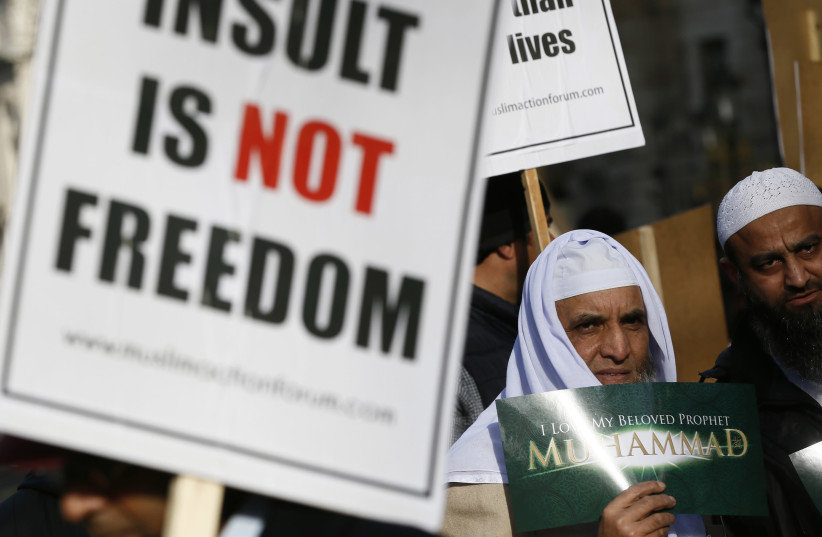
Muslim demonstrators hold placards during a protest
against the publication of cartoons depicting the Prophet Mohammad in
Charlie Hebdo in London (photo credit: REUTERS)
Police
in Germany Friday announced raids they had carried out on the homes and
offices of four individuals they had linked to the 20-year-old man who
launched an attack in Austria. German intelligence had sent a request to
Austria to have them monitor several Germans who had met with Kujtim
Fejzulai, the Islamist attacker shot dead after he killed four people
and wounded over 20 others after opening fire in the central nightlife
district of Vienna on Monday night.
The
Germans had visited Austria this summer and their contacts had been
monitored by German intelligence. Austrian authorities made no move to
alter their risk assessment of Fejzulal, on early release from prison
with a 22-month sentence for attempting to join the Islamic State, but
turned back to France by Turkish authorities. Enrolled in a
deradicalization course in prison, he was considered to have been
effectively deradicalized, earning himself early release.
Police searches near Hamburg in homes and business premises.
According to Austria's Interior Minister Nehammer, "immediate personnel consequences"
had resulted over the botched heads-up over Fejzulai when Erich
Zwettier, head of the local intelligence office in Vienna had resigned.
Mr. Nehammer admitted to "intolerable mistakes" in
tracking the suspect prior to his deadly shooting spree. As a result of
which he ordered the closing of mosques Austrian intelligence now deems
a security risk.
Fejzulai,
born in Vienna, held a North Macedonian passport; his parents had
emigrated from Macedonia to Austria, accounting for the North Macedonian
passport in Fejzulai's possession, as well as an Austrian passport. He
had planned the attack in the knowledge that residents of Vienna would
be out enjoying the last hours before the onset of a new coronavirus
lockdown and curfew. His coordinated actions as he carried an automatic
rifle, handgun and knife took him to six discrete sites in a matter of
eight minutes where he killed four people and injured others, before he
was himself shot dead nine minutes after he began his deadly spree.
Austria's
security services have come under close scrutiny, particularly as it
emerged on Thursday that Austrian authorities had been warned by their
Slovakian counterparts in July of Fejzulai's attempts to acquire
ammunition there, for an assault rifle; a "communication"
problem accounted for the lack of action on Austria's part, according
to Minister Nehammer. A mosque and an Islamic centre that Fejzulai was
known to frequent were closed on Friday, with Integration Minister
Suzanne Raab stating that institutions which are "hotbeds for the blind hatred and violence we experience(d) on Monday" are slated for closure.
Last month, an assailant who shouted "Allahu akbar!"
as he beheaded a woman and attacked and killed two other people with a
knife in a church in Nice placed France on high alert. A 21-year-old
Tunisian had arrived by ship to Lampedusa, a popular Italian island
entry point to Europe for migrants from Africa. He was ordered to return
to Tunisia but made his way to Nice instead, where he planned for and
carried out his deadly attack.
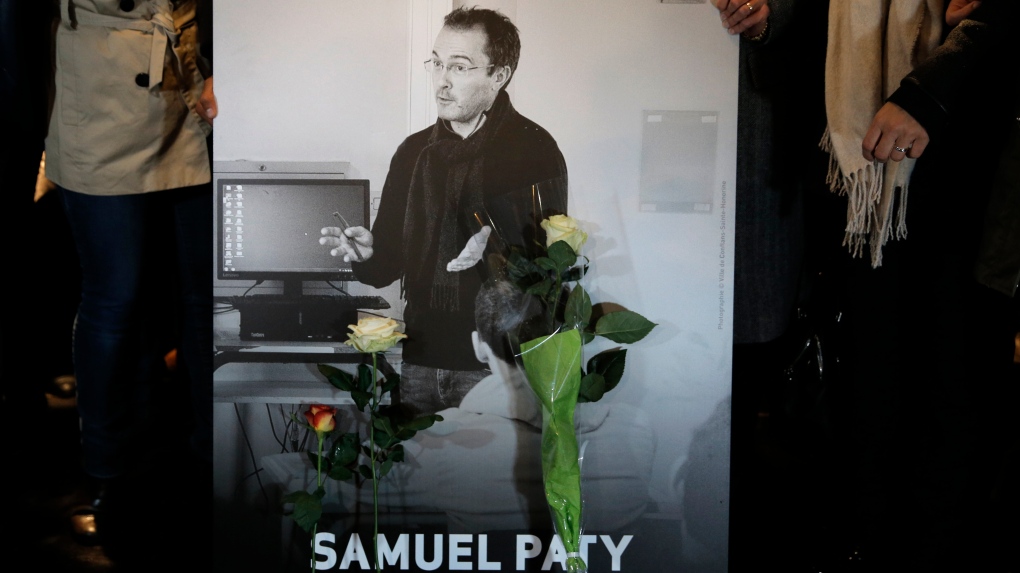
People hold a photo of the history teacher Samuel Paty , who was
beheaded last week, during a memorial march in homage to him, Tuesday,
Oct.20, 2020 in Conflans-Sainte-Honorine, northwest of Paris. (AP
Photo/Lewis Joly)
This
followed the beheading murder of French middle-school teacher Samuel
Paty who had received threats from some of the parents of his students
after he made use of a Charlie Hebdo satirical cartoon mocking the
Prophet Mohammad, in a civics class on French values and freedom of
speech. His murderer, a man of Chechen origins living in France, had set
out to avenge the prophet after a video produced by a Muslim parent
circulated within the Muslim community, identifying the teacher and his
school.
Now,
in the Netherlands a Rotterdam teacher has been forced into hiding as a
result of a classroom discussion of the killing of Samuel Paty. Police
arrested a female teen on suspicion of inciting threats against the
Dutch teacher. Messages were posted on social media, though it was
unclear whether the 18-year-old was a student at the Emmauscollege high
school where the class debate occurred. Dutch Prime Minister Rutte spoke
of the threats as "absurd" and "intolerable".
Two 18-year-old men and a 17-year-old girl were charged Friday with
"criminal terrorist conspiracy" in the murder of French history teacher
Samuel Paty, a judicial source told news agency AFP.
That
class discussion took place as a result of schools in the Netherlands,
France and Germany being requested to hold a moment of silence for Paty
whose death in October shocked the world community. On Monday, during a
classroom discussion at the Emmauscollege, students had taken note of a
bulletin board-posted cartoon that had been in place for years. Among
the students, some took offence at its presence, a cartoon that won a
national prize in 2015, showing a decapitated figure labelled "Charlie Hebdo" sticking out its tongue at a bearded man with a bloody sword.
Soon
afterward a photo of the cartoon began circulating on social media, and
by Tuesday the teacher who led the discussion began receiving threats,
compelling him to go into hiding even as police became involved. That
same day a school in a Paris suburb was reported by Le Monde as having received threats against another teacher, leading to the school being closed.
The Tewhid mosque in Vienna | Georg Hochmuth/AFP via Getty Images
"We heard noises that sounded like firecrackers. We heard about 20 to
30 and we thought that to be actually gunfire. We saw the ambulances...
lining up. There were victims. Sadly, we also saw a body lying down the
street next to us."
Witness Chris Zhao, Vienna
"We are experiencing difficult hours in our republic. Our
police will act decisively against the perpetrators of this hideous
terrorist attack. We will never allow ourselves to be intimidated by
terrorism."
"[The attackers] were very well equipped with automatic weapons [and had] prepared professionally."
"We really can’t say anything about the background yet .Of course an antisemitic background cannot be ruled out."
"One of the perpetrators was neutralized, but several perpetrators
appear to still be on the loose. They seem to also, as far
as we know, be very well equipped with automatic weapons. So they were
very well prepared. It's definitely a terror attack."
Austrian Chancellor Sebastian Kurz
"We, the French people share the shock and grief of the Austrian people,
struck this evening by an attack in the heart of their capital, Vienna.
After France, a friend of ours is attacked. This is our Europe. Our
enemies must know who they are dealing with."
"[Our]thoughts are with the people of Austria - we stand united with you against terror."
French President Emmanuel Macron
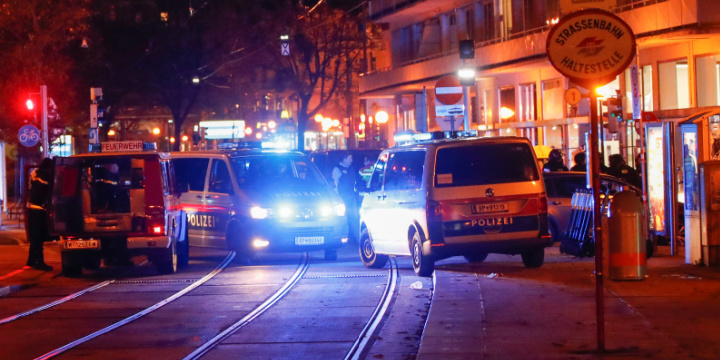
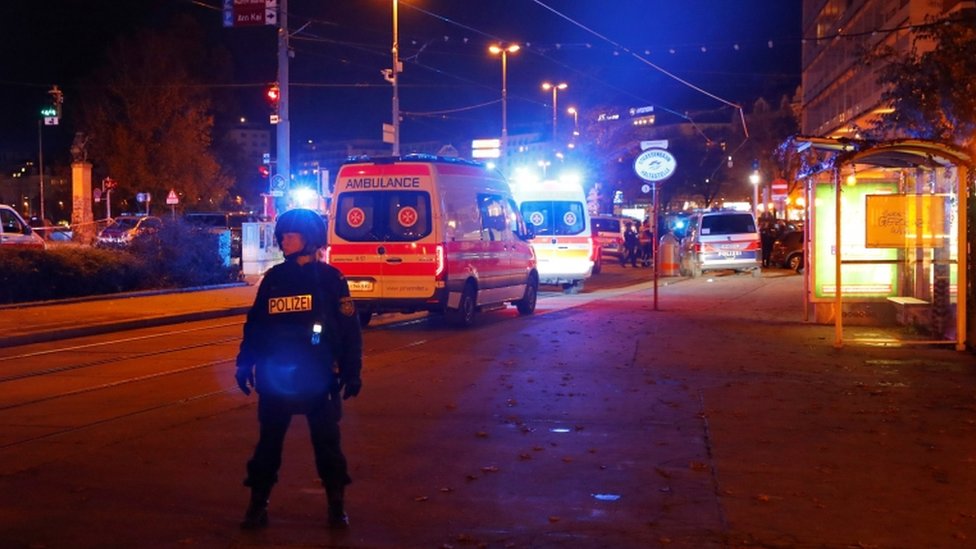
Police block a street near Schwedenplatz Square, after exchanges of
gunfire in Vienna, Austria,, Nov. 2, 2020. Photo: Reuters / Leonhard
Foeger.
Why Vienna? No doubt details and explanations will ensue. For the present, however, the carnage is complete and Austria has been violently inducted into the chamber of horrors represented by Islamist psychopathy. A professionally coordinated series of simultaneous attacks, some six disparate attacks, with the attackers armed with professional weapons of a type not available in Austria. Leaving the question, was some foreign agency involved supplying the attackers with advanced, deadly weaponry, an agency that also went to great lengths to train and coordinate the group of attackers?
France, next door to Austria, is on high alert for ongoing attacks. Austria had no reason to place its emergency services on alert, like most other European nations it stated no overt support for France at its hour of need, facing off against Islamofascists, both internal and external, subjecting its citizens and its institutions to incidents of bloody atrocities. Was the purpose to demonstrate that Islamist jihadis avenging insults to their prophet could strike anywhere at any time? That no non-Muslim country was immune?
Was it easier to send Austria into shock, unprepared for such an attack, than France, prepared and already beyond shock? Since the attackers are now in custody answers may or may not be forthcoming. One person was killed in the attack, another who was wounded later died, and one of the attackers was also killed. While fifteen people were wounded, among them a police officer, and seven of the fifteen were seriously wounded. It took many hours before the standoff was resolved, the attackers taken into custody, the city able to heave a sigh of relief through its shock that the body count hadn't been steeper.
One of the attackers was said to be still at large, leading Interior Minister Karl Nehammer to warn residents not to enter the
center of the city, adding that border checks were being reinforced. Schools would be closed on Tuesday, the minister informed the public. "We have brought several special forces units together that are now
searching for the presumed terrorists. I am therefore not limiting it to
an area of Vienna, because these are mobile perpetrators."
"Upon hearing shots, we looked down [from] the windows [from the synagogue compound] and saw the
gunmen shooting at the guests of the various bars and pubs."
"The gunmen were running around and shooting at least 100 rounds or even more in front of our building."
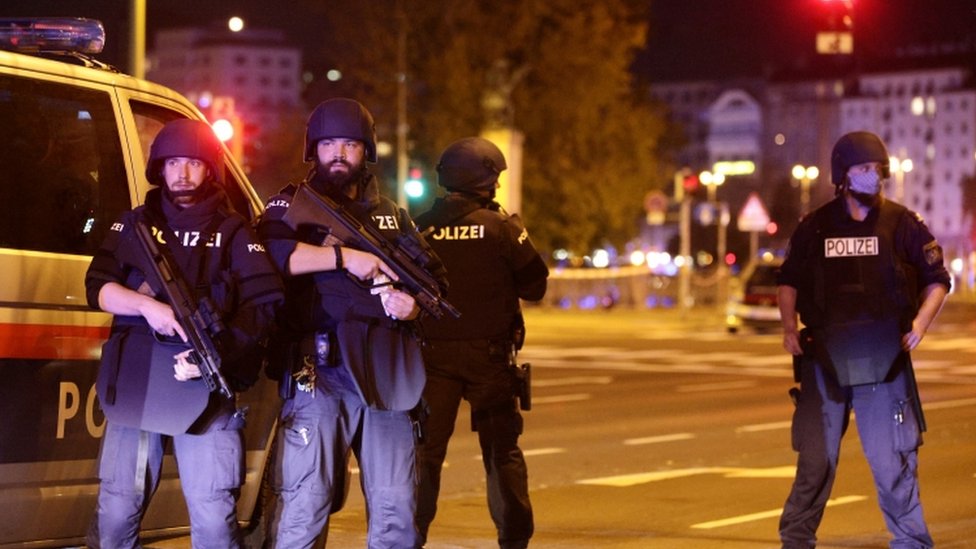
Police sealed off streets near Schwedenplatz in Vienna Reuters
According to police accounts, several shots were fired shortly after 8 p.m.
local time on a street in the city centre and that six
shooting locations were identified. Unverified footage posted on social media showed
gunmen walking through the streets, apparently shooting at random
and wounding several people. People reported hearing shouts of 'Allahu Akbar!' accompanying the shooting.
Videos circulating quickly on social media showed a gunman sprinting down a cobblestone
street while shooting and shouting. One video featured a man gunning down a person
outside what seemed to be a bar on the street housing the synagogue.
Screengrabs of footage appearing on various social media sites showing terrorist attack in Vienna, Nov. 2, 2020.Photo by Screengrab
Two Palestinians attacking the same Viennese synagogue killed two people and injured another 18 people in 1981, while in 19845, three civilians were killed by a Palestinian terrorist group in an airport attack.
Austria now has reason to follow France's suit in ramping up security. The attacks in Paris and Nice, and President Macron's clamp-down on extremist Islamofascist groups in France has earned him condemnation from Turkey, Pakistan, Malaysia and the Palestinian Authority, among others, condemning him for alienating Muslims, insulting Islam and in his proactive and preventive measures, according to his Muslim critics, creating the aura for more and greater violence to be visited upon France and its citizens.
The tens of thousands of soldiers now deployed in protection of sensitive sites such as places of worship and schools, will now see their counterpart taking place in Austria. And should Islamofascists, spurred on and incited by Friday-night mosque prayers and others like Recep Tayyip Erdogan to ever greater violent excesses take place, those European countries now commiserating with Austria who had withheld their support for France, may see their own borders breached and atrocities committed within them.
A number of people have been taken to hospital, including some with serious injuries Reuters
Gangs
of thugs in brown shirts owned the streets. They drove around in
trucks, flashing their guns and their swastika armbands, hooting at the
pretty girls. If they wanted to pick you up or beat you up, they did so
with impunity. Anybody who resisted was beaten or killed or taken away
to Dachau or Buchenwald or some other concentration camp. (You must understand that at that time, the concentration camps were prisons where opponents of the Nazi regime were detained . . . The
inmates were made to work at hard labor and lived in dreadful
conditions, but the words 'concentration camp' came to stand for
monstrous cruelty and almost certain death. Nobody even imagined there
would one day be a death camp like Auschwitz.)
Cheering crowds greet Hitler as he enters Vienna. Austria, March 1938.
— Wide World Photo
How
can I describe to you our confusion and terror when the Nazis took
over? We had lived until yesterday in a rational world. Now everyone
around us -- our schoolmates, neighbours, and teachers; our tradesmen,
policemen, and bureaucrats -- had all gone mad. They had been harboring a
hatred for us which we had grown accustomed to calling 'prejudice'.
What a gentle word that was! What a euphemism! In fact they hated us
with a hatred as old as their religion; they were born hating us, raised
hating us; and now with the Anschluss, the veneer of civilization which
had protected us from their hatred was stripped away.
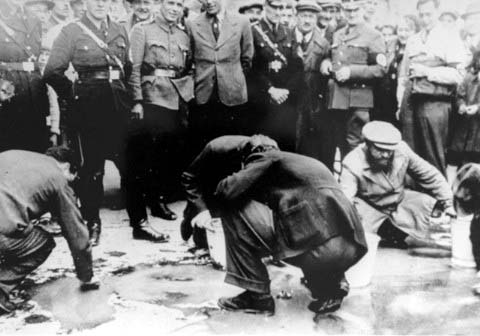
Jews in Vienna forced to scrub Schuschnigg's slogans off the sidewalk -- www.HolocaustResearchProject.org
On
the pavements, protesters had written anti-Nazi slogans. The SS grabbed
Jews and forced them at gunpoint to scrub off the graffiti while crowds
of Austrians stood around jeering and laughing. The
Nazi radio blamed us for every filthy evil thing in this world. The
Nazis called us subhuman and, in the next breath, superhuman; accused us
of plotting to murder them, to rob them blind; declared that they had
to conquer the world to prevent us from conquering the world. The radio
said that we must be dispossessed of all we owned; that my father, who
had dropped dead while working, had not really worked for our pleasant
flat -- the leather chairs in the dining room, the earrings in my
mother's ears -- that he had somehow stolen them from Christian Austria,
which now had every right to take them back.
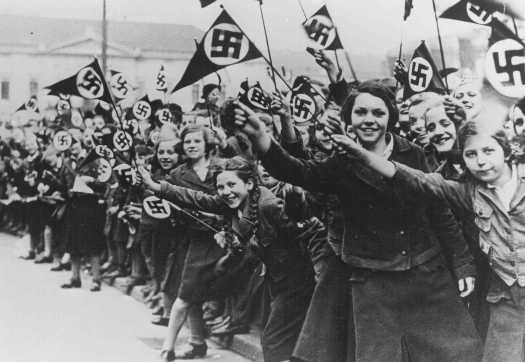
Members of the League of German Girls wave Nazi flags in support of
the German annexation of Austria. Vienna, Austria, March 1938. — Dokumentationsarchiv des Oesterreichischen Widerstandes
Did
our friends and our neighbors really believe this? Of course they
didn't believe it. They were not stupid. But they had suffered
depression, inflation, and joblessness. They wanted to be well-to-do
again, and the fastest way to accomplish that was to steal. Cultivating a
belief in the greed of the Jews gave them an excuse to steal everything
the Jews possessed. We
sat in our flats, paralyzed with fear, waiting for the madness to end.
Rational, charming, witty, dancing, generous Vienna must surely rebel
against such insanity We waited and we waited and it didn't end and it
didn't end and still we waited and we waited. The
restrictions against Jews spread into every corner of our lives. We
couldn't go to movies or concerts. We couldn't walk on certain streets.
The Nazis put up signs on Jewish shop windows warning the population not
to buy there. Mimi was fired from her job at the dry cleaners because
it had become illegal for Christians to employ Jews. Hansi was no longer
allowed to go to school.
Uncle
Richard went to the cafe where he had been going for twenty years. It
now had a Jewish side and an Aryan side, and he sat on the Jewish side.
Because he had fair hair and didn't look Jewish, a waiter, who did not
know him, said he had to move to the Aryan side. But on the Aryan side, a
waiter who did know him said that he had to go back to the Jewish side.
He finally gave up and went home. Baron
Louis de Rothschild, one of the wealthiest Jewish men in Vienna, tried
to leave the city. The Nazis stopped him at the airport and put him in
prison, and whatever they did to him there convinced him that he ought
to sign over everything to the Nazi regime. Then they let him leave. The
SS took over the Rothschild Palace on Prinz Eugenstrasse and renamed it
the Center for Jewish Emigration. Right
after Grandmother died, the world held a conference at Evian-les-Bains,
a luxurious spa in the French Alps near Lake Geneva, at which the fate
of the Austrian Jews was up for discussion. Eichmann sent
representatives of our community to plead with other countries to pay
the Nazi ransom and take us in. "Don't you want to save the urbane,
well-educated, fun-loving, cultured Jews of Austria?" they asked. "How
about paying $400 a head to the Nazi regime? Too much? How about $200?"
They couldn't get a cent. No
country wanted to pay for our rescue, including the United States. The
dictator of the Dominican Republic, Trujillo, took a few Jews, thinking
they might help bring some prosperity to the tiny, impoverished country.
I have heard that they did.
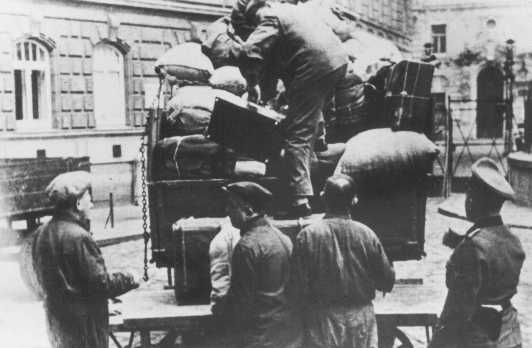
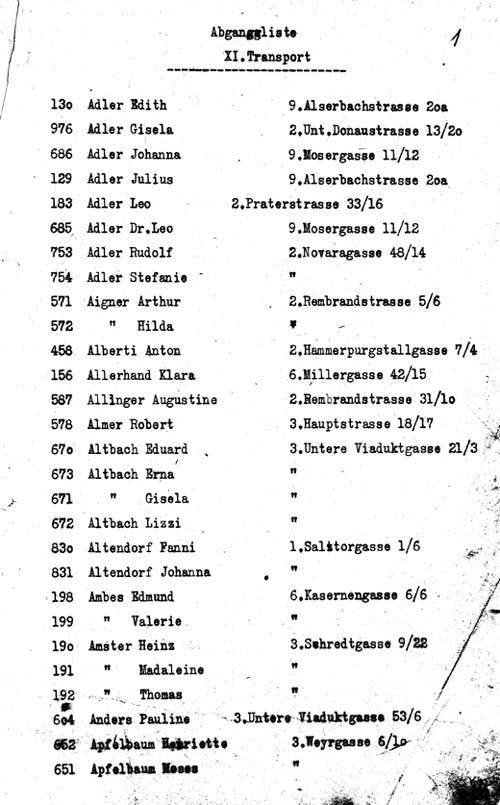
Transport list of Viennese Jews -- www.HolocaustResearchProject.org
From the NAZI Officer's WIFE --Edith Hahn Beer, c.1999
"Expansion and conquest" make one
of the pillars of the Islamist doctrine. For that reason, it requires,
and overtly or covertly struggles for, expanding "rights" in non-Muslim
countries.
It is simply futile to expect Islamists to demonstrate a crumb of the tolerance they demand of non-Muslim nations.
Islamists often do not hide it: They love head-count democracy in
lands where they make a majority; and hate it in lands where they are in
the minority. They would crush other faiths, including different sects
and practices of their own faith -- or no faith, for that matter --
where they are in power.
In that happy set-up, the intriguing word "tolerance" is nowhere to
be seen. Respect for the minority is too rare a commodity: "This is our
land, we are in the majority, we rule and we rule it as we wish; and if
you don't like it, go to hell."
Surprisingly (or maybe not), Islamists happen to become dedicated
warriors of tolerance, religious freedoms, human rights and all other
fancy tags when they live (in their choice of) Muslim-minority
countries. Just imagine what could happen if 1.5 million Israelis lived
in the Gaza Strip bordering a militarily, economically and
technologically mighty, larger, more populous Hamas-ruled Palestinian
state with a Jewish minority. Tolerance and rights for the Jews? Would
you want to be a Jew there?
Naturally, the Islamist Turkish mind is not programmed to think
differently from: "Let's crush the infidels at home and seek broader
rights for Muslims in non-Muslim lands in Europe, America and Asia."
Pluralism, to their way of thinking, should be the respected norm
-- where Muslims are in the minority. The latest Austrian law
regulating Islamic practice is no exception to the Islamist's golden
rule.
The new Austrian law, passed on Feb. 25, aims at integrating Muslims
and fighting Islamic radicalism by promoting an "Islam with an Austrian
character." It seeks to reduce outside meddling by prohibiting foreign
funding for mosques, imams and Muslim organizations in Austria. It also
stresses that Austrian law must take precedence over Islamic Sharia law
for Muslims living in the country.
Mehmet
Görmez (left), head of the Turkish government's Religious Affairs
Directorate, denounced Austria's new "Islam Law" and said that Austria
should instead "make an effort to remove anti-Islamic sentiments and
Islamophobia." Johann Rädler (right), speaking for the Austrian People's
Party, said the law "guarantees Muslims more rights, and on the other
hand it serves to counteract undesirable developments."
The new law regulates at least a dozen separate issues, including
relatively non-controversial matters such as Muslim holidays, Muslim
cemeteries, Muslim dietary practices and the activities of Muslim clergy
in hospitals, prisons and the army. The law also grants official recognition
to holidays and commemoration days of the Alevis, the largest Muslim
minority faith in Turkey. The Austrian state will finance lessons on the
Alevi faith taught at both private and public schools.
"In this respect," writes Soeren Kern,
a senior fellow at the Gatestone Institute, "the [Austrian] government
has met all of the demands put forth by Muslim groups in the country."
But Turkey's Islamists and the state religious authority have once
again asked for more rights -- which they meticulously avoid granting to
non-Sunni believers in their own country.
Unsurprisingly, President Recep Tayyip Erdogan slammed the Austrian bill. "On the one hand you tell about the EU acquis [accumulated legislation], but on the other hand you take steps which totally oppose the EU acquis," said Erdogan.
He further said:
"In Switzerland and Austria new regulations pass that [negatively]
influence Muslims' lives ... as if this is in favour of Muslims..."
Echoing the same view, Turkey's EU minister, Volkan Bozkir, said: "We cannot accept any harm to Muslims because of this law."
And Professor Mehmet Görmez, head of Turkey's state-controlled,
pro-Sunni religious authority, or Diyanet, issued a long statement.
Basically, according to Professor Gormez: a) This law does not befit
Austria or Austrian history; b) This law is the outcome of the wave of
"Islamophobia" that has engulfed Europe, and; c) [His] call to the
Muslims in Austria is to display their reactions within the framework of
democratic rules.
Once again, the Turks were not shy about displaying their sheer hypocrisy when they demanded "broader rights" for Muslims in two European countries.
"There were reports of abuses of religious freedom,
including the imprisonment of at least one conscientious objector for
his religious beliefs … The [Turkish] government did not clarify the
legal authority under which the Greek Orthodox Halki seminary could
reopen after being closed for more than 40 years ... Some religious
groups faced restrictions registering with the government, owning
property, and training their members and clergy … Although religious
speech and conversions are legal, some Muslims, Christians, and Bahais
faced government restrictions, surveillance, and occasional harassment
for alleged proselytizing or providing religious instruction to children
…
"There were reports of societal abuses and discrimination based on
religious affiliation, belief, or practice. Christians, Bahais, many
non-Sunni Muslims, including the sizeable Alevi population, and members
of other religious minority groups faced threats and societal suspicion.
Jewish leaders reported some elements of society continued to express
anti-Semitic sentiments. Persons wishing to convert from Islam
experienced harassment and violence from relatives and neighbors."
Turkey's Islamists slammed the Austrian law that recognizes [Muslim]
Alevi holidays, while they themselves resist calls to recognize the
Alevi houses of prayer, or Cemevis, or to grant abstention to Alevi
schoolchildren from the compulsory religion classes that essentially
teach Sunni Islam.
"Expansion and conquest" make up one the pillars of Islamist
doctrine. For that reason, it requires, and overtly or covertly
struggles for, "dwindling" non-Muslim populations and rights in
Muslim-controlled lands and "expanding" Muslim populations and rights in
non-Muslim countries. It is simply futile to expect Islamists to
demonstrate a crumb of the tolerance they demand of non-Muslim nations.
Burak Bekdil, based in Ankara, is a Turkish columnist for the Hürriyet Daily and a Fellow at the Middle East Forum.
Austrian Chancellor Werner
Faymann has expressed public outrage over the refusal of the King
Abdullah bin Abdulaziz International Centre for Interreligious and
Intercultural Dialogue to speak out against the flogging of Raif Badawi,
a Saudi human rights activist and blogger who has been sentenced to
1,000 lashes and 10 years in prison for "insulting Islam."
"Saudi Arabia practices a form of Sharia law that is one of the most
brutal systems in the world... Does the Austrian Foreign Ministry really
want to give such a state the opportunity to build an international
propaganda center in Austria?" — Editorial, Die Presse.
"An inter-religious dialogue center that remains silent when it is
time to speak out clearly for human rights is not worthy of being called
a dialogue center. It is a silence center." — Austrian Chancellor
Werner Faymann.
"If the center wants to remain only an economic center with a
religious fig leaf, then Austria should no longer be a part of it. In
any event, Austria will not allow itself to be threatened or
blackmailed." — Austrian Chancellor Werner Faymann.
The Austrian government has threatened to close a controversial
Saudi-sponsored religious dialogue center because of the latter's
failure to condemn the flogging of a Saudi human rights activist and
blogger.
Saudi Arabia has responded to the threat by issuing a counter-threat
to move the permanent headquarters of the Organization of the Petroleum
Exporting Countries [OPEC] out of the Austrian capital of Vienna.
The dust-up began in mid-January, when Austrian Chancellor Werner
Faymann expressed public outrage over the refusal of the King Abdullah
bin Abdulaziz International Centre for Interreligious and Intercultural
Dialogue [KAICIID] to speak out against the flogging of Raif Badawi, a Saudi human rights activist and blogger who has been sentenced to 1,000 lashes and 10 years in prison for "insulting Islam."
Austrian
Chancellor Werner Faymann (left) has expressed public outrage over the
refusal of the KAICIID to speak out against the flogging of Raif Badawi
(right), a Saudi human rights activist and blogger who was sentenced to
1,000 lashes and 10 years in prison for "insulting Islam."
That KAICIID, which is headquartered at the Palais Sturany in the
heart of Vienna and has the status of an international organization, is
ostensibly dedicated to "serving humanity" by "fostering dialogue"
between the world's major religions, in order to "prevent conflict."
The KAICIID says that while it condemns all forms of violence, it has
not spoken out specifically about Badawi because it does not want to
get involved in the internal affairs of other countries.
The center was inaugurated in November 2012 in an elaborate ceremony
attended by more than 650 high-profile guests from around the world,
including UN Secretary General Ban Ki Moon and the foreign ministers of
the center's three founding states, Austria, Spain and Saudi Arabia.
Riyadh, which is financing the KAICIID for the first three years at
an annual budget of 10-15 million euros ($11-17 million), has promised
that there will be "zero politics, zero influence in the center."
But the primary focus of the King Abdullah Center has been to promote
a program called "The Image of the Other," which examines "stereotypes
and misconceptions" about Islam in education, the media and the
Internet.
The KAICIID has been mired in controversy from the very beginning,
largely because of Saudi Arabia's dismal record on human rights. Some
critics have charged that the center is an attempt by Riyadh to
establish a permanent "propaganda center" in central Europe from which
to spread the conservative Wahhabi sect of Islam.
Others say the Saudis deliberately chose Vienna to serve as the
headquarters for the new organization because of the city's historic
role in preventing Islam from overrunning Christian Europe during the
Siege of Vienna in 1529 and the Battle of Vienna in 1683. The Saudis,
they say, are simply fighting a new phase of a very old conflict.
The center-left Green Party, which governs Vienna in a coalition, has
said that the KAICIID glorifies a country "where freedom of religion
and opinion are foreign words." In a statement, the party advised:
"Austria should not allow itself to be misused in this
way, to allow itself to be involved in whitewash by a repressive Saudi
regime which is using this center as a fig leaf for its dishonorable
human rights situation."
The center-right newspaper Die Presse, in an editorial published in October 2011, warned:
"The Austrian government needs to ask itself whether it
knows what it is doing: Is it not known that as the state religion of
Saudi Arabia, Wahhabism is fiercely opposed to other religions and uses
'intercultural dialogue' as a means for aggressive proselytizing?
"To clarify: Wahhabism is the only officially recognized and allowed
religion in Saudi Arabia. Other forms of Islam and other religions are
banned and persecuted by the state. Saudi Arabia is the only Islamic
state in which there is no church, no synagogue and no other place of
worship of any other religion. Shiite Muslims have been systematically
discriminated against for decades. Jews are even forbidden to enter the
Kingdom.
"Saudi Arabia practices a form of Sharia law that is one of the most
brutal systems in the world. Saudi Arabia has at all times rejected the
Universal Declaration of Human Rights of 1948. Women may not drive a car
and can be punished by flogging. Corporal punishment, including
amputations and executions, are part of everyday life in the country.
Just two weeks ago a Sudanese immigrant in Saudi Arabia was publicly
beheaded for 'sorcery.' Saudi Arabia is one of the few countries in the
world in which the death penalty is enforced even on teenagers.
"Does the Austrian Foreign Ministry really want to give such a state
the opportunity to build an international propaganda center in Austria?"
Chancellor Faymann is the most senior Austrian politician to suggest
that the KAICIID should be closed. In a January 16 interview with the
newspaper Der Standard, Faymann said:
"This center does not fulfill at all the mandate of
dialogue and is silent about basic issues of human rights. We will not
tolerate this. It is clear to me from today's perspective that we should
get out."
In a January 20 interview with public radio Oe1, Faymann said:
"An inter-religious dialogue center that remains silent
when it is time to speak out clearly for human rights is not worthy of
being called a dialogue center. It is a silence center.
"It cannot possibly be that we have a center in Austria with the
title 'inter-religious dialogue' while at the same time someone who
actually engages in this is in prison and fearing for his life."
Foreign Minister Sebastian Kurz, however, is urging restraint. In a 22-page report
published on January 27, he argues that closing the KAICIID completely
could have a litany of unintended economic, diplomatic and political
repercussions, including causing major damage to Vienna's image as a
host city for many international organizations.
Kurz is especially concerned that Saudi Arabia might make good on
threats, made to the Austrian Ambassador to Riyadh, to relocate the
headquarters of OPEC away from Vienna, where it has been based since
1965. Saudi Arabia is OPEC's biggest oil producer and its most
influential member.
In any event, the report concludes: "Closing the center would do nothing to improve the human rights situation in Saudi Arabia."
The report, which states that there are "deficiencies in the center's
structure, working methods and communication policy," proposes an
alternative course of action: the KAICIID should be fundamentally
reformed.
The first step in this reform apparently involves the removal
of KAICIID's deputy director, former Austrian Justice Minister Claudia
Bandion-Ortner, who has been criticized for downplaying Saudi Arabia's
human rights record. In an interview with the newsmagazine Profil
in October 2014, for example, Bandion-Ortner defended the desert
kingdom. "Beheadings do not occur there every Friday," she said. "That
is nonsense."
Faymann has agreed — for now — to consider proposals for a
"substantive, structural reorganization" of the KAICIID which, at a
minimum, would require the center to "make a clear commitment to
religious freedom" and a "strong commitment to human rights." If the
center cannot be reformed along these lines, however, Faymann says
Austria should initiate an "orderly retreat."
Faymann remains skeptical that the KAICIID can be reformed. In a January 28 interview with the Wiener Zeitung, he said:
"For me, I see no basis [for reform] either now or in the
future. If this center says it stands for interreligious dialogue, then
it must do so. But if it wants to remain only an economic center with a
religious fig leaf, then Austria should no longer be a part of it. In
any event, Austria will not allow itself to be threatened or
blackmailed."
In the meanwhile, Kurz plans to travel
to Riyadh during the second half of February to de-escalate the crisis
in bilateral relations. It remains unclear whether he will ask Saudi
authorities for the release of Raif Badawi.
Soeren Kern is a Senior Fellow at the New York-basedGatestone Institute.
He is also Senior Fellow for European Politics at the Madrid-based
Grupo de Estudios Estratégicos / Strategic Studies Group. Follow him onFacebook and onTwitter.
"There are countless translations, countless interpretations [of the Koran].We will be pushing for this vigorously. It is also in
the interest of the Muslim community that words are correctly
interpreted and reproduced." "[...The primary purpose of the new Islam Law is to establish the] primacy of national law over religious law." Austrian Minister for Integration and Foreign Affairs, Sebastian Kurz
"[The new Islam Law represents an] intolerable legal scandal [seeking to] place the broad mainstream of Muslims either under state supervision,
or to split them into weak and therefore meaningless groups."Muslim Youth of Austria
"[...The new law is] "naive" [treating Muslims as] "second-class" [citizens]: We do not agree with the draft Islam Law. It was presented to the
public without our approval." "[An appeal would be launched with Austria's constitutional court to halt the law which] risks humiliating [Austria's Muslim population]." Fuat Sanac, president, Austrian Islamic Community
As Mr. Kurz, Austrian Minister for Integration and Foreign Affairs would have it, from this time henceforth, with the bringing into law of new integrative measures for Austria's Muslim population, Muslim citizens of the country will be
expected to adhere to Austrian values and to acknowledge the primacy of
Austrian law over Islamic Sharia law. In practice, he said, this means
that Muslims would be prohibited from citing Islamic law as legal
justification for ignoring or disobeying Austrian civil laws. Sharia law
has "no place" in Austria, he stressed.
What took so long? The current law pertaining to the Muslim population has been in effect for a Century, in response to the historic event of The Austro-Humgarian Empire annexing Bosnia-Herzegovina,in 1908, as a means by which Muslim soldiers would be integrated into the Habsburg Army, by recognizing Islam as a religious community within Austria, permitting Muslims to practise their religion in accord with Austrian state laws. Little did this majority Roman-Catholic country realize how matters would stand 100 years on.
The purpose of the bill is manifold; to deal with the devilish details inherent in the reality that Austria has absorbed its share of the Muslim tide that has overwhelmed Europe, and who, through their numbers, seek to wield influence disproportionate to their historical/heritage/cultural place in European society. The bill will as well address limiting religious and political influence within the country of foreign governments, prohibiting them (Turkey, Saudi Arabia, the Arab Gulf states) from financing Islamic centres and mosques.
The parallel Islamic society that has grown within the country is particularly targeted by its undeniable fact of existence, deleterious to the interests of Austria as a European state of Christian heritage, by the bill which will regulate mosques and require clerics to receive their training without exception, at Austrian universities. Muslim groups would be required under the newly-introduced law to terminate employment of clerics with criminal records or who are felt by authorities to represent a potential threat to public safety.
Turkey in particular will see its influence within Austria curtailed since 65 of the 300 clerics currently working in Austria are Turkish civil servants, their salaries paid for by the Religious Affairs Directorate of the Turkish government. Their loyalties are hardly divided; they are addressed to Turkey. The Turkish government is well known in Europe for throwing its weight around, protesting any European government moves to bring their Muslim populations in line with the entire social structure; Turkey claiming its duty to "protect" its post-national expatriate community.
Without foreign funding that many of the mosques depend upon in Austria as elsewhere in the world, many of the mosques in Austria would be "closed immediately", Muslim leaders argue; a matter of dire concern to them, one of quiet satisfaction perhaps, to the government. For lack of exterior financial support those mosques would no longer be financially viable. Claiming the prohibition of foreign funding targets Islam in particular, Muslim leaders argue this would violate provision of the Austrian constitution.
The emerging law, yet to become law, fails to apply similar restrictions to Christians or Jews, counters Muslim leaders and for obvious reasons. Yet, exempt strangely enough from foreign funding restrictions is Vienna-based King Abdullah International Center for Inter-Religious and Inter-Cultural Dialogue, an innocuously-named institution which the Saudis spent multi-millions on, inaugurated in 2012 as a "propaganda center" within central Europe where anti-Western Wahhabist sentiment could be spread throughout Europe.
With Austria's Muslim population now representing 6% of the entire population, increased from its 2% 1990 level, a height of 8.5% (800,000 Muslims) is estimated by 2030. Vienna, Austria's capital city, the largest in the country, is now comprised of 60% immigrant stock. This shift appears irreversible. In Vienna, Muslim students outnumber Catholic students at middle and secondary schools, and stand on the cusp of overtaking Catholics in elementary schools.
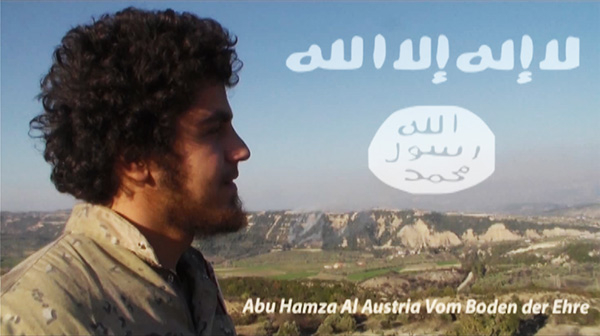
The Austrian Islamist known as "Abu Hamza al-Austria," fighting in Syria, pictured from his jihadist recruitment video.
Austria has been distinguished in other ways, as well, all leading from its growing Muslim population, leading to its having emerged as a base for radical Islam as a gateway through the Balkans for Europeans seek to join jihad in Syria. Austrian intelligence agency BVT warned in a June 2014 report of the "exploding radicalization of the Salafist scene in Austria". Salafism represents fundamentalist Islamism which abhors Western influence and seeks to impose Sharia law wherever Muslims congregate in large numbers. And undeniably, Muslims have converged in large numbers throughout Europe as they migrate from their countries of origin.
Those same countries of origin which deny their citizens free legal rights, places from which they migrated to seek a more stable, promising environment from which to launch their familial aspirations while unwilling to leave the very restraints imposed by Islamic principles and values behind, to take up the liberties and equalities guaranteed them in welcoming European countries which in their universal naivete never imagined their guests would embark on a mission to change their indigenous values, societal norms and laws.
Austria figures prominently in a
map produced by the IS that outlines the group's five-year plan for
expanding its caliphate into Europe, and has emerged as a central hub
for jihadists seeking to fight in Syria.
"The spectrum of recruits for the conflict in Syria is ethnically
diverse. The motivation, however, appears to be uniformly jihadist." —
Austrian intelligence agency BVT.
"Allah also gives you the opportunity to wage jihad in Austria." — Austrian jihadist Firas Houidi.
"We are proud that Allah has chosen us. We feel like lions." — Austrian jihadist Abu Hamza al-Austria.
The Austrian government has announced plans to improve its
intelligence gathering and analysis capabilities in an urgent effort to
crack down on would-be jihadists in the country.
The decision by Austrian Interior Minister Johanna Mikl-Leitner to recruit 20 new intelligence officers to focus exclusively on the threat posed by radical Islam comes after police in Austria arrested nine Chechen immigrants who were on their way to wage jihad in Syria.
The move also comes amid growing concerns that Austria's shiftless
Muslim youth are becoming increasingly radicalized and vocal in their
support of the jihadist group Islamic State.
The Chechens—eight men and one woman, ranging in age from 17 to
32—were purportedly planning to travel to Syria over a land route that
would take them from Austria through the neighboring Balkans and on into
Turkey. Four of the individuals were arrested in the southeastern
Austrian province of Styria, and five others were detained in the
province of Carinthia. Both provinces border Slovenia.
According to an analysis published by the newspaper Der Standard,
Austria has emerged as a central hub for jihadists seeking to fight in
Syria because Austria's geographic location provides easy access to land
routes through the Balkans.
Austrian intelligence officials say that most of the 130 Austrians
who are thought to have travelled to Syria are Chechens. The rest are
immigrants from Bosnia, Kosovo and Turkey. Approximately 60 Austrian
jihadists are currently on the front lines, 50 have already returned to
Austria and 20 have been killed in action.
The returning jihadists are "ticking time bombs," according to Mikl-Leitner. Her concerns are echoed in a June 2014 report by the Austrian intelligence agency BVT, which is emphatic about the threat posed by returning jihadists. The document states:
"When fighters return from the warzone, their newly
acquired combat skills, traumatic experiences and changes in behavior,
plus the possibility that they have become highly radicalized, represent
a considerable security risk for Austria. Those who return could become
involved in proselytizing activities as well as in establishing new
radical centers in which they could serve as instructors. Potential
terrorist attacks could be perpetrated by so-called lone wolves but also
by organized terrorist groups."
The report also warns of the "exploding radicalization of the
Salafist scene in Austria." Salafism is an anti-Western ideology that
seeks to impose Islamic sharia law in Austria and other parts of Europe.
The document states:
"The number of young radicalized followers of violent
Salafism in Austria continues to rise. In this context, the conflict in
Syria is of urgent relevance for Austria, because systematic efforts are
being made within Austria to radicalize and recruit people for the war
in Syria.
"The conflict in Syria has become very popular among violent
extremist Salafists in Austria. The spectrum of recruits for the
conflict in Syria is ethnically diverse. The motivation, however,
appears to be uniformly jihadist.
"So-called hate preachers can have a decisive influence on the
radicalization and recruiting processes by means of ideological and
personal indoctrination. Jihad is offered as the only adequate means to
solving disputes between Muslims and non-Muslims. In Austria, this
targeted manipulation is achieved through conspiratorial performances by
charismatic leaders. Young Muslims, who are seeking alternative
perspectives due to life crises, are often submissive victims to these
'radicalizers' and 'recruiters' and are often fascinated by the prospect
of armed jihad."
In any event, Salafism is on track to becoming a permanent fixture of
Austrian society, if demographics are any indication. The Muslim
population in Austria now exceeds 500,000 (or roughly 6% of the total
population), up from an estimated 150,000 (or 2%) in 1990. The Muslim
population is expected to reach 800,000 (or 9.5%) by 2030, according to
recent estimates.
Muslim students already outnumber Roman Catholic students at middle
and secondary schools in Vienna, the capital and largest city of
Austria, according to statistics compiled by the Vienna Board of
Education (Stadtschulrat für Wien) and published by Radio Vatican website in March 2014.
The data—which show that Muslim students are also on the verge of
overtaking Catholics in Viennese elementary schools—reflect an
established trend and provide empirical evidence of a massive
demographic and religious shift underway in Austria, traditionally a
Roman Catholic country.
In the current school year, 10,734 Muslim students are enrolled in
Viennese middle and secondary schools, compared to 8,632 Roman Catholic
students, 4,259 Serbian Orthodox students and 3,219 students with "no
religious persuasion," the data shows.
As far as elementary schools are concerned, there are 23,807 Roman
Catholic students, followed by 17,913 Muslim students, 11,119
"non-religious" students, 6,083 Serbian Orthodox students and 2,322
Protestants.
The statistics show that the only Viennese schools where Muslims remain a distinct minority are in the gymnasium,
advanced secondary schools that place a strong emphasis on academic
learning rather than on vocational skills. Students graduating from a
gymnasium are more likely than others to be admitted to attend
university in Austria.
Official statistics also show that nearly 60% of the inhabitants of Vienna are immigrants or foreigners.
Meanwhile, Austrian jihadists are busy using social media to promote
their cause, and to taunt counter-terrorism authorities. Before leaving
for Syria in early 2014, a 19-year-old jihadist from Vienna named Firas
Houidi wrote the following message on his Facebook page: "To the
intelligence agent who may be reading this: Either you kill us or we
continue, until the heads fly." In mid-August, Houidi, who goes by the
nom de guerre Firas Abdullah II, sent a follow-up "greeting" from Syria
that included a photograph of an artillery shell in a box ready to be shipped to Austrian authorities.
In another message, Houidi, who has a Tunisian immigrant background,
wrote that it is not necessary for Austrian Muslims to travel all the
way to Syria to wage jihad against infidels. "Even if you do not
emigrate and fight, then do it in Austria," he wrote. "Allah also gives
you the opportunity to wage jihad in Austria." After his Facebook page
was suspended, he reportedly opened another one under the name "Firas
Abdullah III."
Europol, the international police organization, has now issued an international arrest warrant for Houidi for belonging to a terrorist organization and for inciting to commit serious crimes.
Another so-called Austro-Islamist named "Abu Hamza al-Austria" produced an eight-minute recruitment video
calling on Muslims to wage jihad. He can be heard saying: "My name is
Abu Hamza. I lived in Vienna until Allah called me and I obeyed his
call." He continues:
"My brothers and sisters. When I lived in Austria, I
thought it would be difficult to leave because I was used to a life of
luxury. I imagined that in Syria there would be no water, very little
food and drink. This is not the case. We live in houses that exceed
western expectations. We live in villas with fireplaces and swimming
pools. We have everything here. We have no fear of death. We are proud
that Allah has chosen us. We feel like lions."
The Islamist known as "Abu Hamza al-Austria," fighting in Syria, pictured from his jihadist recruitment video.
Austrian jihadists have also used social media to call on fellow
Muslims to murder Yazidis, ethnic Kurdish non-Muslims, living in
Austria. One image shows an Austro-Islamist brandishing a knife accompanied by a quote
from the Prophet Mohammed: "We have come to you for no other purpose
than to slaughter you." Another jihadist writes: "All Yazidis living in
Vienna, report to me. My knife is extra sharp." Yet another writes:
"Every dirty devil worshiper [the Muslim term for Yazidis], report to
me, you will bleed for what you did to my brothers in Herford, in the
name of Allah, you will bleed and be killed by my very own hands."
Evidently, he was referring to jihadist clashes with Yazidis in neighboring Germany in early August.
In Vienna, supporters of the jihadist group Islamic State [IS] have set up a "fan club"
to promote holy war. They sell camouflage baseball caps emblazoned with
the IS logo and T-shirts with terrorist messages in Arabic. Austrian
newspapers have published photographs (here and here)
of IS sympathizers posing in different locations throughout Vienna with
messages of support. One reads: "One billion Muslims support the
Islamic State." Austrian jihadists have been seen wearing IS attire on Vienna subway trains. Others have posted comments and photos on Facebook that glorify jihad and show weapons displays.
The propaganda has added significance because of Vienna's historic
role in preventing Islam from overrunning Christian Europe during the Siege of Vienna in 1529 and the Battle of Vienna in 1683. Like Spain, Austria figures prominently in a map
produced by the IS that outlines the group's five-year plan for
expanding its caliphate into Europe. Today's jihadists are simply
fighting a new phase of a very old conflict.
Soeren Kern is a Senior Fellow at the New York-basedGatestone Institute.
He is also Senior Fellow for European Politics at the Madrid-based
Grupo de Estudios Estratégicos / Strategic Studies Group. Follow him onFacebook and onTwitter.
This represents a general opinion site for its author. It also offers a space for the author to record her experiences and perceptions,both personal and public. This is rendered obvious by the content contained in the blog, but the space is here inviting me to write. And so I do.