Wednesday, November 19, 2025

Bangladesh "Biased and Politically Motivated"

https://i.cbc.ca/ais/0c602a90-d39b-4ba7-904e-1a47dac0d9a2,1723134966169/full/max/0/default.jpg?im=Crop%2Crect%3D%280%2C0%2C1919%2C1079%29%3BResize%3D620 
 
"[The ruling had come from a] rigged tribunal [established and presided over by an unelected government with no democratic mandate]."
"They are biased and politically motivated."
"In their distasteful call for the death penalty, they reveal the brazen and murderous intent of extremist figures within the interim government to remove Bangladesh's last elected prime minister, and to nullify the Awami League as a political force."
"I wholly deny the accusations that have been made against me in the ICT. I mourn all of the deaths that occurred in July and August of last year, on both sides of the political divide. But neither I nor other political leaders ordered the killing of protestors. ... I was given no fair chance to defend myself in court, nor even to have lawyers of my own choice represent me in absentia." 
https://i.cbc.ca/ais/9885fb38-c19e-4827-8697-19e70569b113,1763371418574/full/max/0/default.jpg?im=Crop%2Crect%3D%280%2C31%2C594%2C334%29%3BResize%3D860Bangladesh former Prime Minister Sheikh Hasina  
"Our tribunal was developed in line with the Nuremberg trials. It has met all international standards."
"No one can point to anywhere where those standards have not been met."
"Their defense lawyer was given enough time to come up with the response. He could not take instruction from the accused as they are fugitives."
"If they had been present, they could have given their testimonies and provided further witnesses, and they would have been given further time as per the law."
Chief Prosecutor Mohammad Tajul Islam   
Hundreds of people are shown at a distance standing and walking around the interior of a large room in a building.
Anti-government protesters are shown inside Sheikh Hasina's palace in Dhaka on Aug. 5, 2024, after she was toppled. (K M Asad/AFP/Getty Images)
 
As angry crowds stormed her palace in 2024, Bangladeshi Prime Minister Sheikh Hasina fled to India for haven, when critics accused her of jailing political rivals, enacting harsh anti-media laws and overseeing human rights abuses, killing opposition activists among them. According to the United Nations, some 1,400 people -- mostly students in revolt -- were killed in the months of July and August of 2024.
 
She was sentenced to death by a Dhaka court finding her guilty on three counts of crimes against humanity, including incitement and orders to kill, along with inaction to prevent atrocities from being played out. Hasina, charged chief prosecutor Tajul Islam, was "the nucleus around whom all the crimes (were) committed", during the popular uprising. 
 
Months of testimony detailing mass killings said to be ordered by Hasina were heard during her trial. The trial, Sheikh Hasina stated, was in fact, a "jurisprudential joke". Audio tapes of Hasina purportedly directly ordering security forces to "use lethal weapons", were also played in court by the prosecution. There are additional outstanding cases involving the former Bangladeshi leader, involving her daughter Saima Wazed who became a senor UN official, and her niece Tulip Diddiq, a British lawmaker. 
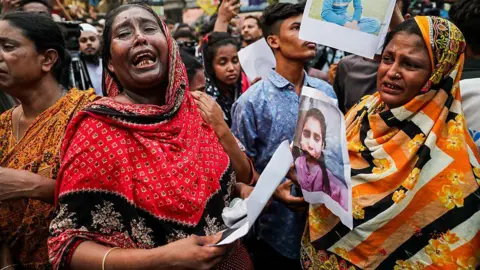
 
Getty Images Two tearful women in the foreground holding on to photographs of their loved ones printed on paper. A larger crowd has gathered behind them, many of them also clutching onto photographs of their relatives
Grief-stricken relatives hold on to photographs of their loved ones still missing after a fire blazed through a garment factory in Bangladesh   Getty Images
 
Hasina's regime presided over a time of rapid economic expansion for Bangladesh, driven in large part by Bangladesh's garment export industry, during her second time as the country's leader in 2008. An industry that was plagued with reported human rights violations in the garment factories, and occasional fires that killed many workers trapped in buildings lacking proper fire exits and basic fire-prevention protocols.
 
At one time considered to be one of the world's poorest countries, the Bangladesh economy grew over six percent annually since 2009, and by 2021 surpassed India's per capita income. "The prospect of Sheikh Hasina mounting a political comeback in Bangladesh now appears very slim", commented International Crisis Group analyst Thomas Kean following the death verdict for the 80-year-old former leader. 
"After the uprising, we might have had a process of justice and peace and reconciliation. We didn't have that. We've had the same as before. We call it accountability, but it's more like political revenge."
"What really matters is, many people think that this is a kind of justice and that no other kind of justice was going to be achieved."
Naomi Hossain, development studies professor, University of London's School of Oriental and African Studies 
https://media.cnn.com/api/v1/images/stellar/prod/gettyimages-1553913077.jpg?c=16x9&q=h_653,w_1160,c_fill/f_avif


Labels: , , , ,

Sunday, December 25, 2022

S.O.S. Save Our Souls! Is There No One There???


"I last spoke with the boat's captain on December 18 and he told me that at least 17 people on board had died due to a lack of food and water."
"They have only been able to drink water when it rains."
"Please tell me, I just want to know if my family is alive or dead. We all want to see our families, that is all we request from the world. Just help us."
Sham Shur Alom, Rohingya refugee in Malaysia

"Several reports indicate dozens of people have already died during this ordeal, while survivors are hungry and thirsty without access to food and water and suffering from sickness."
United Nations' refugee agency 

"Father, please send a boat or I will jump into the ocean. I can't tolerate the pain and struggle anymore. There is no food or water to drink. People are drinking salt water. People are close to dying and mental breakdown. They're going to bite each other."
"Baba. I don't know why I am here. My teeth are dry from the lack of drinking water. Please do whatever is humanly possible for you."
Mosharrof Ullha, to his father Ata Ullha, Rohingya, Cox's Bazar Refugee Camp, Bangladesh
"We urge the Government of India to urgently coordinate and cooperate with other regional governments on the search and rescue operations of Rohingya refugees who are currently stranded in Indian waters with no medical support, food and water"    Amnesty India

The world of the unwanted homeless is ever on the move, hoping to find surcease from their stateless status, their unwanted presence, their suffering and their timeless dilemma. They aspire to live, to have a future, they are not economic migrants but refugees. As it happens, refugees who are Muslim, whom the Myanmar military expunged violently from the country where they were living. Originally from Bangladesh, the Rohingya lived for generations in Myanmar. But Buddhism and Islam oppose one another.
 
Living for years since their expulsion from Myanmar on the border in Bangladesh in an immense squalid refugee camp teeming with refugees whom no one wants responsibility for, there are those who dream of escape, of finding a new life and opportunity elsewhere in the world where they will be accepted, where human aspirations to belong and to succeed in life can be found. And in following that dream they sacrifice themselves to chance and fortune, and sometimes lose.

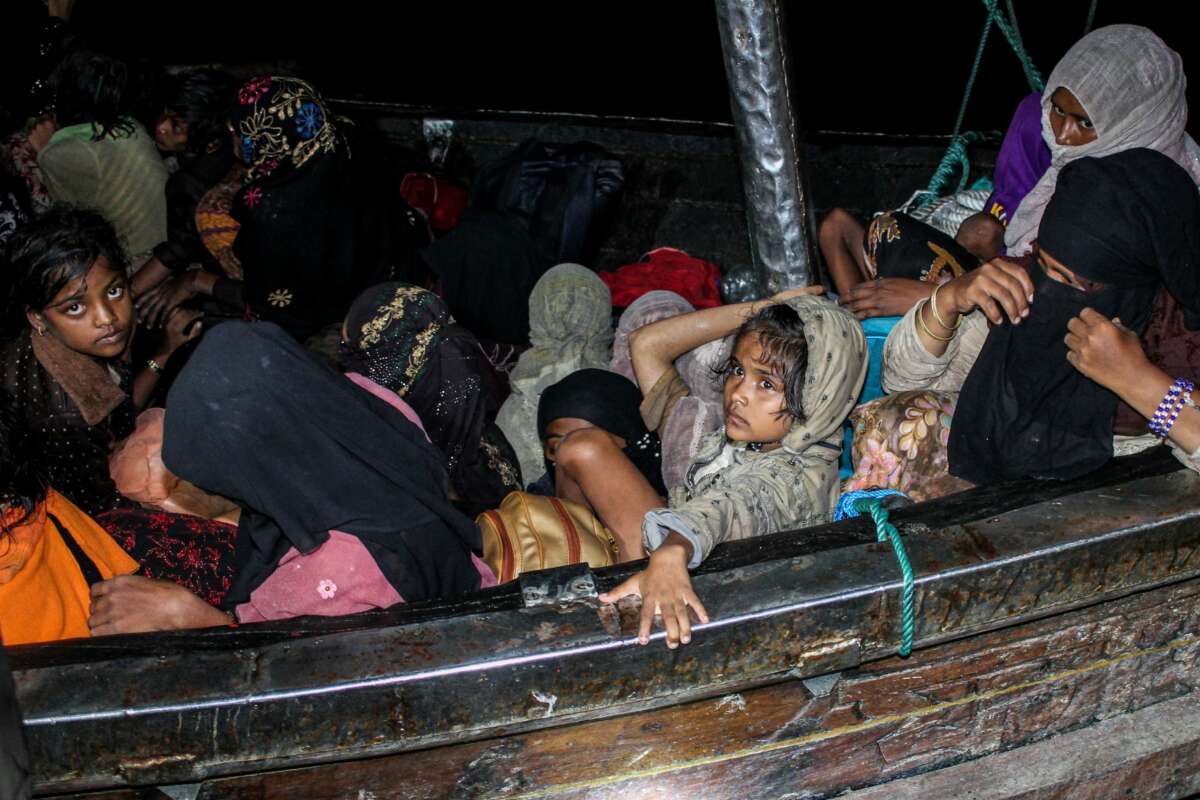
A boat stranded for close to three weeks in the Indian Ocean is desperate for rescue. So far a dozen of the Rohingya refugees populating the wooden craft open to the air, directionless, have died. With no humanitarian intervention from nearby nations fears are that more people will die in the next few days. And the unthinkable, that the  hopeful refugees on board will all perish from neglect by those who could mount a rescue. Indonesia, the nation with the largest Muslim population globally has seen fit not to respond.

Predictably, India, with the world's third largest minority population of Muslims has no wish to acquire more people of the faith its own majority Hindu population is hostile to. Late November saw the open wooden boat set off from Bangladesh for Malaysia, yet another majority Muslim population, with over 150 asylum seekers aboard. On December 4 its engine failed, leaving the vessel to drift at sea, its food and water supplies steadily diminishing.

Most of the people on the ship had set out to meet family in Malaysia, anxious to flee the sprawling Cox's Bazar refugee camp in Bangladesh with its hundreds of thousands of hopeless people languishing there for the past five years. The boat captain refused to allow those who have managed to make contact with the boat by satellite phone, to speak with their relatives. Open to the elements, conditions on the boat are unspeakably urgent.

The Indian navy and coast guard say no information about the adrift ship has reached them; wide-spread media coverage of the crisis aside. "We have no information about the issue",  a spokesperson for the Indian navy responded, to a query. To the present, it is believed that approximately two thousand Rohingya refugees have opted to risk a sea voyage in 2022 as conditions in the refugee camps both in Myanmar and Bangladesh continue to deteriorate.

Although Sri Lanka's navy rescued a boat of 104 Rohingya a week ago, other nations have no wish to encourage the mass flow of people by intervening to offer support. Bangladesh, the Muslim country from which the Rohingya originated has not seen fit to integrate them back into its society as a Muslim-to-Muslim responsibility. Nor have Indonesia or Malaysia recognized their religious responsibility to embrace fellow Muslims.

Rohingya refugees sit on a wooden boat as Indonesian officials conduct evacuation at the Krueng Geukueh port in Lhokseumawe, Aceh, Indonesia, on December 31, 2021.
"Many more will die soon if they are not rescued, due to dehydration."
"We have approached the Indian coast guard and the Thai and Indonesian governments."
"None of them responded."
Mohammed Rezuwan Khan, Rohingya refugee, Cox's Bazar

Labels: , , ,

Monday, May 06, 2019

Surviving a Tropical Cyclone

"This [Cyclone Fani] is not as bad [as the 1999 super cyclone]."
"Apart from these winds which may cause damage in terms of uprooting small trees in West Bangal and some big trees in Odisha and extensive damage to thatched houses and mud houses ... [and] disruption of power and telecommunication lines, it can also impact the rail and road traffic and also air traffic for some time."
Mrutyunjay Mohapatra, Meteorological Department scientist, India

"In the event of such a major calamity like this — where Odisha was hit by close to a super-cyclone — instead of being a tragedy of humongous proportion, we are in the process of restoring critical infrastructure."
"That is the transformation that Odisha has had."
Naveen Patnaik, Odisha state top government official
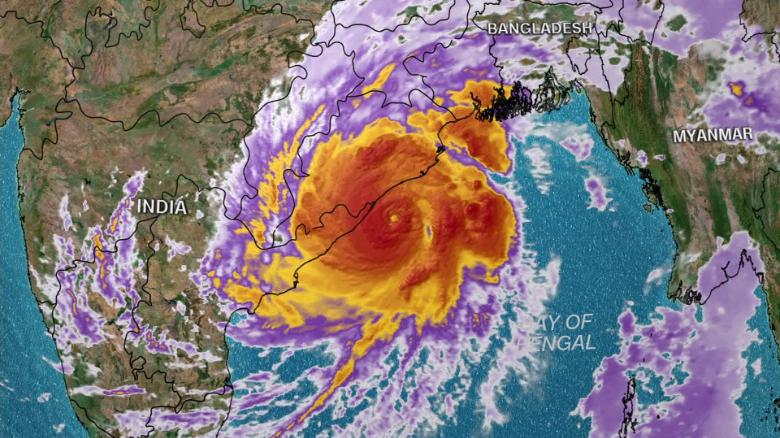
Cyclone Fani makes landfall on India's east coast

The description of the potential damage that a cyclone with lashing rain and winds gusting up to 205 km/h can impact on a geographical area sounds fearful enough in its damaging action on peoples' homes and civic infrastructure to send shivers up and down the spine of people fortunate enough to live in areas of the globe geographically distant from such tropical storm systems. The reality of the damage that the cyclone did inflict on the coastal state of Odisha was sufficiently fearful, withal.

The desert state of Rajasthan bordering Pakistan was impacted by huge dust storms, while on the Arabian Sea the coastal state of Maharashtra saw heat waves and elsewhere bordering China, heavy rains descended, reaching to the Himalayas where the rain fell in the frozen state of mountainous snowfalls. Fani represented the second-most severe of cyclones in India's meteorological measurements, equivalent to a Category 3 hurricane.

"[It is a] very, very scary feeling", Tanmay Das, 40, a resident of Bhubaneswar, a city in Odisha said, describing "the sound of wind as if it will blow you away".  Violent enough to whip palm trees like flexible rubber mops against almost-opaque rain-gusting skies. The thatched-roof houses in the area were all destroyed. Electricity was cut off. Electricity poles were down, alongside fallen trees.
A marooned elderly couple sit on a log close to their home surrounded by high waters in Khulna, Bangladesh on Saturday. (Munir uz Zaman/AFP/Getty Images)

Rail lines were closed, the Kolkata airport was closed, and an estimated 200 trains across India saw cancellation as the storm  hit in the midst of India's six-week general election, forcing cancellation of political campaign events around Kolkata as the cyclone in the Bay of Bengal hit, impacting weather across the Asian subcontinent.

As astonishing 1.2 million people were evacuated from Odisha's low-lying areas, moved to an equally amazing four thousand shelters, a plan carried out by India's National Disaster Response Force. The Indian navy, air force, army and coast guard were placed on high alert. This was a first for India, an unprecedented evacuation of immense proportions. Friday afternoon saw the cyclone downgraded t a "very severe" storm.

Neighbours show damage caused by Cyclone Fani in the Penthakata fishing village of Puri, in the eastern Indian state of Orissa on Saturday. (Associated Press)

There was a dispatch of 54 rescue and relief teams of doctors, engineers and deep-sea divers to areas along the coast prone to flooding, as far afield as Andaman and Nicobar Islands in the Bay of Bengal; the work of the National Disaster Response Force. Sri Lanka, off the eastern tip of India was expecting up to four inches of rain.

On Mount Everest, mountaineers and Sherpa guides descended to lower camps to wait out the worsening weather after a warning was issued that heavy snowfall was expected at  higher elevations. Trekking agencies were required to take tourists to safety, so hundreds of climbers, guides, cooks and porters took haven from the weather raging about them, leading to poor visibility, at the Everest base camp.
A family crosses the Buriganga River by boat during rainy weather in Dhaka, Bangladesh on Saturday. (Monirul Alam/EPA-EFE)

The 1999 "super" cyclone in the Bay of Bengal killed roughly ten thousand people, devastating large areas of Odisha. More reliable forecasts and improved disaster management coordinating saw a vastly better outcome. The 2013 Cyclone Phailin led to the deaths of fewer than fifty people, in contrast to the wind speeds of 260 to 280 km/hr in 1999 that took such a huge death toll.

This time, there were fifteen deaths, and an unknown number of injuries, considerably smaller in numbers reported, thanks to the monumental task of moving 1.2 million people to temporary haven and safety from the initial grade 5 storm that was cyclone Fani. Now, it is the turn of Bangladesh where already a dozen people are reported to have been killed by the effects of the downgraded "severe storm".

Affected area map

Labels: , , , ,

Follow @rheytah Tweet