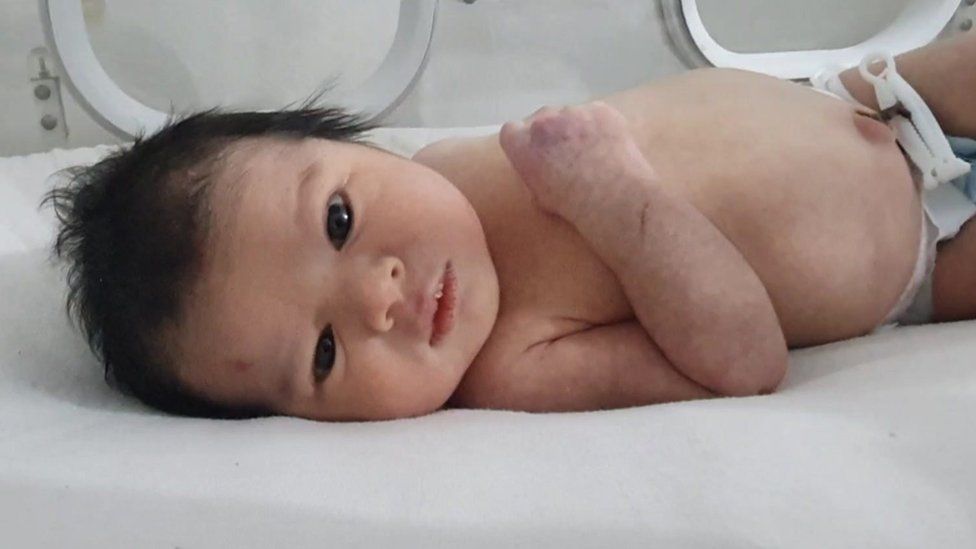
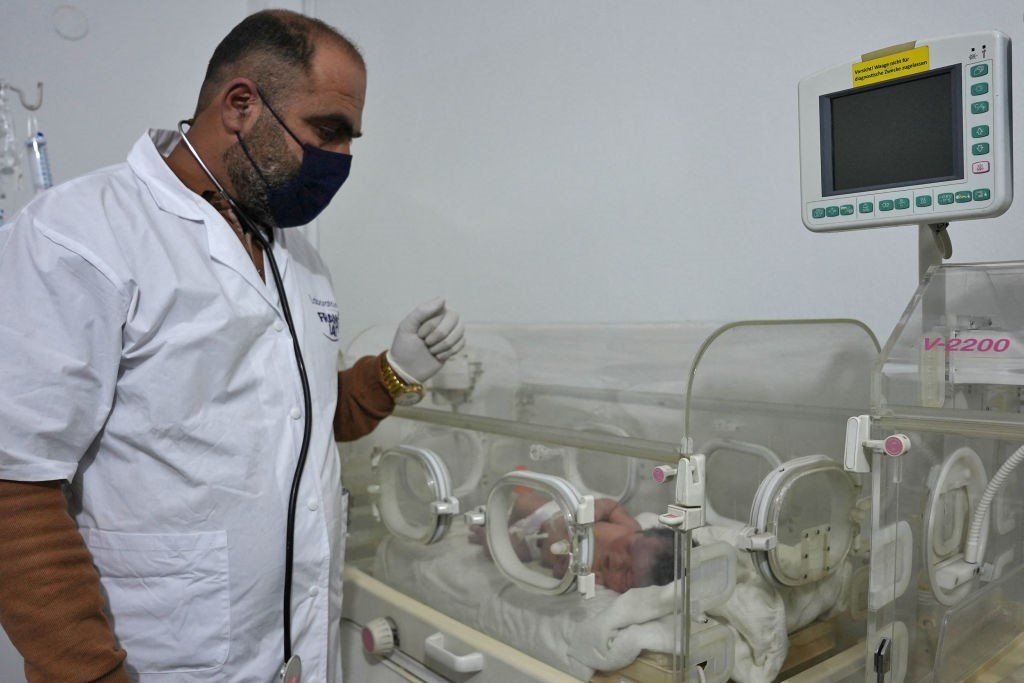
"[We have received dozens of calls from people all over the world wanting to adopt baby Aya]."
"I
won't allow anyone to adopt her now. Until her distant family return,
I'm treating her like one of my own."
Hospital Manager, Khalid Attiah
"The rescuers can end up being victims too because of how unstable the building is."
"We
just pulled three bodies out of this rubble and we think there is a
family in there that is still alive - we will keep on working."
Mohammed al-Kamel, White Helmets rescue group, Jindayris, Syria
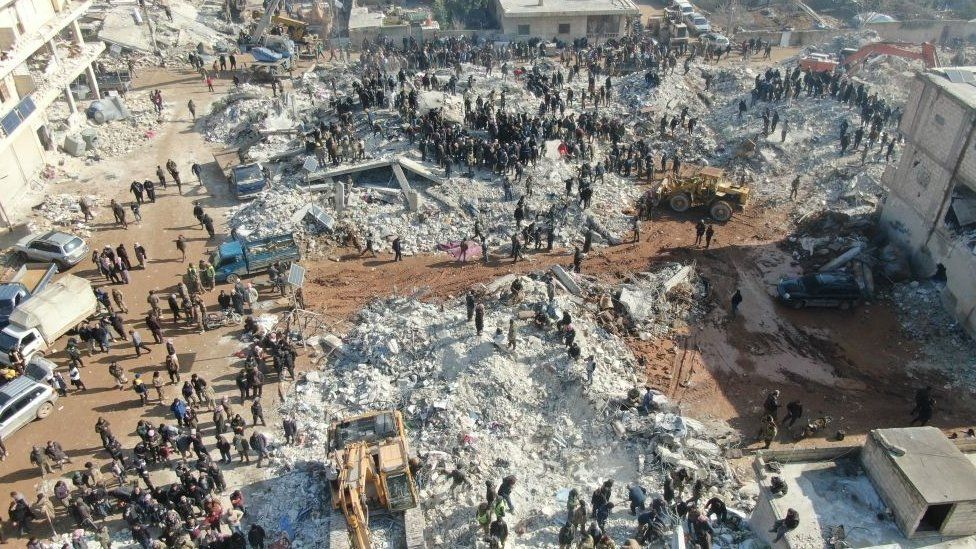
Rescuers from the White Helmets organisation, who are all too familiar
with pulling people out of the rubble for over a decade during Syria's
civil war, have been helping in Jindayris.Getty Images
A
newborn child, umbilical cord still attached to her dead mother, was
found alive by members of the Syrian rescue group White Helmets and
taken to hospital for care. "She arrived on Monday in such a bad state, she had bumps, bruises, she
was cold and barely breathing", the paediatrician
looking after her, Hani Marouf explained. In other circumstances, baby
Aya would have four siblings to play with and grow up with. All four
perished along with their mother and father. When the earthquake struck
Aya's mother went into labour and gave birth; she may never even have
seen her baby daughter before dying.
A
lot of publicity surrounded this child; the video of her rescue was
posted to social media resulting in a response from people all over the
world, offering help, many wanting to adopt the child whose name in
Arabic means "a sign from God". One of the nurses at the hospital
treating the baby aroused suspicion when he was seen photographing the
tiny girl.The hospital manager whose wife was breastfeeding Aya thought
the male nurse might be planning to abduct the baby, so he fired the
nurse.
Before
long the nurse returned along with two thugs with guns who set about
beating the hospital director. The gunmen informed local police officers
they intended to punish the hospital director for firing their friend,
with no interest in kidnapping the baby. False claims of being relatives
to the baby have been made by people showing up at the hospital,
indicating a need for a police guard. In fact, a close relative, her
great-uncle has stated that the baby's paternal aunt plans to raise the
baby together with her own she recently gave birth to.
Getty Images
Ten
hours after the February 6 quake struck, rescue workers in Jindera in
Syria's north discovered the baby while digging through the rubble of a
five-storey apartment building where her parents lived. She has been
cared for at the hospital in Afrin ever since. Dozens of housing units
in the town of Jinderis were destroyed. Her father, originally from a
village in eastern Deir el Zour province, left it when the village was
captured by the Islamic State group.
Many
of the towns and cities where millions lived were reduced to fragments
of concrete and twisted metal following the initial quake, another
almost as strong, and a series of tremors striking southeastern Turkey
and northern Syria. Over a week following the disaster hundreds of
thousands have been left homeless and struggling to find the basics
required to sustain life; shelter, warmth, food, water, medical
attention. The brutal winter weather itself represents a danger to
sustained life for the survivors.
Moving
aid into the large area impacted by the tremblors in Syria is hampered
by the difficulty in access to crossings into the area as a result of
the 12-year civil war where millions of Syrian Sunnis fled to escape the
assaults by the Syrian regime's military. Aid agencies have found it
difficult to deliver life-saving winter clothing, food and potable
water. The Turkish military is still bombing Kurds nearby the disaster
zone in Syria. There are warring factions nearby, including Islamic
State.
People
desperate for aid in Syria in difficult-to-reach areas still have
received nothing. In Turkey survivors have been put up temporarily in
rail cars. In northwest Syria, 190 families sleep on the floor of a
basketball court in Afrin, lying on mats used for training. Children are
wrapped in blankets and sleep on the court floor, some of them becoming
ill from conditions of privation. Local officials are awaiting the
delivery of tents.
The
United Nations reached an agreement with Damascus to deliver aid
through two more border crossings from Turkey to rebel-held areas of
northwest Syria. A $397 million appeal for "desperately needed, life-saving relief for nearly 5 million Syrians" for three months has been launched by the United Nations.
People walk past collapsed buildings on Thursday in the
town of Jinderis, in Syria's Aleppo province, days after a massive
earthquake devastated the region. Ghaith Alsayed/AP
"I
last spoke with the boat's captain on December 18 and he told me that
at least 17 people on board had died due to a lack of food and water."
"They have only been able to drink water when it rains."
"Please
tell me, I just want to know if my family is alive or dead. We all want
to see our families, that is all we request from the world. Just help
us."
Sham Shur Alom, Rohingya refugee in Malaysia
"Several
reports indicate dozens of people have already died during this ordeal,
while survivors are hungry and thirsty without access to food and water
and suffering from sickness."
United Nations' refugee agency
"Father,
please send a boat or I will jump into the ocean. I can't tolerate the
pain and struggle anymore. There is no food or water to drink. People
are drinking salt water. People are close to dying and mental breakdown.
They're going to bite each other."
"Baba.
I don't know why I am here. My teeth are dry from the lack of drinking
water. Please do whatever is humanly possible for you."
Mosharrof Ullha, to his father Ata Ullha, Rohingya, Cox's Bazar Refugee Camp, Bangladesh
"We
urge the Government of India to urgently coordinate and cooperate with
other regional governments on the search and rescue operations of
Rohingya refugees who are currently stranded in Indian waters with no
medical support, food and water" Amnesty India
The
world of the unwanted homeless is ever on the move, hoping to find
surcease from their stateless status, their unwanted presence, their
suffering and their timeless dilemma. They aspire to live, to have a
future, they are not economic migrants but refugees. As it happens,
refugees who are Muslim, whom the Myanmar military expunged violently
from the country where they were living. Originally from Bangladesh, the
Rohingya lived for generations in Myanmar. But Buddhism and Islam
oppose one another.
Living
for years since their expulsion from Myanmar on the border in
Bangladesh in an immense squalid refugee camp teeming with refugees whom
no one wants responsibility for, there are those who dream of escape,
of finding a new life and opportunity elsewhere in the world where they
will be accepted, where human aspirations to belong and to succeed in
life can be found. And in following that dream they sacrifice themselves
to chance and fortune, and sometimes lose.
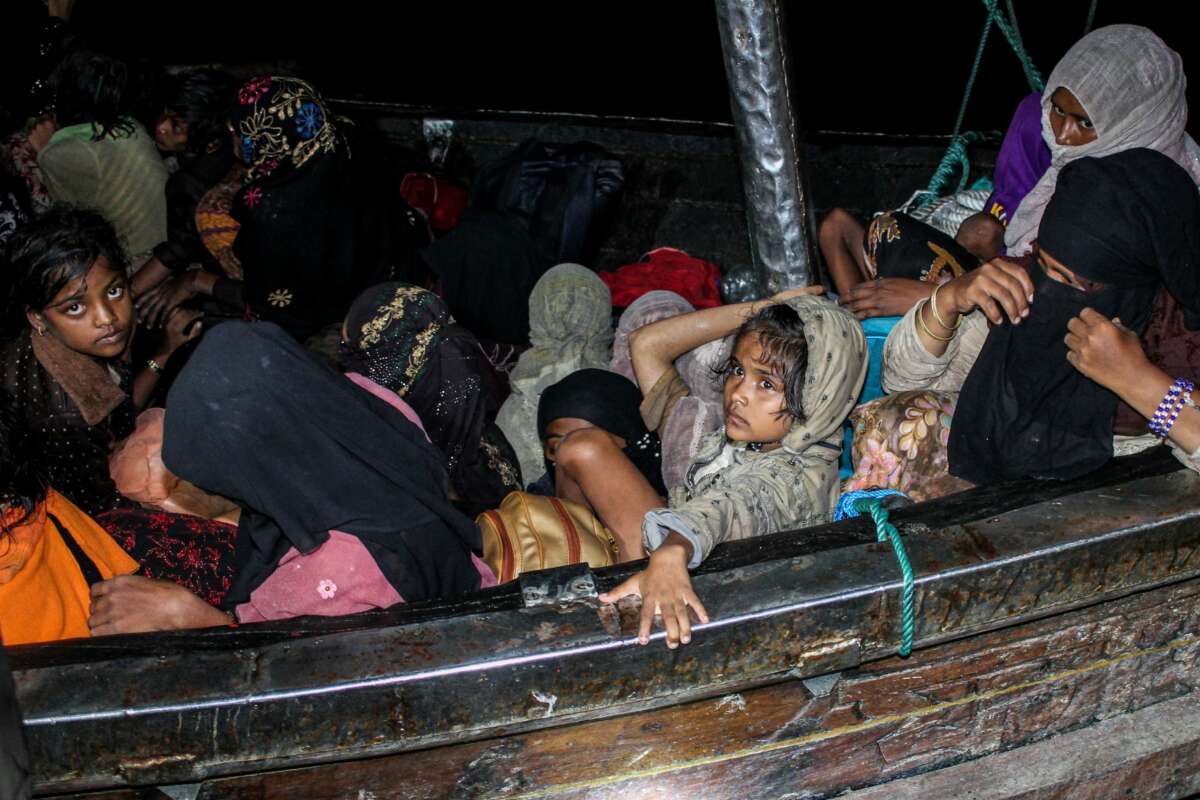
A
boat stranded for close to three weeks in the Indian Ocean is desperate
for rescue. So far a dozen of the Rohingya refugees populating the
wooden craft open to the air, directionless, have died. With no
humanitarian intervention from nearby nations fears are that more people
will die in the next few days. And the unthinkable, that the hopeful
refugees on board will all perish from neglect by those who could mount a
rescue. Indonesia, the nation with the largest Muslim population
globally has seen fit not to respond.
Predictably,
India, with the world's third largest minority population of Muslims
has no wish to acquire more people of the faith its own majority Hindu
population is hostile to. Late November saw the open wooden boat set off
from Bangladesh for Malaysia, yet another majority Muslim population,
with over 150 asylum seekers aboard. On December 4 its engine failed,
leaving the vessel to drift at sea, its food and water supplies steadily
diminishing.
Most
of the people on the ship had set out to meet family in Malaysia,
anxious to flee the sprawling Cox's Bazar refugee camp in Bangladesh
with its hundreds of thousands of hopeless people languishing there for
the past five years. The boat captain refused to allow those who have
managed to make contact with the boat by satellite phone, to speak with
their relatives. Open to the elements, conditions on the boat are
unspeakably urgent.
The
Indian navy and coast guard say no information about the adrift ship
has reached them; wide-spread media coverage of the crisis aside. "We have no information about the issue",
a spokesperson for the Indian navy responded, to a query. To the
present, it is believed that approximately two thousand Rohingya
refugees have opted to risk a sea voyage in 2022 as conditions in the
refugee camps both in Myanmar and Bangladesh continue to deteriorate.
Although
Sri Lanka's navy rescued a boat of 104 Rohingya a week ago, other
nations have no wish to encourage the mass flow of people by intervening
to offer support. Bangladesh, the Muslim country from which the
Rohingya originated has not seen fit to integrate them back into its
society as a Muslim-to-Muslim responsibility. Nor have Indonesia or
Malaysia recognized their religious responsibility to embrace fellow
Muslims.
Rohingya
refugees sit on a wooden boat as Indonesian officials conduct
evacuation at the Krueng Geukueh port in Lhokseumawe, Aceh, Indonesia,
on December 31, 2021.Fachrul Reza / Xinhua via Getty Images
"Many more will die soon if they are not rescued, due to dehydration."
"We have approached the Indian coast guard and the Thai and Indonesian governments."
"None of them responded."
Mohammed Rezuwan Khan, Rohingya refugee, Cox's Bazar
"While
French commandos in buses got their people out, we sent texts [in
English] telling our friends to head to the airport on their own. Ten
buses screamed out of France's embassy in Kabul early this week, past
every Taliban checkpoint along the way, and according to eyewitnesses,
zipped confidently through a back-entrance gate and straight onto the
chaotic tarmac at Hamid Karzai International Airport. Five hundred
exhausted and terrified passengers were then loaded onto a French
military aircraft which quickly took off."
"All
of our allies had eyes and boots on the ground ... at Kabul's airport.
Canada did not. It closed its embassy and withdrew all its diplomats and
military by jet to Ottawa just as the Taliban was rolling into town."
Kevin Newman, journalist, former anchor, Global National
"I'm
scared. Who knows, they could come here in the middle of the night and
nobody is going to know anything. We could be executed, any day any
time, any minute -- I can feel the death coming."
"The
Taliban are driving around, staring at us, wondering what's going on
here [at the hotel assigned to his family by the Canadian government, in
Kabul while awaiting rescue]."
"Your government put us in the line of execution."
Abdul Ahmadullah, Kandahar native, awaiting rescue in Kabul
"Abdul has worked on a daily basis, often on short notice, assisting in resolving issues both complex and urgent in nature."
"His family and country have reason to be proud of this fine young man."
Canadian military officers letter of commendation
"The security situation surrounding the
airport has become increasingly dangerous. Violence has become more
common and Taliban checkpoints in surrounding area are preventing many
from reaching the airport area."
"For
those who do make it ... Canadian Armed Forces members have been able
to assist eligible evacuees to enter the airport parameter."
Unnamed senior government official
Afghans board a U.S. Air Force transport plane during an evacuation at
Hamid Karzai International Airport in Kabul on Sunday. Officials told
media Monday that Canada's special forces are currently working inside
and outside the confines of the airport to ensure Canadians and eligible
Afghans can get onto planes destined for Canada. (U.S. Air Force/REUTERS)
Canadian
military veterans who were assigned to tours of duty in Kandahar
province, Afghanistan, as part of the Western allied forces led by the
United States and NATO, have been extremely aware of the imminent danger
their former Afghan colleagues would be exposed to. They have been
working for months independently of government agencies to locate and
contact former Afghan volunteers, interpreters and others working with
the Canadian military for the ten years of its presence there.
That
same group has desperately urged the Liberal Trudeau government to
action, emphasizing the dire reality of a tragedy waiting to unfold.
They have been frustrated at every turn. Agonizingly complex paperwork
has confronted Afghans registering, proving their past work performance
with the military, with the Canadian diplomatic mission as locally
engaged employees and workers with Canadian NGOs. One department of
government has shunted them off to another. During registration
procedures communication lines freeze.
And
it soon became distressingly evident that the Government of Canada had
made up no contingency plans for evacuation of Afghans who were
eventually successful in obtaining visas, much less those whose complex,
often confusing paperwork had stalled. Finally, with the Taliban
entrance to Kabul imminent, Canada yanked its diplomats out of Kabul and
its military, sending them all back to Canada. And no one was left to
aid and expedite the rescue of hundreds of Afghans promised evacuation
by Canada.
Messages
sent directly from the Department of Foreign Affairs to the cellphones
of the registered visa applicants and holders informed them they must
make their own way to the airport for airlifting out of Afghanistan, at a
time when the Taliban is manning checkpoints refusing to allow even
visa holders entry to the airport. Canada prepared two transport planes
to land at the Kabul airport and they returned half empty. People were
simply unable to reach the airport, as ordered by an absent Canada.
More
than 1,000 Afghans have been flown out on 12 Canadian flights thus far.
Canadian Forces are not bringing people into this country without
legitimate documentation, unlike the U.S. and U.K., says a former Afghan
interpreter. CBC
Abdul
Ahmadullah's plight is a case in point. Back in June the Canadian
government responded to his need as a former interpreter for Canadian
Forces in the knowledge that he was a marked man having worked for the
Canadian combat mission Kandahar and he was forced into hiding while
simultaneously the Taliban were searching for all Afghans linked to
foreign forces. Others, like him interpreters, were found and murdered.
Ahmadullah
had reached Kabul a month ago, with his family, waiting with dozens of
other ex-employees locally engaged by Canada at downtown Kabul hotels
until a flight could take them away. Their wait is interminable and they
grow increasingly fearful in an atmosphere of grim suspense, where it
has become impossible to reach the airport grounds much less make it
inside, without assistance. Massive crowds of desperate Afghans and the
presence of Taliban fighters surround the airport complex.
Some
other countries working to extract their nationals and Afghans linked
to them from Kabul and onto planes have taken people to the compound by
helicopter, or with the use of armed convoys. The backstory is that
interpreters' lives have been threatened by the Taliban and many
assassinated by them. Ahmadullah had applied to emigrate to Canada back
in 2011, when the Canadian mission left or as he put it "disappeared
like ghosts".
Soon
after the Canadians had departed Ahmadullah's young son, on his way
home from school was abducted and he was contacted by someone
representing the Islamic Emirate of Afghanistan inviting him to appear
at a certain place, to see his son. "My wife told me, 'If you go there, both of you are going to die'." Instead,
with the help of Pashtun elders he was able to negotiate a ransom for
his son. Who came home badly beaten, missing two toenails. "You better run for your life, they're coming after you", warned one of the elders.
He,
his wife and children moved every six months to new locations,
attempting to change their appearance as they did -- for the next seven
years. In June Kandahar was breached by the Taliban who killed all the
officers manning the local police station, and took their place. The day
of the invasion he appealed to Canadian officials and was wired $1,500.
He and his family left for Kabul. In their absence from Kandahar their
home was burnt to the ground.
When
the Taliban took the capital on August 15, all those at the hotel they
had been assigned to by the Canadian government were informed they
should head out to the airport. When they did, they reached a dangerous
place of mad chaos, packed with desperate people. They had little option
but to return to the hotel to try again the following day, with similar
results. Those in the hotel whom the Canadian government has pledged to
rescue have tried again and again to reach the blast barriers of the
airfield.
According
to Ahmadullah, Taliban guards ripped up one former employee's Canadian
visa then beat him. He was warned not to return or he'd be killed. "He didn't have hope any more", said Ahmadullah. He said, '[If we wait for Canada, we will die." The Canadian Armed Forces assigned to help extract Afghans has three to four days left to airlift people out of Kabul.
U.S.
President Joe Biden has informed his allies that the withdrawal date of
August 31 is firm and will not be renegotiated with the Taliban. His
concern now is that U.S. troops are vulnerable to attacks by Islamic
State terrorists, obviating the potential of conflict with Taliban
terrorists since the Taliban refer to August 31 as their 'red line' for
foreign departures. And then there is their statement that they do not
want any more Afghan nationals leaving on evacuation
flights
Hoping to flee the country, people gather outside the airport in Kabul, Afghanistan, on Aug. 20, 2021. JIM HUYLEBROEK/The New York Times News Servic
"Nobody will be left alone. We need to help those who are struggling the most." "The government won't look the other way." Italian Prime Minister Giuseppe Conte
"If help from the government arrives in two weeks -- and another two weeks is needed to distribute it -- then we run a big risk." "The distress will turn into violence." Leoluca Orlando, Mayor of Palermo
The government has already approved a €25bn financial package to safeguard the economy.
Photograph: Antonio Parrinello/Reuters
Civil unrest appears to be alerting Italian politicians that citizens in the poorer regions of the country, reacting to lockdowns to be extended until Easter, at least, will result in rebellion by a population that has been stretched to the limits of their endurance while the novel coronavirus sickens tens of thousands and kills thousands in its wake. The overall death toll in Italy is now 11,500, giving the country the dubious distinction of having an 11 percent death rate, where many other countries experience such deathly blows at under one percent.
Another 812 victims died in a single day. Italy now accounts for over a third of the global total who have died of the novel coronavirus that China refuses to own. The daily increase of those struck just the day before stood at 4,050, bringing the country's total infections to 101,000. As the disease rampages through the country, those areas of the nation most affected have seen people resorting to lawlessness as though they have nothing to lose any longer.
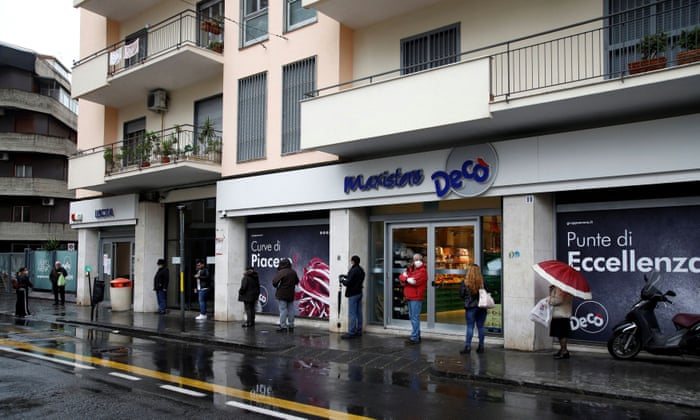
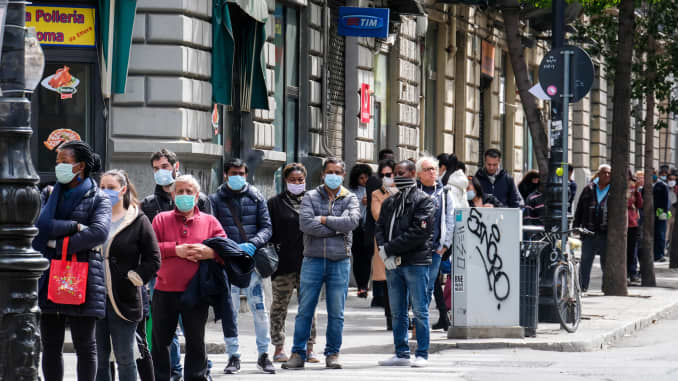
People lined up at the supermarket along the street for grocery
shopping, wearing masks for fear of Coronavirus infection (COVID-19).
Reports emerged of people refusing to pay for their shopping in Sicily, claiming they have no funds after not working for three weeks. In Palermo and Catania standoffs between supermarket staff and shoppers occurred where armed police were sent along to the three largest supermarkets in Palermo in response to calls on social media encouraging a campaign of looting and attacks on responding police.
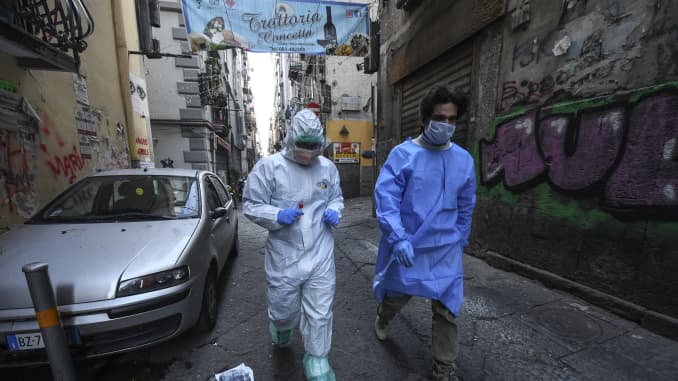
Two doctors, protected
by overalls, masks, gloves and glasses, walk through the streets of the
Spanish Quarters and collect the swabs made to some inhabitants of the
neighborhood, to check for any contagions from Coronavirus (COVID-19).
For the collection of the swabs they also use a mobile sanitary unit. KONTROLAB
That Italy and its population are under immense strain is indisputable since the government took steps to close all but essential shops, businesses and industry, desperate to dampen the infection rate in the population, amidst fears the virus could spread from the suffering north to the more underdeveloped south of the country. Dysfunctional in the sense that the various mafia-type clans have as much control there as the central government.
Struggling families were assured by the prime minister that a $625-million food voucher scheme has been launched to give them help and hope. While it is badly needed, any delay, according to regional politician, in rolling out the new scheme will ensure a backlash of lowered expectations and hope dissipating.
The mayor of Palermo warned of "exploding" social unrest across the south that might spread to the north, naming bed and breakfast owners, travel agents and gym instructors as "the new poor". Fears that the economic downturn spurred by the raging epidemic is ripe for exploitation by mafia groups such as the Camorra in Naples, the Cosa Nostra in Sicily and the 'Ndrangheta in Calabria come as no surprise.
Police carry out checks as part of the coronavirus lockdown
FABIO FRUSTACI (EFE)
Venezuela Imploding and Reverberations in the Caribbean
"We be lookin' for our red fish as normal, think' they be fishin', too. They be needin' help?" "Then we knowin'. They be pirates." "The man talkin' Spanish, he point the gun at me, then he point at the water. I be knowin'. He be wantin' that I jump." "I had already reached the rig, so I had to be jumpin' back in, to help him [another crewman suffering a cramp]." "He was goin' to be drownin'." Jimmy Lalla, 36, Asheena fishing boat crewman, Trinidadian waters
"They said they would take the boat and that everyone should jump overboard. I tried to keep my head above water so I could get air." "I drank a lot of salt water. I looked to the stars and moon. I just hoped and prayed." Deonarine Goberdhan, 47, Guyanese fishing boat
"This reminds me of how the problems started off the coast of eastern Africa [with Somali pirates]." "What we're seeing -- the piracy, the smuggling -- it's the result of Venezuela's political and economic collapse." Roodal Moonilal, lawmaker, United National Congress, Trinidad
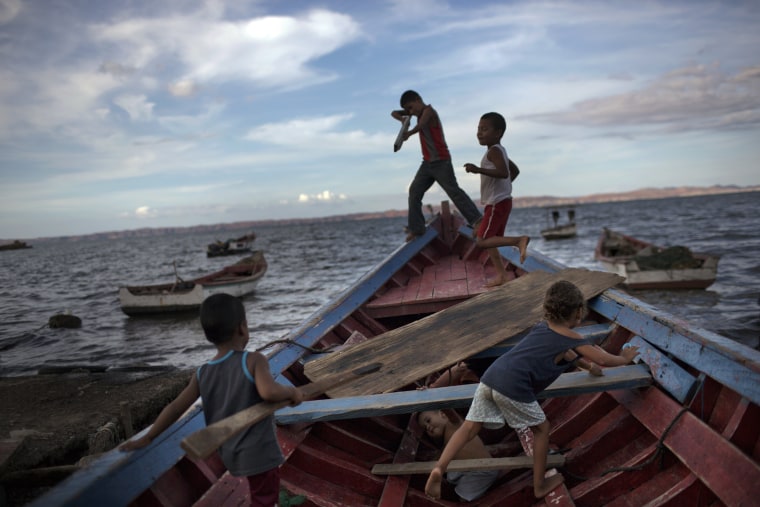
In
this photo, children play "pirates" on a fishing boat in
Cumana, Sucre state, Venezuela. "You hear piracy and you think of guys
robbing container ships in Africa. But here it's just poor fishermen
robbing other poor fishermen," said Sucre lawyer Luis Morales. "It's the
same kind of crime we've seen in the streets, but spreading to the sea.
(AP Photo/Rodrigo Abd)Rodrigo Abd / AP
Muggings on the high seas, threats, murder, looting, boats captured, crews told to swim or sink. Four Guyanese fishing boats 40 kilometres off the coast of Guyana were exposed to the new dangers lurking in the waters they all ply to make their living as fishermen. The survivors of the crews of those four boats describe being doused with hot oil, of being hacked with machetes, thrown overboard, their boats stolen. Most of the crew members died, or have been declared missing. Twenty managed to live to tell about their ordeal.
Close to Honduras, Nicaragua, Haiti and St. Lucia, piracy on the high seas has been reported over the past year and a half. The surge in piracy has its epicentre off the coast of Venezuela where that nation's economic crisis has seen inflation soaring close to a million percent, with food and medicine hard to come by and malnutrition spreading. Water and power grids experiencing a lack of trained staff and spare parts, and failing to operate as needed public utilities.
Venezuelan police and its military abandoning posts in response to worthless paycheques. The socialist revolutionary government of President Nicolas Maduro, inheriting the throne from Hugo Chavez, corrupt beyond measure, using extraordinary repression to keep the masses in check. People are dying from lack of food and medical attention. Hundreds of thousands of Venezuelans have migrated in a desperate search for haven in neighbouring countries, hoping for rescue from their desperate existential plight.
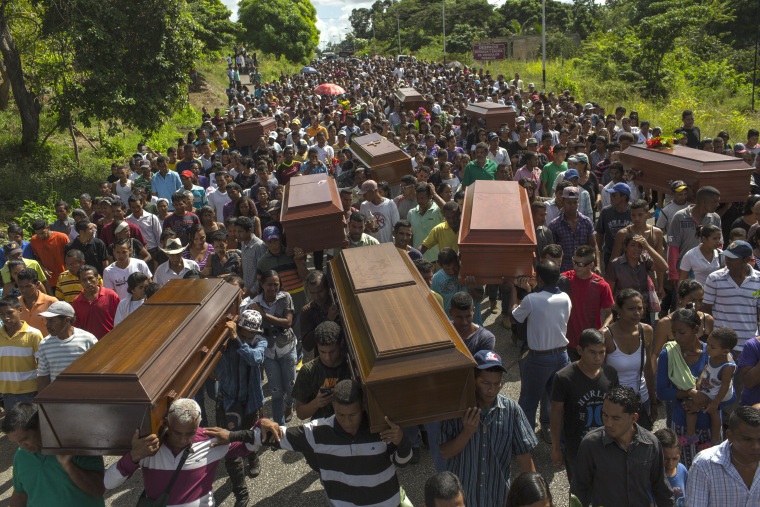
In
this photo, villagers carry the remains of nine slain men
from a fishing family to the cemetery in Cariaco, Sucre state,
Venezuela.Rodrigo Abd / AP
Desperate times makes for desperate alternatives and harden the human conscience. Venezuelan vessels themselves are being raided; knives and guns brandished to emphasize the determination of the raiders to complete their mission, tying up crew, stealing food and electronics. According to the Commercial Crime Services division of the International Chamber of Commerce based in London, such incidents have become commonplace, emanating from Venezuelan desperation. The situation deteriorating rapidly has seen crime proliferate with drug smugglers shipping Colombian cocaine from Venezuelan ports to Trinidad and other Caribbean countries.
Trinidadian fishermen fear for their safety, in witness of Venezuelan boats smuggling military-issue guns along with drugs, exotic animals and women. The flow of automatic weapons out of Venezuela, some appearing to be looted from military stores, is contributing to homicide rates proliferating in Trinidad. When the hijacking of the boat that Jimmy Lalla was on was reported to Trinidadian officials they responded that "We have no boat to go after them; we can do nothing."
The economic crisis in Venezuela has left fishing communities increasingly desperateCredit:
Rayner Pena/Avalon
Are They Spies, Escapees, or Just Desperate Fishermen?
"It's after Kim Jong Un decided to expand the fisheries industry as a
way of increasing revenue for the military. They are using old boats
manned by the military, by people who have no knowledge about fishing." "It will continue." Satoru Miyamoto, professor, North Korea expert, Seigakuin University, Japan
"I am wondering why so many of these [North Korean boats] have all of a sudden come in such a short time." "[North Korea] is a mysterious country. We don't know so much. I don't know if they are coming here to escape or whether they just accidentally drifted here." Kazuko Komatsu, 66, resident, Yurihonjo, Japan
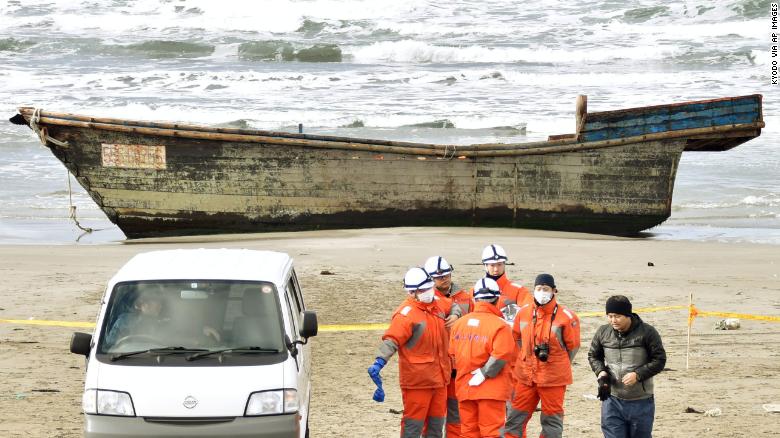
Japanese officials gather on Nov. 27, 2017, near a boat washed ashore in
Oga, Akita Prefecture. Authorities found eight bodies in the
unidentified wooden boat. CNN
"Everyone was hungry, even the soldiers", North Korean defector, former army officer Kang Ri Hyak reported on "brutal" conditions in North Korea before he left four years earlier. "The UN is sending rice and fertilizer and it all goes to the ranking officials under [North Korean leader] Kim Jong Un. There are many soldiers who also die from disease because they're not given medical treatment", he explained.
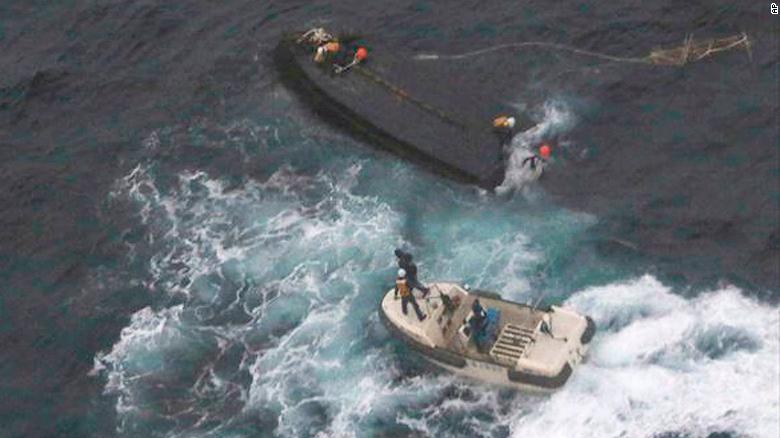
A Japan Coast Guard boat approaches a capsized wooden vessel, on
Wednesday, Nov. 15, 2017. Three crew members rescued from the capsized
boat are North Koreans, and Tokyo is arranging their return home. CNN
For years dilapidated fishing boats have washed ashore on Japanese beaches. Some without the presence of humans, others replete with human skeletons, and some carrying fishermen who are taken into detention and questioned. In the last few years the sightings of these boats, with and without crews, dead and alive, have been increasing in number and they are puzzling both to Japanese rural residents who see them and to authorities who question those aboard.
Seven boats in the past two weeks came ashore in coastal Akita, all of them identified as North Korean, one with eight crew members who arrived in Yuirihonjo an Akita prefecture port town. They were taken directly into police custody for a week, then transferred to a facility for immigrants in Nagasaki, from where the Immigration Bureau plans to return them to North Korea. Although no news has been released to the public, it would be interesting to know whether the eight North Koreans are delighted to be returned to their homeland.
In all probability they can look forward to being detained by the North Korean military and punished for their infidelity to the People's Republic. No doubt while in Japanese detention they will be fed in a manner quite unlike what they are accustomed to in North Korea. No doubt hunger and privation led them to shove off on a fishing venture a little further from North Korea's fishing coastline than practicable if they hadn't meant to 'drift' off to another country on a long sea voyage that could have ended disastrously for them.
That it will end disastrously for them is another matter.
Given the tensions and concerns emanating from North Korea with its violent provocations in sending rockets over Japan and threats to go with them, little wonder Japan will not give haven to these desperate people. Perhaps returning them to South Korea where they will receive grudging haven would be more humane. Stories in the local Japanese media are not averse to noting instances of Japanese citizens abducted by North Korea. It has happened, and no one wants it to happen again.
No fewer than 18 North Korean fishing crew have come ashore on beaches in Japan over the course of this year. The number of skeletons found on ghost ships have been higher, however, a gruesome sight that underlines the sheer desperation of people for whom no other solution to their plight can be envisioned by them as an alternative to remaining in North Korea to starve. The stories the North Koreans tell Japanese authorities is that of bad weather, mechanical problems, and drifting with the currents taking them to Japan.
Evidently, Japanese authorities have reason to doubt some of those stories as for example, when the Japanese coast guard found a North Korean boat near Hokkaido and when they questioned the fishermen from it, they extracted a confession that some of the ten-man crew had been ashore to take possession of refrigerators, televisions, washing machines and a motorcycle from unprotected fishing shacks. The decision whether or not to arrest the men hadn't yet been arrived at. The public is given very few details.
When a North Korean soldier dramatically ran across the demilitarized zone between the two Koreas under gunfire, authorities swiftly made details public. South Korean doctors examined the man to discover multiple and numerous types of parasitic worms, some 27 centimeters long, and that he was also infected with hepatitis B. A professor at Seoul National University College of Medicine specializing in parasites pointed out human fertilizer used on crops and poor sanitary conditions responsible for parasitic cysts in the North.
Contact with feces or unwashed hands lead to intestinal worms, and the North uses untreated human waste as crop fertilizers. Something neighbouring China also traditionally has engaged in. Such infections are readily treated with drugs. "It is a vicious cycle that is hard to stop in North Korea. They are so desperate to make ends meet that they cannot take proper preventive measures", explained Professor Choi Min-ho from Seoul National University.
This represents a general opinion site for its author. It also offers a space for the author to record her experiences and perceptions,both personal and public. This is rendered obvious by the content contained in the blog, but the space is here inviting me to write. And so I do.