Sunday, July 23, 2023

How Goes Ukraine's Counteroffensive With Cluster Bombs?

"They are using them appropriately."
"They're using them effectively and they are actually having an impact on Russia's defensive formations and Russia's defensive manoeuvring."
"I think I can leave it at that." 
U.S. National Security Spokesman John Kirby
 
"[Ukrainian forces need the weapons to] inflict maximum damage on enemy infantry."
"We'd like to get very fast results, but in reality it's practically impossible. The more infantry who die here, the more their relatives back in Russia will ask their government 'why?'"  
"[Cluster munitions would not] solve all our problems." 
"[Their use was controversial, but]: If the Russians didn't use them, perhaps conscience would not allow us to do it too."
General Oleksandr Syrskyi, commander, Ukrainian eastern operations 
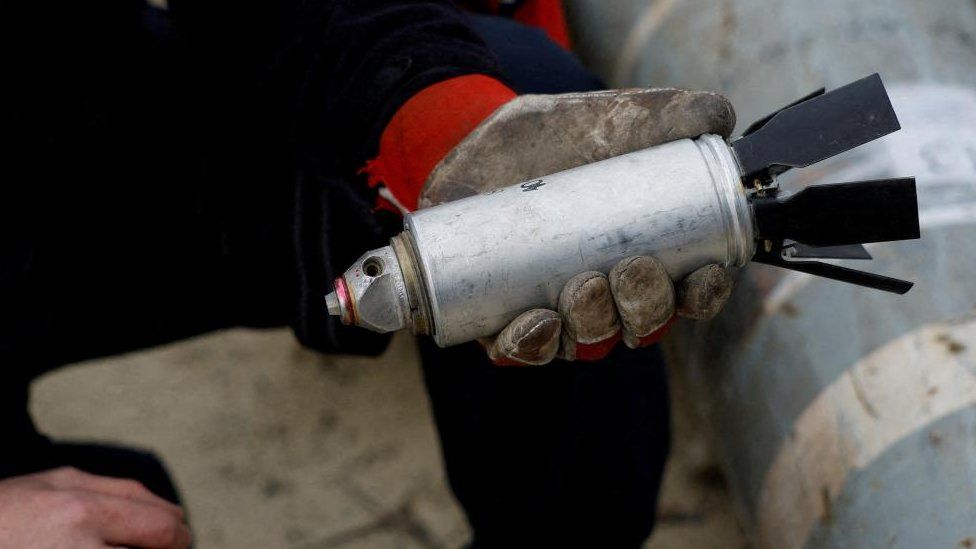
A Russian bomblet fired in Kharkiv
A Russian bomblet fired in Kharkiv earlier in the war   Reuters

"We were filming the Ukrainian army during target practice when suddenly we heard several explosions."
"We lay down, more explosions followed, we saw people were wounded. "
"Later, the Ukrainian army confirmed that we had been fired at with cluster munitions."
DW correspondent Mathias Bölinger, Saturday, July 22, 2023
Ukraine is putting U.S.-provided cluster munitions to work against Russian forces in south-eastern Ukraine with the intention of making some headway in plans to break up the well-fortified Russian positions responsible for slowing Ukraine's summer offensive. President Joe Biden made the "difficult decision" to order delivery of the widely banned munitions, giving human rights groups, European allies and some Democrats reason to criticize the move, with the risk to civilians uppermost of concern.
 
Referring to cluster munitions, Russian President Vladimir Putin threatened retaliation "if they are used against us", irrespective of the witnessed reality of Russia having previously used cluster munitions in populated areas of Ukraine on an estimated 24 occasions since the beginning of the February 24, 2022 invasion by Moscow; a number verified by the United Nations. 
 
And sure enough, a DW cameraman was injured Saturday by shrapnel from Russian cluster munitions that also killed a Ukrainian soldier and wounded several others near the town of Druzhkivka, in the eastern Donetsk region.
 
Outlawed in over 120 countries, cluster bombs explode while airborne over a target, releasing dozens to hundreds of small bomblets across a wide area. Children in particular become vulnerable when the submunitions fail to explode until a much later date when curious children come across them lying in a field and pick them up. Which is when they explode with disastrous consequences, either for the child or for an unaware farmer working in his fields.
 
The cluster munitions will likely be used near the Russian-controlled city of Bakhmut, in addition to front line positions in southeast Ukraine. For its part, Russia has densely mined its strongholds in the east and south with anti-tank and antipersonnel mines and trip wires in areas between three and ten miles in depth. Leading to successful defences, stalling Ukraine's counteroffensive, now a month in operation.
 
According to a Ukrainian official, the munitions have been fired at Russian positions for the purpose of breaking up the trenches that have been detaining Ukrainian forces from its intention to retake territory. U.S. Defense Secretary Lloyd Austin stated that the cluster munitions were to provide a "bridging capability" to apply pressure on the Russians until such time as Western arms production picks up and further resupplies to Ukraine can once again commence.
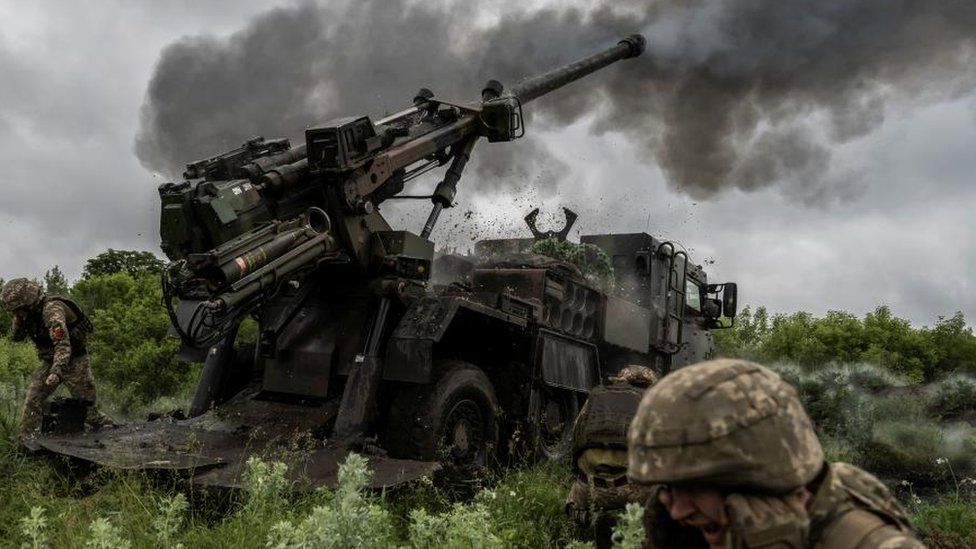
 
Ukrainian soldiers firing artillery
The Ukrainian counter-offensive has been slower than many hoped  Magnum photos


Labels: , ,

Monday, July 17, 2023

The Case for Providing Ukraine With Cluster Bombs

"[Moscow has a] sufficient stockpile [of cluster munitions, and Russia] reserves the right to take reciprocal action [if Ukraine uses the controversial weapons]."
"Until now, we have not done this, [used cluster bombs], we have not used it, and we have not had such a need."
"All attempts by the enemy to break through our defenses ... they were unsuccessful during the entire offensive. The enemy is having no success!"
Russian President Vladimir Putin
 
Cluster munitions are more effective than unitary artillery shells because they inflict damage over a wider area."
"This is important for Ukraine as they try to clear heavily fortified Russian positions."
Ryan Brobst, research analyst, Foundation for Defense of Democracies
https://media.cnn.com/api/v1/images/stellar/prod/230716063741-vladimir-putin-0713-restricted.jpg?c=16x9&q=h_720,w_1280,c_fill/f_webp
Russian President Vladimir Putin speaks at a forum on Thursday in Moscow. Contributor/Getty Images

Vladimir Putin's boast of his troops holding off the Ukrainian counteroffensive may be a morale-booster for his home audience, but Ukraine has more strategic surprises for the Russian invader than confining itself to slowly but surely shoving back the Russian military, while retaking its own geography from the clutches of Russia. 
 
Take, for example, the latest sign that Ukraine is not running out of bold action elsewhere. The Kerch Bridge, linking the annexed Crimean Peninsula to Russia is once again out of commission. Close to 12 miles in length, the bridge represents an artery critical to the supply of Crimea with its daily needs along with supplies for the Russian military.
 
Apart from the symbolism of skillful guerilla action by Ukrainian actors infiltrating the Russian military and its intelligence arm in planned moves of sabotage, aptly demonstrating Ukrainian resolve to retain its territory intact, and to recapture the illegally annexed territories that Moscow now claims as its own, the Kerch Bridge stoppage strikes another humiliating blow to a conquest-driven regime dreaming of its past glories, entrapping its former satrapies into the past.
 
The controversial decision of the United States to open the floodgates of cluster bomb usage has not sat well with its allies. All of whom have provided Ukraine with the munitions it has desperately needed to counter the Russian juggernaut from completing its plans of destroying Ukraine and absorbing its territories into Greater Russia. Most countries were signatories to an anti-cluster-bomb campaign to end their use, condemning them as an after-conflict threat to civilian life and limb by unexploded ordnance.
 
Cluster munitions have in the past been unreliable for the purpose for which they were designed; many failing to explode in midair as designed, falling to the ground below and posing a threat to non-combatants for years to come; making farmland too dangerous to cultivate, and destroying the lives of the unwary. Designed to open while airborne, and release smaller 'bomblets' across a wide area, they are anti-personnel munitions meant to destroy and to maim and to kill.
 
Their purpose is to destroy tanks and equipment, along with troops; their capabilities are meant, when they work, to hit multiple targets simultaneously. The U.S. and allies have already provided the artillery weapons that can also launch cluster bombs, similar to a common 155 mm shell in wide use across the battlefield. Russia, despite Mr. Putin's claims they have not yet been used by his military, has on occasion, made use of cluster bombs. Some Iranian drones are known to explode with multiple bombs.
 
Groups such as Human Rights Watch have verified Russian use of cluster bombs, hitting close to a preschool in the city of Okhtyrka. The intelligence group Bellingcat stated that its researchers had found cluster munitions in that strike along with multiple cluster attacks in Kharkiv, the second-largest city in Ukraine's northeast. A Russian missile and drone barrage hit a number of urban areas in Bakhmut in eastern Donetsk. Russian forces attacked Kostiantynivka with S-300 missiles and cluster munitions.
 
https://dims.apnews.com/dims4/default/ff6d7ba/2147483647/strip/true/crop/4541x3031+0+0/resize/1440x961!/format/webp/quality/90/?url=https%3A%2F%2Fassets.apnews.com%2F10%2Fec%2F8d0692b2a39c0c1645525daf8b23%2F096f1715d30f4a3296cb94272e1e3462
Russian rockets launched against Ukraine from Belgorod region, Russia, July 16, 2023. Vadim Belikov, Associated Press
 
Thousands of small unexploded bomblets remain behind with the high failure rate of the cluster bombs in the past. They were last used by the U.S. in Iraq in 2003 until the conflict moved to more urban settings with their denser civilian populations. The US. Defence Department, according to Brig.-Gen.Pat Ryder, has "multiple variants" of the munitions; those "that we are considering providing would not include older variants with (unexploding) rates higher than 2.35 percent"
 
The U.S. has sent over two million 155 mm rounds to Ukraine with hundreds of thousands more provided by other global allies. Ukrainian ground troops aiming to hit enemy targets from a distance are burning through thousands of rounds a day of the 155 mm rounds capable of striking targets 24 to 32 kilometers in distance. At a German Marshall Fund event a member of Ukraine's parliament said that Kyiv would require firing 7,000 to 9,000 of the rounds daily in intense counterterrorism offensive fighting; substantially pressuring the ability of the US and allies to further deplete their own stocks.

This is what makes the cluster bombs such an attractive alternative for the U.S. which has huge amounts of the munitions in storage. Their use would enable Ukraine to destroy more targets with fewer rounds. A Frontline and AP database named War Crimes Watch Ukraine has catalogued Russia's use of cluster bombs in its destroy-Ukraine campaign.
 
https://www.usatoday.com/gcdn/presto/2023/07/16/USAT/b15df22f-7856-4161-966d-18aedc30b5b0-AP_Russia_Ukraine_War_Daily_Life.jpg?width=1320&height=882&fit=crop&format=pjpg&auto=webp
A man pays his respects to the Ukrainians killed in the Russian invasion of Ukraine, in Kyiv, July 15, 2023. Jae C. Hong/AP


Labels: , , , , ,

Follow @rheytah Tweet