Saturday, August 05, 2017

Taxing Accommodation

"The request we have for the federal [government] is to accelerate the treatment of cases to the maximum so that we can quickly know if their [asylum] request is accepted or not so we can better share expenses."
Quebec Premier Philippe Couillard

"We want migration to Canada to be done in an orderly fashion; there's border checkpoints and border controls that we need to make sure are respected."
"The people coming now irregularly will still have to go through all the proper processes."
"We are ensuring that the capacity to deal with these refugees is in place and our immigration system remains strong and robust."
"The core strength of Canada is that it's not governments that are open to immigration, it's Canadians themselves who are open to immigration."
"One of the reasons Canadians are open to immigration is because we know it has contributed to the growth of this country. Protecting Canadians' confidence in the integrity of our system allows us to continue to be open, and that's exactly what I plan to continue to do."
Prime Minister Justin Trudeau


Canada has for decades maintained an immigration intake roughly equal to a quarter-million new immigrants taken in to the country as landed immigrants annually, eventually to become citizens of the country. Traditionally, and by heritage, Canada can be viewed as a nation of immigrants, a country whose base has been built on the migration of people from across the globe entering the country to forge a new life for themselves. It is done in an orderly fashion, with would-be emigrants applying abroad in their own countries for permission to immigrate to Canada.

Canada began as a vast land inhabited by its original settlers thousands of years ago, the indigenous natives now referred to as First Nations: Indians and Inuit. Colonial Britain and France sent their own settlers to populate the land with Europeans, and for a hundred years it was mostly Europeans of Caucasian stock that Canada welcomed. Chinese, Japanese, Jews and other Europeans were accepted in limited numbers and often as labourers with few rights. Post World War II immigration policies slowly changed.

Canada is now a kaleidoscope of languages, ethnic origins, religions, and backgrounds. At one time new immigrants made it an imperative of their own choosing to integrate themselves into the prevailing Canadian lifestyle, customs, traditions and values. Until the government of the day ushered in a new era, celebrating multiculturalism with few expectations that new immigrants need meld into the prevailing traditions.

What has ensued reflects some disequilibrium as ethnic and religious blocs bring traditional social and religious dysfunctions with them as baggage to their new home.

Canadians do celebrate their diversities and are generally quick to welcome newcomers. The world has erupted in a squall of disproportional groups of peoples displaced by conflict into refugee status. And from other sources where national dysfunction denies citizens their full potential, mass surges of migrants seeking economic and social stability have flooded Europe, fleeing poverty and conflict. Canada has absorbed a share of these refugees in an orderly manner, aware that with them come some level of threat reflecting Islamic 'militancy'.

The United States has struggled for many years with a vast influx of undocumented migrants from Mexico and South America, fleeing violence and poverty and social upheaval. A new government in America has declared itself prepared to deal with the millions of underground refugees representing generations of illegal entrants to the country by turning them out. Some of whom are now turning to Canada for haven. Bypassing legal means of entry to slip into the country beyond legal checkpoints.

Canadians' tolerance for welcoming newcomers, those who in their numbers seek entry through legally approved mechanisms is high. Tose who bypass the legalities and enter undocumented and underground, seeking support and the wherewithal to redraw the parameters of their lives risk rejection. The world is in a state of upheaval, where terrorist violence strikes now and again and nations seek to protect themselves from these violent forces by denying entry to refugees among whom may lurk those dedicated to terrorism.

The vast bulk of the refugees now bypassing normal entry requirements into Canada are people fleeing oppression and poverty. But their search for stability and a future is little different from those people who seek to enter as law-abiding, respecting would-be immigrants. Entering the country illegally, bypassing legal entry to declare themselves refugees does not necessarily endear their efforts to those who receive them. There is a danger that increasing numbers will be rejected, and deported.

Among the North Africans and those from the Middle East that have been entering Canada is a greater proportion by far of Haitians. For the most part these are Haitians who had sufficient personal wealth to fund their travel abroad in search of alternate haven in the wake of the 2010 natural disaster that struck Haiti; an earthquake and tsunami, and now a cholera epidemic. The truly poor and disadvantaged who might wish to seek haven elsewhere cannot; they are not refugees when they remain in Haiti.

Labels: , , , ,

Wednesday, August 05, 2015

Gatestone Institute


  • Are we actually being told, then, that the only way to prevent Iran from having nuclear bombs is to let it have them? If not now, in 10-15 years? And with intercontinental ballistic missiles that can reach the U.S.?
  • Even supporters of the deal say that yes, at the ten year mark, Iran will be able to breakout and build a weapon's worth of nuclear fuel in a year or less -- in other words, have nuclear bombs.
  • Iran has never come clean with the IAEA -- or anyone else -- about its nuclear activities. These were discovered not by IAEA inspectors but by the U.S. and allied law enforcement and intelligence services, as well as by dissident groups within Iran. Are we actually assuming that Iran, under this new deal, will now come clean?
  • Thus under the July deal the U.S. may not (technically) know if Iran, after a breakout, has a nuclear weapon arsenal until Iran either tests a nuclear warhead or explodes it in an American or Israeli city. Then, of course, the discovery will be "too late" to do anything about, especially if the U.S. is helping Iran with technology assistance designed to prevent attacks on Iran's nuclear sites.
  • Having made so many concessions to a non-nuclear Iran, how tough in the future will we be, faced with a nuclear Iran?
Iran says its nuclear technology program is totally peaceful. In 31 other countries with peaceful nuclear programs, there are 438 nuclear power plants in operation, and in another 16 countries, 67 plants under construction.

Under the terms of the 1969 Nuclear Non-Proliferation Treaty, any nation adopting nuclear energy has to comply with International Atomic Energy Agency (IAEA) rules. Every one of these nearly 50 countries does. Iran does not.

For over two decades, in fact, Iran has flouted, bamboozled and cheated the IAEA.
What, then, does this pattern of behavior bode for the emerging nuclear deal with Iran?
Past activities by Iran related to prohibited nuclear weapons have included facilities where nuclear work was done, and the attempted smuggling of nuclear weapons technology, which was interdicted.

These activities, however, were discovered not by IAEA inspectors but by the U.S. and allied law enforcement and intelligence services, as well as by dissident groups, such as the Mujahideen-e Khalq (MEK), within Iran. We cannot necessarily count on such help in the future.

Iran has never come clean with IAEA -- or anyone else -- about its nuclear activities -- unlike the nearly 50 other nations that have, or are planning to have, nuclear energy.

Are we actually assuming that Iran, under this new deal, will now do so? And if it does not, are we actually assuming that we will now have access to suspicious Iranian activity simply by demanding to inspect such sites?

We are being told that access to Iranian sites where cheating has been, or might be, taking place, will be "managed."

Iran will, of course, delay IAEA inspections to sanitize the suspected sites. It will also graciously allow China and Russia to help delay further inspections or enforcement action. And of course they can all graciously veto some UN Security Council action. After 24 days of forewarning and countless delay disputes, what will be left to inspect?

No worry, say deal supporters. If Iran breaks the terms of the deal or is uncooperative, sanctions can be "snapped back" in place.

Although Moscow insisted that there will be no automatic re-imposition of sanctions, what Russia and Iran eventually got in the final agreement was nearly as good. All deals made prior to sanctions being re-imposed will not be affected, a limitation that seriously weakens the effect of the snapback provision.

Deal supporters then optimistically point to Iran's pledge not to build certain new nuclear facilities. But these are facilities Iran had no intention of building in the first place.

Supporters of the deal also tell us that that number of Iranian centrifuges will be sharply reduced. But, we are also told, these centrifuges will not be destroyed (Iran refuses to do); they will be stored. Of course, stored centrifuges can always be un-stored -- and then reconnected to enrich uranium.

"Don't worry," the deal's supporters say. Some of the enriched uranium gas Iran has already produced, from which bombs could be made, will be changed into a solid form, which is not suitable for further enrichment.

Except they apparently "forgot" that it takes only two weeks to turn the enriched solid material back into gas suitable for further nuclear enrichment.

The deal's supporters say that Americans overwhelmingly want a diplomatic outcome to the Iranian nuclear threat and not "another war" -- and, well, a "deal" is a "diplomatic outcome," isn't it? But does this diplomatic deal deny nuclear weapons capability to Iran, as the negotiators said they set out to accomplish? No.

Is Iran's nuclear breakout time even extended? According to Public Affairs expert Alan J. Kuperman, it remains at three to four months at most. Is the deal verifiable? Proliferation expert Ambassador Robert Joseph says no. Will advanced research on centrifuges by Iran stop? The deal explicitly says that advanced research is allowed.

Won't Iran just take the money unfrozen by the deal -- reportedly upwards of $150 billion -- and use it for terrorism and building more missiles? Not really, say deal supporters; Iran is already funding terrorism and missile production. Oh, then the mullahs must be planning to use the new $150 billion for hospice care and battered women's shelters.

Finally, at the end of the deal, presumably in ten years or so, will Iran have, or not have, the capability to build a nuclear weapon?

Even supporters of the deal say that yes, at the ten year mark, Iran will be able to breakout and build a weapon's worth of nuclear fuel within a year or less -- in other words, have nuclear bombs.

Are we actually being told, then, that the only way to prevent Iran from having nuclear bombs is to let it have them? If not now, in 10-15 years? And with intercontinental ballistic missiles that can reach the U.S.?

But, the deal's advocates argue, the IAEA will be able detect such activity, and besides, the nature of the regime will have changed. They do not specify if this change will be for the better or for the worse.

It is important to remember Israel's long-standing and repeated warnings that Iran was close to one year away from having a nuclear weapons capability. Now, even with a deal, Iran may be as close as three months away -- just in time to negotiate still further arrangements until it can run out the clock.

How long will it be, then, before we find out Iran is cheating? And then take action? Here is some history that might give some clues:
Chemical weapons are still being used by the Assad government in Syria -- although there is a US-Russia deal from September 2013 that says no such activity is allowed.

When did we find out the North Koreans had an illegal enrichment facility? When the North Koreans invited US officials to see the facility -- not to get rid of it but to boast that they were going to keep it.

North Korea's cheating, which led up to the revelation of an enrichment capability, happened during the Clinton administration -- which had agreed, along with its 1994-5 Agreed Framework partners, to build two nuclear reactors for North Korea and provide billions in energy and food assistance.

Similarly, there indeed may be a diplomatic purpose to the administration's serial concessions to Iran. The administration may believe they all were necessary -- an "outstretched hand" -- to get the Iranians to think kindly of us and "unclench its fist." What other decisions may have been made to please Iran?

Iran's Foreign Minister and chief nuclear negotiator, Javad Zarif (left), is very, very pleased with the recent nuclear deal. Iran's Supreme Leader, Ayatollah Ali Khamenei (right), is not unclenching Iran's fist in its relations with the West.

Were the chemical redlines in Syria, for example, not enforced for fear of upsetting Iran?
Did the Obama administration not support Iranian people's attempted "Green Revolution" in 2009-10 in order not to upset the mullahs?

Did the U.S. refuse to provide weapons to the Kurds in Iraq, with which to confront ISIS, because we did not want to upset the Iranian mullahs, whose agents control much of the Iraqi government?

Did the U.S. apologize for the supposed role of the U.S. in a 1953 Iranian coup -- which never in fact occurred, as the Shah had the constitutional power to dismiss the prime minister -- again not to upset the mullahs?

Did the U.S. allow India, Japan, Korea and China all to receive sanctions exemptions and import Iranian oil because it did not want to upset the mullahs? It looks suspiciously as if we made all these concessions to grease the diplomatic skids to get a deal. Those represented our "outstretched hand."

But did these concessions succeed in preventing Iran from continuing to build its nuclear weapons capability? Not for a minute.

Thus, under the July deal the U.S. may not (technically) know (although it would definitely be suspicious) if Iran, after a breakout, has a nuclear weapons arsenal, however small, until Iran either tests a nuclear warhead or explodes it in an American or Israeli city.

Then, of course, the discovery will be "too late" to do anything about, especially if the U.S. is helping Iran with technology assistance designed to prevent attacks on Iran's nuclear sites (from terrorists, of course!).

Having made so many concessions to a non-nuclear Iran, how tough in the future will we be, faced with a nuclear Iran?

Labels: , , , , ,

Tuesday, April 14, 2015

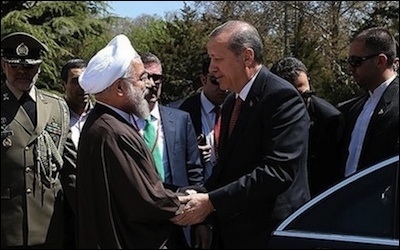
Iranian President Hassan Rouhani (left) greets Turkish President Recep Tayyip Erdogan in Tehran, April 7, 2015.
Time passes quickly; but most scripts at the political musicals of the Middle Eastern theaters remain stubbornly unchanged. The (neo-) Ottoman-Persian theater looks exceptional at deception, self-deception, counter-deception, attempted deception and failed deception: At least the Saudis and Iranians do not embrace and kiss each other while fighting several proxy wars in different theaters of the Middle East.

The complication on the Turkish-Iranian axis has several reasons, none of which is easily comprehensible to the Western mind: Turkey's Sunni Islamists believe that they can always fool their Shiite Iranian "brothers" by smiling to their faces, by standing by them against the Christendom, and by championing the Palestinian cause -- while playing games behind their backs. In return, the Iranians privately smile and think that the not-so-smart Turks are just trying to play backgammon while they, meanwhile, calculate gambit after gambit on a chessboard.
But at least there is an amazing consistency in the way Turkey and Iran have kept playing their parts in modern history, both in "Muslim brotherly" rhetoric and not-so-hidden rivalry and sectarian (cold) warfare.

During an October 2009 visit to Tehran, then Turkish Prime Minister (now President) Recep Tayyip Erdogan said: "We need to establish peace in the region, and its solution is in the hands of regional countries." In return, his host, the Iranian parliament's speaker, Ali Larijani, said that cooperation between Iran and Turkey could strengthen regional security.

A week before smiling hand-in-hand with Rouhani, Erdogan said that he would not tolerate Iran dominating the Middle East.
Five-and-a-half years, and more than a million coffins, civil, sectarian and proxy wars, and almost daily terrorist attacks later, the Turks and Iranians went back to their wardrobes, grabbed their party costumes and started to dance to the same tunes: Turkish belly dancing to the Persian santour.

Erdogan, on a fresh visit to Tehran on April 7, said that Turkey and Iran "should play the mediation role" in the conflicts in Iraq and Syria. "I don't look at the sect. It does not concern me whether those killed are Shiite or Sunni; what concerns me is Muslims," Erdogan said in Tehran. He also said that Turkey and Iran should mediate between the battling parties (in the Middle East, especially in Syria and Iraq). "We have to put an end to this bloodshed, this death," said Erdogan, perfectly performing the Turkish role.

Playing his part in the drama, Erdogan's host, Iranian President Hassan Rouhani, said: "We agreed that there will be no tolerance for instability or distrust in the two countries' relations."

Both leaders, as their drama roles dictate, put on generous smiles in front of the cameras. Lovely! In half a decade, the two brotherly countries have progressed spectacularly from "We need to establish peace in the region" to "We have to put an end to this bloodshed."

Just a week earlier, in a more real world, Turkey and Iran exhibited serious doses of tension over the crisis in Yemen, where airstrikes by a Saudi-led coalition of Sunni countries targeted the Shiite Houthi rebels, who have taken over much of the country. Iran condemned the offensive; Turkey said Iran and "terrorist groups" must leave Yemen.

Erdogan, who hand-in-hand with Rouhani smiled to the cameras in Tehran, only the week before had said that Turkey would not tolerate Iran dominating the Middle East (read: Only the Sunnis can dominate the Middle East, preferably the Turks).

In response, at least 65 Iranian MPs, in a letter, asked Rouhani to caution Erdogan "regarding his anti-Iranian remarks." That was a couple of days before Erdogan's visit to Tehran.

Against that backdrop, Rouhani put the final line into this Act (who knows what number) of the Turkish-Iranian drama: "We both believed that it is necessary for us to witness the end of war and bloodletting in Yemen as soon as possible."

Thundering applause. Curtain down. Until the next Act, which promises full and boring scenes of fanciful playacting.

The truth about the Ankara-Tehran axis is not always as complex as the Middle East itself: Friendship and cooperation against the West and Israel; for trafficking money across the border in official and unofficial trade and for the money pouring into the pockets of both regimes' business cronies; and deep enmity along sectarian lines with historic regional rivalry on top.
Burak Bekdil, based in Ankara, is a columnist for the Turkish daily Hürriyet and a fellow at the Middle East Forum.
Related Topics:  Iran, Turkey and Turks  |  Burak Bekdil

Labels: , , , , ,

Friday, March 06, 2015

Appeasing Iran

"We continue to be focused on reaching a good deal, the right deal, that closes off any paths that Iran could have toward fissile material for a weapon and that protects the world from the enormous threat that we all know a nuclear-armed Iran would pose."
"[If talks are successful, the deal being negotiated will] achieve the goal of proving that Iran's nuclear program is and will remain peaceful."
"No one has presented a more viable lasting alternative for how you actually prevent Iran from getting a nuclear weapon."
U.S. Secretary of State John Kerry
Uranium conversion facility outside Isfahan, Iran (2005)

Try serious, uncompromising and ongoing sanctions; they hurt quite usefully.

Mr. Kerry's upbeat assurances contrast sharply with that of an American official speaking anonymously in accord with State Department rules who gave a more sobering assessment in stating the March first-stage agreement as "an understanding that's going to have to be filled out with lots of detail", before reaching the final target date of June. From optimistic cheerfulness to the recognition of reality's painful difficulties.

Mr. Kerry's overstatements as opposed to the devil that resides in those bedevilling details.

It is the details that Iranian Foreign Minister Mohammad Javad Zarif is skilled in, however, in doing the bidding of his theocratic masters who see no roadblocks steering them away from their stated goal that cannot be overcome by sheer persistence and sly promises never meant to be honoured. For this is what Islam permits its faithful; to achieve a goal they are permitted to engage in circumlocution, falsehoods, promises never meant to be kept.

And the ancient practise of Al-taqiyya equals dissimulation; time-honoured, and as the Islamic Republic of Iran has demonstrated time and again, it works. On the other hand, if Grand Ayatollah Khamenei is as morbidly ill as his emergency trip to hospital might suggest, perhaps if it were not for the fact that the Iranian Republican Guard elite are in control of the nuclear program, a different end could conceivably result.

The sheer doggedness that it takes through diplomatic finessing of haggling for advantage, while appearing to make sacrifices in the earnest effort to seem compliant to the urgent recommendations of those interceding in critical issues of great moment to the international community simply wears down the resolve of those unaccustomed to hanging in there and reiterating uncompromising demands rather than surrendering out of a spirit of exhaustion, to the softly-reasonable-appearing refusals to bend to the will of those seeking to avert disaster.

On November 24 at the discussion of extensions, Philip Hammond, British foreign secretary representing one of the five powers allied with the United States at the negotiating talks, said he had an expectation of "an agreement on substance" by March. The time in between March and June would be a continuation of negotiating details only "if necessary ... to finalize any possible remaining technical and drafting work"; in view of recent events with the talks not yet accomplishing anything of value, an attitude that should be recognized for its over-optimism.

Now, it seems, President Barack Obama will make a final assessment on whether to continue the talks into June once he has been able to evaluate the assessment from U.S. negotiators of what has been achieved up to mid-March. Precious little, it would seem; canny Tehran knows with whom it deals, and it knows also the concern that the White House has to conclude an agreement that it can hold up to the world with ostensible triumph in success, even though it will merely front a failure to have Iran agree to wrap up its nuclear ambitions.

Perhaps Tehran has viewed Libyan Moammar Ghadaffi's surrender of his nuclear program in view of the Iraq invasion on the pretense of destroying nuclear know-how there, and weighed what happened to that tyrant in the aftermath of his acquiescing to Western demands, and his fate thereafter, even though he became an assist to the West in its conflict against extremist Islamists. The speech to Congress by Benjamin Netanyahu gave fresh impetus to congressional critics anticipating lenient terms given to Iran in Obama's anxiety to come up a winner on the issue.

In addressing Congress and stressing that the agreement taking shape is nothing less than steeply dangerous, allowing Iran to develop nuclear weapons, Mr. Netanyahu spoke nothing less than the unadorned reality of the situation. Republicans are busily attempting to have legislation introduced last week passed, to give Congress some measure of control over the deal, and they have a slight majority of American opinion behind them.

After meeting with Iran's foreign minister at Montreux, the next stop for Mr. Kerry was Saudi Arabia, to attempt the challenge of explicating the potential deal to Saudi Arabia's monarch King Salman, and then to consult foreign ministers from Bahrain, Kuwait, Oman, Qatar and the United Arab Emirates. Qatar won't be a problem. Saudi Arabia and other Arab nations view Iran's hegemonic sectarian ambitions and nuclear advances with abhorrence and trepidation.

But Mr. Obama must have his legacy project intact for his future presidential library, which will feature his success in disentangling the United States from international affairs extending from eastern Europe to the Middle East and the Far East.

Labels: , , , , ,

Tuesday, November 04, 2014

Everything you need to know about SodaStream’s move

SIGN UP FOR THE JTA DAILY BRIEFING
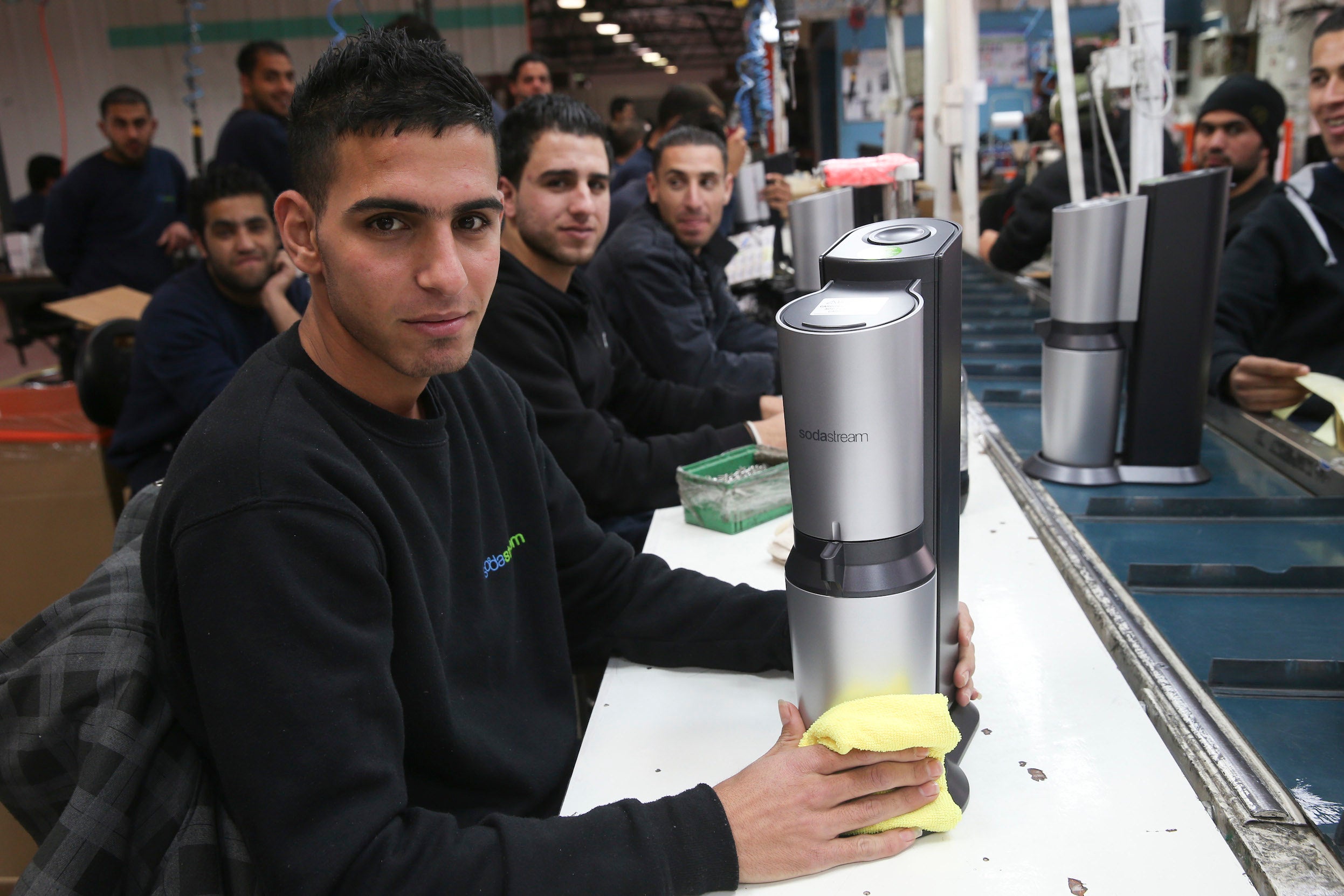
Some of the hundreds of Palestinians who work at SodaStream's West Bank factory that is shutting down. (Nati Shohat/Flash90)
Some of the hundreds of Palestinians who work at SodaStream’s West Bank factory that will be shut down. They could be put out of work with the facility’s relocation to southern Israel. (Nati Shohat/Flash90)

TEL AVIV (JTA) — SodaStream, the Israeli at-home seltzer machine company, announced last week that it would be closing its West Bank factory and moving the facility’s operations to southern Israel next year. Here’s what you need to know about SodaStream, the controversy that has bubbled up in its midst and what the actress Scarlett Johansson has to do with it.

What is SodaStream?
SodaStream is an Israeli company that makes and sells seltzer machines for home use. Since it was founded in 1991, the company has sold more than 10 million machines in 39 countries. The foot-and-a-half-tall machines turn still water into seltzer in 30 seconds. The company also markets dozens of mix-in flavors, such as cola, ginger ale, lemon-lime and fruit punch.

Why is SodaStream controversial?
Until this week, SodaStream’s main factory was located in Mishor Adumim, an industrial park in the Israeli West Bank settlement of Maale Adumim, east of Jerusalem. Because the settlement is likely to be included in Israel in any future peace deal with the Palestinians, many Israelis don’t view it as all that controversial.
But groups that oppose Israel’s occupation of the West Bank have called for boycotts of SodaStream due to the factory’s location. The debate over SodaStream gained attention earlier this year when the actress Scarlett Johansson became the face of the company, appearing in a SodaStream ad during the Super Bowl. Johansson ended up resigning as a spokeswoman for Oxfam International, an anti-poverty group that opposes the West Bank factory, after it criticized the actress’ involvement with the company.

What is SodaStream’s position on its West Bank factory?
SodaStream CEO Daniel Birnbaum has touted the Mishor Adumim factory, which has been in its current location since 1997, as a successful example of Arab-Jewish coexistence in the West Bank. Some 500 Palestinians work at the factory alongside Israeli Jews, and Birnbaum says he pays them well and treats them as equals with their Jewish co-workers, though pro-Palestinian groups allege that the Palestinian employees are treated poorly. The factory includes a mosque for Muslim employees. Closing the factory, Birnbaum says, could mean putting hundreds of Palestinians out of work.
Birnbaum is a proponent of a two-state solution to the Israeli-Palestinian conflict. He has noted that Mishor Adumim is defined as an area under Israeli control by the 1993 Israeli-Palestinian Oslo Accords, and argues that Israeli industry there is thus not a violation of international law.
The company drew more criticism this summer after it fired 60 of its Muslim employees, claiming they refused to work. The employees countered that SodaStream did not provide them with sufficient meals following the Ramadan fast and therefore were unable to safely operate machinery.

So what caused the move?
SodaStream’s third-quarter revenue dropped 13 percent, and sales in the Americas dropped 41 percent — numbers the company says are unrelated to the boycotts.
Moving to Lehavim, a town in southern Israel, near Beersheba, will yield savings of 2 percent, according to a brief SodaStream statement about the move. The Israeli government gave SodaStream a $20 million grant for the new facility, part of a larger government effort to incentivize business growth in the country’s South.
The company claims the motive for the move is “purely commercial,” though Birnbaum told the Forward this year that the Mishor Adumim factory is a “pain in the ass.”
Birnbaum said in the statement that he’s working with the Israeli government to obtain work permits that would enable his Palestinian employees to work at the relocated plant. However, the new facility is 60 miles away from the Mishor Adumim workplace.
“While we are enthusiastic about our new Lehavim facility and the exciting promise it brings to our company, we are committed to doing everything in our power to enable continuity of employment to our family of employees,” Birnbaum said in the statement.

What are protest groups saying about the move?
They have praised the decision … but they’re still boycotting SodaStream. Activists say that the Mishor Adumim factory’s closure is evidence that the BDS movement, which aims to boycott, divest from and sanction Israel, is working.
“Today’s news is just the latest sign that these global BDS campaigns are having an impact on changing the behavior of companies that profit from Israeli occupation and apartheid,” said Ramah Kudaimi, membership and outreach coordinator for the U.S. Campaign to End the Israeli Occupation, which represents 400 organizations.
But Kudaimi’s group, as well as the Palestinian Boycott, Divestment and Sanctions National Committee, say they will continue to boycott SodaStream because they claim its new factory abets dispossession of Bedouin land in Israel, even though the factory will be in an existing industrial park.


Labels: , , , ,

Friday, October 31, 2014

Gatestone Institute


The relevant UN Resolution, as well as the Congressional sanctions bill, says the acceptable level of enrichment is none at all. The administration is, in fact, negotiating a level. This track means the total erasure of all international sanctions.
All of the steps Iran took are reversible. Iran's "expressed desires" should not be the driver of U.S. policy.
The Coach-in Chief, President Obama, appears to believe the West and Iran are on the same team looking for a negotiated tie. The Iranians, however, are looking for nuclear weapons.
In the run up to November's P5+1 talks, Iran has already won the battles that count; remember, this is the bazaar. After last year's unsatisfactory interim agreement, this author wrote:
A deal that is not a capitulation requires two conditions: the parties must equally value the process; and there has to be a compatible endgame. The West invested the process with much more value than did Iran, providing the mullahs with instant leverage, but most important, there was no agreed-upon end game.
The P5+1 wanted to negotiate the terms of Iran's nuclear surrender; Iran was negotiating the conditions under which it will operate its nuclear program.
We are familiar with the rules of buying a rug in the souk. The goals are compatible -- he wants to sell, you want to buy. If you want the rug more than he wants the deal, you will overpay; if he wants the deal more than you want the rug, you win. But either way, money and rug will change hands. Alternatively, if you want to buy a rug and he wants to sell a camel, no matter how ardently you bargain there will be no deal. Unless you change your mind and take the camel.
The White House took the camel.
A speech by Wendy Sherman, the U.S. Under Secretary of State for Political Affairs, to a P5+1 symposium in Washington, made that clear:
"The President has pledged to ensure that Iran will not acquire a nuclear weapon.... Specifically, Iran [took a number of steps, including having] agreed not to make further advances at the Arak heavy water reactor; and opened the door to unprecedented daily access for international inspectors to the facilities at Natanz and Fordow."
Maybe. But all of the steps Iran took are reversible, IAEA inspectors were denied access to a suspected military site at Parchin, and the issue of warhead delivery systems has not been addressed. If they cheat, it is worth noting that its friend in proliferation, North Korea, appears to have miniaturized a nuclear weapon to fit on a mobile missile. Want to risk it? In Wendy Sherman's words:
"[O]ur group has proposed to Iran a number of ideas that are equitable, enforceable, and consistent with Tehran's expressed desire for a viable civilian nuclear program and that take into account that country's scientific knowhow and economic needs."
Iran's legitimate civilian needs could be met through legal purchases of enriched uranium. Iran's "expressed desires" should not be the driver of U.S. policy.

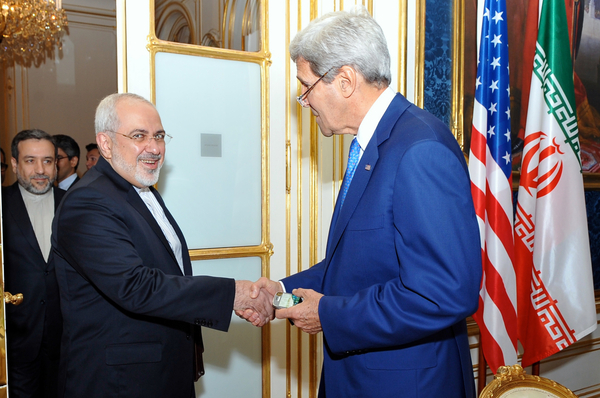
U.S. Secretary of State John Kerry shakes hands with Iranian Foreign Minister Mohammad Javad Zarif during talks in Vienna, Austria, July 14, 2014. (Image source: U.S. State Department)

According to Sherman:
"Iran's Supreme Leader has repeatedly said that his government has neither the aspiration nor the intention of building a nuclear weapon; indeed, he has said that such a project would be forbidden under Islam. So our proposals are consistent with Iran's own publicly-stated position."
Why?
"Iran's leaders would very much hope that the world would conclude that the status quo -- at least on this pivotal subject -- should be acceptable, but obviously, it is not."
Iran's goal was to establish the principle of its "right" to enrich uranium. Although the relevant UN Resolution says the acceptable level of enrichment is none at all -- as does the relevant and lopsidedly approved Congressional sanctions bill -- the administration granted Iran's principle and is, in fact, negotiating a level.
Sherman continued,
"The temptation to link the nuclear question to other topics is understandable. However ... we are concentrating on one job and one job only, and that is ensuring that Iran does not acquire a nuclear weapon."
This single-track negotiation has allowed Iran to proceed without American objection along the path to a variety of other important Iranian ends, including:
Additional repression at home, which is crucial to the longevity of the regime. Twenty-six-year old Reyhaneh Jabbari was the 967th person to be executed since the "moderate" Hassan Rouhani became Iran's president in August 2013. She was convicted of killing the man she accused of raping her, but with no investigation of her claim. The pace of executions has been accelerating: 381 by the end of 2013, 586 so far this year, including Miss Jabbari.

The victims are often hung from cranes in public with an audience that includes children.
There is a new campaign of throwing acid in the faces of women not considered "modest" by roving gangs, and probably instigated by the Basiji paramilitary police. (Check photos on the Internet if you dare, but be warned.) Writer and professor emerita Phyllis Chesler wrote recently that the Women's Freedom Forum of Iran told her laws have been passed to protect the acid throwers, and the regime has been "intimidating the families of the victims and hospital nurses and staff. Reporters are also prevented from going to hospitals to see the victims."

There are also reports of increasing pressure on non-Muslim communities in Iran. The attacks are much like those of ISIS -- but with no condemnation from the White House.

Support for Syrian murderer Bashar Assad: With the U.S. diverting attention to ISIS and demanding that "moderate Syrian rebels" (yes, quotation marks indicate skepticism about whether "moderates" exist and if they do, that we know who they are) shut down their attacks or postpone desired attacks against the Syrian government, which has been repressing, bombing, gassing, and starving their compatriots. Instead, says the U.S., turn on Sunni "radicals," who are at least cousins of the Sunni "moderates," and kill them first -- removing one threat from Damascus.

More support for Assad -- and Iran: The U.S. air campaign is the decision of the President, who said we are there at the "invitation of the Iraqi government." That creates two problems: the Iraqi government, even the new one, is Shiite-dominated and beholden to Iran; and it makes the U.S. Air Force an agent of those two bodies against their most serious adversaries.
If Iran and the Baghdad government are so worried about ISIS (and they are), why not let THEM do something about it? Why is the U.S. trying (not very successfully) to create a Sunni coalition to fight a Sunni organization? America's tepid air support and failure to provide American or allied "boots on the ground" have already bred resentment among Iraqi Sunnis, who are considering how to create some stability with ISIS rather than fighting what they see as a losing battle. (See U.S. withdrawal from Afghanistan for similar problems with the Afghan National Security Force.)

Perhaps most important: The total erasure of all international sanctions. There have been justified complaints about European countries running to do business with Iran, even during the sanctions period; Germany may be the prime offender here. But the U.S. has jumped in bed with them—first releasing billions in frozen Iranian assets and now permitting U.S. companies to sign new contracts with the Islamic Republic. A week ago, Boeing, a major U.S. defense contractor, announced that it had signed its first new contract with Iran since 1979.

The game is not over at halftime. No matter how great the score disparity, if the team behind -- in this case the P5+1 -- makes adjustments and sticks to its goals, victory is still possible. It is not likely in this instance because the Coach-in-Chief, President Obama, appears to believe the West and Iran are on the same team looking for a negotiated tie.
The Iranians, however, are looking for nuclear weapons.

Labels: , , , , , , ,

Tuesday, January 07, 2014

U.S. and Iran Face Common Enemies in Mideast Strife

Ali al-Mashhadani/Reuters
Fighters in Ramadi, Iraq, on Monday. Iran offered to join the United States in sending military aid to Iraq’s Shiite government.
TEHRAN — Even as the United States and Iran pursue negotiations on Tehran’s nuclear program, they find themselves on the same side of a range of regional issues surrounding an insurgency raging across the Middle East.

While the two governments quietly continue to pursue their often conflicting interests, they are being drawn together by their mutual opposition to an international movement of young Sunni fighters, who with their pickup trucks and Kalashnikovs are raising the black flag of Al Qaeda along sectarian fault lines in Syria, Lebanon, Iraq, Afghanistan and Yemen. 

The United States, reluctant to intervene in bloody, inconclusive conflicts, is seeing its regional influence decline, while Iraq, which cost the Americans $1 trillion and more than 4,000 lives, is growing increasingly unstable. 

At the same time, Shiite-dominated Iran, the magnetic pole for the Shiite minority in the region, has its own reasons to be nervous, with the ragtag army of Sunni militants threatening Syria and Iraq, both important allies, and the United States drawing down its troops in Afghanistan. 

On Monday, Iran offered to join the United States in sending military aid to the Shiite government in Baghdad, which is embroiled in street-to-street fighting with radical Sunni militants in Anbar Province, a Sunni stronghold. On Sunday, Secretary of State John Kerry said he could envision an Iranian role in the coming peace conference on Syria, even though the meeting is supposed to plan for a Syria after the resignation of President Bashar al-Assad, an important Iranian ally. 

To some, the Iranian moves reflect the clever pragmatism of Iran’s new president, Hassan Rouhani, and his foreign minister, Mohammad Javad Zarif, aimed at building their country into a regional power. To others critical of the potential reconciliation, the moves are window dressing aimed at lulling the West into complacency while Tehran pursues nuclear weapons and supports its own jihadists throughout the region. 

Yet even Iranians outside the reformist camp see the shared interests as undeniable. “It is clear we are increasingly reaching common ground with the Americans,” said one of them, Aziz Shahmohammadi, a former adviser to Iran’s Supreme National Security Council. “No country should have an eternal enemy, neither we nor the United States.” 

With Iran as an island of stability in a region plagued by violent protests, sectarian clashes and suicide bombers, there are not that many options left for Washington, experts here say. 

“We face the same enemy, and the enemy of my enemy is my friend,” said Mashallah Shamsolvaezin, a prominent Iranian reformist journalist who closely follows the Arab world. He recalled how Iranian intelligence operatives gave reliable information to American Special Forces troops battling Iran’s enemy, the Afghan Taliban, in 2001. 

While the Obama administration acknowledges that Iran has the potential to be an influential player on regional issues from Afghanistan to Syria, senior officials have said they are keeping their focus tightly on the nuclear negotiations. Cooperation on any other issues, they said, hinges largely on coming to terms on Iran’s nuclear program. 

The administration has concluded that Mr. Rouhani and Mr. Zarif have been empowered to negotiate on the nuclear program, but officials said it remained unclear whether their policy-making authority extended to regional issues like Syria. There, the Islamic Revolutionary Guards Corps holds vast influence through its Quds Force, and it is supplying weapons to Hezbollah in an effort to prop up President Assad’s government. 

The thaw in relations extends back almost a year, with the two countries making overtures long thought impossible, deeply angering Washington’s closest regional allies, Saudi Arabia and Israel.
As early as last spring, a series of secret talks in Oman and Geneva laid the groundwork for re-establishing relations, cut over three decades ago after Iranian students took American diplomats hostage in revolutionary Tehran. 

In September came the agreement — credited to President Vladimir V. Putin of Russia but fully backed and partly engineered by Iran — to remove Syria’s chemical weapons. Not long afterward, President Obama and Mr. Rouhani held a historic phone conversation, and in late November the United States and other world powers struck a temporary nuclear agreement with Iran, the first in 10 years. 

Iran has been presenting itself as the voice of reason, pointing at the extremely graphic videos of beheadings and other executions produced by some of the insurgent groups in Syria, while Mr. Rouhani wished a happy new year to all Christians on his Twitter account. 

“Now extremists are once again threatening our security, and as in 2001, both countries will cooperate with each other in Iraq, and potentially elsewhere, too,” Mr. Shamsolvaezin said. “This is the beginning of regional cooperation.”

The thaw presents dangers to Mr. Obama and Mr. Rouhani, who will remain vulnerable to criticism from conservatives in both countries. Mr. Kerry’s invitation on Sunday for Iran to join “on the sidelines” of the Geneva conference was angrily rejected by Iranian hard-liners. 

“The Americans are confessing Iran stands for peace and stability in this region,” said Hamid Reza Tarraghi, a hard-line political analyst, with views close to those of Iran’s leaders. “But when they invite us for a conference on Syria we are ‘allowed’ to be present on the ‘sidelines.’ This is insulting.” 

Even Mr. Zarif rebuffed Mr. Kerry, saying that “everybody must be unified in order to fight the terrorists,” the official Islamic Republic News Agency reported. 

But Tehran’s full participation in the conference would seem to present even deeper problems, in that the talks are aimed at planning for a Syria after Iran’s longtime ally, Mr. Assad, has stepped down. 

Critics of United States policy say that the Obama administration is strengthening Iran at the expense of traditional allies, particularly Saudi Arabia and Israel. They say that Iran has not cut back on its support of its regional allies, like Hezbollah, the militant Shiite group in Lebanon, and Mr. Assad, and is deeply involved with Iraq’s Shiite government. 

Moreover, they say, a final nuclear agreement with Iran, should it be reached, would relieve Iran of crippling economic sanctions, reviving its economy and giving it more resources to spread its influence in the region, while depriving the West of diplomatic leverage to restrain Iran. 

Analysts in Iran say that Tehran is pursuing a clever strategy, using the United States to undermine its greatest regional rival, Saudi Arabia. 

“Cooperating skillfully with Russia, Iran has managed to change the game both in Iraq and in Syria,” said Hooshang Tale, a Tehran-based nationalist activist and a member of Parliament before the 1979 Islamic Revolution. “If we play our cards well, we will end up outsmarting both the U.S. and Saudi Arabia.” 

He and others note that Iran has managed to keep Mr. Assad in power and wields considerable influence over its neighbors, Iraq and Afghanistan. Rightly or wrongly, they view their regional enemy Saudi Arabia as being on the verge of collapse, saying in Friday Prayer speeches and in televised debates that the kingdom is ruled by old men who have lost their way. 

“We are worried for Saudi Arabia, which seems weak and potentially unstable,” said Mr. Shahmohammadi, the former adviser, who heads an institute that promotes dialogue between Sunnis and Shiites. “Even we, as their competitor, see all the horrible consequences if things go wrong there.” 

On Tehran’s streets, where people tend to see much of the region as distant lands filled with mayhem and unrest, many Iranians welcome every step that brings Iran and the United States closer together.
“The U.S. stands for progress, for work, a future, new cars and a better life,” said Mohammad Reza Barfi, an auto mechanic. “I’d rather have peace with the U.S. than with any regional country. What do they have to offer?”

Labels: , , , , , ,

Follow @rheytah Tweet