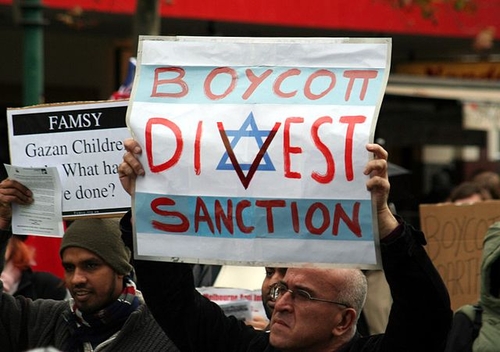
The Western world is full of charities that do nothing but good, such
as fight disease; help the less fortunate, or offer legal protection.
But there are other sorts of charities, the so-called non-governmental
organizations (NGOs); these often work on the international stage,
supposedly for human rights, humanitarian aid, and peace. These NGOs are
funded by foundations, businesses, private persons -- oh, and
governments. They exist in astonishingly large numbers: 1.5 million in
the US, 2 million in India, and
thousands in Europe, over 500 of which are
lobbyists in the European Parliament. The
total income
of OECD-linked NGOs amounts to around $16 billion. Unfortunately, some
of these betray their love of humanity by adopting discriminatory
policies.
Many of these NGOs -- especially those heavily dependent on
government money -- seem to be driven by an ideological or political
commitment, and are inevitably drawn into political engagement.
In a desire to help the underdog, wherever he may be, many NGOs make
ideological choices as to whom they place in that category, and who
falls into the category of "oppressor." This view often means that their
good work may be used as "air cover" for people and actions that are
less admirable.
It is not uncommon to find NGOs ignoring human rights abuses in
countries they seek to have as allies, or with whom they are obliged to
work. Sometimes, NGOs adopt a political stance that is deliberately
prejudiced or prejudicial. The vast majority of politicized NGOs,
whatever their original remit, are those who condemn only one country
and who do so time and time again. That country is, of course, Israel.
Within Israel, the community they attack is, without exception, the
Jewish community. Israelis, it seems, can never do right, while on their
borders, the Palestinians, who are seen as underdogs and victims, can
never do wrong.
Quakers, for example, have always been known for their support for
non-violence. Yet Quaker NGOs claiming to work for peace in the Middle
East grossly ignore Palestinian violence while condemning Israel's right
to self-defence against it. In cooperation with the World Council of
Churches, the Quaker-led organization calling itself the Ecumenical
Accompaniment Programme in the Palestinian territories and Israel
(EAPPI), repeatedly blasts Israel for its use of checkpoints, while
saying nothing about the would-be Palestinian suicide bombers who make
Israeli security such an imperative -- a hypocrisy that does not seem to
trouble their consciences much. And this is exactly where these
politicized NGOs do damage. Their contribution to the recent UN report
on Israel's 2014 war in Gaza has warped it to such a degree that it is
useless for any serious enquiry.
This selection of Israel that emanates from countless NGOs -- as well
as from non-transparent and unaccountable supra-national organizations
such as the UN and the International Criminal Court (ICC) -- is also
reflected in the totally unbalanced singling out of Israel for rebuke by
the United Nations Human Rights Council (UNHRC). Last week, the U.S.
ambassador to the UN, Keith Harper,
protested in no uncertain terms about the fact that the UNHRC criticizes Israel more than it does all the other countries in the world
combined:
We remain troubled, however, by this council's standalone
agenda item directed against Israel, and by the many repetitive and
one-sided resolutions under that agenda item. None of the world's worst
human rights violators, some of whom are the object of resolutions at
this session, have their own standalone agenda item at this council.
Only Israel receives such treatment.
For centuries, almost no other religious or racial community has
received such universal hatred or been subjected to such high levels of
hypocritical double standards and persecution as the Jewish communities
of Europe and the Middle East. Today, the obsessive focus on Israel is a
simple reanimation of these classic hatreds. It is manifestly
anti-Semitic in nature, yet dozens of NGOs that claim to be opposed to
racism are happy to employ it.
Readers who want to gain a broader picture of how this anti-Israel
discrimination works for NGOs can do no better than to consult the many
articles and press releases of
NGO Monitor, an Israeli information, legal advisory and advocacy organization established by
Gerald Steinberg, a professor of political science at Bar Ilan University.
NGO Monitor
is the most crucial resource for the media, the international community
and for anyone who needs to know about the frequently anti-Semitic
charges levelled against the Jewish state -- whether "war crimes,"
"apartheid," or ethnic cleansing.
What is significant is not so much the evident hatred of Israel
expressed by some NGOs, as that so many of them are heavily funded by
foreign governments or foreign institutions
According to NGO Monitor,
"NGOs are meant to represent civil society, not the interests of
foreign governments. Israeli NGOs that receive foreign government
funding benefit from the misleading image of being 'non-governmental,'
non-political, and based in 'civil society.'"
When such funding is provided by allied states such as the U.S. or
the UK, or international unions such as the EU, it constitutes
disproportionate interference by external governments in the internal
affairs of another democratic state.
These foreign agents of influence are why the new government of
Israel needs legislation to bring accountability for those activities,
in part by insisting on transparency in all funding.
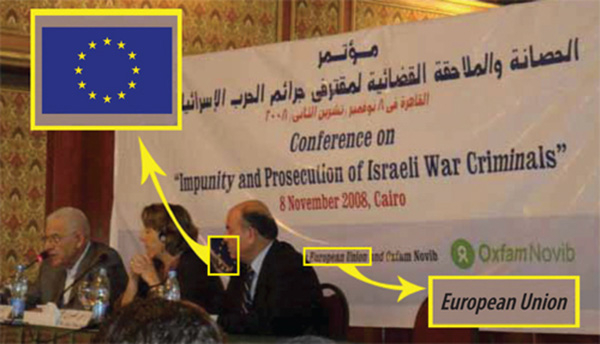
A
2008 conference on "Impunity and Prosecution of Israeli War Criminals,"
held in Egypt in 2008, was sponsored by the European Union. (Image
source: NGO Monitor)
|
It should come as no surprise to learn that Israel's efforts to curb
unregistered foreign agents -- NGOs that together receive tens of
millions of dollars every year, primarily from Europe -- have been, and
are, condemned as "undemocratic." This charge is usually levelled
despite the fact that
no country would tolerate undue
interference in its internal policies by other states, beyond a very
limited and truly humanitarian level.
The pushback began in earnest in 2011, with two bills proposed and
approved for consideration by Israel's Ministerial Legislative
Committee.
[1]
Neither was passed into law, but both reflected the widespread
realization that Israeli democracy has the right and obligation to
defend itself against such foreign attacks and manipulation. The
proposed mechanisms included a 45% taxation rate on income derived from
foreign government donations to highly politicized NGOs, and placing
limits on the amount of donations from governments and international
bodies (such as the UN or the EU).
Although these and similar proposals have been condemned as
discriminatory and anti-democratic
by many organizations, and were not adopted, it is hard to see why that
accusation is true. The NGOs are not being banned, and will continue to
be free to act as they please, so long as they remain within the law.
Democracies place restrictions on all sorts of things. There are those
who think a ban on smoking in public places is a denial of smokers'
rights, while others think the benefits to the nation's health outweigh
any absolute claim to democratic priority.
The need for some sort of control on foreign funding stems from two
considerations, both essential to the proper working of a real
democracy. First, there must be limits to how far foreign governments
and entities can interfere in the politics of another nation. Second,
the sort of intervention to which Israelis object involves the funding
and support of NGOs whose purpose is to attack, weaken -- and, for some,
ultimately destroy -- Israel from without or within. These include
groups and individuals who might well be described as seditious or
insurgent, given that Israel finds itself in a more or less constant
state of war-readiness and of being under attack -- militarily,
economically and diplomatically -- by governments and organizations that
would clearly like to see this lone pluralistic democracy in the region
obliterated.
NGOs such as
Breaking the Silence
(BtS) use anonymous "testimonies" to undermine the reputation and
morale of the Israel Defense Force, and to promote allegations of war
crimes. Other NGOs issue reports replete with distorted or false
information, clearly designed to weaken Israel's position within the
international community; ignore or downplay Palestinian terror and
thousands of rocket attacks from Gaza; call for an end to supposed
Israeli "apartheid," or demand the establishment of a Palestinian state
without necessary negotiations, agreements, checks or balances. Israel
is singled out obsessively and through double standards, while the worst
human rights violators are given a free pass.
A high-level delegation from Human Rights Watch (HRW), for instance, went to Saudi Arabia in 2009,
according to the Wall Street Journal
"to raise money from wealthy Saudis by highlighting HRW's demonization
of Israel... Apparently, [HRW spokesperson Sarah Lea] Whitson found no
time to criticize Saudi Arabia's abysmal human rights record. But never
fear, HRW recently called on the Kingdom to do more to protect the human
rights of domestic workers.... But Whitson wasn't raising money for
human rights. She was raising money for HRW's propaganda campaign
against Israel."
So far, Israel has been remarkably indulgent toward anti-Israel NGOs
and their activities in Israel or the West Bank. But countries openly
targeted for genocide, as Israel is by Iran, may be hampered when they
provide such indulgence. By contrast, this May, Russia's State Duma
passed a bill
for the banning of "undesirable organizations" -- foreign NGOs that
pose a threat to Russia's defence, security, public order or public
health.
Unlike Russia, if any of the Israeli bills are passed, it would be in a thoroughly transparent and democratic manner.
[2]
Further, once the bill would be made law, any individual or NGO may
address the High Court of Justice on issues of rights, infringements or
contradictions to existing laws. It is very hard to see how such a
painstaking and open process can be "anti-democratic."
In analyzing the legislative options, NGO Monitor
argues that when an NGO receives a sizeable portion of its budget from governments, it is no longer a non-governmental organization:
"NGOs are meant to represent civil society, not the
interests of foreign governments. Israeli NGOs that receive foreign
government funding benefit from the misleading image of being
'non-governmental,' non-political, and based in 'civil society.' The
government funders also use this framework to justify their use of NGOs
as a policy instrument, and on a scale which is unique to Israel."
A current and controversial example of this is the
Swiss government's funding
of Breaking the Silence (BtS), a small group at the fringe of the
political spectrum. The Swiss Foreign Ministry and the Zurich
municipality have sponsored an expedition by this famously anti-Israeli
NGO on the grounds that it has increased "dialogue about human rights."
But Breaking the Silence refused to include in its events Israeli
soldiers who would tell a different story. This means that the Swiss
Foreign Ministry and a Swiss municipality are willing to interfere with
Israel by funding a wholly one-sided narrative that impacts the
country's reputation overseas and opens it to charges of criminal
activity.
Breaking the Silence exists for one purpose only: to report on and
quote from the views of anonymous disaffected former Israel Defense
Force soldiers, who accuse Israel's armed forces of war crimes. BtS
uses,
according to NGO Monitor,
"sweeping accusations based on anecdotal, anonymous and unverifiable
testimonies of low level soldiers." In doing so, BtS deliberately
undermines military morale, exposes Israel to international opprobrium,
and brings about a likelihood of IDF officers and politicians facing war
crimes trials.
No country at war -- and Israel, to its disquiet, is always at war --
should be exposed to an international attack on such a scale. Of
course, there are countries and movements that do commit war crimes --
from Syria to Iran to ISIS and Hamas (recently highlighted by a rare and
major
Amnesty International report); and it is right that they be brought to book, which they seldom, if ever, are.
The irony here is that the Israel Defense Force is widely known to be among the
most cautious and
law-abiding
armies in the world. British military commander Col. Richard Kemp has
repeated this many times and in many forums. "No other army in the world
has ever done more than Israel is doing now to save the lives of
innocent civilians in a combat zone," he said
in an interview with Channel 2 News during the last Gaza conflict.
But the role of NGOs in distorting information about Israel's military actions has reached crisis point. The June 2015
UNHRC report on the 2014 Gaza war, taken by many as gospel, relied heavily on NGOs. NGO Monitor
takes up this point:
The report of the Commission of Inquiry on the 2014 Gaza
War is different both substantially and methodologically than its
predecessors, including the 2009 Goldstone Report, according to NGO
Monitor. However, it still quotes extensively from biased and unreliable
political advocacy NGOs. By repeating the unverified and non-expert
factual and legal allegations of groups such as Amnesty International,
B'Tselem, Palestinian Center for Human Rights, and Al Mezan, the UN
investigation is irrevocably tarnished.
"The UNHRC report would be entirely different without the baseless
and unverifiable allegations of non-governmental organizations," said
Anne Herzberg, Legal Advisor at NGO Monitor. "Despite efforts to consult
a wider array of sources, the report produced by McGowan Davis and her
team lacks credibility as a result of NGO influence."
NGO Monitor's initial review of the Commission of Inquiry's "detailed
findings" shows that NGOs were referenced, cited, and quoted at a high
volume: B'Tselem was the most referenced NGO with 69 citations, followed
by Amnesty International (53), Palestinian Center for Human Rights
(50), and Al Mezan (29). UNWRA and UN-OCHA were also featured throughout
the report. As repeatedly demonstrated by NGO Monitor, these groups are
not appropriate for professional fact-finding.
Further commentary by NGO Monitor on the UN report may be found
here. It includes a full list of the NGOs and their donors.
Writing of the
Breaking the Silence report of May 4, 2015,
NGO Monitor explains that,
Contrary to BtS' claim that "the contents and opinions in
this booklet do not express the position of the funders," NGO Monitor
research reveals that a number of funders made their grants conditional
on the NGO obtaining a minimum number of negative "testimonies." This
contradicts BtS' declarations and thus turns it into an organization
that represents its foreign donors' interest, severely damaging the
NGO's reliability and its ability to analyze complicated combat
situations.
A screenshot of a document from 2009 (obtained from the Israeli
Registrar of Non-Profits) shows how the British Embassy in Tel Aviv, the
Dutch church-based aid organization ICCO (primarily funded by the Dutch
government), and Oxfam Great Britain (funded by the British government)
required Breaking the Silence to obtain negative testimonies...
In its report, Breaking the Silence thanks the following for financial support:
"Broederlijk Delen (Belgium), the CCFD - Terre Solidaire
(France), Dan Church Aid, Die Schwelle, Foundation for Middle East
Peace, Human Rights and International Humanitarian Law Secretariat
(funded by Switzerland, Holland, Denmark, and Sweden), Medico
International, MISEREOR (a German "humanitarian aid" organization),
Moriah Fund, New Israel Fund, Open Society Foundations, Pro Victimis,
Rockefeller Brothers Fund, Sigrid Rausing Trust, SIVMO, Swiss Federal
Department of Foreign Affairs, The Royal Norwegian Embassy to Tel Aviv,
Trócaire (Ireland) and countless private individuals."
There is no need to look at these funding bodies here, but it should
be clear that a wide range of church organizations, human rights NGOs,
and a number of European governments are engaged in an extremely
one-sided enterprise to bring about the defamation and destruction of
the Jewish state. The report also brings these organizations and
individuals in line with the many anti-Israel groups that engage in the
Boycott, Divestment, and Sanctions movement, and in daily propaganda hostile to Israel.
Some NGOs do not restrict their activities to claims about the
Israeli occupation of the West Bank, the conflict in Gaza, or general
Israeli "crimes." It has just been
announced
that the National Iranian American Council (NIAC) will unveil a new
tax-exempt lobbying group, named NIAC Action, which will launch with 30
chapters across the U.S.
NIAC itself
has been exposed
as an agency of Iran's Islamic regime, a claim supported in 2012 by
U.S. District Judge John Bates. Not only does its new NGO have an openly
anti-Israel agenda, it has undertaken to support the Iran nuclear deal
by working against the Israeli opposition to it. In February 2015, NIAC
itself
paid for a full-page advertisement in the
New York Times
to condemn Israeli Prime Minister Binyamin Netanyahu's March 3, 2015
speech to the US Congress. The head of NIAC Action, Jamal Abdi, has made
no secret that they plan "to shift the political landscape in
Washington away from groups such as the American Israel Public Affairs
Committee, which has criticized the talks with Iran, and toward
movements more inclined to pursue diplomacy with the longtime U.S.
nemesis."
One Israel-based NGO, the New Israel Fund, plays by far the most
important role in funding and encouraging other Israeli NGOs working
against Israel's interests. It has recently been studied in a somewhat
haphazard way by the American journalist Edwin Black in his book
Financing the Flames.
With a per annum income of $35 million, the NIF has financed smaller
NGOs to the tune of $250 million over seven years and poured money into
organizations such as the Arab-run
Adalah,
B'tselem, the pro-Palestinian
Hamoked,
Ir Amim,
Rabbis for Human Rights, the lobby group
Shatil,
and others. All of these NGOs have much the same political agenda of
defaming, pressuring and undermining Israel; and using human rights
issues to promote a steadily negative view of the country, its
government, its laws, and its defence forces. They never acknowledge the
many positive human rights activities of the country or its basic
qualities as a democratic, open, free and human-rights-observant state.
Many never criticize the Palestinian Authority or Hamas, nor do they
turn their attentions to the desperate state of human rights in states
such as Iran, Saudi Arabia, Syria, North Korea, Venezuela, Cuba, China,
Russia and Lebanon, among others.
Western democracies host many human rights organizations, NGOs that
battle for civil rights, for legal action against discrimination, for
support of minority groups and mistreated individuals, and that advocate
for religious, political, and sexual freedom. Even the best countries
are not perfect; democracies could function perfectly well without
groups that call governments or institutions to account for their
misbehaviour. Nowhere in the West, however, do we find such an array of
haters who seek to bring about the demise of their own free nations.
How many foreign governments finance hatred against themselves to the
extent that NGOs finance antagonism to the United States, the UK,
France, Denmark, the Netherlands, or Canada?
NGOs are being well paid to urge total changes in the constitutions
of other nations, and in the total abolition of another nation's right
to exist at all.
Writing in
Politically Incorrect Politics, Noru Tsalic
demonstrates in a
sequel
that, "Despite the pretence, the 'Israeli NGOs' are neither 'Israeli'
nor 'Non-Governmental': although operating in Israel, they depend on
foreign funding... by foreign governments -- especially those from the
European Union. In short, they are not 'Israeli NGOs', but Foreign
Political Subversion Groups (FPSG)." Often called Foreign Agents or
Agents of Influence, their job is to manipulate the internal workings of
countries not theirs -- usually in ways they would not like other
countries to do in their own countries.
Even if some governments may be forgiven for financing what purport
to be human rights NGOs, it is a disgrace that so many private
foundations and individuals (including many Jewish charities) use their
money to promote what are deeply political, rather than humanitarian,
agendas through NGOs in an open, pluralistic democracy such as Israel,
possibly the one bright spot in a region of authoritarian repression.
The New Israel Fund has, until recently, obtained about twenty percent of its financing through its partnership with the
Ford Israel Fund,
an organization that emerged as an alternative after the US-based Ford
Foundation was exposed for having paid to bring thousands of anti-Israel
radicals to the infamous 2001 Durban conference.
Other organizations from around the world abound, however, adding to
the wide pool of hostile and interventionist funding. These include many
Christian aid, pro-justice and human rights organizations such as the
UK's
Christian Aid, Ireland's
Trócaire, the USA's
Catholic Relief Services, and the
World Council of Churches.
All of these have missionary and evangelization agendas, in addition to
their obsession with politically destroying Israel and leaving the
Palestinians to the tender mercies of their corrupt leaders.
In this regard, the World Council of Churches works chiefly through
its Ecumenical Accompaniment Programme in Palestine and Israel (EAPPI),
which brings members of many churches to Israel and the West Bank. The
stated role of participants in this program is:
- Monitoring and reporting violations of human rights and international humanitarian law
- Supporting acts of nonviolent resistance alongside local Palestinian and Israeli activists
- Offering protection through nonviolent presence
- Engaging in public policy advocacy
- Standing in solidarity with the churches and all those struggling against the occupation
The British and Irish member organizations in EAPPI are:
- Baptist Union of Great Britain
- CAFOD
- Christian Aid
- Church of Scotland
- Church Mission Society
- Churches Together in Britain and Ireland
- Iona Community
- Methodist Church
- Pax Christi UK
- Presbyterian Church of Wales
- Quaker Peace & Social Witness
- Scottish Episcopal Church
- United Reformed Church
- Us
- Trócaire
As
written previously,
many of these groups came together in 2012 for a conference held in the
UK, where they gave their approval to only one side in a complex
conflict, and lambasting Israel at every turn.
With such a one-sided pro-Palestinian and anti-Israel agenda, it must
be asked why it seems undemocratic of Israel to want to exercise some
degree of control over the rights of its citizens not to be exposed to
such unrelenting disinformation, hatred and ruin. No other country in
the world would stand for it; why should Israel?
Israel, a beacon for human rights in a region of war, prejudice,
denial of free speech and opposition to democracy, should be singled out
for its humanitarian commitment to these values. Instead, the
diplomatic jihad, which is the usual response, is -- let us be frank --
nothing more than the same old anti-Semitism, only on a national,
gargantuan scale. Israel has every right to defend itself from what
everyone knows is the oldest and most vicious hatred in history, and
again in the world today.
Denis MacEoin is a lecturer in Arabic and Islamic
Studies. He has an MA in Persian, Arabic and Islamic Studies from
Edinburgh University, a PhD in Persian Studies from Cambridge (King's
College) and an MA in English Language and Literature from Trinity
College, Dublin.
[1] Translations of both bills may be found in appendix 2 of "
NGOs in Israel 101: Background to the Debate and FAQs".
[2]
The process begins with a first reading before a Knesset plenary
session; then the proposed law is sent to the Constitution Law and
Justice Committee for debate and revision, with the revised version sent
back to the Knesset; then a second review by the committee; and a
second and third reading in a plenary session.