"On
behalf of the government of Canada, we wish to apologize to Mr. Khadr
for any role Canadian officials may have played in relation to his
ordeal abroad and any resulting harm." "We
hope that this expression, and the negotiated settlement reached with
the government, will assist him in his efforts to begin a new and
hopeful chapter in his life with his fellow Canadians." Public Safety Minister Ralph Goodale/Foreign Affairs Minister Chrystia Freeland
Minister of Justice Jody Wilson-Raybould stands with Public Safety
Minister Ralph Goodale. The two senior cabinet ministers announced an
apology and settlement with Omar Khadr. (Fred Chartrand/Canadian Press)
"I
can't discuss any details of the settlement but I don't look at this as
profiting. This is not a time for profit or for gaining or for
thinking, 'I hit the jackpot'. This is a time for remembering. It's a
time of reconciliation. This is a time for healing and it's not about
forgetting. I'm sorry if this is causing people pain. I'm trying to turn
a page. Not to forget that page, but just trying to turn a page and
move along." "The
good thing about this apology for me is that it's going to restore a
little bit of my reputation here in Canada. It's been a struggle to find
jobs. People see you with that past reputation. An apology helps people
say, 'We acknowledge the past'. Maybe that will give people an
opportunity to give me a chance and think there might be more than what
is said in the media." Omar Khadr, former al-Qaeda jihadist, former Guantanamo Bay inmate, murderer
Omar Khadr leaves
court after a judge ruled to relax bail conditions in Edmonton on Sept.
18, 2015. THE CANADIAN PRESS/Amber Bracken
"The
government today attempted to lay blame elsewhere for their decision to
conclude a secret deal with Omar Khadr. The decision to enter into this
deal is theirs, and theirs alone, and it is simply wrong." "Canadians deserve better than this." Former Conservative Prime Minister Stephen Harper
"[The
Liberal government chose to apologize and pay Khadr $10.5-million as
continuing to defend itself would have cost more] with virtually no
chance of success [against the civil suit brought by Khadr for
$20-million in damages]." "Despite the Supreme Court of Canada, the Harper government refused to repatriate Mr. Khadr or otherwise resolve the matter." "They could have, but they didn't." Ralph Goodale, Liberal Public Safety minister
"The
government has deliberately helped Mr. Khadr block Sgt. Speer's widow
from executing the $134-million court judgement against him." "They
issued the cheque [to Khadr] in the dark of night. If anything they
should have co-operated with the counsel for Mrs. Speer [wife of slain
U.S. army medic Christopher Speer, killed by Khadr] to ensure her claim
could be heard at a Canadian court prior to the transfer of these
funds." Alberta Progressive Conservative leader Jason Kenney, former federal Cabinet minister
Canada's very own home-grown jihadist, trained along with his brothers
by their al-Qaeda-linked father's arrangement, at a terrorist training
camp to ply their ideological trade of mayhem and murder feels justified
in his contention that he is owed an apology from Canada, and
taxpayer-funded wealth to compensate for his past as an al-Qaeda/Taliban
recruit whose battle experience at age 15 won him a prolonged residence
at Guantanamo Bay prison in recognition of his killer-exploits.
Because he holds Canadian citizenship he is entitled to the very same
broad-based benefits and human rights and equality assurances as any
law-abiding member of the Canadian community of communities. He is a
criminal terrorist; his age while communing with others of his ilk in
Afghanistan is irrelevant within a tribal-religious congregation where
so-called child warriors for Islam is commonplace.
For that matter, during the First- and Second-World Wars, global
conflagrations, many such-aged young Canadians lost their lives
honourably on the battlefield. Theirs was a war to protect their nations
from those who would wrench their freedom from them. Khadr's war is one
where the ideology of Islamofascism believes no individual nor nation
has the freedom not to devote themselves wholly to Islam.
In his own words Omar Khadr, now 30, believes that Canada owes him:
An apology for Canadian representatives having questioned him while in custody and sleep-deprived;
For having relaying what information they gleaned to their American counterparts;
Financial recompense for the pain and suffering he experienced while
incarcerated by the U.S. military as punishment for throwing an
explosive killing an Army medic and blinding another member of the U.S.
military;
These gestures of good will and accommodation are a requisite, enabling him to find employment in Canada;
The rehabilitation of his 'reputation' from jihadi killer to one-time jihadi.
This is what Omar Khadr describes as 'reconciliation'. As though Canada
has an obligation for restitution on behalf of an individual who
exercised free will in practising his Egyptian-Palestinian-Canadian
family's belief in the superiority of Islam and the requirement of its
faithful to engage in violent jihad in support of terrorist groups like
al-Qaeda and the Taliban, both of which were complicit in the deadliest
atrocities committed by non-state militias against nation-states and
exulted in their historical 'conquests', along with much of the world of
Islam celebrating alongside them.
Unsurprisingly, another Muslim, Syrian-Canadian Maher Arar -- who not
long after the dread occurrences of September 11, 2001, travelled abroad
to visit with extended family in North Africa with his wife at a time
of emotional and reactive tumult, was arrested as he transited the U.S.
on his way back to Canada. He was suspected of having links to jihadist
groups, and flown to Syria, his country of birth, where he was
imprisoned and tortured. He too won the support of Canada's justice
system with charges of complicity in his illegal and unwarranted arrest,
and received compensation similar to Omar Khadr's -- has expressed his
support for Khadr
Canada's previous Conservative-led government under Prime Minister
Stephen Harper had no wish to welcome Omar Khadr back to Canada. "We regret that a convicted terrorist has been allowed back into Canadian society without having served his full sentence",
stated then-Public Safety Minister Steven Blaney, expressing the
sentiments of most Canadians in the matter. In the final analysis,
against their better judgement but acceding to Canadian law, Prime
Minister Harper did accept that Omar Khadr would complete his sentence
for murder in a Canadian prison.
Which leaves the current Public Safety Minister uttering a complete
fabrication in claiming that this entire matter is the fault of the
previous government for not having settled the issue. The previous
government, in fact, balked at anything resembling the wholesale
absurdity of an apology to this man who claims that the handing over of
$10.5-million of taxpayer money is irrelevant, that all he really wants
is to have the opportunity to be a normal citizen and live his life free
of drama, doing good things for other people.
As the new leader of the Conservative party of Canada suggests, the good
he could start with is surrendering the money directly to Sgt. Speer's
widow and to the American soldier whose eyesight his explosive took. And
then, no one in Canada wants to see his name in the news again. He will
be free to live out his life alongside that of his mother, sister and
brothers who subscribe proudly to the Islamofascist ideology that
motivated them to leave Canada, returning only when they needed to take
advantage of its social welfare and universal health care systems.
The Canadian public, that portion that is reeling with disbelief at this
extraordinary turn of events, should now have a clearer picture of the
personal sentiments and beliefs of the man they voted for as Prime
Minister of this nation. When the next general election falls due,
memories should sharpen to recall all that his man has done and
continues to do, to demonstrate he might find employment more suitable
to his skills as a drama-school educator, or a teacher of snowboarding.
"The best that can result, in my view, is a military coup against
Bakhtiar and then a deal struck between the military and Khomeini that
finally pushes the Shah out of power." "Conceivably this deal could be struck without the military acting against [then-Iranian Prime Minister] Bakhtiar first." Deputy National Security Adviser David Aaron, January 1979
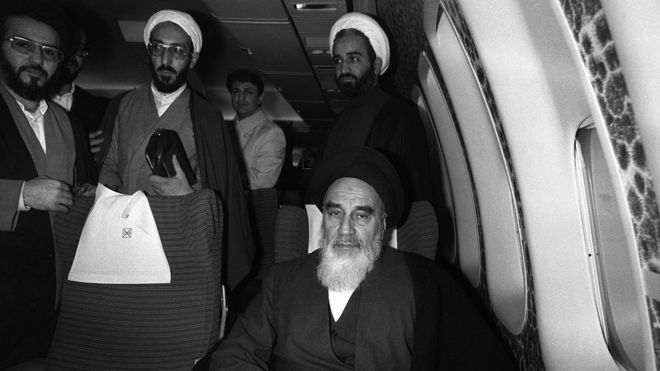
Khomeini aboard the plane that brought him back to Tehran in triumph -- Getty Images
Ayatollah Ruhollah Khomeini was preparing to come out of exile in Paris in 1979, and he planned to successfully execute an Islamist revolution, one that would in its wake, transform Islam itself as it was practised in the Middle East, particularly for Shiite Muslims. What he feared was the intervention of the United States, that hated military-industrial powerhouse that supported Reza Pahlavi, the Shah of Iran whom Khomeini was preparing to unseat.
On 27 January, 1979, Ayatollah Ruhollah Khomeini - founder of Iran's
Islamic Republic, the man who called the United States "the Great Satan"
- sent a secret message to Washington. -- Getty Images
The Shah's Prime Minister Shapour Bakhtiar took steps to close the airport to disrupt Ayatollah Khomeini's plans to return to Tehran. And the U.S. administration saw the potential for a civil war, with the Imperial Guard divisions prepared to defend the Shah against Khomeini's faithful supporters by armed struggle and jihadist inspired martyrdom.
As far as the White House was concerned a civil war would impede American strategic interests in the region, and imperil the lives of thousands of U.S. military advisers, along with the security of American weapons systems such as F-14 jets in Iran, let alone interfere with the flow of oil, vital to American industry. The United States under various administrations has always been prepared to jettison its support of key foreign figures if it was felt required.
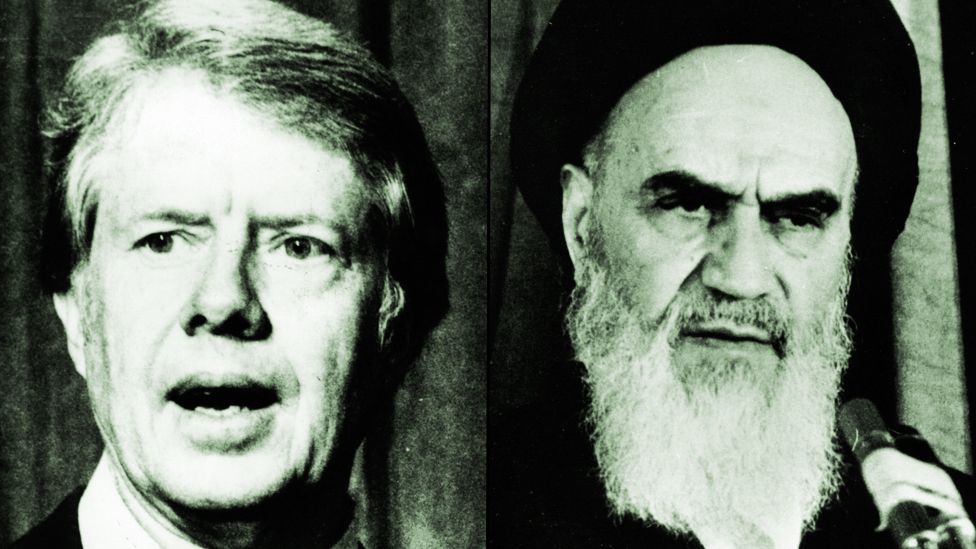
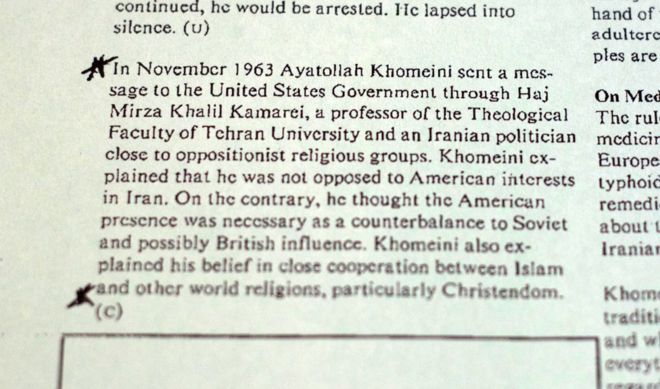
In this instance, it was the ailing Shah, who was advised that he would no longer have the backing and support of the United States. Khomeini had sent messages to then-President Jimmy Carter to assure him that his new regime, once established, would be amenable to working with the United States, that the flow of oil would continue. And Mr. Carter allowed himself to be conveniently convinced that it would be in the U.S. best interests to switch allegiances in Iran.
Khomeini was concerned that at the last moment, the United States would once again reinstate the Shah. He and those who interacted on his behalf who had credibility with the American administration, made every effort to convince President Carter that relations with Iran would remain sound under the Islamic Republic he was bringing in. And he asked that three things be done on his behalf; his return to Tehran be unopposed and even aided by the U.S.; that it convince the constitutional government it must resign in Khomeini's favour, and that the Imperial militias capitulate.
Ayatollah Khomeini intimated that should the Iranian military oppose him in continued support of the Shah, the ardent believers in Khomeini's Islamist promise would begin a violent protest targeting American citizens in Iran. A peaceful resolution of the crisis was entirely possible, he stressed, as long as the United States trusted him and surrendered the future of Iran to his capable hands.
Ayatollah Ruhollah Khomeini (left) being greeted by his supporters in Tehrān, 1979.
AFP/Getty Images
President Carter's decision-making resulted in the historical installation of a fiercely aggressive Islamist administration for Iran -- one whose dedication to the pure version of Islam reflecting the 7th Century advent of a Bedouin-Arab-inspired religion borrowing tenets and philosophical principles heavily from Judaism and Christianity, both of which Khomeini loathed -- which set out to overturn the Sunni command of the Middle East.
It took little time before Khomeini ordered the persecution and slaughter of all he perceived as his enemies, starting with the generals of the Imperial Military, soon to be replaced by the ruthless Islamic Revolutionary Guard Corps, loyal to the revolution and to Khomeini alone. While holding the American Charge d'Affaires and 66 other Americans throughout the Iranian hostage crisis, Khomeini declared triumphantly: "America can't do a damn thing".
Blindfolded American hostage with his Iranian captors outside the U.S. embassy in Tehrān, November 9, 1979.
AP
And he was prescient; America under Carter tried, and bungled and failed to release the American embassy personnel held as prisoners by Khomeini. It would take over a year before the hostages would see their freedom, once Carter was defeated at the polls. The first anniversary of Khomeini's dominating victory was the time of a major proclamation, The Ayatollahs were prepared to challenge worldwide American Imperialism. "We will export our revolution to the entire world...This is an Islamic revolution."
Who might imagine that another American president, decades later, would make it all increasingly possible?
Jimmy Carter, who portrays himself as an international elder statesman, proclaiming righteously on the status of world events, aligning himself with the underdog in a spurious effort to realign his dented image, becoming a diplomat par excellence, leading the world in denouncing the only democracy in the Middle East, deluding himself and others that his support for those who continue their attempts to destroy Israel is moral and honourable has willingly entered a similar trap.
"We have to remember that while we have pretty good intelligence on a lot of the world, a lot of other countries don't necessarily have that great of intelligence on us." "So, in the interest of transparency and [avoiding] miscalculation on their part, sometimes it's worthwhile to allow them to have a look at what you're doing or what you're not doing." Navy Captain Jeff Davis, Pentagon spokesman
"In addition to overflying military installations, Russian Open Skies flights can overfly and collect on Department of Defence and national security or national critical infrastructure." "The vulnerability exposed by exploitation of this data and costs of mitigation are increasingly difficult to characterize." Admiral Cecil Haney, Chief, U.S. Strategic Command
An
OC-135B Open Skies observation plane sits on the runway at Yokota Air
Base, Japan November 15, 2014. The plane has been conducting
surveillance missions over Russia.
Seth Robson/Stars and Stripes
When cool, but increasingly cordial relations take place between former adversaries, as it did when the U.S.S.R. imploded and Russia was all that was left of the former Communist alliance of eastern European countries subservient to the master-state, and through generous impulse and a genuine desire on both sides to foster better relations, they become signatories to military pacts defusing the great tensions that had formerly been in place, the future sometimes brings regrets.
The future is here and now. An increasingly volatile, irritable, bullying Russia has materialized, a Russia frustrated at its loss of status as a world power. One which commanded respect through fear on the world stage until both fear and respect dissipated with the dissolution of its threat to world stability when the constituent parts of its totality abandoned its central authority to resume their former status as sovereign states.
Russia and NATO agreed to ensure neither stepped on the other's geographic toes. But then, distrust and fear on the part of Russia's former satellite states conspired to undo that arrangement when a rush to join NATO occurred. And when countries of the Middle East became violently unstable and the U.S. thought up its 'Star Wars' scenario, Russia saw itself as the target beyond the nice fiction that Iran was. Back when world conflict no longer consumed the focus of the globe, Russia and NATO played civil chess.
Russian President Vladimir Putin is easily bored, a restive man who enjoys action and a whiff of danger to whet his appetite for adventure. And he yearned for the restoration of Russia as a world power, equal to the influence of the United States. Resentment goes a long way to destabilizing once-placid -- or moving to that end -- relationships of collaboration in pledging to destroy clearly unneeded nuclear arms. Just maintaining enough as a comfortable 'deterrent' should anyone become too restive.
The Open Skies agreement approved in 1992 was a reflection of more trusting, comfortable times, now since dissipated. Enacted in 2002, it allowed for signatories to agree that unarmed aircraft carrying video and still cameras, infrared scanning devices and forms of radar could take flight over other treaty signatories' territory. A kind of reassurance for the updating of their intelligence, that nothing untoward and/or threatening might be taking place.
And now that significant untoward and world-peace-destabilizing events have taken place, and Vladimir Putin has taken great delight in leading his American counterpart around by the nose, even while other world leaders have all been given delightful instruction on how one autocratic and ambitious leader among them could send them all into paroxysms of fear-of-consequences, Russia has resumed its bad-boy position of yore.
So when Moscow signals Washington that it seeks permission for a spy plane with advanced digital cameras to gain flight over certain areas off limits under any other circumstances, a dilemma has raised its attention within the U.S. military establishment, let alone the White House. Since the U.S. carries out such Open Skies flights on a regular basis and Russia "has done it many times before", how now, decline?
After all, in 2014, American pilots flew Open Skies missions over Russia.
Iran is on its way in a few
years to having nuclear weapons capability. The breakout time, according
to President Obama, would effectively be "zero." Iran could then make
as many bombs as it would like, along with intercontinental ballistic
missiles to delver them to major American cities, directly from Iran,
from South America, or -- making identification and retaliation
impossible -- from submarines submerged off the U.S. coast.
Obama with one hand allows Iran to glide to nuclear capability
and encourage the Muslim Brotherhood and similar Islamist terrorist
organizations such as the Islamic State in the Sinai Peninsula -- while
with the other hand, he claims to support Israel.
Qatar's role is duplicitous. It plays host to U.S. military bases at the same time that it funds and supports ISIS.
Hamas, since last year's war, has chosen to use its scant
resources to rebuild its kidnapping tunnels and war capability, instead
of developing businesses and turning the Gaza Strip into a magnificent
Arab Riviera, as Dubai has become. Hamas's failure does not come from a
lack of resources; it comes from a deliberate choice of how to use them.
The Iranians, in opposing American policy, which is a tissue of amateur plans and plots, are flexible and exploit Islam's taqiyya
[dissimulation] -- religious approval to lie in the cause of Allah and
to further Islam. However, they are not even bothering with that, they
are telling the truth: "Death to America; Death to Israel."
The United States is playing a double game in the Middle East:
empowering Shiite Iran, while at the same time enabling Sunni ISIS to
overthrow the moderate Arab regimes, as if to stop Iran.
The Americans are well aware that the Sunni Arab countries around
Iran will now have to arm themselves to the teeth, thereby gutting the
Nuclear Non-Proliferation Treaty (NPT).
America, despite its power and the image it projects of working
against ISIS in Iraq, does not touch ISIS in its real headquarters,
Syria, where ISIS actually could actually be hurt. So nothing really
changes, and both Iran and ISIS continue to strengthen.
Even as the members the UN Security Council, eager do business with
Iran, voted to allow Iran to build nuclear weapons, the Iranians
continue to fund Hezbollah, Hamas and the Palestinian Islamic Jihad in
the Gaza Strip -- all Iranian proxies -- in order to split the Arab
ranks.
In other words, the hypocritical Obama administration, in backing the
Iranians, keeps trying to sabotage the Arabs and provoke dissension.
The U.S. "divide-and-conquer" policy can also be seen in America's
ongoing support for Turkey and Qatar, both loyal to the Muslim
Brotherhood. Turkey and Qatar, however, do nothing but foment incitement
and support terrorist organizations. Both countries have totally
abandoned the real existential interest of the Arab nation: its historic
battle against Iran.
Qatar's role is duplicitous. It plays host to U.S. military bases at
the same time that it funds and supports ISIS, which is working against
the West and against moderate Arab regimes.
The worst, however, is Turkey, which supports ISIS -- the enemy of
the West -- despite Turkey being a member of NATO. Turkey also expends
inordinate efforts at retaining its control of occupied Cyprus. Above
all, its hypocrisy is scandalous. While it claims to care about the
independence and human rights of the Palestinians, Turkey is really
nothing but a radical Islamist country now denying independence and
human rights to its own Kurdish citizens. At the same time, it supports
Hamas and Iran in their effort to crush the unity of the Palestinian
Authority (PA) and the PLO as the only legitimate representatives of the
Palestinian people.
Turkey, like many other nations, including the countries that
negotiated with Iran, is just waiting for the sanctions to be lifted
from Iran, so that its dubious military and economic relations with the
Mullahs will finally be acceptable.
Turkey and Qatar have also divided the Sunni Islamic camp and
fragmented the Arab ranks. Both countries give the Palestinians
political support, the deluded hope of "return," and funding that is used for rebuilding Hamas's military capabilities and kidnapping tunnels.
It is both folly and underhandedness for the United States to provide
these countries with even a tattered umbrella of military aid.
Not only the U.S. but Europe, which supports Iran, would like to see
Hamas -- a terrorist offshoot of the Muslim Brotherhood -- become
stronger at the expense of the Palestinian people.
Europe would like to empower Hamas even further by handing it
diplomatic and political support. There are rumors that the UN is
planning to grant Hamas observer status in the General Assembly, as it
did the Palestinian Authority.
We all know that the issue of Palestine could have been resolved long
ago by establishing a demilitarized Palestinian state next to Israel,
and giving the descendants of the original Palestinian refugees living
in the Arab states full citizenship. But the manipulations employed by
the Europeans and Americans deliberately perpetuate the Palestinian
issue by using "good cop - bad cop" tactics.
Europe and the U.S. whitewash not only Hamas's threats to Israel, but
also, more importantly, its deadly subversion of Palestinian Authority.
Both Europe and America totally disregard Hamas's planned coup
against PA leader Mahmoud Abbas last year, Hamas's war crimes in the
Gaza Strip, and the unspeakable treatment of its own people at home.
Only one year ago, Hamas was murdering its own citizens
extra-judicially, and ordering them to be cannon fodder for the benefit
of international television crews.
Hamas, since then, has chosen to use its scant resources to rebuild
its kidnapping tunnels and war capability, instead of to develop
businesses and turn the Gaza Strip into a magnificent Arab Riviera, as
Dubai has become. Hamas's failure does not come from a lack of
resources; it comes from a deliberate choice of how to use them.
Hamas and Palestinian Islamic Jihad are now operating against Egypt
and Israel not only from the Gaza Strip, but from the Sinai Peninsula as
well. Thus, in addition to allowing Iran to sail to nuclear weapons
capability, President Obama encourages the Muslim Brotherhood and other
Islamist terrorist organizations such as the Islamic State in the Sinai
Peninsula with one hand, while with the other hand he claims to support
Israel.
After all is said and done, if we Arabs had joined ranks -- even
temporarily and even with Israel -- we could have long ago put a stop to
Iran's plans for expansion.
But because of our own shortsightedness, we waited too long and now
the Iranians have established footholds in the Arabian Gulf and the Red
Sea, and are increasing their control of Arab states such as Iraq,
Syria, Lebanon and Yemen.
Iran is on its way in a few years to having nuclear weapons
capability. The breakout time, according to President Obama, would
effectively be "zero." Iran could then make as many bombs as it would
like, along with intercontinental ballistic missiles to delver them to
the major cities of the "Great Satan," the United States, directly from
Iran, from South America, or -- making identification and retaliation
impossible -- from submarines submerged off the U.S. coast.
The Iranians, in opposing American policy, which is a tissue of amateur plans and plots, are flexible and exploit Islam's taqiyya
[dissimulation] -- religious approval to lie in the cause of Allah and
to further Islam. However, they are not even bothering with that, they
are telling the truth: "Death to America; Death to Israel."
U.S. President Barack Obama (left). Iranian President Hassan Rouhani (right).
By this point, near the end of the process of Sunni Muslim
self-destruction, a large part of the Arabs' energy has been wasted on
internal wars and the misallocation of resources to the barren, useless
confrontation with Israel, even while many Arab states secretly
collaborate with the Zionists.
All that will be left for the Arabs will be to continue to argue
among themselves and with the Israelis about the Palestinian issue. We
should instead stop the distractions and the wounds we are inflicting
upon ourselves, and put the Palestinian problem behind us by granting
equal rights and citizenship to Palestinians residing in Arab countries,
in order to shift our focus totally, if belatedly, to the real battle:
The Islamic Republic of Iran.
Are we actually being told,
then, that the only way to prevent Iran from having nuclear bombs is to
let it have them? If not now, in 10-15 years? And with intercontinental
ballistic missiles that can reach the U.S.?
Even supporters of the deal say that yes, at the ten year mark,
Iran will be able to breakout and build a weapon's worth of nuclear fuel
in a year or less -- in other words, have nuclear bombs.
Iran has never come clean with the IAEA -- or anyone else --
about its nuclear activities. These were discovered not by IAEA
inspectors but by the U.S. and allied law enforcement and intelligence
services, as well as by dissident groups within Iran. Are we actually
assuming that Iran, under this new deal, will now come clean?
Thus under the July deal the U.S. may not (technically) know if
Iran, after a breakout, has a nuclear weapon arsenal until Iran either
tests a nuclear warhead or explodes it in an American or Israeli city.
Then, of course, the discovery will be "too late" to do anything about,
especially if the U.S. is helping Iran with technology assistance
designed to prevent attacks on Iran's nuclear sites.
Having made so many concessions to a non-nuclear Iran, how tough in the future will we be, faced with a nuclear Iran?
Iran says its nuclear technology program is totally peaceful. In 31
other countries with peaceful nuclear programs, there are 438 nuclear
power plants in operation, and in another 16 countries, 67 plants under
construction.
Under the terms of the 1969 Nuclear Non-Proliferation Treaty, any
nation adopting nuclear energy has to comply with International Atomic
Energy Agency (IAEA) rules. Every one of these nearly 50 countries does.
Iran does not.
For over two decades, in fact, Iran has flouted, bamboozled and cheated the IAEA.
What, then, does this pattern of behavior bode for the emerging nuclear deal with Iran?
Past activities by Iran related to prohibited nuclear weapons have
included facilities where nuclear work was done, and the attempted
smuggling of nuclear weapons technology, which was interdicted.
These activities, however, were discovered not by IAEA inspectors but
by the U.S. and allied law enforcement and intelligence services, as
well as by dissident groups, such as the Mujahideen-e Khalq (MEK),
within Iran. We cannot necessarily count on such help in the future.
Iran has never come clean with IAEA -- or anyone else -- about its
nuclear activities -- unlike the nearly 50 other nations that have, or
are planning to have, nuclear energy.
Are we actually assuming that Iran, under this new deal, will now do
so? And if it does not, are we actually assuming that we will now have
access to suspicious Iranian activity simply by demanding to inspect
such sites?
We are being told that access to Iranian sites where cheating has been, or might be, taking place, will be "managed."
Iran will, of course, delay IAEA inspections to sanitize the
suspected sites. It will also graciously allow China and Russia to help
delay further inspections or enforcement action. And of course they can
all graciously veto some UN Security Council action. After 24 days of
forewarning and countless delay disputes, what will be left to inspect?
No worry, say deal supporters. If Iran breaks the terms of the deal
or is uncooperative, sanctions can be "snapped back" in place.
Although Moscow insisted
that there will be no automatic re-imposition of sanctions, what Russia
and Iran eventually got in the final agreement was nearly as good. All
deals made prior to sanctions being re-imposed will not be affected, a
limitation that seriously weakens the effect of the snapback provision.
Deal supporters then optimistically point to Iran's pledge not to
build certain new nuclear facilities. But these are facilities Iran had
no intention of building in the first place.
Supporters of the deal also tell us that that number of Iranian
centrifuges will be sharply reduced. But, we are also told, these
centrifuges will not be destroyed (Iran refuses to do); they will be stored. Of course, stored centrifuges can always be un-stored -- and then reconnected to enrich uranium.
"Don't worry," the deal's supporters say. Some of the enriched
uranium gas Iran has already produced, from which bombs could be made,
will be changed into a solid form, which is not suitable for further
enrichment.
Except they apparently "forgot" that it takes only two weeks to turn
the enriched solid material back into gas suitable for further nuclear
enrichment.
The deal's supporters say that Americans overwhelmingly want a
diplomatic outcome to the Iranian nuclear threat and not "another war"
-- and, well, a "deal" is a "diplomatic outcome," isn't it? But does
this diplomatic deal deny nuclear weapons capability to Iran, as the
negotiators said they set out to accomplish? No.
Is Iran's nuclear breakout time even extended? According to Public Affairs expert Alan J. Kuperman, it remains at three to four months at most. Is the deal verifiable? Proliferation expert Ambassador Robert Joseph says no. Will advanced research on centrifuges by Iran stop? The deal explicitly says that advanced research is allowed.
Won't Iran just take the money unfrozen by the deal -- reportedly
upwards of $150 billion -- and use it for terrorism and building more
missiles? Not really, say deal supporters; Iran is already funding
terrorism and missile production. Oh, then the mullahs must be planning
to use the new $150 billion for hospice care and battered women's
shelters.
Finally, at the end of the deal, presumably in ten years or so, will
Iran have, or not have, the capability to build a nuclear weapon?
Even supporters of the deal say that yes, at the ten year mark, Iran
will be able to breakout and build a weapon's worth of nuclear fuel
within a year or less -- in other words, have nuclear bombs.
Are we actually being told, then, that the only way to prevent Iran
from having nuclear bombs is to let it have them? If not now, in 10-15
years? And with intercontinental ballistic missiles that can reach the
U.S.?
But, the deal's advocates argue, the IAEA will be able detect such
activity, and besides, the nature of the regime will have changed. They
do not specify if this change will be for the better or for the worse.
It is important to remember Israel's long-standing and repeated
warnings that Iran was close to one year away from having a nuclear
weapons capability. Now, even with a deal, Iran may be as close as three
months away -- just in time to negotiate still further arrangements
until it can run out the clock.
How long will it be, then, before we find out Iran is cheating? And
then take action? Here is some history that might give some clues:
Chemical weapons are still being used by the Assad government in
Syria -- although there is a US-Russia deal from September 2013 that
says no such activity is allowed.
When did we find out the North Koreans had an illegal enrichment
facility? When the North Koreans invited US officials to see the
facility -- not to get rid of it but to boast that they were going to
keep it.
North Korea's cheating, which led up to the revelation of an
enrichment capability, happened during the Clinton administration --
which had agreed, along with its 1994-5 Agreed Framework partners, to
build two nuclear reactors for North Korea and provide billions in
energy and food assistance.
Similarly, there indeed may be a diplomatic purpose to the
administration's serial concessions to Iran. The administration may
believe they all were necessary -- an "outstretched hand" -- to get the
Iranians to think kindly of us and "unclench its fist." What other
decisions may have been made to please Iran?
Iran's
Foreign Minister and chief nuclear negotiator, Javad Zarif (left), is
very, very pleased with the recent nuclear deal. Iran's Supreme Leader,
Ayatollah Ali Khamenei (right), is not unclenching Iran's fist in its
relations with the West.
Were the chemical redlines in Syria, for example, not enforced for fear of upsetting Iran?
Did the Obama administration not support Iranian people's attempted
"Green Revolution" in 2009-10 in order not to upset the mullahs?
Did the U.S. refuse to provide weapons to the Kurds in Iraq, with
which to confront ISIS, because we did not want to upset the Iranian
mullahs, whose agents control much of the Iraqi government?
Did the U.S. apologize for the supposed role of the U.S. in a 1953
Iranian coup -- which never in fact occurred, as the Shah had the
constitutional power to dismiss the prime minister -- again not to upset
the mullahs?
Did the U.S. allow India, Japan, Korea and China all to receive
sanctions exemptions and import Iranian oil because it did not want to
upset the mullahs? It looks suspiciously as if we made all these
concessions to grease the diplomatic skids to get a deal. Those
represented our "outstretched hand."
But did these concessions succeed in preventing Iran from continuing to build its nuclear weapons capability? Not for a minute.
Thus, under the July deal the U.S. may not (technically) know
(although it would definitely be suspicious) if Iran, after a breakout,
has a nuclear weapons arsenal, however small, until Iran either tests a
nuclear warhead or explodes it in an American or Israeli city.
Then, of course, the discovery will be "too late" to do anything
about, especially if the U.S. is helping Iran with technology assistance
designed to prevent attacks on Iran's nuclear sites (from terrorists,
of course!).
Having made so many concessions to a non-nuclear Iran, how tough in the future will we be, faced with a nuclear Iran?
Two of the top candidates for the Republican nomination for president
are fighting over the Iran deal. Governor of Wisconsin Scott Walker says
he’d tear up the Joint Comprehensive Plan of Action on Day 1 of a
Walker Administration. That’s a rash novice speaking, says Jeb Bush. The
former governor of Florida hates the deal, too, but says he’d have to
appoint his national security cabinet and confer with allies first.
The truth is that wherever the Republican candidates profess to
stand, none of them has the slightest practical influence over the Iran
deal. The one and only presidential candidate who does is Hillary
Clinton, who can crash the deal a year and a half before the 2016
election. Sure, she already came out with a statement
tentatively praising the deal, but with a vote in Congress due in the
fall, she still has time to shape the results. If Clinton comes out
against the deal, she will start a chain reaction in her own party, with
Democrats on the Hill abandoning President Barack Obama’s signature
foreign policy initiative like a sinking ship and joining Republicans in
an overwhelming No.
If on the other hand Clinton says nothing, stays loyal to the
president she served, and maintains party unity, the deal will almost
certainly sail through Congress untouched. If Clinton becomes president,
she will then inherit an agreement nearly guaranteeing that a
terrorist-supporting, anti-American, anti-Semitic ruling clique in Iran
will continue to spread chaos throughout the Middle East and will likely
acquire a nuclear bomb on her watch. Whether Clinton decides to speak
out or stay quiet is perhaps the most important decision of a Clinton 45
Administration—a decision that will powerfully shape her own foreign
policy legacy and determine what sort of world she will hand off to the
future.
Barring an Israeli strike on Iranian nuclear facilities—and a recent joint war game with Greece shows
that the Israeli Air Force is still working out countermeasures for the
S-300 air-defense system that Moscow sold Iran—there are no more wild
cards left in the great Iran debate. Everyone is locked in, except for
Clinton.
After several years of secret talks with Iran starting in 2009, and
nearly two years of public negotiations, the Obama Administration is all
in on a deal that they are promoting as the centerpiece of the
president’s foreign policy legacy. They don’t care that the terms of the
Joint Comprehensive Plan of Action have no real inspection and
verification regime to make sure that Iran is abiding by the deal
because, they say, it is the best possible deal that they could get.
John Kerry and his staff don’t mind saying that they were lying about
making sure that the agreement would ensure anytime/anywhere
inspections of Iranian nuclear facilities. The way they see it, any deal
is better than no deal. Sure, the president says
his name is on the deal, but he understands better than anyone that the
attention span of the American public is no longer than a 12-hour
Twitter cycle. He’s confident that someone else will be holding the bag
if and when Iran gets the bomb.
The Iranians are happy, too. Supreme Leader Ali Khamenei will likely
get to see Iran test a nuclear device before he passes from this realm
into the next. The IRGC will enjoy a huge windfall with the $150 billion
signing bonus even as it further consolidates control of the Iranian economy with European and Asian investors now knocking on their door.
French Foreign Minister Laurent Fabius put on a good show for a
while, protesting the White House’s continuously weakening position, but
it was inevitable the Europeans would eventually fold. Earlier in the
week, the U.N. Security Council unanimously approved
the Iran deal, and soon the Europeans will be making available the
industrial goods—precision tools, etc.—Iran needs to build the bomb.
Many Arabs aren’t happy about the deal, but what choice do they have?
They know they’re not loved on Capitol Hill or by the American public,
so they have little room for a public spat with a president they fear
still might hurt them, even with only 15 months left in office. The way
the Saudis see it, they’re not family like Israel is, so they’ll
accommodate the White House and to a certain extent their Iranian rivals
as well and wait to see what happens next.
The Israelis are unified in their opposition to the agreement. It’s
not just Bibi who bellows that an Iranian bomb is an existential threat
to the Jewish state—opposition leader Isaac Herzog also believes it’s a dangerous deal and intends to make his feelings known to U.S. congressmen and senators.
But both Bibi and Herzog are certainly wasting their breath—everyone
on the Hill has been settled for two years now. The Republicans
overwhelmingly dislike the deal, with even neo-isolationist Rand Paul
coming out strongly against it. Herzog’s counsel won’t have any effect
on the Democrats, even if it’s a little more complicated on the other
side of the aisle. Sen. Robert Menendez has long been wary of the
administration’s Iran nuclear talks and along with other senators, like
Maryland’s Ben Cardin, is displeased the White House wants to circumvent
the Hill by getting the JCPOA approved at the U.N. first.
Still, it’s not easy to go against the head of your own party, who is
enjoying a surge of popularity right now—especially when he threatens
to run primary candidates against you as Obama is rumored to have
threatened potential Democratic deal opponents. Some observers
think this is Chuck Schumer’s big moment, but the reality is that if
Schumer were going to go against the Iran deal, he’d have joined forces
with Menendez long ago. Schumer apparently detests Netanyahu, and more
to the point, he knows there’s a heavy price to be paid within his own
party for opposing the president and no price to be paid for going
against Israel.
This of course is one of the great innovations of the Obama White
House. They discovered that you can stick it to Israel and trot out
anti-Semitic conceits to scare off potential critics in the pro-Israel
community—people shouldn’t read the deal influenced by “lobbying,” Obama
said
last week, but should rather be guided by U.S. national interests—and
the Jews will still vote overwhelmingly Democratic no matter what.
Clinton’s decision, meanwhile, isn’t really about Israel or the
American Jewish community either. It’s about what kind of party—and what
kind of country—she wants to lead.
If Clinton were to come out against the Iran deal, she’d give cover
to all the Democrats on the Hill who don’t like the deal and don’t trust
Obama—and who don’t want to have to explain to their constituents why
they voted for an Iranian nuclear mushroom cloud in the desert, or
somewhere worse. The Democratic Party would be able to escape being
portrayed as the party that gave in to Iranian demands because it was so
bedazzled by the promise of a second Nobel Peace Prize and the illusory
hope of peace at any price. Consequently, the JCPOA would be
resoundingly defeated, letting the Democrats slip the noose of Obama’s
foreign policy failures, and stripping the Iranian nuclear weapons
program of the international legitimacy granted by the deal.
It’s a no-brainer for Clinton, unless she wants to be the last one
standing in a game of musical chairs and inherit an international order
more dangerous than at any time since the Cold War. It’s true that the
Iranian military is a far cry from a Red Army capable of overrunning
Europe, but that’s precisely why Tehran seeks the bomb. A nuclear weapon
fixed on ballistic missiles, including missiles that will soon be able
to reach the United States, makes a regional power like Iran a global
threat.
The problem for Clinton in opposing the deal may be something closer
to home—the threat that Obama will support a primary challenger to her
and release those 30,000 emails from her private server that the White
House has in its possession and is now presumably investigating. If she
comes out against the Iran deal, the administration will leak
something—or many things—capable of doing irreparable harm to her
candidacy.
If Clinton comes out against the Iran deal, she might not get to be
president. If she gives the deal her blessing, she’ll be wrestling for
eight years with a tiger that her predecessor left on her doorstep and
she brought in the door. Either way, Obama has booby-trapped Clinton’s
White House.
"When
President Barack Obama took office, he faced an Iran that had mastered
the nuclear fuel cycle, had constructed a covert uranium enrichment
facility inside a mountain, was on its way to installing nearly 20,000
centrifuges for uranium enrichment, was developing advanced centrifuges
and was building a heavy-water reactor that could produce weapons-grade
plutonium. If Iran wanted to develop a nuclear weapon, it was already
well down that road and the international community had little insight
into its program. Against this backdrop the president vowed never to let
Iran obtain a nuclear weapon." "The
deal reached in Vienna this month is not only the best way to prevent
Iran from having a nuclear weapon but also the only durable and viable
option for achieving this goal. This comprehensive diplomatic resolution
has the unified support of the world's leading powers. It extends the
time Iran would need to develop a nuclear weapon, provides strong
verification measures that give us ample time to respond if Iran chooses
that path and takes none of our options off the table." John Kerry, Secretary of State, Ernest Moniz, Secretary of Energy, United States of America
IAEA Vienna Headquarters. Photo: Wiki Commons.
Disingenuous
at best, deliberately obtuse and sufficiently so to bypass reality,
even while mouthing the very issues that have served Iran well in the
past through its capacity for underhanded action led by its contempt for
its international critics. Most certainly Iran engaged in subterfuge
and misleading those tasked to ensure that its penchant for inciting
violence and instability abroad -- funding terrorist groups for that
purpose, threatening the existence of another state -- augmented by
nuclear warheads its goal leaving no opportunity untested to achieve its
end-game of achieving the power of control of the Middle East.
Nothing
succeeds quite so well in the Middle East as exhibiting florid
belligerent power to subdue challenges. Funding terror groups infused
with the psychosis of battlefield martyrdom to destroy those whose
humanity forbids them from inflicting violence on others while believing
that killing at random and profusely will bring honour to Islam and
ensure that the killers find their way to Paradise while others await
the arrival of the Hidden Mahdi to honour the righteous, is the way of
the Iranian Ayatollahs.
Messrs. Kerry and Moniz
speak of their president's overtures to disarm Iranian disaffection
with the West, extending a hand of friendship. Iran's mullahs slapped
that hand away; they have no desire to warm relations between themselves
and the Great Satan. They have, after all, made "Death to America"
the most common and popular refrain among the populace of the country.
Of whom not enough dissenters exist to protest their country's
increasing execution rate of 'prisoners' who insult Islam.
In
tribal societies where war is a proud tradition and hostility toward
other tribes and most certainly other religious sects and minorities is
part of the heritage of the Middle East, striving to achieve an accord
between belligerents is viewed as cowardice. President Obama has earned
his reputation for untrustworthiness
in the Middle East, blowing hot in warning he will not countenance
human rights abuses, then sucking cool when those abuses occur and he
prefers not to acknowledge them.
The first paragraph of Messrs. Kerry and Moniz's
righteous apologia to a world that misunderstands America's motivations
correctly enumerates the Republic's past litany of averting global
condemnation by simply proceeding with its nuclear agenda covertly and
with malice aforethought. Lauding the deal signed in Vienna as the only
manner in which Iran's aspirations could be prevented is absurd, and
speaking of it as a durable and viable method whereby Iran can be
controlled is insulting to the intelligence of their audience.
Assuring that audience as they have attempted to do with their explanatory editorial in The Washington Post,
that should Iran fail to meet its obligations sanctions would 'snap
back into place' is a risible canard. The sanctions that took years and
international cooperation to achieve, and more years to exert its full
potential cannot simply be 'snapped back', and clearly the authors are
aware of that. They assure the gullible that sans deal, Iran could
expand its stockpile of enriched uranium.
With the deal
it will do just that, surreptitiously, with great care to ensure it is
not detected, for their long-honed skills at circumventing detection are
second to none. They have gone to great lengths to evade detection in
the past and will continue to do so in the future. Until, surprise,
surprise! their intention has been achieved. They consider it their just
due, resenting interference and inferences that their plan is devious
and destructive to peace, when all evidence points to just that as a
reality.
To state that with the deal Iran will be
incapable of producing weapons' grade plutonium and thus achieving
atomic bombs is wishful thinking of the unicorn variety that John Kerry
is fond of quipping about. "In February 2003, the IAEA
requested access to a suspicious facility in Tehran, and negotiations
dragged on as Iran tried to remove evidence. But even after six months,
tests revealed nuclear activity despite Iran's attempt to cover it up", the duo wrote.
How this argument is felt by Kerry and Moniz to be in their favour when it is blatantly a description of Iran's duplicity of a nature so perverted and self-servingly dangerous to the world, is mind-boggling in its naivete. Finally, they conclude with reiterating "The
president has said clearly that Iran will not get a nuclear weapon.
Neither sanctions nor military action can guarantee that outcome. The
solution is the comprehensive diplomatic deal reached in Vienna".
Absolute and utter trash-talk.
"A close examination of the Joint Comprehensive Plan of Action released
by the Obama administration reveals that its terms permit Iran to hold
inspectors at bay for months, likely three or more", according to a recent Wall Street Journal report. This begins with a process that unravels when the IAEA inspectors have concerns over "undeclared
nuclear material or activities".
IAEA
inspectors are to present
Iran with their concerns, whereupon clarification is required for Iran
to provide. Nuclear monitors can request access should Iran not satisfy
their concerns.There is no set limit of time involved in the process. A
24-day period follows for the two to resolve concerns; failing this, one
of the countries on the Joint Commission (The UK, US, Russia, France, Germany, EU) can bring the dispute before the Joint Commission, given 15 days to resolve the issue.
Another 15 days is set aside for foreign ministers to act or request a nonbinding opinion from an advisory board.
Tediously
long as urgent processes go, well beyond the measured 24-day notice
which in itself poses great concerns, with up to 30 to 45 days
representing the real length of time that can drag by with a
recalcitrant Iran dragging the process through its permissible limit,
allowing it to do what it will with potential incriminating details
and/or evidence of non-compliance.
"There was no human rights agenda in the negotiations at all, not from the beginning It gives the regime a green light to get away with murder. To Iranian pro-democracy activists it looks like nobody cares, that the world doesn't care at all." "In Canada, sure, if you talk to people who are sympathetic to the regime, they think it's great." "When the sanctions are lifted this agreement will allow the regime to spend more money on terrorism and the repression of the people." Sayeh Hassan, Toronto lawyer, Iranian pro-democracy activist
"The deal with world powers does not address Iran's terrorist activities in the region, carried out by its proxies in Syria, Lebanon, Iraq and Yemen." "Iran is almost certainly going to use the newly available cash and bolstered economy to prop up its proxies and try to assert its hegemony in the region, causing more conflict and bloodshed." Syrian National Council spokesman
"Now Iran is out of the cage and will become a regional tiger." "[The lifting of sanctions will flood up to $150-billion into Khomeinist treasuries] which will reach our enemies at our borders." Israeli opposition leader Isaac Herzog
"This deal provides greater security for our allies in the region, and brings the world closer to nuclear non-proliferation and disarmament." NDP foreign policy critic Paul Dewar, Ottawa
The ten-year road map legitimizes the Islamic Republic of Iran's relentless journey toward nuclear arms. A country whose oil product has earned it hundreds of billions in illegal sales to Asian countries during the sanction period, will have that hundred billion released to it from Asian sources with the relaxation of sanctions, quite separate and apart from its investments being released from Western sources to enable Iran to get on with its agenda of destabilization for the region.
The West, which is congratulating itself for having 'solved' a seemingly insolvable problem for which no solution seemed to present itself until it slowly was ground down by Iranian skills in the art of 'diplomacy' and casuistry to relent on all its demands, and surrender to the Islamic Republic of Iran's demands out of Tehran that its sovereign rights to nuclear technology for peaceful means be blessed, will eventually have to deal with a megalomaniac mullahs' ownership of nuclear weapons.
By then the ultimate solution will be a nightmare so ghoulishly destructive that hand-wringing will accomplish nothing and a war to truly end all wars may well erupt. Iran with a sanctions-free economy along with an intercontinental ballistic missile program and its hands free to continue on with its thuggish internal politics and the barbarism of its sectarian conflicts in the Middle East, is a prospect too dreadful to contemplate, so Europe will not think too deeply about it, while America's current administration will be but a bleak memory.
Tehran's Islamic Revolutionary Guard Corps and the Quds Force commanders who prosecute the ayatollahs' agendas have had their hands untied.
Hours after Washington published a “fact sheet” in
Lausanne Thursday, April 2 - which enumerated “the parameters of the
agreed framework” hammered out by the US world powers and Iran - Tehran
countered with its own version the next day, after the lead Iranian
negotiator Foreign Minister Mohammed Javad Zarif, dismissed the American
accounting as “spin.”
The Iranian version departs substantially from President Barack
Obama’s assurance of “a deal that meets our core objections,” and
statement,: “There is no way Iran can get around it to build a bomb or
produce plutonium at its Arak plan…verification mechanisms built into
the agreed framework will ensure that if Iran cheats, the world will
know it.”
Tehran’s version had two objects: 1) To refute Obama’s presentation
of the outcome of the Lausanne talks, and 2) To show the Iranian people
how successful its negotiating team had been in defending its national
interest.
debkafile reports
that the battle of versions, fought just hours after both sides claimed
victory in the diplomatic contest played out at Lausanne, makes it
obvious that the gaps between the world powers and Iran are far wider
than admitedt. They could not even find a common definition of what if
anything was achieved in the talks: “a framework deal” in US terms; or
“a package of solutions leading up to a future Comprehensive Plan of
Joint Action” – in Iranian parlance.
The gaps on such key issues as enrichment, sanctions, research and
development, means of verifying compliance (described by Obama as
intrusive”) could no longer be papered over after Tehran issued its
version. It was a short document and here are its main points:
Iran’s version of the Lausanne deal
Iran’s nuclear program including enrichment will continue.
None of Iran’s nuclear facilities or related activities will be
stopped or shut down or suspended and activities will continue at
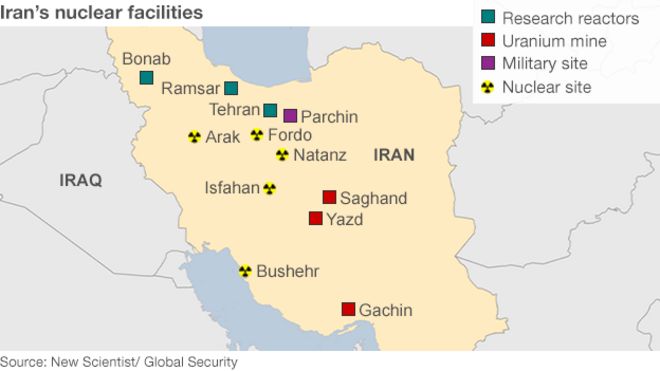
Natanz, Fordow, Isfahan and Arak.
There is no confirmation of Obama’s claim that the Arak plant will
not be allowed to produce plutonium. The Iranians say: The Arak heavy
water research reactor will remain - enhanced and updated with
re-modifications as a joint international project. In addition to
decreasing the amount of plutonium production, the efficiency of the
Arak reactor will be increased significantly.
After the implementation of the Comprehensive Plan of Joint Action,
all the UN Security Council resolutions will be revoked, and all the
multilateral economic and financial sanctions of the EU and the
unilateral ones of the US (which are detailed) immediately removed.
After the preparatory phase and the start of Iran’s nuclear-related
implementation work, all the sanctions will be automatically annulled on
a single specified day. Furthermore, all P5-1 members are committed to
restrain from imposing new nuclear-related sanctions.
There is no word in the entire Iranian document on inspections of any
kind, which counters the “verification mechanisms built into the agreed
framework” referred to by President Obama.
Instead, the Iranian version says that violations “by any one party” will have “predetermined mechanisms of response.”
Sanctions were ruled out by the previous point.
The devil is in the equivocations
According to the US version, Iran’s preparatory work must include the
de-tuning of Fordow and Arak, reducing the Natanz centrifuges down to
6,000, with 5,000 working, uranium stocks reduced from 10,000 kilos to
300 and the Additional Protocol activated.
Iran’s version:
Fordow will be converted into an advanced nuclear and physics
center and keep more than 1,000 centrifuges – in line with the US
perception except for the word “more.” But then Iran adds …and all
relating infrastructure, out of which two centrifuge cascades will be in
operation.
The Iranian version also agrees up to a point with the US assertion
that 5,000 machines will continue enriching 3.67 percent grade uranium
at Natanz. But this too is qualified: Additional machines will not be
disabled but held ready to replace any that are damaged – contrary to
the US version which places them under IAEA supervision or dismantled.
Iran will continue its research and development of advanced
centrifuges and the initiation and completion phases of the process for
IR-4, IR-5, IR-6 and IR-8 centrifuges during the 10-year period of the
Comprehensive Plan of Action.
It is claimed by Washington that the new deal binds Iran to stop
developing or holding advanced centrifuges (that would speed up uranium
enrichment many times over.)
Iran will implement the Additional Protocol on a voluntary and
temporary basis for the sake of transparency and confidence-building.
A non-binding package
The Islamic Republic of Iran declares formally that the package
contained in the solutions necessary to attaining the Comprehensive Plan
of Joint Action agreed with the P5+1 countries, China, Russia, France,
the United States, England and Germany, “does not have legal binding”
and will only provide a “conceptual guide for calibrating and assessing
the Comprehensive Plan. On these grounds the drafting of this plan will
begin in the near future.”
The Iranian document ends by saying: "It is far too early to tell
if the compromises will survive the next final negotiating round, or
review by Washington and Tehran. The timing of sanctions relief remains
unresolved, for example, and already the two sides are describing it in
different terms."
"We're very happy to be here [Artemivsk, not far from Debaltseve]." "We were praying all the time and already said goodbye to our lives a hundred times." Exhausted, demoralized Ukrainian soldier
"[The troop pullout took place] in a planned and organized manner. We managed to show to the whole world the true face of the bandit-separatists backed by Russia." Ukrainian President Petro Poroshenko
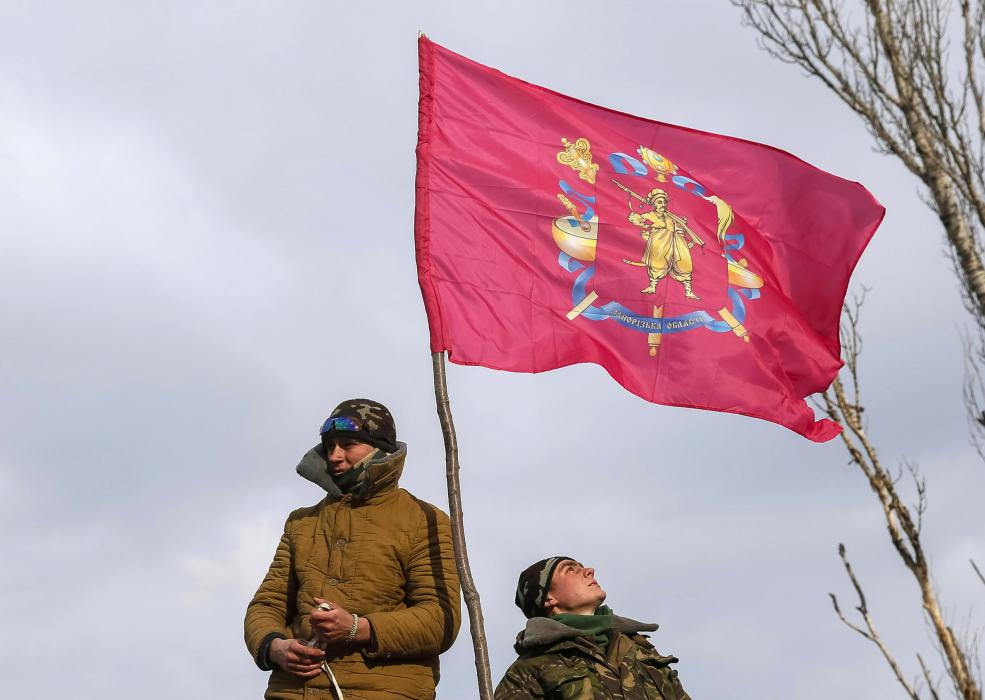
Ukrainian servicemen who fought in Debaltseve raise their unit flag
before leaving for home, near Artemivsk February 19, 2015. Fighting
raged in eastern Ukraine on Thursday despite European efforts to
resurrect a still-born ceasefire, a day after pro-Russian separatists
who spurned the truce forced thousands of government troops out of a
strategic town. (REUTERS/Gleb Garanich)
The 2,500 government troops ingloriously departed from Debaltseve, the railroad town in eastern Ukraine, whose defaulted handover to the separatist rebels will now give them the unimpeded and direct link between Luhansk and Donetsk that they had planned for, and established the month-long siege to accomplish. Ceasefire? Oh, was there a ceasefire? Well, it was meant to be recognized elsewhere, clearly not just there, in Debaltseve.
The exhausted, dirt-plastered Ukrainian soldiers who plodded their way out of the city on foot spoke of their forces having suffered heavy losses. How could it be otherwise, given that no supplies were able to breach the encirclement by the Russian-backed rebels; no ammunition, no food, no water. But the truce will go on, presumably, elsewhere. To preserve that possibility it was required that Kyiv once again make a sacrifice. Not that a real choice presented itself.
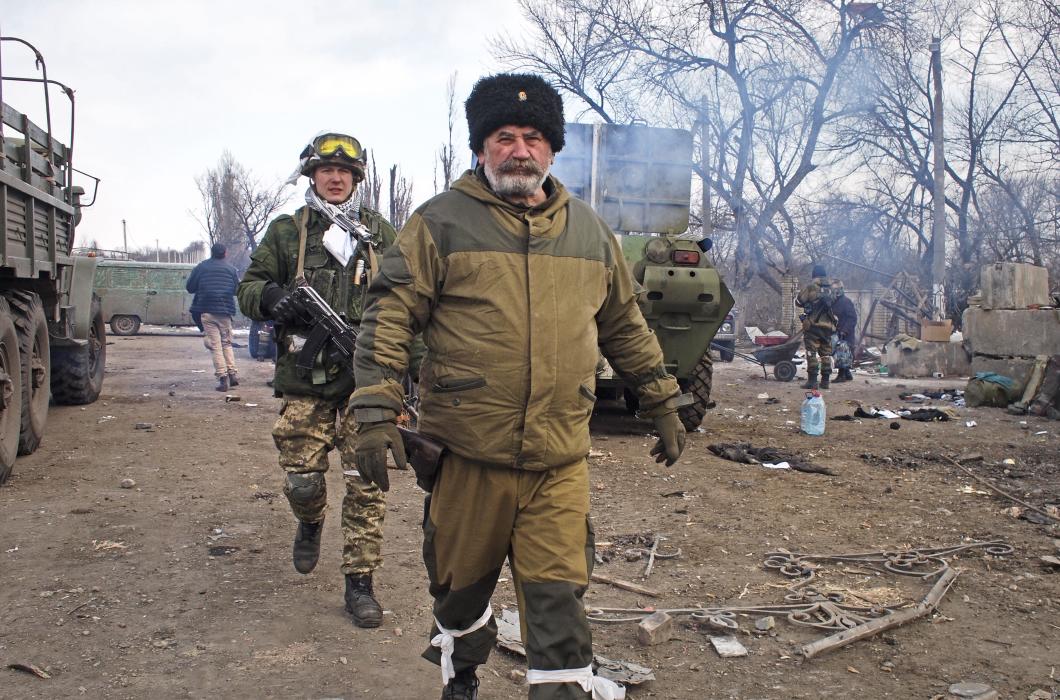
Cossack commander Nikolai Kozitsyn, foreground, a Russian national known
to his fellow rebel fighters by the nom de guerre "Daddy," walks
through a crossroads by the east Ukraine town of Debaltseve on Thursday,
February 19, 2015. The town was captured by Russian-backed separatists
this week after weeks of bitter battles around the area. (AP Photo/
Peter Leonard)
Ukraine's national army is no match for that of the Russian Federation, after all, even if Moscow has not interfered one iota in a match between the Ukrainian military and the rebel militias who on their own courageously faced off against a superior antagonist. Which, had that been the case, the situation would have been reversed, but not quite to Vladimir Putin's liking. It's entirely possible that Mr. Poroshenko partially believed that Mr. Putin's word could be trusted. But which of his words?
Now the transportation connections have been solidified to the satisfaction of Moscow and the separatists. "We had enough forces and means. The problem is the command and coordination. They are as bad as can be" wrote Semyon Semenchanko, a battalion commander and member of parliament who accused the military command of betrayal in Debaltseve. Weigh that against Denis Pushilin, a rebel official claiming that the rebels had overpowered the soldiers killing and forcing surrender.
A pro-Russia rebel holds a flag of the rebel-held city of Luhansk in
Debaltseve, eastern Ukraine, Thursday, Feb. 19, 2015. After weeks of
relentless fighting, the embattled Ukrainian rail hub of Debaltseve fell
Wednesday to Russia-backed separatists, who hoisted a flag in triumph
over the town. The Ukrainian president confirmed that he had ordered
troops to pull out and the rebels reported taking hundreds of soldiers
captive. (AP Photo/ Peter Leonard)
Verification of anything said by vested interests is not possible since neutral international journalists were blocked from accessing Debaltseve. Though Russian television ran videos of rebels raising the Novorossiya flag in Debaltseve, along with images of captured Ukrainian troops ushered along a village road by the rebels. The intense rebel shelling had made it impossible for the military to obtain basic supplies, not even food or water.
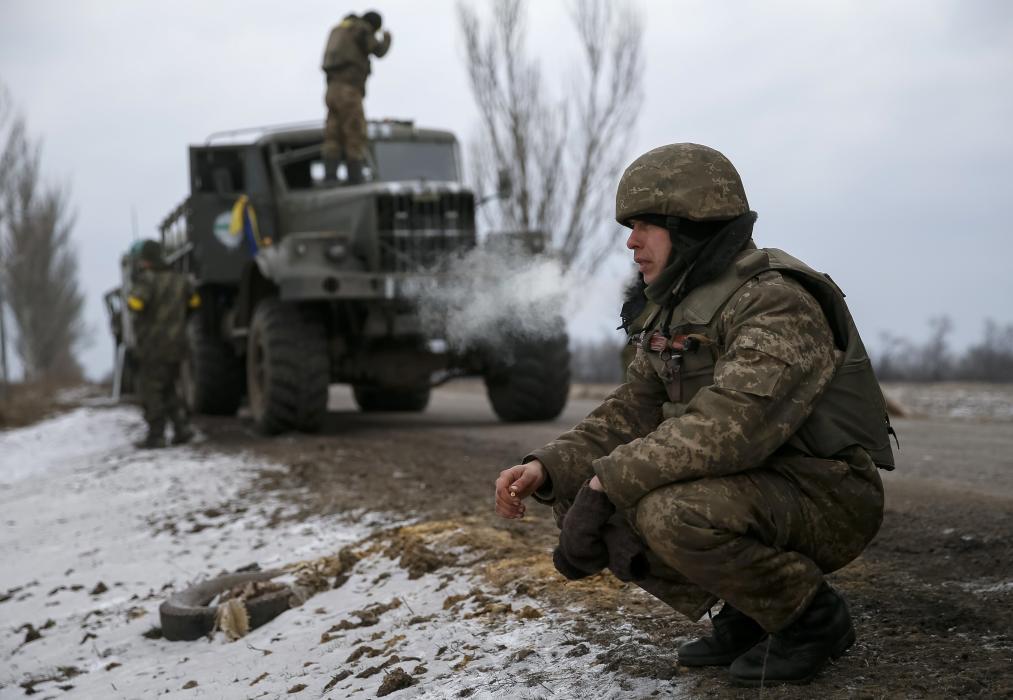
Ukrainian servicemen who fought in Debaltseve are seen near Artemivsk
February 19, 2015. Fighting raged in eastern Ukraine on Thursday despite
European efforts to resurrect a still-born ceasefire, a day after
pro-Russian separatists who spurned the truce forced thousands of
government troops out of a strategic town. (REUTERS/Gleb Garanich)
Ukrainian soldiers spoke of sheltering in bunkers for hours on end because of the shelling. But, then, there is the Minsk ceasefire agreement to be considered for full implementation. Requiring Ukraine to pass laws giving some degree of autonomy, not yet fully delineated, to the newly-consolidated separatist regions. And yes, the issue of official status for the Russian language.
Ignominious capitulation imposed by the harsh reality of Vladimir Putin's diktat. The jackal's triumph.
And how is NATO reacting? Well, it is concerned that Mr. Putin's lust for expanding the Russian Federation has not been slaked. That he will now concentrate elsewhere, say for example, Estonia, some Baltic state or other. So NATO is preparing its rapid response force. In the latest NATO exercise before the turn of the year German soldiers used broomsticks in place of guns; equipment shortage the cause.
Soldiers from the mechanized infantry battalion hadn't 31% of their MG3 general-purpose machine guns, 41% of their P8 handguns and over 75% of the Lucie night-vision devices for their use on that occasion; so a pantomime performance took place. General Harold Kujat, former German chief of staff for the armed forces and chairman of the NATO military committee spoke of the occasion as a "huge embarrassment".
So there you have it, embarrassment on two fronts; strike one out for Ukraine, another for NATO.
"We now have a glimmer of hope, we have agreed on a comprehensive implementation of Minsk. But ... there are still major hurdles that lie ahead." "I have no illusions. We have no illusions. Much work [remained]." German Chancellor Angela Merkel
"It was not the best night in my life, but [in] the morning I think, it is good because we have managed to agree on the main things despite all the difficulties of the negotiations." Russian President Vladimir Putin
Paul Hackett / Reuters
"We demanded immediate ceasefire without any precondition. Unfortunately they demanded we have almost 70 hours before ceasefire was launched. Immediately after the deal was signed, the Russian-backed terrorists started the offensive operation." "That is why it is vitally important for us, for all of us to keep the pressure to keep the promises about the ceasefire -- about the withdrawal of the heavy weapons, about the immediate release of all the hostages, about the withdrawal of all the foreign troops and mercenaries, and the closing of the border." Ukraine's President Petro Poroshenko
Mr. Poroshenko knows Mr. Putin very well indeed. And knowing him as well as he does, he has little hope that the second agreement, modelled on the Minsk agreement before it, will turn the tide of violent evisceration of his country to benefit Moscow's aspiration of regional territorial theft. He knows the mettle of the man with whom he is dealing. He knew him personally before he became Ukraine's president, and he knows him even better now that they are adversaries, not of Mr. Poroshenko's choosing, but reflective of Mr. Putin's ambitions.
Sixteen hours of intense negotiations in Minsk resulted in an agreement, although concessions were one-sided by necessity of threat of worse occurring. Ukraine, backed into a corner by the very Europe that should have in all moral conscience, backed its inalienable right to its sovereign territory. Ukraine, backed into another corner by the voracious appetite of Moscow prepared to sate its ravenous need to once again occupy its near neighbours; to 'protect' the Russian speakers in their midst.
Hostilities, according to the 'agreement' to cease on Sunday morning as soon as the pendulum swings from ll:59 pm to 12:01 am. Until then, all bets are off, and the rebels have mounted and re-mounted their advance with a vengeance. Victory for the forbearing patience of France and Germany, however, in trying to tame the circus bear, to spare the sacrificial goat for another day. All Ukraine has to commit to is indemnifying the rebels.
Their violent predations to be forgiven, and their aspirations to be confirmed, affirmed and legalized with legal autonomy; power to be devolved from Kyiv to the eastern regions of the Donbass. Messrs Alexander Zakharchenko and Igor Plotnitsky, heads of the Donetsk and Luhansk People's Republics prevailed upon by their mentor to sign the road map to 'peace'. Concessions by embattled Ukraine, victory for the secessionists and their smiling champion; the winning team.
Both rebel leaders had renounced the original Minsk agreement for full independence from Ukraine. Are they now to be satisfied with mere autonomy? Stubborn Ukraine, refusing to treat the rebel leaders as genuine negotiators. Debaltseve, the railway junction where several thousand Ukrainian troops are valiantly attempting to break out of a separatist encirclement evidently was a matter of some contention; some measure of resistance from Ukraine is, after all, inevitable.
The following two days before the ceasefire was to take effect would follow a well-recognized and prescribed-by-the-Kremlin pattern: rush to overwhelm government troops to gain as much territory as possible from which to advance yet again in the next round of talks for yet another agreement some months down the road through 2015. As for the one vital commitment that Moscow must adhere to; the withdrawal of "foreign armed groups and military equipment", and the disarming of "illegal armed groups"; total innocence.
Might there conceivably be anything more that Vladimir Putin wants to risk European patience with in wringing from Ukraine? Much of the east is now his, so to speak. And that includes Ukraine's industrial heartland and most of its coal reserves. Beggaring the country which has also had to commit to restoring payments to public servants as well as retirement benefits and welfare to the areas now cut off from Kyiv administration. Paying the costs for the rebels' advances while its natural resources have been looted.
Meanwhile, in the interval between the agreement's signing and implementation, violence has escalated, and Ukrainian officials state that even more Russian tanks have crossed the border during the talks. Some 50 tanks, 40 missile systems and 40 armoured vehicles crossed during the night from Russia via Izvaryne border crossing into the Luhansk region. While correspondents in the east saw heavy weaponry heading toward Debaltseve.
Separatist forces in preparation for a last-minute sprint to destroy the Ukrainian garrison hold-out against their onslaught before the ceasefire takes effect. Surely, Mr. Putin's feelings were quite injured when Mr. Poroshenko said he just didn't trust his antagonist at his word...?
Russian President Vladimir Putin smiles after the conclusion of Ukraine peace talks in Minsk, Thursday, Feb. 12, 2015.Reuters/Vasily Fedosenko
This represents a general opinion site for its author. It also offers a space for the author to record her experiences and perceptions,both personal and public. This is rendered obvious by the content contained in the blog, but the space is here inviting me to write. And so I do.