"I told him: 'Yevgeny, do you understand that you will doom your people
and will perish yourself?'"
" He had just come back from the front. On an
impulse he said: 'I will die then, damn it!'"
Belarusian President Alexander Lukashenko
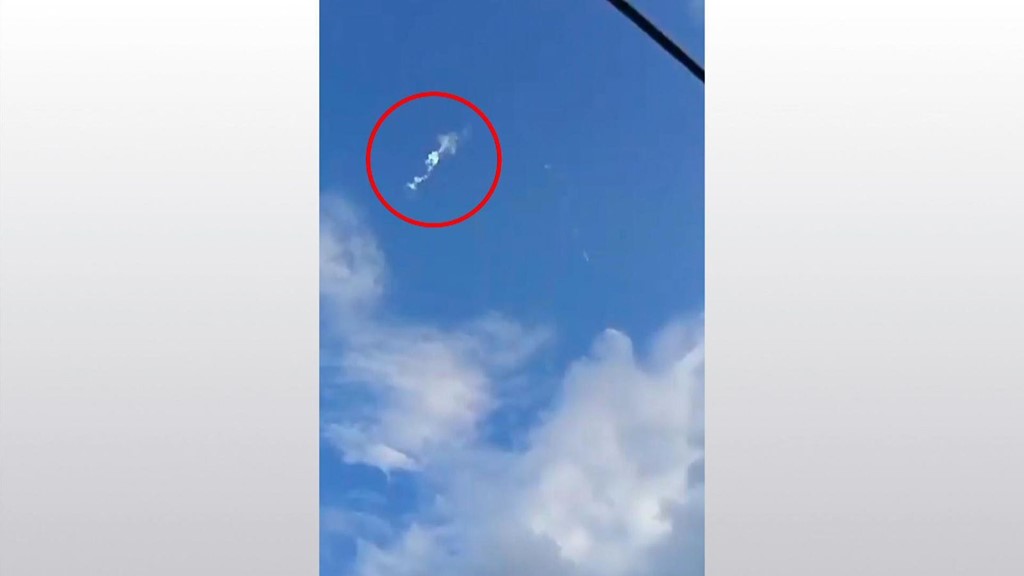
"[If a surface-to-air missile hit the plane], you would see that sort of vapour trail in the final stages of its approach."
"Therefore,
either that could be an explosion, or it could be a surface-to-air
missile system. This is almost certainly not smoke [and is probably]
fuel venting. It's a large quantity, that is a massive damage to the
aircraft that's caused that."
"Now, you put all of that together... there's lots of reasons why
that might have occurred, but that is not a natural accident."
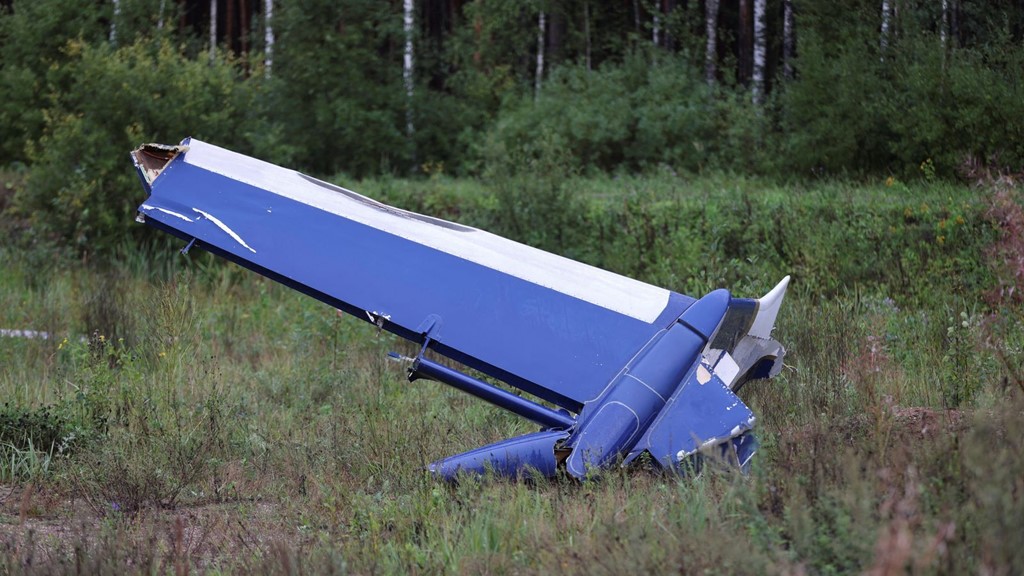
"[Footage of the plane closer to the ground appears to show it without
its wing or its tailplane, which could explain why it came down] vertically, not unlike a falling leaf."
"[Other
pictures from the crash site show the tailplane] some distance [from
the main part of the aircraft]. That is a catastrophe that's happened in
the air...
there were rumours that a case of wine [containing a bomb] was put on
the aircraft at the last minute."
"The trouble with that theory is
that generally speaking, [an explosion] inside an aircraft blows it
out... whereas a surface-to-air missile system or an air-to-air missile
system generally tries to seek out the juiciest, meatiest part of an
aircraft."
"That would explain why it potentially could rip a wing off. And as soon as it did that, the fate of the aircraft was sealed."
Military analyst, former pilot Sean Bell
The
Kremlin has rejected allegations of its involvement in the plane crash
that killed mercenary leader Yevgeny Prigozhin. They have also announced
discovery of the black box, to aid in the investigation of the crash.
An investigation that will thoroughly examine the cause of the crash
which will most certainly negate all the unfounded rumours circulating
wildly both within Russia among the many admirers of the former Wagner
boss, and abroad in elite intelligence services.
Prigozhin
and his dedicated fighting men, feared for their military skills and
brutality in Ukraine, Africa and Syria was honoured by a eulogy
delivered by his old friend Vladimir Putin a day after the plane
carrying him and six other members of the Wagner executive team crashed
mysteriously soon after takeoff from Moscow, in a routine flight en
route to St.Petersburg.
According
to a preliminary American intelligence assessment the plane crashed as a
result of an intentional explosion. It was determined that Yevgeny
Prigozhin was "very likely" the target of the crash that resulted in the
death of the three air crew and high-ranking Wagner members. The
clumsiness and obvious conclusion held by many that the bloodless
'punishment'-driven Putin agenda was responsible for the drama that
wiped out yet another Putin-authority critic is not untypical of the
Russian leader's modus operandi.
The
mission succeeded in removing another irritation, an erstwhile friend
and supporter who had become tediously irrepressible in his aggravating
claims and behaviour. An event whose success and purpose lay in
delivering a message to any others who might harbour thoughts of
challenging the primacy of President Putin and his decision-making on
such issues as 'special military operations' that have so far proven
inadequate to his goal of tucking Ukraine securely under his wing again
as a Russian appendage.
"Right
now, of course, there are lots of speculations around this plane crash
and the tragic deaths of the passengers of the plane, including Yevgeny
Prigozhin. Of course, in the West those speculations are put out under a
certain angle, and all of it is a complete lie."
"He
[Vladimir Putin] said that right now all the necessary forensic
analyses, including genetic testing, will be carried out. Once some kind
of official conclusions are ready to be released, they will be
released."
Kremlin spokesman Dmitry Peskov
According to Britain's Defence Ministry, the death of Prigozhin could serve to destabilize the Wagner Group. His "exceptional audacity" and "extreme brutality" permeated the organization "and are unlikely to be matched by any successor",
they concluded. The fighting group's reputation and success in the
battlefield is one that President Putin would like to harness and bring
tightly under his control, as part of the Russian military, as a
national fighting force.
There
was an earlier call from the Russian military elite for the Wagner
militias to surrender their weapons to the military and allow themselves
to be enrolled as a regular part of the military, though with their
special skills and personal thuggery intact they could be deployed as
special-events units to be mobilized when the need for ruthless deadly
action was to be deployed.
This
was a recommendation by the Russian military which Mr. Prigozhin took
exception to, and outright refused. On that occasion, the Russian
President sided with the military, no doubt for the first time
abandoning Prigozhin's confidence, which eventually led to his
insubordination. Now, Prigozhin gone, Mr. Putin has signed a decree
making it mandatory for the mercenaries to swear an oath of allegiance
to the Russian State - to Putin.
"It
is a concealed message to military intelligence to find and prosecute
Wagner fighters."
"[And a clear message to the fighters]: Either take
the oath and keep your arms or disarm yourself."
"You obey or you go to
prison."
"They chose Wagner because Wagner gave them special treatment, without
the bureaucracy of the huge Russian army. If they get special treatment
under Putin's orders, I don't think they care about where, to whom and
for whom they will fight."
Petro Burkovskyi, head, Democratic Initiatives
Foundation, Ukraine think tank
"We have arrested the lorry driver in connection with the incident who remains in police custody as our enquiries continue." "This is a tragic incident where a large number of people have lost their lives. Our enquiries are ongoing to establish what has happened." Essex Chief Superintendent Andrew Mariner
"[I am] appalled by this tragic incident in Essex." "I am receiving regular updates and the Home Office will work closely with Essex Police as we establish exactly what has happened." "My thoughts are with all those who lost their lives and their loved ones." "We know that this trade is going on - all such traders in human beings should be hunted down and brought to justice." British Prime Minister Boris Johnson
"Sadly, this is not the first time that we have found people in metal containers in my constituency." "We're really sorry to say it's all too regular an occurrence and it was only a matter of time before that would end in tragedy." Jackie Doyle-Price, Conservative Member of Parliament
"Potential victims of human trafficking were reported from 130 different nationalities in 2018 [and] Albanian and Vietnamese nationals were the most commonly reported." "[Victims are assigned to forced labour, in the sex industry and other fields]." British National Crime Agency
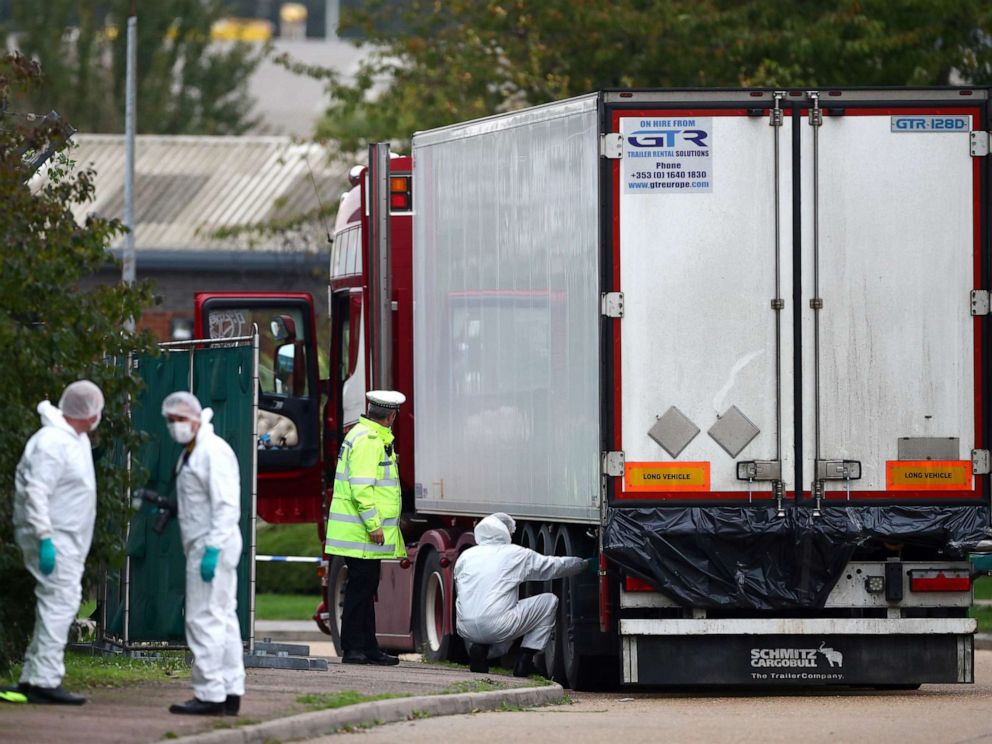
Leon Neal / Getty Images The tractor part of this unit where 39 bodies were found Wednesday is felt to have originated in Northern Ireland
Human trafficking and modern-day slavery are, unbelievably, on the rise world-wide. According to Britain's National Crime Agency, 6,993 victims of this crime had been referred to the government's program whose purpose is to identify and support victims, representing a 36 percent increase from 2017. Additionally, most fatal situations where victims of trafficking perished trapped inside shipping containers and trucks have been migrants, in recent years.
The bodies of 58 Chinese immigrants were discovered in June of 2000, in the back of a truck container in the port city of Dover, while in August of 2015, 71 bodies were found on a highway in Austria, trapped within a hermetically sealed and locked freezer truck. Most of those victims had come from Syria, Iran, Iraq and Afghanistan, at the peak of Europe's influx of refugees and migrants.
German public television and the Sued-deutsche Zeitung newspaper revealed afterward that Hungarian officials had tapped the phones of the traffickers, according to their research, but had failed to intervene in a timely manner that might have, if such intervention had occurred, saved those lives. The E.U. Law enforcement Agency (Europol), after the 2015 event, added a dedicated European Migrant Smuggling Centre to its law-and-order enterprise.
This year Europol published a report reflecting that the centre had discovered the most common method of smuggling relates to people being concealed in cars, or inside vans or trucks. Managing Director Rod McKenzie of policy and public affairs at the Road Haulage Association explained that the journey for people in the truck from Bulgaria would have been "hellish". From photographs that emerged it was clear the truck was equipped with a refrigerated unit, with temperatures dipping as low as -25C.
This, in relation to one of Britain's largest murder investigations when 39 bodies were found within a tractor-trailer parked on an industrial estate in southeast England. The driver, a 25-year-old man from Northern Ireland, is under arrest on suspicion of murder. The dead, comprised of 38 adults and a teenager, were discovered at Waterglade Industrial Park in the town of Grays, Essex, some 32 kilometres east of central London.
The truck was registered in Varna, Bulgaria, a port city on the coast of the Black Sea, to a company owner identified as an Irish woman. Since Bulgarian citizens as part of the European Union, and can travel freely to Britain, it was assumed originally that the truck occupants may have derived from elsewhere, confirmed when all the dead were identified as Chinese nationals. The truck had been driven from Belgium to a small town in Essex on the Thames.
Thirty-five minutes after the truck left Purfleet on Wednesday, police responded to an alert from local ambulance services who were at the container.
It was surmised by Mr. McKenzie of the Road Haulage Association that whoever sent the trailer through Essex might have favoured the route in avoidance of strict checks at the popular Calais, France crossing to Dover where authorities use sniffer dogs and monitors capable of detecting heartbeats, heat and C02 levels. "Purfleet, however, doesn't have that level of technology to screen lorries".
"We can then look at survivors and see if they can recall any of these stimuli, and when they were able to receive information, and how that relates to their brain resuscitation quality." "What happened to this person's mind and consciousness, this sweet human being that I was talking to just a half an hour ago? Is he conscious? Is he able to see us, hear us? When did he lost it, if he did lose his consciousness?: "Transcendental mystical or spiritual experiences close to death have been described for millennia. The problem with all those studies are that none of them are causative -- none of them show you how brain cells could possibly generate a thought, which is the fundamental problem of consciousness." "Why would my brain cells, millions of them connected together, suddenly feel guilty, or have a sentiment of guilt, like if I were to throw a brick in my neighbour's window, or be rude to somebody or do something immoral?" "Yet, paradoxically, what we started to see is that millions of people have now been resuscitated, and many of them have reported these very lucid, well-structured thought processes [able to to form memories, describe conversations and what people were wearing] Except that their brain has shut down and they've gone through death. Which is completely a paradox, it should not happen." "We're all conscious, thinking beings. Everything we do starts with consciousness. Yet we don't know fundamentlaly where it comes from." Dr. Sam Parnia, author, AWARE, awareness during resuscitation, resuscitation specialist, NYU Langone Medical Center
Cornelia Li for National Post
"If you take that organ [the brain] away or kill that organ or that organ dies, you cannot be conscious. [While there is no identified conscious centre of the brain, nothing to point to and claim] 'there, that's where it all happens." "And I know of no case in the literature of a brain dead patient coming back." Adrian Owen, neuroscientist, Western University
"Serotonin in particular was very high [in dying brains]. We know that the serotonin is associated with hallucinations and other mental functions." "But the part that is at least partly responsible for conscious information processing is actually increased tremendously in the dying brain [for 30 seconds at least]." Jimo Borjigin, associate professor, University of Michigan Medical School
Dr. Parnia believes that human consciousness may very well go on even after our heart stops beating for an undetermined period of time. He has taken the testimony of many people whose detailed descriptions of their out-of-body-at-death experience he gives credence to. A man, for example who suffered a cardiac arrest, and his brain "flatlined", with no sign of brain activity of any meaning. He described someone beckoning to him from the ceiling, and then the next second, "I was up there, looking down at me", a corpse, surrounded by doctors, nurses.
He witnessed his blood pressure being taken, a doctor placing something down his throat, saw a nurse pumping on his chest. He described the people, the sounds and the events of his eventual "resurrection". The man experienced conscious awareness for three to five minutes in the absence of detectable brain activity, "When no human experience should be happening whatsoever", stated Dr. Parnia, who cited the case in his study published in 2014 called AWARE.
According to Dr. Parnia, who has made himself an expert on the phenomenon, evidence from AWARE along with other related studies brings in the possibility that the mind or consciousness; the psyche, the "self", the spirit that reflects our uniqueness may not originate after all in the brain as popularly imagined as reality, but may rather reflect a separate, as yet-undiscovered scientific entity. Modern science at the present time lacks the tools required to demonstrate this, that when we die, what we name consciousness or the self does not become "immediately annihilated".
Dr. Parnia is not religious, he is not looking for proof of an afterlife; he and others who believe as he does are attempting to discover improved methods whereby the brain can be saved to avoid "disorders of consciousness", such as that which afflicted a Florida woman who suffered massive brain damage which resulted in a permanent vegetative state following a cardiac arrest. He is also searching for a method whereby he can test the accuracy of fantastical claims of near-death experiences with the use of objectively scientific approaches.
He plans to measure, second by second, oxygen levels inside the brain through a planned study of 1,500 people in cardiac arrest when a "code" is called so participating researchers, once alerted can dispatch themselves to resuscitation rooms with backpacks carrying portable brain oxygen monitoring devices. A portable EEG will measure whether the brain is functioning, and patients will be fitted with wireless headphones where random words and sounds will be transmitted and images beamed upwards as people undergo CPR.
The ultimate goal is to understand the optimal brain oxygen levels to be targeted by doctors during cardiac arrest and CPR to be able to optimize survival and bring a whole person back from cardiac arrest, with intact brain and mind and full functionality for their living future. This reflects advances in resuscitation where death can be reversed in those who have lacked a pulse for hours. Even greater numbers of people could be brought back across the death threshold, believes Dr. Parnia, if more hospitals implemented advanced techniques; chilling bodies to protect the brain, or using automated mechanical devices for chest compressions beyond what a human could perform.
Most people ultimately die of cardiac arrest, irrespective of how it has come about; the drop of blood pressure, the heart's inability to pump sufficient blood to supply the body, the heart eventually stops, respiration stops, electrical activity to the brain stops, and the brain flatlines. Studies suggest that six to 23 percent of cardiac arrest survivors report having clear memories fitting the parameters of a near-death experience. From a functional perspective, the moment the heart stops, the brain shuts down, said Dr. Parnia; even so, people become resuscitated, they form memories, describe conversations, "Except that their brain has shut down and they've gone through death".
The notion of a soul or mind existing separate from the body, charge his detractors is absurd. "I thought to myself, we can probably figure this [conundrum of brain-mind and near-death phenomenon] out in, like, a year, year-and-a-half of research", muses Dr. Parnia. He's still struggling with it after twenty years, with no end in sight, but opportunities to conduct further research, looking for that elusive "eureka!" moment of discovery.
"We have absolutely advised them to stay out of At Tanf. We are postured to respond."
"The United States does not seek to fight the government of Syria or
any groups that may be providing it support." " However, if attacked, the
United States will not hesitate to use necessary and proportionate force
to defend US, coalition or partner forces." U.S. defense official
"The government plan was to give the maximum possible chance for a reconciliation, but unfortunately there was no progress in this regard." "The radicals are in control in Idlib." "This looks like preliminary bombardment before a major land operation." Syrian government official
"[Safe passage would be
essential in the event of an assault.] A staggering 700,000 people could
be displaced overnight. Already people are on the move again
out of fear of what might come next, and are struggling to find
shelter." "As NRC witnessed in eastern Ghouta or Aleppo, routes to safety came
too little too late for thousands of civilians trapped in the violence.
The only way to truly ensure the safety of civilians in Idlib is to
prevent an outbreak in violence altogether." "We must see the world’s top
powers commit to peaceful negotiations and agreements which protect
civilians and grant them safety." The Norwegian Refugee Council (NRC)
A screenshot
of the White Helmets' Twitter account shows what the organization
describes as the aftermath of an airstrike on a town in the countryside
of Idlib, September 4, 2018.Screenshot / @SyriaCivilDef / Twitter
One of the world's "top powers" is bombing the hell out of Idlib city, evidently unconcerned that the top "top power" has issued a warning that Russian jets doing just that are in the process of helping Syria to make yet another "grave mistake". Syria doesn't seem to care. Moscow seems less than concerned that it is once again, placing the lives of Syrian civilians into a destructive dust-heap of cadavers. Damascus may have pointed out to Moscow that Washington is protecting some areas the Syrian regime means to recapture, shielding U.S. allies.
To which Moscow has responded by warning Washington it should haul its troops out of harm's way. Washington's response was that there is no intention of withdrawing its troops which will, if they come under fire, return fire, both for self-protection and that of its allies, aiding in removing what remains (in the thousands) of ISIL fighters. No fewer than 24 locations in the northwester province of Idlib were struck, interpreted as the opening salvo of an offensive.
Even Israeli jets visited Syria, striking Iranian military positions in Hama and Tartus provinces two days ago. On many fronts, this long-lasting, wide-ranging war in what was once a well developed country has become complex with a myriad of opposing actors, from Syria, Iran, Lebanon, Russia, United States, Israel, and Turkey, involving Sunnis, Shias, Kurds and foreign Islamists all clamouring for their aspirations and rights to be recognized in a country whose infrastructure has been bombed, its heritage smashed, its citizenry displaced, dismembered, murdered en masse.
The Syrian government forces that have massed around Idlib are prepared for an assault to rout the last opposition stronghold remaining in the country. President Trump's warning against Russian and Iranians "recklessly" attacking Idlib hasn't made much of a dent in their plans though he elaborated that "a grave humanitarian mistake" was on the horizon where hundreds of thousands of lives could be lost. But as long as chemical weapons are refrained from use, it's unlikely there will be any U.S. intervention; Russia's presence mitigates against anything so foolish.
Millions of Syrians live in Idlib province, half of them displaced from other areas in Syria, where they moved in panic to avoid being bombed elsewhere, now finding themselves targets once again. When, not if the offensive strikes it is expected to be one of the deadliest outcomes in the seven-year war. According to UN officials up to 800,00 people may be displaced, those in urgent need of aid dramatically increasing.
Any citizens, including Sunni Syrian rebels who baulk at surrendering to government troops with the full knowledge of what they will mean to their chances of emerging alive, have nowhere left to migrate to, for survival much less safety.
Members of Russian and Syrian forces stand guard
near posters of Syrian President Bashar al-Assad and his Russian
counterpart Vladimir Putin at the Abu Duhur crossing on the eastern edge
of Idlib province on August 20, 2018.George Ourfalian/AFP/Getty Images
This represents a general opinion site for its author. It also offers a space for the author to record her experiences and perceptions,both personal and public. This is rendered obvious by the content contained in the blog, but the space is here inviting me to write. And so I do.





/cdn.vox-cdn.com/uploads/chorus_asset/file/12758891/SYRIA_IDLIB_MAP_AUG_2018.jpg)

/cdn.vox-cdn.com/uploads/chorus_image/image/61123017/GettyImages_1019969058.0.jpg)
