"There
are estimates that over the 200 years of Canadian slavery, between
4,000 and 8,000 were held in bondage. Even at the height of slavery in
Montreal, slaves constituted only 0.01 percent of the population."
"By
contrast, at the outbreak of the American Civil War, slaves constituted
40 percent of the population of the Confederate States of America."
"The
result was a society and economy wholly geared toward slavery in ways
that never quite materialized in Canada. Full-time bounty hunters
roaming the countryside for fugitive slaves, columns of shackled men and
women being marched into frontier settlements, vast plantations of
slaves overseen by whip-
wielding overseers; these were all scenes distinct to the territories south of the Mason-Dixon line."
Tristin Hopper: Canada's Best-Kept Secret, National Post
"Canada
might not have been a slave society -- that is, a society whose economy
was based on slavery -- but it was a society with slaves."
"Canada's best-kept secret."
Afua Cooper. Canadian historian: The Hanging of Angelique, a chronicle of Canadian slavery, 2006
"We have a duty to remember slavery, but it is not an identity, and we cannot let slavery define Black history in Canada."
Aly Ndiaye/Webster, Quebec artist and author
Abolitionist
Harriet Tubman lived openly in what is now St.Catharines, Ontario, her
actions in shepherding fugitive slaves to freedom aside, though it was
considered to be a federal crime in the United States to aid and abet
runaway slaves. They were enshrined in U.S. law as personal property. At
the time, however, in the 1850s, Canada had long since surrendered as
an abomination to humanity the keeping in bondage and owning of human
beings.
But
it was not always that way. During the American War of Independence,
the paroxysm when the United States rebelled against the British Crown,
to become a new country whose foundation was freedom and liberty, those
living in those British-American colonies faithful to the Crown, known
as United Empire Loyalists left the United States to trek north to
Canada. "Neither
confiscation of their property, the pitiless persecution of their
kinsmen in revolt, nor the galling chains of imprisonment could break
their spirits", a monument to the loyalists proclaims.
Josiah Hanson, Philanthropist
Who
knew there were Black Loyalists? These were freed slaves who had
escaped from American owners emancipated by the British who settled in
Nova Scotia. And then there were the others, the Black slaves who
accompanied their owners as they made their way to Canada. The official
Act of Parliament welcomed white Loyalist refugees to British North
America, allowing them to bring "any negroes in their possession", along with them, exempt from paying duty to the Crown.
An estimated 2,500 Black slaves were brought to Nova Scotia which became a slaveholding territory. "During the late 18th century practically every county in mainland Nova Scotia had slaves, and this story remains to be told",
wrote historian Ken Donovan in 2014. Nova Scotia has always been
represented as the final stop of the Underground Railroad, which
abolitionist Frederick Douglas called "the real Canaan of the American bondmen".
A
generation prior to Abraham Lincoln's Emancipation Proclamation, in
Canada human beings were listed for sale in newspapers; enslaved
children were presented as gifts, authorities hunted down fugitive
slaves, murder and rape of enslaved Africans was permitted by the Crown.
A young woman whose name was Angelique was tortured and hanged to death
in 1734 after being accused of setting fire to a large section of
Montreal.
Incendiary, Marie-Joseph Angelique Kit Lang
Mohawk
leader Joseph Brant who marshalled indigenous armed resistance to the
American Revolution was the owner of 40 Black slaves. Advertisements of
slaves for sale were published in the Montreal Gazette, as well as rewards offered for the return of escaped slaves. "FOR SALE:A Young healthy Negro Wench between 12 and 13 years of age, lately from Upper Canada, where she was brought up", read an ad from 1735.
In
fact 1628 is thought to have been the year that the first Canadian
slave arrived in Quebec City where New France was actively encouraging
the use of African and Indigenous slavery in order to build and serve
the growing colony. Following the conquest of New France in the Seven
Years' War, Canada was the westernmost outpost of a British Empire that
became the world's leading slave trader.
(Mario Tama/Getty Images)
French
law recognized slaves as humans, albeit of diminished rights, while
under English law any slave resident in Canada was considered property,
nothing more. It took until the early 19th century for slavery in the
British Empire to be reversed when co-ordinated boycotts led to the
outlawing of slavery in the British Empire and antislavery patrols off
the West African coast. Emancipation in Canada began three decades
earlier, the result of grassroots actions of members of Canada's Black
community.
In
1793, Peter Martin, a free Black Loyalist, veteran of the Revolutionary
War, appealed to Upper Canadian authorities at a executive council
before which he appeared to speak of the "violent outrage" Americans
committed against an escaped Black slave, Chloe Cooley, whom they
violently forced aboard a vessel to return her to her owner in the
United States. His appeal against the situation where Americans could
enter Canada and violently abduct someone inspired the 1793 Act to Limit
Slavery in Upper Canada.
The
act, even while enshrining the legality of slavery, banned the
importation of slaves, setting out a program to free the children of
Canadian slaves who had reached the age of 25. The act, however, began
an inevitable trajectory toward rejecting institutionalized slavery. One
that London cemented with its passage of the 1833 Slave Emancipation
Act. So that by the 1850s, while Americans were hotly divided over the
issue, Canada had long since settled it. Publisher George Brown while
negotiating the creation of modern Canada, accused the United States of
perpetrating the "sum of all human villainies".
In
Canada today here are 1.2 million Black Canadians, fifty percent of
whom are first-generation immigrants. None of whom may know that
centuries ago Black slavery was institutionalized in Canada. Because
Canadians simply are unaware of this iniquitous part of Canadian
history; best 'forgotten', laid high up on an unreachable shelf of
stagnant memory.
"We have arrested the lorry driver in connection with the incident who remains in police custody as our enquiries continue." "This is a tragic incident where a large number of people have lost their lives. Our enquiries are ongoing to establish what has happened." Essex Chief Superintendent Andrew Mariner
"[I am] appalled by this tragic incident in Essex." "I am receiving regular updates and the Home Office will work closely with Essex Police as we establish exactly what has happened." "My thoughts are with all those who lost their lives and their loved ones." "We know that this trade is going on - all such traders in human beings should be hunted down and brought to justice." British Prime Minister Boris Johnson
"Sadly, this is not the first time that we have found people in metal containers in my constituency." "We're really sorry to say it's all too regular an occurrence and it was only a matter of time before that would end in tragedy." Jackie Doyle-Price, Conservative Member of Parliament
"Potential victims of human trafficking were reported from 130 different nationalities in 2018 [and] Albanian and Vietnamese nationals were the most commonly reported." "[Victims are assigned to forced labour, in the sex industry and other fields]." British National Crime Agency
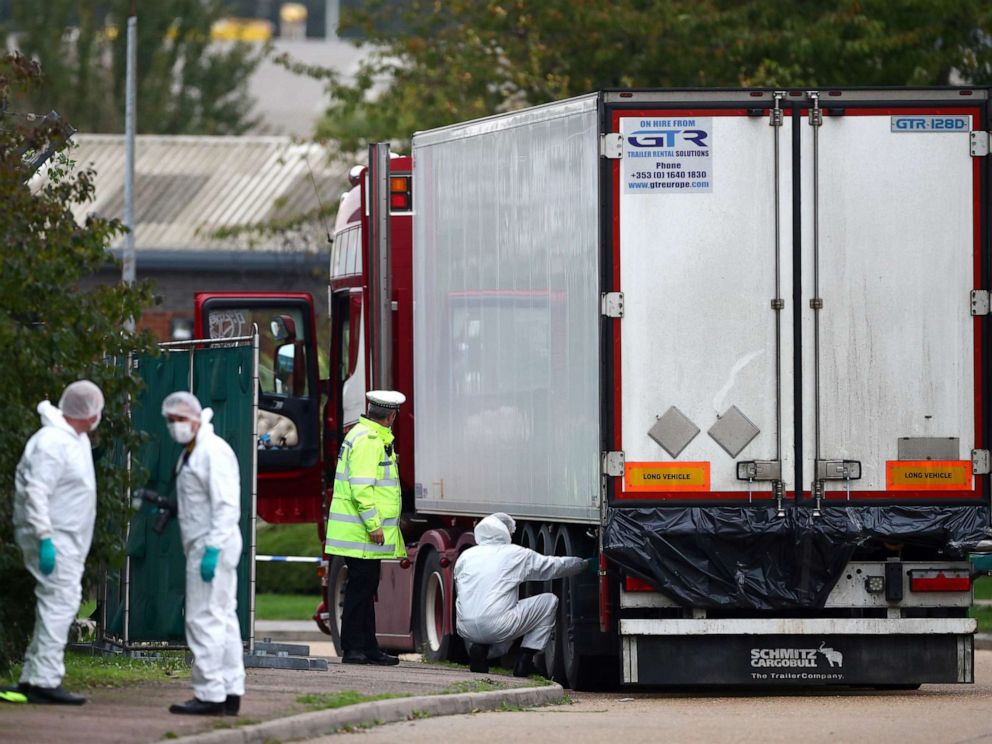
Leon Neal / Getty Images The tractor part of this unit where 39 bodies were found Wednesday is felt to have originated in Northern Ireland
Human trafficking and modern-day slavery are, unbelievably, on the rise world-wide. According to Britain's National Crime Agency, 6,993 victims of this crime had been referred to the government's program whose purpose is to identify and support victims, representing a 36 percent increase from 2017. Additionally, most fatal situations where victims of trafficking perished trapped inside shipping containers and trucks have been migrants, in recent years.
The bodies of 58 Chinese immigrants were discovered in June of 2000, in the back of a truck container in the port city of Dover, while in August of 2015, 71 bodies were found on a highway in Austria, trapped within a hermetically sealed and locked freezer truck. Most of those victims had come from Syria, Iran, Iraq and Afghanistan, at the peak of Europe's influx of refugees and migrants.
German public television and the Sued-deutsche Zeitung newspaper revealed afterward that Hungarian officials had tapped the phones of the traffickers, according to their research, but had failed to intervene in a timely manner that might have, if such intervention had occurred, saved those lives. The E.U. Law enforcement Agency (Europol), after the 2015 event, added a dedicated European Migrant Smuggling Centre to its law-and-order enterprise.
This year Europol published a report reflecting that the centre had discovered the most common method of smuggling relates to people being concealed in cars, or inside vans or trucks. Managing Director Rod McKenzie of policy and public affairs at the Road Haulage Association explained that the journey for people in the truck from Bulgaria would have been "hellish". From photographs that emerged it was clear the truck was equipped with a refrigerated unit, with temperatures dipping as low as -25C.
This, in relation to one of Britain's largest murder investigations when 39 bodies were found within a tractor-trailer parked on an industrial estate in southeast England. The driver, a 25-year-old man from Northern Ireland, is under arrest on suspicion of murder. The dead, comprised of 38 adults and a teenager, were discovered at Waterglade Industrial Park in the town of Grays, Essex, some 32 kilometres east of central London.
The truck was registered in Varna, Bulgaria, a port city on the coast of the Black Sea, to a company owner identified as an Irish woman. Since Bulgarian citizens as part of the European Union, and can travel freely to Britain, it was assumed originally that the truck occupants may have derived from elsewhere, confirmed when all the dead were identified as Chinese nationals. The truck had been driven from Belgium to a small town in Essex on the Thames.
Thirty-five minutes after the truck left Purfleet on Wednesday, police responded to an alert from local ambulance services who were at the container.
It was surmised by Mr. McKenzie of the Road Haulage Association that whoever sent the trailer through Essex might have favoured the route in avoidance of strict checks at the popular Calais, France crossing to Dover where authorities use sniffer dogs and monitors capable of detecting heartbeats, heat and C02 levels. "Purfleet, however, doesn't have that level of technology to screen lorries".
"I have been hit, tortured, humiliated -- I'm always the first to wake up and the last to go to sleep." "None of us ever went to school. None of us had identity or civil papers. I received no support, no one could help me." "I was totally at the mercy of my masters." Habi Mutraba, Maurtania
Former slaves Habi and her brother Bilal, above left, stand in front of
Bilal’s garage outside Nouakchott. The siblings were both slaves to a
family east of the capital, but Bilal fled suddenly one day after his
master beat him. After several attempts to rescue his sister, who was a
victim of sexual abuse and forced labour, she was finally freed with the
help of SOS Slaves in 2008. Today, the pair live in a poor
neighbourhood on the periphery of Nouakchott. With the help of some
activists, Bilal recently opened a small tyre-mounting garage
"For the last two weeks, we have been thrown into the corridor of a cramped courtyard with no roof to shelter us from the rain." "It [his arrest] was necessary to prevent me from entering the assembly and, better still, to invalidate my claim to run for the presidency of the republic in 2019." "The only solution to ending slavery in Mauritania is that Europe and the U.S. as well as donors, stop giving money to the Mauritanian regime." Biram Dah Abeid, anti-slavery advocate, Mauritania "The government turns a blind eye because, traditionally, they are the affluent ethnic group who owned slaves." "They have run the country and still do." Jakub Sobik, Anti-Slavery International
"They raped me, all the time, and so I became pregnant with my first child. They did this all the time, every day, whenever they wanted." "My daughter was taken from me when she wasn't even five and so it was that my own story was repeating itself." "To really stop slavery, an uprising of all the former slaves is needed, to unite with human rights movements globally." Barkam Tusakim, 30
Mauritania
is a bridge between the Arab Maghreb of north Africa and darker-skinned
sub-Saharan Africa. The ruling Arab-Berbers have higher paid positions
in jobs and government, while the darker-skinned Haratines and
Afro-Mauritanians are under-represented in leadership positions and face
many obstacles in society, from access to education to well-paid jobs
Taken herself at age five from her own mother, this woman is now seeing her own horrible life as a child inducted into a life of slavery repeated with her daughter. Mauritania is the last country on earth where human slavery persists as part of the culture, despite that formally in 1981 it abolished slavery. While doing so, it overlooked the necessity to introduce criminal laws to enforce the ruling until 2007.
Anti-slavery NGO SOS-Esclaves estimates that at least 500,000 people remain enslaved in the country representing 18 percent of the population; a number vastly greater than any other country internationally. The slavery culture is deeply engrained dating hundreds of years back, passing through family lines where slaves are born into servitude. The enslaved population is isolated to the extent that most have never known any other life.
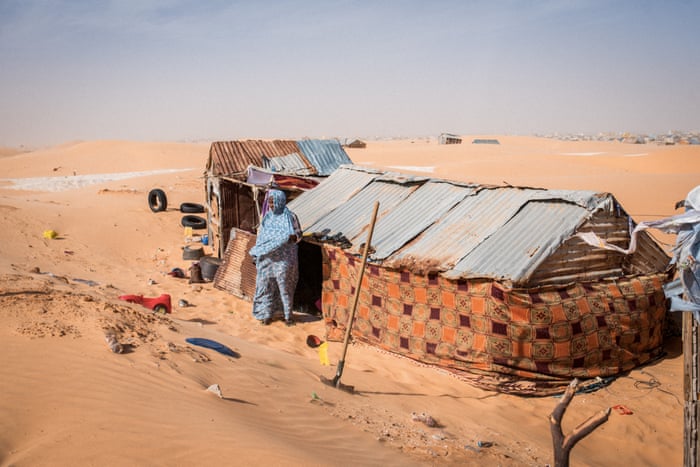
Slave owners include government officials, and Judges. Slave owners never traditionally release a slave to freedom. Routine tradition sees slaves traded between families, treated just as livestock would be; material possessions. In their master's house slaves cook and clean, or are tasked to live their lives in desert areas herding goats or camels in remote regions for months on end.
Habi, who spoke of the miseries she experienced in her West African country, was enslaved from birth when her mother was raped by her "master". On her birth, Habi was given as a gift to another member of the extended family. She tended to livestock or worked in the household, fetching water, preparing food and was regularly raped by the household head under knife threat. Her own pregnancy resulted by the son of the household raping her.
She did manage to free herself, escaping with the aid of Biram Dah Abeid who helped organize her rescue and who is himself being held in the Nouakchoff Central Prison, uncharged with any offence, his sixth imprisonment where he has been denied sleep, showers and a mosquito net, and nor is he permitted family visits, medical care and legal advice. His sin, that of confronting government and planning to run for election himself.
A Tarhil neighborhood resident outside her house, where she was
relocated by the state when her slum in Dar Naim was demolished to make
way for the construction of a road. Married, with two children, she
sells biscuits to passersby while her husband holds small jobs in the
city. “If we had the budget, we would have rented a room in Nouakchott.
Here, we don’t even have water – we have to pay for a cart to deliver
water,” she says.
The Sahara Desert makes up a huge part of Mauritania where black sub-Saharan Africans are held hostage to the beydan tribe as slaves to tend livestock. It is the light-skinned beydan Berbers which are the minority of the population, forcing the Haratine ethnic group of blacks to a lifetime of slavery. A rigid caste system maintains that social order, with the majority of the country's wealth in the hands of the beydan.
The country's president is beydan along with his political allies. Even those haratine who are free face legal and practical obstacles in obtaining property, land or employment, with little political incentive to modernize the system, since many of Mauritania's political and judicial figures are themselves slave-owners. Complicating matters is Mauritania posing as an ally in the West's efforts to stop irregular migration and end terrorism in the Sahel.
Britain, France and Spain managed plans to increase EU funding for the G3 Sahel that will benefit Mauritania which has received millions in EU funding to stem migration. International advocacy groups are denied entry to the country, leaving internal activists isolated and on their own, fighting for change.
The Haydel family in front of their tent next to their master Sheikh Ouled Mhammed’s house.
Photograph: Seif Kousmate/Hans Lucas
"My family had to sell land, borrow money and even take out a bank loan to pay for it all. We were contracted to build a social housing development. For three months we got no salary at all. We thought our boss would pay us eventually, but then we discovered he'd fled to Singapore." "We weren't able to make the monthly repayments [on the loan] so now we're in trouble. If we still can't pay back the bank, they're going to seize the deeds for my family's land. The bank's also lodged a police report against me, so when I do go back to Bangladesh, I might be detained." 24-year-old Bangladeshi construction worker
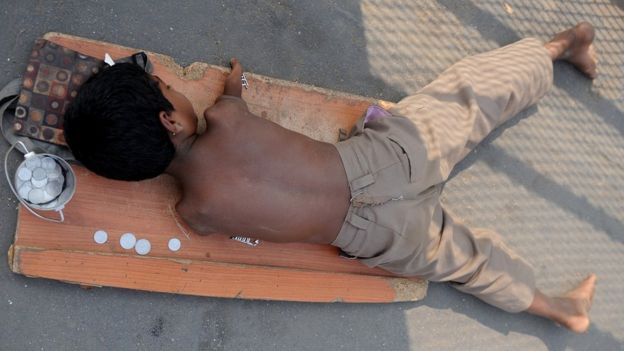
Children can be forced to beg on the streets (file photo) AFP
So much for trust, for poverty persuading people to make risky efforts to retain employment and in the process laying themselves wide open not only for exploitation but to that added complications in their lives leading to penury and imprisonment through no fault of their own other than gullibility led on by desperation. It is what allows people from impoverished countries who cannot find work, hope for some dignity for their future when they agree to travel abroad -- and themselves pay for the privilege -- to work long hours for scant remuneration far from home, where there are no legal worker protections.
Going from the Philippines or Bangladesh to Saudi Arabia or Qatar to work on construction projects where they are housed in miserably squalid conditions, where there are no medical facilities available to them despite working in dangerous situations, and where the food allocated to them by their employers is of poor quality and quantity, failing to meet the daily energy requirements of construction workers. Often their passports are held for security purposes, and if workers are treated harshly and decide to leave for home, they are trapped without the documentation and the finances to allow them to.
Many trafficking victims are forced to work on fishing boats Getty images
The long-gone era of slavery was a horrible time of people treated as possessions with no voice to protect them since slavery was accepted as normal; ownership of other human beings. It has been estimated that people sold into slavery represented 13 million souls at the height of the slave trade. At that time no government condemned the institution of slavery, it represented a valued commercial product in the age of emerging industrialization. For about 350 years people were forced into misery as slaves, automatons whose only purpose in life was to obey others
How fortunate we are, all of us, to live in an enlightened age when the institution of slavery is recognized for what it was; an unforgivable blight upon human history. There is now no such abomination assaulting and degrading humanity as trading in slaves, and people who took pride in their role of that trade as slave traders who would raid villages to gather people desperate to escape, many of whom died during their passage to the trading markets. Wars represented another generator of slaves.
Conflict persists. And so does slavery. The Yazidis of Iraq were murdered and the women and children enslaved by the Islamic State of Iraq and the Levant. But in Asia, there are poverty-stricken people who willingly allow themselves to be worked as slaves in the fishing industry, in mining. Above all, there are women who are forced into sex slavery, for there are huge profits to be made in forcing people to perform work that has financial value and that degrades the human spirit.
The United Nation's labour organization now calculates that there are at the present time, some 21 million people retained through some measure of modern slavery. If what happened in the past was reprehensible beyond shameful, what is now occurring is another age of slavery representing an atrocity of global proportions. It is a secret industry -- in reflection of its illegality.
Shandra and three other trafficking victims near a brothel in Connecticut. They were told to pose. Shandra Woworuntu
It is estimated by those who follow this unsavoury and brutal subject of human trafficking that the most profitable of the slavery situations is women and girls who are trafficked in brothers. Generally, slaves forced to fish or mine minerals can generate roughly $4,000 each slave annually for those who exploit them. In contrast, the more lucrative trafficking is that of women where the profit represents an annual $36,000 income from each of the victims' activities.
Commonly, an innocent person eager for employment will be persuaded into 'debt bondage' whee employment agents promise them jobs in distant locales, have them sign for a loan to pay their passage the the fee the agent collects, and from them force repayment of the loan irrespective of the fact that the pay turns out to be less than promised and the work far more difficult, and in the process holding the passport as security.
"We're asking to bring that child to be reunited with his mother. That's all we want. That's all the mother wants." "It's all the child wants." "A 12-year-old child is not safe unless he is in the arms of his mother. That's what we know; that's the language we understand." "But he is safe." "We don't want to be filling applications and documentation and such and such. We even offered to pay for the flight [to reunite the young boy with his mother in Winnipeg]." Hadji Hesso, Yazidi Association of Manitoba
"We didn't think we would ever see him again." "I was very saddened [by his condition] when I saw his photo ... I spoke to him on the phone and he said, 'I'm OK, I'm going to be fine'." "We will never forget what [ISIL] did to us -- the torture, the pain, everything they did to us." Nofa Zaghia, Yazidi refugee, Winnipeg, Manitoba
Emad Mishko Tamo was separated from his mother in August 2014 when the Yazidi family was captured by ISIS. (Facebook)
Now resident in Canada as a refugee, Nofa Zaghia is making a new life for herself and her four youngest children. She had two older boys with her husband. In 2014 Islamic State of Iraq and the Levant arrived to invade her village in Iraq. ISIL targeted the Yazidi minority for extermination looking upon them as unfit to live. They are a minority ethnic group whose religious practises sets them apart from the Muslim majority in Iraq, who consider them to be heretics.
Islamic State terrorists rounded up Yazidi men to slaughter and leave them in mass graves, while the women and children were taken as slaves, to be used and sold on the slave market. Women and girls to be used as sex slaves. Tens of thousands of Yazidis were besieged when they fled the terrorists on Mount Sinjar above the town of Sinjar and their surrounding villages. They, presumably, were the fortunate ones, escaping death and enslavement. But on the mountain they faced winter cold, privation and starvation.
Kurdish forces effected a rescue, and since then rescued Yazidis have sought asylum elsewhere than their homeland of Iraq. Untold numbers of Yazidi women and children are still being held by ISIL terrorists, others have been sold into slavery, ending up in places like Mali. And there are still families of Yazidis marooned on Mount Sinjar. This week Nofa Zaghia received a call from her brother, living in a refugee camp in Iraq. He informed her that her 12-year-old son Emad Mishko Tamo had been rescued by Iraqi soldiers and brought to the camp.
And her brother posted a photograph of the boy through social media, seated in a pickup truck, frail in appearance, wide-eyed, encrusted with blood and mud, but alive. Her two years living in captivity under Islamic State, separated from her husband and their two older boys left her convinced that only she and the four younger children had survived. Now she knows that she will be reunited with her 12-year-old son.
The fate of her other son and her husband is unknown to her. She had somehow managed to escape with her four young children, but she has no idea what happened to the others.
Emad is receiving medial treatment. He has a bullet wound in his arm, and sustained injuries to his stomach. The Yazidi association representing her interests and those of her son, receives assistance from the Kurdish Initiative for Refugees and Winnipeg Friends of Israel. Canadian authorities are being urged to expedite the young boy's journey from the refugee camp in Iraq to Canada, to be reunited with his mother and four younger siblings.
"I have heard nothing of my husband and daughters since the day that Daesh [Islamic State of Iraq and the Levant] took us." "I cannot sleep at night; I think and I think and I think." "They are in God's hands. We depend on God to take care of us. We believe in Him. I have no power, so I ask God to release them." Ayshan Murat, Sinuni, Iraq
Matthew Fisher / National Post Ayshan Murat stands with her two sons, Jamal and Hachem (in her arms) who were released last year in Syria
"[ISIL did] terrible things." "You can understand the meaning of 'destroyed' if you come here. Yazidi women were taken. Yazidi men were killed." Aziz Chanem, Sinuni, Iraq
"I don't think anybody could really understand the depth of human suffering that has happened here. The kind of trauma and kind of cruelty that these people have endured is something beyond what many of us have ever heard of or thought of." "How they keep going through the injury and assault and abuse that they have suffered is amazing to me." "They cannot finalize within themselves whether they are dead or alive or in captivity. They live in perpetual grief that can be very taxing." "I am inspired by many of the women that have returned from intense suffering and intense abuse. They decide for the sake of their children they are going to get better and they work at making themselves better. They work at providing as comfortable a home as they can in their tent or unfinished building. Many of these women are inspiring to know because of the courage they show. They try to leave behind what has happened to them." "We can help them with material things. But what they want is faith and hope." Marigold Vercoe, Australian psychiatric nurse, humanitarian worker, Sinuni, Iraq
Yazidis' religion is an unique and ancient one, with various influences and origins. Their religion is particularly scorned by the barbarians of Islamic State. ISIL in its Sunni-sect-inspired Islamism has tormented and threatened and slaughtered Shiite Muslims, and Iraqi Christians, but it has reserved its very special atrociously inhumane treatment for Iraqi Yazidis. The men corralled and subjected to mass slaughter, women and children taken as slaves to be sold, and young women and girls as bartered sex slaves.
When Islamic State first marched into the ancestral geography of Iraq's Yazidi population around the city of Sinjar and the many towns in the area, they cleansed the city and the towns through killing and kidnapping. Those Yazidi men, women and children who managed to escape the deadly noose that closed around them, fled up nearby Sinjar mountain two years ago, and with winter oncoming, they were without food and potable water and shelter.
Ahmad Al-Rubaye / AFP / Getty Images A
file picture taken on August 13, 2014, shows displaced Iraqi families
from the Yazidi community crossing the Iraqi-Syrian border at the
Fishkhabur crossing, in northern Iraq
Both Iraqi and Syrian Kurds mounted a rescue of the trapped Yazidis, helping them off the mountain and into Kurdish territory. The Iraqi and Syrian Kurds had a falling out with the Syrian Kurds wanting to continue aid, comfort and haven for the Yazidis, guiding those they rescued toward Syria, while the Peshmerga warned the Syrian Kurds to vacate Iraqi Kurdish territory. The international community save for a brief flyover by American planes dropping supplies, did nothing. There are still thousands of Yazidis trapped on the mountain awaiting rescue, facing another winter.
The United Nations has given technical refugee status to Syrians fleeing their government, but have ignored the plight of the Yazidis. Without the official status of documented refugees it is difficult for countries offering to take in Syrian and Iraqi refugees to focus on taking in Yazidis as the most vulnerable and in need of help. To be eligible for UN refugee status people cannot remain in their native countries, but must move elsewhere.
Iraqi and Kurdish governments, along with international organizations, have discovered mass graves teeming with the skeletons of murdered Yazidis; some were shot, others buried while still alive, where leg bones and jaws can be seen in a field around Sinjar city which has since been retrieved by the government of Iraq. And where electricity and potable water are in short supply. Yazidis are slowly returning to the city where it will take a monumental effort to return it to the status and condition its residence once enjoyed.
Sinjar was once the cultural hub of the Yazidi community, where almost 100,000 resided. Now it is abandoned, its streets and buildings bearing the hallmarks of the violent ISIL invasion. There are booby-trapped bombs silently waiting to be set off, there are tunnels everywhere, ISIL-built and -used as cover for airstrikes and escape routes.
ISIL is complacent in its treatment of non-believers, with codified strict rules "on taking captives and slaves", published as guides. Women could be beaten, according to Koranic instructions and girls as well, avoiding the head. Women between 34 and 40 years of age are to be sold for $75, and those between age ten and 20 years valued at $130, while girls under the age of nine had a price tag of $172.
Ayshan Murat spoke of her nightmare when her family was captured two years earlier by the jihadists. She and her two young sons spent 14 months in captivity until her father-in-law and other relatives paid ISIL a ransom of $20,000 for their release. No one knows what had become of her husband and their three daughters after they were captured in their farming village at the foot of Sinjar mountain. Separated, she and her boys were taken to Syria and her husband and their girls, nine, seven and five were sent to Mosul.
"He [ISIL slave-owning soldier] told us that Taus Malik is not God. He said that Taus Malik is the devil and that because you worship the devil, you belong to us." "We [Islamic State terrorists] can sell you and use you [as a slave], as we see fit." Escaped Yazidi woman
Kirsten Luce for TIMENadia, a young Iraqi Yezidi who was abducted into slavery by members of ISIS, is photographed in the U.S.
Two years ago the world became aware of an obscure tribe of people living in the Middle East, called the Yazidi. They live in Turkey, in Syria, in Iraq and elsewhere, in small villages, and often among a larger Kurdish population. They have been historically vulnerable as a distinct ethnic group with a religion that is considered to be a hybrid religion, not Muslim, but taking elements from even earlier religions of the region.
Their history as a people is an ancient one, known to have arisen in Mesopotamia. They have, despite aeons of oppression, discrimination and massacres, remained true to one another and to their religion which Muslims declare to be devil-worshipping. They are the quintessential outsiders, they find protection only living among the Kurds, another, much larger distinct ethnic group which considers the Yazidis to be a Kurdish 'cousin', an offshoot.
As far as Muslims are concerned, the Yazidis are subhuman, leading to contempt for them and their beliefs, leading in turn to ongoing repression and violations of their most basic human rights. They, on the other hand, respect both the Bible and the Qur'an. Their own religion follows an oral tradition of belief in souls and rebirth and ultimate purification as monotheists whose singular divine being is represented by seven spirits.
The greatest of those spirits is named the Peacock Angel, Malik Taus, the executor of divine will to whom Yazidis pray. An alternate name for Malik Taus is Shaytan, Arabic for "devil", leading Muslims to cast aspersions on Yazidis and their religion as devil worshippers. It is in their self-appointed role as defenders of Islam that Islamic State has taken to "erase their identity", as the UN describes the genocidal intentions of ISIL.
The Islamic State assault two years ago on the major Yazidi town of Sinjar saw five thousand Yazidi men and boys slaughtered, and over three thousand Yazidi women and girls rounded up to be taken away as slaves. The women are used in a system of human ownership lauded by ISIL, which refers to the Koran for its guidance in how to treat their vulnerably helpless captives.
They are bought and sold, kept in compounds like cattle until such time as a buyer steps forward. They have no rights, since they are entirely the possession of whomever buys them. They can be bought singly or in groups by 'wholesalers'. They are despised as unbelievers, relegated to an even lower status than Christians and Jews.
One woman attributes her freedom to the collusion of the wife of the man who bought her, enabling her successful escape. They represent, it seems the "Jews" of the Arab/Muslim world of conquest, rejection and subjugation.
"Slavery was abolished, and the old slaves became citizens. They even elected deputies. But the plantation economy continued with the same masters, who then became employers." Frederic Regent , expert historian, French slave trade
"It's from slavery that we have the discrimination we have today and the racism we see in France today. It's not yet totally done in France. France has many, many institutional links to slavery." Myriam Cottias, historian, Representative Council of France's Black Associations
"I wish to give to France an institution [major foundation in creation of a slavery memorial and museum] it still lacks, a foundation for the memory of the slave trade, slavery and its abolition." French President Francois Hollande, Paris
"[The historical lack of a French institution dedicated in memory of black slavery rankles]: It clearly means that black lives do not matter." "What was different between that [continuation of the plantation economy using former slaves as 'workers'] and slavery? Nothing." "Black anti-Semitism is growing in France, and it's not exactly the same as the other types. It's usually rooted in the comparison between the two memories." Louis-Georges Tin, president, Representative Council of France's Black Associations
Paris’s
only significant slavery memorial — a bronze statue of broken chains —
sits in front of an ornate building once owned by the Bank of France.
(James McAuley/The Washington Post)
The complexity of racial discrimination and its variants, along with the residual effects on the psyches of survivors, and the reluctant acknowledgement of its painful, shameful historical realities has consequences that while now evident, might not have been imagined. Take, for example, France coming to terms with its inexplicably official catering to Nazi Germany and suppressing its cooperation with Germany in the Holocaust.
Official France finally forced itself to admit its shame and produce an apology for participation in Nazi genocide carried out during the Second World War by Vichy France which saw no reason not to aid in the deportation of Jews to eastern European concentration and death camps. Anti-Semitism was alive and well in the France of that era, and it was of great assistance to the Third Reich in its reach toward the Final Solution.
So while there exists a Memorial to the Abolition of Slavery in Nantes on the Atlantic coast which once represented France's major slave-trading hub, French blacks feel this is a wholly incomplete admission of shame and guilt in being an important cog in the European slave trade, bringing black Africans to Europe as slaves and using them for economic production gain. "France has a memory of abolition, but not of slavery", commented Mr. Tin.
Memorial to the Abolition of Slavery, Nantes, France
France had been one of the major European slave-trading nations, fully engaged in enslaving and selling an estimated 1.4-million people during the 18th and 19th centuries. It was in 1848 that slavery was officially outlawed in France. But in the interim the country's colonial conquests in Africa, in Southeast Asia and in the Caribbean made it extremely wealthy with slave labour generating products sold elsewhere in Europe.
France was a laggard in outlawing slavery, behind Canada and other British territories, but a generation before the United States took that humane step. And while the thought of liberation was empowering the reality was somewhat other, for blacks in French territories overseas still worked at the same plantations doing the same labour, but as 'free' men and women, not slaves, although the conditions were precisely the same.
France created a Holocaust Memorial Museum and research centre in 2005 and installed black plaques at most of the sites known to have been distinguished by the arrests of Jewish children in Nazi-occupied France, and all with the enthusiastic assistance of French officialdom who were sometimes more heartless and savage in their treatment of Jews than the German officers they were so eager to serve.
Because the French shame has finally been officially recognized and repented, hostile resentment arose against Jews from blacks in the minority communities, leaving the impression with French blacks that their suffering was less important.That comparison, it is argued, is behind the performances of French-Cameroonian comedian Dieudonne M'Bala M'Bala whose anti-Semitism
has become legendary.
In an odd exchange of sensibilities French Jewish organizations and community leaders have been supportive of the movement for a slavery museum and foundation, joining with Tin's campaign from the outset. "The two histories come from different epochs, and they don't have the same places in society. But of course it's important to improve the public spaces", commented journalist Antoine Spire, a leader for the cause of a foundation.
Wall of the Righteous, Paris. Photo GLK On the opposite side of the Allée des Justes can be seen a plaque
indicating that more than 11,000 Jewish children were sent to the camps
from France, including more than 500 from this, the 4th, arrondissement.
"One should remember that enslaving the families of the [nonbelievers]
and taking their women as concubines is a firmly established aspect of
Islamic law." "Their creed is so deviant from the
truth that even cross-worshipping Christians for ages considered them
devil worshippers and Satanists." "The enslaved Yazidi families are now sold by the Islamic State soldiers." Islamic State magazine, Dabiq
Islamic State jihadists say they sell enslaved Yazidi women for as little as $US1000 ($1142) to use as concubines. Photo: AP
The Islamic State propaganda magazine has given the world notice that Yazidi women and children represent spoils of war. Captured as the fanatical jihadists marched into their ancient towns and villages in Iraq, thousands of women and children are suffering unspeakable atrocities, and considered in their vulnerable state to be valuable as livestock used for breeding purposes. Hundreds of thousands of Yazidis, an offshoot of Kurds, practising pre-monotheistic religious rites were made homeless by the Islamic State advance.
Targets for Islamic State ... Yazidi Iraqi women walk
at the Bajid Kandala camp near the Tigris River, in Kurdistan's western
Dohuk province, where they took refuge after fleeing advances by IS
jihadists in Iraq. Photo: AFP
Young women and teenage girls were separated from their families, while thousands of Yazidi men were slaughtered, many beheaded, and many more desperately fled to the mountain behind their Sinjar area of northern Iraq, last August. It was the Kurds of Syria and Iraq who came to their rescue, helping the tens of thousands of Yazidis who had fled their towns and villages with the advance of the Islamic State in fear for their lives, finding themselves stranded on the mountain, starving.
Those who had fled the Sinjar area had described men being massacred, and hundreds of women and children taken by the marauders. Dabiq described how the women and children were divided among fighters, in accordance with Islamic law. In an article contained in the magazine, it was stated that Christians and Jews, in reflection of the Koranic canon, can be offered the opportunity to save their lives by paying a tax or through conversion. Yazidis, though, are not accorded those privileges.
The men are murdered, because their religious devotion is anathema to Islamists, while the women and children are enslaved, captured during a conflict, reflecting the very historical advance of Islam during its formative years when it embarked on a far-reaching odyssey to spread the faith by the scimitar, claiming the Middle East as its own, and advancing into Europe to proselytize in their inimitably violent manner, increasing the numbers of the faithful and their geographic domination.
Human Rights Watch based in New York interviewed some Yazidi women who carefully avoided admitting they had been raped, and for reason enough, since the shame of having been a victim of sexual assault is a stigmatizing factor in the deeply conservative sect. One woman who was interviewed by them stated she had experienced seeing "brides" taken from a school and a prison that she had been held in. "Some were as young as 12 or 13, and up to age 20", she affirmed. "The Islamic State's litany of horrific crimes against the Yazidis in Iraq only keeps growing", Fred Abrahams, a special adviser at Human Rights Watch said. Islamic State jihadis are faithful to the traditions of historical Islam. They are intent on putting into practise precisely what the history of Islam's development and inexorable spread reveals. And in the process treating those whom they conquer in the very same manner their forbears did.
Islamic State consider themselves authentic Islam reborn. And with that authenticity comes the obligation to Islam to obey the major precepts of the responsibility of all Muslims to convert those without the faith to a presence within the faith. Conversion is a triumph. One which does not necessarily confer responsibility of the inductor toward the inductee. Which is why Islamic State sees no reason why it should not behead foreign abductees whether or not they convert to Islam.
This represents a general opinion site for its author. It also offers a space for the author to record her experiences and perceptions,both personal and public. This is rendered obvious by the content contained in the blog, but the space is here inviting me to write. And so I do.
/https://www.thestar.com/content/dam/thestar/news/canada/2021/01/31/what-we-dont-know-about-the-history-of-slavery-in-canada-and-why-we-dont-talk-about-it/qg_20_aug_1778_vol_no_677_p_3.jpg)
/https://www.thestar.com/content/dam/thestar/news/canada/2021/01/31/what-we-dont-know-about-the-history-of-slavery-in-canada-and-why-we-dont-talk-about-it/_1_200402278.jpg)


/https://www.thestar.com/content/dam/thestar/news/canada/2021/01/31/what-we-dont-know-about-the-history-of-slavery-in-canada-and-why-we-dont-talk-about-it/_200402023.jpg)