The Giant Shifting Its Weight
"China has become older before it has become rich.""[China's population has been in decline since 2018; the population crisis is] much more severe [than previously thought].""[China's] real demographic crisis is beyond imagination and that [means] all of China's past economic, social, defence and foreign policies were based on faulty demographic data."Yi Puxian, demographer, expert on Chinese population trends University of Wisconsin-Madison"For policies to reverse the fertility decline itself is very challenging. In recent years China has already been coming up with lots of new measures, including getting rid of the one-child policy, some kinds of subsidies at different levels. But they haven't really been working well, fertility has not reversed. I do think this decline will continue.""But what's really causing concerns socially is what that means in terms of the structure. Because things are changing really fast… societies may not have time to adapt,"Shuang Chen, assistant professor, department of social policy, London School of Economics"The Chinese economy is entering a critical transition phase, no longer able to rely on an abundant, cost-competitive labor force to drive industrialization and growth.""As the supply of workers begins to shrink, productivity growth will need to pick up to sustain the economy’s heady pace of expansion."HSBC chief Asia economist Frederic Neumann."[We will] improve the population development strategy [and ease economic pressure on families]."“[We will] establish a policy system to boost birth rates, and bring down the costs of pregnancy and childbirth, child rearing, and schooling.""We will pursue a proactive national strategy in response to population aging, develop elderly care programs and services, and provide better services for elderly people who live alone."Chinese President Xi Jinping
 |
Wherever,
whenever the Chinese Communist Party creates solutions to problems that
confront it, Beijing somehow manages to make the problems more severe
than ever imagined. Its interference through measures that tend to be
draconian in nature solving nothing and complicating everything. Just as
its zero-COVID measures served only to stave off the inevitable. Just
as it ignored the welfare of the elderly by failing to inoculate them
adequately against the SARS-CoV-2 virus. Just as it refused to import
mRNA vaccines that were immeasurably more effective than Chinese
vaccines.
Its
policy of one-child per family, meant to slow down population growth,
deprived families of the choice of the number of children they would
ideally prefer to have, and in the long term began a stealth campaign
against female children. Since in Chinese culture (practised elsewhere as well)
male babies were preferred, abortions of female foetuses were common,
and neglect of female babies including infanticide was not unknown.
Which
has now given way to a paucity of females of marriageable,
child-bearing age in China and an embarrassment of young Chinese men who
cannot find brides. Women of marriageable age are now more educated and
many refuse to be child-bearers, much like their counterparts elsewhere
in the developed world where population replacement levels are on the
decrease. Women prefer careers over child-rearing. There are now more
elderly Chinese dying than children being born in the space of a year.
Over
the past three years while China and the rest of the world have been
coping with economic downturns resulting from the pandemic, workplaces
shuttered and people became unemployed. In straitened economic times
people are not inclined to grow their families. All these issues have
left China with a diminishing population. Granted, with 1.4 billion
people, China has been celebrated as the most populous country on Earth (many now claim India has overtaken China in population growth and numbers), with an ample and cheap labour force.
That
labour force is now compromised and the growth engine of world
production is stalling. China has established itself as a production
colossus, the manufacturing and export hub of the world community. In
the past few years manufacturing has slowed considerably thanks to
COVID-19's impact, and supply lines have stalled. A situation not
guaranteed to improve much any time soon. In fact, with China now facing
the likelihood of an ongoing and even accelerated drop in its
population base, the entire world's production and distribution
capabilities will be affected.
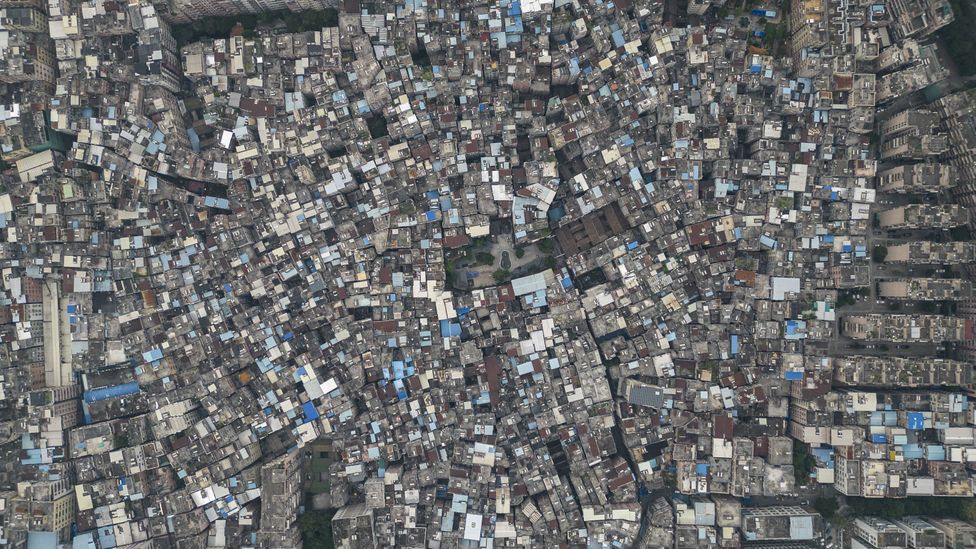 |
| China is home to several of the most populous cities on Earth (Credit: Getty Images) |
The
country whose government was set on controlling the world's commercial
resources has failed its own population which lacks the resources to
care for its aging population. At a time when inflation is running high
through the global community there is no rescue from a situation which
suddenly appears even more bleak, with the official news out of China of
its shrinking population and a crisis of demographic proportions.
According
to a report released by the National Bureau of Statistics, China had
850,000 fewer people at the turn of the year than the previous year.
This number refers to the population of mainland China only, not
inclusive of Hong Kong and Macau. Fewer babies were born in China to the
tune of over a million, than the year before. China's newly-sclerotic
economy due to incessant lockdowns bodes ill for the future. It was
reported by the Bureau that 9.56 million births took place in 2022,
while deaths numbered 10,41 million.
The
situation rivals the time of the Great Leap Forward when collective
farming and industrialization propelled by Mao Zedong in the 1950s
resulted in a massive famine where millions of people starved to death. A
decline in population had been officially recognized, but this decline
is at least a decade faster and steeper than authorities anticipated.
The working age population between 15 and 59 years of age totalled
875.56 million, accounting for 62 percent of the national population,
according to the statistics bureau. Those aged 65 and over totalled
209.78 million , relative to 14.9 percent of the total.
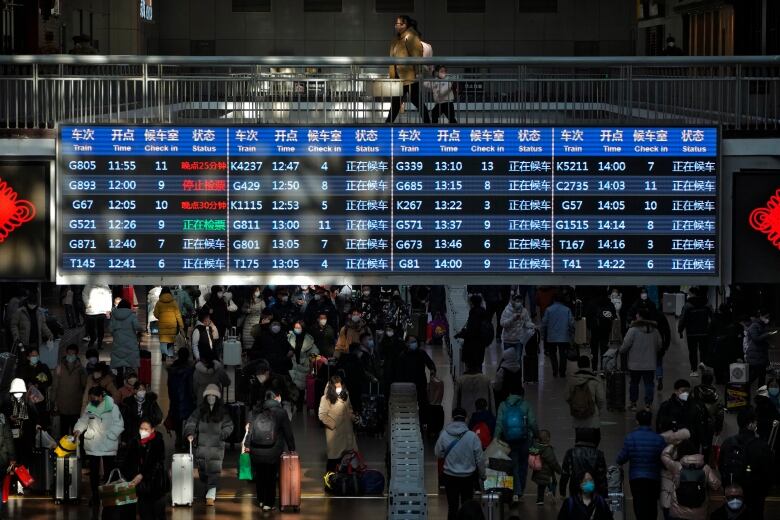 |
| China's overall population has not declined for decades. (Andy Wong/The Associated Press) |
Labels: China, Distribution, Economy, Export, Inflation, Manufacturing, Population Decline
posted by Pieface @ Thursday, January 19, 2023


