"Four years since Russia’s February 2022 full-scale invasion of Ukraine,
Russia still occupies roughly 20 percent of the country after gaining
almost five thousand square kilometers of territory in 2025."
"Russia
continues to bombard Ukrainian cities, while Ukraine maintains drone
attacks on Russian oil infrastructure and military sites."
"Since
January 2022, Ukraine has received about $188 billion in aid from the
United States and $197 billion from the European Union."
"Fighting
and air strikes have inflicted nearly 56,000 civilian casualties, while
3.7 million people are internally displaced, and 5.9 million are
registered as refugees. 10.8 million people need humanitarian
assistance."
Global Conflict Tracker
"In many respects, this war in Ukraine is the one that most closely resembles World War I."
"[In
both wars it was the intensity of firepower that forced armies to turn
to trenches]: You bury yourself to protect yourself." Michel Goya, former French colonel, historian
People visit the graves of their relatives, who were killed during
Russia's attack on Ukraine, as a large-scale light installation
illuminates the Lychakiv cemetery in Lviv, Ukraine, on Feb. 23, 2026,
marking the fourth anniversary of the full-scale Russian invasion. (Roman Baluk/Reuters)
The
heavy casualty counts and brutal infantry assaults of the ongoing war
in Ukraine strikes some war historian as comparable to conflict
conditions experienced during World War I. By June 11, the war in
Ukraine -- Vladimir Putin's 'special military operation' -- saw a point
in time where it has been prolonged for four years and three months, its
duration outlasting World War I's epic conflict.
Mr.
Putin's expectation that his large operational full-on incursion of
February 2022 would swiftly see Ukraine surrendering, his goal
accomplished in a mere matter of months if not weeks. The Ukrainian
counter offensive which saw Russia effectively opposed and the conflict
became a war of attrition, it would have seemed inconceivable to any
strategists, much less servicemen fighting for their lives on either
side of the hostilities that the war would drag on for so many weeks,
months and years.
Yet
the war has a life of its own, reflecting the level of determination on
both sides; Moscow's to achieve its objective; Kyiv to sustain its
sovereign rights and push its aggressor entirely out of its geography,
including from Crimea and Donetsk, both of which fell to Russia in
2014.
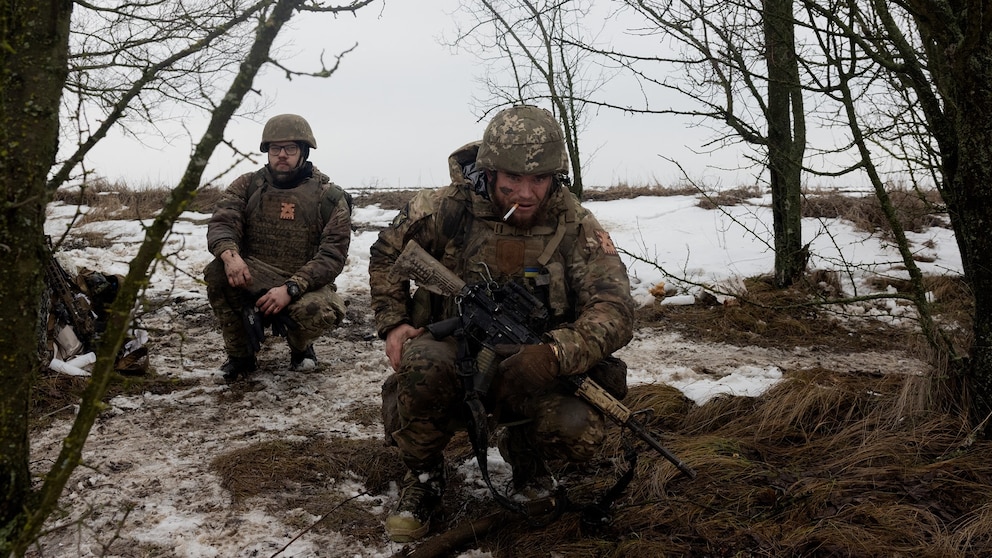
Ukrainian
servicemen of the 33rd separate assault regiment participate in a
training at an undisclosed location in Zaporizhzhia region on Jan. 30,
2026, amid the Russian invasion of Ukraine.
Tetiana Dzhafarova/AFP via Getty Images
Recent
polls indicate that almost fifty percent of Ukrainians feel the war
will not end before 2027. Among Ukrainians many are prepared to argue
that the war's beginning in reality was 2014 when Russian troops with
the assistance of Russian-Ukrainian rebels swept Crimea to seize it for
Greater Russia, complementing Vladimir Putin's yearning for the days of
firm control of eastern Europe during the Soviet Union, and he a
modern-day Czar.
According
to Ukrainian historian Yaroslav Hrytsak, the conflict that Russia
imposed upon Ukraine will rank in historical accounts as among the most
consequential in modern European history. Alluding to both wars, having
altered geopolitics in Europe through the reshaping of military
alliances, driving a feverish defense buildup through NATO, unseen since
the end of the Cold War.
The war in Ukraine has now exceeded the first world war in duration. And
while the comparison between these two conflicts is imperfect, it is
becoming difficult to ignore.
A
century earlier, point out military analysts, it was the new
technologies of warplanes and tanks that drove the fighting antagonists,
while today advances in unmanned aerial war machines have taken centre
stage in an increasingly brutal onslaught against humans more attuned to
conventional warfare. As in 1914, so too in 2024, where a frozen front
line maintains a status quo and where neither attacker nor defender can
claim the upper hand.
Historians
see World War I trench warfare repeated in the trenches and bunkers
that Ukrainian soldiers have been using where assaults with artillery
barrages followed by storming enemy trenches by infantry squads were the
elemental formulaic schemes brought to play in the early years of the
current war, echoing what had been current a hundred years earlier.
Once
drones were brought into play, trench-like networks became outdated as
unsafe, where drones monitored the battlefield, striking with precision
greater than that of artillery shells. Survival now depends on smaller,
more discreet and deeper trenches to outfox the drones; shelters now
house a handful of soldiers in dugouts. As for the fearsome tanks of
WWI, they have become targets for drones, and have been largely
retired.
According
to Admiral Pierre Vandier, Supreme Allied Commander Transformation in
NATO, the Ukrainian front has been lethalized by drones. And the
strategy that Ukraine relies upon to use drones to strike deep into
Russia to hit its oil assets, strikes at its very economy which funds
Putin's special military operation. The battlefield has been flooded
with small attack drones of Ukrainian design and forward technology. "This is World War I, but with drones", said historian Yaroslav Hrytsak.
"Ukraine is grinding down Russian forces. Russian gains are small relative to costs. There has been no collapse of the front."
"[On the other hand], Ukraine is losing territory. The coldest part of the winter is yet ahead."
"The current theory of success is unclear, or what resources will be made available by the West in 2025."
Michael Kofman, Carnegie Endowment
"Measures to identify and destroy enemy assault groups that are trying to infiltrate our battle formations are underway."
Ukrainian military command defending Kurakhove
A soldier holds up a Russian flag in Kurakhove, Donetsk Region,
Ukraine in this screen grab taken from a social media video released on
January 5, 2025, obtained by Reuters
Russia's
Defence Ministry now claims that its troops in eastern Ukraine have
taken command of the Kurakhove stronghold after months of battle, thus
adding the ruined town to conquests claimed by the Kremlin. A Russian
claim, however, denied by the Ukrainian force tasked to defend Kurakhove
even while acknowledging that Russian forces were attacking urban
areas.
The
previous day the Russian Defence Ministry revealed that Ukrainian
forces were pressing renewed attacks in Russia's Kursk border region. To
this claim, Ukrainian officials made no counter-comment as is usual,
with Ukraine's leaders allowing a time lapse between Russian
announcements, before responding.
An
air of uncertainty hangs over Kyiv, with the impending inauguration of
incoming President Donald J. Trump, when no one knows how the mercurial
and often adversarial new president will proceed with his pre-election
promise of putting a quick end to the conflict between Ukraine and
Russia and his known reluctance to continue financially supporting
Ukraine, and providing it with new weaponry.
Kurakhove
acts as a stronghold for the Ukrainian army on the eastern front line
in the partially occupied Donetsk region. The town still holds about
half of its original pre-war population of about 20,000 people. Under
relentless attack from artillery, multiple rocket launchers, powerful
guided bombs and drones, many of its buildings have been shattered.
Kurakhove
is notable for its industrial zone, a thermal power plant, and a
reservoir. It is established on a highway between eastern and southern
Ukraine. In its determination to capture all of Donetsk, Russia has been
pushing west in a slow and personnel-costly drive to capture its goal,
with a view to capitalizing on greater land occupation before the
inevitable start of peace negotiations driven by a Trump White House.
Pokrovsk,
a key road junction and rail distribution centre used to dispatch
supplies to a broad span of the Ukrainian front line, is also in
Russia's cross-hairs. Ukraine is short of front line troops, straining
mightily to contain the larger Russian army.
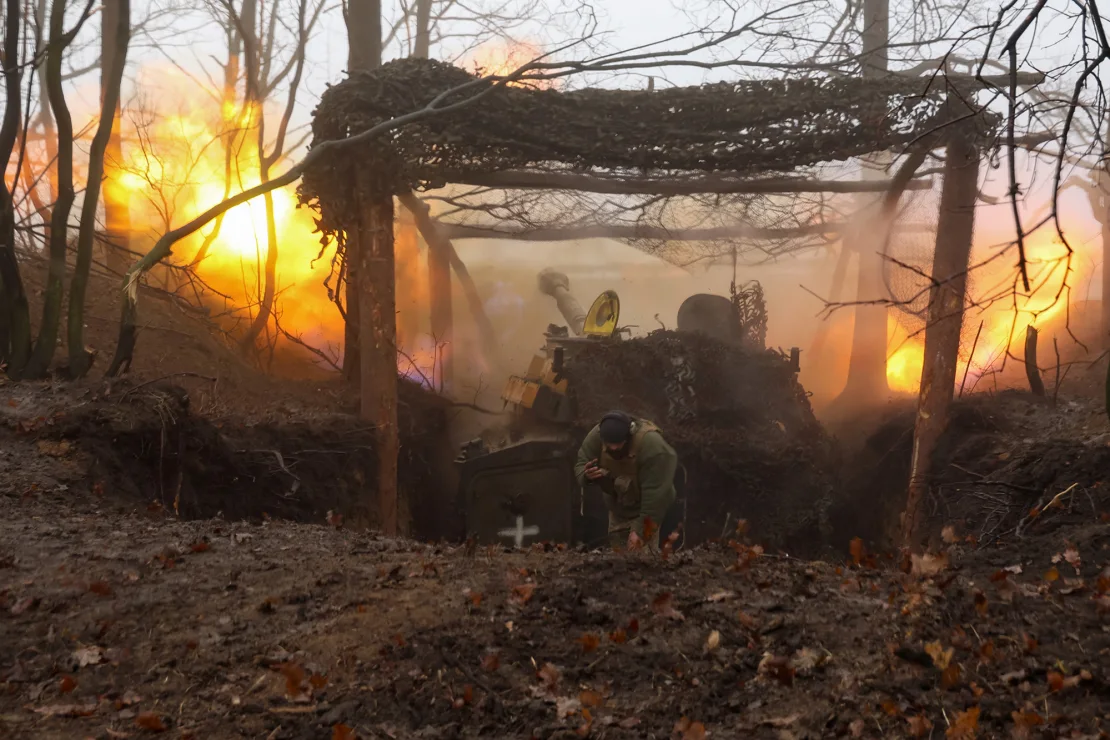
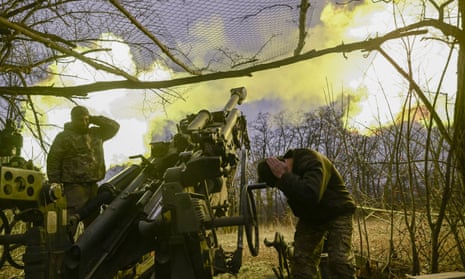
A Ukrainian artillery crew fires towards Russian infantry in Donetsk region, Ukraine, December 24, 2024.Ivan Antypenko/Suspilne Ukraine/Global Images Ukraine/Getty Images
"[If
those behind such reports; forced deportation of children; supported
objectivity] then we are ready to analyze specific cases, answer
questions, provide data, statistics and facts."
"But if they are biased, if they represent only one point of view ... then there is no use responding to these reports."
Russian Foreign Ministry spokeswoman Maria Zakharova
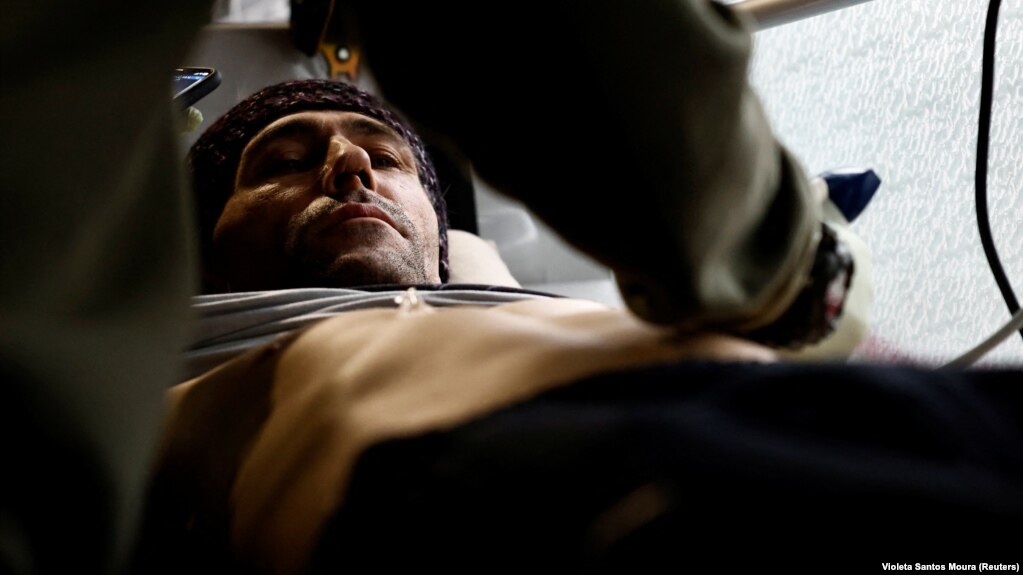
Stasik,
45, a Ukrainian soldier who recently had his right arm amputated, is
examined by a medical volunteer during an evacuation operation from the
eastern frontline near Bakhmut to hospitals in the Dnipropetrovsk region
on March 15.
The
reports this spokeswoman refers to based on over 500 interviews along
with satellite images and in-person visits to detention sites and
graves, discuss incidents of Russian forces committing war crimes in
Ukraine; out of a UN-mandated investigation. Detailing wilful killing,
torture, detaining non-combatants and in some instances forcing children
to witness their mothers, sisters, aunts being raped. How can there be
'neutrality' over such episodes of military atrocities being carried out
by Russian forces in Ukraine?
Coincidentally
with the release of the report, the International Criminal Court in The
Hague has issued arrest warrants for Russian officials for their role
in having Ukrainian children forcibly deported from Ukraine, as well as
the Russian military's deliberate targeting of civilian infrastructure
in the country Russia has invaded. Russia, needless to say, denies
having committed any such atrocities, much less attacking Ukrainian
civilians.
Meeting
members of Russia's business elite this week, President Vladimir Putin
urged them to invest in their country, to give it the financial
assistance it needs to see out what he names the "sanctions war" imposed
on Russia by the West. Of those attending the meeting called for the
first time since the invasion, many are themselves under Western
sanctions.
And
it just happens that a day later, Russian President Vladimir Putin was
placed under a warrant of arrest by the ICC, also obviously persecuting
Russia for no good reason.
Ukrainian troops fire
a howitzer at Russian positions near Bakhmut, eastern Ukraine, on
Friday. A Nato official says Russia is sustaining up to 1,500 casualties
a day, mostly in Bakhmut, while Ukraine is taking ‘an order of
magnitude less’.Photograph: Aris Messinis/AFP/Getty Images
The
man who has instructed the Russian military to destroy Ukraine, at the
same time that he has declared eastern Ukraine Russian territory,
oversees a military and a nation that brooks no interference or
criticism in its brutality to bring a neighbouring country to its knees.
A stubborn neighbour at that, refusing to pay obeisance to the bully
next door intent on expanding its territory while terrorizing a
community which refuses to submit to terror.
In
destroyed Bakhmut the bloody infantry battle continues, with Russian
forces led by the Wagner mercenary army capturing the city's east
portion. Plans to encircle Bakhmut that had been boasted of have not yet
materialized, since the Ukraine military has no intention of allowing
it. "Sometimes we see groups of seven people (Russian soldiers). We strike, three fall and the rest continue to advance" -- Marian, age 21, a member of the 80th Ukrainian Air Assault Brigade, describes, at his mortar position.
A Ukrainian soldier, Bakhmut trench Reuters
Seven
mortars were fired by the brigade from that position, as small arms
fire in the distance speak to the constant unfolding of a long-drawn-out
checkmate. Taking Bakhmut has become a major aspiration for Moscow
which sees it as opening a path to the entire surrounding Donetsk region
finally falling to Russia. Kyiv, on the other hand, has decided that
the ruined city is still worth fighting to contain for its value in
inflicting huge damage on Russian troops.
"They (the Russians) need this victory like air and therefore do not count the losses"
of untrained, poorly kitted-out Russian conscripts and mercenaries
falling in huge numbers of dead and wounded in the fray of conflict
where they are ordered to advance en masse, explained Serhiy Cherevatyl,
a spokesman for Ukraine's eastern military command.
A
declassified video was released Thursday of a Russian military jet
intercepting an American drone in international airspace over the Black
Sea two days previously. Highlighting risks of a potential clash
between the two nuclear powers. Moscow accused Washington of escalating
tensions near Ukrainian Crimea annexed by Russia in 2014. The Pentagon's
release of the video recorded the incident when the MQ-9 Reaper drone
was intercepted by a Russian jet, sending it crashing into the sea.
A
Russian Su-27 fighter jet can be seen in the video close to the drone
dumping jet fuel over it in an obvious attempt to damage the aircraft. A
second pass by another Russian jet resulted in a collision with the
drone, the Russian plane striking the propeller, disabling the damaged
drone. According to Russia, no such collision took place, the drone
crashed when it made "sharp manoeuvres" while "provocatively" flying close to Russian airspace.
The
episode proving that the United States is actively, directly taking
part in the Ukraine war that is none of their business; strictly a
Russian internal affair, proclaims Moscow.
"{The situation there [in the Eastern Donbas] is difficult, painful. The occupants are spending
all the resources available to them — and these are significant
resources — to squeeze out at least some progress."
"As of this evening, about 9 million people are cut off in different
regions of Ukraine. But the number and duration of outages is gradually
decreasing. I am grateful to each and every person who ensured this
result."
"Today, I held a special meeting with government officials on the
situation in the energy sector and infrastructure. We are preparing for
the next year — and not only for the winter months. There are threats
that must be eliminated. There are steps to be taken. And the state will
definitely make them."
"Air defense is preparing, the state is preparing, and everyone must be prepared. Please pay attention to the sirens."
Ukrainian President Volodymyr Zelenskyy
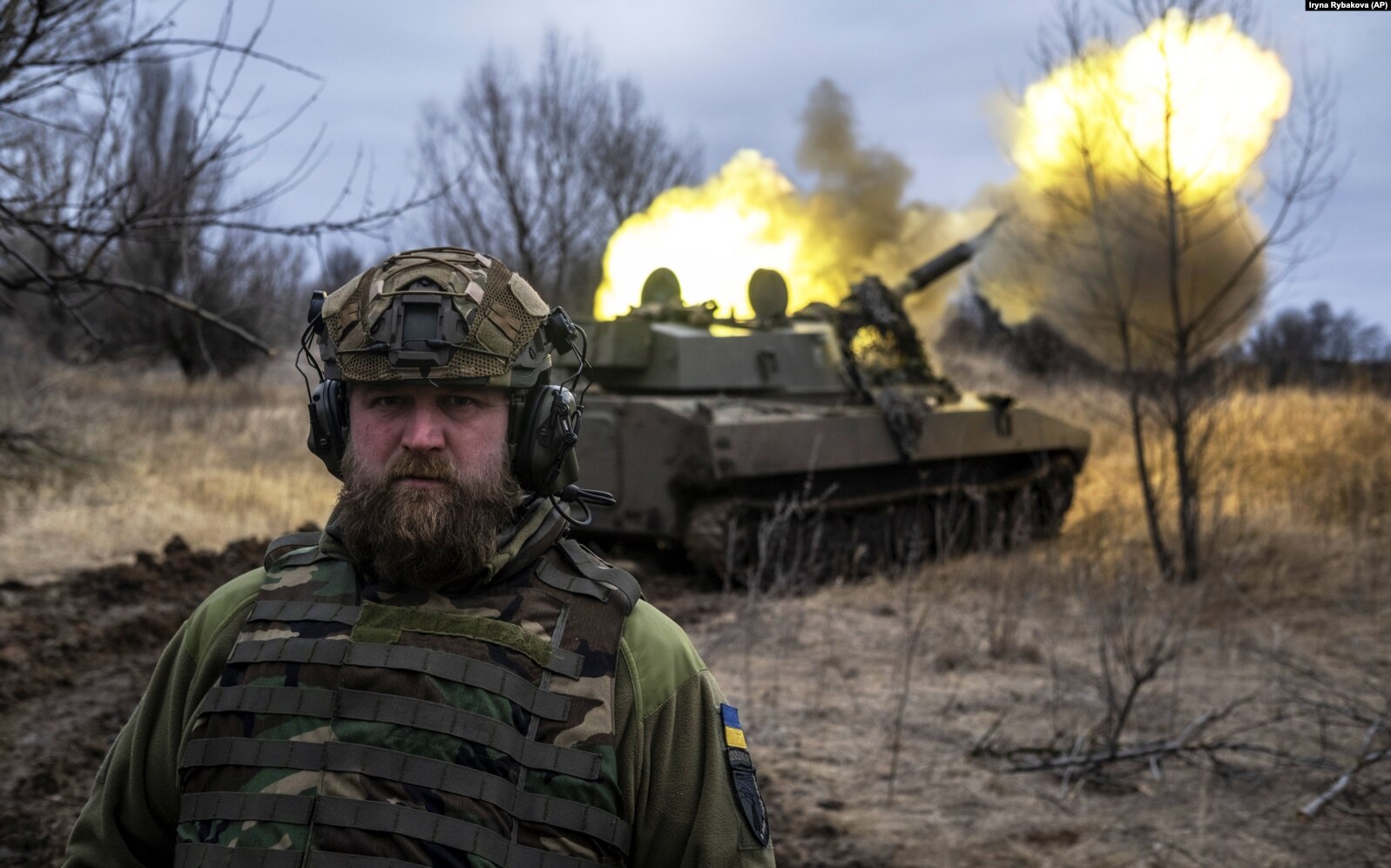
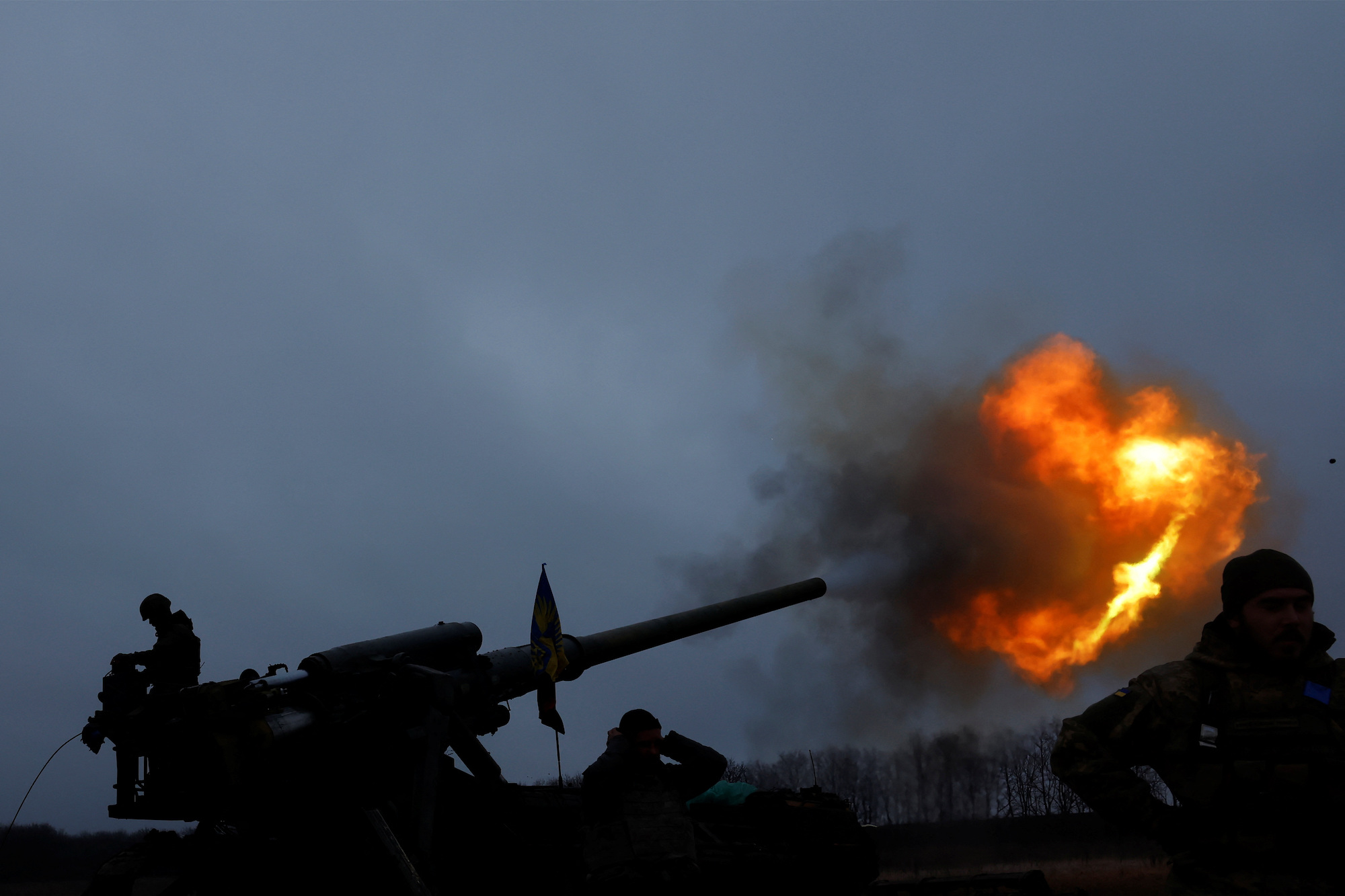
Ukrainian soldiers with the 43rd Heavy Artillery Brigade fire a rocket
from a self propelled cannon on the front line in Bakhmut on Monday, 26 December.
(Clodagh Kilcoyne/Reuters)
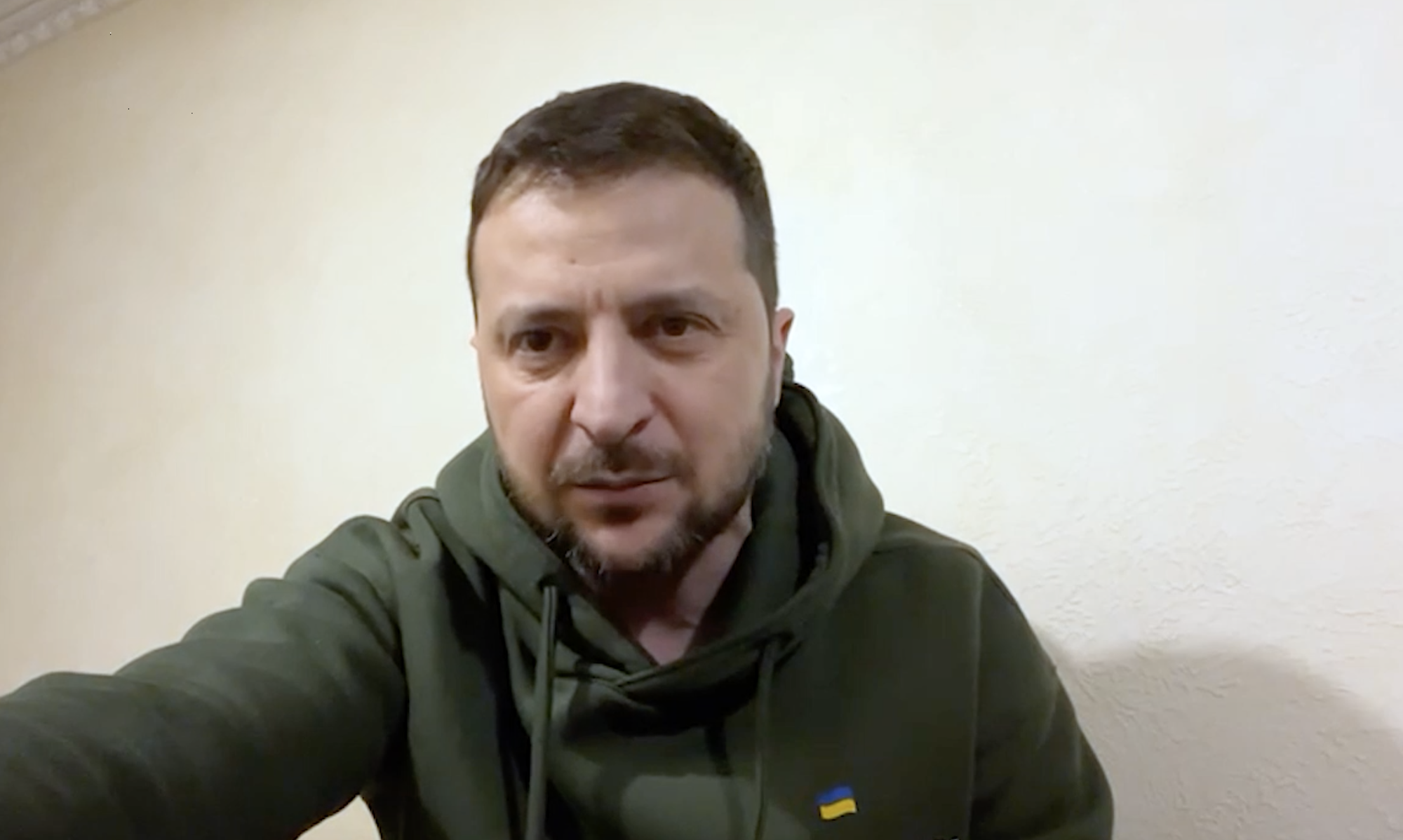
With his return back to Ukraine, President Zelenskyy spoke of his forces "working toward victory",
contradicting Russian President Putin's warning no end to the war would
occur until Russia's military aims were achieved. On his trip to
Washington, President Zelenskyy was awarded a new $1.8 billion military
aid package to which he pledged "we'll overcome everything".
Strategic agreements with Washington, he announced later to Ukrainian
ambassadors, would strengthen Kyiv's defence forces for the year to
come.
Mr.
Zelenskyy also thanked the Netherlands which pledged up to $2.65
billion for 2023 to help in financing military equipment and the
rebuilding of critical infrastructure. Relentless Russian artillery,
rocket and mortar fire is continuing in Ukraine's east; airstrikes on
the eastern and southern fronts are also ongoing. Dmitry Peskov,
spokesman for the Kremlin stated the war would end once the "special military operation" reached "the goals that the Russian Federation has set. A significant headway has been made on demilitarization of Ukraine".
Of
course in that same sense, Ukraine has succeeded in its self-defence in
making headway in 'demilitarizing' Russia. There are all the Russian
tanks and other military hardware Ukraine destroyed, along with the
battlefield hardware that Russian troops abandoned in their haste to
retreat before the forward action of the Ukrainian counteroffensive. And
finally all the missiles shot down by Ukraine that Russia has sent
whizzing over Ukrainian towns and cities.
According to the Ukrainian military, Russian forces fired multiple rocket launchers "more than 70 times" across Ukrainian geography in one night alone [Russia busy 'demilitarizing' itself, depleting its missile stockpiles],
while battles raged fiercely around the city of Bakhmut in eastern
Donetsk province. Bakhmut and Lyman in neighbourimg Luhansk region
together with the Kharkiv region have borne the brunt of Russian
strikes, explained the General Staff of the Ukrainian Armed Forces.
In
a 24-hour period. up to 61 Russian rocket, artillery and mortar fire
attacks were launched in the Kherson region with regional Kherson
Governor Yaroslav Yanushevych posting that Russian forces attacked from
dug-in positions on the Dnieper river to hit educational institutions,
apartment blocks and private homes. Russian strikes on Kherson have been
constant since the Ukrainian military succeeded in freeing the city
from Russian occupation.
Russia
continues to target civilian areas, with Ukrainian forces repelling
Russian ground attacks on or close to 19 settlements in Ukraine's north
and east. A district hospital in the city of Volchansk, Kharkiv region,
was struck by Russian shelling. Several factory buildings housing
Russian troops in the occupied city of Tokmak in southern Zaporizhzhia
region on Thursday were hit with several blasts, sparking a fire.
In
the city of Melitopol a car used by Russian occupation forces exploded,
a day after a car bomb killed the Russian appointed head of the village
of Lyubymivka in Kherson region.
For
months, Ukrainian guerrillas have operated behind Russian lines in the
occupied south and east of Ukraine. Their target: Kremlin-installed
officials, institutions and key infrastructure, like roads and bridges.
And in Mariupol, its famed theatre, the site of a deadly airstrike where
up to 600 people were killed sheltering in the theatre transformed into
a bomb shelter, its remaining walls are being destroyed. Moscow faces
accusations of destroying evidence of its war crimes.
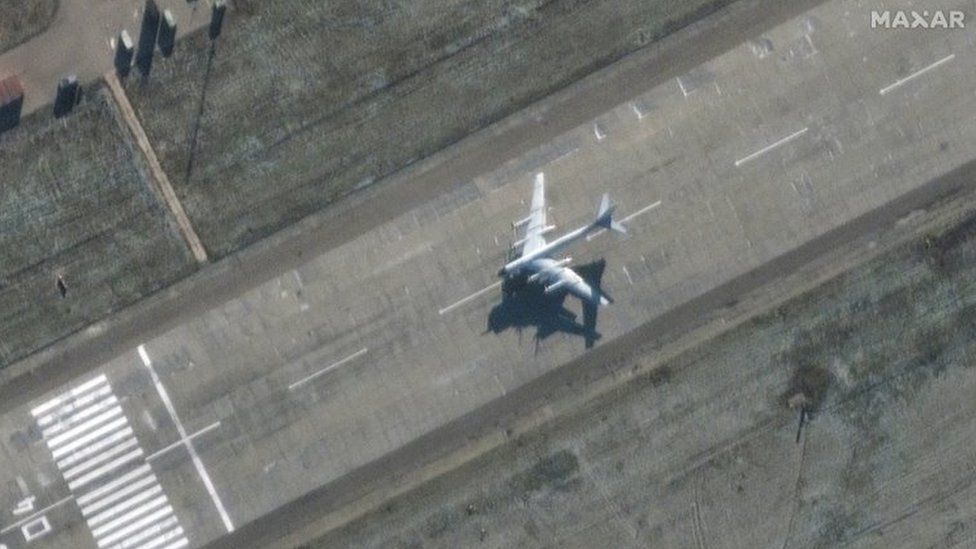
Today,
Monday 26 December, a Ukrainian drone struck within Russia. It was shot
down by Russian air defences when it approached a military airfield in
Saratov Oblast, deep inside Russian territory,
in the western port city of Engels, some 500 miles southeast of Moscow,
located on the Volga River. Nothing is more geared to making Moscow
furious with indignation; than that Ukraine would dare to strike Russian
territory. This was the second such drone strike on the city, which
houses the Engels-2 military airfield, a strategic bomber airbase.
"[The attack was the] consequence of what Russia is doing."
"If
the Russians thought that the war would not affect anyone in the deep
rear [of Russia] or anywhere else, they were deeply mistaken."
"Therefore, as we see, such things are happening more and more often, and let's hope that this will only benefit Ukraine."
Ukrainian Air Force spokesperson Yurii Ihnat
The Engels air base has been repeatedly used by Russia to carry out missile strikes on various targets in Ukraine Reuters
"The occupiers have already felt what modern artillery is like, and
their rear will not be safe anywhere on our land that they have
occupied."
"They have felt that the operations of our intelligence
officers for defending their homeland are of an order of magnitude
greater than any of their special operations."
Ukrainian President Volodymyr Zelenskii
"[In eastern Luhansk], fighting continues near the villages [on the
administrative border with neighbouring Donetsk]".
"The Russian army burns down everything in its way. The artillery
barrage doesn’t stop and sometimes continues for four to six hours on
end."
Luhansk Governor Serhiy
Haidai
Image taken from social media of a Ukraine-launched HIMARS hitting a Russian ammunition supply depot in Nova Khakovka.Photo by Twitter/Denys Kazanskiy
Reports reached the world press that the Ukrainian military on Tuesday
had announced the destruction of a Russian ammunition depot in
Russian-occupied Nova Kakhovka, located some 55 kilometres east of the
port city of Kherson on the Black Sea, also occupied by Russian forces,
in southern Ukraine. The resulting explosion was seen in a capture on
social media. The strike was precise, inferring that U.S-supplied
multiple-launch High Mobility Artillery Rocket Systems was used to hit
the area by Ukrainian forces.
Ukraine
spoke of its intention most recently that in planning to launch a
counteroffensive with the intention of reclaiming its territory in the
south, even as Russia relentlessly bombards the Donbas region after
treating Luhansk province to similar overwhelming tactics in its
concentration on achieving full occupation of both provinces which
together comprise the entirety of the Donbas region, Ukraine's
industrial heartland, now claimed by ethnic Russian Ukrainian opponents
of Kyiv.
According to Russian news agency Tass,
the monstrous blast in Nova Kakhovka hit a mineral fertilizer storage
facility, exploding it to the ground. Also hit, the news agency
reported, was a market, hospital and houses, all damaged by the strike.
Ingredients in fertilizer, they fail to mention, can be used for
explosive ammunition. The Tass claim of wider, civilian damage caused by the pinpoint strike has not been verified independently.
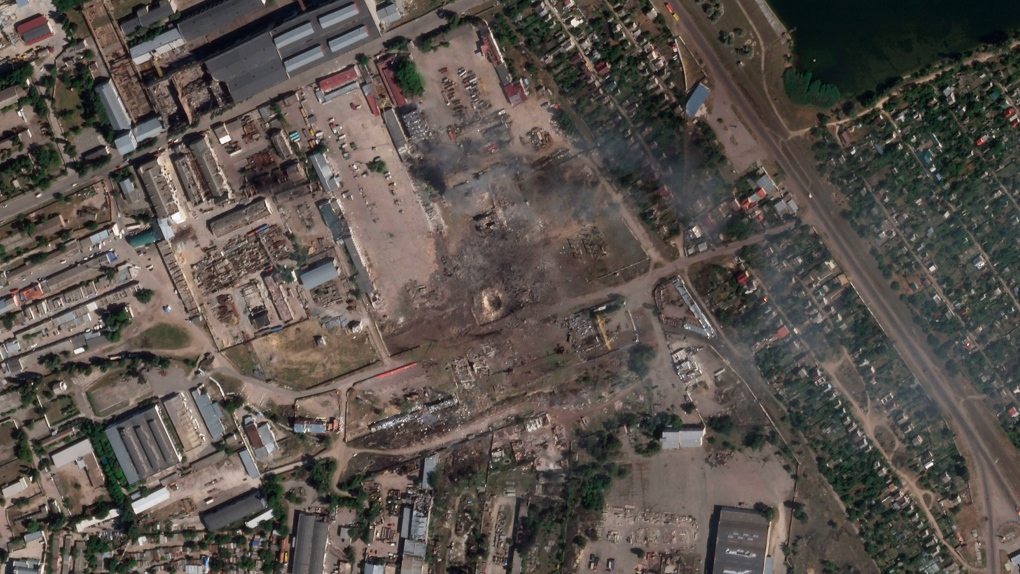
The Associated Press,
however, analyzed a satellite photo taken of the effect of the blast
and significant damage did appear as a massive crater precisely where a
large warehouse structure stood in the city. Ukraine is in possession of
eight of the HIMAR systems; a truck-mounted missile launcher with high
accuracy, and is awaiting delivery of another four such systems in
fulfillment of a U.S. promise.
Russian
shelling in the past 24 hours saw 15 civilians killed and 48 wounded,
according to Ukraine's presidential office. No fewer than five southeast
region cities and towns came under Russian fire. Russian rocket attacks
targeted Sloviansk and Toretsk, where a kindergarten was hit. Russia
continues to make "small, incremental gains" in Donetsk where heavy
fighting saw the governor of the province urge its 350,000 its still
remaining residents to remove to safer areas in Ukraine last week.
This satellite image from Planet Labs PBC shows the aftermath of a
Ukrainian strike on a Russian ammunition depot in Nova Kakhovka,
Ukraine, July 12, 2022. (Planet Labs PBC via AP)
"There
was an attack on Kyiv -- it shocked me, not because I'm here but
because Kyiv is a sacred city for Ukrainians and Russians alike."
"[The
Security Council had failed to prevent or end the war in Ukraine.This
was] a source of great disappointment, frustration and anger."
"Let me be very clear: [it...Security Council] failed to do everything in its power to prevent and end this war."
"I am here to say to you Mr President [Zelenskyy], and to the people of Ukraine, we will not give up." "[While the
Security Council had been] paralyzed, [the UN was taking other actions]."
"The UN is the 1,400 staff members in Ukraine who are working to provide assistance, food, cash [and] other forms of support."
"Mariupol is a crisis within a crisis. Thousands of civilians
need life-saving assistance, many are elderly and in need of medical
care, or have limited mobility. They need an escape route out of the
apocalypse."
UN Secretary-General Antonio Guterres
"[The blasts are] proof that we need a quick victory over Russia."
"We
must act quickly ... more weapons, more humanitarian efforts ...
because every day Ukraine pays a high price for the protection of
democracy and freedom."
Andrey Yermak, chief of staff, Ukraine President Volodymyr Zelenskyy
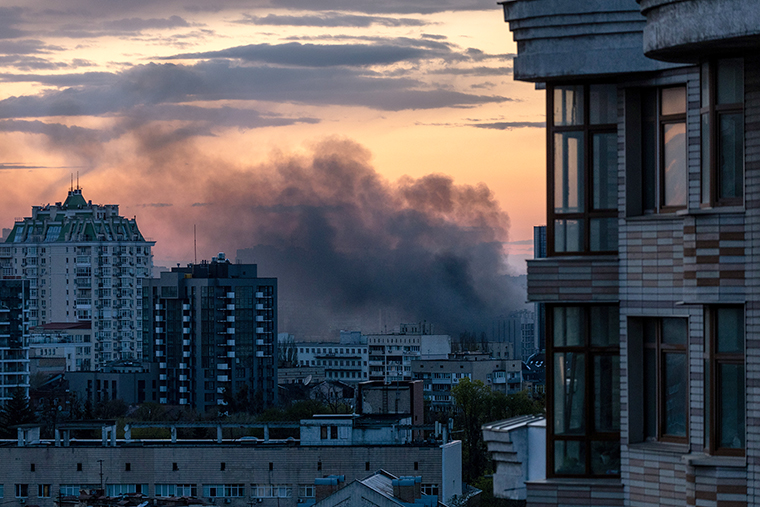
Smoke rises after missiles landed at sunset on April 28, in Kyiv, Ukraine. (John Moore/Getty Images)
A
member of the United Nations Security Council took especial notice with
the UN's Secretary General appearing in Kyiv, to give him a surprise
welcome. Warm, in the sense that two missiles blasted the historic city
while Antonio Guterres was there, visiting with Ukrainian President
Volodymyr Zelenskyy, to see for himself what the population of Russia's
neighbour is suffering under an endless barrage of bombs and missiles.
And
while Mr. Guterres hugely regretted that the Security Council failed to
intervene to convince one of its permanent members that invading
another country with violent intent, even naming it a 'liberation' move
under a special military operation is uncivilized at best, criminal in
its most severe outlook. But then, Russia is accustomed to being
misunderstood and blamed for events it is not responsible for. As
Vladimir Putin would have it, he was provoked by American interference.
Moreover,
the events described as war crimes -- rapes, destruction of civic
infrastructure, mass graves are not his doing; they are in reality the
malevolent orchestration developed by Ukraine that devised a grisly
scenario of ghastly atrocities, enacted by Ukraine's own military and
then ascribed to Russia. This is the kind of adversary Moscow faces, a
fascist, neo-Nazi Ukrainian administration impudently accusing
solicitous Russia of ill intentions toward Ukraine.
American
and NATO provocations have brought this situation to pass, not Russian
aggression. Russia will always enter the fray to protect its interests,
to ensure that Russian-speaking citizens of a neighbouring country are
not victimized by Russia-hating neighbours. Those two missiles fired at
long range into Kyiv Thursday were just a friendly reminder that Moscow
expects Kyiv to do the right thing and surrender its war-mongering
government to Russia.
After
all, Russian troops withdrew from the suburbs around Kyiv. To focus on
the Donbas, where Luhansk and Donetsk are already declared Russian
territories. The intention, of course, just to tidy things up, drive the
Ukrainian military out of its lair there and leave both Republics in
peace. Just incidentally Mariupol's destiny is to welcome its new
status, contributing to the land bridge delivering a direct route from
the Russian border to the Crimean Peninsula.
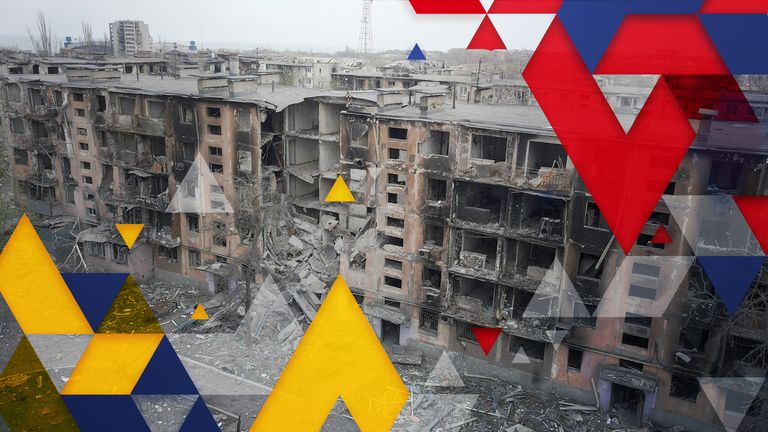
A destroyed apartment building in the southern port city of Mariupol
Moscow
is thoroughly displeased with its nemesis, the United States. Not only
has the White House pledged a $33-billion gift in humanitarian and food
security and weaponry aid to Ukraine, it has outright stated its hope
that Ukrainian forces beyond repelling Russia's assault on the east, but
succeed to a degree that Russia's military will be reduced in strength
so it cannot continue to threaten its neighbours. Russia, a threat to
its neighbours? What effrontery; the U.S. is revealing its mendacious
spirit, wounding Russia beyond mere words.
Now
entrenched in the east, Russian forces are focusing on the separatist
Russian-speaking rebels' success in accessing the entire Donbas along
with the secession provinces. The southern city of Kherson, the sole
regional capital captured by Russia's military since the invasion had
overnight blasts to awaken its still-stunned residents. Whose Wednesday
pro-Ukrainian protests were faced by Russian troops using tear gas and
stun grenades in their peaceful occupation.
Moscow
has reported a series of Ukrainian strikes on Russian regions bordering
Ukraine. Issuing a stern warning that such attacks risk escalation to a
significant degree. In the Russian city of Bellgorod two large
explosions occurred. It is simply outrageous that Ukraine would take
their battle with Russia into Russia, endangering the lives of innocent
Russians...
"I deem it necessary to make a decision that should have been made a long time ago -- to immediately recognize the independence and sovereignty of the Donetsk People's Republic and the Luhansk People's Republic."
"If Ukraine was to join NATO it would serve as a direct threat to the security of Russia."
"[Russia and Ukraine are] parts of what is essentially the same historical and spiritual space; [their] spiritual unity [is under attack]."
"[What is happening to Ukraine today, is a] forced change of identity. And the most despicable thing is that the Russians in Ukraine are being forced not only to deny their roots, generations of their ancestors but also to believe that Russia is their enemy."
"So you [Ukraine] want de-communization? That suits us.
But let's not stop half way. We are prepared to show you what real
de-communization looks like."
"[Ukraine is not a real country, but one] created [by Russia in the 1920s] on ancient Russian lands".
Russian President Vladimir V. Putin
Vladimir Putin (l) at a meeting of Russia's national security chiefs on Monday (Photo: kremlin.ru)
The Russian commander of all that is Russia convened a meeting on Monday of his lieutenants in a special session of the Russian security council, meeting in St.Catherine's Hall in the Kremlin, resplendent in gleaming marble. An august setting for a theatre of impending conflict. A special convening, one where the musical accompaniment heard in the subconscious of all those present, was a slow rumble of the drums of war.
It was too splendid a theatre, too seriously onerous a decision not to share with all of Russia to view at a remove the seriousness with which their president views the impending danger their nation faces under the sinister denial of a neighbour unwilling to consider the Kremlin's offers of reinstatement of Ukraine in the bosom of Russia's fond historical memories.
Where an ingrate nation determined to rule itself as a sovereign right, makes a mockery of its own historical, heritage alignment with Russia. An insult not to be borne without a suitable response.
President Volodymyr Zelensky of Ukraine speaking at the Munich Security Conference on Saturday.Credit...Pool photo by Ronald Wittek
What the meeting revealed to the enquiring eyes focused on the unfolding drama of top-echelon investigators and intelligence lieutenants was their striking reluctance to recommend war, outweighed by their fearful inhibitions over displeasing their interlocutor, he who cannot be denied. Moscow's foreign intelligence chief Sergei Naryshkin was invited by Mr. Putin to express his opinion whether Russia should recognize the separatist governments in the Donbass' Donetsk and Luhansk regions.
To do so would obviously be construed as a call to regional war with Russian troops dispatched to the territories prepared for a confrontation with Ukraine's military which would, as would any nation's military, defend Ukraine's geographic territorial imperative as a fully sovereign nation which another nation's defiance of national boundaries has placed at risk, including that posed to its citizens.
That the leaders of Donetsk and Luhansk had earlier evacuated hundreds of thousands of civilians from the territories to Russia, speaks of a pre-arranged agreement whose time had come.
In so doing, the invasion that the West warned was imminent and that Ukraine's President Volodomyr Zelensky beseeched the West for modern weaponry with which to counter Russia's move had anticipated. Naryshkin's first response was a hesitant feeling that Russia should allow Ukraine "one last chance to seek peace", an opinion that failed to impress Mr. Putin who responded, with a rictus smile:
"Do you want to recognize their sovereignty or do you want to launch talks?" The startled, sputtering intelligence chief was harshly prompted to "Speak up!". The immediate response was that the spy chief dropped his prevaricating stance, claiming his backing of the annexation of the separatist region, after all. "We're not talking about it, we're not debating it", a sneering Putin responded, shaking his head.
That little episode cautioned all others present that if they were at all invested in avoiding a slap-down by their president, they might be well advised to carefully weigh both their words and any expression of doubt over the president's feigned opinion-seeking over a matter he had long since debated within himself and arrived at an irreversible conclusion that they would prefer to avoid.
A woman in St. Petersburg, Russia, watching President Vladimir Putin address the nation on Monday.Credit...Anatoly Maltsev/EPA, via Shutterstock
Western intelligence has accused spy Chief Naryshkin of mounting massive cyberattacks on Ukraine, and he was in the presence of another two dozen senior officials all of whom were expected to present reports during the meeting, ostensibly to update the president on their findings and conclusions. A sham that stretched on for an hour and a half, all of which was broadcast on all major Russian TV channels.
Each of the attendees, one after the other, took to a lectern in the delivery of their assessment. Several appeared to be struck with stage fright, seemingly confused over what was expected of them. Mr. Putin, their stage-master and drama coach, drummed his fingers, appearing morosely unimpressed throughout the meeting's presentations. One can only wonder what ordinary Russians who viewed these sternly implacable-faced men with fear, thought of, seeing them humbled by their master.
"I was really struck not just by the toxic atmosphere, but also the King Lear vibe as courtiers were expected to vie with each other in playing the lunacy of the day", opined Mark Galeotti, a Russia expert and associate fellow with the Council on Geostrategy who compared the scene to witnessing a Shakespearean drama.
A
column of Russian armored vehicles, military trucks and supply units
about 60 miles away from the border with Ukraine on Monday.Credit...Sergey Ponomarev for The New York Times
Truth Concealed, Revealed : Malaysia Airlines Flight 17
"We now have proof Russia was involved in this tragedy, this crime." "One day after 17 July they were in a position to tell us exactly what happened. They knew." "The Buk [missile] was used in eastern Ukraine and they know this. They didn't give us this information." "These suspects are seen to have played an important role in the
death of 298 innocent civilians." "Although they did not push the button themselves, we
suspect them of close co-operation to get the [missile launcher] where
it was, with the aim to shoot down an airplane." "[Investigators had] evidence showing that Russia provided the missile launcher." Fred Westerbeke, chief prosecutor, Netherlands
"[I hope] those who
are guilty of this brazen murder [shooting down of Malaysia Airlines Flight 17] of innocent children, woman and men
will be put in the dock." Ukrainian President Volodymyr Zelensky
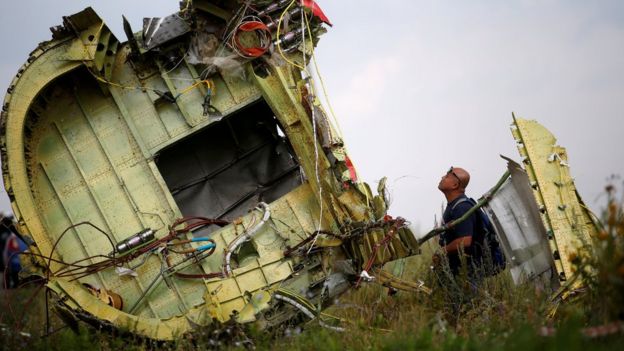
An investigator inspects the wreckage of Malaysia Airlines Flight MH17 Reuters
"You know our position on this investigation. Russia had no chance to
take part in it, even though from the very start -- the first days of
this tragedy -- Russia... tried to be part of the investigation into
this terrible catastrophe." "So our position on this investigation is very
well known." Kremlin spokesman Dmitry Peskov
Actually, yes. Moscow's position on the tragedy was well known; while denying any involvement whatsoever, the Kremlin accused Ukraine of shooting down the Malaysian Airlines passenger jet. The missile launcher, they asserted, came out of Ukraine's armoury. As for cooperation with the Joint Investigation Team, according to the Dutch authorities, there was no cooperation from Russia as their investigation wended its long way to a conclusion.
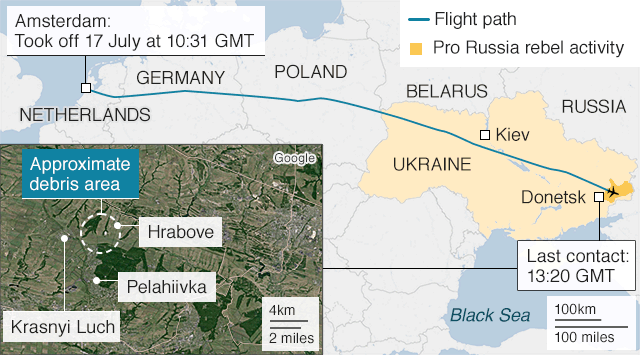
The team of investigators -- comprised of detectives and prosecutors from the Netherlands (as the nation that suffered the greatest loss of innocent lives); Malaysia (whose passenger jet it was); Ukraine (in whose airspace the plane was shot down and on whose soil the shattered plane and its murdered passengers came to rest), along with Australia and Belgium -- stated their conviction that the Buk missile system involved in shooting down flight MH17 belonged to the Russian army's 53rd Anti-Aircraft Missile brigade, based in Kursk, Russian Republic.
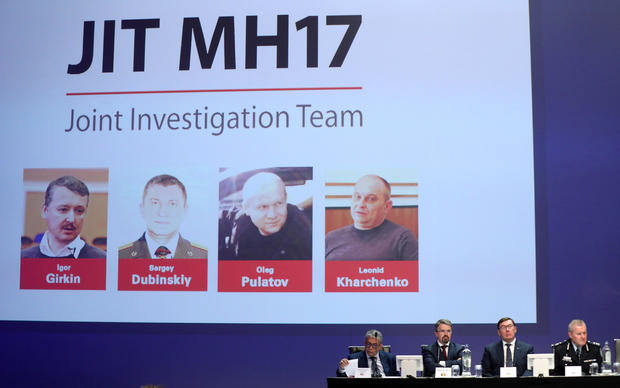
The investigation now concluded, murder charges were announced by the international prosecutors on June 19 against three Russian citizens and one Ukrainian. When Malaysia Airlines Flight 17 was shot out of the sky five years ago, 298 people lost their lives. The dead passengers and crew represented 193 Dutch nationals, 43 Malaysians, 27 Australians, 12
Indonesians, 10 Britons, four Belgians, four Germans, three Philippine
nationals, one New Zealander and one Canadian.
International investigators present their
latest findings in the downing of Malaysia Airlines flight MH17, nearly
five years after the crash that killed 298 passengers and crew, in
Nieuwegein, Netherlands, June 19, 2019.REUTERS
The day following the shooting down of MH17 over the eastern provinces of Ukraine in 2014, the government of the United States had concluded a Russian-made surface-to-air missile launched from territory in eastern Ukraine held by ethnic Russian rebels brought the passenger jet down, killing all those aboard. The team of prosecutors from Ukraine and four other nations as well as private agencies subsequently documented the passage of a missile launcher from an active Russian military unit driven into eastern Ukraine.
Ukrainian separatists were aiming to target Ukrainian government aircraft at lower altitudes than what commercial jetliners are accustomed to use. And they fired a Buk missile with the use of the Russian missile launcher at the passenger jet, bringing it down, committing a criminal act of major international injury. Now actual names and faces have been linked to that lethally destructive and deliberately murderous crash.
Acting on orders from Moscow according to the investigative conclusion, in Russia's proxy military conflict with its former satellite whose geographic sovereignty Russia was intent on purloining, the four named malefactors are to stand trial in a Dutch court in a trial to commence on March 9, 2020; a trial set to take place in the Netherlands in recognition of the fact that 193 of the 283 passengers -- aside from the 15 crew members -- were Dutch.
International arrest warrants have been issued. Intercepted telephone calls where the men discuss moving the missile launcher and the firing of the missile directly implicates them. Igor Girkin was a colonel in Russia's F.S.B. spy service; Sergey Dubinsky and Oleg Putatov served with the G.R.U. military intelligence agency and Leonid Kharchenko a Ukrainian leader of a rebel combat group in Donetsk. While none named fired the missile they "formed a chain" that linked the "Donetsk People's Republic" directly with Russia.
They brought the Russian missile system into eastern Ukraine making them criminally responsible for the murder of 298 people. And that criminal responsibility certainly extends to the source of the orders they were obeying -- Russia.
This represents a general opinion site for its author. It also offers a space for the author to record her experiences and perceptions,both personal and public. This is rendered obvious by the content contained in the blog, but the space is here inviting me to write. And so I do.



:format(jpeg)/cloudfront-us-east-1.images.arcpublishing.com/tgam/DBZOP4XRJRPTNLWAPADBX72ZII.JPG)
:format(webp)/https://www.thestar.com/content/dam/thestar/news/world/europe/2022/06/20/russian-forces-pound-eastern-ukraine-as-zelenskyy-makes-appeal-for-weapons/ukraine.jpg)