Much Ado: Cinematic Verity and Violence
"We behave rather strangely for a country acclaimed as the world's largest democracy."
"In a country beset with such serious problems as a slowing economy, crumbling infrastructure, suffocating pollution, ailing health care and a pathetic education system, the national conversation is dominated by a mythical character."
Aroon Purie, editor-in-chief, India Today, India
"Karni Sena [the hardline Rajput group leading the protests] was unknown outside Rajasthan so far."
"In 2010
when they vandalized theatres in Rajasthan over a less high-profile
film, they barely received attention."
"By now strategically going after a
highly anticipated film like Padmaavat, they have gained national
visibility."
Anna MM Vetticad, Indian film critic and author
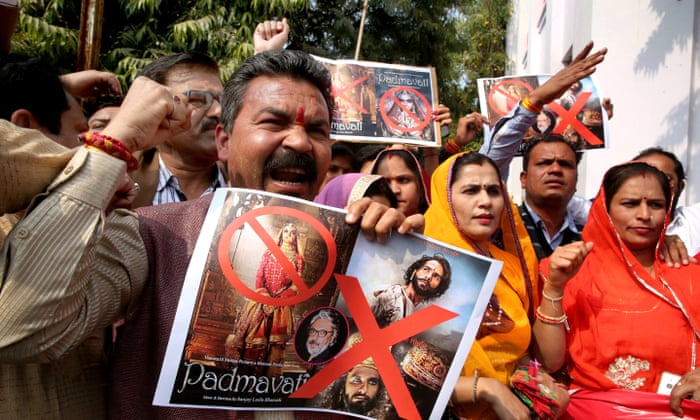 |
Members of the Indian Rajput
community hold placards during a protest against the release of the
Bollywood movie Padmaavat in Bhopal. Photograph: Sanjeev Gupta/EPA
|
Tribal and ultra-religious people living in the Indian sub-continent can be passionately violent, their outrage over perceived disrespect to cultural traditions and religious precepts, let alone popular myths that become as fixating as ideological commitments of strictured fundamentalism, can cause riots that do little to reflect well on those lending themselves to the kind of mass hysteria that can roil society on occasion. In this, at least, they rival the tendency leading fundamentalist Muslims to mount raging mobs of hateful violence, concerned that their Prophet or religion are being mocked by the kuffars, Infidels and Jews.
Extremist Hindu groups have taken to whipping their faithful into a frenzy of outrage over a recently produced Bollywood film portraying a dramatized version of a legendary 14th Century Hindu queen who is popularly believed to have committed suicide rather than surrender to the amatory advances of a Muslim grandee consumed with carnal desire for her supposedly unmatched beauty. The Hindu queen, Padmavati, is considered a saint by many who believe the legend to be fact and who now are enraged that Bollywood has trivialized her memory.
Indian riot police have been mobilized in various areas of India to put down violent protests where movie theatres have been vandalized, vehicles burned, a school bus pelted with stones. The school bus, carrying children and their teachers drove into a near-riot. A video clip of terrified and weeping children crouching on the floor of the bus while windows were being smashed by rocks flung by a screeching horde outside, portrayed an image of a world gone mad. That same mob had earlier torched a state transport bus after the passengers had disembarked.
The Rajput community of Rajasthan, in reverence of the legendary Queen Padmavati whom historians doubt ever existed, has been the source of the opposition to the film and the savage temper of the crowds that has resulted from their incitement to react. In the film, the queen is shown as "flirting" with a sultan, though she is the wife of the king of the Rajputs. According to its critics, the film is not "historically accurate", which is a bit of a stretch since there is no historical evidence to support the contention that this deity-like personage ever even existed.
"Rajputs [the ethnic tribe depicted in the controversial film] can never even think of attacking a school bus. This is a plot being created by politicians, who wish to weaken our peaceful protest", Vijendra Singh, a spokesman for the group attested. While in its filming stages death threats were sent to the cast and director of the film. Some state governments refused to allow the film to be screened, though the Indian supreme court ruled this to be an illegal move.
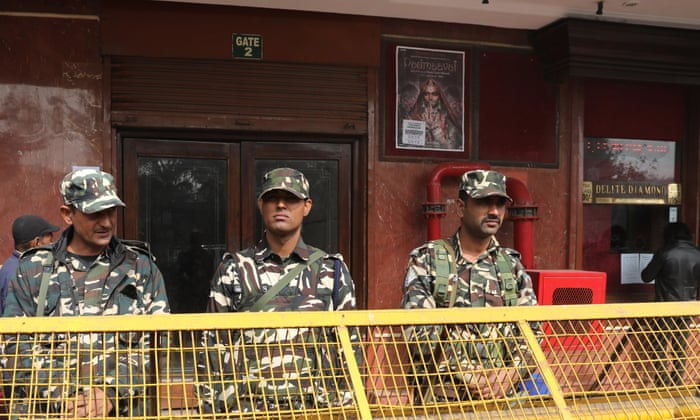 |
Indian security personnel stand guard during the screening of Padmaavat at a cinema hall in New Delhi.
Photograph: Rajat Gupta/EPA
|
The fact that few people have yet seen the film, perplexes Indian intellectuals, given that fact and the widely reported violence that has accompanied its release; it is hearsay and that alone that motivates the mob violence. And though the leader of the Muslim invasion the film depicts, Alauddin Khilji, did exist as well as the Hindu king Ratnasimha, there are no historical sources to be found giving mention of Queen Padmavati.
"We are living in strange times", commented Manish Tewari, an official of the nation's leading opposition party.
The film was believed to have cost around $30 million in its production. Whether that investment will be recouped is now in doubt since many cinema owners refuse to allow the film to be shown in their premises for fear of their own safety, much less that of their theatres. The reputation of the warrior tradition of the Rajput caste established in Gujarat and Rajasthan states places fear in the hearts of those who know they will become a target for violence should they be foolhardy enough to invite the film into their premises.
Albeit in sane minds this is much ado about nothing, in India this is a serious matter. Or one of delicious absurdity. Given the fact that a group of 300 women has threatened mass suicide should the film be shown anywhere. They await a response from the government before embarking on making good on their threat. A Bharatiya Janata Party official (state level) offered a bounty to anyone who would defend the honour of Queen Padmavati by beheading the lead actress and the director of the film.
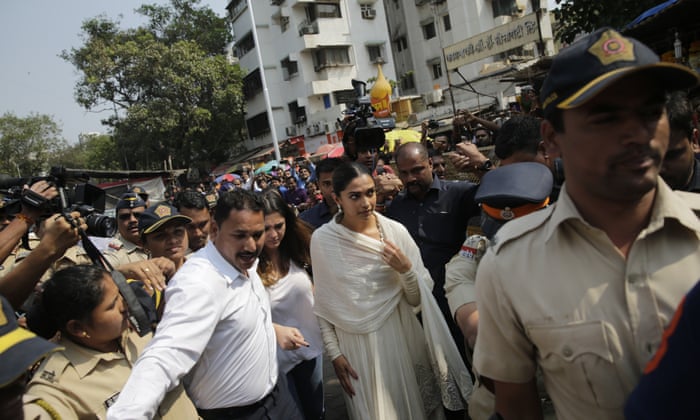 |
Bollywood actor Deepika
Padukone, centre, arrives escorted by police to offer prayers at a Hindu
temple ahead of the release of Padmaavat in Mumbai on Tuesday. Photograph: Rafiq Maqbool/AP
|
Labels: Bollywood, Controversy, Fundamentalism, Hindus, India, Violence
Islam, Religion of Peace
In Kabul, at Cure International Hospital, an NGO-operated facility that employs international medical personnel, specialized treatment of disabled children and women takes place. The one-hundred bed facility is known for the quality of its medical treatment, far outdistancing government hospitals. Women are treated for problems such as fistula, arising from genital mutilation. And premature babies get a boost on their life at the hospital.
In Afghan society where fundamentalist Islam is practised, traditionally women were never treated by male doctors. There were hospitals that treated female patients only, and the female surgeons that practised in them had to wear full-body covering just like their patients. Afghan men traditionally do not wish other men to view their wives.
And on Thursday, an Afghan police officer newly assigned to the unit guarding the hospital turned his gun on three American doctors at the facility. One of the doctors was hosting three visitors from the U.S., according to General Mohammad Zahir, the Kabul police chief. Ainuddin, the police officer, fired on the Americans as they entered a security vestibule at the building's entrance, killing three of the men, wounding a woman.

An
Afghan police ambulance leaves the Cure International Hospital in
Kabul, Afghanistan, Thursday, April 24, 2014. The U.S. embassy in
Afghanistan says three American doctors have been killed at by an Afghan
security guard who opened fire at a hospital in Kabul. AP Photo/Massoud
Hossaini
Entering the interior courtyard, he continued to fire at foreigners until he was shot by fellow officers. One of the dead was a Cure International doctor who had lived and worked in Kabul for seven years. His Chicago family named him as paediatrician Dr. Jerry Umanos. He had worked as a paediatrician for over 16 years at the Lawndale Christian Health Center in Chicago before moving to Afghanistan in 2006.
There has been an increase in attacks against conspicuous foreigners in Afghanistan. Many of those attacks have targeted journalists. They have followed on the more numerous attacks by Afghan soldiers against their coalition allies, in the infamous green-on-blue shootings before NATO members pulled most of their militaries from the country in anticipation of the full withdrawal soon to come.
While some people were fearful the facility might be closed after the killings, leaving people to become reliant again on poorly funded public hospitals, others felt sympathetic to the killings.
"The foreigners have been here too long" one man said, whose female relative was undergoing surgery in the hospital.
"People are tired of them."
When a car pulled up shortly after the shooting, the driver was advised to leave the area by police. When it was explained to him that an officer had shot and killed three foreigners, the driver responded:
"Good for him that he killed the infidels."
This, of course, is the universal sentiment in Afghanistan of a pious people, dedicated to their religious faith, the very faith that is described by Western leftists as well as Western Muslims who do nothing to protest against the violent jihad that emanates from Islam, as the foremost Religion of Peace.
Labels: Afghanistan, Fundamentalism, Health, Heritage, Humanitarian Aid, Islamism, Jihad
Malyar Sadeq Azad
BBC Afghan
 Female students in full body veil at the Ashraf-ul Madares madrassa
An unregistered religious school in northern Afghanistan has been accused of radicalising thousands of women.
A BBC investigation has found that the Ashraf-ul Madares
madrassa in Kunduz province preaches that listening to radio, watching
television and taking photos are un-Islamic activities and that women
should not work outside their homes.
Activists say the school undermines women's rights, but the founders say they are providing badly needed religious education.
About 6,000 women and young girls are studying at the
madrassa which was established by two influential mullahs in Kunduz four
years ago.
Students from the madrassa are instantly recognisable because of their strict Islamic clothing.
The older students cover their heads, faces and eyes, and they
also wear gloves and socks. Some wear a full body black chador, which
has led to them being dubbed "tent-wearers" by some residents.
Kunduz city officials say the radical interpretation of Islam
taught in the school - particularly over dress codes - is causing
tension between seminary students and other local people.
 Teachers at the madrassa say religious instruction in state schools is insufficient
"They tell them 'you are an infidel - why is your clothing
un-Islamic, why don't you know how to pray?'" says an official from the
Kunduz Women's Affairs Directorate.
Some of the seminary students also attend local government-run schools, and here too there have been confrontations.
"When [they] see students or teachers of ordinary schools
wearing normal clothes or with their hair visible, they stop them and
openly tell them: 'You have committed a sin by not wearing clothing to
cover your entire body'," says Wazhma, a teacher at a government-run
school.
The head of the madrassa, Mawlavi Abdul Khaleq, rejects the criticism.
He told the BBC the school's goal was to help young women
achieve their full potential by understanding the history and basic
teachings of Islam.
"In the beginning of Islam, Muslim girls used to take part in
religious activities," he said. "They even used to participate in wars…
but we Muslims have now lagged behind."
So what do the students themselves think? Although they've
been warned not to talk to the media, one young woman agreed to speak on
condition of anonymity.
"If a chocolate does not have a wrapper, every fly can sit on
it, but if it has a wrapper, it can be protected better," she said. "So
the hijab for women is like a wrapper for them."
She told the BBC that she had grown up as a refugee in Pakistan, and had previously attended a private university.
"I used to wear short, tight clothes which are not
appropriate for a Muslim woman," she said. "But now I have been informed
about the truth of Islam and I know it is not appropriate for a Muslim
girl to laugh and joke at any party."
 A madrassa teacher instructs pupils from behind a curtain
In government-run seminaries in Afghanistan, male teachers can
instruct girl students face to face - as they do in ordinary schools and
colleges.
But at Ashraf-ul Madares, male staff have to teach their girl
students from behind a curtain or from inside a booth in order to avoid
eye-contact.
"There should be partitions so that the male teacher can't
see the girls, even if they wear hijab, because their eyes are open
during reading," says Abdul, one of the seminary teachers.
The rules are less strict for the 200 girls under 10 who also study at the Ashraf-ul Madares.
Here the teachers sit among the children, wooden ruler in hand to enforce good behaviour.
"The madrassa discipline is military-style, and children will be punished if they don't learn well or are noisy," Abdul says.
So why go to an unregistered madrassa when there are more
than 30 similar schools in Kunduz run by the Ministry of Education and
already catering for some 2,000 female students?
Officials at the Ashraf-ul Madares argue that the curriculum
provided by the Ministry of Education is not fully Islamic. They say
they offer different teaching based on books brought in from Iran,
Pakistan and some Arab states.
Afghanistan's deputy education minister Shafiq Samim,
declined to comment specifically on the Ashraf-ul Madares madrassa, but
acknowledges there is a problem in Kunduz.
 Teachers use a wooden booth in class to avoid direct contact with female students
"Students are told people who don't pray are infidel, while in
Sharia law only unbelievers are called infidel," he said. "One madrassa
student even told her mother that she was infidel because she did not
pray for a few days."
Mawlavi Abdul Khaliq, the head of Ashraf-ul-Madares takes issue with this.
"Those who oppose this seminary are actually unaware of Islam
or are influenced by countries that support non-Islamic ideas and
values in Afghanistan and want a decline in Islamic values", he says.
"In general, these kinds of people are provoked by outsiders."
Many of the school's critics also want to know how it is funded.
Mawlavi Abdul Khaliq says some costs were covered by donations from students.
"They sell their earrings, rings and gold to help," he said.
"Once we were even able to buy land for around $20,000 and build on it,
all paid for by these girls."
The madrassa has expansion plans, hoping to open branches in other Afghan provinces.
The Ministry of Education has confirmed that there are about
1,300 unregistered religious schools operating in the country, as
opposed to 1,100 state-run madrassas.
Shahrzad, a civil society activist in Kunduz fears that the
growing influence of conservative establishments outside government
regulation could cost women in particular dear.
"When religion is misinterpreted, the first and biggest
victims will be women," she says. "Their Islamic and legal rights, their
rights to work, learn, train and join politics and their civil freedom
will be restricted."
Labels: Afghanistan, Education, Fundamentalism, Human Rights, Islamism, Sexism


