The Khalistani Rebellion
"We don't want any violence. We don't want any violence from pro-Khalistan forces or the Indian side."
"We are saying, let's give votes a chance ... We are fighting for our own political opinions to be heard."
Gurpatwant Singh Pannun, Sikhs for Justice
"They're using Canadian territory for activities which could jeopardize India's security and interests."
"If
the [Canadian government can do something about the referendum] and try
to prevent it, that would be useful because it only creates a bad
atmosphere and incites violence against India and Indians."
Manish, Indian High Commissioner to Canada
"Secessionism amongst Sikhs has been very much in retreat in India itself."
"My sense is that there aren't serious tensions between Hindus and Sikhs."
"The
main attacks that Hindus or Muslims or Sikhs have faced have come from
white nationalist groups -- racist groups -- attacking all of them
equally as people of colour."
Dr. Narendra Subramanian, political science professor, McGill University
 |
| Trudeau and then-Defence Minister Harjit Sajjan, left, met with Chief
Minister of Punjab Amarinder Singh in Amritsar . (Sean Kilpatrick/Canadian Press) |
Relations
between Canada and India, long friendly, have become somewhat strained
in the last several years. Jagmeet Singh, the leader of Canada's third
political party, the New Democratic Party (NDP) is a Khalistan proponent
and supports the referendum being carried out on Canadian soil. Harjit
Sajjan, now Minister of International Development was formerly Canada's
Minister of Defence, and a supporter of a Sikh homeland in the Khalistan
movement to separate the Indian Punjab from India to become a
Sikh-autonomous region.
When
Prime Minister Justin Trudeau visited India in 2018, his manner of
dress was bizarre enough to draw the amazed attention of Indians; the
Trudeau family costumed themselves throughout the trip in flashy outfits
not even Bollywood stars would appear in. At a reception, the
appearance of a former Khalistani convicted of attempted murder of a
visiting Punjabi official to Canada, proved an embarrassment to Canada,
and a provocation to Narendra Modi's government.
A
former premier of British Columbia Ujjal Dosanjh, himself a Canadian
Sikh, had years ago been savagely beaten by Sikh separatists for his
public condemnation of the separation movement. A British Columbia Sikh
newspaper editor who had also been critical of the movement was murdered
by Sikh separatists. And Canada's worst terrorism event took place when
in the mid-1980s Khalistani terrorists placed bombs on Air India Flight
182 flying from Canada to India, killing all 329 aboard.
There
are 800,000 Sikh Canadians comprising 2.1 percent of the Canadian
population, a huge diaspora. In 2019 the Statistics Canada total for all
Indo-Canadians came to 1,008,995. By no means does the total, whether
Hindu or Sikh support the separatist movement of Sikh nationalists.
After the Air India bombing, the Khalistan movement receded to a degree
in its provocations. At the present time, however, another movement has
arisen calling for a referendum on separatism among the global diaspora
of Indian Sikhs.
 |
| Khalistan Referendum in Canada (Source: Twitter/@Azhar Javaid) |
Called
the Punjab referendum, it asks people of Sikh origin their opinion of
the Sikh-majority Indian state of Punjab separating, fulfilling the
dream of Khalistan. Canada has become one amongst the first to hold
votes, organizers claiming that over 100,000 people participated in the
balloting near Toronto a month ago. A group calling itself Sikhs for
Justice is careful to point out theirs is a peaceful exercise in free
will. A situation that New Delhi sees as an abhorrent attempt against
its territorial integrity and sovereignty.
Whatever
the outcome of the referendum it has no legal status; it is not
binding, and completely unofficial. Its organizers hope to strike a
'moral' victory to enable it to apply international pressure on India.
Voting on the referendum began in the U.K. a year ago, went on to Italy
and Switzerland, and a second round resumed in Brampton, just outside
Toronto a month ago. It is destined to move to Montreal, Edmonton,
Calgary, Vancouver, Surrey and Abbotsford early in the coming year
before travelling to the United States.
With
the balloting complete, its organizers hope to be able to present a
compelling proof to the United Nations that Indian Sikhs have a moral
and traditional heritage right to their own geography independent of
India to be self-governed by Sikhs alone. The ghostly horror of the
partition of India and Pakistan, and Pakistan and Bangladesh in 1948
comes to mind. India's reaction to the movement has been predictably
condemnatory.
The
truly curious thing about the entire situation is that separation
appears to be entirely led by the expatriate Indian Sikh community.
Within India, Sikhs, particularly those living in the Punjab, appear
rather less than interested in separating, more than a little
comfortable with the status quo. Indian Sikhs appear not to be
influenced by the strenuous, disruptive efforts of the diaspora to
impose upon them a state they're not asking for.
And
what is passing strange, is the fact that their peers populating the
globe in foreign countries as citizens of those countries, expend time,
energy and political will in expounding their vision of a dire need for
an exclusionary homeland, one where neither they nor their descendants
will cleave to and live within. In Canada, a rift is appearing between
Canadian Hindus and Canadian Sikhs. The former becoming targets of the
latter.
Liberal
Member of Parliament Chandra Arya last month accused "Khalistani
extremists' of painting graffiti on the BAPS Shri Swaminarayan Mandir
temple in Toronto. In July, a Rutgers University report warned of an
explosion in "Induphobia:" online. The source not Sikhs, but white
supremacists, Islamists and Iranian trolls sowing division.
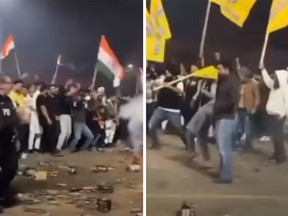 |
| A crowd waving Khalistan flags faced off with
nationalists brandishing the Indian flag in a Mississauga, Ont., parking
lot on Diwali. Police watched as the two sides yelled and set off
fireworks, but there was no violence. Photo by SherePunjabRadio AM600 /YouTube |
Labels: Hindus, India, Indian Diaspora, Referendum, Separation, Sikh Khalistan, Sikhs
And Never The Twain...India's Hindu-Muslim Divide
"People are frustrated that they are not being able to get jobs."
"There is angst, which is spreading across communities and people ... It's a reaction to their circumstances."
Vasundhara Raje, Leading member, Bharatiya Janata Party [BJP]
"I have a strange sense of confidence now. The group has taught us what is right, what we need to do for society."
"Earlier there was a fear that the government would arrest us, but now with the Yogi government, we don't have any fear."
"Even if a smuggler is killed during a fight, we don't have to worry about it. Even if a life is lost, we don't care."
"All these BJP leaders, they've said, 'Do what you want to do about cow protection. Don't worry, if there is any problem we are there for you."
Ram Kumar, 23, Govardhan, India
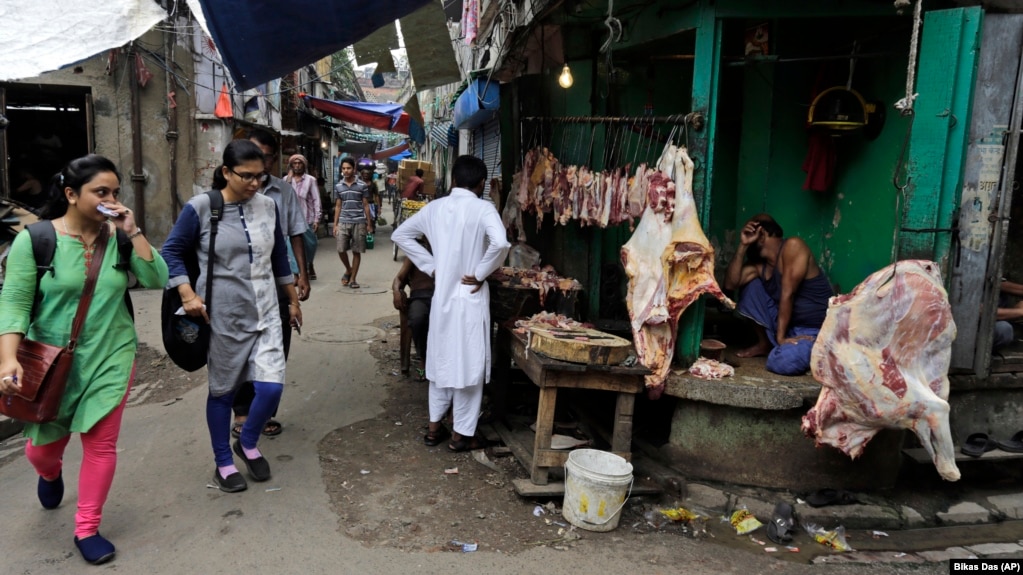 |
| People walk past a shop selling cow meat in Kolkata, capital of the eastern Indian state of West Bengal. |
There are over 600 million people under the age of 24 in India with access to technology and education. But India has a vast population, many in the same age cohort who despite the advance in technology and education available to them now, for whom there will be scant opportunity for meaningful employment. The negatives don't end there; because boys are seen as preferential to girls, the culture selects for males, either in the womb or through neglect after birth.
The result of which is that there is an estimated 37 million men for whom a mate will never be found, thanks to aborted female fetuses. These are called
"bachelor bombs", for whom the presence of a woman in their lives and the fulfillment of family life will never defuse those incipient 'bombs'. The cultural legacy of preference for boys leaves those young men bereft of a normal future.
Each month in India over a million young men enter the labour market, often with inadequate employment skills. India is able to generate 1.8 million jobs annually, according to the Center for Monitoring Indian Economy. The government, on the other hand, claims that closer to 7 million new jobs were created last year.
The result of this growing social dysfunction with scant employment opportunities and restless young men for whom life seems purposeless, is a search for meaning. Some attend leadership camps; they are themselves under no economic duress, coming from well-off families. And they are joining right-wing groups in the belief that they can help clean up society's ills.
Their core Hindu beliefs, they believe, require their very particular vigilance to ensure that society knows its place. Beating others suspected of violating those Hindu beliefs, threatening interfaith couples in the belief that Muslims are plotting to steal their Hindu women for whom they're prepared to kill in defence of the faith.
This past summer has seen dozens of people killed by lynch mobs, where extremist Hindus assault and kill other people, mostly Muslims. Religious zealots responded to a minor traffic accident by demolishing a car with sticks to vent their rage, even while police looked on, unresponsively. The Hindu nationalist Bharantiya Janata Party governing India is being blamed for encouraging violence by Hindu extremists.
Ram Kumar is one example of a college graduate who attended a leadership camp sponsored by the Hindu nationalist World Hindu Council. And this is where he became familiar with the need to protect cows held sacred by Hindus but butchered and eaten by Muslims. It is where he was inspired to protect women's modesty, and to prevent those outside the faith from converting Hindus to their own faith.
Military drills, sleeping in spartan concrete dorm rooms, eating lentils and rice was part of the hardening off formula of these activists. Kumar, and his friend Gaurav Sharma, 22, a law student, come from Agra where they grew up, the city that boasts the Taj Mahal, the world-famed monument to love, which they regard as symbolic of the Mughal invaders subjugating India's Hindus.
After Kumar's indoctrination in the training camp he became accustomed to chasing down and threatening interfaith couples, conducting the kind of moral activism he feels is required to stop Muslim men from seducing girls
"as young as 14", a practise known as
"love jihad". At night Kumar prowls the streets on the lookout for cattle traders illegally smuggling cows to slaughter.
He and five other committed activists recently stopped a truck transporting cows and beat the driver, a Muslim, who pleaded for them to spare his life. His life was spared but not by the activists, when police arrived.
"I was raging, if I had a pistol, I would have killed him", said Kumar. Since the BJP came to power in the state of Uttar Pradesh, the activists have no fear of accountability to authorities.
"Our parents never told us anything bad about Muslims. But in madrassas, they learn that Hindus are bad."
"We will tell the next generations how bad these people are."
Gauray Sharma, 22, law student
Labels: Conflict, Customs, Hindus, India, Muslims, Traditions
Much Ado: Cinematic Verity and Violence
"We behave rather strangely for a country acclaimed as the world's largest democracy."
"In a country beset with such serious problems as a slowing economy, crumbling infrastructure, suffocating pollution, ailing health care and a pathetic education system, the national conversation is dominated by a mythical character."
Aroon Purie, editor-in-chief, India Today, India
"Karni Sena [the hardline Rajput group leading the protests] was unknown outside Rajasthan so far."
"In 2010
when they vandalized theatres in Rajasthan over a less high-profile
film, they barely received attention."
"By now strategically going after a
highly anticipated film like Padmaavat, they have gained national
visibility."
Anna MM Vetticad, Indian film critic and author
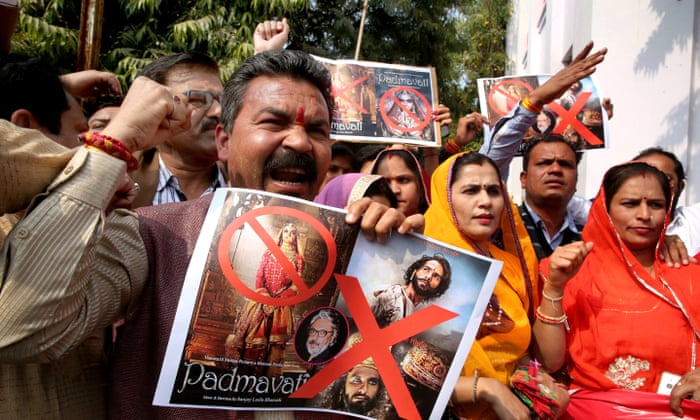 |
Members of the Indian Rajput
community hold placards during a protest against the release of the
Bollywood movie Padmaavat in Bhopal. Photograph: Sanjeev Gupta/EPA
|
Tribal and ultra-religious people living in the Indian sub-continent can be passionately violent, their outrage over perceived disrespect to cultural traditions and religious precepts, let alone popular myths that become as fixating as ideological commitments of strictured fundamentalism, can cause riots that do little to reflect well on those lending themselves to the kind of mass hysteria that can roil society on occasion. In this, at least, they rival the tendency leading fundamentalist Muslims to mount raging mobs of hateful violence, concerned that their Prophet or religion are being mocked by the kuffars, Infidels and Jews.
Extremist Hindu groups have taken to whipping their faithful into a frenzy of outrage over a recently produced Bollywood film portraying a dramatized version of a legendary 14th Century Hindu queen who is popularly believed to have committed suicide rather than surrender to the amatory advances of a Muslim grandee consumed with carnal desire for her supposedly unmatched beauty. The Hindu queen, Padmavati, is considered a saint by many who believe the legend to be fact and who now are enraged that Bollywood has trivialized her memory.
Indian riot police have been mobilized in various areas of India to put down violent protests where movie theatres have been vandalized, vehicles burned, a school bus pelted with stones. The school bus, carrying children and their teachers drove into a near-riot. A video clip of terrified and weeping children crouching on the floor of the bus while windows were being smashed by rocks flung by a screeching horde outside, portrayed an image of a world gone mad. That same mob had earlier torched a state transport bus after the passengers had disembarked.
The Rajput community of Rajasthan, in reverence of the legendary Queen Padmavati whom historians doubt ever existed, has been the source of the opposition to the film and the savage temper of the crowds that has resulted from their incitement to react. In the film, the queen is shown as "flirting" with a sultan, though she is the wife of the king of the Rajputs. According to its critics, the film is not "historically accurate", which is a bit of a stretch since there is no historical evidence to support the contention that this deity-like personage ever even existed.
"Rajputs [the ethnic tribe depicted in the controversial film] can never even think of attacking a school bus. This is a plot being created by politicians, who wish to weaken our peaceful protest", Vijendra Singh, a spokesman for the group attested. While in its filming stages death threats were sent to the cast and director of the film. Some state governments refused to allow the film to be screened, though the Indian supreme court ruled this to be an illegal move.
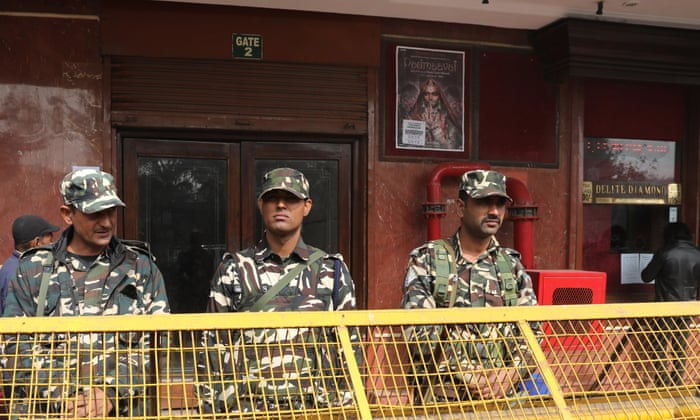 |
Indian security personnel stand guard during the screening of Padmaavat at a cinema hall in New Delhi.
Photograph: Rajat Gupta/EPA
|
The fact that few people have yet seen the film, perplexes Indian intellectuals, given that fact and the widely reported violence that has accompanied its release; it is hearsay and that alone that motivates the mob violence. And though the leader of the Muslim invasion the film depicts, Alauddin Khilji, did exist as well as the Hindu king Ratnasimha, there are no historical sources to be found giving mention of Queen Padmavati.
"We are living in strange times", commented Manish Tewari, an official of the nation's leading opposition party.
The film was believed to have cost around $30 million in its production. Whether that investment will be recouped is now in doubt since many cinema owners refuse to allow the film to be shown in their premises for fear of their own safety, much less that of their theatres. The reputation of the warrior tradition of the Rajput caste established in Gujarat and Rajasthan states places fear in the hearts of those who know they will become a target for violence should they be foolhardy enough to invite the film into their premises.
Albeit in sane minds this is much ado about nothing, in India this is a serious matter. Or one of delicious absurdity. Given the fact that a group of 300 women has threatened mass suicide should the film be shown anywhere. They await a response from the government before embarking on making good on their threat. A Bharatiya Janata Party official (state level) offered a bounty to anyone who would defend the honour of Queen Padmavati by beheading the lead actress and the director of the film.
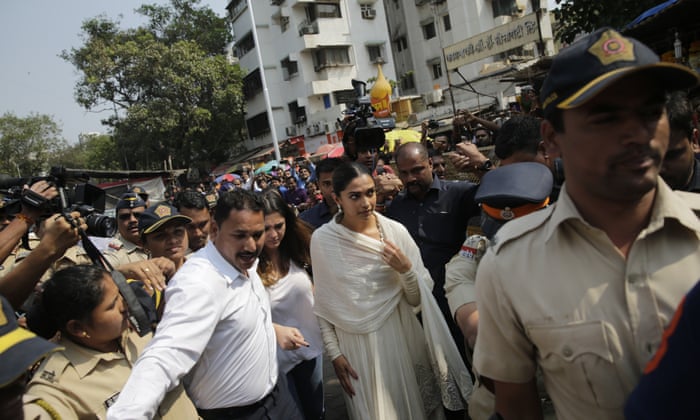 |
Bollywood actor Deepika
Padukone, centre, arrives escorted by police to offer prayers at a Hindu
temple ahead of the release of Padmaavat in Mumbai on Tuesday. Photograph: Rafiq Maqbool/AP
|
Labels: Bollywood, Controversy, Fundamentalism, Hindus, India, Violence
Irreconcilable Hostilities
"Because Myanmar has refused access to human rights investigators, the current situation cannot yet be fully assessed, but the situation seems a textbook example of ethnic cleansing."
Zeif Ra'ad Al Hussein, UN high commissioner for human rights
"When we were about to have our meal, the kalars [Muslims] entered our village and started burning our houses. They were holding machetes and spears and started shouting, 'We will shower with the Hindus' blood'."
"So we ran away from our houses. If there are Muslims, the problems will never end, but if kalars are not here anymore, it will be more peaceful."
Hazuli, minority Hindu Burmese citizen
"They burned their own houses and ran away."
"We
didn't see who actually burned them because we had to take care of the
security for our outpost. ... But when the houses were burned, Bengalis
were the only ones in the village."
Aung Kyaw Moe, Buddhist villager
"[It was the Rohingya themselves setting their homes ablaze. I even tried to stop them."
"I told them not to do that, but it seemed like they wanted to."
Abbott of Buddhist monastery, Zawtika, Rakhine state
 |
| In this image made from video, fires occur in
Gawdu Zara village, northern Rakhine state, Myanmar, Thursday, Sept. 7,
2017. Journalists saw new fires burning Thursday in the village that had
been abandoned by Rohingya Muslims, and where pages from the Quran were
seen ripped and left on the ground. (AP Photo) |
An estimated 313,000 Rohingya villagers have now fled the violence taking place in Rakhine state. The minority Muslim population, denied citizenship, and derided as Bangladeshis in all probability fled that poverty-stricken country across the border into Myanmar generations ago. Doubtless Bangladesh was glad to see them go; it certainly now is not welcoming them back; though, faced with a humanitarian crisis, for the time being it is forced to accommodate their presence in desperation.
In the village where the monastery abbot informed reporters that the Rohingya themselves destroyed their homes in fiery blazes, a man by the name of Maung Maung Htwe showed he photographs he had captured on his mobile phone. In the photos, clearly identifiable as individuals several people are seen torching houses. As it happened, the photos were clear enough for the journalists to recognize Hindus they had seen being sheltered in a school nearby, displaced Hindus claiming their homes had been torched by Muslims.
The government of Myanmar has been informing the world that it has been the Rohingya that have been responsible for burning their villages in norther Rakhine. They also attacked majority Buddhists and minority Hindus in a spree of unaccountable violence. Unaccountable since the government has no idea why people who are traditionally held in contempt, persecuted, and their generations unrecognized with citizenship, should react against the violence visited on them.
Nothing new about Rohingya villagers being tormented by the military, their homes burned to the ground, however.
Accusing Nobel Laureate Aung San Suu Kyi of overseeing "textbook ethnic cleansing" has not moved her one iota. Even the Dalai Lama saw fit to voice his concerns by criticizing Buddhist attacks on the Rohingya Muslims of Myanmar. Who are derogatorily called Bengalis by the military and by their neighbours, to distinguish them from all others and remind themselves that they originated in Bangladesh.
Expressing the intention to protect their ethnic minority, Rohingya insurgents had started this latest outbreak on August 25, attacking military posts and killing Burmese, leading to a violent crackdown to cleanse the area of terrorists, all-inclusive of all Rohingya civilians, the stateless people whom no one wants, not the Burmese, not the Bangladeshis. The minority Hindus have been given state protection denied the Rohingya.
Clearly, all three groups, Buddhist, Hindu and Muslim have no intention of living in harmony amongst themselves.
The woman shown in the photographs setting fire to the thatched roof of houses in the Rohingya village emptied of its residents was captured in the act of doing what they claimed the Rohingya were responsible for. She it was who described the plight of the Hindus who were attacked by Muslims and she was only returning the compliment, this mother of six who resents so heartily the presence of Muslims among Hindus.
These violent confrontations, the victimhood and the hatred, the slanders and the attacks do not represent a sudden change of relationships between former neighbours. What they demonstrate is the history of disparate tribal, ethnic and religious groups with their intolerance and resentment toward one another and their willingness to use violence to express their determination to rid themselves of people they have no use for.
This is a universal human dilemma of inhumanity toward others unlike oneself.
Labels: Buddhists, Conflict, Hindus, Muslims, Myanmar, Rohingya
Fanatics Countering Fanatics
"The situation is worse in terms of atmospherics, because the alienation and anger of young Kashmiris is now out of control."
"There is a sense of hopelessness with villagers, students and even schoolgirls coming out onto the streets. This has never happened in the past."
Amarjit Dulat, (former) head, Research and Analysis Wing, Srinagar, India
"The wave of Hindu fanaticism sweeping across India is hardening postures in Kashmir."
"There are no moderates espousing peace left in Kashmir any more. Mentally, we are all militants."
Khurram Parvez, human-rights activist, Jammu Kashmir Coalition of Civil Liberty
"This clampdown could trigger a blowback that will only aggravate anti-India sentiment in Kashmir."
"It will only exacerbate the challenge of containing Kashmir's spiralling violence."
Brigadier General Rahul Bhonsie (retired), Strategic Foresight Asia, New Delhi
![The emergent generation of stone-pelting young Kashmiris are calling the new wave of protests an 'Intifada', writes Hussain [EPA]](http://www.aljazeera.com/mritems/imagecache/mbdxxlarge/mritems/Images/2016/7/19/ae1a750e7c06488fa62ca79b5ac63bd4_18.jpg "Two centuries of oppression in Kashmir") |
| The emergent generation of stone-pelting young Kashmiris are calling the
new wave of protests an 'Intifada' [EPA] |
India and Pakistan have fought three wars; two of those wars involving the nuclear-armed adversaries -- whose conflicts have remained in the realm of conventional warfare, but given the nuclear arsenals both warehouse, the world waits with bated breath for Pakistan to somehow trigger a conflict from which neither country could recover -- relate to each claiming the right to fully possess Kashmir, the mountainous state in the Himalaya.
Because Kashmir is majority Muslim-populated Pakistan believes it should be handed over from India to Pakistan. Pakistan and Bangladesh were once part of India. In 1947 both countries signed an agreement allowing Pakistan to separate from India; that separation caused the madness of religious hatred between Hindus and Muslims to be unleashed and hundreds of thousands of Muslims and Hindus died in a paroxysm of violence at Partition when the two populations switched.
 |
| September 1947: Muslim refugees on the roof of an overcrowded coach railway rain near New Delhi attempting to flee India. Millions of Muslims migrated from India to Pakistan when Partition marked a massive upheaval across the subcontinent as Hindus living for generations in what was to become Pakistan were forced to flee their homes overnight. AP Files |
The same kind of bloody conflict ensued when Bangladesh demanded its sovereignty and separation from Pakistan. In 1989 an insurgency began in Kashmir which India has placed blame for on Pakistan. Logically enough, since Pakistan always seems to precipitate violent unrest in the geography; its vicious hostility to India has brought the two countries to the brink of war often enough. Pakistan's cultivation of Islamist terrorist groups, inciting bloody attacks on India have been numerous.
But India too has its ardently religious fanatics, and lately, under the rule of nationalist Hindu Prime Minister Narendra Modi, virulently orthodox Hindus have been accusing Indian Muslims of criminal activity for butchering cattle for consumption. For Hindus cattle are considered sacred. For Muslims they represent food. Attacks by fanatical Hindus against Muslim cattle-herders and butchers have been roiling the nation.
And in Kashmir, teenage Muslim schoolgirls in Srinagar have increasingly begun what in the West Bank of 'Palestine' is called an Intifada; attacks by Arab Muslims against Jewish Israeli citizens in the Middle East, fighters for Muslim sovereignty of Kashmir in the Indian subcontinent.
"Is it not better to die challenging the situation once and for all than to live with it and die a slow death every day?", one 14-year-old Muslim Kashmiri girl's rhetoric of dramatic purple prose posed.
Schoolgirls carrying backpacks with their schoolbooks, hurl rocks at Indian soldiers. Surrounding an Indian army armoured vehicle, kicking the doors, a group of schoolgirls called for the security personnel within the vehicle to fire on them. Clashes between Indian security forces in Srinagar and the local Muslim population can occur with flashpoint unexpectedness. The stability of normal life can suddenly evaporate and rock-hurling students erupt against security forces.
A mirror-image of what so frequently occurs in Israel with the Palestinian Authority spurring young Palestinians to do their duty of 'resistance' against the 'occupation'. Stoning by Muslim youth appears to be genetically inherited as a public and social pastime. The civil disobedience movement gripping a majority of Muslim Kashmiris expands "exponentially", a security official in charge of Kashmir stated.
"There is an overwhelming sense of siege in Kashmir and levels of isolation amongst locals have peaked", he warns.
The Indian military is in no mood to sit back at this point and just allow tensions to mount and perhaps fizzle. Random searches by the Indian army are guaranteed to further inflame Kashmir's Muslims. What has occasioned the searches was the kidnap and murder of a Kashmiri army subaltern. The "sweep operations" by the army, warn military analysts could become counterproductive, triggering furious militancy.
Again a repeat of what Hamas in Gaza, for example has engaged in; abducting Israeli soldiers, sending rockets from Gaza into Israel, provoking the Israeli Defence Forces to retaliate and invade. Now it's India's turn. Israel has a million and a half Palestinian Muslims living in the country as citizens. India's population of 1.3 billion includes 15 percent Muslim citizens. The population mix is reversed in Kashmir.
And Pakistan which controls a third of Kashmir denies inciting for a
"Kashmir freedom struggle", claiming its only contribution to that struggle is moral, diplomatic and political support. Indeed.

Labels: Conflict, Hindus, India, Kashmir, Muslims, Pakistan
Nuclear Armed and Jittery
"The growth path of Pakistan's nuclear arsenal, enabled by existing infrastructure, goes well beyond the assurances of credible minimal deterrence provided by Pakistani officials and analysts after testing nuclear devices."
Carnegie Endowment for International Peace/Stimson Center report
"This report is overblown."
"However ... what the world must understand is that nuclear weapons are part of Pakistan's belief system. It's a culture that has been built up over the years because [nuclear weapons] have provided a credible deterrence against external aggression."
Mansoor Ahmed, nuclear expert, Quaid-i-Azam University, Islamabad
"We assume, maybe correctly, maybe inaccurately, with the fuel coming out of the four reactors, they are processing it as rapidly as possible to get the plutonium out."
Toby Dalton, co-director, Carnegie Endowment Nuclear Policy Program
"[India views nuclear weapons] as a political tool, a prestige item, not something you use on a battlefield."
"[In Pakistan, nuclear weapons are seen as] things you have to be willing to use [to guarantee stability].
Michael Krepon, co-founder, Stimson Center
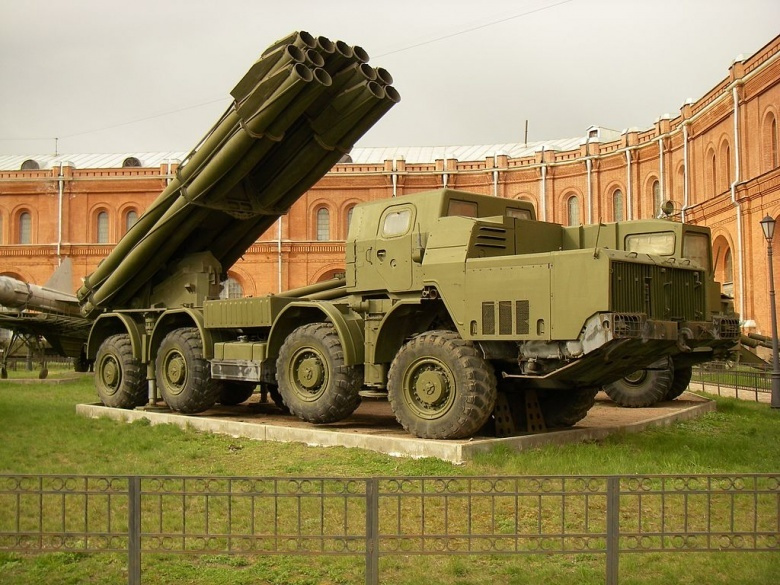
Pakistan has been quietly increasing the numbers of its nuclear warheads. A new report issued through two think tanks in the United States states that the only Muslim country to have nuclear weapons, one perpetually on the brink of war with its much larger neighbour India, from which it broke off geographically in 1947, is known to encourage Islamist terrorist groups to incite violence in disputed Kashmir.
The two countries have fought conventional-weapons wars in the past. India is not inclined to foment war between itself and its neighbour, a volatile, impassioned Pakistan infused with the fuel of Islamist sentiments against non-Muslim states which appears not entirely reluctant to continually bring hostilities to the fore. Pakistan is a paranoid neighbour to the more powerful and populous India which itself has a sizeable Muslim population, the third-largest in the world.
India's larger stock of plutonium, required for the production of high-yield warheads, is mostly used in the production of domestic energy. Pakistan in contrast, uses its large stockpile of highly enriched uranium to produce low-yield nuclear devices expeditiously. It's estimated by experts in the field that Pakistan, at the rate it is churning out nuclear warheads could stockpile 350 warheads within five to 10 years, an increase of over 300%.
Pakistani authorities are secretive about their fissile materials and the number of nuclear weapons in their possession; they are roughly equal to the number that India has stockpiled. The Pakistani military agitates to increase its stockpile, a move justified by its nuclear specialist recently named a nuclear security fellow at Harvard University's John F. IKennedy School of Government.
The country quietly and without fanfare added a fourth plutonium production reactor at its Khushab Nuclear Complex. It was, infamously, a Pakistani nuclear scientist who had opened a Pandora's box of nuclear research, making it available to other Muslim countries like Libya, and whose playing loose with formulae may have aided North Korea in the creation of its nuclear program.
India's
"no-first-use" policy on nuclear weapons stands in contrast to the policy of Pakistan's leaders who decline to reciprocate, claiming they may be 'forced' to resort to the use of nuclear weapons should India's military invade Pakistan. That India is not the instigator generally of restive relations between itself and Pakistan is a reality. That border guards on either side often trade gunfire in Kashmir is another reality.
With each side blaming the other for
"unprovoked firing and shelling",where people are killed, before matters are once again brought to a poisonous lull, incidents are 'tolerable'. Firing and shelling can be unfortunate but reactions of suspicion and anger against a perceived enemy; misunderstanding leading to the accident of nuclear weapons use because someone misread communications or a volatile incident flames out, is not conducive of pull-back and a return to cold hostilities.
Labels: Hindus, India, Muslims, Nuclear Weapons Conflict, Pakistan


