"One
would hope that at this point, with Meng home, China would see no
further point in threatening to execute [Robert] Schellenberg."
"It would be seen as killing someone out of pure spite."
Donald Clarke, expert on Chinese legal system, George Washington University
"I'm pretty sure that Ambassador [Dominic] Barton must have raised the case of Schellenberg."
"[But] I would not be surprised if the Chinese took advantage of the situation to ask a few things from Canada."
Guy Saint-Jacques, (former) Canadian ambassador to China
"In
the two Michaels' case, Canada had the U.S. as leverage. It didn't have
anything else. But for Schellenberg, it doesn't have any leverage. So I
don't know what we can do."
"China would expect something in return [for sparing the Canadian's life]. I don't feel we should be offering much in return."
Wei Cui, professor, expert, Chinese legal system, University of British Columbia
Canadian Robert Schellenberg during his retrial on drug trafficking charges in Dalian, China, January 14, 2019.Photo by Handout/Intermediate Peoples' Court of Dalian/AFP/Getty Images
Meng
Wanzhou, the CFO of Huawei and its founder's daughter has now been
released by a Canadian court, no longer held for extradition to the
United States on a state department warrant for misleading a U.S. bank
on Huawei's ties to a company that broke American sanctions against
Iran, as a result of an arranged plea bargain where she admitted guilt,
but would not face a trial, charges dropped. She is back in China, feted
for her courage in luxuriating in one of her Vancouver mansions.
The
two Canadians, former diplomat Michael Kovrig and businessman Michael
Spavor have also been released from their 11-year sentences for
'espionage', arrested and imprisoned the week that Ms.Meng was detained,
in a blatant display of Beijing's embrace of 'hostage-diplomacy'. While
they were in the custody of the benevolent Chinese prison system for
almost three years, the Liberal government of Justin Trudeau did nothing
to counter China's belligerent aggression.
PM
Trudeau saw his prized aspiration for a trade deal with China evaporate
long before this episode in a trip to China where he expected to sign a
trade deal, and was summarily dismissed by China's vice-president and
sent packing. During the recent Canadian federal election campaign in
mid-September, China blatantly interfered with the election, with
explicit warnings delivered by China's ambassador to Canada that
election of a Conservative-led government would cost Canada dearly.
The
Liberal government hesitates to enrage China by taking steps to counter
its hostile punishment of Canadians and the Canadian export-to-China
market. A decision whether or not to allow Huawei to take part in
Canada's 5G upgrade, has been delayed in the wake of Beijing's warnings
that Huawei should be a player. Canada, as one of the members of the
"Five-Eyes" security/intelligence group comprised of Australia, New
Zealand, the United Kingdom and United States is the only member that
has yet to exclude Huawei from Canada's networks.
Canada's
telecommunications companies have themselves taken the initiative,
shunning Huawei materials, opting for international competitors to take
its place in their communications networks. The shoe has not yet been
dropped. And there are consequences. There are other Canadians in
Chinese prisons; Huseyincan Celil, a Chinese-born Uyghur arrested on a
trip to Uzbekistan, extradited to China and sentenced on charges of
espionage to life in prison.
Another
is Robert Schellenberg who appealed his 15-year sentence for drug
smuggling only to see the justice authorities summarily change his
sentence to execution. Another blow to Canada through abuse of yet
another Canadian citizen meant to persuade Canada to see the error of
its ways. It doesn't help his case that Schellenberg had a record in
Abbotsford, British Columbia as a drug dealer. Formerly an oilsands
worker, he spent two years in a Canadian prison for trafficking cocaine
and heroin.
He
was arrested on a trip to China where he states he was set up by a
translator, arrested and prosecuted for involvement in smuggling 200
kilograms of crystal meth to Australia. He appealed his death sentence
just as he had appealed his original 15-year-imprisonment sentence, and
to no avail; it was upheld on appeal a month ago. He would not be the
only Canadian executed under China's drug laws in the past.
And
there are three other Canadian citizens facing death for drug offences.
The Supreme People's Court reviews all death sentences prior to being
carried out, but the court almost always confirms executions. There is
irony here aside from the fact that Beijing has struck out on so many
fronts to punish Canada for its arrogance in upholding Western law and
justice.
The
world outside China is reeling under the onslaught not only of the
Wuhan virus, but lab-produced opioids courtesy of China. Fentanyl and
Carfentanil are cutting a swath of death-by-overdose, picking up the
slack any time SARS-CoV-2 recedes.
Canadian Robert Schellenberg during his retrial on drug trafficking charges in Dalian, China, January 14, 2019.Photo by Handout/Intermediate Peoples' Court of Dalian/AFP/Getty Images
"It
has long been a fully proven fact that this is an incident of political
persecution against a Chinese citizen, an act designed to hobble
Chinese high-tech companies."
"The so-called 'fraud' charges against Ms.Meng Wanzhou are purely fabricated."
"Canada should draw lessons and act according to its own interests."
"General Secretary Xi Jinping made important instructions."
Hua Chunying, Chinese foreign ministry spokesperson
"The U.S. government concocted the incident to repress Chinese high-tech companies and obstruct China's development."
"[Meng's
arrest was the culmination of a] dirty [U.S. game to destroy Huawei.]
Over the past two years and more the U.S. wasted no time in suppressing
Huawei, cooking up disinformation to smear Huawei and coercing its
allies to boycott Huawei."
China's ambassador to Canada, Cong Peiwu
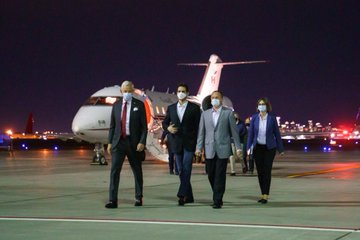
Huawei
executive Meng Wanzhou landed back in China on Saturday morning after a
B.C. court dropped her extradition case following a plea agreement with
the United States. CBC
So
there, Canada, smarten up! Beijing does not appreciate upstart nations
interfering in its smooth sailing. To act on a request by a neighbouring
country with which you have an extradition agreement, as is common
between neighbours and allies in democratic alliances, and by the act of
apprehending the chief financial officer of Huawei Technology, China's
communications giant, was a very unwise decision. You have it direct
from the horse's...er Communist Party of China's mouth.
China
is celebrating Ms.Meng's release from her injudicious and cruel
detention, languishing in one of her two Vancouver mansions, out on
bail, escorted and protected whenever she goes out on a shopping
expedition. Wearing an ankle bracelet that looks quite chic with her
designer garments. Passing the time with her husband, taking up pleasant
distractions like calligraphy, painting, corresponding with friends and
supporters, and shopping, shopping, shopping. Truly an ordeal.
Days
after her apprehension in December of 2018 two Canadians on business in
China were summarily arrested and a year later charged with espionage.
The reasoning being that if Canada feels it is justified in detaining a
very important Chinese citizen, daughter of the founder of Huawei no
less, Beijing feels justified in incarcerating under harsh conditions
befitting the crime of being in the wrong place at the wrong time,
businessman Michael Spavor and diplomat Michael Kovrig.
And
while Ms.Meng had high-priced lawyers arguing her case in a Vancouver
courtroom and to the media at large, exonerating her from any purported
wrong-doing the two Michaels were denied lawyers and only sporadically
permitted Canadian consular assistance. Held for close to three years on
spurious charges, undergoing interminable interrogation sessions,
occupying solitary jail cells where the light is never turned off,
sentenced to fifteen years of their lives in prison.
But
never discount diplomacy and the capacity of two nations at a
competitive tension-war to finally accommodate one another by each
agreeing to sacrifice a principle. For China the losing-face principle,
for the United States, something very similar sourced from an unseemly
jostling for advantage in a cut-throat world of upsmanship and prestige
and market control.
Is
everybody happy? Meng Wanzhou is feted in China as a 'survivor' of
cruel Western imperialist skulduggery. Beijing boasts of its
uncompromising stance of national dignity; no one, no government, no
human-rights group may sling arrows at its performance as a world-class
bully, swallowing Tibet, threatening Taiwan, yanking democracy out from
under Hong Kong's unique status, imprisoning Uyghurs, imposing its
ownership on airspace and contested geographies with Japan, India,
Philippines, Vietnam.
And
Beijing, with concrete verification that threats and intimidation and
'wolf' diplomacy are the characteristics that have proven hugely
successful for it, will now carry on while plumbing the abysmal depths
of dictatorial officiousness, proven to work marvellously well;
ultimatums designed to make other nations cower, and when they fail to,
smoothly engaging in self-righteous propaganda assuring the Chinese
public that all is well with their world, Beijing and the CCP is in
charge...
Return to Canada of Michael Spavor and Michael Kovrig
"I
think now that we've got the two Michaels back it's time for us to stop
pussyfooting around, it's time for us to make a clear statement about
where we stand in the region."
"And
we can't condone a number of other things China is doing. The violation
of their own international commitments to respect the autonomy of Hong
Kong, systematic cultural genocide of Uyghur Muslims in Xinjiang,
increasing drumbeats of war on the Taiwan Strait, these are all
completely unacceptable geopolitically and from Canadian values
perspective."
"So we have to position ourselves on the right side of history on these issues."
"There
has traditionally been a lack of consensus within the Canadian foreign
policy establishment as to whether it's better to try to engage China
and accommodate China, or basically stand firmer on principles when
Canadian principles and values conflict with Chinese principles and
values and Chinese foreign policy goals. I think it's time to get beyond
that."
David Welch, professor of political science, University of Waterloo
"Many middle-class Chinese used to believe that if they went to good schools, worked hard and cared little about the current affairs they would be able to realize their Chinese dreams." "Now their dreams are in tatters." Chinese blogger, Weibo
"One enjoyed a sunny Canadian mansion while the other enjoyed the cold and damp detention cell in Shenzhen." Jiang Feng, psychologist, Zhihu Internet site, China
"Huawei has the right, and in fact a duty, to report the facts of any suspected illegal conduct to authorities. We respect the decisions made by the authorities." "If Li Hongyuan believes that he has suffered damages or that his rights have been infringed, we support his right to seek satisfaction through legal means, up to and including lawsuit against Huawei." Huawei Technologies
Huawei is facing backlash after a former employee was wrongfully detained for eight months in China. Getty
When, over a year ago, Huawei's CFO, Meng Wanzhou was arrested at the Vancouver Airport on an extradition warrant from the United States for malfeasance relating to the Iran sanctions, an outpouring of support was manifested in China for Huawei and the arrested Ms. Meng. Huawei's smartphone sales in China increased from a year earlier by 66 percent. While sales for Apple and Huawei's own domestic competitors dwindled, according to research firm Canalys.
That was then. There is an entirely different story afoot currently with many Chinese thinking of boycotting Huawei products. A new wristband campaign is circulating online of a pair of Huawei-branded handcuffs. One of the bands is the "free meal and accommodation version" in reference to life in prison. According to a public relations executive, Tang Ting, the outrage could very well be the cause of long-lasting damage for the Huawei brand.
Meng Wanzhou, chief financial officer of Huawei Technologies Co., leaves
her home for a court appearance wearing an electronic ankle tag in
Vancouver, British Columbia, Canada, on Oct. 1, 2019. Jennifer Gauthier—Bloomberg via Getty Images
And that has its genesis in the plight of a former Huawei employee who had graduated from one of China's 985 elite universities, worked from 9:00 a.m. to 9:00 p.m. six days weekly and then was put in jail for 251 days when he demanded severance pay when his contract failed to be renewed. This story generated furious online responses. Articles and comments on the issue saw swift deletion thanks to Chinese censors.
Li Hongyuan, the former employee, was released from prison eventually. No charges were ever brought against him. He did receive government compensation to the tune of $15,000 a few weeks back, and then he did the unthinkable; he shared his story online. Which became a cause celebre and a gigantic headache for Huawei as its reputation began to wane.
And then, coincidentally, Meng Wanzhou published an open letter bemoaning feelings of fear, pain, disappointment, helplessness, torment at her arrest and subsequent bail which allowed her to live in one of her luxury Vancouver mansions. Happily, she wrote, she has learned to accept the unknown and passes her days, talking to people, shopping, painting.
On its publication, the Chinese Internet went wild at the published plight of "princess", daughter of Huawei's founder, Ren Zhengfei. On Weibo, the Chinese media platform, users posted the numbers 984, 995, 251 and 404 in comments under her letter, referring to the real plight of Li Hongyuan. The contrast between Meng's house arrest and the Huawei employee's plight struck a chord in the public.
They would, of course, know nothing about the arbitrary arrest of two Canadian businessmen in China who have been incarcerated for over a year, as pay-back to Canada for Meng's arrest. The Canadians, Michael Spavor and Michael Kovrig languish in harsh conditions in a Chinese jail, refused legal counsel, unable to see family members, permitted brief and infrequent consular visits, awaiting their fate, having been accused of trumped-up charges of espionage.
The Chinese public is fixated on the contrast between Meng's and Li's circumstances. Having been employed by Huawei for 12 years, Li negotiated a $48,000 severance package in 2018 but he was not given an end-of-year bonus that had been promised him and he sued Huawei in November 2018. A month passed and he was detained and accused of leaking commercial secrets. Officially arrested in January on an accusation of extortion, he was released with no charges in August.
"Once a company becomes a cold, dehumanized grinding machine, what's the point for it to exist?" wrote a blogger, Jiang Jingling, criticizing Huawei for trampling on its employee's rights. In its initial operation, Huawei had cultivated a "wolf culture" encouraging employees to embrace hard work to the extent that new employees would be given a mattress on joining the firm, since everyone was expected to work late and often to sleep in the office.
A series of employee deaths drew harsh attention to the company's work ethic with an investigative report by a news weekly verifying six unnatural deaths in two years, including four suicides, linking them all to the company's work rules. More currently, Huawei became symbolic of China's technological industry, and the public was encouraged to criticize the U.S. for its efforts to degrade Huawei's reputation with claims of cyber espionage.
Online users have been circulating articles about what it's like to be imprisoned, particularly in Shenzhen in the Longgang detention centre where Li was imprisoned for over eight months, leading many middle class professionals to be concerned that what happened to Li could visit them. Huawei just happens to be based in Shenzhen's Longgang district.
The Weibo posts of Meng's letter received thousands of comments, many of which simply noted 251, the number of days Li had been detained in prison. "A company that's too big to criticize is even scarier than a company that's too big to fail", stated economics professor Nie Huihua, at Renmin University in Beijing.
This represents a general opinion site for its author. It also offers a space for the author to record her experiences and perceptions,both personal and public. This is rendered obvious by the content contained in the blog, but the space is here inviting me to write. And so I do.