Sudan: From Islamist Military Regime to Military Rule
"What has been just stated is for us a coup, and it is not acceptable."
"Our request for a civilian transitional government has been ignored."
Sara Abdelgalil, spokeswoman, Sudanese Professionals' Association
"He's like the spider at the centre of the web -- he could pick up on the smallest tremor, then deftly use his personalized political retail skills to manage the politics of the army."
"Most of them [provincial leaders and tribal chiefs] became militarized and enmeshed in one of the popular defence forces. He has that extraordinary network, and it's all in his head."
Alex de Waal, professor, Fletcher School of Law and Diplomacy, Tufts University
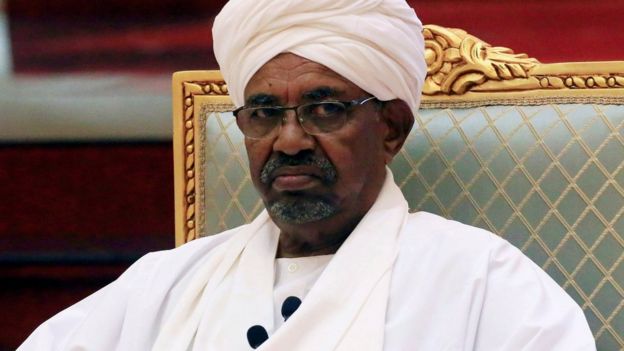 |
| Omar al-Bashir has been in power since 1989 Reuters |
It is far, far from justice, but at the very least perhaps a start in turning Sudan around from its dread ill repute as a nation whose ruler stifled dissent through a scorched earth policy. It seems, on the evidence, a very Arab response to a public outcry against a regime's ill treatment of its minority population, or a majority population ruled by a minority-representative administration -- with the previous examples of Rwanda and Syria, unrivalled in their massive butchery.
Former Sudanese President Omar al-Bashir was responsible for a horrendous slaughter in Darfur when black Darfurians protested their inferior status at the hands of its Arab rulers. Al-Bashir set out to slit the collective throats of Darfur's largely farming community beset and disadvantaged by the preferential treatment of Arab herders -- and in that revolt and its aftermath an estimated 300,000 Darfurians were killed, 2.7 made homeless, and mass rapes perpetrated.
Al-Bashir not only used helicopter gunships to unmercifully shoot down fleeing Darfurians hoping to find refuge in the forests, he bombed them, and urged and armed the mounted Arab militias known as the Janjaweed to pursue, torment and slaughter the Darfurians. When the International Criminal Court named him for genocide and declared him a fugitive from justice, no other Arab regime had the slightest interest in handing him over to the ICC.
The 75-year-old dictator prided himself on his humble beginnings born into a farming family. He had no iota of compassion for the remote villages and farming communities he destroyed in Darfur. He joined the military as a paratroop commander and in 1989 was leader of a coup to take the country from its elected prime minister, in a country accustomed to military takeovers. Leading an Islamist regime intent on embedding shariah law, international jihadis converged on Sudan, Osama bin Laden among them.
The vast country of Sudan was divided among Muslims, Animists and Christians in the south, where a war raged in a battle for independence. Sudan had become one of those wealthy, oil-rich nations enabled to fund modernization of its urban areas, and that enabled al-Bashir to cultivate a culture of one-man-rule exemplified by their president's personality cult; cue Saddam's Iraq, Moammar Gaddafi in Libya, Hosni Mubarak's Egypt and Bashir al-Assad's Syria.
/cdn.vox-cdn.com/uploads/chorus_image/image/63396263/AP_19099493501918.0.jpg) |
When Christian South Sudan gained its independence in 2011 and split off from Sudan its geographic split included most of Sudan's oil riches. Suddenly Sudan became poor again and Khartoum was under pressure. Gradually the economy of Sudan faltered and went into free-fall, an inflation rate of 72 percent, scarce fuel, and living standards collapsing, raising the ire of the urban middle classes leading to a revolt.
The initial protest against rising bread prices spread like wildfire from one town to cities across Sudan, protests led by doctors and other professionals. The protests continued and they swelled, just as they did in Egypt when Mubarak was brought down and the Muslim Brotherhood moved on their opportunity to bring an Islamist to the presidency in Mohammed Morsi. Neither the civil conflict nor the atrocities in Darfur with their enormous loss of life moved Sudanese to revolt; the price of bread did.
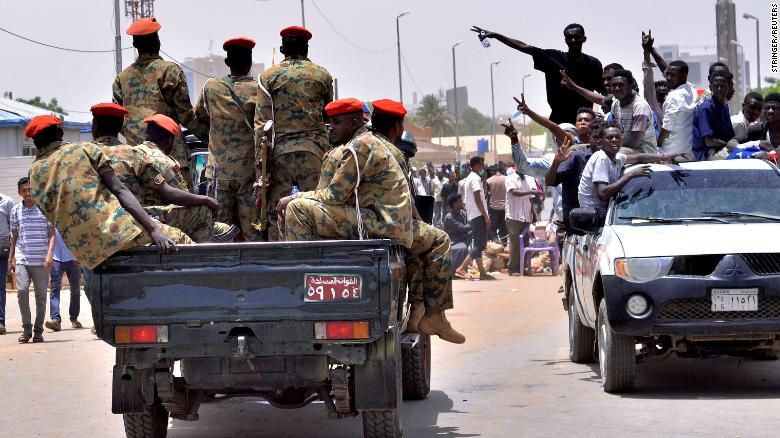 |
| Sudanese demonstrators cheer as they drive towards a military vehicle |
Sudan's top military man, General Awad ibn Ouf, named de facto leader faced the wrath of the demonstrators demanding a transition to democracy under a civilian body. He was forced to make way for another military man, one with no involvement in savage brutality; the former announcement had Sudanese celebrating, the latter had them sputtering with rage, claiming that military rule was simply extending the regime of Omar al-Bashir.
A military tribunal, it was stated, would hold al-Bashir to account for crimes he committed; no doubt the other two Sudanese military elites under al-Bashir's rule indicted by the ICC -- the interior and defence minister and the senior security chief -- will sit on that tribunal as senior military figures. It was emphasized, however, that Sudan is not prepared to hand over their former president for trial into war crimes and crimes against humanity to the ICC; it would humiliate Sudan.
"Revolutionaries, we will continue our path", chant tens of thousands of people rallying in front of military headquarters in protest over the military power takeover, making a travesty of justice of the removal of the former president. "Just fall, that is all!" the crowds chanted, oblivious to the gunfire being exchanged by rival gangs of soldiers.
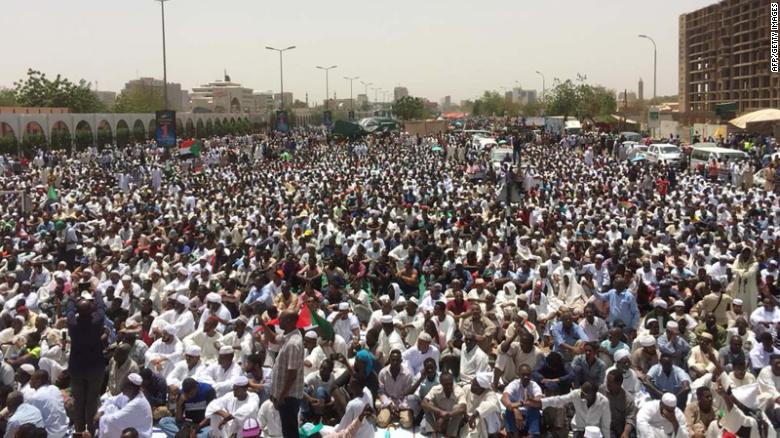 |
| Sudanese protesters gather near the military headquarters in Khartoum as they continue to rally demanding a civilian body to lead the transition to democracy one day after a military council took control of the country, on April 12, 2019. |
Labels: Coup, Darfur, International Criminal Court, Militarization, Sudan
posted by Pieface @ Saturday, April 13, 2019


/arc-anglerfish-arc2-prod-mco.s3.amazonaws.com/public/DNBQ4JGPCRHNBDPKZTYVWBU54Q.jpg)