Sudan: From Islamist Military Regime to Military Rule
"What has been just stated is for us a coup, and it is not acceptable." "Our request for a civilian transitional government has been ignored." Sara Abdelgalil, spokeswoman, Sudanese Professionals' Association
"He's like the spider at the centre of the web -- he could pick up on the smallest tremor, then deftly use his personalized political retail skills to manage the politics of the army." "Most of them [provincial leaders and tribal chiefs] became militarized and enmeshed in one of the popular defence forces. He has that extraordinary network, and it's all in his head." Alex de Waal, professor, Fletcher School of Law and Diplomacy, Tufts University
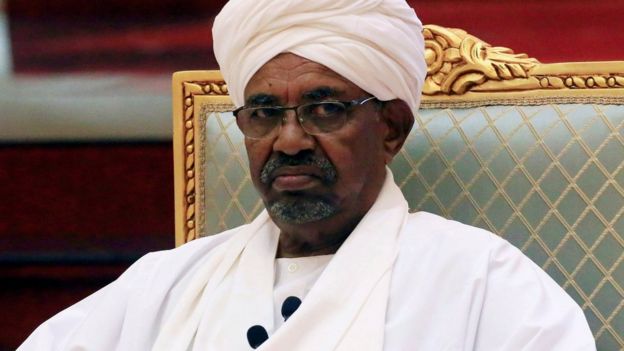
Omar al-Bashir has been in power since 1989 Reuters
It is far, far from justice, but at the very least perhaps a start in turning Sudan around from its dread ill repute as a nation whose ruler stifled dissent through a scorched earth policy. It seems, on the evidence, a very Arab response to a public outcry against a regime's ill treatment of its minority population, or a majority population ruled by a minority-representative administration -- with the previous examples of Rwanda and Syria, unrivalled in their massive butchery.
Former Sudanese President Omar al-Bashir was responsible for a horrendous slaughter in Darfur when black Darfurians protested their inferior status at the hands of its Arab rulers. Al-Bashir set out to slit the collective throats of Darfur's largely farming community beset and disadvantaged by the preferential treatment of Arab herders -- and in that revolt and its aftermath an estimated 300,000 Darfurians were killed, 2.7 made homeless, and mass rapes perpetrated.
Al-Bashir not only used helicopter gunships to unmercifully shoot down fleeing Darfurians hoping to find refuge in the forests, he bombed them, and urged and armed the mounted Arab militias known as the Janjaweed to pursue, torment and slaughter the Darfurians. When the International Criminal Court named him for genocide and declared him a fugitive from justice, no other Arab regime had the slightest interest in handing him over to the ICC.
The 75-year-old dictator prided himself on his humble beginnings born into a farming family. He had no iota of compassion for the remote villages and farming communities he destroyed in Darfur. He joined the military as a paratroop commander and in 1989 was leader of a coup to take the country from its elected prime minister, in a country accustomed to military takeovers. Leading an Islamist regime intent on embedding shariah law, international jihadis converged on Sudan, Osama bin Laden among them.
The vast country of Sudan was divided among Muslims, Animists and Christians in the south, where a war raged in a battle for independence. Sudan had become one of those wealthy, oil-rich nations enabled to fund modernization of its urban areas, and that enabled al-Bashir to cultivate a culture of one-man-rule exemplified by their president's personality cult; cue Saddam's Iraq, Moammar Gaddafi in Libya, Hosni Mubarak's Egypt and Bashir al-Assad's Syria.
Anti-government protests in Khartoum, Sudan, on April 9, 2019. AP
When Christian South Sudan gained its independence in 2011 and split off from Sudan its geographic split included most of Sudan's oil riches. Suddenly Sudan became poor again and Khartoum was under pressure. Gradually the economy of Sudan faltered and went into free-fall, an inflation rate of 72 percent, scarce fuel, and living standards collapsing, raising the ire of the urban middle classes leading to a revolt.
The initial protest against rising bread prices spread like wildfire from one town to cities across Sudan, protests led by doctors and other professionals. The protests continued and they swelled, just as they did in Egypt when Mubarak was brought down and the Muslim Brotherhood moved on their opportunity to bring an Islamist to the presidency in Mohammed Morsi. Neither the civil conflict nor the atrocities in Darfur with their enormous loss of life moved Sudanese to revolt; the price of bread did.
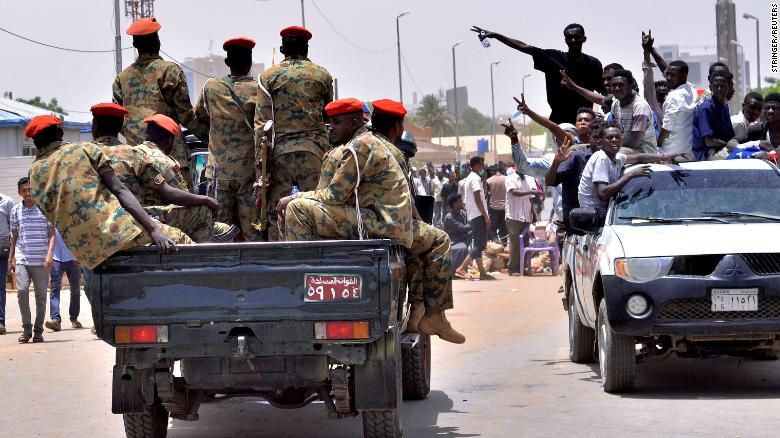
Sudanese demonstrators cheer as they drive towards a military vehicle
Sudan's top military man, General Awad ibn Ouf, named de facto leader faced the wrath of the demonstrators demanding a transition to democracy under a civilian body. He was forced to make way for another military man, one with no involvement in savage brutality; the former announcement had Sudanese celebrating, the latter had them sputtering with rage, claiming that military rule was simply extending the regime of Omar al-Bashir.
A military tribunal, it was stated, would hold al-Bashir to account for crimes he committed; no doubt the other two Sudanese military elites under al-Bashir's rule indicted by the ICC -- the interior and defence minister and the senior security chief -- will sit on that tribunal as senior military figures. It was emphasized, however, that Sudan is not prepared to hand over their former president for trial into war crimes and crimes against humanity to the ICC; it would humiliate Sudan.
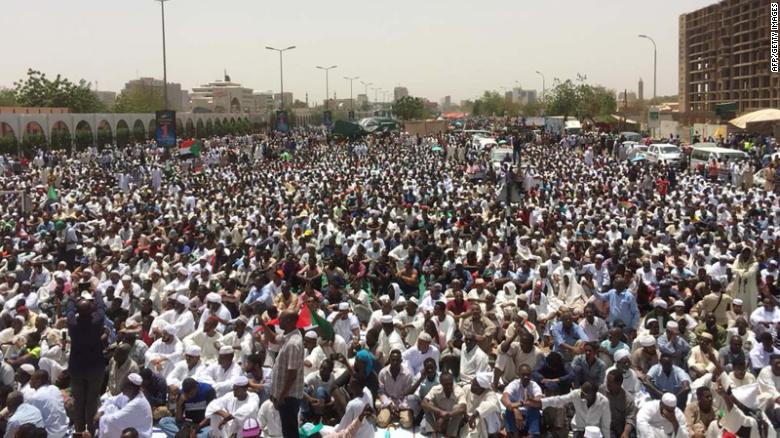
"Revolutionaries, we will continue our path", chant tens of thousands of people rallying in front of military headquarters in protest over the military power takeover, making a travesty of justice of the removal of the former president. "Just fall, that is all!" the crowds chanted, oblivious to the gunfire being exchanged by rival gangs of soldiers.
Sudanese protesters gather near the military headquarters in Khartoum as
they continue to rally demanding a civilian body to lead the transition
to democracy one day after a military council took control of the
country, on April 12, 2019.
"Given the vitriol and hatred toward Grace Mugabe, I suspect she will move in and out [of her mansion in Harare] but spend more time out of Zimbabwe." Welshman Neube, opposition leader, Zimbabwe
"I appeal to all genuine people of Zimbabwe to come together. We are all Zimbabweans ... we need peace in our country and jobs, jobs, jobs." "He [Robert Mugabe] is now the former president of Zimbabwe." Emmerson Mnangagwa, Zimbabwean President-elect
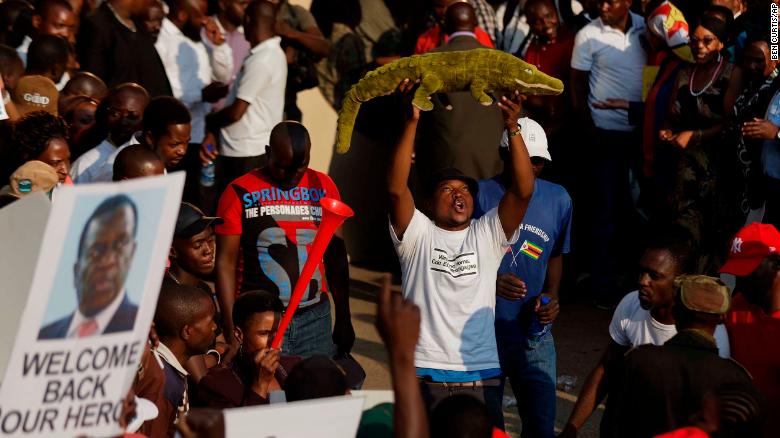
A supporter holds up a toy to welcome Emmerson Mnangagwa, known as "The Crocodile," back to the country on Wednesday in Harare. CNN
Mr. Mnangagwa, Robert Mugabe's former vice-president, is full of praise for the military with which he is closely aligned. He extended his praise to the speaker of parliament and the other party leaders who have all supported the dismissal of Robert Mugabe, Zimbabwean ruler-for-life-almost and their support for his return from exile after his summary dismissal as vice-president and heir to the presidential throne for which he considered himself to have been groomed.
At Mugabe's side for almost 40 years, one of the original freedom fighters who helped sovereignty succeed in independence from foreign rule when his country was Rhodesia, not Zimbabwe -- a British colony -- he is cut from the same cloth as Mugabe. Robert Mugabe may have made the decisions to brutally attack white Zimbabwean farmers and divest them of their holdings, in the process destroying the country's agricultural preeminence, but it was his enforcer, Mnangagwa, who enacted those decrees.
Known for vicious brutality, he was popularly referred to as the 'crocodile'. His own ambitions coincided in lock-step with that of Robert Mugabe's wife Grace -- who succeeded in persuading her doddering husband that she would far better carry on his priceless legacy that impoverished the country, sending it into hyperinflation, raising unemployment to impossible levels, creating food and medicine shortages while she burned through the state treasury on shopping sprees -- and she won.
When she persuaded her husband to dismiss his faithful colleague who had carried out all his destructive orders as the heavy of the team, neither she nor her husband imagined the reaction, which became a popular revolt in the guise of a military coup. While she fled the consequences, her husband remained in place to meet an African Union delegation to persuade him to step down, but he remained steadfast in his belief that he was beloved of his oppressed people until ZANU-PF dismissed him after the failure of diplomacy persuading a tyrant to depart.
Now Emmerson Mnangagwa is prepared to rule in the place of his former mentor. He will complete Mugabe's latest 'term' in office. And in taking his place he will without a doubt truly take his place. The people who believe that they have been delivered from the iron clutches of a tyrant are about to understand that Mugabe's replacement is a replica of the original. This is the fate of Africans; to be abused by one tyrant only to face similar abuse by another. The next 'election' will be held under the same conditions as all those which saw Mugabe 'elected' and re-elected.
As for the ambitions of Grace Mugabe, while they are shattered in the political-power sphere, she still has all the riches that she looted from the country that has reeled in a state of dysfunctional poverty for years. The agreement was reached that Mugabe and his family will remain in the country and permitted to retain possession of their 'assets'. The vast mansion in Harare that Grace Mugabe looted the treasury to build to house the nation's first lady will remain hers.
The farms she commandeered from other black Zimbabweans who had been allotted them after their divestiture from their white owners may be another thing, if anything remotely resembling justice and an effort to put Zimbabwe back on a working track is pursued. As for the vast wealth acquired by Grace Mugabe as the largest landholder and real estate portfolio in the history of the country, her personal adornments, designer clothing and jewellery, and the way she managed to acquire it all, who knows?
In continued deference to the elder statesman of African leadership post-colonialism -- a man whom even Nelson Mandela made no effort to reprimand for his ruination of a nation and his racial abuse -- for whatever few years left of his life Grace Mugabe will be safe. On his death she would be well advised to make her presence in Zimbabwe a mirage, taking with her into exile whatever she can spirit out of the country. The crocodile has a maw full of vengeful teeth.
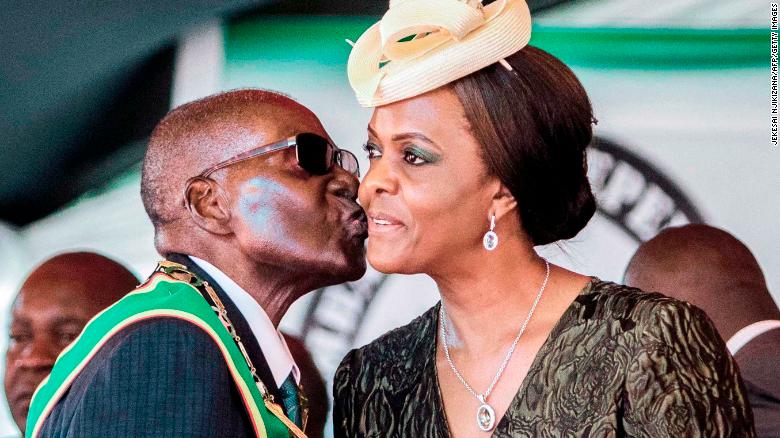
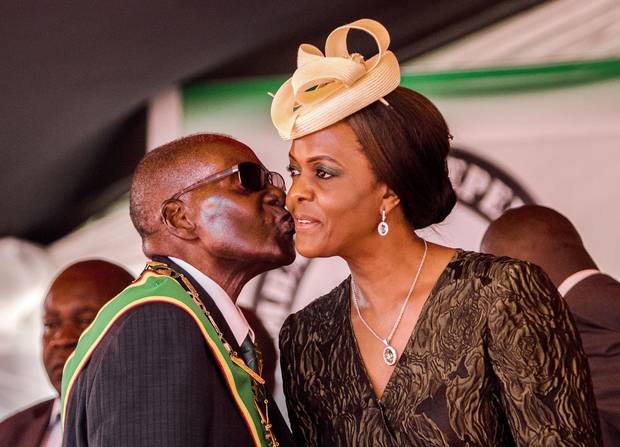
Robert Mugabe kisses his wife, Grace Mugabe, at Independence Day celebrations in Harare on April 18, 2017 CNN
"This is political theatre. Chiwenga and the army want to give Mugabe a soft landing, a dignified exit." "They are working on the choreography of how this will be done. By calling a full summit (the regional leaders] are showing respect for Mugabe, the last of the liberation war heroes. Mugabe wants the full fanfare as he exits stage left." "The regional leaders will be showing deference to Mugabe, even though they can't wait to see the back of him." Piers Pigou, southern Africa expert, International Crisis Group
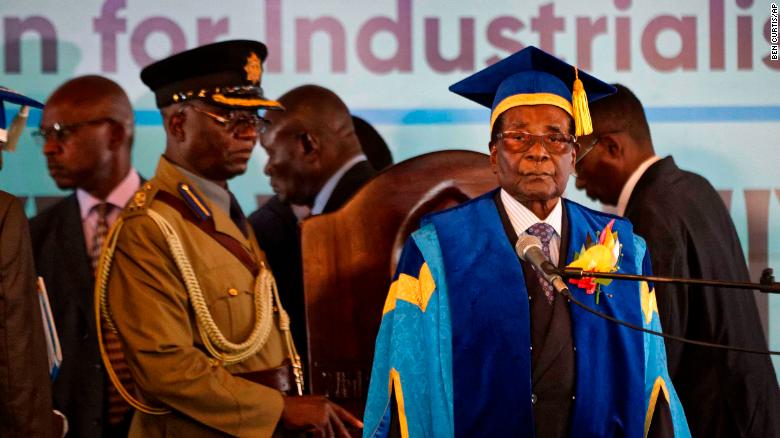
Zimbabwe's President Robert Mugabe, right, arrives at the Zimbabwe Open University in Harare. CNN
Isn't this typical Africa? That Mugabe transformed Zimbabwe from its colonialist oppressor state as Rhodesia and succeeded in bringing his country to independence was indeed something to celebrate. Initially, the white government in power, acceding to African rule as natural justice would have it, that the original inhabitants of a land and the vast majority of the country needed to shake off the shackles of third-class inhabitants to re-assume their heritage status represented an honourable undertaking and victory.
That the man who won independence for his country, renaming it and declaring that Black Rhodesians as Zimbabweans proud of their ancestry and their rule over their own land could also be generous in victory, slowly became transformed himself by 37 years in power to end up so harming the future prospects and prosperity of his country that he destroyed it, was unforgivable. His tyranny ensured that all the land was returned to black rule, including farms owned and operated by white Zimbabweans for generations, as functional, producing sources of food to feed the nation.
That all fell by the wayside as white farmers were violently thrown off their land, their properties confiscated and handed over to those who could claim they were in the forefront of freeing the country from its white oppressors. Which might have been viewed as just desserts, but which in the end, destroyed the nation's agricultural industry it once exported abroad as well as feeding itself. Now, food and commodities are scarce, unemployment is high, inflation skyrocketed and currency hugely devalued.
Supports of Zimbabwean opposition leader Morgan Tsvangirai rally in
Harare in August. The long-time MDC Leader’s illness but refusal to step
down has left the party rudderless, and in ‘a very bad place,’ one
activist says. JEKESAI NJIKIZANA/AFP/Getty Images
Opposed by a political party that is moderate in its outlook and a leader not seeking self-aggrandizement but the opportunity to lead the country back to prosperity and sound management, Morgan Tsvangirai, once dismissed from power sharing as leader of the MDC may be given the opportunity to return to government. Unless, as seems more likely ZANU-PF, Robert Mugabe's ruling party to which the nation's military appears loyal, will re-invest the presidency with the man Mugabe and the party had groomed to be his successor, a man with the same cutthroat instincts as Mugabe, named "the Crocodile", an erstwhile enforcer for Mugabe.
Envoys representing South Africa's Jacob Zuma, himself an embattled president mired in corruption and self-availment, had been tasked with persuading Mugabe that it would be in his best interests and that of the nation to 'resign' his presidency at age 93. While his wife Grace Mugabe has already fled Zimbabwe, knowing that the dismissed vice-president Emmerson Mnangagwa, who along with General Constantine Chiwenga, head of the armed forces would be likely to hold her accountable for Mugabe's latest excesses and insistence that she be his replacement, he had steadfastly refused to 'resign'.
Sanctioned by the United States in 2003 identifying him as one among other officials "who undermine democratic processes and institutions in Zimbabwe", Mnangagwa, widely considered to be as corrupt and abusive as Mugabe, is supported by the military and as such more likely than Tsvangirai, to replace Mugabe. The result of which could be that Zimbabwe's brief celebration at the removal of their dictator will be short-lived, when a replacement dictator steps in.
Robert Mugabe kisses his wife Grace during during the country’s 37th
Independence Day celebrations at the capital, Harare, in April, 2017.
Her unpopularity may drive voters to opposition camps, a senior member
of a rival party says, as she is ‘the most hated woman in Zimbabwe.’
JEKESAI NJIKIZANA/AFP/Getty Images
Mugabe's authoritarian rule and mismanagement of the country leading to the steep economic decline of the nation has made him a deeply unpopular figure, although he himself thinks that he is held in deep affection by ordinary Zimbabweans. That his wife Grace Mugabe, continued to spend huge sums of state treasury on designer clothing, jewellery, the building of several mansions, throwing costly parties while ordinary people suffered economic marginalization and scrounged for food, certainly failed to endear her to the population.
The unfortunate thing is that there will be no 'clean sweep' of the stables in this country; one corrupt megalomaniac will simply replace another. And the envoys from the Southern African Development Community which had sent them to appease Mugabe's hurt feelings by assurances given to him that he remains fondly regarded as one of the heroes of African liberation, will return whence they came, satisfied with a job well done.
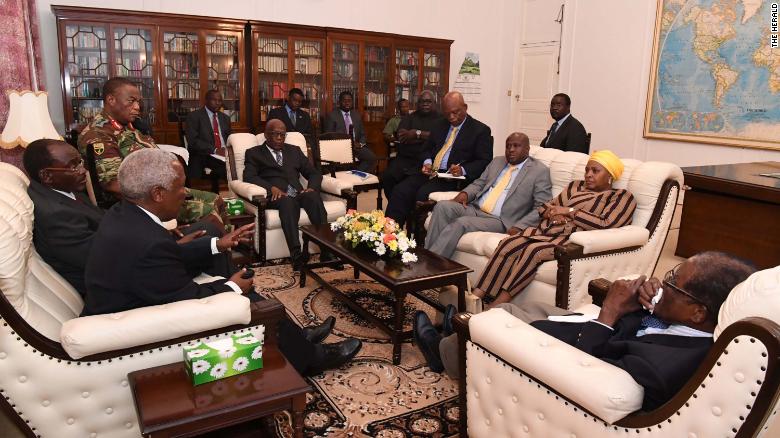
Mugabe in talks about his future, in this image tweeted by the editor of Zimbabwe's Herald.
"Since
2014, when Mr. Erdogan was elected president after 11 years as prime
minister, he has sought to transform Turkey from a parliamentary
democracy into an “executive presidency,” essentially without checks on
his power. In that context, Mr. Erdogan’s recent statement that the
failed coup was a “gift from God” is ominous. As he seeks to purge still
more dissenters from government agencies — nearly 70,000 people have been fired so far
— and to crack down further on Hizmet and other civil society
organizations, he is removing many of the remaining impediments to
absolute power. Amnesty International
has revealed “credible” reports of torture, including rape, at
detention centers. No wonder Mr. Erdogan’s government suspended the
European Convention on Human Rights and declared a state of emergency."
"Turkey’s
president is blackmailing the United States by threatening to curb his
country’s support for the international coalition against the Islamic
State. His goal: to ensure my extradition, despite a lack of credible
evidence and virtually no prospect for a fair trial. The temptation to
give Mr. Erdogan whatever he wants is understandable. But the United
States must resist it."
"Violent
extremism feeds on the frustrations of those forced to live under
dictators who cannot be challenged by peaceful protests and democratic
politics. In Turkey, the Erdogan government’s shift toward a
dictatorship is polarizing the population along sectarian, political,
religious and ethnic lines, fueling the fanatics."
"For
the sake of worldwide efforts to restore peace in turbulent times, as
well as to safeguard the future of democracy in the Middle East, the
United States must not accommodate an autocrat who is turning a failed
putsch into a slow-motion coup of his own against constitutional
government."
Fethullah Gulen, Islamic scholar, preacher, social advocate.
"In 2001, the Justice and Development Party—known by its Turkish
initials, A.K.P.—was founded by a group of men led by Tayyip Erdoğan. A
dynamic former mayor of Istanbul, Erdoğan had recently emerged from
prison; he had been jailed by the country’s military leaders after
giving a speech that included the lines “The mosques are our
barracks . . . and the believers our soldiers.” The next year, he
announced his candidacy for Prime Minister. In campaign speeches, he
proclaimed himself an Islamist, a voice for pious Turks, but he also
promised to keep Islam out of politics."
Dexter Filkins, The New Yorker
Supporters of Turkish President Recep Tayyip Erdogan are dispersed with shots in the air by the military at Taksim Square on the night of July 16, 2016, in Istanbul, Turkey. Murad Sezer -- Reuters
One of Turkey's philanthropists, a liberal, secular activist, became the focus of Recep Tayyip Erdogan, who had him arrested and imprisoned on two charges, one of which was his "contact with Henri Jak Barkey and foreigners who were among the organizers of the July 14, 2016 coup attempt". That liberal activist, Osman Kavala, was supposedly in attendance and conspired with an American academic, Dr. Henri J. Barkey who had convened an academic workshop on Iran on an island close to Istanbul.
That was the fateful night of an attempted coup against Recep Tayyip Erdogan. That failed coup resulted in a hard backlash, giving the Turkish President the opportunity to mount a campaign of massive proportions, one of repression on a wide, indiscriminate scale that is still raging through the country. Professor Barkey knew nothing of the coup and its immediate aftermath. He had a conference to speak at, a workshop for academics, and he proceeded to honour his commitment to those present from within the Turkish academic community. After which he left Istanbul to return to his home in the United States.
And then he discovered how prominent he has become in the Erdogan sphere of punishment meted out for criminal action against the state of Turkey, with the media shouting headlines that he had appeared on Buyukadanot Island at that academic workshop for a covert purpose which had nothing to do with foreign relations with Iran, but to focus on manoeuvres linked to the coup. Unknown even to himself he was the link between the CIA and the attempted coup that went awry.
The professor, most comfortable in his bailiwick, teaching at Lehigh University and alternately appearing at Washington think tanks along with aiding the State Department's policy planning staff, had no idea he was a tool of the CIA, involved in undercover work and intelligence, tasked with directing the failed coup. Five Turkish scholars who had been in attendance at that conference have been stripped of their passports and temporarily detained, their academic credentials completely defamed.
People occupy a tank during the attempted coup -- Tolga Bozoglu, EPA
Now news that a Turkish prosecutor has issued a warrant for Professor Barkey's arrest. Also charged was Metin Topuz, a U.S. consular employee. Detained by Turkey several weeks ago, that detention was the spark that led to a standoff seeing both countries suspend issuing visas. And nor did Metin Topuz as well attend the conference; his name has no familiar ring to Professor Barkey. So, then, among the 140,000 Turks that have been imprisoned, fired or sanctioned by the Erdogan administration among whom are 150 journalists and 6,000 university employees, are these three men, philanthropist Kavala, diplomat Topuz and Professor Barkey.
Propagandists for Erdogan insist that Professor Barkey had brought along with him from the U.S. a convicted murderer named Scott Peterson, a man imprisoned in California presumably interchangeable with an American journalist who happened to be at the meeting, with the very same name. It is clear in Turkey that the United States government and its international intelligence arm were deeply involved in the plot led by Erdogan's nemesis Fethullah Gulen, the man behind the coup.
Erdogan's charges have been proven beyond a doubt; hasn't he after all, been unsuccessful in persuading the U.S. government under two administrations of the necessity of surrendering the Turkish Gulen living in Pennsylvania to Turkey to face his due punishment?
A
file picture from March 15, 2014, shows Fethullah Gulen, an Islamic
scholar and founder of the Gulen movement, during an interview at his
residence in Pennsylvania. Selahattin Sevi—Zaman Daily News/EPA
"This is so offensive and disappointing. They see us as enemies." "I think about this a lot It's very disappointing, sad, even frustrating." Anar Mehraliyev, principal, girls' campus, Nile Academy, Toronto
"[The wider world] didn't really grasp the seriousness [of the July 15 coup attempt in Turkey]." "[Its occurrence revealed the presence of a covert] parallel state [controlled by exiled preacher Fethullah Gulen], prepared to blackmail and slaughter toward power." "It is not a small, disorganized thing. It was an organized and serious thing." Selcuk Unal, Turkey's Ambassador to Canada, Ottawa
Tanks moved into position as Turkish people
attempt to stop them, in Ankara, Turkey, during the attempted coup. (AP)
Just as China maintains a deadly focus on Falun Gong practitioners around the world, persecuting, arresting and torturing them to the extent of extracting their bodily organs for transplant, and killing them, Turkey is now focusing on what they classify as a movement to destroy the current government and to effect the takeover of Turkey by Gulenists, followers of the man whom Recep Tayyip Erdogan and his Justice and Development Party consider a traitor to Turkey whom the death penalty awaits.
Ankara now accuses the United States of being involved in the plot to unseat Erdogan and his Islamist party in favour of allowing Fethullah Gulen, self-exiled in the United States, to return to Turkey as its new leader. Turkey has insisted in his extradition to stand trial for ordering the coup. Reasonably enough, the United States asks that evidence be produced implicating Mr. Gulen, that would move them to surrender him to his political adversaries, rabid for his head.
Famously, or infamously now as the case may be, there is a huge demographic of Turks in Germany, originally brought in as labourers and never meant to be citizens, but citizens they now are, and Turkey has financed countless mosques to be built in Germany, along with the financing by Saudi Arabia of mosques and madrassas. Erdogan insists that German Turks are under his care, and he bullies the German government to reflect his care of German Turks.
He is now turning his attention to the international community, tasking those whose population includes Turks, Canada included, to root out the evils of Gulenism. To close down, as he has done, the Gulen-funded Hizmet schools; above all to extradite their leaders to Turkey, so the nation, increasingly Islamized under the Justice and Development Party, and prepared to reinstate the death penalty, can dispose of them.
Turkey has intensified a sweeping crackdown on the media, the military,
the courts and the education system following an attempted coup,
targeting tens of thousands of teachers and other state employees
believed to have links with Fethullah Gulen for dismissal. (ALKIS KONSTANTINIDIS / REUTERS)
At the Gulenist-sponsored Hizmet school of the Nile Academy in northwest Toronto, students follow the Ontario academic curriculum. The instructors on behalf of the small Turkish community reflecting Gulenism, teach their students the basic tenets of of Gulenist religious sensibilities where the sentiment, "The highest result of education is tolerance" represents the Gulen philosophy. The Turkish and other Muslim students are taught an inclusive faith.
President Erdogan and his Islamist party have embarked on a witch hunt, arresting and imprisoning tens of thousands of military, police, lawyers, teachers, journalists, government workers; anyone he suspects of belonging to the Gulenist movement. A purge of academia, the judiciary, the military and police is continuing including the detention of two Canadian Turks on charges of allegiance to Gulen.
Several decades ago the Turkish media featured advertisements about settling in Canada, and many among the disenfranchised and persecuted Gulen-supporting Turks emigrated from Turkey to Canada. Other Turkish-Canadians who don't support the Gulenists view them with contempt as traitors. Though Canada is a country of immigrants, it is also riven by contrasting values reflecting the culture they fled from.
"Mao and the Iranian Revolution are the ones that come to mind. But these were revolutions. You expect this [wholesale purge of the military, the judiciary, the police, the news media in Turkey]." "So the interesting question is, Is Erdogan having his own revolution? He is going to completely restructure the Turkish state." Henri J. Barkey, Turkey expert, Woodrow Wilson International Center for Scholars, Washington
"We knew a lot, but either we didn't have enough legal basis or the time [to remove the Gulenists from government]." "We are not making up these stories; this is not some Jason Bourne trilogy. We have these massive cells, networks, and they have a bank. They have massive financial resources." Mehmet Simsek, deputy Prime Minister, Turkey
NewStatesman, Taksim Square July 24, 2016
Recep Tayyip Erdogan has been patient up until the last few years. The first decade of his Justice and Development Party's election victories saw a Turkey being governed by a man who appeared reasonable and a capable administrator. The economy was doing well, there was an eventual ceasefire agreement with the Kurds and there were no border problems, before Syria imploded under the weight of its sectarian violence.
And a man whose view of Islam seemed to echo Erdogan's own, a religious scholar of great repute and following who had supported the early Erdogan was a friendly colleague. Over the succeeding years, however, Erdogan's inbred ego became more difficult to restrain and the corruption of his administration more difficult to hide, and a sundering of relations occurred between Fethullah Gulen and the autocrat.
The Turkish intelligence service was instructed to investigate the suspected fifth column within Turkey. Years were spent putting together dossiers on tens of thousands of Turks across the country; links with Mr. Gulen, proven and unproven were all noted and stored for use. Those tens of thousands are inclusive of civil servants who had suddenly become state enemies, traitors, loyal to the the cleric now in self imposed exile, not Turkey, not Erdogan ... or so claims Erdogan.
The coup which resulted when some of those in the military realized that they were being sidelined and preparations were underway to arrest them reacting by mounting a coup hoping to pre-empt the inevitable, has given Erdogan the opportunity he has craved, to consolidate his tight Islamist control of the country, giving himself, in the guise of protecting Democracy, the powers that he has longed to vest in the presidency. The coup failure has led to an immense paroxysm of purging.
Foreigners looking in at the result of the failed coup might wonder how it might be possible for a country to hit back so relentlessly and fulsomely on those it claims to be involved, clearly having no idea of what Erdogan is capable of. The initial purging of the military a decade ago was merely the start. Turkish officials have long been tasked with identifying traitors; well before the attempted coup lists of military officers and others whose loyalties were suspect, were established.
The country's intelligence service came into possession of a surreptitious channel of communications where tens of thousands of names and identification numbers linking people to Fethullah Gulen's movement were found, a veritable bonanza. Among those names was 600 military officers. The armed forces were notified of those names with instructions to sideline all those suspected; when promotions were announced they would not be among them.
Any groups who the government suspects of disloyalty: political opposition groups, secularists, nationalists and Kurds who had all supported the government when the coup was underway, are now witnessing a concerning display of troubling responses to the coup. They have reason to be concerned; the purge that is decimating soldiers, police, teachers, journalists and government officials is likely to reach a little further, to include many of them, as well.
Schools and universities have been shuttered; if this is democratic rule in practise, it is a variant on the kind of democracy that most nations recognize. Media outlets have been targeted with the closing of 45 newspapers, three news agencies, 16 television channels, 15 magazines and 29 publishers, lest they seek to publish information that might render unto the population statistics and concerns of troubling legitimacy.'
As for any who might presume to stand in the way of Erdogan's now-inevitable expansion of presidential imperial powers, the arrest of thousands of judges and prosecutors, placed in detention along with dozens of foreign ministry employees who were fired allegedly for links to Gulen, bodes well for Erdogan's fuutre, and ill for the country, a Western ally, a NATO member, the link between Europe and the Middle East.
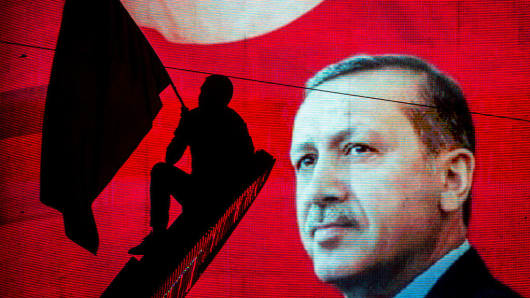
A supporter of Turkish President Recep Tayyip Erdogan waves a flag
against an electronic billboard during a rally in Kizilay Square on July
18 in Ankara, Turkey. Continuing raids across the country have seen
thousands detained, suspended or arrested, including high ranking
soldiers, judges and police officers.
The Planned and Ongoing Purge -- to be Indefinitely Extended
"The aim of the declaration of the state of
emergency is to be able to take fast and effective steps against this
threat against democracy, the rule of law and rights and freedoms of our
citizens." "We will remain within a democratic parliamentary system. We will never step away from it." "No democracy shall allow for soldiers, prosecutors, police, judges and bureaucrats to take orders from an outside organization instead of the institutional bureaucracy." Turkish President Recep Tayyip Erdogan
Chris McGrath | Getty Images A supporter of Turkish President Recep
Tayyip Erdogan waves a flag against an electronic billboard during a
rally in Kizilay Square on July 18, 2016 in Ankara, Turkey.
Which statements have paved the way seamlessly for Erdogan to press the United States to extradite the influential Turkish cleric who had once supported his presidency, but who several years ago distanced himself and his Gulenist movement from the Justice and Development Party and the Turkish President, influenced by the revelations of corruption and cronyism and the increasing evidence over the past several years of Erdogan's transition to a tyrant under the guise of a democrat.
Now, a declaration of a national state of emergency. A move that post-dates the detention of over 6,000 armed forces personnel, ranging from foot soldiers to their commanders, along with the suspension of almost three thousand judges and prosecutors, ostensibly with links to Fethullah Gulen, whom Erdogan accuses of authorizing the failed coup against his presidency. Turkish courts and the rule of law will henceforth reflect Erdogan's wish and will. The police have once again been purged by eight thousand of their members in both Ankara and Istanbul. Media outlets considered supportive of Gulen have been shut -- and that is on top of the media that have already been shuttered or placed under the management authority of Erdogan supporters. Turkey, even before this situation erupted, stood 151st in the world of countries that repress journalists and legitimate news outlets, ranking at the very bottom. The Education Ministry has overseen the suspension of over 20,000 teachers and administrators. The country's intelligence agency has dismissed one hundred of its officials, while 492 people have been suspended from the Religious Affairs Directorate, 257 from the office of the prime minister, and 300 employees dismissed at the Energy Ministry; relieved from duty as suspected of being disloyal to Sultan Erdogan. He vowed revenge, and he's working on it. By all indications he will be working on it for a long, a very long time.
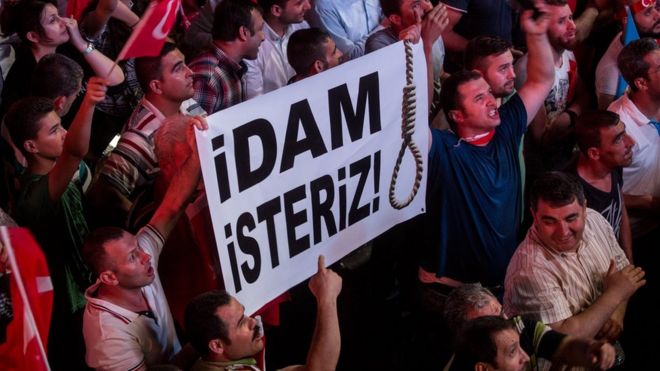
Demands for vengeance have been
prominent in the mass demonstrations in support of the president - such
as this sign, which reads: "We want to execute" Getty Images
All military judges and prosecutors are to be investigated by the Defence Ministry and it has taken preliminary steps to suspend 262 who have been designated disloyal. In Ankara, 900 police officers have been dismissed, the purge extending to civil servants working in the environment and sports ministries. Roughly one third of Turkey's approximately 360 serving generals are being interrogated, detained for an uncertain period, perhaps until they confess under duress. As it is, of that number 99 have been charged, awaiting trial. It will seem a familiar process to them. The country has transitioned from the turmoil and uncertainty of discreet conflict against the Syrian regime [not to arouse the wrath of Moscow]; the Islamic State which it once aided, and the Kurdish PKK which it has always hated. It is the administrative middleman between millions of Syrian refugees in Turkey and their desperate transit to Europe, where Erdogan felt confident his gatekeeper status would finally earn him entry to the European Union. That is now in jeopardy as is his due, with his crocodile statement that Turks insist on a return to the death penalty.
Under the state of emergency, academics may no longer travel abroad, said to be a temporary measure to ensure that the risk of alleged coup plotters at universities planning to flee the country cannot materialize.
TRT state television announced the removal from their Istanbul University posts of 95 academics. The state of emergency, according to Erdogan, will be of three months' duration to permit his government to take the swift action required to shut down any further avenues of dissent with his rule.
His goal to change the constitution to give the presidency imperial powers is certain to proceed. Just as emergency rule allows the president and his cabinet to bypass parliament to pass new laws and limit or suspend rights and freedoms as deemed necessary in their unopposed opinion. Who now, will after all, dare to oppose him and his minions? His courts have ordered the generals held in custody, charged with supporting Fethullah Gulen.
Former air force commander General Akin Ozturk, the alleged ringleader of the July 15 attempted putsch and General Adem Hududi, commander of the country's 2nd Army charged with countering threats from Syria, Iran and Iraq are out of commission, and no doubt nursing the debilitating physical blows they accidentally came across through interrogation into their desperate intrigues. To be joined by Erdogan's Air Force adviser, Lt. Col. Erkan Kivrak, disloyal despite his inner-circle status.
Meanwhile, dossiers outlining details of Gulen's actions are now in American authorities' hands. But without conclusive evidence that verifiable charges by Erdogan against Mr. Gulen are included, the insistence that the United States extradite the cleric from his home in Pennsylvania back to Turkey will not net Erdogan the response he insists upon. At which juncture he will be able to voice his displeasure by castigating the United States for being a co-conspirator in the failed coup.
At which point Turkey's continued membership in NATO may suddenly be considered moot.
"We will certainly support bringing the
perpetrators of the coup to justice but we also caution against a reach
that goes well beyond that."
"[The EU and US] urge the government of Turkey
to uphold the highest standards of respect for the nation’s democratic
institutions and the rule of law.” U.S. Secretary of State John Kerry
"The rule of law must prevail."
"France has condemned the coup, you can’t
accept the military taking power. At the same time we have to
be vigilant that the Turkish authorities don’t put in place a system
which turns back democracy." French Foreign Minister Jean-Marc Ayrault
"[The Erdogan administration] squandered [the opportunity to transform the country into] a functioning democracy that upholds universal human rights, gender equality, the rule of law and the rights of Kurdish and non-Muslim citizens." "Government should be won through a process of free and fair elections, not force." Exiled Turkish Muslim cleric Fethullah Gulen, Pennsylvania
"Bottom line is the relationship between the government and the military, no matter how loyal the generals may claim to be in future, is broken for good." Chris Kilford, former Canadian military attache to Turkey, expert on Turkish military
An
armed Turkish police officer stands guard during a funeral ceremony for
victims of the failed July 15 coup attempt at Kocatepe Mosque in Ankara
on July 17, 2016. (ILYAS AKENGIN / AFP)
The United States and the European Union have warned Turkey to respect the rule of law after President Recep Tayyip
Erdogan’s government launched a massive crackdown following the failed
coup, arresting over 7,500 people and removing over 9,000 from the military, the police and the judiciary ... and particularly after hearing Erdogan musing that it's time to bring back the death penalty.
Strangely enough, the government was in possession of a list of thousands to be detained and arrested even before the coup attempt took place. That list was prepared for the same purpose to which it has now been put, and word of its existence has been rumoured to be the reason why the attempted putsch took place when it did; before those leading the attempt to remove the Justice and Development Party and President Erdogan from power were really prepared to take that final step in their long-simmering plans.
According to Turkey's state-operated Andalou news agency, Turkey’s former military attache to Israel reportedly has confessed
to plotting the failed military coup to unseat President Recep Tayyip
Erdogan. Apparently, Akin Oturk confessed while under the process of interrogation. Photographs published in Turkish media show Ozturk, formerly
chief of the Turkish Air Force, with injuries to
his head and upper body.
The coup that left several hundred dead and several thousand wounded is over. Led by air force, military police and armoured units, senior commanders of the military appear to have closed ranks behind Erdogan. The presumed thousands of accused plotters were speedily detained leading to new purges in the military to ensure that anyone with a whiff of sympathy to the coup among soldiers and officers to be summarily removed.
The commander of the nation's second army based in eastern Turkey to counter threats from Syria, Iran and Iraq was arrested. "A new wave of purges in the military will likely weaken overstretched security services ... even if basic policies will remain the same", was the opinion of Howard Eissenstat at St.Lawrence University in Canton, N.Y. Most of Erdogan's military adversaries had already been jailed long before the failed coup erupted.
Turks
waving their country’s flag at a rally in Ankara in reaction to the
failed military coup, July 17, 2016. (Chris McGrath/Getty Images)
Democracy under Erdogan and his Justice and Development Party has gradually eroded as civil liberties have been constrained. Newspapers and television stations in opposition to Erdogan were shuttered and occasionally new managers brought in to manage them. A thousand journalists and editors found themselves unemployed. Anyone who dared criticize Erdogan on social media found themselves charged and facing court action.
There may have been a few popular protests against Erdogan, promptly countered by security police, tear gas and rubber bullets, but for the most part, though secularists decried the changes Erdogan brought in countering the former long-lived Ataturkian Western-oriented values, the growing influence of Turkish Islamists has ensured that the Justice and Development Party had maximum electoral support. Stunningly, post-coup, Erdogan's popularity level has risen.
His roundup of 70 of Turkey's 350 generals and admirals is consolidating his power, and yet the deep divisions that are present within the armed forces will not dissolve. Thanks to social media and communications capacity Erdogan was able to call out his supporters to defy troops on the streets to kill them, leading the soldiers to hesitate and spelling the end of the coup.
Akin Ozturk, member of the Turkish Supreme Military Council, included the president's top military adviser in his coup's inner circle and the commander of the Second Army among his coup cohorts. . He was in command of the main airbase (Incerlik) used by America troops. At the pinnacle of the coup, rebel pilots of two F-16 fighter jets had Erdogan's plane in their sights as he returned to Istanbul from the coastal resort of Marmaris.
"Why they didn't fire is a mystery", mused one former military officer. In an obvious attempt to seize Erdogan, 25 soldiers descended from helicopters on the Marmaris hotel from ropes, shooting as they rappelled, but simply minutes late, after Erdogan had departed. I must have come as a shock that among the names of plotters was Erdogan's military aide from his intimate inner circle, involved -- or accused of having been involved.
With his popularity level at such astronomical levels who now will be able to stop Erdogan from changing the country's constitution to remake the presidency into the imperial stronghold he envisions befitting a benevolent tyrant anxious to hold the title of imperial power to match the sumptuous glory of the imperial palace he built for himself as a caliph as of yore?
"[The aborted coup d'etat represents' an attempt at an uprising by a minority within our armed forces." "They will pay a heavy price for their treason. The process has started today and it will continue just as we fight other terrorist groups." "I'm making a call out to my people. I'm inviting them out to all our public squares. I'm inviting them out to our airports. Let us gather in our squares, at our airports as the people and let that minority group come upon us with their tanks and artillery and do whatever they wish to do." Turkish President Recep Tayyip Erdogan "Those who are attempting a coup will not succeed. Our people should know that we will overcome this." Turkish General Zekai Aksakalli, commander, military special forces
"[We have seized control] to re-install the constitutional order, democracy, human rights and freedoms, to ensure that the rule of law once again reigns in the country, for the law and order to be reinstated." Coup leaders statement
People stand on a Turkish army tank in the capital Ankara [Tumay Berkin/Reuters]
The arrogant presumption of a man claiming his determination to protect the very democracy he has altered to suit his personal taste is responsible for the delayed reaction of a significant proportion of the Turkish military, demeaned and subjugated, held in contempt, cleansed of its 'secular' generals and kept in tight control by Islamist defenders of the faith has come back to clamp its aggravated teeth on the seat of Erdogan's expensive trousers. He felt confident he had eradicated officers who might wish to return the nation to its traditional secular status separating faith and state.
Friday night it seemed certain that those members of Turkey's armed forces who remained loyal to the democratic European vision of Kamel Ataturk, in taking the initiative while Mr. Erdogan was on vacation outside the country, had taken control of the country. The background of troop movement, helicopters overhead, explosions, gunfire and an air battle between the coup helicopters and loyalist military warplanes marked the wholesale, unexpected violence that was taking place.
And when Turkey's president called on Turkish citizens to get out on the streets to demonstrate their support for his government, he was calling on people to place themselves in high danger to satisfy his need to demonstrate that there are Turks prepared to sacrifice their safety for his ongoing demagoguery as a leader intent on destroying the country's democratic credentials, wedded to his rage at Turkish Kurds, his appetite to destroy the judiciary, to criminalize journalists who criticize him and his support of fanatical Islamism.
Turkey has not, in reflection of its past, been entirely comfortable with Erdogan's authoritarian rule; that he ran afoul recently of another authoritarian with an ego as large as his own, equally given to self-boosterism and sidelining state finances to erect palatial palaces while engaging in raging conflict with those who defy them, sank Turkey further into a state of isolation on the world stage. His crackdown on dissidents and the media expressing an opposing opinion to his own is legendary.
Brutalization of the Turkish Kurdish population in the southeast of the country while portraying them as prepared to destroy the country through their separatist agenda brought the country to an embattled state, fighting Syrian and Turkish Kurds while finally ending support of Islamic State terrorists to pretend to confront them on the battlefield, as a NATO member.
Soldiers had blocked Istanbul's main Ataturk Airport with four tanks stationed there and another two along with a military vehicle before the VIP terminal for the obvious purpose of denying Erdogan return to the country. All flights were stopped when soldiers entered the flight tower. The headquarters of the TURKSAT satellite station and Ankara police headquarters were attacked. A palace in the use of the prime minister and deputy prime ministers had a dozen tanks moving toward it.
The purge of the army high command, Erdogan's accusations against senior officers of coup plotting and the hundreds he had placed on trial during the "sledgehammer" cases has all waited silently in the background, simmering on low heat until the coup plotters felt sufficiently prepared to mount a real coup. Had they been successful Erdogan's determination to rewrite the constitution to give himself imperial presidency powers in perpetuity would have been stopped.
On the other hand, Turkey has the government a majority voted into power. Those Turks who are unhappy with the Justice and Development party are not in the majority. That the majority has been influenced by the propaganda machinery of an Islamist party speaking to those who already share its political ideology but who have been willing to be convinced that malign forces conspire to destroy Turkey and its cultural and religious values is only a partial explanation.
President Erdogan can now go on to claim that foreign interests were involved in motivating the coup leaders to strike against his rule, his party, the elected government and the people of Turkey. The very fact that it took a military coup, not an election to attempt to remove this man and his party from government will be validation enough for his claims that 'terrorists' have attempted to hijack the Turkish agenda to favour the evil plans of outside sources.
If it weren't for the fact that Erdogan was forced by the country's increasing isolation and failing economy, complicated by conflict on all fronts, to make peace with Russia and with Israel, he might have pointed the finger of blame at Israel which has in fact extended its support for him in a display of Realpolitik. On the other hand, he could still hint darkly at a "Jewish conspiracy" that succeeded in conspiring to persuade disloyal members of the military to topple him.
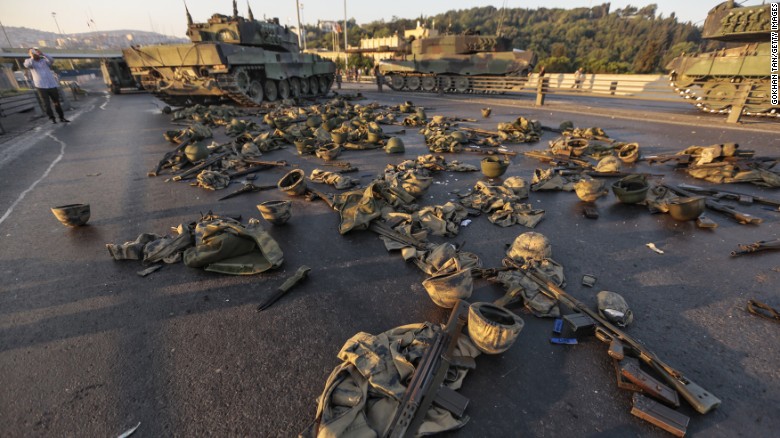
Clothes and weapons belonging to soldiers involved in the coup attempt lie on the ground abandoned on the Bosphorus Bridge. CNN
"The reconquest of Crimea has caused a clear change of tone in Moscow, with celebration of old-fashioned Russian nationalism coming into fashion. It's clear that Moscow intends to conquer something like half ... of Ukraine, through quasi-covert means if possible, by overt invasion if necessary." John Schindler, historian
"There has probably not been another book published in Russia during the post-communist period which has exerted (such) an influence on Russian military, police, and statist foreign policy elites." John Dunlop, scholar
"Our troops will occupy the Georgian capital Tbilisi, the entire
country, and perhaps even Ukraine and the Crimean Peninsula, which is
historically part of Russia anyway." Aleksandr Dugin, Moscow State University
Aleksandr Dugin, Founder, Russia's Eurasian Party
In the lead-up to the annexation of Crimea, Aleksandr Gelyevich Dugin, Russian intellectual, son of a KGB officer, appeared on Russian television programs, in support of and promoting Vladimir Putin's policies as representing "a struggle for reunification of Slavic peoples". Where "the reunion with the Crimea (is) a victory for us", and that a "Russian Spring" revealing Europe and Russia allying would enable them to "break loose of American hegemony."
According to Russian political scientists the 52-year-old Aleksandr Dugin has "become part and parcel of the daily political and intellectual life of contemporary Russia". Mr. Dugin has achieved enough respect in his contention that Russia must bring an end to U.S. world dominance to become championed by people of influence, including the Speaker in the Duma. Head of the sociology of international relations department at Moscow State University, he urges a resurgent Russia.
"The West's hegemonic status, particularly that of the United States, may soon be an historical memory", stated political scientist Alexandros Petersen, claiming that the world is witnessing the throes of the West being eroded, no longer representative of geopolitical order, economic power and military supremacy.
A more assertively confident Russia has emerged throughout the course of Vladimir Putin's three presidential terms. Energy wealth has enabled the country to flaunt its capacity to make both east and western Europe tremble at the dictatorial tantrums of the energy giant. Its humbly meek exterior seen after the collapse of the Soviet empire has been transformed as Russia has slid past its Cold War persona into that of a country which has invested hugely in new arms to bolster its geographic aspirations.
Russia, through Vladimir Putin, dreams of a Eurasian empire. Aleksandr Dugin visualized the concept of Eurasianism that would restore Russia to its former glory as a super power and then propel it into an even larger, more powerful position of strength, influence and power. His work, Foundations of Geopolitics: The Geo-political Future of Russia, published in 1997, has influenced Russia's power elites through the siren song of its urges to conquest.
His position on Eurasianism imagines an axis of power through three Russian-dominated groups; Moscow-Berlin; Moscow-Tokyo; Moscow-Tehran, with the common enemy of all identified as the "Atlantic" West, specifically the United States and Britain. Russia and Germany, according to Dugin, would divide Central and Eastern Europe with the Germans claiming Central and Eastern Europe, and Russia controlling Finland, Poland, Latvia, Lithuania, and Ukraine, Belarus, Moldova and the northern Balkans from Serbia to Bulgaria.
The Heartland Theory represents Dugin's adoption of British geostrategist Halford Mackinder's imagined geopolitical strategy in the early 20th century where the argument was made that the world's land mass be divided into three zones; a "world-island", including Europe, Asia and Africa; the "offshore islands" of Britain and Japan, and the "outlying islands" including North and South America, and Australia.
The Heartland, a region stretching from the Volga River to the Yangtze River, running north to south, from the Arctic Ocean to the Himalayas, represents the core of the world-island. And whoever controls the Heartland with its immense population base, and natural resources obviously has world domination in hand.
"In Mackinder one can find the clearly formulated and minutely described ideology of accomplished and absolutized 'Atlanticism', whose doctrine stands at the base of Anglo-Saxon geopolitical strategy in the 20th century", wrote Aleksandr Dugin in a 1992 essay. "Mackinder's ideas ... opened the way to the explicit ideological formulation of the opposition to Atlanticism in the pure Euroasian doctrine."
In 2007, Vladimir Putin gave warning to NATO that Russia had no intention of standing by as Western encroachment on regions it considers part of its sphere of influence took place. In 2008, Putin tasked Russian troops to seize two Georgian provinces giving ample warning he would not tolerate the country brought into NATO.
History is now repeating itself in Ukraine. And the dream of Nazi Germany has been transferred to Russian domination of the new world order.
"Don't be fooled by these lies and deception that aim to label us with terrorism, violence, (and) killing ... at a time when the hands of the coup regime are drowned in blood." Fugitive Muslim Brotherhood figure Mohammed el-Beltagy
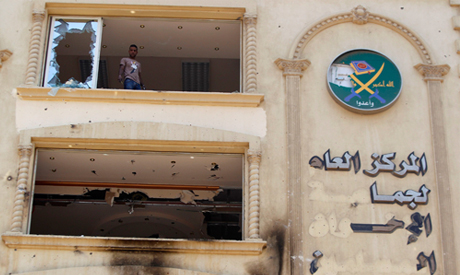
A
looter stands near a broken window at the Muslim Brotherhood's
headquarters after it was burned down by protesters opposing Egyptian
President Mohamed Morsi in Cairo's Moqattam district - July 1, 2013
(Photo: reuters)
Even as Mohammed el-Beltagy, seeking refuge from capture by the Egyptian military denies accusations the Muslim Brotherhood is committing "terrorism" in the wake of the coup that removed Mohammed Morsi from the presidency, there are new demonstrations in the planning stages. The last demonstration that had been planned and labelled "the Day of Martyrdom" hadn't been successful in persuading large numbers of Brotherhood supporters out on the streets.
It was a lame, limpid, phlegmatic affair, soon dispersed after having accomplished nothing much. The new demonstrations are meant to present defiance of the security crackdown that has emasculated the effectiveness of the Brotherhood movement by imprisoning most of its senior and mid-level leadership. Among whom now is 25-year-old Mohamed Soltan, son of Brotherhood figure Salah Soltan. His arrest certain to bring the attention of the U.S. through his American citizenship.
There remains polarized opinion within the U.S. government over the situation in Egypt. The U.S. had seen fit to surrender their long-time ally, former president Hosni Mubarak to his fate, to limply endorse the Muslim Brotherhood and Mohammed Morsi who had lived and studied in the U.S. Perhaps the current interim government in Egypt and the military are giving the U.S. a little pay-back in their resistance to armed intervention in Syria, now.
El-Beltagy is wanted on accusations of inciting violence. The former lawmaker has evaded capture for three weeks. In a videotaped message aired on Al-Jazeera Mr. el-Beltagy insists Egyptian authorities were busy turning a "political crisis" into a security problem with their accusations of terrorism on the part of the Brotherhood.
Amir Nabil/The Associated Press
There certainly seemed an illusion of terrorism after the military break-up of the two Brotherhood sit-ins at opposite ends of Cairo, with its unfortunate death rate, when Morsi supporters went on a violent rampage, attacking police stations, government buildings and Christian churches. Charges of inciting to violence were levelled against Brotherhood leaders and they were taken into custody to face those charges in a court of law.
Egypt's interior ministry released figures claiming that 106 security personnel were killed since August 14. Over 900 were wounded in violence. That number including soldiers and police. Police claim the Brotherhood remained committed to spreading chaos and violence in the country through inciting splits among army ranks and police. Along with acts of civil disobedience.
While some Egyptian authorities are in favour of outlawing the Muslim Brotherhood, others aren't quite so willing to do so. The Brotherhood is well known to have made alliances with al-Qaeda, Hamas and Islamic Jihad (both knock-offs) in the Sinai, conducting an onslaught there against Egyptian security with the help of local Bedouin Islamists. Past attempts at mediation with the Brotherhood had failed.
"Let's face it, there were some serious attempts [at mediation] before the 30 June demonstrations and before the 3 July [removal of Morsi] but they did not work", one political source involved in discussions with state bodies and Brotherhood leaders said. "From what I know, the army, [especially Defence Minister and Army Chief Abdel-Fattah El-Sisi] was hoping the mediation [before Morsi's removal] would work", he said. In fact, El-Sisi had given Morsi more than adequate advance warning.
That mediation at that time was for a mutually-agreed upon pact to suspend demonstrations in return for the president's agreement on holding a referendum to determine popular opinion whether he should complete his four-year term. Those mediation efforts had been supported by some European foreign ministers and Cairo-based ambassadors, but they failed. "Because the Brotherhood leaders and president Morsi himself did not believe there would be big demonstrations."
New negotiations are being considered between government and the Brotherhood which would address an end to both anti-state and anti-Islamist incitement, along with the release of all Brotherhood members under arrest proven innocent of inciting or committing acts of violence and inclusive of the suspension of anti-military attacks in Sinai.
The government would then be prepared to reconsider its previous stance on the dissolution of the Brotherhood. Fair enough...?
This represents a general opinion site for its author. It also offers a space for the author to record her experiences and perceptions,both personal and public. This is rendered obvious by the content contained in the blog, but the space is here inviting me to write. And so I do.
/cdn.vox-cdn.com/uploads/chorus_image/image/63396263/AP_19099493501918.0.jpg)