Saturday, February 13, 2021

Drunk Driving Penalties in Canada

"Your child has proven themselves 'just not ready' for the privilege of driving."
"[Behind the wheel of a Hyundai Veloster coupe the 18-year-old's driving reached an] unbelievable level of irresponsibility that could easily have resulted in a life-altering tragedy."
Sgt.Craig Roberts, traffic case manager, Ottawa Police Service
Image result for drunk driving accident photos
Bellevue Reporter
 
That's a note sent to a parent of an 18-year-old G2 driver clocked at 213 km/hr a few days back. He was charged with stunt driving, leading to a court date with fines of between $2,000 and $4,000 if he's convicted, on top of an automatic one-week driver's licence suspension and the impounding of the vehicle. Six demerit points as well, and potentially a two-year licence suspension. In all likelihood he may never become a conscientious, responsible driver. And he may also become a driver among many that constitute a menace on the road.

But then, because he lives in Canada and will likely continue to drive on Canadian highways, should he imbibe alcohol and then drive, he's in luck if he kills someone. Canadian law seems somehow to forget that vehicular manslaughter is in effect murder when it happens in drunk-driving. Murder with a blunt-force weapon. And if a negligent, entitled driver who doesn't feel that getting behind the wheel of a vehicle is a privilege, not a right to be compounded by inebriation, his/her attitude will be validated by the extent of the judgement levelled, even if multiple deaths occur.

Canada's courts seem to have a soft spot for alcohol abusers who think nothing of getting behind the wheel of a powerful engine encased in sheet metal, to hurtle down highways with blurred vision, slack responses and a casual disregard for personal responsibility. Take the case of a young man from an affluent family who disembarked from a private jet in Toronto, in an alcoholic stupor after attending a bachelor party in the U.S. Drunk enough to urinate on himself. But determined to drive his Jeep Cherokee from airport to home.

Streaking through a stop sign he hit a minivan and just like that three young children and their grandfather were dead. A ten-year prison sentence took him to prison in 2015, but since last April he's been on day parole. And in eight years' time he'll be driving again. He was no doubt devastated by the fact he was responsible for the deaths of four people. But he was in fact responsible for killing four people, and the penalty for that willful decision-making by someone of privileged entitlement was two years of incarceration followed by a relaxed regimen commensurate with a slap on the hand.

The message there can only be that Marco Muzzo did not deliberately cause grievous harm to others of an untold magnitude. And the tragedy that ensued when he felt it his right to do as he wished irrespective of capacity to do so in safety to himself but above all, toward others, was viewed by the court as unfortunate but obviously forgivable. If being the cause of four people's premature death in a horrendous, avoidable event merits such a judicial shrug, Canada refuses to penalize malefactors while ignoring the human rights and expectations of security of the majority.

In 2010, driving twice the speed limit without a licence or insurance, Alan Wood drove his Chevy Silverado into a Toyota Tercel driven by Bryan McCron, delivering newspapers with his 17-year-old son. The younger McCron groped his way out of the badly damaged Tercel with the intention of calling 911, only to have Wood punch him in the stomach. The teen's father died of a severed aorta. Wood's two-year prison sentence saw him on day parole after 7.5 months.

Jonathan Pratt had a blood alcohol level close to 2.5 times the legal limit while driving his truck 200 km/hr in 2011 near Edmonston, striking a Pontiac Grand Am. Bradley Arsenault 18, Kole Novak 18, and Thaddeus Lake 22, were smashed to smithereens in the impact that the truck created as it pierced the entire passenger compartment. There were three convictions of manslaughter that saw Pratt sentenced to serve the three convictions concurrently. In 2018 he was on day parole. 

Chad Olsen's blood-[alcohol content was three times the legal limit in 2010 in Alberta when he was responsible for the deaths of Brad and Krista Howe, parents of five children. He was speeding and sped through a stoplight. Nothing too much unusual for someone who had a lengthy record of traffic offences despite his  young years. Although he was originally given a two-year sentence, a Crown appeal increased the prison term to 3.5 years. Within seven months he was given day parole and by August of 2012 full parole.

In 2001, six-year-old Kevin Lavalee was playing in front of his Quebec home on the sidewalk. A truck driven by Andre Sweeney crushed the child to death. Sweeney was three times over the legal limit. Following two years in prison Sweeney bid for parole. It was rejected since it was noted by the parole board that he had failed to address his alcoholism. By 2006 the Parole Board of Canada claimed Sweeney to have shown "significant evolution" and parole was  his.

Marie-Michelle Benjamin enjoyed a night of drinking that left her with a blood-alcohol content close to twice legal limit in 2017. Driving a Chevrolet Aveo through two stop signs and a red light, she drove the wrong way to a bridge approach, struck a car head on, driven by Robert Albert 60, killing him. Although given a three-year prison term, she had parole within six months. The Parole Board of Canada sympathized with her "self-esteem issues" having precipitated the collision.

There's more, many more. Drunk-driving? It's an offence against humanity. Even the present Prime Minister of Canada's mother Margaret was once stopped and ticketed for driving drunk. Her high-priced legal representative argued that her fragile mental health condition exonerated her unfortunate lapse of judgement. Fortunately for the public at large, driving and pedestrian, she was stopped before an accident occurred.
It is an offence to drive or have care or control of a motor vehicle if one’s ability to do so is impaired to any extent by alcohol and/or drugs. The key issue is whether a person’s ability to operate a motor vehicle is impaired to any extent; the amount of alcohol and/or drugs an individual has consumed is irrelevant. As a result, a person can be convicted of impaired driving even if his or her blood-alcohol concentration (BAC) is below the federal legal limit of .08%. The phrase “to any extent” was added to this offence in 2018. Consequently, as currently written, the offence would include individuals who exhibited signs of only modest impairment of their ability to drive. However, it remains to be seen whether the courts will interpret the scope of this offence more broadly in light of the 2018 amendment.
MADD Canada
Image result for drunk driving accident photos
Warren and Kallianos

There is no shortage of lawyers ready and prepared to defend clients on charges of driving under the influence. They openly advertise their services, counselling would-be clients never to plead guilty to such charges, and offering their advice, such as this:
Facing impaired driving charges is a stressful situation. You may have stopped thinking clearly and just want to put the whole situation in your past. The worst thing you can do at this point is plead guilty so that you can get the ordeal over with.
Impaired driving is a criminal charge. A criminal record can affect your ability to work and travel. If convicted, you face significant fines and possible jail time. Even after the suspension of your driver’s licence is lifted, you may find that your insurance rates are prohibitively high, preventing you from driving for years.
Fortunately, you don’t have to face these possible consequences alone. There’s help and there’s hope.  Sean May can assess your case and will fully explain the following:
  • Impaired driving charges are difficult to prove and it is the prosecutor’s job to prove that you are guilty. They may not have sufficient evidence to prove the case against you.
  • You may have a defence that will cause your charges to be dismissed, even though it may not be apparent to you.
  • Even without a defence, you may be able to negotiate a plea to a lesser offence, like a traffic ticket.  Sean May can determine if this is an option in your case and get you the best possible result.
  • If you do proceed to trial, Sean May’s expertise and training will be crucial to preparing for and conducting the trial.

Never assume that the case against you is open and shut. Do not plead guilty until Sean May has reviewed your case.

Labels: , , , ,

Thursday, January 14, 2021

The U.S. Death Penalty : Federal Executions

"The spate of executions during this last year of the Trump administration has been extraordinary."
"I don't think that there's anybody who's been paying attention to the federal death penalty who thinks that anything like that will continue once Trump leaves office."
David Dow, Cullen Professor, University of Houston Law Center
"The federal death penalty applies in all 50 states and U.S. territories but is used relatively rarely. About 55 prisoners are on the federal death row, most of whom are imprisoned in Terre Haute, Indiana. Three federal executions have been carried out in the modern era, all by lethal injection, with the last occurring in 2003."
"The federal death penalty was held unconstitutional following the Supreme Court’s opinion of Furman v. Georgia in 1972. Unlike the quick restoration of the death penalty in most states, the federal death penalty was not reinstated until 1988, and then only for a very narrow class of offenses. The Federal Death Penalty Act of 1994 greatly expanded the number of eligible offenses to about 60."
"The use of the federal death penalty in jurisdictions that have themselves opted not to have capital punishment—such as Washington, D.C., Puerto Rico, and many states—has raised particular concerns about federal overreach into state matters."
Death Penalty Information Center 
The first federal execution of 2020 was that of Daniel Lewis Lee in July at the Federal Correctional Complex in Terre Haute, Indiana.
"With a stroke of your pen, you can stop all federal executions, prohibit United States Attorneys from seeking the death penalty, dismantle death row at FCC Terre Haute, and call for the resentencing of people who are currently sentenced to death."
Letter to incoming President-elect Joe Biden signed by 40 members of Congress
 
"No president in the 20th or 21st century before this year presided over double-digit executions in any calendar year. The Trump administration has carried out ten in the space of five months,"
"You'd have to go back to 1896 and President Grover Cleveland's second presidency to find this many federal civilian executions in a single year."
"Traditionally, out of respect for the incoming administration, and because executions are a matter of life and death, executions weren't carried out during a transition period."
"Everybody else knew that it was more important to protect the public health than it was to kill prisoners now, who could be executed when it was safe to do so later. Only the federal government moved forward with those executions."
"Nearly 25% of the population of death row is now in counties where prosecutors say they won't use the death penalty or are going to significantly restrict its use. All of that suggests the numbers will stay low in most of the country going forward."
Robert Dunham, executive director of the Death Penalty Information Center
Normally, when the thinking public's mind turns to the death penalty, Iran, and Saudi Arabia come to mind, ultra-fundamentalist regimes whose idea of punishing extreme crimes finds the death penalty more than suitable to sending a message to their populations. Countries like Pakistan and Afghanistan also qualify, where the justice system views insulting the Prophet and Islam or conversion away from Islam to be deserving death-penalty issues. On the other hand, dictatorships like China consider criticism of Beijing and its politboro worthy of the death penalty.

The United States is considered by itself and the world community to be a civil democracy with fairly liberal values that for the most part set the standard for responsible governance, the rule of law and a fair and equitable system of justice. But it has never, like most democratic nations of the world, abolished the death penalty, which places it in the company of countries like China, Iran and Pakistan. There has been an increasing tide of rejection of the death penalty, where many States take it upon themselves to no longer recognize the death penalty.

The federal government appeared to be reaching a like conclusion that the death penalty had no place in the justice system of a civilized society. Lately, however, there has been a decided swing back to enacting justice by taking a life as punishment for taking a life. The Trump administration saw the recent execution of two men who committed dreadful crimes while in their teen years. On death row for over a decade each, both were executed in 2020. 
 
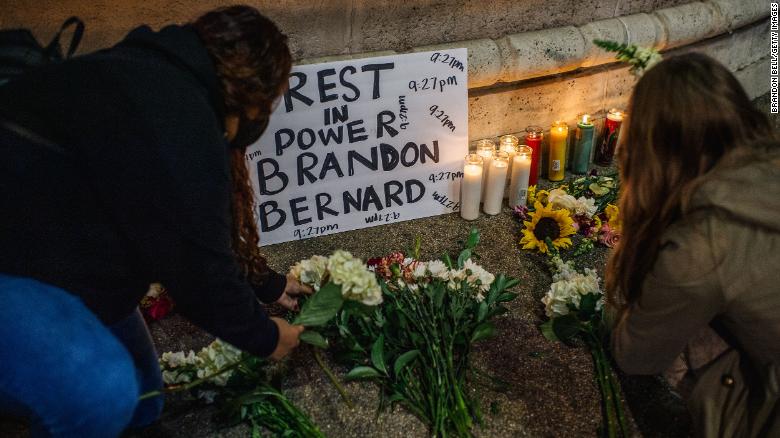
The execution of the first, 19 at the time he murdered two people, represented the first federal execution in 68 years of an offender, a teen at the time of his crime. The second, Brandon Bernard, on trial with Christopher Vlalva for the same offence, was 18 at the time of the double murder. He was 40 years old by the time he was taken off death row and executed for his crime committed in 1999. A high profile campaign to spare his life failed, and he met his destiny with death through federal execution in December. 

The U.S. Department of Justice amended its federal execution method rules in late November with a ruling that any methods permitted by states may be used to executive federal prisoners. Lethal injection being the most common method, though nine states allow the use of the electric chair, six the use of the gas chamber, and three firing squad while another three allow for hanging executions. 

A year-long search for drugs that would work efficiently culminated in ten men being executed in the U.S. federal death chamber in Indiana; the lethal drug cocktails used historically no longer available leading to experimental execution drugs which occasionally saw executions gruesomely botched. Many death row inmates sought alternative ways to die, given their fear of the needle, after the well-publicized executions that malfunctioned with experimental drug cocktails.

When Florida's electric chair malfunctioned several times and the heads of two condemned men were set on fire, that method of execution went into retirement.  Yet fear of death by three-drug cocktail spurred Nicholas Sutton in February of 2020 to be executed by the state of Tennessee by electric chair, citing the dangers of lethal injection drugs.

Women lay flowers at a candlelight vigil for Brandon Bernard on December 13 in Los Angeles. Bernard, 40, was the youngest person to be executed in the US in nearly 70 years, and was put to death for a crime committed when he was a teenager.

Labels: , , , , ,

Thursday, October 03, 2019

Deprived of Life, Their Murderer Given Liberty

"Any expansion of privileges will occur at a very slow pace and close supervision is warranted,”
“The board is of the view that significantly more time is required to evaluate and test the potential for relapse."
"Should he relapse and reoffend… the violence is likely to be unexpected, rapid, extreme and with multiple victims."
"The family members of the victims are in considerable pain. For most, the process of attending hearings annually serves as a painful reminder."
Alberta Review Board
Matthew de Grood killed five people in Calgary on April 15, 2014 (Canadian Press)

"We must help create awareness for the problems with the NCR reintegration process and continue to push for a law amendment where [people found] NCR… at a minimum, never receive an absolute discharge where no responsible medical practitioners monitor their medicine intake."
"The board re-emphasized the distinct threat de Grood presents to the public, and noted his loss of insight to symptoms when his oral medication was stopped for a time, but still sided with unsupervised access to the community and week-long travel in Alberta."
Greg Perras, father of Kaitlin

A scene of unimaginable horror occurred in 2014, when 22-year-old Matthew de Grood walked into a house in Calgary in the midst of a party celebrating the end of the school year. He had a knife and he used it unsparingly on the young university students who were there to share their happiness with one another, but ended up in a group of dead young people, murdered by a man who testified at trial that he believe the devil was in communication with him, informing him a war bringing the end of the world was about to erupt.

That, evidently, gave him the impetus to kill five people, Zackariah Rathwell, 21; Jordan Segura, 22; Kaitlin Perras, 23; Josh Hunter, 23; and Lawrence Hong, 27. A subsequent trial two years later found him not guilty of the murder of those five young people. As someone held to be not criminally responsible he was being treated in several hospitals, the last at Alberta Hospital in Edmonton for the year just past, where he has been given unsupervised outings -- though, according to the Albert Review Board, he remains a significant threat to public safety.

Despite which his treatment team has decided he should be given even greater liberties, and he will be permitted to visit locations in Edmonton without any supervision, granted overnight passes for up to a week. All this, to give him experience in negotiating society and his place in it, for the purpose of aiding him in the transition to life in a group home. In addition, he has been given permission to travel within the province of Alberta for up to a week, while under the supervision of a responsible adult. The goal of transferring him to a group home in Edmonton, is to be accomplished within the space of a year.

Now 29 years of age, and years since he stabbed the five young people to death in a situation expert psychiatrists classify as a psychotic break. Dr. Santoch Rai spoke of the risk of a violent relapse as "low", even while he added should a relapse occur, it could be expected to be of a "high severity". Perhaps that is also the descriptive given to the scene all those years ago, when he dispatched the lives of five people. He is, in other words, a psychiatric time bomb whose mental condition is for the time being under control, without guarantees possible that the wick may be lit and the bomb explode at any given time.

Dr. Rai, however is satisfied that his patient has made "very good progress", since his last annual review a year ago, and has been since then a "model patient". The board had moved de Grood from Calgary to Edmonton a year ago for additional treatment, where his independence had been increased while being treated. And the strange thing is that the board chair stressed that privileges for this man would be granted only when the team feels it is safe to do so. How that assurance can be trusted when his own doctor sits on the fence over his potential to explode into another vicious psychopathic rage of lethal intent is questionable.
From left: Zackariah Rathwell, Lawrence Hong, Kaitlin Perras, Jordan Segura and Joshua Hunter were stabbed to death April 15 while celebrating the end of post-secondary classes. (Photos from Facebook)

Labels: , , , , , ,

Follow @rheytah Tweet