Monday, February 16, 2026

Ultimately, Death

"Russia saw [Russian opposition leader Alexei] Navalny as a threat."
"By using this form of poison the Russian state demonstrated the despicable tools it has at its disposal and the overwhelming fear it has of political opposition."
"[The attack] must have been authorized at the highest level, by President Putin."
British Foreign Secretary Yvette Cooper
 
[I was] certain from the first day [that Alexei was poisoned], but now there is proof."
"Putin killed Alexei with chemical weapons."
"[Putin is] a murderer [who must be held accountable]."
Yulia Navalnaya, Alexei Navalny's wife 
 
"No one but Putin's henchmen will be able to say in detail what happened on February 16, 2024, in the Russian penal colony."
"But it is clear that Russian authorities had the possibility, the motive and the means to administer the poison to Navalny."
German Foreign Minister Johann Wadephul
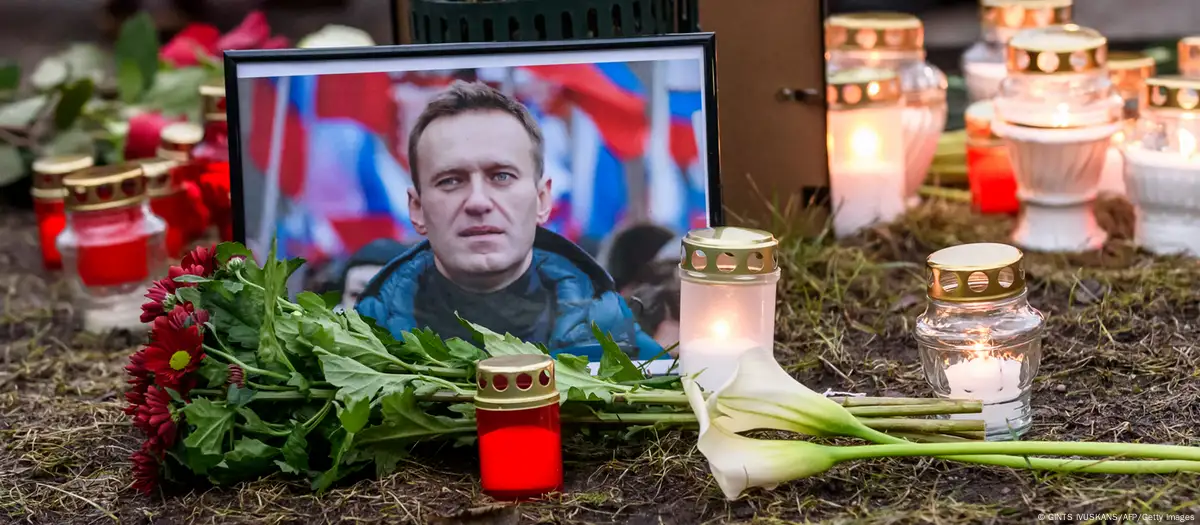
https://static.dw.com/image/70967814_1004.webp
The longtime Kremlin critic died in prison following charges he decried as politically motivated  Image: GINTS IVUSKANS/AFP/Getty Images
 
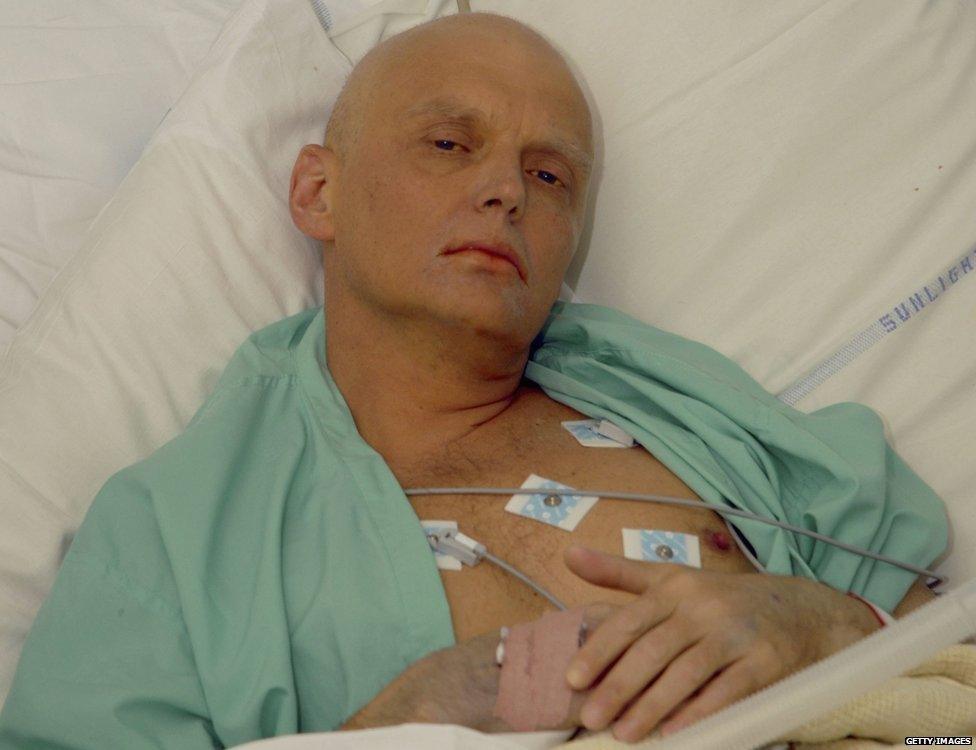
Alexander Litvinenko is pictured at the Intensive Care Unit
Alexander Litvinenko in ICU, Getty Images
In 2006, former Russian agent Alexander Litvinenko died an excruciating death in a London hospital. He had become a stern critic of the Kremlin. The radioactive isotope polonium-210 had been slipped into tea he was served, and it went right to work painfully degrading his bodily functions. It took an agonizing 21 days of unremitting pain for the man to die, while doctors working to help save his life tried to diagnose what was killing him; radioactive poisoning.
 
In Salisbury England in 2018 the Kremlin launched an attack targeting former Russian intelligence officer Sergei Skripal, with the nerve agent Novichok that made Skripal and his daughter seriously ill, but they survived. When a British woman came across a discarded bottle holding traces of the nerve agent, she died of its effects. Subsequently British intelligence found traces of the biological weapon in various places, posing a deadly threat to the public. 
 
In 2020, Alexei Navalny was poisoned with a nerve agent that he identified as an attack by the Kremlin. This was not the first time attempts to poison him and cause his death occurred and he recognized the method and the medium as he became deathly ill. He was flown to Germany for medical attention, where he was treated and recovered from the attack. Rather than remain in safety out of the reach of the Kremlin he decided to return to Russia, where he was immediately imprisoned, with trumped-up charges.
 
Given one sentence after another on the basis of charges that could never stand up to scrutiny, he was imprisoned for years, and finally sent to the 'Polar Wolf' penal colony for an additional 19-year sentence. He was weak and ill and to no one's surprise several years later, he  died in that prison in the Russian Arctic. Cause of death, according to Russian authorities; high blood pressure caused by cardiac arrythmia. 
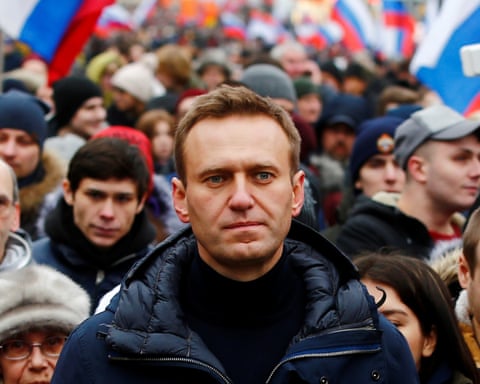
 
Russian opposition leader Alexei Navalny in 2015
Russian opposition leader Alexei Navalny in 2015 Photograph: Sefa Karacan/Andalou/Getty Images
 
Now, the foreign ministries of the U.K. France, Germany, Sweden and the Netherlands have announced findings from analyses in European laboratories of Navalny body samples that "conclusively confirmed the presence of epiatidine", a neurotoxin secreted by South American dart frogs. A toxin not found anywhere in Russia; but one that could be imported or chemically produced in a lab. "Russia had the means, motive and opportunity to administer this poison", a joint statement read.
 
Leading to the five countries reporting Russia to the Organization for the Prohibition of Chemical Weapons for a breach of the Chemical Weapons Convention. Crusading against official corruption, Navalny staged massive anti-Kremlin protests. Navalny's poisoning demonstrates "that Vladimir Putin is prepared to use biological weapons against his own people in order to remain in power", stated French Foreign Minister Jean-Noel Barrot.
 
Last year, said Navalny's widow Yulia Navalnaya, two independent labs found her husband was poisoned shortly before his death. While according to Russian authorities, the imprisoned politician fell ill following a walk, dying from natural causes. Epibatidine acts on the body similarly to nerve agents, causing shortness of breath, convulsions, seizures, slowed heart rate, and ultimately death.
 
Russia's Navalny appeals extra 19 years jail term for extremism
Russian opposition politician Alexei Navalny appears on a screen via video link from the IK-6 penal colony in the Vladimir region, during a court hearing to consider an appeal against his sentence in the criminal case on numerous charges, including the creation of an extremist organization, in Moscow, Russia September 26, 2023   Reuters


Labels: , , , ,

Monday, August 24, 2020

Disposing of Critics

Disposing of Critics

Medical specialists carry Russian opposition leader Alexei Navalny on a stretcher into an ambulance on their way to an airport before his medical evacuation to Germany [Alexey Malgavko/ Reuters]

"Tests were immediately taken for the presence of toxic substances in the body. Already today we can say that oxybutyrates, barbiturates, strychnine, convulsive or synthetic poisons have not been found. Alcohol and caffeine were found in the urine." 
Omsk regional health ministry

"So clearly, being an outspoken opposition leader or being a corruption fighter or a whistle-blower in Russia is a dangerous business indeed."                               "Navalny was doing a lot of work exposing corruption, including at the highest level … and this is what they do to retaliate against their critics."                                     Ariel Cohen, senior fellow, Atlantic Council

"He survived the flight and he's stable. It's obvious that something terrible happened. He's a healthy, strong man with a good constitution -- the night before the attack he was swimming in a river."                                                       "Obviously this was an attack on his life ... A healthy man suddenly was in life danger and maybe could have died and maybe he can still die."                           Jaka Ibzili, German organization Cinema For Peace   

"It takes a while to rule things out. And particularly if something is highly toxic — it will be there in very low concentrations, and many screening tests would just not pick that substance up."                                                                                             Alastair Hay,  emeritus professor, toxicology expert, school of medicine, University of Leeds

Alexei Navalny is seen at a Siberian airport before boarding the plane where he was taken ill. Pic: @djpavlin
Mr Navalny is on a ventilator after drinking what is thought to have been poisoned tea. Pic: @djpavlin

A standoff between doctors and allies of Kremlin critic Alexei Navalny came to a head on Friday when official clearance was granted for his transfer to a Berlin hospital from the Omsk Emergency Hospital where he was being treated after collapsing and falling into a coma on a routine flight from Siberia to Moscow. It is assumed that he was poisoned, a not-incongruent method frequently used to silence critics of the Kremlin and of Vladimir Putin, and possibly the second time poison was used on Mr. Navalny himself who survived the first attempt and may this one as well.

Others have been less fortunate. Conflicting accounts on Mr. Navalny's condition and whether he might be taken aboard a specially outfitted German medical evacuation flight waiting to receive him at the Omsk airport were eventually concluded. Omsk Emergency Hospital chief physician, Alexander Murakhovsky early on Friday said the patient's state of health mandated he not be moved, but hours later he reversed himself, saying transfer to German care could proceed.

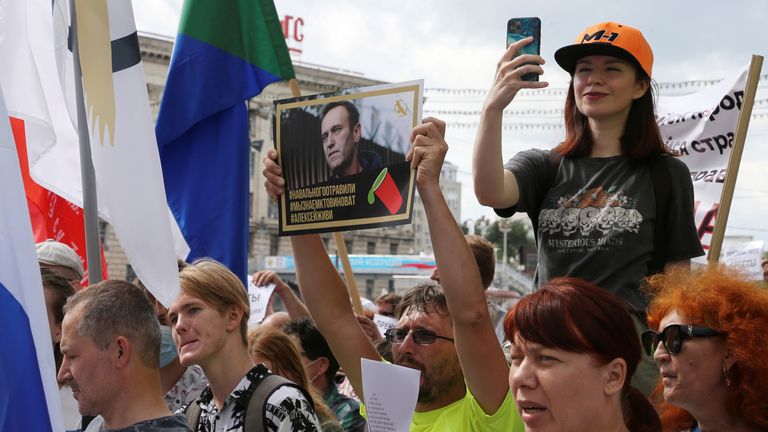
An anti-Kremlin protester's poster reads: "Navalny was poisoned. We know who is guilty. Alexei, live"
Anti-Kremlins: 'Navalny was poisoned. We know who is guilty. Alexei, live'

Dr.Murakhovsky also stated that no indication presented itself that Mr. Navalny had been a victim of poisoning, despite that he had said earlier it would take two days before laboratory results would be received. Those speaking for Mr. Navalny were under no illusions that he hadn't been a poisoning target, the most recent victim of state-ordered poisoning. His condition had improved from Thursday when he had been stricken, but no details were available from attending doctors.

The human rights activist Jaka Bizilj's Cinema for Peace Foundation was eager to leave Saturday with the patient on a chartered ambulance aircraft, for Berlin. When it arrived in Omsk Friday, three German physicians were aboard who eventually were permitted to examine Mr. Navalny. The German doctors were made unavailable -- forcibly escorted elsewhere by Russian authorities -- for their conclusions to be shared with Yulia Navalnava, Mr. Navalny's wife, nor with his colleagues; all blocked from speaking with them.

As far as Mr. Navalny's spokeswoman Kira Yarmysh was concerned, Russian doctors were guilty of endangering the stricken man's life by prolonging his Omsk Hospital stay rather than assent to his immediate departure for Berlin, as a reflection of their intentions to hinder an investigation "until the poison in his body can no longer be traced". She charged that "The ban on transporting Navalny is an attempt on his life, which is now being carried out by the doctors and the deceitful authorities who sanctioned it."

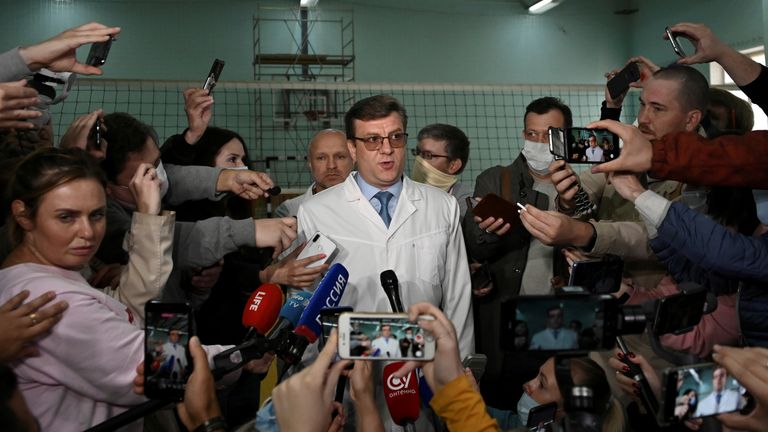
Chief doctor Alexander Murakhovsky tells media in Osmk, Russia there is no trace of poison in Mr Navalny's body
Doctors in Omsk hospital said there was no trace of poison in Mr Navalny's body  Sky News

Doctors at his hospital, said Dr.Murakhovsky, were possessed of "five working diagnoses", without divulging any details. The most likely cause of the coma that Mr. Navalny fell into, he later stated is "a metabolic disorder caused by a sharp drop in blood sugar levels during the flight [from Siberia to Moscow, which was aborted when Mr. Navalny fell suddenly ill]." Transportation police, on the other hand, had informed a Navalny associate, Ivan Zhdanov, that they had discovered poison deemed a danger not only to Mr. Navalny but anyone else close to him, meaning access to Navalny not be permitted without the protection of a full haz-mat suit.

The explanation proffered by the Omsk physicians was an industrial chemical substance found on Mr. Navalny's clothing, denying that the chemical poisoned Mr. Navalny. Mr. Navalny's enemies are those of whom he has been ultra critical; his Anti-Corruption Foundation served to expose excesses and corruption carried out by members of Russia's elite, enriched through their Kremlin connections.

"The plane with Alexei has taken off for Berlin. A huge thank you to everyone for your support." "The struggle for Alexei's life and health is just beginning and there will be much more to go through, but at least now the first step has been taken."  Kira Yarmysh
The emergency medical plane transporting Mr Navalny lands at the Tegel airport in Berlin


Labels: , ,

0 Comments:

Post a Comment

<< Home


Labels: , , , , ,

Tuesday, October 08, 2019

The Legacy of Pesticides

"It's a sperm-killer."
"Thousands of individuals were knowingly put into the zone of risk of these pesticides after it was banned."
Stuart H.Smith, legal team
DBCP’s Effects on health
sterility
skin cancer
blindness
respiratory diseases
precancerous legions
lung, liver, kidney damage
damage to the reproductive organs in the women
congenital deformities in their children
and many other serious diseases…
Banned in most of the United States in 1977 -- after the chemical dibromochloropropane (DBCP), an active ingredient in Nemagon -- after it was found to have caused sterility among thousands of male workers exposed to it at Dow, Shell and Occidental plants across America -- food growers based in the United States continued its use through the early 1980s at banana and pineapple plantations, according to lawsuits, in countries with lower environmental standards.

Nicaraguan plantation workers launched a wave of lawsuits in the 1990s. Those lawsuits were blocked by Dow and Shell, as well as by the growers Dole Fruit, Del Monte Fruit and Chiquita Brands, on the grounds that the U.S. was not the place to try them since the damage occurred in Central America. Nicaraguan courts awarded hundreds of millions in compensation to victims, while Dow, Shell and Doyle refused to pay, declaring that those courts lacked jurisdiction.

A Florida court denied recognition of a $97 million judgement against Dow and Dole in 2009, with the claim that the Nicaraguan proceedings were biased against the American companies. Lawsuits against Dow and Dole were thrown out by a California judge in the same year, after the judge ruled that the plaintiffs and their lawyers had made use of fraudulent tactics.

After settling claims decades ago, the chemical and banana companies argue they have no additional responsibilities. With the exception of Dole, they settled in 1997 with 26,000 former banana workers in Central America, Africa and the Philippines for a piffling $41 million. In 2014 Dole agreed to compensate over 1,700 former banana workers from Nicaragua for an undisclosed amount.

Survivors of the thousands of victims -- where the pesticide was sprayed at banana plantations around Central America, sterilizing workers -- have attempted to gain compensation ever since. They have taken to suing Dow Chemical, Shell Oil and Occidntal Chemical (now OxyChem) in France in hopes of recovering hundreds of millions in unpaid damages awarded to them by Nicaraguan courts where many of the poisonings happened.

Other countries were also harmed by the use of the pesticide Nemagon. A total of $805 million in damages was ordered by Nicaraguan courts to be paid to hundreds of victims, the companies refusing to pay, insisting the courts' lack of jurisdiction protects them and that the trials were unfair. The companies have significant assets in Europe where 1,245 former workers and their relatives are attempting to collect the compensation awards.

Now, a French judge is set to determine whether court opinions in other countries can be enforced in France and in the European Union, capping decades of legal maneuvering between the U.S. where are based, and countries in Central America and beyond where the pesticides were ultimately used despite their being banned in the United States with the knowledge of their deadly effects.


Labels: , , , , , , , , , ,

Follow @rheytah Tweet